CFA Institute

Hedge Funds: A Poor Choice for Most Long-Term Investors?

Hedge funds have become an integral part of institutional portfolio management. They constitute some 7% of public pension assets and 18% of large endowment assets. But are hedge funds beneficial for most institutional investors? To answer that question, I considered performance after fees and compatibility with institutional investors’ long-term investment goals. I found that hedge funds have been alpha-negative and beta-light since the global financial crisis (GFC). Moreover, by allocating to a diversified pool of hedge funds, many institutions have been unwittingly reducing their equity holdings. So, while my answer is no, hedge funds are not beneficial for most institutional investors, I propose a targeted approach that may justify a small allocation. And I cite new research that leaves the merit of hedge fund investing open to debate among scholars. Performance After Fees Hedge fund managers typically charge 2% of assets under management (AUM) plus 20% of profits. According to Ben-David et al. (2023), hedge funds’ “2-and-20” fee structure adds up to more than “2-and-20.” Ben-David and his co-authors estimate that the effective incentive rate is 50%, which is 2.5 times greater than the nominal 20% figure. The authors say, “This happens because about sixty percent of the gains on which incentive fees are earned are eventually offset by losses.” They calculate a 3.44% average annual cost of AUM for the hedge fund industry between 1995 and 2016. This is a heavy burden for what are essentially portfolios of publicly traded securities. How have the funds fared? Hedge funds were star performers prior to the GFC, but then things changed. Cliff Asness shows how hedge funds ran out of gas. Maybe it was because hedge fund assets increased tenfold between 2000 and 2007. Maybe it was because of the accounting rule change regarding the valuation of partnership assets that took effect in 2008. And, possibly, increased regulatory oversight from the 2010 Dodd–Frank reforms “…chilled some profitable hedge fund trading….” In any event, diversified hedge fund investing appears to have underperformed in modern (post-GFC) times. For the 15 years ending June 30, 2023, the HFR Fund-Weighted Composite Index had an annualized return of 4.0%. This compares to a 4.5% return for a blend of public market indexes with matching market exposures and similar risk, namely, 52% stocks and 48% Treasury bills. By this measure, the hedge fund composite underperformed by 0.5% per year. The recent scholarly literature on hedge fund performance is mixed, however. Sullivan (2021) reports that hedge fund alpha began declining after the GFC. Bollen et al. (2021) reach a similar conclusion. On the other hand, a more recent paper by Barth et al. (2023) indicates that a newly emergent subset of hedge funds — those not included in vendor databases – has produced returns superior to those that do participate in the databases. The reason for this is not entirely clear. Nevertheless, the revelation of the existence of these heretofore-overlooked funds suggests that they warrant further study and leaves the merit of hedge fund investing open to debate among scholars. Hedge Fund Impact on Alpha In our work, we focus on how alternative asset classes such as hedge funds have affected the alpha garnered by the institutional investor portfolios we study. This approach is concrete and pragmatic. We calculate the alphas of a large sample of pension funds. Then, we determine the sensitivity of alpha production among the funds to small changes in the percentage allocation to the asset class. Here, we are observing the return impact of each fund’s allocation to hedge funds and the performance impact of those hedge funds on the institutions’ bottom line. There is nothing nebulous or hypothetical about the procedure. Our dataset of institutional funds comprises 54 US public pension funds. Using returns-based style analysis, we devised a benchmark for each of them and calculated their alpha over the 13 years ended 30 June 2021. The range of alphas is -3.9% to +0.8 per year, or a little less than five percentage points. For each pension fund, we obtained the average allocation to hedge funds over the study period from the Public Plans Data resource of the Center for Retirement Research at Boston College. While some pension funds in the database allocated 0% to hedge funds, the average allocation was 7.3% and the maximum average allocation was 24.4%. Exhibit 1 illustrates the result of regressing the alphas on the respective hedge fund allocation percentages. The slope coefficient of -0.0759 has a t-statistic of -3.3, indicating a statistically significant relationship. We can interpret the slope coefficient as follows: A decrease of 7.6 bps in total pension fund alpha is associated with each percentage point increase in the hedge fund allocation percentage. The average allocation to hedge funds for the full 54-fund sample is 7.3% during the period under study. This translates to an alpha reduction of 0.55% per year at the total fund level for public funds in aggregate (0.073 x -7.6). That is a big hit for an asset class the constitutes less than 10% of AUM, as is the case for public pension funds in aggregate. Exhibit 1. The Relationship Between Pension Fund Alpha and Hedge Fund Allocation (2009 to 2021) Summing up so far: Hedge funds are diversified portfolios of publicly traded securities. A recent estimate of their cost to investors is 3.4% of AUM annually, which is a heavy burden. Using HFR data, we estimated that hedge funds underperformed a benchmark with matching market exposures and risk by 0.5% per year since the GFC. The scholarly literature on hedge fund performance is mixed. Our evaluation of the impact of hedge fund investing on the performance of public pension funds since the GFC indicates that an average allocation of about 7% of assets has cost the funds, in aggregate, roughly 50 bps of alpha a year. Taken as a whole, these results challenge the wisdom of investing in hedge funds — at least in diversified fashion — as a source of value added. Hedge Funds Are Not Stock Surrogates

Hedge Funds: A Poor Choice for Most Long-Term Investors? Read More »

The Evolving International Cannabis Landscape

The evolving landscape of the non-U.S. cannabis industry mirrors the early growth stages seen in the United States, which we outlined in our preceding article in this series. As recreational cannabis markets emerge, the consumer base expands from daily enthusiasts, who might even cultivate their own cannabis, to a wider demographic. In the U.S., younger individuals from diverse backgrounds are choosing cannabis over alcohol for a fun Saturday night, while older demographics are discovering its benefits for pain relief and the management of various health conditions. These trends in market maturity indicate what might be expected in regions such as Europe, Latin America, Africa, Oceania, and Asia over the next decade. Governments play a crucial role as gatekeepers in this development, and regulatory reforms toward cannabis access vary significantly across the globe. A World Tour of Cannabis Regulations In Europe, expected regulatory reforms and growing acceptance of both medical and recreational cannabis use are contributing to a robust growth in the cannabis sector. The European market is becoming increasingly sophisticated, with a regulatory focus on consistency and compliance. We believe the European cannabis industry is on the cusp of significant transformation, driven by a wave of regulatory developments. Countries like Germany, Malta, and Luxembourg are at various stages of legalizing or expanding legal access to cannabis, indicating a wider trend toward liberalization across the continent. Germany is currently debating the establishment of a regulated market for adult-use cannabis, which could set a precedent for other European Union countries. Additionally, the EU’s evolving position on CBD — recognizing it as a novel food — provides a legal framework that could boost the CBD market’s growth. These regulatory changes, along with increasing public support for cannabis legalization, are poised to drive substantial growth and innovation in Europe’s cannabis industry over the next decade. With several EU countries already having legalized cannabis in some form, the region shows potential for significant market expansion, particularly as regulations evolve and export opportunities increase. Latin America has been at the forefront of cannabis regulatory reform, with countries like Uruguay and Colombia leading the way in legalization for medical and adult use. In the coming years, Mexico may fully legalize cannabis, which would significantly impact the regional market, and potentially create one of the world’s largest legal cannabis markets. Brazil’s expanding medical cannabis program and Argentina’s recent regulations allow home cultivation and pharmacy sales for medical use. This illustrates the broader trend towards liberalization in Latin America. These developments, combined with the region’s favorable climate for cannabis cultivation, are expected to attract significant international investment and increase Latin America’s prominence in the global cannabis market. Interest is growing in African cannabis cultivation for both local consumption and export is growing. While regulatory and infrastructural challenges hamper the market’s full potential, Africa’s cannabis industry is poised for growth, supported by regulatory advancements in countries like South Africa, Lesotho, and Zimbabwe, which have made strides in legalizing and regulating cannabis for medicinal and industrial purposes. A landmark court ruling in South Africa in 2018 decriminalized private cannabis use, but there has been significant confusion around the rules, which exposes a need for regulatory adjustments. South Africa’s efforts to establish a legal framework for commercial cultivation and trade nevertheless underscore the region’s potential. Lesotho became a pioneer in Africa by granting licenses for medical cannabis cultivation in 2017. It was also the first country to export legal cannabis. This legacy, along with the country’s ideal growing climate, is increasingly attracting foreign investment. As more African nations reevaluate their cannabis laws to tap into the economic benefits, the continent could become a key player in the global cannabis supply chain. Oceania has been a leader in medicinal cannabis. Australia’s progressive medical cannabis laws and recent proposals for further liberalization, including potential pathways to recreational legalization, highlight the country’s growing market. Although New Zealand did not pass a law for recreational cannabis in a recent referendum, the country continues to expand its medical cannabis program. These regulatory developments, along with ongoing research and international trade opportunities, position Oceania for significant growth and innovation in cannabis cultivation, production, and distribution. Asia presents a complex regulatory landscape for cannabis, with countries like Thailand attempting stuttering steps towards liberalization by legalizing cannabis and removing its narcotics designation. The introduction of medical cannabis clinics and dispensaries marks Thailand’s ambition to lead in Asia’s cannabis market. However, more recently, Thailand’s new prime minister, Srettha Thavisin, has said that his government will “rectify” its cannabis policy and limit its use to medical purposes. Thailand is also considering instituting a monetary penalty on recreational users. Meanwhile, countries like South Korea and Japan are cautiously expanding access to medical cannabis and CBD products, respectively. Alas, strict drug laws across the region remain a major barrier to development. Over the 10-year horizon, as social attitudes evolve and the economic potential of cannabis becomes increasingly recognized, regulatory reforms in select Asian countries could unlock substantial growth opportunities in the cannabis sector there. The International Growth Outlook Knowing all of this, which part of the world should a curious cannabis investor focus on? Below, we project annual growth rates for different regions based on current trends, legislative reforms, theological advancements, demographics, shifts in social attitudes, and industry reports up to April 2023. Projected Annual Growth Rates Region 1-Year Growth Rate 5-Year Growth Rate 10-Year Growth Rate Europe 9% – 13% 21% – 25% 19% – 23% Latin America 8% – 11% 19% – 23% 23% – 27% Africa 7% – 9% 15% – 20% 20% – 24% Oceania 10% – 15% 23% – 27% 21% – 25% Asia 5% – 10% 13% – 17% 18% – 22% Europe and Oceania emerge as leaders in short-term market growth potential, driven by progressive legalization movements and advanced regulatory frameworks. Latin America, Oceana, and Africa are identified as promising markets with substantial longer-term growth prospects, contingent on overcoming existing regulatory and infrastructural challenges. Asia’s complex regulatory environment produces a cautious growth outlook, albeit with notable

The Evolving International Cannabis Landscape Read More »

A Reality Check on Private Markets: Part III

This is the final post in my three-part series on performance measurement for private market funds and the difficulties of using the internal rate of return (IRR) measure as equivalent to a rate of return on investments. In Part I, I discussed the rise of global assets under management (AUM) in private market funds and how this trend may have been driven by a perception of superior returns compared to traditional investments. As I illustrated, a root cause for this belief is the generalized use of IRR to infer rates of return, which is problematic. In Part II, I discussed in more detail how IRR works and why it should not be misconstrued as an equivalent measure to infer investment rates of return. In this post, I will review existing corrective measures for IRR, which present their own challenges, and propose a fix: NAV-to-NAV IRR. Existing IRR Corrections The most common correction is the modified IRR (see Phalippou 2008 for a comprehensive discussion).[1] For example, Franzoni et al. (2012) use MIRR to study the determinants of the return of individual LBO investments.[2] With an MIRR, you need to choose a financing and re-investment rate. Both rates can be set to 8%, the usual hurdle rate, or to a stock market index. If intermediary cash flows are not large and the investment is held for a relatively short period of time, MIRR is fine. Thus, in a context like that of Franzoni et al. (2012), using MIRR is natural and results are insensitive to the exact reinvestment rate assumption. However, in some of the cases I reviewed previously, the holding period is long. The longest one was the 48-year track record of KKR. Over such a long period, MIRR converges to whichever reinvestment rate has been chosen, which is unappealing. MIRR is just like a net present value (NPV) calculation. You need to choose discount rates, which is effectively the same as choosing financing and reinvestment rates. With IRR, you do not need to choose the discount rate. Just like any derivative of NPV, such as the Kaplan-Schoar Public Market Equivalent, the only conclusion that can be drawn is on relative performance. That is, if one uses an MIRR, NPV or PME, all that can be concluded is whether the benchmark has been beaten or not, but not the magnitude (alpha). We do not know how large any under- or over-performance is. In the above example, what we calculated was an MIRR because we assumed a financing rate and a reinvestment rate and computed the rate of return ror. Proposing a Simple, Albeit Imperfect, Fix: NAV-to-NAV IRR My analysis so far in this series (see Part I and Part II) shows that the issue comes from early cash flows, which are high either by design (survivorship bias) or by active manipulation (exit winners quickly, use of subscription credit lines). Intuitively, a solution is a measure that takes out these early cash flows. One option is then to require any private capital firm to report its past five-, 10-, 15-, and 20-year returns (aggregated at the level of a strategy, the whole firm, and by funds); and to forbid any use of since inception IRR. Thus, any fund or firm that is less than five years old cannot display an IRR, only a multiple. The IRR would be reported as non-meaningful.   The measure just described is called an NAV-to-NAV IRR because it takes the aggregate NAV at the beginning of the time period, treat it as an investment, record all the intermediary cash flows that occurred, treat the aggregate NAV at the end of the time period as a final distribution, and then compute the IRR on the time-series.[3] Alternative names include “horizon pooled return,” perhaps to avoid the word IRR. This measure is quite common in presentations of aggregate private capital performance. NAV-to-NAV IRRs would be a major improvement. In a previous post, we saw that when KKR publishes a “past twenty years” IRR, their figure is around 12%. A 12% IRR is realistic because the reinvestment assumption is realistic. That 12% also squares up with its multiple. According to Preqin data, KKR’s net of fees multiple is about 1.6, which is what an investment earning 12% per annum would generate after four years, and four years is the average holding period of private equity investments. Similarly, when Yale stopped reporting its since inception IRR, and switched to past 20 years IRR, its performance was 11.5% — a far cry from the 30% that led to the endowment  being hailed an Investment Model. CalPERS, which did not experience abnormally high cash flows early on in its private equity investment program, also has a since-inception IRR of 11%. Thus, Yale and CalPERS have had similar returns in private capital. The past 20-, 15-, 10-, and five-years horizon IRRs would probably show this picture explicitly and more accurately. Exhibit 11 shows the horizon IRRs reported by Cambridge Associates. The first two rows could be what is mandated, except for the short-term figures. A one-quarter, or even past three-years return in private markets is not meaningful because it is mostly based on the NAVs. Reported returns for private equity (only funds classified as leveraged buy-out and growth) are 18%, 16%, 16%, 15%, and 13% at 5-, 10-, 15-, 20- and 25-years horizon. These figures are reasonable. The limits of NAV-to-NAV IRRs The proposed solution effectively boils down to cutting the initial years. As the window moves every year, the measure cannot be gamed because the early cash flows one year no longer are the early cash flows two or three years down the line. There are two main drawbacks, however. The first drawback is that some data is thrown away. If a fund did well between 1995 and 1999, this will not be recognized in the 2024 report because we include up to 25 years. However, these far-away results may not be relevant to judge a track record. A related issue is that

A Reality Check on Private Markets: Part III Read More »

For Plan Sponsors: Understanding Investment Vehicles and Fees

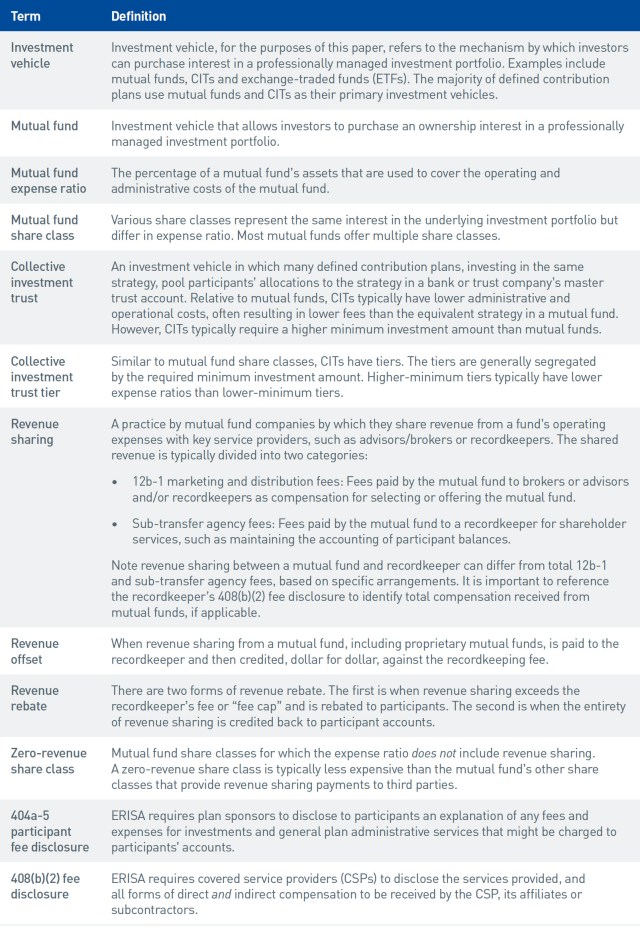
When constructing an investment menu for a defined contribution retirement plan, the focus is often on selecting the right investment managers and products. The goal is to choose options that best align with the retirement plan committee’s investment philosophy and are most suitable for the organization’s workforce. While these decisions are important, we believe it is equally important to select the right investment vehicles to fulfill that strategy. That is, the most appropriate mutual fund share class or collective investment trust (CIT) tier. In this post, we review various investment vehicle types, discuss how vehicle choice can impact fees and performance, and outline key criteria to consider when analyzing the reasonableness of the fee structure for a given defined contribution plan. Key Terminology First, it is critical to establish key terminology for this discussion. While this list is not exhaustive, it covers many of the relevant terms used when evaluating investment menu share class decisions and overall fee structures. The Current Landscape The Employee Retirement Income Security Act of 1974 (ERISA) requires retirement plan fiduciaries to act prudently and solely in the interest of the plan’s participants and beneficiaries. As such, the Department of Labor’s (DOL) fee guidance to plan sponsors has emphasized the responsibility of plan sponsors to monitor plan expenses, including assessing the reasonableness of total compensation paid to service providers, identifying potential conflicts of interest, and making the required disclosures to participants. To help plan sponsors evaluate fee reasonableness, the DOL’s guidance on section 408(b)(2) of ERISA requires service providers like recordkeepers and advisors, to disclose total compensation received by the service provider, their affiliates, or subcontractors. Despite this guidance and the benefit of required disclosures, some fee arrangements — such as those involving revenue sharing — can be difficult for plan sponsors to analyze, let alone participants. Not surprisingly, several organizations have found themselves in fee-related lawsuits over the last decade. In our practice, we see most plan sponsors moving away from revenue sharing and other opaque fee arrangements. Aside from concerns about fee-related litigation, many plan sponsors value the clarity provided to plan participants when offering only zero-revenue share classes in their plan lineups. Participants can easily ascertain recordkeeper fees and be assured the mutual fund expense ratio is used only for the mutual fund provider’s expenses. The Plan Sponsor Council of America’s (PSCA’s) 66th Annual Survey reported that only 35% of plans surveyed include revenue-sharing funds within their investment lineups, meaningfully lower than in prior years. In our role as plan advisor, we have helped many plan sponsors reduce plan fees and increase fee transparency by moving to zero-revenue share classes. We expect this trend to continue in the coming years. Share Class Choice Impacts Fees and Investment Performance From a fee perspective, the difference between revenue-sharing and zero-revenue share classes is illustrated in Figure 1. In the example, the revenue-sharing share class (R3) of a popular target date fund is compared with the zero-revenue share class (R6). The values are normalized from an approximately $30 million plan with roughly $20 million invested in the target-date funds. In this example, there is approximately $125,000 of revenue sharing generated by the R3 share class (as estimated by comparing the modeled investment fees of the R6 share class to the modeled investment fees of the R3 share class). Figure 1. Share Class Difference Illustration Notably, in this example, the difference in manager fees between the two share classes is typically used to compensate the recordkeeper and/or advisor — either in part or in whole. In the R3 share class scenario, it is likely the $125,000 difference between the R3 and R6 share classes (representing distribution fees) would be used to pay part or all the recordkeeper and/or advisor fees. Conversely, in the R6 share class scenario, the advisor and/or recordkeeper fees would need to be paid by the plan or by the plan sponsor directly. In both cases, a plan sponsor would need to determine what is a reasonable level of fees for an advisor and a recordkeeper based on plan size and participant count as well as services included. In addition, in the case of revenue sharing, plan sponsors must ensure anything above the “reasonable” fee level is credited back to participants or used to pay other plan expenses. To make this fee reasonableness determination, a plan sponsor must calculate the amount of fees going to vendors and compare that figure to industry benchmarks for plans of similar size, receiving similar services, on an annual basis. This can place a significant burden on plan sponsors and, in our experience, is not often reliably completed. Following this approach, many plan sponsors discover their fees are out of line with industry benchmarks and can achieve cost savings by moving to zero-revenue share class structures. From an investment performance standpoint, fees have an impact on investment performance. The higher the fees, the less money available to compound and grow in each participant’s investment portfolio. In Figure 2, we illustrate the differences in performance between the R3 and R6 share classes of the same target-date fund as Table 1. As a reminder, they both hold the same investment portfolios: the only material difference is the expense ratio. Comparing the performance of a $10,000 investment over a 10-year period, an investor in the R6 share class would end with approximately $1,000 more than an investor in the R3 share class. Larger investments or longer periods of time would magnify this effect, resulting in even greater differences in outcomes. Figure 2. Investment Performance Illustration Estimate is hypothetical and assumes an initial investment of $10,000 is invested for 10 years in the R3 share class and the R6 share class of the same target date fund in the same vintage and utilizes historical 10-year annualized return as of 12/31/2023. In the absence of revenue sharing, a plan that charges fees to participants would allocate the advisor and/or recordkeeper fees to participants’ accounts, which would appear as a separate line item on their

For Plan Sponsors: Understanding Investment Vehicles and Fees Read More »

What Price Risk? Unpacking the Equity Risk Premium

Editor’s Note: This is the second in a series of articles that challenge the conventional wisdom that stocks always outperform bonds over the long term and that a negative correlation between bonds and stocks leads to effective diversification. In it, Edward McQuarrie draws from his research analyzing US stock and bond records dating back to 1792. CFA Institute Research and Policy Center recently hosted a panel discussion comprising McQuarrie, Rob Arnott, Elroy Dimson, Roger Ibbotson, and Jeremy Siegel. Laurence B. Siegel moderated. The webinar elicits divergent views on the equity risk premium and McQuarrie’s thesis. Subscribe to Research and Policy Center, and you will be notified when the video airs. Edward McQuarrie: My inaugural post on the equity risk premium presented a new historical account of US stock and bond returns that tells a different, more nuanced story than the account offered by Siegel in his seminal book, Stocks for the Long Run, now in its 6th edition. This blog series stems from my Financial Analysts Journal article, “Stocks for the Long Run? Sometimes Yes, Sometimes No,” which is open for all to read on Taylor & Francis. A reader of my first post objected to my conclusions, arguing that the 19th century US data presented was just too far in the past to be meaningful to investors today. I anticipated that objection at the end of my last post. Here, I refute that notion with the help of recent international data. New International Data is Available When Siegel began his work in the early 1990s, international market history was more terra incognita than 19th century US market history. In recent years, Elroy Dimson and his colleagues have shed light on historical returns. In 2002, they published Triumph of the Optimists, an account of 15 markets outside the United States, replete with historical returns on stocks and bonds dating back to 1900. The Dimson-led effort was not the only expansion of the international record. Bryan Taylor at Global Financial Data, and Oscar Jorda and colleagues at macrohistory.net, have also developed historical databases of international returns, stretching back in some cases to the 1700s. Indeed, many financial historians, including William Goetzmann, Editor of the Financial Analysts Journal, have spent entire careers digging into historical data to extract insights that shape our evolving understanding of markets and their role in shaping society. A few years after Triumph‘s publication, the Dimson team began to update and expand their database on an annual basis, producing a series of yearbooks, most recently the 2024 edition. Along the way, they’ve expanded the markets covered. Triumph had been criticized for survivorship bias, i.e., including only the markets that fared reasonably well and excluding markets that went bust, such as Russia in 2017 and those that fizzled, such as Austria after the war. Most important, the Dimson team began to calculate a world ex-US index of stock and bond performance, allowing a better assessment of the differences between US stock returns and returns elsewhere. None of this data had been compiled when Jeremy Siegel started out. I presented portions of it in my paper as an out-of-sample test of the Stocks for the Long Run thesis. The United States in Context The 120-year annualized real return on world stocks ex-US is now estimated by the Dimson team to be approximately 4.3%. Siegel estimated real long-term returns of 6% to 7%. That difference does not sound like much, but Dimson and colleagues note: “A dollar invested in US equities in 1900 resulted in a terminal value of USD 1937 … An equivalent investment in stocks from the rest of the world gave a terminal value of USD 179…less than a tenth of the US value.” We might say that international investors suffered a 90% shortfall in wealth creation. Regime Switching A key concept in my paper is the idea of regime switching, when asset returns fluctuate through phases that can last for decades. In one phase, bonds may perform terribly, as seen in the United States after World War II. In another phase, stocks may languish, as seen in the United States before the Civil War. Because returns are not stationary in character, it may not be useful to calculate asset returns over centuries and sum these up by offering one single number. In my view, there’s too much variance for one number to offer investors meaningful guidance, or to set expectations for what might happen over their unique horizons. The Range of Returns: the Good, the Bad, and the Ugly Here is an analogy to highlight the problem. Let’s say that the 100 students who attended my lecture this morning had their shoes ruined. The carpet cleaner last night used a solvent rather than the intended cleaning solution. This caused the carpet to lift in patches, which bonded to the students’ shoe soles. The University wishes to make amends by purchasing a new pair of shoes for each student. As an academic educated in statistics, I suggest to administrators that they simplify their task by buying 100 pairs of shoes all in the average shoe size, because the mean gives the best linear unbiased estimate. How many students will be happy with their new shoes? Returning to market history, what investors need to understand is the range of returns, not the all-sample average. Investors need to grasp how much returns can vary over long time horizons that correspond to the periods over which they might seek to accumulate wealth, such as 10-, 20-, 30-, or 50-year spans. The accepted approach for doing so is to calculate rolling returns. Thus, we can look at the set of 20-year returns: 1900 to 1919 inclusive, 1901 to 1920, 1902 to 1921, etc. Rolls allow us to examine how investors fared across all available starting points: the good, the bad, and the ugly. In my paper I looked at 20-, 30-, and 50-year returns for 19 markets outside the US, using data as far back as were available. First, however, we need to deal with an objection that quickly

What Price Risk? Unpacking the Equity Risk Premium Read More »

Investing Through Uncertainty: 5 Lessons in Emotional Discipline

In times of geopolitical tension, market volatility, and economic uncertainty, emotions can become a hidden liability for investors. The temptation to react, often hastily, can lead to decisions that erode long-term returns. Understanding and managing emotional biases isn’t just good practice; it’s essential to stay grounded when the headlines are anything but. Emotional biases aren’t new. Examples date back centuries and more recently have been well-documented by behavioral economists including the late Nobel laureate Daniel Kahneman. For example, when something happens in the stock market, we instinctively want to take action. We are overconfident. We have a fear of missing out. We confuse correlation with causation. And we’re enticed by tantalizing yet unattainable high expected returns. By understanding and learning from history, investors can avoid the emotional biases and mistakes that others have made. In light of the uncertainty dominating today’s markets and headlines, it’s worth revisiting some of the behavioral pitfalls that have tripped up investors for centuries, many of which I explore in my recent book, Trailblazers, Heroes, and Crooks: Stories to Make You a Smarter Investor. Emotional Bias #1: Feeling the need to sell when there is a large drop in the stock market When there is a large drop in the stock market, investors may feel the need to sell. Yet this is often the worst time to sell. Instead, a better strategy is known as “masterly inactivity,” or the art of knowing when not to act. It dates back to the Second Punic War (218–201 BCE), when Roman dictator Quintus Fabius defeated Carthaginian Hannibal Barca, one of the greatest military commanders in history. When Hannibal initially tried to engage Fabius in a battle, Fabius did nothing, biding his time until he was able to build up his army. In 1974, in Zaire, Africa Muhammad Ali used masterly inactivity in the form of his famous rope-a-dope strategy to defeat George Foreman in an epic boxing match known as the Rumble in the Jungle. In 1975, trailblazer Jack Bogle founded The Vanguard Group and introduced the first mutual fund index fund, designed as a long-term buy-and-hold vehicle. According to Bogle, “When you hear news that moves the market and your broker calls up and says, ‘Do something,’ just tell him my rule is ‘Don’t do something, just stand there!’” Let’s look at what would have happened if an investor panicked following large stock market drops. The worst 10 US stock market days occurred in 1987, 1997, 2008, and 2020. The one-day drops ranged from -20% to -7.0%. The median (or mid-range) daily loss was -8.9%. Panic selling would have locked-in these losses. Alternatively, how would masterly inactivity have played out? Over the subsequent 10 trading days, in seven of the 10 cases, the market was up, in one case the market was flat, and on only two cases the market continued downward. In both of those continued downturns, the market corrected soon after the 10 trading days. Overall, the average median short-term rebound was 5.5%. So, related to extreme negative events, on average, masterly inactivity pays off. Emotional Bias #2: Overconfidence in investing abilities Emotions and behavioral biases tend to lead to underperformance. A major bias identified by numerous studies is that investors tend to be overconfident in their abilities. Overconfidence can lead to excessive trading. In a classic study, academics Brad Barber and Terrence Odean from the University of California, Davis examined the discount broker accounts for more than 66,000 households between 1991 and 1996. While the overall market annual returns were 17.9%, those investors who traded the most underperformed by 6.5%. In 1998, Charley Ellis wrote the best-selling book, Winning the Loser’s Game. He used the analogy of amateur tennis players who tried to play like the pros but ended up losing. The same goes for investing. Instead of trading excessively and trying to beat the market, it can pay off to simply buy and hold an index fund. Emotional Bias #3: Fear of missing out One of the worst emotional reactions for an investor is FOMO or fear of missing out. It’s not a new investment phenomenon. It dates back at least three centuries. That’s when famed mathematician and physicist Sir Issac Newton made a huge gain in 1720 by investing in South Sea stock and sold out. He then watched the stock continue to rise, and afraid of what he was missing out on, got back in — right near the peak. He ended up losing the equivalent of millions of dollars today. As he purportedly observed, “I can calculate the motion of heavenly bodies, but not the madness of people.” More recently, many investors were burned by FOMO in meme stocks like GameStop. Once an investor sells a security, they shouldn’t look back. Emotional Bias #4: Assuming correlation implies causation Correlation doesn’t imply causation. This headline from The Washington Post, in 2021 is a good example of getting that wrong: “Cristiano Ronaldo snubbed Coca-Cola. The company’s market value fell $4 billion.”  At a European Football Championship press conference, Ronaldo proceeded to remove two bottles of Coke that were prominently displayed on the table in front of him. This was shocking because Coca-Cola was one of the tournament’s official sponsors. He replaced them with a bottle of water, saying, “Agua. No Coca-Cola.” But the stock price drop had nothing to do with Ronaldo. Rather, the stock fell as expected that day on a technicality, on its ex-dividend date. Here’s another example that shows correlation doesn’t imply causation. In 20 out of the first 22 Super Bowls, when an original NFL team won, the stock market was up that year, and vice versa when an AFC team won. That’s when the Super Bowl Indicator became huge news. But what could possibly suggest the winner of a football game could cause the outcome of the stock market in the subsequent year? Simple answer: nothing. Not surprisingly, since the Super Bowl Indicator appeared in the popular press, it’s been debunked. It’s been a virtual coin

Investing Through Uncertainty: 5 Lessons in Emotional Discipline Read More »

DC Plan Sponsors: Seven Priorities for 2023

Defined contribution (DC) plans, among other retirement savings vehicles, are the most common ways that US workers save for retirement. DC plan programs in the United States totaled $8.9 trillion in assets as of Q3 2022 and represent 22% of total retirement assets in the country. Plan sponsors thus have a tremendous responsibility to provide and manage retirement benefits on behalf of their employees. To help plan sponsors, we curated seven topics that we believe are top priorities for retirement programs in 2023. 1. Saving for Retirement: Lower for Longer Investment Expectations Setting aside the 2022 bear market for equities and most other fixed-income types, capital market assumptions about investment performance over 10-year and 30-year horizons are lower than their historical averages. All else equal, this implies that retirement savers need to save more to build their desired retirement nest egg. This is especially concerning for retirement savers who are unaware of the changing expectations or the resulting need to up their savings rates. Because retirement savers don’t always know about the dichotomy between past and expected future investment performance, plan sponsors should maximize their communications and prioritize educational methods that encourage increased savings rates. Two specific approaches have succeeded with our clients. The first is high-quality, one-on-one or group financial education. The second is assessing whether a plan’s automatic enrollment and automatic increase deferral percentages are set to appropriate levels given lower-for-longer investment expectations. Reviewing tools, such as retirement calculators, can also be useful to help ensure their settings reflect lower expected returns. 2. Examining the Investment Menu Review Process Creating and maintaining an investment menu that empowers plan participants to select and build a diversified investment portfolio is among DC plan sponsors’ most important duties. Reviewing the menus should be a regular, well-documented, and ongoing exercise — and not just during or following challenging years like 2022. In particular, we’ve noticed more plan sponsors want to reaffirm their target date fund (TDF) suite selection or consider a change. As participant demographics evolve over time, does the current TDF remain appropriate? That is a critical question to evaluate. We encourage plan sponsors to integrate guidance from the Department of Labor’s (DOL’s) “Target Date Retirement Funds — Tips for ERISA Plan Fiduciaries” into the review and document the process and outcome. We recommend regular reviews, at least every three-to-five years, and potentially more often when there are material changes to the composition or characteristics of the participant group or to the glide path or composition of the TDF. 3. Driving Employee Engagement through Plan Advocates/Plan Champions Labor trends and the war for talent are forcing employers to highlight the value and quality of theirretirement benefits. We work with clients to analyze how competitive their plans’ key features are within their industry. With that in mind, even the most competitive DC plan is only as effective as the degree to which employees engage with it. To bring more employees in, we recommend customizing messaging and communications based on their different knowledge levels and backgrounds. As the Baby Boomer generation nears retirement and Gen Z enters the workforce, workforce demographics are changing — and communication strategies need to adapt to stay relevant. We also encourage empowering “plan advocates” outside of the HR team who can help champion the plan to other employees. This works especially well when hiring managers are among the plan advocates. They can leverage their plan knowledge both in their recruiting efforts and to retain the teams they manage. One final note: Statistics show that not all demographic groups are benefiting equally from their DC plans. Better communication methods can help close that gap. Generic, one-size-fits-all messages won’t. Plan advocates with diverse backgrounds, experience, and career levels can help customize messaging in a way that resonates across the organization. 4. Delayed Retirements Due to 2022 Market Downturn The 2022 market downturn led some individuals to delay or consider delaying retirement. Those who chose to delay need to re-examine and re-affirm their asset allocation or TDF vintage. Industry surveys show that participants have a general misunderstanding about TDFs, particularly around equity risk at retirement age and the protection of principal. Plans sponsors need to clear up this confusion for those at or near retirement or who might be 10 to 15 years away from their planned retirement age. To this end, plan sponsors in 2023 should consider communications and participant education focused on planning for retirement. This education should familiarize participants with adjusting asset allocation based on expected retirement date, adequacy of savings, risk tolerance, and general financial planning, among other topics. Further, we believe this education is best delivered by unbiased, non-commissioned educators who are not driven by rollovers or commissions. The programs should be available at different times, including early morning and at night, to fit all employees’ schedules. These efforts together can not only help those near or at retirement get back on course; they can also improve employee morale over the long term. 5. Legislative and Regulatory Activity Congress and the DOL have been actively revising DC plan rules and regulations over the past couple of years. Late in 2022, President Joseph Biden signed the omnibus spending package, which includes the Setting Every Community Up for Retirement Enhancement (SECURE) 2.0 Act. The Act expands on SECURE Act 1.0 themes and concepts intended to expand retirement plan access and make saving for retirement easier for employers and employees alike. It also introduced provisions impacting plan distributions, among other initiatives. The Act has widespread implications for the industry and will increase many Americans’ saving potential. Some SECURE 2.0 provisions took effect on 1 January 2023. The required minimum distribution age rose to 73, for example. Other aspects, such as requiring automatic enrollment for new 401(k) and 403(b) plans, will start in 2025. Most plan sponsors are not required to amend the plan to comply with the Act until the end of the 2025 plan year. There is no doubt that plan sponsors will be focusing on the

DC Plan Sponsors: Seven Priorities for 2023 Read More »

COVID-19 Correlations: Local Cases, Local Returns?

That local mood affects local stock returns is a longstanding truism of the financial markets. Numerous behavioral studies back this up. When a sports teams loses, for example, the stocks of local firms tend to fall as well. Similar patterns have emerged around weather and election results. That is, sunny weather in a particular market is correlated with outperformance of the corresponding stocks, and equities associated with particular causes or candidates do well when elections seem to result in their favor. But what has the COVID-19 era revealed about this local phenomenon? Specifically, since 2020, have COVID-19 case counts had any correlation with stock returns in certain regions? To study this premise, we identified four sectors that are associated with specific geographies. We homed in on the communications, energy, technology, and finance industries and the corresponding US regions they are often associated with: Los Angeles, Houston, the San Francisco Bay Area, and New York City, respectively. We used exchange-traded funds (ETFs) as rough proxies for each industry and region, with the Communication Services Select Sector SPDR Fund (XLC) standing in for Los Angeles/communications, the Energy Select Sector SPDR Fund (XLE) for Houston/energy, the Technology Select Sector SPDR Fund (XLK) for the Bay Area/tech, and the Financial Select Sector SPDR Fund (XLF) for New York City/finance. In each sector/region, we looked at how the case count in that particular metropolitan area correlated with returns in the associated industry from February 2020 through February 2022.  So, what did we find? Median Weekly Abnormal Returns Sector/Region Low COVID-19 Case Count25th Percentile and Below High COVID-19 Case Count75th Percentile and Above Communications (Los Angeles, XLC) 0.0017 0.0001 Energy (Houston, XLE) –0.0108 0.0217 Technology (San Francisco Bay Area, XLK) 0.0046 –0.0015 Finance (New York City, XLF) –0.0006 –0.0026 Across the four areas, we did not identify any major difference in abnormal returns in either a high or low COVID-19 case month across the full two years of data. But the worst month for COVID-19 case counts was a different story. In the months where COVID-19 cases were at their highest, there was a negative correlation between cases and returns. In other words, as the case counts spiked in these regions, the prices of the ETFs associated with the local industry fell. Highest Case Month: Correlation between Stock Returns and Cases Communications (Los Angeles, XLC) –0.049 Energy (Houston, XLE) –0.572 Technology (San Francisco Bay Area, XLK) –0.050 Finance (New York City, XLF) –0.231 Our results suggest that only the worst COVID-19 months had an effect on returns in localized areas and industries. In particular, as cases spiked in Houston, XLE prices plummeted. Of course, correlation is not causation, and the financial performance of these industries and regions is hardly explained by any one single variable.  Nevertheless, the results suggest that COVID-19 may have had an outsized effect on localized returns — but only when the local case counts were sufficiently high. If you liked this post, don’t forget to subscribe to the Enterprising Investor. All posts are the opinion of the author. As such, they should not be construed as investment advice, nor do the opinions expressed necessarily reflect the views of CFA Institute or the author’s employer. Image credit: ©Getty Images/Avalon_Studio Professional Learning for CFA Institute Members CFA Institute members are empowered to self-determine and self-report professional learning (PL) credits earned, including content on Enterprising Investor. Members can record credits easily using their online PL tracker. source

COVID-19 Correlations: Local Cases, Local Returns? Read More »

The 10 Greatest US Investors and the Virtues That Made Them

“There can be few fields of human endeavor in which history counts for so little as in the world of finance. Past experience, to the extent that it is part of memory at all, is dismissed as the primitive refuge of those who do not have the insight to appreciate the incredible wonders of the present.” — John Kenneth Galbraith Who are the greatest investors of all time? Andrew Mitchell, founder of Ophir Asset Management, recently asked ChatGPT to name the top 10. The AI responded with the list below, which the manager then posted to LinkedIn. It prompted a lively discussion. I was intrigued by both the question and ChatGPT’s response. I’d just finished the manuscript for Investing in U.S. Financial History, and so many legendary investors were on my mind. While ChatGPT’s list was not terrible, it included four individuals who I believe were undeserving and excluded several more who were very much worthy. So where did ChatGPT go wrong? There were four problems in my view. First, by only including US men with 20th- and 21st-century track records, ChatGPT displayed three biases: nationality, gender, and recency. It also did not explain its selection criteria. In fairness, Mitchell did not ask for ChatGPT’s rationale, but the lack of transparency still presented a problem. ChatGPT’s List of the Greatest Investors 1. Warren Buffett 2. Peter Lynch 3. Benjamin Graham 4. George Soros 5. Ray Dalio 6. Jim Simons 7. Philip Fisher 8. John Paulson 9. Charlie Munger 10. Jesse Livermore The absence of standard criteria got me thinking about the fundamental factors that differentiate the best investors of all time. To my mind, the first criterion must be the duration of the individual’s investment track record. Given the ruthless and ever-increasing efficiency of securities markets, only investors with persistent success over an extended period warrant consideration. Further, to ensure that skill rather than luck drove that outperformance, they ought to have excelled in different market environments. A track record that depended upon a few windfalls is not enough to qualify. This initial screen disqualifies Jesse Livermore, John Paulson, and Peter Lynch. Livermore’s career ended in bankruptcy in the wake of the Great Crash of 1929. Paulson made billions in the global financial crisis (GFC) but has had mixed results since. Lynch’s heyday lasted only 13 years or so, and his strategy benefited from a strong tailwind thanks to prevailing market forces of the day. Finally, I had to exclude Philip Fisher. While my knowledge of Fisher’s techniques is more limited, his name struck me as the least compelling left on the list, and room had to be made for J. Pierpont Morgan. Timeless Investing Virtues So, why have the other individuals identified by ChatGPT earned their positions? And who should occupy the three spots that are still open after the addition of Morgan? I selected individuals based on the assumption that great investing depends on four key premises. The first is that the only way for investors to achieve sustained outperformance relative to the market and their peers is if they have a unique ability to uncover material facts that are almost completely unknown to everybody else. Second, once such investors act on these facts, they must often hold unpopular positions for a long time before they realize a profit. Third, they must sustain their competitive advantage as markets evolve. Finally, the rarest talent among the greatest investors is creating a legacy and passing their talents on to the next generation. The best investors in US history all meet the first three requirements, but only a very select few have achieved the fourth. What follows are my revisions to ChatGPT’s rankings. The brief summary of each investor’s qualifications is also accompanied by a distinct virtue in which they excelled. An important caveat is that the proposed revisions to ChatGPT’s selections suffer from some of the same limitations: They are US-centric and overwhelmingly male. For this reason, this is more a list of the best investors in “US history.” Nevertheless, this list helps explain why truly exceptional investors are such rarities. 1. Discovering Hidden Truths The wisdom of crowds is the most underappreciated principle in investing. It explains why securities markets are so unforgiving and why just about all investors should stick with traditional asset classes and index the vast majority of their portfolio. Still, some individuals do outperform market indexes and peers by uncovering truths that are overlooked by almost everybody else. Virtues that assist them in this effort include skepticism, persistence, and creativity. Charlie Munger: Skepticism “Invert, always invert: Turn a situation or problem upside down. Look at it backwards.” — Charlie Munger Unearthing valuable, unseen facts is only possible when we question conventional thinking. Charlie Munger elevates this quality to an art form by using the practice of inversion. His 13 June 1986 commencement address at the Harvard School in Los Angeles demonstrates this. Rather than advise graduates on how to achieve success, Munger turned things upside down and discussed what vices they could embrace if they wanted to live a miserable life. He suggested being unreliable in relationships, refusing to learn from the mistakes of others, and always giving up in the face of adversity. Rather than tell the graduates what to do, he told them what not to do. Munger applies the same inversion techniques in his evaluation of investments and credits many of his best decisions to his willingness to examine problems from an unconventional perspective. Recommended Reading: Poor Charlie’s Almanack by Charlie Munger Ray Dalio: Persistence “There is almost always a good path that you just haven’t figured out yet, so look for it until you find it rather than settle for the choice that is then apparent to you.” — Ray Dalio Former Bridgewater Associates CIO Ray Dalio generated consistent outperformance over nearly three decades, a feat even more impressive when adjusted for risk and fees. Core to Dalio’s achievements was his relentless and often painful pursuit of truth. This forced Bridgewater’s investment teams to confront uncomfortable

The 10 Greatest US Investors and the Virtues That Made Them Read More »

Mergers and Acquisitions in Quebec

Quebec — La Belle Province — has experienced a significant uptick in mergers and acquisitions (M&A) deal activity among small-cap companies since early autumn. To date, private equity firms and strategic investors have acquired several Quebec-based companies at healthy premiums. What do they know that other investors don’t? For some time, my colleagues and I have been beating the drum in our commentaries and webinars about the value that the current gulf between the intrinsic value and market prices of some of these Quebec-based companies represents. There are appealing risk/reward attributes and the potential for high future returns at bargain prices. The list of recent transactions spans sectors and industries from semiconductors (OpSens) to water treatment (H2O Innovation) and marine terminals (Logistec). Why the sudden interest from investors? Two key drivers have propelled the surge in dealmaking, and we don’t anticipate them easing up anytime soon. 1. Mind the (Valuation) Gap The divergence between small- and large-cap companies reached historic levels. In November 2023, the S&P 500 was up 17% for the year compared with the Russell 2000, which had only risen 2%. Investors noticed the difference and the premium underlying it. 2. Buyer, Meet Seller Pent-up demand created a more favorable match-up between motivated buyers and sellers. Private equity funds have $2.5 trillion in dry powder, and sellers are slowly realizing that it’s 2023, not 2020, and company valuations should be adjusted accordingly. Indeed, frustrated shareholders have increasingly taken an activist stance and called on company boards to unlock value at the current market price. Investors have capitalized on this environment. For example, in the completed acquisition of Magnet Forensics and current offers for H2O Innovation and Q4 Inc., private equity–led management buyouts and insiders rolled their interest into the privatized company. Aimia Inc. is also in the midst of a hostile takeover from its largest shareholder, Mithaq Capital, amid a contentious battle among insiders. Such conditions constitute a favorable environment for small-cap-focused equity funds. Companies are trading at deep discounts to their intrinsic or private market value. This presents a favorable tailwind for arbitrage funds since M&A activity in the small-cap universe tends to drive performance in this space. Several additional market dynamics make small-cap M&A particularly compelling right now and particularly in Quebec: Smaller companies have a larger pool of potential suitors, including strategic buyers, management buyouts, private equity funds, pension/sovereign funds, and industry consolidators. The end-market for small-cap businesses is often domestic or transborder. Amid geopolitical uncertainty and governments promoting reshored supply chains, these are appealing characteristics. It’s not 2021 when it comes to financing conditions either. Borrowing rates are much higher and large-cap mergers and leveraged buyouts (LBOs) require large syndicates of financiers. Smaller acquisitions are easier to finance with cash on hand and more flexible funding options. Many companies that went public in 2020 and 2021 are trading well below their initial public offering (IPO) price. Even with positive growth and good fundamentals, many of these businesses will find it challenging to gain new public market investors because of anchoring bias, among other reasons. Once bitten, many investors are twice shy. These companies can be attractive insider buyout targets. The regulatory environment in both Canada and the United States is more restrictive when it comes to mergers. Smaller mergers may avoid the regulatory pushback. In the current economic environment, well-heeled strategic buyers looking to leverage scale and synergies by acquiring competitors have more leeway to negotiate favorable conditions. While these conditions may not be unique to Quebec, recent M&A activity suggests the province has more than its share of opportunities. We believe investors should pay attention. If you liked this post, don’t forget to subscribe to Enterprising Investor and the CFA Institute Research and Policy Center. All posts are the opinion of the author. As such, they should not be construed as investment advice, nor do the opinions expressed necessarily reflect the views of CFA Institute or the author’s employer. Image credit: ©Getty Images / naibank Professional Learning for CFA Institute Members CFA Institute members are empowered to self-determine and self-report professional learning (PL) credits earned, including content on Enterprising Investor. Members can record credits easily using their online PL tracker. source

Mergers and Acquisitions in Quebec Read More »