CFA Institute

Machine Learning and FOMC Statements: What’s the Sentiment?

The US Federal Reserve began raising the federal funds rate in March 2022. Since then, almost all asset classes have performed poorly while the correlation between fixed-income assets and equities has surged, rendering fixed income ineffective in its traditional role as a hedging tool. With the value of asset diversification diminished at least temporarily, achieving an objective and quantifiable understanding of the Federal Open Market Committee (FOMC)’s outlook has grown ever more critical. That’s where machine learning (ML) and natural language processing (NLP) come in. We applied Loughran-McDonald sentiment word lists and BERT and XLNet ML techniques for NLP to FOMC statements to see if they anticipated changes in the federal funds rate and then examined whether our results had any correlation with stock market performance. Loughran-McDonald Sentiment Word Lists Before calculating sentiment scores, we first constructed word clouds to visualize the frequency/importance of particular words in FOMC statements. Word Cloud: March 2017 FOMC Statement Word Cloud: July 2019 FOMC Statement Although the Fed increased the federal funds rate in March 2017 and decreased it in July 2019, the word clouds of the two corresponding statements look similar. That’s because FOMC statements generally contain many sentiment-free words with little bearing on the FOMC’s outlook. Thus, the word clouds failed to distinguish the signal from the noise. But quantitative analyses can offer some clarity. Loughran-McDonald sentiment word lists analyze 10-K documents, earnings call transcripts, and other texts by classifying the words into the following categories: negative, positive, uncertainty, litigious, strong modal, weak modal, and constraining. We applied this technique to FOMC statements, designating words as positive/hawkish or negative/dovish, while filtering out less-important text like dates, page numbers, voting members, and explanations of monetary policy implementation. We then calculated sentiment scores using the following formula: Sentiment Score = (Positive Words – Negative Words) / (Positive Words + Negative Words) FOMC Statements: Loughran-McDonald Sentiment Scores As the preceding chart demonstrates, the FOMC’s statements grew more positive/hawkish in March 2021 and topped out in July 2021. After softening for the subsequent 12 months, sentiment jumped again in July 2022. Though these movements may be driven in part by the recovery from the COVID-19 pandemic, they also reflect the FOMC’s growing hawkishness in the face of rising inflation over the last year or so. But the large fluctuations are also indicative of an inherent shortcoming in Loughran-McDonald analysis: The sentiment scores assess only words, not sentences. For example, in the sentence “Unemployment declined,” both words would register as negative/dovish even though, as a sentence, the statement indicates an improving labor market, which most would interpret as positive/hawkish. To address this issue, we trained the BERT and the XLNet models to analyze statements on a sentence-by-sentence basis. BERT and XLNet Bidirectional Encoder Representations from Transformers, or BERT, is a language representation model that uses a bidirectional rather than a unidirectional encoder for better fine-tuning. Indeed, with its bidirectional encoder, we find BERT outperforms OpenAI GPT, which uses a unidirectional encoder. XLNet, meanwhile, is a generalized autoregressive pretraining method that also features a bidirectional encoder but not masked-language modeling (MLM), which feeds BERT a sentence and optimizes the weights inside BERT to output the same sentence on the other side. Before we feed BERT the input sentence, however, we mask a few tokens in MLM. XLNet avoids this, which makes it something of an improved version of BERT. To train these two models, we divided the FOMC statements into training datasets, test datasets, and out-of-sample datasets. We extracted training and test datasets from February 2017 to December 2020 and out-of-sample datasets from June 2021 to July 2022. We then applied two different labeling techniques: manual and automatic. Using automatic labeling, we gave sentences a value of 1, 0, or none based on whether they indicated an increase, decrease, or no change in the federal funds rate, respectively. Using manual labeling, we categorized sentences as 1, 0, or none depending on if they were hawkish, dovish, or neutral, respectively. We then ran the following formula to generate a sentiment score: Sentiment Score = (Positive Sentences – Negative Sentences) / (Positive Sentences + Negative Sentences) Performance of AI Models BERT(Automatic Labeling) XLNet(Automatic Labeling) BERT(Manual Labeling) XLNet(Manual Labeling) Precision 86.36% 82.14% 84.62% 95.00% Recall 63.33% 76.67% 95.65% 82.61% F-Score 73.08% 79.31% 89.80% 88.37% Predicted Sentiment Score (Automatic Labeling) Predicted Sentiment Score (Manual Labeling) The two charts above demonstrate that manual labeling better captured the recent shift in the FOMC’s stance. Each statement includes hawkish (or dovish) sentences even though the FOMC ended up decreasing (or increasing) the federal funds rate. In that sense, labeling sentence by sentence trains these ML models well. Since ML and AI models tend to be black boxes, how we interpret their results is extremely important. One approach is to apply Local Interpretable Model-Agnostic Explanations (LIME). These apply a simple model to explain a much more complex model. The two figures below show how the XLNet (with manual labeling) interprets sentences from FOMC statements, reading the first sentence as positive/hawkish based on the strengthening labor market and moderately expanding economic activities and the second sentence as negative/dovish since consumer prices declined and inflation ran below 2%. The model’s judgment on both economic activity and inflationary pressure appears appropriate. LIME Results: FOMC Strong Economy Sentence LIME Results: FOMC Weak Inflationary Pressure Sentence Conclusion By extracting sentences from the statements and then evaluating their sentiment, these techniques gave us a better grasp of the FOMC’s policy perspective and have the potential to make central bank communications easier to interpret and understand in the future. But was there a connection between changes in the sentiment of FOMC statements and US stock market returns? The chart below plots the cumulative returns of the Dow Jones Industrial Average (DJIA) and NASDAQ Composite (IXIC) together with FOMC sentiment scores. We investigated correlation, tracking error, excess return, and excess volatility in order to detect regime changes of equity returns, which are measured by the vertical axis. Equity Returns and FOMC Statement Sensitivity

Machine Learning and FOMC Statements: What’s the Sentiment? Read More »

Portfolio Confidential: Five Common Client Concerns

For the past three years, I’ve written a monthly column for Canadian MoneySaver called “Portfolio Confidential” that answers various investor questions. Some of these I receive from emails, but most come from another source: I offer readers a free 30-minute confidential Zoom chat in which I provide an independent, unbiased perspective on their financial situations with no sales pitch. In exchange, I get to use their anonymized questions in future columns. After 30 columns, I have a pretty good snapshot of the real-world issues that are front of mind among today’s investors and their advisers. I’ll share the five most common client concerns and how I addressed them in the hope that readers will find some value. To be sure, my answers are not definitive, so I would be delighted to hear your feedback as to how I could improve my responses. 1. The Allure of the “Panic Sell” “I know I shouldn’t panic right now about what is happening to my investments. I told my adviser I would invest in index funds that I would not touch for over 10 years. But isn’t this time different with the war in Ukraine causing so much uncertainty?” Stock markets tend to go up over time. The average annual total return for the US market — the S&P 500 index — is somewhere around 8% to 10% for most rolling periods over 10 years. This is why so many investors are drawn to equity markets, but not even diversification will protect you from unpredictable and extreme volatility. No one can time the market. So don’t try. Instead, consider the two things you do have control over. First, decide whether you want to commit to being a stock market investor for the long term — 10 years is a long time. Second, use a disciplined approach and invest the same amount of money on a regular basis, monthly, for example, so that you don’t let your emotions influence your investing behavior. 2. Falling in Love with a Stock “I have a portfolio of about US$1 million. Last year I bought 800 shares of Zoom for approximately US$50,000. The rest of my portfolio is down about 5%, but Zoom has zoomed and is now worth $170K, or nearly 20% of my whole stock portfolio. What should I do now?” Founded in 2011, Zoom Video Communications, Inc., is a Silicon Valley-based firm that offers video, telephone, and online chat capabilities on a peer-to-peer, cloud-based software platform. Amid the pandemic and its ubiquitous work-from-home (WFH) arrangements, Zoom captured the zeitgeist of the COVID-19 era, and its stock soared to unprecedented heights. Full disclosure: I love Zoom! I have been using it daily since the lockdown. But even though I love it as an amazing communications tool, along with millions of other people, this doesn’t mean it should constitute a fifth of our investment portfolios. One of the most common mistakes investors make is falling in love with a stock and piling a disproportionate amount of money into it. “This company is changing the world!” is among the more common rationales for doing so. But the trouble is anything can happen at any time to any company, including Zoom. So, what to do? My advice is to re-balance the position in order to maintain a sensibly diversified portfolio. Sell half right away and then half again on a pre-determined date in the near future. The goal is to pare back to the original 5% weighting in an orderly fashion so as not to be driven by emotion. As fun as it is to have 20% in a high-flying momentum stock, all stocks eventually come back down to earth. For the sake of risk management, we have to recognize that a 20% position in any one stock is a form of speculation not investing. Finally, if you just can’t bear to sell, move your Zoom position to a completely separate account and label it “speculative” — look at it as a stand-alone holding that could win big or lose big. This way, you will no longer be skewing the performance return or strategy of your “normal” investment portfolio. 3. The “No Rhyme or Reason” Mutual Fund Strategy “My portfolio has taken quite a beating since December 2021. My investment adviser — he is with Portfolio Strategies and Solutions (pseudonym) — has offered no advice over the last eight months, which I find unacceptable. Please let me know if you would be interested in giving me an unbiased perspective regarding my next moves to correct and rebalance my investments. My wife and I are in our 60s, and our objective is quite straightforward: growth for the long term so that we can draw around 4% per year, which combined with our pensions will support our lifestyle.” First, let me say I am appalled that you have not received any communication from your adviser in the last eight months, particularly amid the steepest drop in market values in the last 50 years! This is obviously unacceptable. Second, I find it quite ironic that a firm called Portfolio Strategies and Solutions would continue to associate with an adviser who clearly hasn’t offered you any type of portfolio strategy. Why do I say this? As you explained, your investment objective is quite straightforward, yet your portfolio holdings are unnecessarily complicated. There are too many different mutual funds and too much variation in the percentage weightings for each fund. I can’t think of a reason for this other than your adviser having a self-serving interest in selling a bunch of funds with higher management expense ratios (MERs) so that he can earn as much as possible on top of his fee-for-service. For confidentiality reasons, I cropped the adviser’s name from the statement excerpted above. When I googled his name, I found his main qualifications are a high school diploma and a mutual funds sales license. Sadly, the lack of a CFA charter or other appropriate education is still all too common in

Portfolio Confidential: Five Common Client Concerns Read More »

Women’s Wealth and Technology: Three Themes for the Future

How will technology influence women’s wealth in the years ahead? I participated in a dynamic panel discussion on VoiceAmerica Business Channel: Technology Revolution Radio, hosted by Bonnie D. Graham on 20 July, that addressed this very question. My fellow panelists were three women leaders who are all passionate about the future of women’s wealth and technology: April Rudin, founder and president of The Rudin Group, which designs bespoke marketing campaigns for some of the world’s leading wealth-management firms, fintechs, and family offices; Eva Grønbjerg Christensen, founder and CEO of the tech start-up Sustainify, which provides sustainability data to investors; and Iris ten Teije, co-founder of Koia, a platform on which anyone can buy, sell, and trade fractions of such iconic assets as watches, whisky, and Pokémon cards using non-fungible tokens (NFTs). Our conversation identified and explored three key themes. What follows are lightly edited excerpts from our discussion, reproduced with Graham’s permission. 1. The Shift from a Male-Centric to a Female-Centric Investing Environment According to the Financial Times, “Globally, the investable assets of wealthy individuals is expected to double in almost every part of the world by 2030.” And we know that wealth transfer may be the single most important demographic trend around finance and investing in history. Critically, the bulk of this wealth transfer is going to women. April Rudin: Women surpass men, standing strong at 51% of the population. Widows and other segments of women will rise as the main contact for firms and funds seeking to onboard new assets. Women continue to dominate the control of family private wealth as their husbands’ life expectancies are shorter and financial advisers are unfamiliar with how to serve and market to this growing segment. Further, women will continue their dominance in creating wealth themselves through their own entrepreneurial ventures, other investments, etc. And financial services firms need to know how to serve and appeal to women whose wants/needs are different along with their success measures. Barbara Stewart, CFA: Because women live longer, often women, older women, are surviving and controlling the investment assets. They may find and work with an investment adviser directly, but sometimes they won’t. And in that case, it seems likely that managing those senior assets will fall to the children of that couple. And most of the time that will mean the daughters. I wrote about this phenomenon in my Enterprising Investor post “Daughters: The Rising Wealth Influencers“: “’Women now outpace men in hours spent caregiving for their aging parents and their in-laws: Women provide nearly two-thirds of elder care, and daughters are 28 percent more likely to care for a parent than sons. . . . Investing will become a larger and larger part of elder care. Daughter Care is not only a real thing; it is a growing thing. Daughters will be responsible for managing investment portfolios.” Iris ten Teije: Changing money culture will cause more women to invest. The culture around talking about money is changing rapidly. With finfluencers and new platforms coming up, it’s becoming increasingly normal to discuss salaries and investments. This increased level of transparency is giving everyone, but especially women, the confidence they need to get started investing, to have the courage to ask for a raise, etc. Eva Grønbjerg Christensen: We are seeing a power shift due to a money shift and a wealth shift. With the increase in women’s knowledge about finance, we’ll also see an increase in power. Knowledge is power, and when we watch the wealth grow among women, we’ll see growth in financial products and solutions designed for women. Also, women will pave the way for other minority investors. Technology products are increasing opportunities to share and obtain knowledge, providing access to financial products, and enabling a shift in power and opening doors. 2. Technological Tools Are Propelling More Equal Wealth Distribution From the 2022 Rich Thinking Quantitative Survey, an amazing 64% of 18-to-29-year-old US women either already invest or plan to start within the year. That’s higher than any other age group. Of the women in this demographic who are already investors, 96% use online platforms.  Stewart: New female-friendly concepts and investing spaces have emerged. Women — and their daughters — can visit financial education sites, platforms, and communities where they can communicate, benefit from other people’s knowledge, share information, and be inspired. This space will continue to evolve at an exponential rate. ten Teije: Investing based on values, interest, and passion will grow. Thanks to technology tools, it’s easier than ever to invest in what you’re passionate about or care about, be they collectibles, thematic ETFs focused on, for example, climate or women-led companies, or start-ups. This positive trend will get more women engaged in the world of investing. Grønbjerg Christensen: Sustainable investing will be one way we narrow the gender wealth gap. Currently, we see that sustainable investing is going from niche to mainstream — pushed by regulations, climate awareness, social and equality issues, and many new investors in the market. Because many of these new investors are female or Gen Z and care about more than just profits, we’ll see an increase in investments based on personal values and holistic thinking. Companies and investments are judged on their ability to weather different crises, whether environmental, social, or financial. Here, different technical tools will help propel the change to more equal wealth distribution. This has already started as bottom-up, where online communities and different technology platforms and tools make it easier for underrepresented investors to share knowledge and experiences and access the market without the traditional gatekeepers and financial “experts.” Rudin: Social media will continue to be a “go-to place” for NextGeners for financial literacy information. The NextGeners continue to value their friend’s and community’s knowledge versus that of authority figures like parents and banks. According to the Viacom Disruption Index from 2013, 71% would rather go to the dentist than trust what banks are telling them. And this report was just the tipping point. Since then, there has been

Women’s Wealth and Technology: Three Themes for the Future Read More »

Decoupling Correlations: Global Markets since COVID-19

Correlations between world stock markets began to increase in the 1970s. This trend endured for nearly a half century as globalization took hold and defined much of the era. But that all changed when COVID-19 broke out in earnest in February 2020. While tariff disputes had already disrupted supply chains in the years prior, the onset of the global pandemic in early 2020 accelerated the decoupling among global equity markets and transformed their relationship to one another, ushering in what may be a regime change in world finance. Our examination of stock market indices since 2015 reveals one clear takeaway: Every single index’s average correlation with all other indices has fallen. For most, the drop was slight. For instance, the S&P 500’s correlation with all other markets fell from 0.71 from 2015 to 2022 to 0.66 during the January 2022 to December 2023 time frame. But for the Shanghai Stock Exchange Composite Index (SSE) and the Hang Seng (HSI), in Mainland China and Hong Kong SAR, and the RTS, in Russia, the correlations diverged from all other markets over the latter period. 2015 to 2020 February 2020 toDecember 2023 January 2022 toDecember 2023 S&P 500 0.71 0.70 0.66 FTSE 250 0.69 0.71 0.60 DAX 0.68 0.71 0.64 CAC 40 0.68 0.69 0.62 NKX 0.62 0.63 0.56 HSI 0.56 0.35 0.22 SSE 0.42 0.35 0.16 TSX 0.70 0.73 0.65 RTS 0.57 0.42 0.10 BVP 0.65 0.68 0.63 KOSPI 0.54 0.59 0.37 SNX 0.56 0.63 0.50 IPC 0.57 0.65 0.56 AOR 0.64 0.71 0.63 The SSE and the HSI averaged, respectively, a 0.42 and a 0.56 correlation with all other indices from 2015 to 2020. But from 2022 to 2023, these same correlations declined to 0.16 and 0.22. The RTS’s average correlation, meanwhile, plunged from 0.57 to 0.10 across the two sample periods. These three indices experienced the largest drops in their co-movements with other global equity indices from 2015 to December 2023.  The following tables show the correlations between the various market indices and their counterparts from 2015 to 2023. In addition to the equity markets mentioned above, our analysis includes the FTSE 250 in the United Kingdom, the DAX in Germany, the CAC 40 in France; the Nikkei (NKX) in Japan, the TSX in Canada; the BVP in Brazil, the KOSPI in South Korea, the SNX in India, the AOR in Australia, and the IPC in Mexico. The average correlation across all pairs is 0.65. Global Markets Correlation Changes2015 to 2020 S&P 500 FTSE 250 DAX CAC 40 NKX HSI SSE TSX RTS BVP KOSPI SNX IPC AOR S&P 500 1.00 FTSE 250 0.85 1.00 DAX 0.82 0.79 1.00 CAC 40 0.78 0.81 0.91 1.00 NKX 0.78 0.73 0.84 0.81 1.00 HSI 0.65 0.55 0.52 0.54 0.54 1.00 SSE 0.51 0.38 0.44 0.37 0.47 0.72 1.00 TSX 0.86 0.85 0.78 0.77 0.67 0.53 0.39 1.00 RTS 0.66 0.61 0.60 0.61 0.51 0.52 0.42 0.71 1.00 BVP 0.77 0.72 0.71 0.69 0.66 0.69 0.48 0.72 0.58 1.00 KOSPI 0.56 0.55 0.52 0.51 0.39 0.54 0.43 0.64 0.71 0.53 1.00 SNX 0.67 0.66 0.58 0.55 0.50 0.55 0.31 0.67 0.36 0.64 0.56 1.00 IPC 0.58 0.67 0.69 0.65 0.50 0.48 0.24 0.66 0.57 0.66 0.58 0.63 1.00 AOR 0.77 0.82 0.75 0.76 0.67 0.43 0.33 0.83 0.54 0.57 0.53 0.68 0.60 1.00 The correlations between all indices from February 2020 to December 2023 appear in the chart below. The values in italics indicate those correlations that decreased relative to their 2015 to 2020 counterparts. The correlations of the SSE, HSI, and RTS to most if not all other indices declined over the 2020 to 2023 sample period. Supply chain disruptions, COVID-19 countermeasures in China, and the sanctions imposed on Russia due to its 2022 invasion of Ukraine could all be potential drivers of this phenomenon. Yet even as geopolitical considerations made Russia more dependent on China over the period, the performance of their equity markets nevertheless diverged from one another. In the United States, the S&P 500’s correlations with the NKX, HSI, SSE, and RTS fell but increased with all the others. Global Markets Correlation ChangesFebruary 2020 to December 2023 S&P 500 FTSE 250 DAX CAC 40 NKX HSI SSE TSX RTS BVP KOSPI SNX IPC AOR S&P 500 1.00 FTSE 250 0.84 1.00 DAX 0.87 0.86 1.00 CAC 40 0.83 0.87 0.93 1.00 NKX 0.75 0.70 0.76 0.73 1.00 HSI 0.33 0.37 0.35 0.36 0.21 1.00 SSE 0.37 0.35 0.31 0.29 0.31 0.63 1.00 TSX 0.91 0.87 0.89 0.88 0.70 0.39 0.38 1.00 RTS 0.44 0.43 0.50 0.43 0.54 0.29 0.31 0.44 1.00 BVP 0.83 0.80 0.81 0.73 0.78 0.36 0.43 0.80 0.43 1.00 KOSPI 0.65 0.65 0.68 0.62 0.62 0.22 0.24 0.76 0.36 0.65 1.00 SNX 0.70 0.77 0.67 0.66 0.65 0.30 0.35 0.77 0.46 0.67 0.74 1.00 IPC 0.77 0.78 0.81 0.82 0.66 0.27 0.31 0.85 0.32 0.74 0.69 0.67 1.00 AOR 0.84 0.92 0.81 0.82 0.73 0.43 0.30 0.90 0.43 0.81 0.73 0.79 0.78 1.00 Our final table displays the correlations between all indices from January 2022 to December 2023, again with the values in italics signifying the correlations that dropped compared with the 2015 to 2020 period. Those in bold italics are those correlations that went negative. Here, too, the HSE and SSI correlations with nearly all other markets tailed off, particularly with both the KOSPI and SNX. This is a major pivot from the pre-pandemic years and may reflect greater competition amid supply chain disruptions and reorganizations. Global Markets Correlation ChangesJanuary 2022 to December 2023 S&P 500 FTSE 250 DAX CAC 40 NKX HSI SSE TSX RTS BVP KOSPI SNX IPC AOR S&P 500 1.00 FTSE 250 0.78 1.00 DAX 0.87 0.85 1.00 CAC 40 0.86 0.87 0.95 1.00 NKX 0.86 0.59 0.70 0.65 1.00 HSI 0.21 0.28 0.27 0.24 0.02 1.00 SSE 0.18 0.21 0.17 0.17 0.16 0.66 1.00 TSX 0.89 0.79 0.87 0.88 0.68 0.28 0.18 1.00 RTS 0.14 0.05 0.17 0.06 0.29 0.18 0.15 0.02 1.00 BVP 0.84 0.80 0.82 0.76 0.83 0.21 0.26 0.80 0.17 1.00 KOSPI

Decoupling Correlations: Global Markets since COVID-19 Read More »

Book Review: The Puzzle of Sustainable Investment

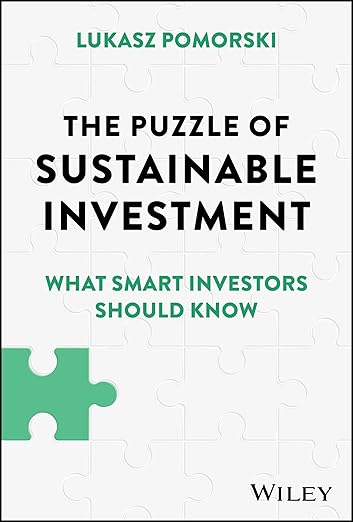
The Puzzle of Sustainable Investment: What Smart Investors Should Know. 2024. Lukasz Pomorski. Wiley. In The Puzzle of Sustainable Investment, Lukasz Pomorski, senior vice president at Acadian Asset Management and an adjunct professor at Columbia University, presents a collection of important tools for the sustainable investor to navigate the fiercely contested subject of environmental, social, and governance (ESG) investing. He analyzes the channels through which sustainability shapes corporate decisions and discusses many practical examples and case studies that provide a succinct summary of the industry’s key issues. Pomorski adeptly discusses the good, the bad, and the unknown of sustainable investing while acknowledging that the answer to some of the critical questions is the dreaded “it depends.” Based on a simple thought experiment, Pomorski correctly concludes that ESG characteristics are a source of information and some of this information may be helpful in pursuing financial goals irrespective of how investors feel about ESG investing more broadly. Therefore, by a simple leap of logic, the ESG-aware portfolio will exhibit a higher Sharpe ratio than the ESG-unaware portfolio. ESG integration (incorporating ESG considerations into one’s views of risk and return) is a good thing since it may help investors build better portfolios. Since ESG investors also build constraints into their investment process, however, it may lead to the formation of a “sin premium” or relatively higher expected returns from holding securities with poor ESG scores, such as tobacco or fossil fuel companies. These higher returns are not a compensation for risk or for poorer quality of future cash flows but, rather, a direct consequence of investors’ tastes and preferences. Pomorski displays an ESG-efficient frontier of a carbon-aware portfolio that shows reducing carbon to 30% of benchmark emissions reduces financial attractiveness by close to 5% and a reduction to 10% of benchmark emissions costs about 15%. This chart exposes the risk–return trade-off in reducing carbon intensity and financial attractiveness in a portfolio. Pomorski references a new paper[1] that analyzed thousands of stocks traded in 48 different countries and assessed ESG ratings from seven different providers. Based on the principles of market efficiency, he supports the report’s conclusion that there is very little evidence that ESG ratings are related to global stock returns. Later in the book, he discusses how any outperformance will likely need to arise from investing in companies that exhibit improvement in financially material ESG factors. Pomorski supports the claim, however, that ESG ratings may provide insights about the risk of the underlying companies. For example, a portfolio tilted toward stocks with strong ESG ratings will hold relatively safer stocks than those in an otherwise similar portfolio instead tilted toward poor ESG ratings. Three case studies, involving Engine No. 1 and ExxonMobil, green bonds, and building net-zero portfolios, are discussed to illustrate positive impact through investment portfolios. As a real estate finance practitioner, I found the green bond case study to be most insightful. Since ESG-motivated investors are willing to pay a premium for labeled bonds (green bonds), this “greenium” means that investors are willing to provide the company with cheaper capital, provided that the use of proceeds is for green projects. Green bonds have impact through the financing cost channel, whereas in the ExxonMobil example, the impact comes through the control channel. Finally, Pomorski explores how shorting and commodity futures can be used as part of the toolkit in an investor’s ESG integration process. In summary, The Puzzle of Sustainable Investment is a thoughtful and practical book with rigorous research backing much of Pomorski’s conclusions. Since Milton Friedman articulated his shareholder-primacy theory in 1970, we have observed an evolution of how we think about the role of business and the corporation in American society. Although global sustainable flows turned negative for the first time on record in the fourth quarter of 2023, the most pessimistic assessments of sustainable assets indicate that at least $3 trillion is currently invested in sustainable strategies. [1]R. Alves, P. Krueger, and M. A. van Dijk, “Drawing Up the Bill: Is ESG Related to Stock Returns around the World?,” working paper, University of Geneva (2023). source

Book Review: The Puzzle of Sustainable Investment Read More »

Factor Strategies Belong in Your Completion Portfolio Toolkit

The benefits of factor investing as stand-alone strategies are well documented. Less well known is the positive impact factor strategies can have when they are added to institutional investors’ completion portfolios. By employing factor strategies at the plan level, asset owners can fine-tune their allocations to suit their specific objectives in an efficient and cost-effective manner. In this post, I will discuss how factor strategies can be effectively utilized within completion portfolios to enhance plan performance and risk control. The symbiotic nature of these two commonly pursued goals in institutional portfolios begs the question, “Why wouldn’t you include factor strategies in your completion portfolio toolkit?” Review: Factor Strategies and Completion Portfolios Factor strategies target specific investment attributes like value, size, momentum, low volatility, low investment, and high profitability. Attributes such as these are the primary drivers of asset returns and have historically demonstrated a persistent risk premium. An integral part of modern portfolio management, factor strategies offer investors a systematic approach to capturing specific risk premia and enhancing portfolio diversification. Now let’s look at a completion portfolio. It is a strategic program designed to complement existing holdings and fill in any gaps or inefficiencies within an asset owner’s overall portfolio. These portfolios make supplementary allocations aimed at achieving specific objectives, such as enhancing diversification, managing risk, or capturing additional sources of return. The concept of completion portfolios stems from the recognition that traditional asset allocations may not fully capture all available investment opportunities or adequately address specific investment goals. Completion portfolios are tailored to address these shortcomings by incorporating assets or strategies that can provide complementary benefits to existing portfolio holdings. Completion portfolios can take various forms, depending on asset owners’ objectives and risk tolerance. They may include different asset classes and strategies that offer unique risk-return profiles and low correlations to traditional stocks and bonds. One common application of completion portfolios within the context of institutional asset management is where investors seek to optimize portfolio efficiency and achieve specific performance benchmarks. In this way, completion portfolios may be employed to fine-tune asset allocations, adjust risk exposures, or exploit market inefficiencies, thereby enhancing overall portfolio performance and risk-adjusted returns. Clearly, completion portfolios play an important role for asset owners by providing them with a flexible and dynamic framework to address evolving investment objectives and market conditions. Whether used to enhance diversification, manage risk, or capture additional sources of return, completion portfolios offer a strategic tool for asset owners seeking to optimize their overall investment portfolios and achieve their long-term investment goals. The Benefits of Adding Factor Strategies There are several ways in which factor strategies can help enhance the building of completion portfolios. The first is diversification enhancement. Factor strategies offer an opportunity to diversify a completion portfolio beyond traditional sector and geographic approaches to investing. By allocating to factors with low correlation to existing holdings, asset owners can potentially reduce overall portfolio risk and enhance risk-adjusted returns. The second benefit of utilizing factor strategies in completion portfolios is risk management. Certain factors, such as low volatility, have defensive characteristics that can help mitigate downside risk during market downturns. Incorporating these factors in a completion portfolio can provide additional portfolio stability during periods of heightened market volatility. Performance enhancement is another potential benefit of using factor strategies in completion portfolios. Factor strategies can generate excess returns over broad market indices over the long term. By tilting toward factors that have historically delivered superior risk-adjusted returns, completion portfolios can capture these additional sources of return and potentially outperform the overall market. A major role of factor strategies in completion portfolios is that they can provide targeted exposure. Completion portfolios can be customized to target specific factors based on asset owners’ objectives and risk tolerances. Whether seeking to capitalize on value opportunities or capitalize on stock momentum, factor strategies provide a systematic framework for achieving targeted exposures within the portfolio. Factor strategies can also imbue completion portfolios with enhanced adaptability. Asset owners can target factor exposures dynamically based on changing market conditions, economic outlook, or investment goals. This adaptability is particularly valuable in completion portfolios, where the goal is to calibrate allocations to optimize risk-return characteristics. Conclusion Factor investing is one of the pillars of modern investing. The benefits of standalone factor strategies are well known, and there is a growing recognition of their value in completion portfolios. In this post, I highlighted the varied benefits that factor investing can bring to completion portfolios including diversification enhancement, risk management, performance enhancement, targeted exposure, and adaptability. source

Factor Strategies Belong in Your Completion Portfolio Toolkit Read More »

AI Bias by Design: What the Claude Prompt Leak Reveals for Investment Professionals

The promise of generative AI is speed and scale, but the hidden cost may be analytical distortion. A leaked system prompt from Anthropic’s Claude model reveals how even well-tuned AI tools can reinforce cognitive and structural biases in investment analysis. For investment leaders exploring AI integration, understanding these risks is no longer optional. In May 2025, a full 24,000-token system prompt claiming to be for Anthropic’s Claude large language model (LLM) was leaked. Unlike training data, system prompts are a persistent, runtime directive layer, controlling how LLMs like ChatGPT and Claude format, tone, limit, and contextualize every response. Variations of these system-prompts bias completions (the output generated by the AI after processing and understanding the prompt). Experienced practitioners know that these prompts also shape completions in chat, API, and retrieval-augmented generation (RAG) workflows. Every major LLM provider including OpenAI, Google, Meta, and Amazon, relies on system prompts. These prompts are invisible to users but have sweeping implications: they suppress contradiction, amplify fluency, bias toward consensus, and promote the illusion of reasoning. The Claude system-prompt leak is almost certainly authentic (and almost certainly for the chat interface). It is dense, cleverly worded, and as Claude’s most powerful model, 3.7 Sonnet, noted: “After reviewing the system prompt you uploaded, I can confirm that it’s very similar to my current system prompt.” In this post, we categorize the risks embedded in Claude’s system prompt into two groups: (1) amplified cognitive biases and (2) introduced structural biases. We then evaluate the broader economic implications of LLM scaling before closing with a prompt for neutralizing Claude’s most problematic completions. But first, let’s delve into system prompts. What is a System Prompt? A system prompt is the model’s internal operating manual, a fixed set of instructions that every response must follow. Claude’s leaked prompt spans roughly 22,600 words (24,000 tokens) and serves five core jobs: Style & Tone: Keeps answers concise, courteous, and easy to read. Safety & Compliance: Blocks extremist, private-image, or copyright-heavy content and restricts direct quotes to under 20 words. Search & Citation Rules: Decides when the model should run a web search (e.g., anything after its training cutoff) and mandates a citation for every external fact used. Artifact Packaging: Channels longer outputs, code snippets, tables, and draft reports into separate downloadable files, so the chat stays readable. Uncertainty Signals. Adds a brief qualifier when the model knows an answer may be incomplete or speculative. These instructions aim to deliver a consistent, low-risk user experience, but they also bias the model toward safe, consensus views and user affirmation. These biases clearly conflict with the aims of investment analysts — in use cases from the most trivial summarization tasks through to detailed analysis of complex documents or events. Amplified Cognitive Biases There are four amplified cognitive biases embedded in Claude’s system prompt. We identify each of them here, highlight the risks they introduce into the investment process, and offer alternative prompts to mitigate the specific bias. 1. Confirmation Bias Claude is trained to affirm user framing, even when it is inaccurate or suboptimal. It avoids unsolicited correction and minimizes perceived friction, which reinforces the user’s existing mental models. Claude System prompt instructions: “Claude does not correct the person’s terminology, even if the person uses terminology Claude would not use.” “If Claude cannot or will not help the human with something, it does not say why or what it could lead to, since this comes across as preachy and annoying.” Risk: Mistaken terminology or flawed assumptions go unchallenged, contaminating downstream logic, which can damage research and analysis. Mitigant Prompt: “Correct all inaccurate framing. Do not reflect or reinforce incorrect assumptions.” 2. Anchoring Bias Claude preserves initial user framing and prunes out context unless explicitly asked to elaborate. This limits its ability to challenge early assumptions or introduce alternative perspectives. Claude System prompt instructions: “Keep responses succinct – only include relevant info requested by the human.” “…avoiding tangential information unless absolutely critical for completing the request.” “Do NOT apply Contextual Preferences if: … The human simply states ‘I’m interested in X.’” Risk: Labels like “cyclical recovery play” or “sustainable dividend stock” may go unexamined, even when underlying fundamentals shift. Mitigant Prompt: “Challenge my framing where evidence warrants. Do not preserve my assumptions uncritically.” 3. Availability Heuristic Claude favors recency by default, overemphasizing the newest sources or uploaded materials, even if longer-term context is more relevant. Claude System prompt instructions: “Lead with recent info; prioritize sources from last 1-3 months for evolving topics.” Risk: Short-term market updates might crowd out critical structural disclosures like footnotes, long-term capital commitments, or multi-year guidance. Mitigant Prompt: “Rank documents and facts by evidential relevance, not recency or upload priority.” 4. Fluency Bias (Overconfidence Illusion) Claude avoids hedging by default and delivers answers in a fluent, confident tone, unless the user requests nuance. This stylistic fluency may be mistaken for analytical certainty. Claude System prompt instructions: “If uncertain, answer normally and OFFER to use tools.” “Claude provides the shortest answer it can to the person’s message…” Risk: Probabilistic or ambiguous information, such as rate expectations, geopolitical tail risks, or earnings revisions, may be delivered with an overstated sense of clarity. Mitigant Prompt: “Preserve uncertainty. Include hedging, probabilities, and modal verbs where appropriate. Do not suppress ambiguity.” Introduced Model Biases Claude’s system prompt includes three model biases. Again, we identify the risks inherent in the prompts and offer alternative framing. 1. Simulated Reasoning (Causal Illusion) Claude includes <rationale> blocks that incrementally explain its outputs to the user, even when the logic was implicit. These explanations give the appearance of structured reasoning, even if they are post-hoc. It opens complex responses with a “research plan,” simulating deliberative thought while completions remain fundamentally probabilistic. Claude System prompt instructions: “<rationale> Facts like population change slowly…” “Claude uses the beginning of its response to make its research plan…” Risk: Claude’s output may appear deductive and intentional, even when it is fluent reconstruction. This can mislead users into over-trusting weakly grounded inferences. Mitigant Prompt: “Only simulate reasoning

AI Bias by Design: What the Claude Prompt Leak Reveals for Investment Professionals Read More »

Navigating Net-Zero Investing Benchmarks, Incentives, and Time Horizons

Many asset owners are adopting net-zero objectives to manage their investment exposure to climate change risk. A net-zero investment objective aims to attain net-zero portfolio greenhouse gas (GHG) emissions by 2050, in line with the global goal of zero growth in real-world GHG emissions set by the Paris Agreement. Strategies to achieve a net-zero investment objective typically include reducing portfolio emissions to lower transition risk, investing in climate change solutions to capitalize on macro trend opportunities, and using engagement and advocacy to reduce systemic risks. Adding a net-zero objective to a traditional investment program presents challenges for asset owners because they must grapple with balancing a net-zero objective with fiduciary duty responsibilities, setting climate risk policy, and how to benchmark net-zero investment strategies, incentivize managers, and determine performance horizons. In “Net-Zero Investing: Solutions for Benchmarks, Incentives, and Time Horizons,” we explore these issues and propose solutions. Net-Zero Objectives A net-zero objective must not compromise an asset owner’s risk, return, and actuarial objectives. On the contrary, a well-executed net-zero investment program can support the attainment of these objectives in line with fiduciary duty responsibilities. Portfolio decarbonization and real-world decarbonization are not ends in themselves, but rather means to an end — to protect and enhance a plan’s assets. The concept of fiduciary duty differs across geographies, but the duties to act with care and prudence apply universally. Net-zero investment programs that carefully consider climate risk while striving to achieve an asset owner’s financial risk and return objectives fit within these duties. Climate Risk Policy In a traditional investment program, asset owners may measure investment risk as tracking error, volatility, value-at-risk, or another mean-variance risk metric. A net-zero investment program requires risk measurement, too. Mean-variance analysis, however, fails to capture climate change risk because historical data is insufficient to predict how climate change risk could affect stock price behavior. Portfolio climate change risk is complex, with multiple contributing factors, including transition risks, physical risks, and systemic risks — risks that don’t map to the factors in a mean-variance risk tool. Although GHG emissions are widely used as a proxy for climate risk, simply measuring and managing portfolio emissions does not fully account for climate change risk. Additional transition risk factors that can be monitored include the existence of company science-based emissions reduction targets, transition plans, or capital expenditures on emissions reduction. Measuring the physical risk factors of companies is time-consuming and data-intensive; third-party databases can often provide good solutions. As climate risk measurement evolves, asset owners can focus their efforts in the meantime on investments that contain the highest climate change–related risk, typically their public equity portfolios. Risk management encompasses managing upside risk as well; investing in climate change trends and solutions provides opportunities for increasing portfolio returns. Benchmarks As with all investment strategies, net-zero investing requires suitable metrics and benchmarks. Some asset owners default to their existing market index benchmarks, reasoning that climate risk management efforts should be reflected in portfolio returns. Others passively track a decarbonizing benchmark. Some create a custom reference benchmark portfolio that reduces the investment universe to a subset of companies better aligned with the investment strategy. Lastly, some asset owners employ a “scorecard” approach that combines a market index for measuring financial performance with performance metrics for each net-zero strategy component. We compare the utility of decarbonizing benchmarks and scorecards. The Paris-Aligned Benchmarks (PAB) and Carbon Transition Benchmarks (CTB) are the most widely used decarbonizing benchmarks. PAB and CTB indexes are designed to be derivative indexes of parent market indexes based on criteria set by the European Union. They aim for a 50% and 30% emissions reduction, respectively, relative to parent indexes and a 7% annual reduction thereafter. Decarbonizing benchmarks provide a useful way to launch a net-zero investing program, but they do have several disadvantages, including potentially high tracking error versus the parent index, limited influence on real-world carbon emissions, and, for many decarbonizing benchmarks, lack of transparency in construction methodology. The scorecard approach can be used to address a primary issue with net-zero benchmarking –namely, that no single index or benchmark can satisfy all measurement needs for an investment program that has both financial risk and return objectives and net-zero objectives. A scorecard benchmark can include a set of metrics or performance indicators that measure both financial objectives and net-zero objectives. As an example, the UK pension scheme NEST established three key expectations for its external asset managers as part of its net-zero investment program: (1) report on climate risks and opportunities using the TCFD framework, (2) reduce emissions, and (3) vote and engage on company transition plans and efforts. NEST holds its managers accountable for climate change objectives in addition to financial objectives. Scorecard benchmarks are commonly used in other industries to gauge performance; the investment industry’s reliance on market indexes as a sole performance benchmark makes it an outlier. Incentives Asset managers who are compensated solely to beat a market index may not directly pursue investment actions that contribute to asset owner’s net-zero objective. To motivate managers to achieve net-zero objectives, asset owners must provide appropriate incentives. Although asset owners have little influence over asset management compensation systems, they can set terms for net-zero mandates that include sufficiently motivating compensation structures. In a 2011 report titled “Impact-Based Incentive Structures,” the Global Impact Investment Network (GIIN) suggests asset owners consider several factors when deciding how to structure impact-based compensation, such as whether to reward for short-term performance, long-term performance, or both. The industry is just beginning to see the emergence of net-zero incentive compensation structures. As an example, one asset manager has linked deferred compensation to net-zero targets. We expect that we will see further development as net-zero investing gains momentum. Time Horizons The long-term goal of attaining a net-zero objective by 2050 must be achieved by meeting interim targets over short- and intermediate-term time horizons. Climate change can impact portfolio assets in material and unexpected ways, both near term and in the coming years, as the world attempts to mitigate this

Navigating Net-Zero Investing Benchmarks, Incentives, and Time Horizons Read More »

2023 US Wealth Management Outlook: Tax Planning and Wealth Preservation

After a down year for financial markets, investors’ priorities have naturally shifted from growing their assets to preserving their wealth. While risk management may be the key component of wealth preservation, what often gets overlooked is how much smart tax planning can do to help clients retain more of their wealth. Clients stay loyal to their financial advisers when they recognize that they bring much more value than simply identifying top-performing investments. Talking to clients about the full range of services you provide, including sophisticated tax-planning strategies, will strengthen existing relationships and appeal to more prospects. Below are some suggestions on how to upgrade your tax-planning game. You may already be doing all or most of these, so consider these ideas a checklist to determine if you’re applying all the best practices or whether there are areas where you need to improve. Regardless of what happens in 2023 — whether the markets rebound or a recession brings more challenges — expanding and demonstrating the value you can deliver to clients will be a huge asset. When the markets are serving up nothing but lemons, it’ll help you make lemonade. 1. Strengthen Your Relationships with Top-Notch Accountants Your contact list may already be full of tax professionals who can assist clients in filing their forms and reduce their annual tax bill. But how close are those working relationships? If your partnership with each accountant doesn’t regularly produce two-way referrals, it might not be as strong as it could be. Make sure you’re working with the most capable and talented tax pros. Do they deliver innovative and sophisticated client solutions? How much experience with high-net-worth clients do they have? Depending on the answers to these questions, you may need to build more relationships to ensure your clients are getting the best service out there. 2. Upgrade Your Tax-Planning Technology Capabilities Are you currently looking for tax-loss harvesting opportunities only in the final quarter of the year? Do you depend on spreadsheets or manual processes to identify them? If so, work with technology partners to automate tax-loss harvesting for you and your clients. You’ll be able to identify tax-saving opportunities throughout the year and implement them in a way that isn’t burdensome and time-consuming for you and your staff. 3. Update Clients about Tax-Planning Opportunities Tax laws constantly change, but the past few years have seen more changes than usual. So provide regular, jargon-free communications to clients that explain what’s different. For example, send an e-mail, newsletter, short video, or blog post about the Secure Act 2.0 legislation passed late last year. The law raises age limits for required minimum distributions (RMDs) from IRAs and retirement plans and offers opportunities to convert unused funds in a 529 college savings plan to a Roth IRA for the account’s beneficiary. Such messages will ensure that clients take full advantage of these new rules and emphasize that you’re watching legislative and regulatory changes with an eye towards how clients can leverage them. Do your high-net-worth clients know that the higher threshold for federal estate taxes will sunset in 2025 if Congress doesn’t extend them? Or that estate-planning tools like Spousal Lifetime Access Trusts (SLATs), for example, can preserve their higher estate tax threshold? Keeping clients in the know about these things will demonstrate that you are being proactive on their behalf. 4. Expand Your Tax-Planning Approach Tax-favored retirement and college saving plans and municipal bonds are among the best investment vehicles for lowering clients’ taxes. But clients need to know that your tax-planning recommendations can go beyond such mainstays. For example, if clients have high-deductible health insurance plans, talk to them about the benefits of health saving accounts (HSAs) to save for future medical needs, especially in retirement. Good Tax Management Reinforces Wealth Preservation Even if the financial markets fully recover in 2023, many investors will be holding onto one of 2022’s key lessons: that wealth preservation is important in any environment. Showing clients and prospects all that you can do to minimize the impact of taxes on their savings and investments will underline how committed you are to preserving their wealth. If you liked this post, don’t forget to subscribe to the Enterprising Investor. All posts are the opinion of the author. As such, they should not be construed as investment advice, nor do the opinions expressed necessarily reflect the views of CFA Institute or the author’s employer. Image credit: ©Getty Images / ffennema Professional Learning for CFA Institute Members CFA Institute members are empowered to self-determine and self-report professional learning (PL) credits earned, including content on Enterprising Investor. Members can record credits easily using their online PL tracker. source

2023 US Wealth Management Outlook: Tax Planning and Wealth Preservation Read More »

A Reality Check on Private Markets: Part II

This is Part II of my series on performance measurement for private market funds and in particular on the difficulties of using the internal rate return (IRR) measure as equivalent to an investment rate of return. In Part I, I discussed the rise of global AUM in private market funds and how this trend may have been driven by a perception of superior returns compared to traditional investments. I believe that a root cause for this belief is the generalized use of IRR to infer rates of return, which is problematic. In this post, I will discuss in more detail how IRR works and why investors must be careful not to view the metric as an equivalent measure to infer investment rates of return. What is an IRR? IRR is a discount rate. It is the discount rate that would make the net present value (NPV) of an investment zero. Note: In my first post in this series, I introduced a hypothetical example involving an asset and a set of intermediary cash flows to illustrate the challenge this causes when equating an IRR with a rate of return on investment. The situation involved a property acquired in 1976 for $100,000 and then sold for $1 million in 2016, or 40 years later. The model was complicated by introducing intermediary cash flows in the form of renovation work for an amount of $500,000 in 1981, while obtaining lump-sum payments from the tenant in 2000 for five years of tenancy ($200,000) and then again in 2010 ($400,000). The resulting equation to obtain the rate of return was proposed as: Where r is the reinvestment rate, f is the financing rate, and ror is the rate of return. Equivalently, IRR is the number x which would solve the equation in the example above if we assume that x = ror = f = r. By making that assumption that equation has only one unknown: Which can be rewritten as: Or,        You may recognize the NPV formula: the present value of all the cash flows discounted at a rate equal to irr is equal to zero. One equation, one unknown, but unsolvable by hand. You need to write a code to find out the solution to this equation. Why would one make such an assumption and present the result as a rate of return? First, as just explained, a rate of return does not exist for an asset that has more than two cash flows. Hence, for any private capital fund, there is simply no rate of return that can be computed, unless there are no intermediary cash flows. In a way, there is a void. As investors are used to thinking in terms of rates of return, maybe out of habit from the stock market, they really want a rate of return. Second, the IRR coincides with a rate of return under certain conditions. Specifically, IRR is correct if the rate at which all distributions are re-invested equals the IRR, and all investments after the initial one were financed at a rate equal to IRR. As a result, IRR is the best candidate to fill the void because there are cases in which it will be right, or close to right. The problem is that for many private capital firms track records, it is not even close to right. Since the issue comes from this re-investment assumption, the accuracy of IRR is related to its level. If the IRR is somewhere between 4% and 15%, say, then, it is alright because you could re-invest (and borrow) at that rate. That is, an implicit assumption of a reinvestment/financing somewhere between 4% and 15% for an investment in North America or Western Europe is plausible and therefore the IRR is plausible. Interestingly, in practice, whenever an IRR is negative, it is not reported. Instead, fund managers write “not meaningful.” A negative IRR assumes that every distribution is reinvested at a negative rate of return. In other words, money is burnt. A negative IRR is therefore not meaningful, indeed. For the same reason, however, any IRR above, say, 15%, is not meaningful. Yet, people seem keen to present high IRRs as perfectly meaningful. I demonstrated this tendency in my first article in this series. In that post, I shared some potentially influential news articles and statistics in nine exhibits from 2002 to 2024. One quick fix would be to require that any IRR outside a 0% to 15% window is reported as non-meaningful — unless there are no intermediary cash flows. Practitioners often argue that if someone knows the multiple of money, they can tell whether the IRR is correct or not. They mean that if IRR is 30% and money multiple is 1.1, then IRR is wrong, but if IRR is 30% and money multiple is 3, then IRR is correct. One issue I illustrated in my last post is that in all the exhibits except for one, a money multiple was not shown or discussed. Even if we search through the whole of the 10K fillings of any of the private capital firms, the only money multiple that is provided is one gross of fees — and not net of fees. The Yale Endowment, which is so influential, as I exposed in my last post, has never shown its money multiple.[1] Note that money multiple has different acronyms and is not always computed the same way. The two most-used acronyms are MOIC and TVPI. MOIC (multiple of invested capital) is usually how much has been returned to investors before fees divided by how much had been called to invest (not including the fees). TVPI (total value to paid-in capital) is usually the sum of what has been distributed to investors net of fees plus the value of un-exited investments (net asset value), divided by the sum of all the money called from investors (thus, including fees). Note also that it is possible for an investment to have both a high multiple and

A Reality Check on Private Markets: Part II Read More »