Forrester

Are You Ready to Grow Your B2B Business with Product-Led Sales?

Product-led sales (PLS) empowers B2B buyers to discover, evaluate, and commit to offerings on their own terms. PLS blends product-led growth and sales-led approaches by attracting users through product trials, viral sharing, and word of mouth and then tees up sales teams to close or upsell those most likely to convert. It’s a model that fits how today’s buyers and users want to buy: Self-serve first, with sales’s assistance when needed. When done right, PLS can lower customer acquisition costs, speed up sales cycles, and more economically drive upsell and cross-sell growth. But to make it work, teams need tight alignment across product, marketing, and sales; strong data; and a mindset shift toward product-assisted selling. Without that, it’s easy to miss the mark and the revenue. Assess Your Ability To Be Successful With A Product-Led Sales Strategy Leadership Commitment Is Foundational To PLS Success For PLS to be successful, sales, marketing, and product teams must refocus on finding and engaging users. They must be tightly aligned so they can define and iterate on plays to drive engagement and convert product-qualified leads. Additionally, PLS is a cultural shift, focusing on users initially as opposed to buyers. It also requires investment in technology to track and compile user engagement. Ask the following questions: What challenges or successes have you faced in aligning teams around shared goals, cultural change, and experimentation? Can you earn executive support and investment into PLS (resourced team, tools, and integrations)? Product Must Create A Self-Serve Growth Engine The most successful PLS products solve a broad problem easily and can be structured for bottom-up adoption and a smooth conversion from self-serve to paid. Ask the following questions: Is there a product in your portfolio that easily solves a broad problem and that can show its value through a self-serve trial? For said product, can you develop a sales-assisted monetization strategy through usage and feature limits, natural tiering, and up- and cross-sell options to drive revenue expansion? You Can’t Be Successful With PLS Without Accurate Product Usage Data And Analytics In PLS, understanding how users engage with the product is essential for identifying when a customer is ready for outreach or when they show signs of interest in a higher tier. Monitoring in-app actions and usage patterns, aligning on intent signals, and grouping users based on conversion readiness sets the stage for refining outreach and monetizing customers. Ask the following questions: Are we tracking in-product user activity and engagement metrics to identify high-intent users? Do we have defined product engagement thresholds that indicate readiness for sales outreach and upselling? Build A Go-To-Market Team Skilled In The Product-Led Motion PLS sales reps don’t do cold outbound calls. They help users see the value and expand usage. They need to understand product usage data to tailor outreach to drive expansion and teamwide adoption. Together, sales and marketing must collaborate closely to design playbooks that prompt sales outreach with specific messaging when certain in-product actions are completed. Ask the following questions: Is your organization able to build and train a dedicated PLS team? Is there appropriate alignment and communication in place between marketing and sales teams? For an in-depth look at factors contributing to PLS readiness, read this report or use this decision tool. Forrester clients can request an inquiry or guidance session with myself or other analysts here. source

Are You Ready to Grow Your B2B Business with Product-Led Sales? Read More »

Global Capability Centers Add Depth, Not Just Breadth, To Your Tech Workforce

Global capability centers (GCCs) are surging in popularity. Nasscom’s recently concluded GCC Summit 2025 showcased the evolution of the country’s rapidly evolving GCC ecosystem. Forrester attended the event and spoke to several GCC leaders as well as providers serving the GCCs. It is becoming evident that enterprises have been increasingly valuing their GCC not just as a cost-saving mechanism but as equal partners and collaborators with other in-house groups. This mindset shift is supercharging their role. We have seen them emerge as an accelerant for digital transformation initiatives. Many have become the key centers for R&D and innovation for their organizations. The most advanced ones have become virtually indistinguishable from the offices in their parent geography. A few factors we have noticed in the evolution of GCCs include: GCCs are trusted to handle more complicated projects. The maturity of technology talent in key GCC markets such as India has risen rapidly since the pandemic. It is easier and faster to get a GCC up to speed than ever before. They are not only capable but are increasingly demanding to take end-to-end ownership of tech initiatives. As you establish trust, consider bringing your GCCs onto more innovation-oriented initiatives. Frequent turnover and attrition continues to be challenging. This is more true in cases where GCCs do not have a seat at the table. Treating GCC staff as valued employees serves a key role in your success. Regardless of employment structure, if workers don’t feel that they have a clear career path, they will move to other opportunities. You must raise the profile of the work that you source from your GCCs. India is a focal point of GCC growth. Over the last four years, revenue generation has significantly increased from India-based GCCs. At the GCC Summit, Nasscom revealed that India is now home to close to 1,800 GCCs, a number that is poised to grow beyond 2000 in the next two years. Access to a pool of digital and engineering talent at a large scale is drawing global firms to India. An evolving trade landscape further boosts the appeal of GCCs. While there is no direct impact of the recent imposition of tariffs on US importing of goods, the resulting uncertainty from the move makes GCCs more attractive. GCCs, combined with a local entity, can serve as that neutral third-party offering flexibility, to firms in both the US and other economies, in mitigating the tariff impact. This is in addition to them taking advantage of GCCs’ ongoing evolution into higher-skill work, which they need at scale. Anticipate The Boom And Bust Cycle To Develop Resiliency We have seen GCCs go through ups and downs in the past. Firms must prepare their GCCs to both supercharge their growth and provide cover during economic downturns. For these trends to work in your favor, you must ensure a longer-term commitment to your GCCs. Reverting to a traditional, purely transactional model midway through a contract would be the worst of both worlds, demoralizing GCC partners and compounding your costs. Ensure that your internal stakeholders agree on your GCC approach and stay the course throughout, and note that there is much more to do to get your GCC strategy and approach right. By Your Side For GCC Expertise This is an exciting time for GCCs, and Forrester is monitoring the space closely. Read our report, Global Capability Centers: A Rising Tide, for further insight into the growing enthusiasm for GCCs and how to avoid the boom-bust dynamic that persists, and keep an eye out for our upcoming report on maximizing value from your GCC, where we will share findings from our research on the practices that mature GCCs follow. If you are a Forrester client, set up a guidance session with Bill Martorelli or Ashutosh Sharma to learn more about the current state of GCCs, best practices for working with them, and how you can best leverage their capabilities for your business. source

Global Capability Centers Add Depth, Not Just Breadth, To Your Tech Workforce Read More »

Introducing TCQ, Forrester’s Technology Change Quotient

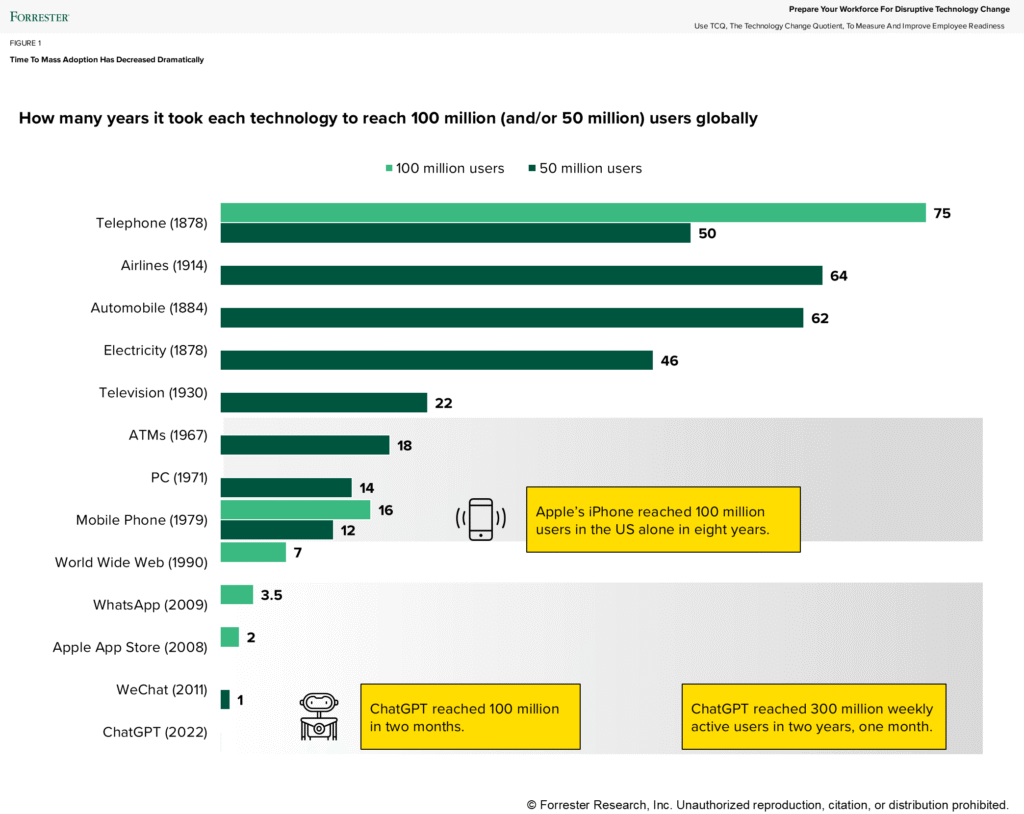
Rapid, Tectonic Shifts In Technology Challenge Your Employees And Organization They don’t make technology revolutions like they used to; now, they make them faster. Consider the history of technology adoption (see figure below). While it took 50 years for 50 million people to use the telephone (1878), it only took 22 years for television (1930) to reach the same penetration. Yet the iPhone (2007) reached 100 million users in the US alone in just eight years. Fast, right? Not as fast as today. How about WeChat (2011), which took only one year to reach 50 million users, or ChatGPT (2022), which reached 100 million in two months? Time To Mass Adoption Has Decreased Dramatically This kinetic pace of technology change challenges both workers and your organization: It’s hard for employees to adapt effectively and quickly, which creates frictions that undermine your technology deployments and business results. Disruptive Technology Change Is A Human, Not A Technology, Challenge In case it’s unclear, we’re not talking just about technology employees (though they face challenges, too). We’re talking about every employee in every role. It’s true for AI: We’ve shown how grounding your workforce AI strategy in human experience is crucial to business success. But human factors influence the adoption of every technology, from devices to software to AI and beyond. And too often, organizations invest in technologies that don’t meet employee needs, ignore the central role that employee experience plays in technology adoption, and underinvest in comprehensive learning and engagement programs. The Future Of Work Requires A High Technology Change Quotient (TCQ) Focusing on technology alone is a losing strategy: You can’t predict exactly how new technologies will unfold, nor precisely which vendor will roll out the features you need most. Focusing on the human side, however, prepares your organization for any turns that the technologies take, making you resilient to the ever-changing technology landscape: You can prepare your employees to become adaptable learners who quickly embrace and master each new wave of technology change that arrives. How? Enter TCQ, Forrester’s technology change quotient: TCQ measures the readiness of employees, teams, and organizations to adapt to technology in a way that drives productivity, creativity, and inventiveness. Teams and individuals with higher TCQ possess attributes that help them — and your organization — thrive in today’s environment of accelerated technology change. It predicts four business-crucial outcomes, including these two: Adaptiveness. Being able to adapt to new technology is the key capacity that employees must develop in the face of disruptive technology change. Higher adaptiveness means faster time to value when you deploy new technology and lower rates of employee rejection of those tools. Productivity. Translating deployments of technologies into genuine workforce productivity is a common challenge. Higher productivity means that employees create the ROI you seek when investing in workforce technologies. Driving higher TCQ requires you to provide resources — both tangible and intangible ones — to help employees understand and embrace new technologies as an opportunity builder. As one employee from Forrester’s ConsumerVoices Market Research Online Community told us, “constant support is always good when it comes to technology.” With TCQ, you — as a leader — can help ensure that these resources are available. Benchmark Your Employees With TCQ As with Forrester’s artificial intelligence quotient, Forrester Decisions seatholders can deploy our TCQ survey to large groups of employees to benchmark readiness, identify gaps and opportunities, and develop a comprehensive strategy for driving business outcomes through technology deployments. It can save you from leaping too soon or help you develop a high-TCQ workforce that’s ready to take advantage of new technologies. Next Steps For You? Read Our Report And Let’s Talk. We’ve just released a major report detailing TCQ and how it can help you: Prepare Your Workforce For Disruptive Technology Change. Forrester clients should check out the report, then reach out to schedule a guidance session with me — I’ll help you design a successful workforce AI strategy. source

Introducing TCQ, Forrester’s Technology Change Quotient Read More »

Forrester präsentiert die Top 10 der Emerging Technologies für 2025: Automatisierung, Roboter und synthetische Daten nehmen an Fahrt auf

Die Entwicklung von Emerging Technologies schreitet immer schneller voran, bewegt sich jedoch auch in immer neuere und riskantere Richtungen mit hoher Leistungsfähigkeit. In unserer letztjährigen Liste der Top 10 der Emerging Technologies haben wir generative KI in zwei Kategorien aufgeteilt: Sprache und visuelle Inhalte. Diese Aufteilung haben wir für 2025 beibehalten, allerdings haben sich die Zeitpläne verschoben: Generative KI für Sprache ist bereits da, während es noch etwas dauern wird, bis die Transformation digitaler Erlebnisse durch GenAI für visuelle Inhalte erreicht ist. Der Rest der diesjährigen Liste macht deutlich, wie rasant der Wandel voranschreitet: es gibt viel Neues über Automatisierung, Dateninnovation und Embodied KI zu berichten.  Im Folgenden beleuchten wir drei bemerkenswerte Änderungen bei den diesjährigen Top 10 der Emerging Technologies und erinnern an eine grundlegende Wahrheit, die unverändert Bestand hat. Um einen umfassenden Überblick über alle 10 Technologien zu erhalten, schauen Sie sich unser Webinar an. Agentenbasierte KI: Automatisierung mit Gehirn (und einem Warnhinweis)  Seitdem Forrester 2020 erstmals intelligente Agenten vorgestellt hat, haben wir die Entwicklung der Automatisierung mit KI aufmerksam verfolgt. Letztes Jahr konnten wir eine Weiterentwicklung zu „KI-Agenten“ beobachten. 2025 ist eine neue Stufe erreicht und wir sehen agentenbasierte KI als eigenständige Emerging Technology.  Warum? Weil KI-Agenten durch eine neue Welle von Architekturen und Orchestrierungstools deutlich flexibler und leistungsfähiger – aber auch unberechenbarer – werden. Dank dieser Technologien ist die Automatisierung in der Lage, Aufgaben mit offenem Ende zu übernehmen, ihre Reaktionen anzupassen und unabhängig zu arbeiten. Damit eröffnen sich neue Möglichkeiten für Unternehmen – und neue Risiken. Das bedeutet, dass parallel zu dieser Technologie klare Grenzen, Governance-Vorgaben und ein Vertrauensgerüst entwickelt werden müssen. Wir haben bereits einen wichtigen Grundlagen-Report zu dieser Technologie veröffentlicht.  Synthetische Daten: vom Datenschutz-Tool zum Performance-Treiber  Zwar geben 42 % der Unternehmen an, synthetische Daten bereits für den Datenschutz einzusetzen, das eigentliche Potenzial dieser Technologie tritt jedoch erst jetzt zutage und katapultiert sie in die Top 10.  Schließlich sind synthetische Daten nicht nur für Datenminimierung und die Reduzierung von Voreingenommenheit wichtig, sondern haben rasant an Bedeutung als kritisches Schulungs- und Optimierungstool für Foundation Models gewonnen. Unternehmen nutzen synthetische Daten zur Erstellung realitätsnaher Datensätze, wenn echte Daten nur begrenzt oder gar nicht verfügbar sind, um das Verhalten von KI unter Stress zu testen und im großen Umfang Fairness sicherzustellen. Das Ergebnis? Ein robusterer Weg zu verantwortungsvoller KI – und ein neuer Hebel für Innovationen.  Humanoide Roboter: von der Fabrikhalle zum Einsatz an vorderster Front Humanoide Roboter waren im letzten Jahr nicht einmal in unserer Top-20-Liste vertreten, haben es dieses Jahr jedoch in die Top 10 geschafft. Was hat sich geändert?  Im Jahr 2025 kamen mehrere Faktoren zusammen: sinkende Bauteilkosten, zunehmende Geschicklichkeit von Robotern und rasante Fortschritte der Sprach-KI. Zusammen haben sie Roboter in Menschengestalt möglich gemacht, die über alle Branchen hinweg für Arbeiten an vorderster Front eingesetzt werden können. Immer mehr Anwendungsfälle eröffnen sich: von Lagerhäusern und Restaurants bis hin zu Altenpflege und Sicherheit.  Wenn sich der derzeitige Trend fortsetzt, könnten humanoide Roboter bis 2030 viele physische Dienstleistungsbranchen revolutionieren. Bei der Robotik steht nicht mehr die Automatisierung im Vordergrund, sondern es geht um Präsenz, Interaktion und menschenähnliche Gestaltung.  Was hat sich nicht geändert? Vertrauen hat immer noch Priorität.  Die allerwichtigste Botschaft des letzten Jahres gilt unverändert auch für 2025, trotz der höheren Volatilität in diesem Jahr: Um für die Innovationen von Morgen bereit zu sein, müssen Technologieführer heute in vertrauenswürdige und sichere Technologie-Grundlagen investieren. Technologische Innovationen schreiten in einem enormen Tempo voran, echte Skalierung ist jedoch nur mit Vertrauen möglich.  Möchten Sie einen umfassenden Überblick erhalten?  Nehmen Sie an einem unserer Webinare teil, um sich einen Überblick über alle 10 Technologien zu verschaffen, die künftige Innovationen prägen werden, und um zu erfahren, wie sie daraus einen strategischen Wettbewerbsvorteil erzielen können. Wir stehen gerne bereit, um Ihnen alle Fragen zu Ihren eigenen Plänen für Emerging Technologies zu beantworten.  Dieser Blog wurde aus dem Englischen übersetzt. source

Forrester präsentiert die Top 10 der Emerging Technologies für 2025: Automatisierung, Roboter und synthetische Daten nehmen an Fahrt auf Read More »

Great News! We’re Extending The Deadline For The 2025 Forrester APAC Technology Awards

We’ve seen an incredible wave of interest and some truly inspiring initial submissions for the 2025 Forrester Technology Awards in the APAC region! Your enthusiasm for showcasing how technology drives business results, enhances experiences, and fuels innovation is exactly what these awards are all about. To ensure that everyone has ample opportunity to craft their best submissions and share their success stories, we’re thrilled to announce an extension to the nomination deadline for APAC. New extended deadline to submit your nominations for the APAC region: Tuesday, June 10, 2025. Why Should You Seize This Extra Time To Apply? Winning a Forrester Technology Award offers significant prestige, global recognition, and invaluable exposure to industry leaders and peers. It’s a powerful affirmation of your team’s hard work and the tangible impact that your technology initiatives have on business success. Technology Strategy Impact Award. This award celebrates excellence in IT strategy that continuously improves business results through technology, emphasizing alignment, trust, and adaptivity: the core of high-performance IT. Showcase how your IT strategy aligns with business goals, fosters trust, adapts to change, and measurably improves business outcomes. Enterprise Architecture Award. Judged in partnership with The Open Group, author of the TOGAF® Standard, this award recognizes EA practices that make a material contribution to managing risk, driving cost-efficiency, improving customer and employee experience, and increasing revenue or supporting mission outcomes. Who’s Eligible? Nominations are open to organizations with 1,000 or more employees in sectors other than software or professional services. We invite technology leaders, including chief information officers, chief technology officers, chief digital officers, and enterprise architects, to apply. Please note that you do not need to be a Forrester client or Open Group member to apply. Consultancies and agencies are also welcome to nominate their clients with their clients’ written permission and agreement to the terms of the award. Ready To Share Your Story? For more information on award categories, detailed submission packages, and instructions, please visit the Forrester Technology & Innovation Summit APAC website. Don’t miss this chance to shine a spotlight on your organization’s achievements. We look forward to receiving your nominations! source

Great News! We’re Extending The Deadline For The 2025 Forrester APAC Technology Awards Read More »

Master Tech Mayhem: Technology & Innovation Summit APAC

The AI you piloted yesterday is not the AI challenging your strategy today. What began as a tool is rapidly evolving into an active, often autonomous, force within your organization: a digital “mind” reshaping operations, risk, and your very definition of value. As a technology leader in the APAC region, the pivotal question is no longer about whether AI will transform your business but how you will leverage AI to lead your organization through ongoing global volatility and escalating costs. The initial AI excitement has given way to the critical work of embedding intelligence responsibly and profitably into your organization, all at a time when geopolitical currents, tightening regulations around data and AI ethics, and the sheer capability of agentic systems combine to fundamentally alter the playing field. Your existing IT foundations, unless forged for this new era, risk becoming anchors, not engines, leading to squandered AI investments, missed opportunities, and unmanaged threats. To navigate this defining moment and forge the strategies essential for this new era, Forrester invites you to join leading minds and your peers at Technology & Innovation Summit APAC in Sydney this August 19. At this year’s event, we’ll equip you with the skills, practices, and platforms to master today’s tech mayhem and achieve high performance in a volatile environment. Gods, Machines, & Kaos: High-Performance IT (Because Prayer Isn’t A Strategy) What can you expect at this event? For one, you can expect Forrester’s analysts and presenters to confront the volatile business environment head on to help you become more strategic in addressing the challenges. We’ll dive into Forrester’s high-performance IT strategy, the pragmatic, battle-tested response to a world increasingly dominated by chaotic business shifts, seemingly intelligent machines, and relentless budget cuts; this is the very foundation required to prevent your IT from becoming an anchor. At the event, you will learn how to lead with clarity (even when everything appears to be on fire), architect systems designed to absorb shock without breaking, and replace wishful thinking with a resilient and actionable tech strategy fit for your business context. AI Wakes The Sleeping Giant: Continuous, Agentic, Intelligent Transformation Building on this robust IT foundation, we’ll inspire you to harness the profound impact of AI’s evolution. The modern enterprise, while powerful, has often moved with force rather than agility. The era of the sleeping giant is decisively over. We are entering an age of genuine agency, demanding that organizations adapt to AI as an active participant. Intelligent agents are navigating the digital nervous system of your firm, surfacing insights, contributing to decisions, and acting with intent. Your business is growing a cognitive layer. At this event, you’ll learn how cutting-edge developments in AI, graph technology, and systems thinking serve as the fundamental building blocks of this new learning enterprise. We will guide you beyond static dashboards, enabling you to orchestrate living systems of intelligence, and together, we will define how leadership, strategy, and governance must profoundly evolve to command this new era. Address 2025 Cyber Threats With Preparation And A Steady Hand Transformative power presents new, complex vulnerabilities. Predictive, generative, and agentic AI are taking the world by storm. But this shift is occurring amid a chaotic political climate, the looming specter of a global recession, and an ongoing global trade war — an overwhelming list of uncertainties that can embolden bad actors in the region. At T&I Summit APAC, we will empower you to deconstruct and anticipate the top current and emerging cyber threats facing Australian and APAC organizations. You’ll learn how to act decisively to protect your organization and gain crucial insights on how to work effectively with your stakeholders to respond with wisdom and agility in the face of adversity. Leadership In The Agentic Era Ultimately, mastering these advancements and navigating these threats requires a new paradigm of leadership, a core component of your reinvention. As AI systems become increasingly capable and agentic, enterprises are entering an operational era where the traditional leadership playbook no longer fits. At our event, we will have sessions that help define the necessary evolution of leadership, equipping you with the new capabilities, essential mindsets, and collaborative models required to lead with impact when humans and intelligent systems work side by side. You’ll walk away with a clear view of how AI agents are reshaping work, insight into how leadership and change management must adapt, and practical guidance for developing the adaptive, AI-literate leadership capabilities vital for leading teams and businesses to future success. Celebrate The Winners Of Forrester’s Technology Awards! Join us in recognizing the trailblazers who have set new benchmarks in technology and innovation in APAC. Forrester’s Technology Awards celebrate outstanding achievements in two key categories: the Technology Strategy Impact Award and the Enterprise Architecture Award. The APAC region winners will be unveiled at the Summit in Sydney. These awards highlight the transformative impact of technology, showcasing organizations that have excelled in enhancing business and mission outcomes through their IT capabilities. At the Summit, you’ll hear the award winners share their unique high-performance stories, and you’ll be invited to connect with them to learn more from their experience. Join Us In Sydney The path forward is complex, but it is navigable with the right strategy, insights, and connections. Join us at Forrester’s Technology & Innovation Summit APAC in Sydney to equip yourself and your organization with proven frameworks and peer-tested strategies designed for this new age of AI. This is your prime opportunity to cut through the noise, connect directly with Forrester’s leading global analysts, and network with your fellow CIOs to forge a clear, confident path forward. We look forward to welcoming you. source

Master Tech Mayhem: Technology & Innovation Summit APAC Read More »

Sustainability Leaders Must Drive Operational Results In 2025

The year 2025 marks a pivotal year for sustainability leaders as a new environmental, social, and governance winter sets in with a new global political reality. Sustainability leaders are operating in a much looser regulatory environment, with key sustainability reporting regulations such as the EU’s Corporate Sustainability Reporting Directive delayed and some of its key provisions weakened. This year, leaders should focus on how sustainability delivers measurable business results. Organizations must move beyond sustainability merely as a compliance or virtue-signaling exercise and use it as a strategic lever for operational efficiency and business growth. The Forrester sustainability team has just released its latest research paper, Top Recommendations For Your Environmental Sustainability Program, 2025, giving view of the five key actions that sustainability leaders need to take in 2025. Here are a few highlights: Transfer energy to renewable sources to reduce costs and increase resilience. All organizations should evaluate energy transfer because it reduces scope 2 emissions, reduces costs, boosts energy resilience, and is relatively straightforward to achieve. International Energy Agency analysis shows that renewable energy transfer strategies also shield organizations from energy price volatility. Sustainability leaders capitalize on energy transfer by showing how it’s driving down energy costs, increasing profits. Energy audits, clean-energy target-setting, and renewable energy partnerships are all necessary tactics to achieve the potential cost savings. Integrate circular economy principles to drive profitability. Forrester predicted late last year that circular economy commitments by organizations would accelerate in 2025. Leading firms, such as IKEA, Decathlon, and Cisco, are implementing circularity within their product lifecycles to reduce waste. Reducing waste leads to less acquisition of new raw materials as well as less energy usage to create products. It also improves operating margin, which drives higher profits. Furthermore, executives get to add services for maintenance, repair, and recycling as a new revenue stream. Sustainability leaders must educate their product teams about how implementing circularity boosts profitability of their products. They must also upskill teams in ecodesign and lifecycle assessment methodologies. Finally, leaders must invest in sustainability tools to help them calculate product carbon footprints to spot where the efficiency opportunities exist. Prove operational effectiveness with sustainability reporting. Sustainability leaders can do more with their sustainability reporting programs than simply demonstrate compliance to regulations. Leaders can use sustainability data to show where sustainability strategies are delivering concrete business results, such as increasing revenues. Sustainability leaders must implement sustainability management solutions to not only automate compliance reporting; they must also establish a robust measurement framework to track and measure ROI and operational improvements. Forrester clients can read our report here to find out more and can contact any of the other authors to request a guidance session to discuss our recommendations. source

Sustainability Leaders Must Drive Operational Results In 2025 Read More »

Healthcare Organizations: Turn Volatility Into Strategic Advantage

Adaptability and agility will differentiate healthcare organizations (HCOs) that flourish amid volatility, per our new research, Healthcare Leaders: How To Thrive Through Volatility. Following recent changes in health policies and US government funding, it could be tempting for leaders at US HCOs to hunker down. Instead, to successfully navigate uncertainty and bolster their image as a pillar of strength and stability, healthcare providers and health insurers must lead with core values and revisit their priorities. Prioritize And Be Proactive In Decision-Making For forward-thinking HCOs, the onslaught of rapid changes can be a catalyst for innovation and transformation. From private-sector players to government agencies, HCO leaders must navigate change while honoring their mission and values. They must balance cost savings, growing cybersecurity and concentration risks, pressure to innovate, and leading change for their (often extensive) teams. We know it’s a tall order. Where should you start? HCOs must firmly root their actions in their core values and foster collaboration within and across sectors of the industry. To bolster efficiency and stability, HCO leaders must also proactively develop and use frameworks to evaluate, test, measure, and invest in emerging technologies and new, innovative business models. Forrester’s new Healthcare Rapid Change Prioritization Tool helps leaders assess new initiatives in terms of their potential impact on customers, the business, and employees. We’re here to help you navigate the complexities of today’s healthcare landscape with confidence and resilience. Forrester clients can read our latest research for a detailed look at actionable strategies to thrive through volatility in healthcare and use the accompanying prioritization tool to determine their best steps forward. Clients: Please schedule a guidance session to delve into this research and have us by your side every step of the way. Not a client? Let’s talk about how we can help. source

Healthcare Organizations: Turn Volatility Into Strategic Advantage Read More »

Rethinking Government Reform: Can In-House Government Consultants Deliver Lasting Impact?

Nineteen percent of business and technology professionals in the public sector are bringing previously outsourced processes or functions back in-house to reduce costs, according to Forrester survey data. Internal consultancies — mission-driven capability centers for innovation, strategy, and execution — are emerging as key vehicles for governments seeking to do more in-house. Some of the most well-established examples are the bipartisan Australian Government Consulting (AGC) unit, the Canadian Digital Service, Singapore’s GovTech agency, and the UK’s Government Digital Service. As many more jurisdictions adopt internal consultancies, we need to ask: Are we building them to last or simply building them fast? Internal Consultancies Help Governments Adopt Emerging Tech Public-sector organizations, hindered by legacy tech and complex landscapes, can be slower than their private-sector counterparts to adopt emerging technologies — despite their appetite for it. When formed as multidisciplinary teams, internal consultancies are uniquely positioned to help governments: Tackle tech debt. Working across organizations, these centers identify areas of legacy technology and implement ways to overcome them. The UK’s Government Digital Service provides a framework for how to track and prevent technical debt. Capitalize on emerging tech. Strengthened by cross-disciplinary expertise, internal centers have the opportunity to explore use cases and implementation models for new technologies, ensuring that the government is not left behind. Reinvest in R&D. One of governments’ critical roles is their ability to support scientific breakthroughs, such as Australia’s Commonwealth Scientific and Industrial Research Organization developing Wi-Fi, polymer bank notes, or vaccines. As a center for collaboration, these consultancies can reinvest public-sector capabilities to aid the private-sector application of such knowledge. Success Factors For In-House Consultancies Our initial analysis of internal government consultancies revealed the following key success factors: Clarity of mission. Internal consultancies are not designed to be all things to all agencies — they should be aligned to long-term mission outcomes. The AGC, for example, has absorbed $3.6 million in external consulting spend while uplifting internal delivery capabilities. Independence, with accountability. These organizations need autonomy, but they can’t execute in a vacuum. New Zealand’s Policy Project thrives because it answers directly to the Department of the Prime Minister and Cabinet, fostering trust and transparency. Sustained, cross-disciplinary expertise. Comprised of experts from many agencies, these units exist independently of any one department. Singapore’s GovTech agency succeeds due to its ability to merge policy, product, and engineering skill sets across projects and election cycles. Transparency of value creation. Success must be defined, measured, and outcome-oriented. Whether it’s the Canadian Digital Service’s ability to send millions of multilingual messages via GC Notify or Malta’s Information Technology Agency’s digitization of civil service workflows, articulating value and success to the public is critical. Avoiding internal replication of “the big con.” As Mariana Mazzucato and Rosie Collington warn in their book of the same title, private-sector consultancies erode public capabilities when left unchecked. If internal consultancies adopt the same behaviors, they risk the same, albeit with a government stamp of approval. Build Capabilities For A Strong Future In an age of volatility, the ability of a government to think, act, and deliver on its mission is an imperative in the national interest. If we are serious about restoring trust in government, reducing wasteful spending and private-sector dependency, and building systems that not only survive but thrive under pressure, then mission-driven internal consultancies must be designed and implemented with rigor, governed with intention, and supported with bipartisan clarity. I’d love to hear how others — inside and outside of government — are navigating this shift. Schedule a guidance session to discuss how we can shape models fit for a world that won’t wait. (This blog post was written in collaboration with Chiara Bragato, senior research associate, as part of Forrester’s research and continuous guidance for public-sector and government leaders.) source

Rethinking Government Reform: Can In-House Government Consultants Deliver Lasting Impact? Read More »

Data- And Agent-Centric Roadmap Inspires Coupa’s Vision For Autonomous Spend Management

Coupa Inspire 2025 unveiled an elevated brand and a new leadership team on a mission to leverage two decades of spend data from 10 million buyers and suppliers to build and deploy an agent-driven engagement layer and pivot pricing to an accuracy-based value model. With a seasoned CEO at the helm, and private market success under Thoma Bravo, could this be Coupa’s Cinderella moment? While the announcements were received with excitement by the audience, much of this highly anticipated roadmap won’t be generally available until 2026. With our different coverage areas, Meng Liu, Jeffrey Rajamani, and I found a few insights that stood out: The roadmap focused on AI agents, not agentic AI. These days, agentic AI is the buzzword around every industry and vendor event, and Coupa Inspire 2025 didn’t disappoint. Coupa’s strategy for agentic AI is less about AI taking action in its environment with increasing levels of autonomy and more about task-specific agents such as those for discovery, operational reporting, analytics, supplier onboarding, engaging users, and making recommendations. Workflow will be initiated by humans, not AI. Details of the adoption strategy were light at best, however, and according to our research, despite the tremendous interest, generative AI adoption remains nascent, especially in many accounts payable (AP) use cases. Customers will need more than a demo and a test drive to take the leap. Coupa’s pricing strategy shifts to value and usage. Coupa is making a bold transition to its pricing strategy: User-based pricing is out, and value-based pricing based on the accuracy of the AI agent’s recommendation is in. Customers will buy a bundle of AI credits. And according to Salvatore Lombardi, Coupa’s new chief product and technology officer, if the AI agent provides an inaccurate or “not good” recommendation, you don’t pay. This approach is definitely unique, however; disputing the recommendation accuracy will likely prove to be a time- and resource-intensive process that could frustrate customers. Additionally, the “pay per recommendation” approach could deter usage necessary to build confidence and trust — both critical factors for broad customer adoption. International expansion is key to Coupa’s business strategy. International market expansion is a critical initiative for Coupa. Citing economic uncertainty, tariffs, and business volatility, Coupa projects 60% growth in the non-US market with a 16% contribution to overall revenue. Just days before the event, Coupa announced the acquisition of Cirtuo, an AI-based category management vendor based in Austria. This move broadens its capabilities and provides a European hub from which to execute its strategy for geographic diversification, giving its focus on the midmarket a boost. The investment to unify AP, payments, and fraud management solutions resonated. Treating AP invoicing and B2B payments as separate functions creates integration challenges and disjointed user experiences that actually increase fraud risk. Turning these fragmented use cases into a single orchestrated solution will help break down those silos and is a refreshing approach to a long-standing challenge in the industry. Third-party risk gets revamped and merged into supplier value management. Coupa Risk Assess, the vendor’s product for third-party risk assessment, is getting rolled into Coupa’s supplier value management offering. The plan is to combine supplier profile information with the supplier’s risk information to create a one-stop shop for supplier onboarding. Companies that conduct superficial third-party risk evaluations so that they can onboard as quickly as possible, however, are blindsided when it comes to changes to their risk exposure and are leaving money, and value, on the table. For more insights into the event, Coupa’s product offerings, or the markets it plays in, Forrester clients can schedule an inquiry or guidance session with us to learn more. source

Data- And Agent-Centric Roadmap Inspires Coupa’s Vision For Autonomous Spend Management Read More »