IT Leadership Means More Change Management
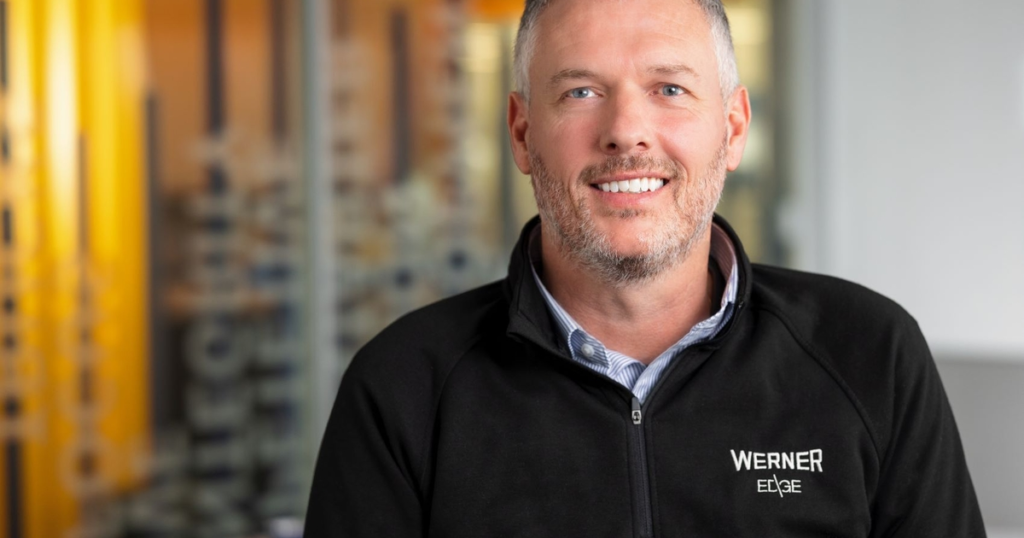
One way to see a new country is to become a professional truck driver. Werner Enterprises EVP and CIO Daragh Mahon did just that when he immigrated from Ireland to the US. After about nine months, he wanted to find something different and decided to leverage his prior inventory management experience to embark on a new career. “I went to work for a company called PeachTree Software as an inventory control manager, but literally everything was considered inventory management — unloading trucks, shipping stuff, running returns. Over the first couple of months, I realized that nothing was automated. It was all spreadsheets at the time,” says Mahon. “I started learning how to code, and I started to write some applications, but I got fed up. I thought, ‘This is just pointless. Why should I build this if I can buy it?’ so I negotiated a deal with Manhattan Associates for a shipping and warehouse management system and signed a contract I had no authority to sign.” While he wasn’t fired for overstepping his role, the CFO, Teri McEvily, reminded him that he’d violated company policy and that the software ‘better work’ or he would be fired for sure. Mahon worked closely with IT and together they helped Manhattan Associates develop one of their first high-volume shipping systems. Over the next couple of years, he continued to help IT in the afternoon or evenings, after working full-time in the warehouse. Related:Digital Transformation Is a Golden Opportunity for RGP When PeachTree was acquired by Sage Group in 1999, the IT department was doing an SAP implementation. McEvily was tasked with running the SAP implementation for North America and subsequently globally. She asked Mahon to help with the implementation since he was a supply chain expert. “I volunteered for and moved into the data migration area, because it wasn’t working and nobody had any data migration experience, nor did I. [Nevertheless,] Teri told me to make it work because it was a mess,” says Mahon. “So, I gathered a bunch of SQL and data guys, we sat down and figured it out. Suddenly, we were doing things with SAP data services that Deloitte and SAP probably didn’t know you could do. I started gradually doing all sorts of SAP work. Wherever there was a need, I filled it, such as running security on the platform. The more I got stuck with technical problems, the more I enjoyed it. I love chaos.” Meanwhile, his job scope expanded to managing the relationship between the business teams and the service desk and infrastructure. In fact, Mahon and the Sage team virtualized the SAP environment, which was an industry first. When they told SAP what they were doing, they expressly told him not to do it on the grounds that it wouldn’t work. Related:What a CIO Needs to Do Today to Prepare for Quantum Computing “We installed SAP on virtual servers in a data center, and SAP told us not to do it, but we couldn’t figure out why we shouldn’t do it [because] it would save us a ton of money [and] effort. It worked just fine,” says Mahon. “Over the coming years, I started to work with SaaS platforms Salesforce and Zuora, and that’s kind of what brought me to my build versus buy mentality. This was at the beginning of our move to the cloud, which the CIO spearheaded. We were early adopters, and I just felt it was the wave of the future. As we came out of the SAP implementations, I got involved in business analysis and I remember going to Teri one day and saying, ‘You know, I’m kind of pissed off. I’ve become a jack of all trades and a master of none, when others in the organization own a specific piece of the IT world.” McEvily told Mahon he was looking at it the wrong way. The reason he found himself in this situation was because he was the only guy she and others could trust to fix problems. (In fact, his favorite award of all was the one given after the 10-year SAP implementation. All the approximately 200 people involved in the deployment nominated Mahon for the award, “Who to call when the **it hits the fan.”) Related:IT Leadership Takes on AGI Mahon spent just over 20 years at Sage Group, rising through the ranks to director of IT and finally senior director, IT & business applications. After that, he held several positions at Vonage, from director of business services to ultimately senior vice president – global and IT business applications before joining Werner as EVP and CIO in 2020. “As I moved on into director, VP, and senior VP, and CIO roles, I realized that all of that being kicked around the place, going from one area to another, one problem to another and one **it storm to another was actually a good thing,” says Mahon. “It meant I had cybersecurity and infrastructure knowledge. I ran development teams and the service desk. I worked with all the different business units as well: marketing, sales, contact center, accounting, finance, HR, you name it. So, when I sit down and have an IT conversation with anyone, I’ve been there and done [what they do] to a certain extent.” Important Lessons Learned Along the Way Planning is considered critical in business to keep an organization moving forward in a predictable way, but Mahon doesn’t believe in the traditional annual and long-term planning in which lots of time is invested in creating the perfect plan which is then executed. “Never get too engaged in planning. You have a plan, but it’s pretty broad and open-ended. The North Star is very fuzzy, and it never gets to be a pinpoint [because] you need to focus on all the stuff that’s going on around you,” says Mahon. “You should know exactly what you’re going to do in the next two to three months. From three to six months out, you have a really
IT Leadership Means More Change Management Read More »