VentureBeat

OpenAI updates ChatGPT Search with voice queries, faster results, mobile maps integration

Join our daily and weekly newsletters for the latest updates and exclusive content on industry-leading AI coverage. Learn More On the eighth day of Christmas…er, the eighth day of “12 Days of OpenAI” (a series of holiday-themed announcements from the company behind ChatGPT), OpenAI took to its now-familiar livestream on YouTube to announce a series of search-related updates for its signature AI chatbot. Specifically, OpenAI just unveiled three major updates to its web search experience within ChatGPT, which was officially rolled out back in October 2024 after running as a separate, invitation-only preview website called SearchGPT for several months prior. Here’s what’s changed: ChatGPT Search is now available to all users globally, even free users — when logged in. You’ll need to create a free account to get it, but once you do, you can click on a tiny globe icon in the bottom of the “compose” bar to activate it and get updated information live from the web in your responses, as opposed to before, when it was only available to paid subscribers on the ChatGPT Plus and above (Pro, Edu, Team, Enterprise) plans. OpenAI has updated the search results experience in ChatGPT so that prominent links to webpages such as Netflix’s or travel booking websites will appear before the rest of the generated, text-based answers written by the chatbot. Arguably the most impressive and biggest update is that users can now search by voice queries when they have Advanced Voice Mode activated (turn it on by pressing the audio waveform button in the compose bar at the bottom, which looks like a series of parallel vertical lines). This allows a user to ask for up-to-date information on travel destinations, the latest weather forecasts, and even ideas for activities (as well as, presumably, well, anything else in the world that’s not sexually explicit — ChatGPT Search doesn’t offer that functionality). ChatGPT’s Voice Assistant will respond in the voice you’ve selected for it to use among the 10 pre-set voice style options. Also part of the second update: OpenAI has made it so that the ChatGPT mobile apps for iOS and Android devices now integrate with those platforms’ respective maps, so that if you search for restaurants nearby, it will use the system map app on your device (Apple Maps or Google Maps, respectively) to show the list of results. Altogether, it was a series of useful if not blockbuster improvements, and should help ChatGPT users on-the-go most of all. Already, OpenAI’s presenters teased that tomorrow, on the ninth day of 12 Days of OpenAI, there will be news to share for third-party developers building atop OpenAI’s platform and application programming interfaces (APIs). Stay tuned, and we’ll keep you posted on the latest. source

OpenAI updates ChatGPT Search with voice queries, faster results, mobile maps integration Read More »

​​IBM wants to be the enterprise LLM king with its new open-source Granite 3.1 models

Join our daily and weekly newsletters for the latest updates and exclusive content on industry-leading AI coverage. Learn More IBM is staking its claim at the top of the open-source AI leaderboard with its new Granite 3.1 series out today. The Granite 3.1 large language models (LLMs) offer enterprise users extended context length of 128K tokens, new embedding models, integrated hallucination detection and improved performance. According to IBM, the new Granite 8B Instruct model tops open-source rivals of the same size including Meta Llama 3.1, Qwen 2.5 and Google Gemma 2. IBM ranked its models across a series of academic benchmarks included in the OpenLLM Leaderboard.  The new models are part of the accelerated release cadence of IBM’s Granite open-source models. Granite 3.0 was just released in October. At the time, IBM claimed that it has a $2 billion book of business related to generative AI. With the Granite 3.1 update, IBM is focusing on packing more capability into smaller models. The basic idea is that smaller models are easier for enterprises to run and are more cost-efficient to operate. “We’ve also just boosted all the numbers — all the performance of pretty much everything across the board has improved,” David Cox, VP for AI models at IBM Research, told VentureBeat. “We use Granite for many different use cases, we use it internally at IBM for our products, we use it for consulting, we make it available to our customers and we release it as open source, so we have to be kind of good at everything.” Why performance and smaller models matter for enterprise AI There are any number of ways an enterprise can evaluate the performance of an LLM with benchmarks. The direction that IBM is taking is to run models through a gamut of academic and real-world tests. Cox emphasized that IBM tested and trained its models to be optimized for enterprise use cases. Performance isn’t just about some abstract measure of speed, either; rather, it’s a somewhat more nuanced measure of efficiency. One aspect of efficiency that IBM is aiming to push forward is helping users spend less time to get desired results. “You should spend less time fiddling with prompts,” said Cox. “So, the stronger a model is in an area, the less time you have to spend engineering prompts.” Efficiency is also about model size. The larger a model, the more compute and GPU resources it typically requires, which also means more cost. “When people are doing minimum viable prototype kind of work, they often jump to very large models, so you might go to a 70 billion parameter model or a 405 billion parameter model to build your prototype,” said Cox. “But the reality is that many of those are not economical, so the other thing we’ve been trying to do is drive as much capacity as possible into the smallest package possible.” Context matters for enterprise agentic AI Aside from the promise of improved performance and efficiency, IBM has dramatically expanded Granite’s context length. With the initial Granite 3.0 release, the context length was limited to 4k. In Granite 3.1, IBM has extended  that to 128k, allowing for the processing of much longer documents. The extended context is a significant upgrade for enterprise AI users, both for retrieval-augmented generation (RAG) and for agentic AI. Agentic AI systems and AI agents often need to process and reason over longer sequences of information, such as larger documents, log traces or extended conversations. The increased 128k context length allows these agentic AI systems to have access to more contextual information, enabling them to better understand and respond to complex queries or tasks. IBM is also releasing a series of embedding models to help accelerate the process of converting data into vectors. The Granite-Embedding-30M-English model can achieve performance of 0.16 seconds per query, which IBM claims is faster than rival options including Snowflake’s Arctic. How IBM has improved Granite 3.1 to serve enterprise AI needs So how did IBM manage to improve its performance for Granite 3.1? It wasn’t any one specific thing, but rather a series of process and technical innovations, Cox explained. IBM has developed increasingly advanced multi-stage training pipelines, he said. This has allowed the company to extract more performance from models. Also, a critical part of any LLM training is data. Rather than just focusing on increasing the quantity of training data, IBM has put a strong emphasis on improving the quality of data used to train the Granite models. “It’s not a quantity game,” said Cox. “It’s not like we’re going to go out and get 10 times more data and that’s magically going to make models better.” Reducing hallucination directly in the model A common approach to reducing the risk of hallucinations and errant outputs in LLMs is to use guardrails. Those are typically deployed as external features alongside an LLM. With Granite 3.1, IBM is integrating hallucination protection directly into the model. The Granite Guardian 3.1 8B and 2B models now include a function-calling hallucination detection capability. “The model can natively do its own guardrailing, which can give different opportunities to developers to catch things,” said Cox.  He explained that performing hallucination detection in the model itself optimizes the overall process. Internal detection means fewer inference calls, making the model more efficient and accurate. How enterprises can use Granite 3.1 today, and what’s next The new Granite models are all now freely available as open source to enterprise users. The models are also available via IBM’s Watsonx enterprise AI service and will be integrated into IBM’s commercial products. The company plans on keeping an aggressive pace for updating the Granite models. Looking forward, the plan for Granite 3.2 is to add multimodal functionality that will debut in early 2025.  “You’re gonna see us over the next few point releases, adding more of these kinds of different features that are differentiated, leading up to the stuff that we’ll announce at the IBM Think conference next year,” said Cox. source

​​IBM wants to be the enterprise LLM king with its new open-source Granite 3.1 models Read More »

Coplay raises $1.2M to build AI copilot for game devs

Join our daily and weekly newsletters for the latest updates and exclusive content on industry-leading AI coverage. Learn More Coplay, the AI copilot for game developers, today announced it has raised $1.2 million in pre-seed funding to accelerate its mission of streamlining game development. The goal is to automate repetitive tasks in game engines that bog developers down. The funding round was led by Failup Ventures, with participation from Tower Research Ventures, Founders Inc., Sequoia Scouts and other investors. Currently in closed beta, Coplay is already saving developers up to five hours per week, reducing repetitive tasks in game engines, and unlocking creativity, the company said. Coplay said that, as a game developer, you spend 50% of your time in code and 50% inside the game engine. The problem with game engines is that their deeply nested point-and-click interface leads to tedious repetitive tasks. After seeing the power of large language models (LLMs) for AI and agents, the team realized it could eliminate and automate all of the game engine tedium with AI, the company said in an email to GamesBeat. Jos van der Westhuizen is CEO of Coplay. While the code copilot space includes notable products like Cursor, Codeium, and Bolt, Coplay takes a unique approach by providing a natural language interface for traditionally complex software. Coplay offers a groundbreaking chat interface that empowers game developers to control the Unity game engine, replacing cumbersome nested click interfaces and automating tedious tasks. With Coplay, developers can effortlessly create, assign, optimize, and debug any game objects, assets, and properties in their project—all through natural language commands. Additionally, Coplay integrates with popular 3D and image generation tools, enabling rapid iteration directly within the game engine. One of its standout features is the “record and replay” capability, which replicates repetitive processes to significantly enhance iteration speed. For larger projects with hundreds of assets and tens of thousands of files, Coplay’s automation capabilities streamline workflows, manage live updates, and reduce errors—allowing teams to focus on creativity and deliver exceptional gaming experiences. Coplay has attracted over 400 developers across 22 studios on its waitlist, and plans to expand its integrations to additional game engines. Joned Sarwar is cofounder of Coplay. Jos van der Westhuizen, CEO of Coplay, said in a statement, “Our vision is to empower game developers by automating tedious tasks, allowing them to focus on crafting amazing experiences. With this funding, we’re not just building a tool—we’re creating an AI partner that fundamentally transforms how games are made. We believe this innovative approach positions Coplay as more than just a developer copilot; it’s a pioneering step toward redefining the future interface for all software.” The Coplay founding team brings a wealth of expertise to their mission. Jos van der Westhuizen, who has a doctorate in AI from Cambridge University, has scaled a tech startup to 1.5 million users. Marcus Sanatan is cofounder of Coplay. Coplay cofounders Joned Sarwar (cofounder of AI analytics startup Alchera) and Marcus Sanatan, (organizer of the largest game jam in the Caribbean), together have over a decade of experience building scalable systems and developing more than 30 games. Their combined expertise uniquely equips them to tackle the biggest challenges in game development. Jesse Heikkilä at Failup Ventures said in a statement, “Many AI solutions in the gaming space, like assetgenerators or NPC enhancers, feel like point solutions rather than holistic transformations. What excites me about Coplay is its ground-up approach — a fresh take on the game engine itself. I believe the games industry will be democratized by a technology company that can make the entire game development process accessible through natural language. When I came across Coplay, it was clear that their vision perfectly aligned with this thesis.” Jared Young at Tower Research Ventures said in a statement, “The video game market is growing rapidlyworldwide, yet game development is long overdue for disruption. Coplay’s AI solution addresses a universal pain point for developers, offering a transformative tool that has the potential to become a must-have for studios. With a team that brings deep expertise and a truly innovative approach, Coplay is well positioned to capitalize on this significant growth opportunity in the industry.” Game developers are invited to join Coplay’s closed beta waitlist to be among the first to experience the future of game development. Founded by Jos van der Westhuizen, Joned Sarwar, and Marcus Sanatan, the San Francisco-based team brings over a decade of experience in scalable systems and game development. There are four people in the company. source

Coplay raises $1.2M to build AI copilot for game devs Read More »

AI filmmakers take note! Runway launches talent platform to meet, greet, and get hired

Join our daily and weekly newsletters for the latest updates and exclusive content on industry-leading AI coverage. Learn More As Google and OpenAI continue to crank up the video generation space with their respective AI models, Runway, another notable player in the category, is moving to expand the reach of these advanced systems. Today, the New York-based company announced a new talent network that helps brands, agencies and studios hire AI filmmakers. Starting today, global creatives, artists and companies specializing in AI video tools — such as those from Runway — will be able to use the network to showcase their work and connect with folks searching for talent in the industry. The platform is already home to dozens of independent AI artists, specializing in different areas, as well as production houses.  The move delivers dual benefits. First, it acts as a much-needed bridge to help companies that are looking to accelerate their creative workflows with AI discover and hire the right AI video talent for their needs. Secondly, it also gives Runway a way to accelerate the adoption of its video models in enterprises’ creative workflows. The company itself notes that many of the members in the talent network come from its own Creative Partner Program, where they have exclusive access to new Runway tools and AI models. What to expect from the Runway Talent Network Even though generating an AI video is a piece of cake today, organizations are very well aware that most tools out there are still not good enough to replace the depth and authenticity of human-directed video projects. The tools do help automate several aspects of the creative workflow and drive efficiencies, but one still needs to have experts who can put the models to best use and turn the AI clips into high-quality, production-grade content.  This essentially means hiring professionals — from creative directors and artists to colorists and video editors — who specialize in AI video tools and can quickly use them to conceptualize what organizations want, generate pre-production clips in different styles (in line with the concept), and then stitch everything together with sounds and other elements to prepare the final video/film.  So far, finding this kind of talent has proven a challenge, with teams having a hard time integrating AI into their project workflows. “With tens of millions of users and many thousands of companies now using Runway, we consistently heard that one of the most recurrent needs was finding new talent and professionals to help integrate AI into diverse workflows — from concepting and pre-production to final frames,” Runway noted in a blog post. To bridge this gap, the company has introduced the Runway Talent Network, which allows independent creatives, artists and production companies to showcase their work with AI video tools and get discovered by potential brands, agencies and studios looking for talent to produce content for movies, TV shows, advertisements or even games. Runway Talent Network The platform already has dozens of members, including those who are a part of Runway’s Creative Partner Program and have exclusive access to the company’s latest AI models and tools. A number of these members are also early adopters of video AI and are pioneering new workflows within their industries, Runway added. Production companies currently in the network include Tool, Builders Club, Silverside, Obsidian, Zukunft, [AI]imagination, and Harmony Korine’s digital IP-based studio EDGLRD. More members to be added soon As the network has just been announced, it is fair to say that the list of members showcasing their AI work will only grow in the coming weeks. Runway has already set up a Google form with a set of questions to bring more artists and production companies onboard. However, the company notes that it may not be able to respond to every submission due to high volumes. Notably, Runway will also launch a separate job board, where agencies and brands hiring for AI-skilled talent will be able to post job listings with their requirements, inviting potential candidates to apply. It remains unclear when that will go live. source

AI filmmakers take note! Runway launches talent platform to meet, greet, and get hired Read More »

Google debuts new AI video generator Veo 2 claiming better audience scores than Sora

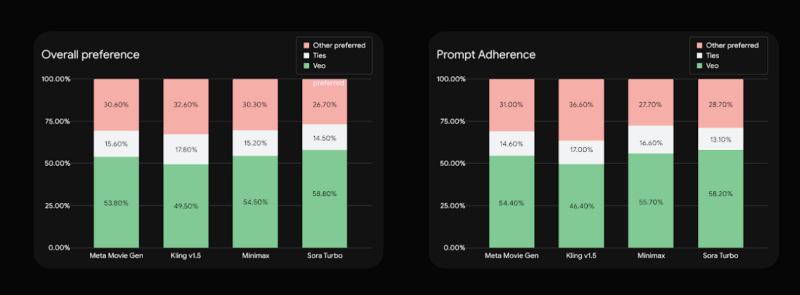
Join our daily and weekly newsletters for the latest updates and exclusive content on industry-leading AI coverage. Learn More Google is going head to head against OpenAI’s Sora with the newest version of its video generation model, Veo 2, which it says makes more realistic-looking videos. The company also updated its image generation model Imagen 3 to produce richer, more detailed photos.  Google said Veo 2 has “a better understanding of real-world physics and the nuances of human movement and expression.” It is available on Google Labs’ VideoFX platform — but only on a waitlisted basis. Users will need to sign up through a Google Form and wait for access to be granted provisionally by Google at a time of its choosing. “Veo 2 also understands the language of cinematography: Ask it for a genre, specify a lens, suggest cinematic effects and Veo 2 will deliver — at resolutions up to 4K,” Google said in a blog post.  Video generated with Veo 2 While Veo 2 is available only to select users, the original Veo remains available on Vertex AI. Videos created with Veo 2 will contain Google’s metadata watermark SynthID to identify these as AI-generated.  Google admits, though, that Veo 2 may still hallucinate extra fingers and the like, but it promises the new model produces fewer hallucinations.   Veo 2 will compete against OpenAI’s recently released Sora video generation model to attract filmmakers and content creators. Sora had been in previews for a while before OpenAI made it available to paying subscribers.  Impressively, Google says that on its own internal tests gauging “overall preference” (i.e. which videos an audience liked better) and “prompt adherence” (how well the videos matched the instructions given by the human creator), Veo was preferred by human evaluators to Sora and other rival AI models. Google announced Veo in May of this year during its Google I/O developer conference with a video made in partnership with actor-musician Donald Glover, aka Childish Gambino. AI video generation still needs some work AI video generation has long been an area of generative AI in which big model developers, like Google and OpenAI, regularly compete with and catch up with relatively smaller companies.  RunwayML, one of the pioneers of AI video generation, recently launched advanced controls for its Gen-3 Alpha Turbo model. Pika Labs released Pika 2.0, giving users more control and enabling them to add their own characters to a video. Luma AI announced a partnership with AWS to bring its models to Bedrock for enterprise use. Luma also expanded its Dream Machine generation model. However, AI video generation still needs to convince both creators and viewers. After Sora’s long-anticipated release, people remained skeptical of its capabilities when it continued to generate physics and anatomy-defying figures. Users felt it gave inconsistent results.  A trailer from the recent Game Awards also showed people’s distrust of what they perceive as “AI slop.”  Some filmmakers, though, have begun to embrace the possibilities AI video generators can provide. Famed director James Cameron joined the board of Stability AI, while actor Andy Serkis announced he was building an AI-focused production company.  Google said it’s seeing interest from many users. The company said YouTube creators have been using VideoFX to make backgrounds for YouTube Shorts to save time.  Updates to Imagen 3 Google also updated its image model Imagen 3, which it recently made available through its Gemini chatbot on the web, to be more realistic and offer brighter images.  Imagen 3 can now render more art styles accurately, “from photorealism to impressionism, from abstract to anime.” Google said the model will also follow prompts more faithfully.  People can access Imagen 3 through ImageFX. source

Google debuts new AI video generator Veo 2 claiming better audience scores than Sora Read More »

See how Google Gemini 2.0 Flash can perform hours of business analysis in minutes

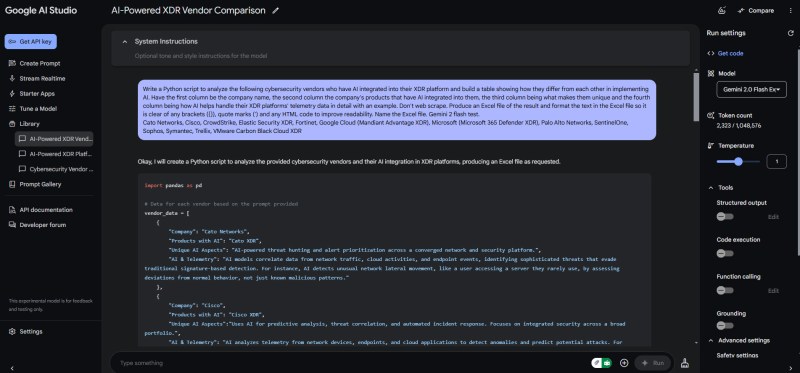
Join our daily and weekly newsletters for the latest updates and exclusive content on industry-leading AI coverage. Learn More Anyone who has had a job that required intensive amounts of analysis will tell you that any speed gain they can find is like getting an extra 30, 60, or 90 minutes back out of their day. Automation tools in general, and AI tools specifically, can assist business analysts who need to crunch massive amounts of data and succinctly communicate it. In fact, a recent Gartner analysis, “An AI-First Strategy Leads to Increasing Returns,” states that the most advanced enterprises rely on AI to increase the accuracy, speed, and scale of analytical work to fuel three core objectives — business growth, customer success, and cost efficiency — with competitive intelligence being core to each. Google’s newly released Gemini 2.0 Flash provides business analysts with greater speed and flexibility in defining Python scripts for complex analysis, giving analysts more precise control over the results they generate. Google claims that Gemini 2.0 Flash builds on the success of 1.5 Flash, its most adopted model yet for developers. Gemini 2.0 Flash outperforms 1.5 Pro on key benchmarks, delivering twice the speed, according to Google. 2.0 Flash also supports multimodal inputs, including images, video, and audio, as well as multimodal output, including natively generated images mixed with text and steerable text-to-speech (TTS) multilingual audio. It can also natively call tools like Google Search, code execution, and third-party user-defined functions. Taking Gemini 2.0 Flash for a test drive VentureBeat gave Gemini 2.0 Flash a series of increasingly complex Python scripting requests to test its speed, accuracy, and precision in dealing with the nuances of the cybersecurity market. Using Google AI Studio to access the model, VentureBeat started with simple scripting requests, working up to more complex ones centered on the cybersecurity market. What’s immediately noticeable about Python scripting with Gemini 2.0 Flash is how fast it is — nearly instantaneous, in fact — at providing Python scripts, generating them in seconds. It’s noticeably faster than 1.5 Pro, Claude, and ChatGPT when handling increasingly complex prompts. VentureBeat asked Gemini 2.0 Flash to perform a typical task that a business or market analyst would be requested to do: Create a matrix comparing a series of vendors and analyze how AI is used across each company’s products. Analysts often have to create tables quickly in response to sales, marketing, or strategic planning requests, and they usually need to include unique advantages or insights into each company. This can take hours and even days to get done manually, depending on an analyst’s experience and knowledge. VentureBeat wanted to make the prompt request realistic by having the script encompass an analysis of 13 XDR vendors, also providing insights into how AI helps the listed vendors handle telemetry data. As is the case with many requests analysts receive, VentureBeat asked Python to produce an Excel file of the results. Here is the prompt we gave Gemini 2.0 Flash to execute: Write a Python script to analyze the following cybersecurity vendors who have AI integrated into their XDR platform and build a table showing how they differ from each other in implementing AI. Have the first column be the company name, the second column the company’s products that have AI integrated into them, the third column being what makes them unique and the fourth column being how AI helps handle their XDR platforms’ telemetry data in detail with an example. Don’t web scrape. Produce an Excel file of the result and format the text in the Excel file so it is clear of any brackets ({}), quote marks (‘) and any HTML code to improve readability. Name the Excel file. Gemini 2 flash test.Cato Networks, Cisco, CrowdStrike, Elastic Security XDR, Fortinet, Google Cloud (Mandiant Advantage XDR), Microsoft (Microsoft 365 Defender XDR), Palo Alto Networks, SentinelOne, Sophos, Symantec, Trellix, VMware Carbon Black Cloud XDR Using Google AI Studio, VentureBeat created the following AI-powered XDR Vendor Comparison Python scripting request, with Python code produced in seconds: Next, VentureBeat saved the code and loaded it into Google Colab. The goal in doing this was to see how bug-free the Python code was outside of Google AI Studio and also measure its speed of being compiled. The code ran flawlessly with no errors and produced the Microsoft Excel file Gemini_2_flash_test.xlsx. The results speak for themselves Within seconds, the script ran, and Colab signaled no errors. It also provided a message at the end of the script that the Excel file was done. VentureBeat downloaded the Excel file and found it had been finished in less than two seconds. The following is a formatted view of the Excel table where the Python script was delivered. The total time needed to get this table done was less than four minutes, from submitting the prompt, getting the Python script, running it in Colab, downloading the Excel file, and doing some quick formatting. A convincing argument to unleash AI on monotonous tasks For the many professionals who have worked in a variety of business, competitive, and market analyst roles in their careers, AI is the force multiplier they’ve been looking for to trim hours off of repetitive, monotonous tasks. Analysts, by nature, have a high degree of intellectual curiosity. Unleashing AI on the most mundane and repetitive parts of their jobs and equipping them to create the comparisons and matrices they are often asked to develop quickly is a powerful boost to an entire team’s productivity. Managers and leaders of business, competitive analysis, and marketing teams need to consider how the fast advances in models, including Google’s Gemini 2.0 Flash, can help their teams get growing workloads under control. Helping lift that burden will give analysts a chance to do what they enjoy and do best, which is to use their intuition, intelligence, and insight to deliver exceptionally valuable ideas. source

See how Google Gemini 2.0 Flash can perform hours of business analysis in minutes Read More »

MidJourney adds Pinterest-like ‘moodboards’ and support for multiple custom AI image models

Join our daily and weekly newsletters for the latest updates and exclusive content on industry-leading AI coverage. Learn More MidJourney, the popular AI image generator with more than 19 million users (including several of us at VentureBeat), has introduced new features to enhance user customization. Today, the small company launched Pinterest-inspired “moodboards” and support for multiple personalization profiles — meaning users can now create and switch among multiple custom versions of Midjourney’s latest image generator AI model, version 6.1, that are tailored to their unique aesthetics. The updates aim to streamline the creative process for individuals and teams, making it easier to integrate personalized styles across various projects. What are Midjourney’s new moodboards? The standout feature, moodboards, enables users to upload curated collections of images that act as inspiration for generating new art. The AI model adapts to the diversity and complexity of the uploaded images, creating a unique style profile that remixes the visual elements. This addition is complemented by the ability to create multiple personalization profiles, allowing users to organize and deploy their different styles seamlessly. Setting up a custom model has also become significantly faster, with the company claiming a fivefold improvement in image ranking speed. The “ranking” system is how Midjourney trains a custom model on behalf of you, the user. You need to navigate to Midjourney’s image ranker and pick which of a pair of random images you like best, then continue rating pairs of images until you’ve reached a certain threshold where the model understands what kinds of images and aesthetics you like. Users now need just 40 ratings to begin creating a profile, with optimal stability achieved at 200. Previously, you needed 200 to personalize the model. While heavy users may still prefer contributing thousands of ratings for maximum precision, the streamlined process lowers the barrier to entry for new users. Users can begin rating pairs of images at midjourney.com/personalize. Better organization features The updates also introduce organizational improvements. Users can now name their profiles, designate one or multiple profiles as defaults, and track all images associated with specific profiles. Midjourney emphasizes that these features are particularly beneficial for those juggling multiple projects or collaborating with others. David Holz, founder of Midjourney, shared the announcement on the company’s Discord server earlier today. He explained the motivation behind the updates, expressing a desire to make personalization accessible for a broader range of creative workflows. Holz highlighted that the new tools allow users to take control of their projects while maintaining the flexibility to work with diverse creative teams. As Midjourney continues to refine its personalization infrastructure, the company is soliciting user feedback through its “ideas-and-features” channel. These developments highlight the platform’s commitment to empowering creators with tools that are both intuitive and powerful, marking another step forward in the evolution of AI-assisted creativity. The additions come as expected following Midjourney’s announcement last week of an experimental new collaborative image-making whiteboard feature called Patchwork. source

MidJourney adds Pinterest-like ‘moodboards’ and support for multiple custom AI image models Read More »

Cohere’s smallest, fastest R-series model excels at RAG, reasoning in 23 languages

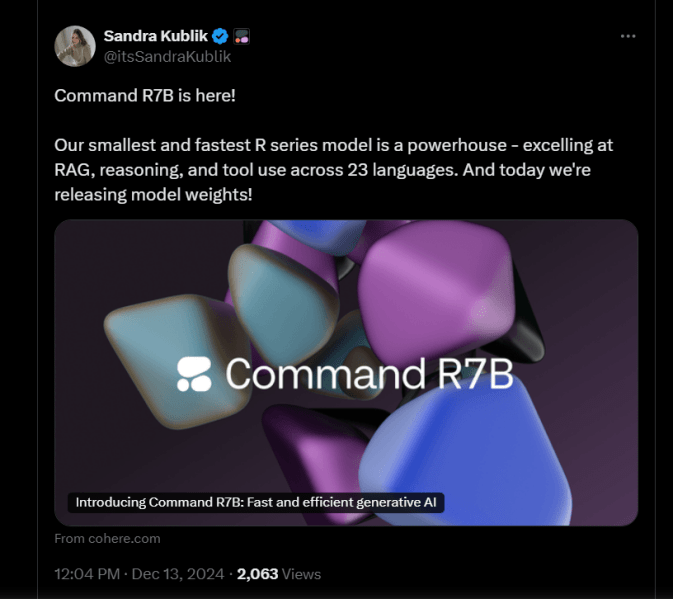
Join our daily and weekly newsletters for the latest updates and exclusive content on industry-leading AI coverage. Learn More Proving its intention to support a wide range of enterprise use cases — including those that don’t require expensive, resource-intensive large language models (LLMs) — AI startup Cohere has released Command R7B, the smallest and fastest in its R model series.  Command R7B is built to support fast prototyping and iteration and uses retrieval-augmented generation (RAG) to improve its accuracy. The model features a context length of 128K and supports 23 languages. It outperforms others in its class of open-weights models — Google’s Gemma, Meta’s Llama, Mistral’s Ministral — in tasks including math and coding, Cohere says. “The model is designed for developers and businesses that need to optimize for the speed, cost-performance and compute resources of their use cases,” Cohere cofounder and CEO Aidan Gomez wrote in a blog post announcing the new model. Outperforming competitors in math, coding, RAG Cohere has been focused on enterprises and their unique use cases. The company introduced Command R in March and the powerful Command R+ in April, and has made upgrades throughout the year to support speed and efficiency. It teased Command R7B as the “final” model in its R series, and said it will release model weights to the AI research community. Cohere noted that a critical area of focus when developing Command R7B was to improve performance on math, reasoning, code and translation. The company appears to have succeeded in those areas, with the new smaller model topping the HuggingFace Open LLM Leaderboard against similarly-sized open-weight models including Gemma 2 9B, Ministral 8B and Llama 3.1 8B.  Further, the smallest model in the R series outperforms competing models in areas including AI agents, tool use and RAG, which helps improve accuracy by grounding model outputs in external data. Cohere said Command R7B excels at conversational tasks including tech workplace and enterprise risk management (ERM) assistance; technical facts; media workplace and customer service support; HR FAQs; and summarization. Cohere also stated that the model is “exceptionally good” at retrieving and manipulating numerical information in financial settings. All told, Command R7B ranked first, on average, in important benchmarks including instruction-following evaluation (IFeval); big bench hard (BBH); graduate-level Google-proof Q&A (GPQA); multi-step soft reasoning (MuSR); and massive multitask language understanding (MMLU).  Removing unnecessary call functions Command R7B can use tools including search engines, APIs and vector databases to expand its functionality. Cohere reports that the model’s tool use performs strongly against competitors in the Berkeley Function-Calling Leaderboard, which evaluates a model’s accuracy in function calling (connecting to external data and systems).  Gomez pointed out that this proves the model’s effectiveness in “real-world, diverse and dynamic environments” and removes the need for unnecessary call functions. This can make it a good choice for building “fast and capable” AI agents. For instance, Cohere pointed out, when functioning as an internet-augmented search agent, Command R7B can break complex questions down into subgoals, while also performing well at advanced reasoning and information retrieval. Because it is small, Command R7B can be deployed on lower-end and consumer CPUs, GPUs and MacBooks, allowing for on-device inference. The model is available now on the Cohere platform and HuggingFace. Pricing is $0.0375 per one million input tokens and $0.15 per one million output tokens. “It is an ideal choice for enterprises looking for a cost-efficient model grounded in their internal documents and data,” wrote Gomez.  source

Cohere’s smallest, fastest R-series model excels at RAG, reasoning in 23 languages Read More »

The future of AI regulation is up in the air: What’s your next move?

AI regulation has always been a hot topic. But with AI guardrails set to be dismantled by the incoming U.S. administration, regulation has also become a big question mark. It’s more complexity and a great deal more volatility for an already complicated compliance landscape. The VentureBeat AI Impact Tour, in partnership with Capgemini, stopped in Washington D.C. to talk about the evolving risks and surprising new opportunities the upcoming regulatory environment will bring — plus insights into navigating the new, uncertain normal. VB CEO Matt Marshall spoke with Vall Hérard, SVP, Fidelity Labs and Xuning (Mike) Tang, senior director of AI/ML engineering at Verizon, about the significant and growing challenges of AI regulation in financial services and telecom, and dug into issues of risk management, the threat of accountability and more with Steve Jones, EVP of data-driven business and generative AI at Capgemini. Accountability is a moving target The problem, Jones says, is that lack of regulations boils down to a lack of accountability, when it comes to what your large language models are doing — and that includes hoovering up intellectual property. Without regulations and legal ramifications, resolving issues of IP theft will either boil down to court cases, or more likely, especially in cases where the LLM belongs to a company with deep pockets, the responsibility will slide downhill to the end users. And when profitability outweighs the risk of a financial hit, some companies are going to push the boundaries. “I think it’s fair to say that the courts aren’t enough, and the fact is that people are going to have to poison their public content to avoid losing their IP,” Jones says. “And it’s sad that it’s going to have to get there, but it’s absolutely going to have to get there if the risk is, you put it on the internet, suddenly somebody’s just ripped off your entire catalog and they’re off selling it directly as well.” Nailing down the accountability piece In the real world, unregulated AI companionship apps have led to genuine tragedies, like the suicide of the 14-year-old-boy who isolated himself from friends and family in favor of his chatbot companion. How can product liability come to bear in cases like these, to prevent it from happening to another user, if regulations are deprecated even further? “These massive weapons of mass destruction, from an AI perspective, they’re phenomenally powerful things. There should be accountability for the control of them,” Jones says. “What it will take to put that accountability onto the companies that create the products, I believe firmly that that’s only going to happen if there’s an impetus for it.” For instance, the family of the child is pursuing legal action against the chatbot company, which has now imposed new safety and auto moderation policies on its platform. Risk management in a regulation-light world Today’s AI strategy will need to revolve around risk management, understanding the risk you’re exposing your business to, and staying in control of it. There’s not a lot of outrage around the issue of potential data exposure, Jones adds, because from a business perspective, the real outrage is how an AI slip-up might impact public perception, and the threat of a court case, whether it involves human lives or bottom lines. “The outrage piece is if I put a hallucination out to a customer, that makes my brand look terrible,” Jones says. “But am I going to get sued? Am I putting out invalid content? Am I putting out content that makes it look like I’ve ripped off my competition? So I’m less worried about the outrage. I’m more worried about giving lawyers business.” Taking the L out of LLM Keeping models as small as possible will be another critical strategy, he adds. LLMs are powerful, and can accomplish some stunning tasks. But does an enterprise need its LLM to play chess, speak Klingon, or write epic poetry? The larger the model, the bigger the potential for privacy issues, and the more potential threat vectors, Tang noted earlier. Verizon has a huge volume of internal information in its traffic data, and a model that encapsulates all of that information would be massive, and a privacy risk, and so Verizon aims to use the smallest model that delivers the best results. Smaller models, made to handle specific, narrowly defined tasks, are also a key way to reduce or eliminate hallucinations, Hérard said. It’s easier to control compliance that way, when the data set used to train the model is a size where a full compliance review is possible.   “What’s amazing is how often, in enterprise use cases, understanding my business problem, understanding my data, that small model delivers a phenomenal set of results,” Jones says. “Then combine it with fine tuning to do just what I want, and reduce my risk even more.” source

The future of AI regulation is up in the air: What’s your next move? Read More »

Slack’s AI agents are learning from your office chats—here’s what’s next

Join our daily and weekly newsletters for the latest updates and exclusive content on industry-leading AI coverage. Learn More Slack will deeply integrate Salesforce’s Agentforce AI agents into its workplace collaboration platform, emphasizing contextual intelligence as the key differentiator in the increasingly crowded AI agent market. “There’s so much of your organization’s knowledge context [there]…Slack’s channels typically reflect your organization’s structure, but also your priorities for that given moment,” said Rob Seaman, Slack’s chief product officer, in an exclusive interview with VentureBeat. “That is just such rich context for agents to be able to answer questions and reason through whether or not they need to be able to take action.” Why context matters for enterprise AI The integration, part of Salesforce’s Agentforce 2.0 launch scheduled for tomorrow, December 17, aims to make AI agents more effective by giving them access to the vast troves of conversational and organizational data that flow through Slack’s channels daily. Seaman outlined three critical capabilities that define these next-generation AI agents: comprehensive contextual knowledge, reasoning ability, and action-taking power. What sets Slack’s implementation apart is its unique position as what Seaman calls a “searchable log of all communication and knowledge” — effectively making it the central nervous system of modern enterprises. Inside Slack’s new AI agent library The platform will introduce a library of customizable AI agents that can perform various tasks, from onboarding new employees to managing complex cross-functional projects. “You’ll see the library of agents in Slack. And it’s pretty magical to see humans and agents together, and to think of this world where humans continue to work with humans, but agents are there as part of the team,” Seaman explained. A key focus is user trust, and another is data governance. Seaman emphasized that all agents will operate with “user context,” meaning they can only access information that the user has permission to see. “Our goal ultimately is to honor user context for every system that an agent and a person [have] interacted with,” he said. The platform includes robust safeguards through what Salesforce calls a “trust layer,” which handles sensitive information appropriately and ensures compliance with business rules. Users can test agents in real time and observe their decision-making processes through a transparent builder interface. How AI agents could transform enterprise software For enterprises struggling with fragmented software stacks, this integration could signal a shift in how organizations approach their technology infrastructure. While Seaman avoided specific predictions about which tools might become obsolete, he suggested that many manual processes currently “spaghetti-ed across numerous systems” could be streamlined through these contextually-aware agents. One concrete example Seaman highlighted was employee onboarding: “Taking you from new hire to productive, is something that the company cares about, and it’s also, from an end-user perspective, it’s kind of a lonely, scary experience in your first several months as you’re trying to find your way.” The race for enterprise AI dominance The integration represents a strategic move by both Slack and Salesforce to position themselves at the forefront of the enterprise AI revolution. While companies like Anthropic and OpenAI have launched their own AI agents, Slack’s deep integration with enterprise workflows and access to organizational context could provide a significant competitive advantage. The development comes at a crucial time as organizations grapple with how to effectively implement AI tools while maintaining security and trust. With this launch, Slack and Salesforce are betting that contextually-aware AI agents, deeply integrated into existing workflows, will prove more valuable than standalone AI solutions. The question remains whether enterprises will embrace this vision of AI agents as team members, but with Slack’s widespread adoption in modern workplaces, the platform is well-positioned to drive this transformation. As Seaman notes, “We’re pretty lucky, frankly, that we’re in this moment, and we have a lot of the primitives that are required to make this possible.” source

Slack’s AI agents are learning from your office chats—here’s what’s next Read More »