CFA Institute

Concerned About Market Concentration and Lofty Valuations? Consider Small Caps

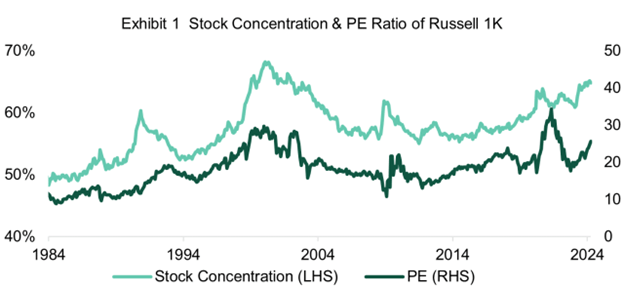
If you are wringing your hands over large-cap stocks due to high market concentration and lofty valuations, allocating to small-cap stocks may give you some peace of mind. Beyond concentration and valuation considerations, there are several good reasons why this is a good time to consider adding small caps to your portfolio. As the US stock market reached all-time highs in June, market concentration among large-cap stocks also approached levels not seen since the Tech Bubble. The top 10% of names account for about 66% of the total market cap of the Russel 1000 Index as of May 31. Stock market valuations of the Russell 1000 Index, which represents the top 1,000 US companies by market capitalization, also appear elevated. The index’s price-to-earnings (PE) ratio of 25.6 in May is in the 92nd percentile for the ratio since its launch. Source: FactSet, Bloomberg, NTAM Global Asset Allocation Quantitative Research. Data is from 1/1980 to 5/2024. Stock concentration is the percentage of total market cap by top 10% largest companies in Russell 1000 Index.  More Attractive Fundamentals After decades of technological advancement, tech sectors like Information Technology and Communication Services now represent more than 38% of the total weight of the Russell 1000 Index. The valuations of mega-cap firms within these sectors have been buoyant, driven by high growth expectations. In contrast, the distribution of sector weights and PE ratios of the constituents in the Russell 2000 Index (2,000 small-cap companies) are more moderate and normalized, as depicted in Exhibit 2. Source: FactSet, Bloomberg, NTAM Global Asset Allocation Quantitative Research. As of May 31, 2024. Relative to their own history, small-cap stocks are trading at a big discount to large-cap stocks. Exhibit 3 shows the forward PE ratios of the Russell 2000 Index over the Russell 1000 Index since 1990. As of May 31, the forward PE ratios of small caps over large caps was 73%, which indicates small caps are currently trading at a 27% valuation discount to large-cap stocks. Such a low valuation discount ratio is ranked at the 18th percentile over the last 35 years. Source: FactSet, Bloomberg, NTAM Global Asset Allocation Quantitative Research. Data is from 3/1990 to 5/2024.  Exclude stocks with negative earnings.  The valuation ratios between small caps and large caps have predictive power over their future relative performances. In Exhibit 4, we created a scattered plot between forward PE ratios and the forward 10-year return spread of small minus large cap stocks. The trend line slope is -0.11. The negative slope, or beta coefficient, indicates that cheaper relative valuations can lead to better small-cap performance. Relative valuation explains 60% of the total variance of the 10-year forward return spread. Given current historically low valuations, we expect small caps will outperform large caps over the next 10 years. Source: FactSet, Bloomberg, NTAM Global Asset Allocation Quantitative Research. Data is from 3/1990 to 5/2024. Forward PE excludes stocks with negative earnings. Small Caps do Better When Economy Recovers Small-cap firms are younger companies with less established businesses compared to their large-cap counterparts. Small-cap stocks are more sensitive to economic conditions and, therefore, are more correlated with economic cycles. As the economy starts to recover and expand, small-cap stocks tend to rebound the most due to their more attractive valuations. Exhibits 5a and 5b show the average return of small caps vs. large caps across different economic cycles. Small caps outperformed large caps by an average of 66 basis points (bps) and 493 bps during recovery and expansion regimes, respectively.    Source (5a and 5b): FactSet, Bloomberg, NTAM Global Asset Allocation Quantitative Research. Data is from 1/1984 to 4/2024. Performances in Exhibit 5b are annualized average monthly returns of Small (Russell 2K) and Large (Russel 1K). Our macro-economic regime model suggests that we are currently in the recovery regime given that the Leading Economic Indicators month-over-month change has remained negative but is trending upward. Small caps will outperform large caps when the economy is on its path to full recovery and beyond. Rates Can Be a Tailwind for Small Caps Small companies do not have the same level of access to external debt financing as their larger brethren. They also rely more on floating-rate and short-maturity debt to finance their business operations. When the Federal Reserve (Fed) tightened monetary policy by raising interest rates, small firms faced a significantly higher cost of capital, and this can adversely impact their profitability. However, when the Fed starts to ease monetary conditions by cutting interest rates, small firms will benefit more from improved credit conditions than large firms.  Exhibit 6 shows the interest rate sensitivities of the return spread between small caps and large caps over Fed Funds rate changes. In the scatter plot, Y-axis is the one-year forward return spread between the Russell 2000 and the Russell 1000. The X-axis shows quarterly change of effective Fed Funds rates. Negative regression betas indicate that, historically, cutting rates led to better future performance of small caps. The forward-based relationship is also statistically significant with a t-stat of -3.1. The analysis provides empirical support that the anticipated rate cuts by the Fed will likely be a tail wind for small caps.   Source: Bloomberg, NTAM Global Asset Allocation Quantitative Research. Quarterly data from 1/1984 to 5/2024. Small-Cap Firms May Benefit From Reshoring According to an International Monetary Fund research report, globalization has entered a new phase of “Slowbalization.” The Global Trade Openness Index has plateaued due to rising geopolitical tensions, and many large, multi-national corporations have started to shift their supply chains back to domestic suppliers. This will likely benefit small-cap firms, which are more domestically focused than large-cap firms. Source: FactSet, Bloomberg, NTAM Global Asset Allocation Quantitative Research. As of 06/17/2024. Key Takeaway Investors are showing increased concern about large-cap stocks due to their high market concentration and lofty stock valuations. Meanwhile, small-cap stocks appear to be underbought despite their attractive fundamentals. Current economic conditions are favorable for a small-cap stock rebound. And the reshoring should benefit smaller US companies in the long-term. All these factors

Concerned About Market Concentration and Lofty Valuations? Consider Small Caps Read More »

The Six Stages of Asset Bubbles: The Crypto Crash

“At some point in the growth of a boom all aspects of property ownership become irrelevant except the prospect of an early rise in price.” — John Kenneth Galbraith Countless asset bubbles have inflated and burst over the course of history and it is an absolute certainty that more will come. Bubbles recur so often because hundreds of thousands of years of evolution have hardwired the herd instinct into the human brain. Despite the repetition, every bubble feels unique in its own warped way. But after studying dozens of them, I’ve found that investors can protect themselves by recognizing the trajectory that most follow. The cryptomania of the 2010s and 2020s is just the latest example, and as far as bubbles go, it fits the pattern quite well. A Bubble’s Life Stages 1. A New Innovation with Potential Mass Market Applications Emerges Tulip manias notwithstanding, most asset bubbles tend to form around some promising new technology that can radically transform society. Think: canals, railroads, consumer electronics, and e-commerce. Mass market appeal is what makes asset bubbles difficult to identify in the moment. They can only happen when many believe they are not happening, which ensures that the concerns of skeptics are suppressed by the noise of the crowd. The circular logic of crypto advocates holds that cryptocurrencies represent the foundation of a new decentralized, unregulated financial system that will render traditional central banking and fiat currencies obsolete. They forget that central banks were designed specifically to mitigate the very dangers of a decentralized, unregulated financial system. 2. Early Investors Make a Windfall First movers have a distinct advantage and often generate gargantuan returns. But their good fortune tends to owe more to luck than skill. They were simply first to arrive at the buffet. Nevertheless, as Louis D. Brandeis observed, “The weakness of human nature prevents men from being good judges of their own deservings.” Early investors boast of their achievements, attributing their success to their investment acumen. Emboldened by adulation in the media, they encourage new investors to join the stampede, which increases their wealth even further. The self-reinforcing hype cycle intensifies and the lucky first movers — the Sam Bankman-Frieds — are heralded as market gurus of a new era. 3. Late Adopters Inflate the Bubble. Fueled by the reckless evangelism of these newly minted gurus, the fear of missing out (FOMO) galvanizes many more to join the frenzy. The flood of new capital inflates prices beyond even the most optimistic metrics of fundamental value. Battle-tested investment principles are discarded and replaced with new ones developed to rationalize the insanity: Dot-com companies no longer need to generate profits, they just need to acquire users; cryptocurrency exchanges no longer need the protections of a well-regulated banking system that were designed to prevent the very abuses in which they engage. 4. The Supply of Money Tightens. The mania may eventually reach a point when inflated asset values and tight labor conditions stoke inflation. Central banks react by tightening monetary policies and reducing the money available to drive prices up further. Crypto investors are now experiencing this pressure. Without central bank intervention, the mania might persist until the money simply runs out on its own. Then, when the crash comes, there is nothing to stop or mitigate the deflationary death spiral. Stories from the so-called “Hard Times” in the mid-1800s testify to the misery of such an experience. 5. Panic and Crash As the pool of new capital dries up, sellers begin to outnumber buyers. Before long, investors conclude that the innovation may not be as world-changing or as valuable as they thought. The pain of falling asset prices soon morphs into terror that total capital loss is possible. The price of the asset crashes. In the aftermath, ruined investors discover that many companies and bubble evangelists were at best wildly optimistic and at worst clueless grifters or outright frauds. 6. Forget and Repeat Chastened investors pledge never to make the same mistake again. But as John Kenneth Galbraith noted, “for practical purposes, the financial memory should be assumed to last, at a maximum, no more than 20 years.” Sure enough, within a decade or two, few investors keep their promise. Michael Saylor exemplifies this principle: He was caught in both the dot-com and crypto bubbles, which were separated by 21 years. Protection from the Next Bubble So how can we resist the updraft of the next asset bubble? It won’t be easy, but holding to a few principles may help. 1. Resist the Temptation to Cheat Time History’s best investors — the Hetty Greens and Warren Buffetts — demonstrate extraordinary patience. They understand that successful investing is more like watching paint dry than hitting the jackpot on a slot machine. Asset bubble victims often suffer from a desire to compress the time required to turn a little money into a lot. But there are more dead-ends in investing than there are shortcuts. Remembering this principle will help us see bubbles for what they are and avoid turning a lot of money into a little. 2. Prepare to Be Lonely Bubbles expand only when a sizable portion of the market believes the frenzy is justified. This, in turn, galvanizes FOMO. The rare voice of reason is rarely heard. In the run-up to the Great Depression, Charles E. Merrill, founder of Merrill Lynch, warned that stock prices had reached absurd levels. He was correct, but the market rose for more than a year before the crash arrived in October 1929. In the meantime, he suffered relentless ridicule and came to question his own sanity before seeking psychiatric treatment. The principle to remember is that those who recognize asset bubbles will find that few people agree with their assessment. Perhaps the only consolation is the tight correlation between the depths of a contrarian’s loneliness and the supply of money available to fuel an asset bubble. When there is nobody left to feed the bubble, the collapse is imminent. So, the lonelier a contrarian

The Six Stages of Asset Bubbles: The Crypto Crash Read More »

Book Review: On Progress and Prosperity

On Progress and Prosperity: Essays 2019–2024. 2024. Laurence B. Siegel. Edited by Wayne Wagner. Montesquieu Press. Suppose you rolled into one individual an intense curiosity about his field, a first-rate intelligence, decades of professional experience, a gift for lucid writing, and an irrepressible sense of humor. You would get something like Laurence B. Siegel, whose propulsively readable essays make up this volume. They were selected by Wayne Wagner, founding partner of Wilshire Associates and a man with the breadth of experience to match Siegel’s. With two exceptions, the articles are Siegel’s book reviews from 2019 through 2024. The exceptions are a reprint of a Financial Analysts Journal article (co-authored by Siegel) and an interview about his book Fewer, Richer, Greener. The topics span almost everything a serious investment professional ought to know — not just to analyze securities but to grasp the economic, technological, and political currents that shape them. Twenty-four articles are grouped into five sections: Progress, Investing, Technology, Political Economy, and “Provocative.” The questions they address are as ambitious as their titles suggest: What cultural ingredients stimulate innovation and growth? What intellectual tools sharpen investment insight? What must we understand about technology to navigate the forces reshaping markets? What principles of political economy clarify the swirl of policy and ideology? And how, finally, can we simply think better? On Progress and Prosperity has stimulating answers to all. Siegel has the gift of condensing a book’s insights into memorable phrases and vivid images. The volume is scattered with aphorisms, some his, others borrowed. From Matt Ridley’s How Innovation Works: “Improbable arrangements of the world, crystallized consequences of energy generation, are what both life and technology are all about.” Or “It is the people who drive down costs and simplify the product who make the biggest difference.” Siegel delights in such clarifying lines. He notes that the computer in your iPhone “has more computing power than a $30 million Cray-2 supercomputer from the 1980s — and 100,000 times that of the Apollo 11 craft.” Reviewing Andrew McAfee’s More from Less, he distills the argument: “Making more out of less is what much of the human enterprise is about.” On environmental priorities: “Everybody wants a clean environment, but poorer people want other things more –eating, for example.” As for advice to investors: “Don’t be lazy. Be very lazy.” (Darwin might have approved.) Siegel’s review of Sebastian Mallaby’s history of venture capital captures the essence of that business with a single mordant line: “All of them involve unreasonable, maladjusted people who are a pain in the neck.” That, too, has investment relevance. In his take on Brad DeLong’s Slouching Towards Utopia, Siegel writes: “Everyone was born into a world in which the basic ingredients of a decent life have already been invented. We should contemplate our amazing good fortune lest we squander it.” Elsewhere, quoting Roger Ibbotson, he reminds us: “Finance appears extraordinarily complicated, but when simplified to its bare essentials it relies on two prices: the price of risk and the price of time.” Kevin Coldiron adds the sequel: “Without positive real interest, therefore, there can be no capital. Without capital, no capitalism.” Even the charts and tables are worth lingering over. A graph on page 38 shows global GDP taking off like a rocket around 1800. Others reveal when pollution began falling, how fertility patterns reversed, and how industries evolved over two centuries of US capitalism. It is like getting a visual refresher in economic history — without tuition. Siegel never loses sight of his audience. He spells out why each book or idea matters to investment professionals: “Investors need to be keenly aware of the sources of, and obstacles to, innovation in their search for prospective returns.” Reviewing McAfee again, he notes: “Some companies and industries will be hurt while others will be helped immensely. Actively managed portfolios can benefit from this insight.” From his Financial Analysts Journal reprint: “Most decision makers — pension trustees, consultants, and portfolio managers — are not aware of the tendency of mean-variance optimization to magnify the errors of the input assumptions.” A gentle reminder, and a useful one. Siegel is no cheerleader. He praises generously but does not spare criticism. McAfee’s More from Less, he notes, is about one narrow aspect of technological progress, dematerialization, and readers seeking a broader perspective should check out McAfee’s previous co-written book, The Second Machine Age. Of DeLong’s book: “He imagines his restructuring proposal is liberal, but it is deeply reactionary, throwing sand in the gears of mobility and ambition.” On the limits of the market to produce happiness: “That’s because it’s not supposed to! The market is an economic system, not (pace Ayn Rand) a moral one.” To say that Siegel’s reviews are a concise substitute for the books themselves would be unfair — to the books. Still, readers looking for sharp, well-informed insights into some of the most important ideas shaping economics and investing will find On Progress and Prosperity an education in itself, and an entertaining one. Some smart readers will undoubtedly refer to many of the chapters again over the course of their careers. source

Book Review: On Progress and Prosperity Read More »

Mind the Cycle: From Macro Shifts to Portfolio Plays 

Professional investors face a persistent challenge. Macro data describes where the economy has been, not where it’s going. Still, markets move ahead of the macro cycle. Understanding that gap can help investors sharpen allocation timing and interpret weak data in context.  In early 2023, for example, equities rallied even as the ISM Manufacturing Index stayed below 50 and recession calls mounted. That pattern is not an anomaly. Financial conditions often lead, influencing liquidity and sentiment well before the real economy adjusts.   For portfolio managers, the edge lies in spotting those turning points early and separating noise from genuine shifts. The global cycle should be viewed not as a static forecast but as a dynamic system where momentum, breadth, and liquidity interact to create both risk and opportunity.  By focusing on rates of change rather than levels, and on how growth, inflation, and financial conditions intersect, investors can identify inflection points sooner and position portfolios more proactively. What follows is a roadmap for reading market turns before they appear in the data.  The Rear-View Mirror Problem  Gross Domestic Product (GDP), the Consumer Price Index (CPI), and payrolls are lagged and often revised. Markets, in contrast, react to changes in trajectory—not just levels.  Two principles matter:  First order derivative (rate of change): Are growth and inflation accelerating or decelerating?  Second order derivative (change in the rate of change): Is acceleration itself speeding up or slowing down?  When contraction slows (less negative momentum), risk premia can compress, curves can reprice, and equity multiples can stabilize before the data “look good.”   Portfolio implication: Investors who wait for textbook confirmation tend to enter after risk has already been repriced.  Early Signals Matter, Interaction Matters More  Early indicators such as Purchasing Managers’ Index (PMI) data, new orders, export growth, or housing activity are useful, but each is partial. The signal improves when multiple strands turn together such as growth momentum, inflation momentum, and financial conditions. Investors should look at intersecting data points, not single prints. Inflection points tend to occur when several disparate series of data start to pivot in the same direction within a short window. A lone improvement rarely carries the cycle; a synchronized turn often does.  Track a small basket of timely indicators for each pillar:   Growth: PMI data (manufacturing & services), new orders/inventories, freight/exports.  Inflation: trimmed mean or median inflation, breakevens, input cost surveys.  Financial conditions: real yields, broad USD, credit spreads, volatility gauges.  Portfolio implication: When two pillars flip (e.g., financial conditions ease and growth momentum stabilizes), the burden of proof shifts, even if headline data still looks weak.  Financial Conditions: The Underestimated Driver  Many market inflections originate in financial conditions, not in the real economy. Falling real rates, a softer US dollar, tighter credit spreads, and lower volatility operate like a stealth easing—even without a policy pivot. Easier conditions improve funding, reduce required returns, and invite risk-taking.  This mechanism helps explain why asset prices can rise while the data are still deteriorating on the surface. The liquidity window opens first; the macro data follows with a lag. Missing that window means paying a higher entry price later.  Portfolio implication: When your financial-conditions dashboard shows a persistent easing impulse, reassess defensiveness. Rotations that often follow include:  From duration to beta (or from quality/defensive to cyclical/early-cycle exposures).  From US dollar strength to selective emerging market currencies or cyclically sensitive currencies.  From long volatility/hedges back toward carry and spread risk—prudently sized.  The Global Cycle is the Primary Tempo  Country-level growth is important, but markets respond most to the global business cycle. When the largest economies enter a synchronized acceleration (or deceleration), the macro “tide” shifts prices, curves, and cross-border flows. For better decision-making, reframe the question from “Is growth high or low?” to “What’s the probability that the global cycle will turn in the next three to six months?” That probability can be proxied by:  The proportion of major economies showing improvement in leading indicators.  The breadth of upturns in PMI new orders.   Turning points in global trade proxies and semiconductor or industrial activity.  The direction and scope of easing in financial conditions.  Portfolio implication: Breadth is the tell. A rising share of large economies entering acceleration usually precedes a durable risk rotation; narrowing breadth warns of broad de-risking.  Reflexivity: Prices, Narratives, and Liquidity Feed Each Other  Markets are reflexive, not purely deductive. Price changes alter narratives; narratives influence flows; flows affect liquidity, looping back into prices. A drop in real yields can lift valuations, compress volatility, attract capital, and further ease conditions. The loop then amplifies the initial impulse.  Reflexivity also explains snap reversals. When positioning is one-sided and liquidity thins, the loop can flip quickly.   Portfolio implication: For allocators, the task is less about predicting a precise level and more about recognizing when the feedback loop is likely to strengthen or exhaust.  Policy and Political Shocks: Context Is Liquidity  Policy shifts and political events are frequently labeled exogenous “risks,” but the market impact depends on their financial-conditions footprint. The same shock can tighten or loosen conditions depending on how it affects real rates, the dollar, credit, and volatility.  Example framing:  If a policy surprise weakens the dollar and lowers real yields, it may ease global conditions even if it trims growth expectations, which is bullish for duration-sensitive and risk assets (with lags).  If a shock boosts real rates and volatility while widening spreads, it tightens conditions. This is bearish for cyclicals and emerging markets, supportive for duration and quality.  Portfolio implication: Shift the question you ask yourself from: “Is this shock good or bad?” to “How does it transmit into financial conditions—and for how long?”  Bottom Line  Markets turn when conditions change, not when forecasts say they should. By emphasizing rates of change, breadth, and the state of financial conditions within a global-cycle frame, portfolio managers can improve timing, reduce whipsaw from backward-looking confirmation, and allocate capital more proactively.  The goal is not clairvoyance. It is to recognize, early and probabilistically, when the future is starting to arrive in prices.  source

Mind the Cycle: From Macro Shifts to Portfolio Plays  Read More »

How to Future-Proof Your Career: T-Shaped Skills

It is a logical truism that advancing our skills advances our careers. The challenge, however, is knowing where to focus our personal development so that it will have the maximum benefit. The “Future of Work in Investment Management: Skills and Learning” research report from CFA Institute identifies current gaps in the supply and demand of skills in the investment industry, highlights the sources of disruption in the sector, and examines the intersection between them. As such, it provides a roadmap for how best to move our careers forward. Areas for Development The report breaks investment management down into four skill categories: Technical skills are the sector’s foundational competencies, such as financial analysis, asset valuation, portfolio management, and so on.  Soft skills are more nuanced and qualitative. Negotiations and relationship management as well as effective communication are some prime examples. Leadership skills focus on ethical culture, governance, and how to articulate an organizational mission and vision. T-shaped skills form the nexus between deep technical knowledge in one domain, a broad understanding of other disciplines, and the ability to synthesize the two.  Just how crucial these skill categories are depends on where we are in our careers. Technical skills have more value early on: They are often required knowledge for entry into the industry and to perform our jobs on a day-to-day basis. As we climb the ranks, however, soft skills and leadership skills grow more vital as relationship management and influence become integral to fulfilling our responsibilities. T-shaped skills also increase in importance as we ascend the professional ladder and are called upon to demonstrate our situational fluency and grasp of organizational contexts. Importance of Skills in Career Progression Of course, new products and technologies combined with regulatory uncertainty have added to the complexity of the investment management industry’s already complex ecosystem. So while there is no substitute for technical, soft, or leadership skills, T-shaped skills have become especially critical. The earlier “Investment Professional of the Future” report from CFA Institute found that such skills were the most important type to develop. A recent poll of more than 8,000 LinkedIn users backed this up: T-shaped skills were rated more valuable than technical, sustainability/ESG, and soft skills. The question is why. Rank the importance of the following skill types for successful investment professionals in the next 5 to 10 years (% ranked first) Disruption as a Driver of Change Nearly 4 of 10 respondents to the Skills and Learning survey believe their job role will either substantially change or cease to exist in the next 5 to 10 years. Disruption, according to this cohort, is inevitable. So, where is disruption coming from? Respondents to the Skills and Learning survey expect that new analytical methods, including artificial intelligence (AI) and machine learning (ML), and an increased emphasis on sustainability will be the two main sources of job role disruption. Which of these industry disruptors do you expect will significantly contribute to the change? (select all that apply) T-shaped mindsets help us hone our adaptability and adjust to new trends and technologies. Indeed, the continuous development of such skills may be the most effective way to prepare for the uncertain future that lies ahead. Industry disruptors often emerge from the gaps in key skill development. Recent industry trends bear this out. AI/ML and sustainability are the two main sources of disruption. They are also areas where those demonstrating proficiency are vastly outnumbered by those pursuing or interested in pursuing proficiency. That is, the demand for talent in these areas vastly outstrips the supply, which is why current and aspiring investment professionals may want to focus on them. Supply and Demand of Key Skills As new technologies and investment products and strategies come on line, broad knowledge across multiple disciplines will be critical. Today’s innovations will become tomorrow’s conventions as specialist skills are integrated into the generalist toolkit. How quickly we can adjust to such transitions is a factor of skill adjacency: The more aligned the emerging skill is to the generalist skillset, the faster it can be integrated.  AI/ML and sustainability demonstrate this relationship. Sustainability is an extension rather than a rejection of traditional investment approaches: It seeks to build a more holistic view of investment risks and opportunities. That means that the required technical skills overlap with or are adjacent to those already widely applied in investment management. So, integrating sustainability approaches into the generalist skillset should not be too tall an order. AI and ML, however, pose a much larger challenge. They require fundamentally different skillsets — data science, coding, etc. — than most investment management generalists have at their disposal. Thus, the sustainability supply and demand skill gap will likely close at a much faster rate than the gap in AI and ML talent. And that’s something to keep in mind when considering how to position your career for the future. Upskilling for the Future Investment management is both ripe with opportunities and ripe for disruption. Amid such a competitive and changeable landscape, diversifying our skillset is essential. An added focus on developing more T-shaped skills can help us prepare for and adapt to the industry’s inevitable transformation. We need to identify the gaps between the supply of talent and the demand for training to position ourselves for career advancement. Right now, adjacent skills — like sustainability — may be the low-hanging fruit. We should think about what skills are in demand and adjacent to our existing knowledge base. Those might be good targets to focus on. They can be developed quickly without straying too far into unfamiliar ground. Other skills that are less analogous to those of traditional finance may be harder to develop. But if they have anything like the potential of AI and ML, they also may pay more of a dividend over the long run. Given their complexity, such skills are likely to remain the domain of specialists for the foreseeable future. But whatever subject or skill category we choose to focus on, we need to commit ourselves to lifelong learning, to

How to Future-Proof Your Career: T-Shaped Skills Read More »

Book Review: Rethinking Investing: A Very Short Guide to Very Long-Term Investing

Rethinking Investing: A Very Short Guide to Very Long-Term Investing. 2025. Charles D. Ellis. John Wiley & Sons, Inc. www.wiley.com Charles Ellis gores many an ox in just 106 pages in his guidebook for individual investors, Rethinking Investing. • Active managers will be put off by the author’s recommendation to save money by not hiring them. • Mutual fund companies will bristle at Ellis’s note that 89% of US funds lagged the S&P 500 over 20 years and that 85%–90% of past winners will lag next time. • Fixed income professionals will be miffed by his contention that bonds are unneeded in investors’ portfolios because their long-run stabilizing role is fulfilled by home equity and the future value of Social Security benefits. • Life insurance agents accustomed to the ongoing commissions on whole life policies will not care for Ellis’s embrace of the “buy term and invest the rest” principle. • Proprietors of golf courses and ski resorts will not appreciate Ellis’s advice to save money by taking up less-expensive pastimes such as hiking and biking. Ellis, the founder of Greenwich Associates and a prolific author, emphasizes savings because of the huge effect of compounding on even a small increment of initial principal. His target audience of nonprofessional investors is likely to benefit immensely from studying the relevant math. Those calculations amply flesh out the saying, “A penny saved is a penny earned.” That is, incidentally, a paraphrase rather than a direct quotation of Benjamin Franklin, to whom Ellis attributes the adage and who, in turn, paraphrased some earlier writers. Some readers may initially feel that Ellis gets carried away with advocating frugality in the interest of maximizing retirement savings, such as when he recommends buying only used cars. Not to be outdone, foreword writer Burton Malkiel advocates banking the cash instead of going out once a week to breakfast on a latte and sausage roll. Surely, many will say, high earners can enjoy a few current luxuries without jeopardizing their financial security several decades hence. Fortunately, readers who go beyond his bullet points will find that Ellis is not in fact inflexible in his prescriptions. He writes, for example, “Of the many ways to save, select the ways that are best for you.” Bond sellers will be gratified to learn that Ellis makes exceptions to his general aversion to their product when it comes to funding known future liabilities, such as college tuition, or generating income during retirement. Near the end of the book, he even acknowledges that some of his readers may fail to avoid the emotional, irrational behavior he warns against, e.g., selling out at the bottom and overreacting to short-term market changes. He writes, “[I]f you think you need some professional advice, you might investigate the services of a Registered Investment Advisor.” Sticking to his thrifty theme, however, he suggests retaining the RIA at an hourly rate rather than paying a continual percentage-of-assets-based fee. One particularly useful passage lists reasons why one piece of conventional wisdom, allocating to bonds a percentage equivalent to one’s age, is not suitable for all investors. He notes that a person with substantial wealth may feel capable of weathering a market downturn and therefore perceive no advantage in maintaining such a large concentration in bonds. The notion of a 40-year-old needing a 40% bond component, he points out, also overlooks non-securities financial assets that provide desired stability. Ellis might have added that older, wealthy individuals who are generating sufficient income from stock dividends may regard themselves as investing on behalf of their children or grandchildren, for whom bond allocations of 70 or 80 percent would be highly inappropriate. Managers of individuals’ portfolios will do well to read Rethinking Investing, as their clients may at some point confront them with the arguments contained in it. In response to Ellis’s depiction of the near impossibility of beating the index, they might bring up the active share literature. Also, one might challenge the notion that future Social Security benefits provide stability that obviates the need for bonds based on uncertainties regarding Social Security’s ability to make good on its promises. Reading the book to find out what to expect from clients who get hold of it will not be an onerous task, given Ellis’s colorful prose. For example, he says that one major advantage of index funds is that they are not interesting. As he wryly remarks, no one wants to experience an “interesting” airplane flight. Elsewhere in the book, Ellis likens index funds and ETFs to dishwashers and indoor plumbing. (They make life easier and free up time for long-term financial planning that would otherwise be spent on frequent investment decisions, wasted effort in his view). As for any purveyors of golf equipment who are upset by his steering of potential customers into less-costly leisure activities, Ellis provides an update of sorts to his 1975 Financial Analysts Journal article, “Winning a Loser’s Game.” In that classic piece, he applied to investing a lesson drawn from tennis: At least for weekend players, the most fruitful approach is not trying to win points through superb execution, but rather to avoid errors. In Rethinking Investing, Ellis quotes the legendary Tommy Armour in a similar vein: “The key to success in golf is making fewer bad shots.” It would therefore be incorrect to say that he has no use for the game. source

Book Review: Rethinking Investing: A Very Short Guide to Very Long-Term Investing Read More »

6 Ways Longevity Is Transforming Investment Careers

The investment industry’s greatest asset has always been its people. As populations age and careers extend, that asset is changing in ways firms can’t ignore. According to research from Stanford[1], living to 100 is increasingly becoming the norm in many countries including the United States, with our careers expecting to stretch over 60 years, underscoring how longer, healthier lives are redrawing the boundaries of work. For investment firms and professionals alike, this longevity shift is rewriting the rules of career progression. While much of the discussion around aging focuses on changing client priorities, particularly wealth transfer and pensions[2], the greater disruption may come from within. That is, how to manage up to five generations of professionals under one roof, keep them learning, and sustain productivity and well-being across longer, less-linear careers. To explore these challenges, CFA Institute conducted a literature review and interviews with industry experts. Our findings highlight six themes with practical actions for leaders seeking to align longevity, inclusion, and firm performance. 1. Managing Multigenerational Investment Teams An investment firm’s value lies, in large part, in its human capital. Capital is increasingly shaped by different working generations[3], ranging from Traditionalists to Generation Z, which is a dynamic that can bring intergenerational friction. Firms should be aware of three conflicts[4]–[5]: Behavior-based: differences in communication styles. Value-based: conflicting work values, such as autonomy versus purpose. Identity-based conflicts: stereotypes and perceptions between generations. How conflicts are experienced vary by career stage. Junior analysts may struggle to feel heard by senior colleagues with more traditional values. Mid-career portfolio managers often balance expectations from both junior and senior staff. Chief Investment Officers (CIOs) face the challenge of aligning multigenerational teams around shared goals despite differing work styles. Recommended Actions According to the AARP, 83% of global executives in 36 OECD countries see multigenerational workforces as key to long-term success[6]. However, reactive conflict management is unsustainable. Firms should consider: Proactive measures like reverse mentoring that empower younger members to support others as mentors, intergenerational learning to foster knowledge exchange and engagement across all levels[7], and communication protocols to close generational gaps. Shared leadership models that give all employees, regardless of age or career stage, a voice in decision-making to foster inclusion and collaboration. 2. Redefining Career Paths for Longer Working Lives To sustain living standards and address labor shortages from declining birth rates, the OECD predicts that many countries will need people to work beyond traditional retirement ages of 60 or 65[8]. A similar trend appears in our Future of Work research, where 10% of 11,000 CFA Institute members surveyed globally were aged 61 and older[9]. Longer careers impact investment roles differently. Analysts may take a flexible approach to early development, preferring to accumulate general knowledge first over immediately specializing in a specific sector or industry. This often involves changing firms and jobs relatively frequently — a pattern that is becoming increasingly common among early-career professionals across sectors, many of whom stay in roles for no longer than two years[10]. Mid-career portfolio managers may continuously upskill according to evolving client needs. Finally, CIOs will likely adopt long-term strategies, including succession planning, knowledge retention, and flexible role design, to maintain team stability as career spans lengthen. Recommended Actions Have regular conversations with employees to understand evolving career goals, upskilling objectives, and anticipate changes like delayed retirement. Explore flexible hiring models like job sharing and part-time roles to turn demographic shifts into strategic advantages and tackle labor shortages. 3. Preparing for the Great Wealth Transfer Population aging means more clients will likely have to balance income generation with capital growth in later life in anticipation of living and working longer. This contrasts with traditional decumulation strategies that focus on income (drawdown). Longevity is also changing who manages wealth: globally, women outlive men by five to six years and, in the United States, widowed women are expected to inherit almost $40 trillion from their spouses[11]–[12]. Investment professionals at all career stages must adapt soft and technical skills to serve clients over longer relationships, many of whom will likely be women. Recommended Actions Leverage a more granular approach to analyzing demographic shifts. For example, recognizing the distinct characteristics of micro-segments, such as individuals that are self-sufficient versus those that are care-dependent, can help to sharpen investment strategy and enrich client engagement. Deepen technical expertise in retirement income strategies, longevity risk, and financial literacy to support long-term client outcomes. 4. Building Health and Resilience into Firm Culture Health is central to the longevity conversation. While client investment trends are shifting, the expectations investment professionals have toward their employers are evolving as well. Specifically, while the high-pressure environment characteristic of the investment industry has been present across all career stages, longer career spans mean these demands now extend further into later life[13]. Additionally, as professionals remain in the workforce for longer, they are more likely to experience age-related chronic health conditions while still working, which has cost implications for employers[14]. Simultaneously, concepts like “successful aging”[15] are placing greater emphasis on holistic health support. As a result, firms may be increasingly expected to rethink traditional health coverage and spending to include support for mental health and social connection, alongside physical health needs that emerge as we live and work longer. Recommended Actions Broaden workplace initiatives. Consider proactive healthcare screenings, healthy aging education, and resilience training to support longer, healthier working lives. Configure physical workspace with ergonomic and age-friendly designs, including adjustable furniture, improved lighting, and accessible layouts. 5. Bridging Digital Gaps Across Generations Willingness is often assumed to be the defining factor for adopting AI and digital technologies[16]. A recent survey, however, found that differences in adoption rates are more closely linked to variations in learning styles across generations currently in the workforce[17]. This implies that as investment firms invest in new technologies to meet the evolving needs of clients across an extended lifespan, such as for retirement planning, it is essential that employees are sufficiently trained to use these tools effectively. This training should support different learning styles to help all team members

6 Ways Longevity Is Transforming Investment Careers Read More »

How Do Cryptocurrencies Correlate with Traditional Asset Classes?

For more on the crypto and blockchain phenomena, read Valuation of Cryptoassets: A Guide for Investment Professionals by Urav Soni and Rhodri Preece, CFA, from CFA Institute Research and Policy Center. The crypto market’s recent gyrations following the FTX exchange’s bankruptcy necessitate a fresh look at the evolving relationships between cryptocurrencies and traditional asset classes. Current market dynamics notwithstanding, interest in digital assets remains high: 16% of Americans have either invested in, traded, or used cryptocurrencies, while around 87% say they know at least a little about them, according to Pew Research Center data from July. While bitcoin was once touted as a hedge against equity markets and a potentially uncorrelated addition to investment portfolios, its growing correlation with the S&P 500 indicates otherwise. Correlation’s role in portfolio diversification is well-known: Less correlation reduces risk and overall portfolio volatility. From 2019 to 2022, however, the S&P Cryptocurrency Broad Digital Market Index (SPCBDM)’s correlation to the S&P 500 rose from 0.54 to 0.801, indicating that cryptocurrencies have moved increasingly in tandem with equities. To better understand crypto’s relationship with other asset classes and the larger market, we investigated how various digital currencies correlate with active and passive funds, SPDR sector ETFs, and commodities. If they’re uncorrelated or negatively correlated, then crypto could potentially contribute to lower overall portfolio risk through diversification. If not, a crypto allocation may be counterproductive. To conduct our analysis, we gathered daily close price data for five cryptocurrencies — bitcoin (BTC), Ether (ETH), Litecoin (LTC), XRP, and Cardano (ADA) — from October 2019 to October 2022. We collected the same data subsets for a selection of mutual funds, including large-cap growth, large-cap value, and mid-cap growth, among other varieties, as well as for various active and passive equity and bond funds, with each category consisting of a total of 30 funds. We also culled daily close price data for the following eight SPDR sector ETFs during the same period: XLB (US materials), XLE (US energy), XLF (US financials), XLI (US industrials), XLK (US technology), XLP (US consumer staples), XLU (US utilities), and XLV (US health care). Finally, we compiled the same data for gold, silver, crude oil, natural gas, and the Bloomberg Commodity Index (BCOM). We then calculated daily returns based on these prices using Python. From there, we created correlation matrices and heat maps to assess the relationships among the cryptocurrencies and the various funds, sectors, and commodities. Crypto and Sector ETFs: Correlation Heat Map Source: Refinitiv data Crypto Coefficients Of the five cryptocurrencies, Litecoin had the highest correlation with both bitcoin and Ether at 0.81, while bitcoin and Ether had a significant positive relationship, with a correlation of 0.79. Comparatively, Cardano and XRP had lower correlations, from 0.46 to 0.58, with their crypto peers. The five cryptocurrencies have negligible or weak positive correlations with the sector ETFs, according to our results. These correlations range from 0.1 to a maximum of 0.39, with XRP exhibiting the lowest. Among ETFs, the XLK (US technology) and XLB (US materials) demonstrated the highest — if only weakly positive — correlation with the cryptocurrencies. The correlations within the sector ETFs were much greater, topping out at 0.92 for XLI (US industrials) and XLF (US financials), and XLI and XLB. So what about the correlation between crypto and the various mutual funds? The following heat map illustrates the low positive correlation among them. The correlations range from a bottom of 0.19 to a high of 0.41. These suggest a relatively weak but slightly stronger relationship than that between the digital currencies and the sector ETFs. As with the sector ETFs, of all the cryptocurrencies, XRP displays the lowest mutual fund correlation. Crypto and Mutual Funds: Correlation Heat Map Source: Refinitiv data Growth funds exhibit a stronger correlation to cryptocurrencies than value funds. The correlation coefficient between small-cap growth funds and bitcoin, for instance, is 0.41, compared to 0.35 for small-cap value funds and bitcoin. This relationship is similar for both mid-cap and large-cap funds and implies that crypto assets are weakly sensitive to the interest rate dynamics that have driven much of the recent drawdown in growth stocks. The correlation with mutual funds was much higher, however, with that between mid-cap value and small-cap value funds topping out at 0.97. The cryptocurrencies display even weaker positive correlations with bonds than they do with equities, according to the following heat map. Demonstrating Sharpe’s arithmetic, the correlation to active and passive equity funds is by far the highest at 0.98. Crypto, Passive and Active Equity and Bonds: Correlation Heat Map Source: Refinitiv As for commodities1, the heat map below demonstrates that all the cryptocurrencies have negligible positive or negative correlations with them. Only natural gas shows low negative relationships with crypto, specifically BTC, LTC, ADA, and XRP. Since the values are close to zero, these assets have little to no co-movement. Silver has the highest correlation, peaking at 0.26 for silver and bitcoin. Bitcoin, the so-called “digital gold,” exhibits only weak correlation with the precious metal. Crypto and Commodities: Correlation Heat Map Sources: Gold, silver, and BCOM data from Refinitiv; natural gas and crude oil data from Federal Reserve Bank of St. Louis and US Federal Reserve Economic Data (FRED). So, what can we take away from all this? Cryptocurrencies’ low positive correlation with mutual funds and ETFs may indicate an increase in cross-market trading and signal crypto’s growing popularity. Moreover, in a rising interest rate environment and amid the diminished efficacy of the traditional 60/40 equity/bond portfolio, crypto’s weak correlation to traditional assets may offer potential diversification benefits for long-horizon investors who can withstand added short-term volatility. Not all cryptocurrencies display the same lack of correlation to traditional assets, however, so investors need to be discerning about which ones they target. 1. People commonly invest in commodities through forward contracts or futures contracts. Since these contracts are derivatives, they derive their values from their underlying assets. A futures contract on gold, for instance, derives its value from the spot prices of gold. According to

How Do Cryptocurrencies Correlate with Traditional Asset Classes? Read More »

From Sharpe to Pedersen: Why Active Management Isn’t Zero-Sum After All

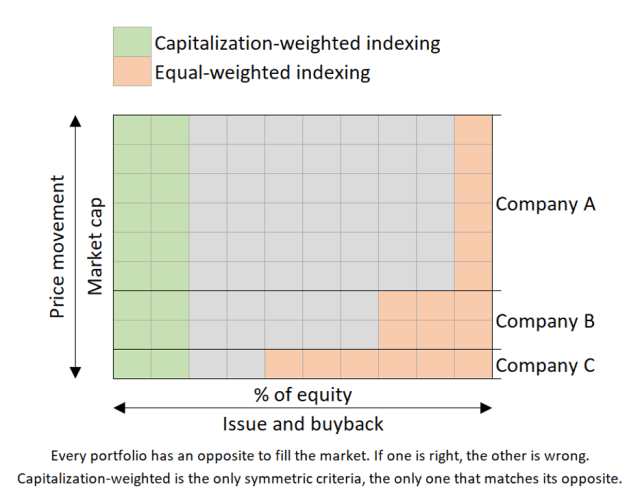
For three decades, William Sharpe’s Arithmetic of Active Management, published in the Financial Analysts Journal in 1991, has been treated as near scripture for passive investing. The Nobel laureate, protégé of Harry Markowitz, and creator of the capital asset pricing model (CAPM) applied a clean, elegant logic that has shaped investment thinking ever since. Sharpe’s thesis was blunt: higher fees ensure active portfolios lag passive ones. Before costs, both groups earn the same market return; after costs, active investing becomes a zero-sum, and ultimately negative-sum, game. Sharpe’s 1991 paper was among those recognized to have an enduring impact on the investment industry as part of CFA Institute Research and Policy Center’s year-long celebration of the 80th Anniversary of the Financial Analysts Journal. It’s a message that has fueled the rise of index funds and haunted generations of investors. Why bother paying for skill when the market’s average return is right there, free for the taking? Sharpe’s logic was groundbreaking, but it described a closed, static market. Later thinkers, most notably Lasse Heje Pedersen, have shown how active management contributes to the market’s evolution rather than simply redistributing returns. This post follows that progression, showing how Pedersen’s refinement completes Sharpe’s arithmetic and restores active management’s constructive role in market efficiency. Sharpe’s thesis captures what passive management really is: effortless exposure to the market’s collective wisdom. In a capitalization-weighted index, portfolio weights adjust automatically with price movements. There’s no trading required. For every active bet, there’s an equal and opposite one. The index is that balance point, the distilled consensus of all investors. Tracking it means letting the market decide who’s right. Source: Diego Costa Yet something about this logic feels incomplete. If Sharpe’s world were perfectly accurate, active management would eventually vanish, and markets would stop functioning altogether. Sanford J. Grossman and Josephe Stiglitz had already demonstrated 10 years earlier, in 1980, that the market rewards those who incorporate information into prices in On the Impossibility of Informationally Efficient Markets with their “equilibrium degree of disequilibrium.” As a corollary, Sharpe’s arithmetic works only if you ignore the economic mechanisms that allow markets to function. So, what if markets aren’t static, and active management doesn’t just redistribute wealth, but actually creates it? The Simple Elegance of Sharpe’s Arithmetic Imagine a world with one hundred investors, each owning one hundredth of every company. Fifty are passive, fifty are active. The passive investors sit tight. The active ones trade among themselves, paying managers and advisors 2% in annual costs. After a year, the active investors earn less overall because of fees. The logic impressed Nobel laureates like Eugene Fama and Ken French. Warren Buffett later retold it as The Gotrocks Family parable, warning that “returns decrease as motion increases.” John Bogle built an empire around it in The Little Book of Common Sense Investing. The message was clear: markets are a closed system. Every winner has a loser. So why play a negative-sum game? The Math Isn’t “Mathing” The trouble is that Sharpe’s arithmetic describes a world that doesn’t exist. He made some statements in his article that, in retrospect, I find quite controversial. For example, he says that if data contradicted him, then the data is wrong: “Empirical analyses that appear to refute this principle are guilty of improper measurement.” Crucially, he also states in one of the footnotes that corporate actions “require more complex calculations but do not affect the basic principles.” That footnote, often overlooked, turns out to be a crack in the foundation. Sharpe’s model assumes a static market, a snapshot in time where no new companies are born, none die, and nothing changes except existing equity shares. But in the real world, everything moves. Companies issue new shares, repurchase old ones, merge, spin off, or go bankrupt. Markets are living, breathing entities reflective of human behavior and trends. Indexes evolve and rebalance to reflect the economy’s shifting structure. Active management tries to precisely do just that, change the index to improve it. Sharpe’s analysis fails because it omits the potential positive effects that its costs enable in aggregate. It’s like assessing R&D spending in a world where nothing remains to be invented. Sharpening the Arithmetic This is precisely what Pedersen pointed out in his 2018 article Sharpening the Arithmetic of Active Management, also published in the Financial Analysts Journal. His insight was simple but profound: markets evolve, and active managers play a crucial role in that evolution. Pedersen gathered data showing that the average annual turnover of US equities is about 7.6%. Bonds turned over closer to 20%. Even if every investor stopped trading, the market would still change. And even passive investors must regularly trade to maintain their portfolio and rebalance to maintain market weights—sell what leaves an index and buy what enters it. The graph below is taken from Pedersen’s 2018 article and shows what happens to an investor who invests money but then never trades after that. Source: Lasse Heje Pedersen, Sharpening the Arithmetic of Active Management, pg 9, Financial Analysts Journal, 2018. “The solid blue line shows an investor who bought the entire US stock market in 1926 and did not participate in any IPOs, SEOs, or share repurchases and did not reinvest any dividends….” Therefore, the investor’s owned share of the market deteriorates over time. The other lines indicate the same for investors who started investing in 1946, 1966, 1986, and 2006. Active Management as Economic Engine Pedersen’s revision doesn’t just fix Sharpe’s math; it reframes the purpose of active management. When active managers identify misallocations of capital—firms wasting resources or ventures capable of higher productivity—they aren’t just trading paper. They are reallocating capital to its most productive use. Through engagement, voting, and investment decisions, active managers influence which firms issue shares, which buy them back, which expand, and which contract. These actions shape the real economy: which technologies get funded, which innovations reach the market, and which industries shrink to make room for more efficient ones. In effect, it creates price discovery, that elusive

From Sharpe to Pedersen: Why Active Management Isn’t Zero-Sum After All Read More »

Book Review: Can’t Deny It

Can’t Deny It: An Unlikely Wall Street Career and the Calls that Reshaped an Industry. 2024. Doug Terreson. Seminole LLC. In Can’t Deny It, Doug Terreson, former head of Energy Research at Evercore ISI and Morgan Stanley, provides a fascinating memoir in which readers are taken on a journey through the worlds of the Gulf of Mexico oil patch, global oil markets, and Wall Street. He describes the inside stories behind his notable market calls in such chapters as “The Era of the Super-Major,” “The Golden Age of Refining,” and “The Pledge.” Terreson was ranked as the #1 or #2 Integrated Oil Analyst in the Institutional Investor poll for 20 years and was a member of the All-America Research Team (II) 24 times. In the chapter “Cutting My Teeth in the Oil Patch,” the author shares that prior to his Wall Street career, he worked as an engineer for Schlumberger (now SLB). He explains how his firsthand experience with evolving technologies and processes in the oil industry gave him a significant advantage in his finance career. Acquiring geological and technological expertise, as well as extensive field experience, was a rarity among his Wall Street peers, who typically came from economics or finance with Ivy League degrees and worked in investment banks, asset management, or private equity. For younger practitioners, Terreson’s early career path offers a reminder that working in a selected industry can provide valuable experience prior to embarking on a finance or Wall Street career. As a real estate finance practitioner, I found Terreson’s summary of crude oil and the chaos of 2008 during his time at Morgan Stanley to be the most interesting part of Can’t Deny It. His oil price forecast of $95/bbl for 2008, made on 14 March 2008, was in stark contrast to the prevailing Wall Street consensus, which was raising forecasts daily to align with rising market prices. In March 2008, the West Texas Intermediate crude oil price got as high as $110/bbl. Goldman Sachs indicated a likelihood of $150–$200/bbl over the next six to 24 months, while other competitors asserted that oil could rise to $200 or even $300/bbl, which highlighted the bullish sentiment at the time. Terreson left Morgan Stanley on 8 July 2008, just three days prior to the all-time peak oil price of $147/bbl on 11 July 2008. The price eventually plunged to $37/bbl by December 2008 and for the year as a whole averaged $98/bbl, within 3% of his $95/bbl projection for 2008. This experience taught him to trust his instincts and the value of rigorous analysis, as well as to be willing to stand apart from the crowd, even when it is uncomfortable. The chapter on privatizations highlights the important role that Terreson played in the initial public offerings of Sinopec in China, Statoil in Norway (now Equinor), and Conoco in the United States and explores the heartbreaking story of PDVSA, Venezuela’s national energy company. The author summarizes how Morgan Stanley’s proposal to privatize PDVSA was rejected by the new government after Hugo Chávez won the presidential election in December 1998. The result was an economic disaster in Venezuela as oil production plummeted due to mismanagement, corruption, economic sanctions, and such flawed policies as currency and price controls. In thinking about the potential trajectory of PDVSA and Venezuela, the author correctly stresses how the country had the opportunity to mirror Norway’s success with its massive sovereign wealth fund, benefiting current citizens as well as future generations. My favorite chapter is the final one, in which the author highlights current trends in the industry, including those that led him to leave Evercore ISI in July 2021. A key factor for his departure involved the broader changes occurring within Wall Street research and investment banking as firms began to increasingly compete more with financial capital rather than intellectual capital. A key shift in sell-side research resulted from the European Union’s 2014 Markets in Financial Instruments Directive (MiFID), which introduced new regulations aimed at enhancing competitiveness. Under these new rules, financial institutions must unbundle the cost of research from other services and directly charge clients for it. This new system does not favor older business models that allowed analysts like Terreson the time, focus, resources, and freedom to make substantial, multi-year strategic forecasts. Another important trend is rapidly evolving artificial intelligence (AI), which has the potential to disrupt the financial industry and the work of Wall Street research analysts. The author skillfully incorporates personal stories — including how his 48-foot boat named “Can’t Deny It” and crew won the Emerald Coast Blue Marlin Classic — to explain the business lessons he has learned. This memoir, written by one of the most decorated research analysts in recent decades, covers many relevant topics and will appeal to all finance practitioners and energy industry specialists. source

Book Review: Can’t Deny It Read More »