CFA Institute

A Case for Broadening Retail Access to Private Markets

The surge of retail investor activity in public markets is a well-documented phenomenon. Digital brokerage platforms and online learning channels are the primary drivers. They often give users the illusion that they can compete with large institutional investors and capitalize on market volatility. Retail investors comprised 25% of total equities trading volume in 2021, which was nearly double the percentage reported a decade earlier, according to online investing platform Public. In February 2023, retail investors across online platforms set a new all-time high for weekly inflows, with $1.5 billion in retail assets pouring into the market in a single week, Public reports. Sadly but predictably, however, only a small minority of retail investors make money through day trading: between 10% and 30% every quarter. Yet, every day, hundreds of millions of dollars are invested through online trading platforms, including those that allow risky binary options trading. Many of these platforms appeal to the same human instincts as sports betting platforms, emphasizing the adrenaline of “winning” and “becoming rich,” as if day trading was a certified tool to make money. Scores of financial influencers (finfluencers) blast “magic” trading tricks on social media, further pushing uninformed retail investors to day-trade. Easy access to online platforms with limited controls creates an uneven playing field vis-à-vis institutional investors. Retail investors are in effect competing against professional institutional traders who have access to top research and data. The potential for an overwhelming amount of capital chasing the same opportunities in public markets, potentially exacerbating stock market bubbles, is the result, as we witnessed in the GameStop short squeeze. Private Markets Offer an Alternative Risk-Return Profile Private market opportunities offer an alternative risk-return profile that could benefit a retail investor’s portfolio through diversification. But these opportunities are often overlooked, and retail investors are underrepresented. Several factors create a barrier to private markets that is difficult for retail investors to cross. First, private offerings are only available to accredited investors, who meet certain  asset or income thresholds. Second, high minimum investment requirements are common for most private market opportunities, including private equity funds. These requirements run contrary to traditional portfolio allocation recommendations of 5% to 10% in alternative assets. Finally, a general lack of information and education about private markets perpetuates the myth that private market investments are inherently “riskier.” SEC Rules 506(b) and 506(c) severely limit access to private offerings, allowing access to only accredited investors and  a limited number of non-accredited. The SEC’s intention is to protect investors with limited financial knowledge or limited available assets to allocate to less liquid investments. Less-sophisticated investors are deemed to be more vulnerable in private markets due to the high level of customization of investment opportunities.  Unsophisticated investors are able  to access online trading platforms, however, including those that offer binary options. These platforms are built and advertised in the same fashion as sports betting sites. Investors on these platforms typically lose money, data shows, and odds are stacked against them in these markets, which  are characterized by massive information asymmetry. Are Public Markets Really Less Risky? Ultimately, the notions that public markets are inherently less risky or  that anyone with a laptop and an internet connection is a knowledgeable investor are misconceptions. Behavioral finance has already debunked the myth that human beings are rational investors. We know that public market bubbles are exacerbated by investor “heuristics.” Such bubbles may have become larger and more frequent since the increase in retail investor participation. Something also needs to be said about higher minimum allocations. While there are some private market investment vehicles with minimum investments as low as $25,000, most opportunities require investments in the range of millions of dollars. If a traditional portfolio allocates 10% to alternatives, an investor will have to hold substantial amounts of investable assets to access a single private market opportunity. It is hard to see how this does not limit opportunities for diversification. Private market investments, especially private credit, can offer returns that are not subject to daily market fluctuations, providing much-needed diversification in an investor’s portfolio. Private markets are more insulated from daily investor sentiment because their performance is driven by more fundamental factors. They present an opportunity for patient capital to be deployed to professionally sourced opportunities that are less correlated to public market oscillations. Education is Key In this post, I merely raise the question of whether the current regulatory framework is conducive to better consumer “welfare.” That is not to say that retail investors should be allowed to seamlessly access private markets. In fact, education is key. “An Introduction to Alternative Credit,” which I co-edited with Philip Clements for the Research Foundation, is a good primer on the credit side. Service providers that offer private investments should offer retail investors more transparency and more education. Ultimately, a more balanced investment strategy that includes private market allocations—subject to well-informed investor decisions—could potentially offer a more stable and diversified portfolio. Editor’s Note: CFA Institute Research and Policy Center delves into the challenges the author identifies with financial influencers in its report, “The Finfluencer Appeal: Investing in the Age of Social Media.” The report also points out that some finfluencers are creating informative and engaging content that educates and increases participation in capital markets. If you liked this post, don’t forget to subscribe to Enterprising Investor and the CFA Institute Research and Policy Center. All posts are the opinion of the author. As such, they should not be construed as investment advice, nor do the opinions expressed necessarily reflect the views of CFA Institute or the author’s employer. Image credit: ©Getty Images / Rudenkoi Professional Learning for CFA Institute Members CFA Institute members are empowered to self-determine and self-report professional learning (PL) credits earned, including content on Enterprising Investor. Members can record credits easily using their online PL tracker. source

A Case for Broadening Retail Access to Private Markets Read More »

From Theory to Trillions: David Booth | Financial Thought Exchange

It’s easy to forget that the idea of investing in the entire market — passively and scientifically — was once heresy. But as listeners quickly learn in David Booth’s conversation with Larry Siegel on the Financial Thought Exchange, it was this very heresy that upended the investment industry over the last four decades. Booth, co-founder of Dimensional Fund Advisors (DFA), didn’t set out to change the world. In fact, he left academia precisely because he didn’t want to be the guy inventing new theories. His talent, he realized early on, was applying the breakthroughs others had already made. That insight, along with his time spent in the halls of the University of Chicago surrounded by future Nobel laureates, set in motion a movement that would redefine how portfolios are built, markets are understood, and investors are served. As the CFA Institute Research Foundation celebrates its 60th Anniversary, Booth’s story serves as a powerful reminder of what rigorous, applied research can achieve. The revolution in finance that he helped catalyze — rooted in empirical evidence, academic collaboration, and a deep respect for markets — mirrors the Research Foundation’s mission to advance the frontiers of investment knowledge. Booth’s conversation with Siegel exemplifies how research doesn’t just inform theory — it shapes industries, builds institutions, and transforms investor outcomes. With some help from our AI tools, I summarize some of the key talking points. But consider this to be a preview. There’s so much more — from Booth’s early brush with Milton Friedman to behind-the-scenes stories about building DFA and navigating decades of market change. Listen in for the full story: Part I and Part II. The Data That Changed Everything In the mid-1960s, the finance world was experiencing a paradigm shift. For the first time, thanks to advances in computing and newly available datasets from the Center for Research in Security Prices (CRSP), researchers could empirically test investment ideas. Booth, then a PhD student under Eugene Fama and a classmate of Roger Ibbotson’s, watched as the myth of consistent manager outperformance began to crumble under statistical scrutiny. Most investors didn’t know what the market returned, let alone how to beat it. When early data studies showed equities had historically delivered more than 9% annually, many were shocked. Trust departments at institutions couldn’t come close. Active managers were exposed. “We suddenly had a science,” Booth said. “We could test what worked and what didn’t.” And What Didn’t Work? Most of the Industry. What emerged from this upheaval wasn’t just a critique of active management but a roadmap for how to invest better: embrace the market, avoid unnecessary costs, and be flexible. Booth’s work at Wells Fargo, under the influence of pioneers like Fischer Black and Myron Scholes, gave him a front-row seat to the birth of index investing. But he also saw its shortcomings: mechanical rigidity, inefficient trading, and missed opportunities. “These were wild times, new ideas springing up everywhere.” So when Booth launched DFA in 1981 with Rex Sinquefield, they didn’t simply replicate the market, they reimagined how to access it. DFA’s breakthrough was to build broadly diversified portfolios, especially in underrepresented segments like small-cap stocks, but don’t be slavish to the index. Use data to guide structure, use judgment to trade intelligently. Booth called it “flexibility with discipline” — a philosophy rooted in academic evidence but tempered by market practicality. This was the birth of factor investing, though the term didn’t exist at the time. Academic studies (Rolf Banz on the small-cap premium, Fama and French on multi-factor models) provided the foundation. DFA built portfolios around size, value, and profitability long before those terms became industry buzzwords. Booth and Sinquefield weren’t chasing alpha. They were building access to dimensions of risk that had been shown to matter. Brutal Beginnings And yet, the early years were brutal. Small caps massively underperformed large caps through the 1980s. DFA’s flagship fund lagged the S&P 500 by hundreds of basis points per year. Most firms would have folded. DFA didn’t. Why? Because their belief wasn’t rooted in a bet; it was grounded in theory and data. “How do you survive?” Booth asked. “You go back to the fundamentals. You believe in diversification. You believe in markets.” Then came the second big reveal — the advisor channel. It would quietly reshape the industry from the ground up. But to hear how it unfolded, and who set it in motion, you’ll have to listen to the podcasts. Asked for advice to young professionals, Booth provided a framework: embrace uncertainty, find your comparative advantage, and build something you want to own if it works. He sees huge opportunity in financial advice, especially as technology lowers the cost of personalization. “People don’t want robo-advice,” he said. “They want to be heard. They want someone to help them connect life to money.” Booth’s story is a case study in how research, applied with conviction and creativity, can build enduring value. As CFA Institute Research and Policy Center marks 60 years of the Research Foundation — and 80 years of the Financial Analysts Journal — this conversation is a timely reminder of what that mission looks like in practice. The lessons may be rooted in the past, but their relevance for investors, advisors, and entrepreneurs today is undeniable. The best part? There’s still more to Booth’s story. Listen to the full conversation for the personalities, turning points, and off-the-cuff moments that didn’t make it into this summary. source

From Theory to Trillions: David Booth | Financial Thought Exchange Read More »

Leveraging AI to Identify and Predict Financial Crises

Artificial intelligence (AI) can improve our ability to identify and predict financial crises. A key innovation in AI is the ability to learn from data without being told exactly what to look for. Leveraging technologies like AI requires us to move away from traditional, subjective approaches and let the data tell us when conditions are ripe for a crisis. Grouping data points in a way that reveals patterns and insights we might not have noticed before is one method for identifying financial crises. This helps us get a better handle on what triggers these crises. At the University of Liechtenstein, Michael Hanke, Merlin Bartel and I are pushing this envelope further. In our recent  paper, we demonstrate how we redefined what we consider a financial crisis and used machine learning algorithms to predict banking crises in the United States. Our initial findings are encouraging, showing the potential to use AI to forecast financial downturns. Financial downturns can come in many shapes and sizes, like when a country cannot pay its debts, its banks face a rush of withdrawals, or the value of its currency plummets. These situations share a common thread: they stem from deep-rooted problems that gradually get worse over time. Eventually, a specific event might trigger a full-blown crisis. Spotting this trigger beforehand can be tricky, so it is crucial to keep an eye on these brewing issues. In simpler terms, these issues are like warning signs that hint at the chance of financial trouble ahead. Traditionally, experts used methods such as solving complex equations to guess whether a financial crisis might happen. This involves linking various factors to whether a crisis might occur, treating it as a yes-or-no question. Deciding what counts as a crisis often relies on expert judgment, highlighting the importance of how we define a crisis. Our approach is about fine-tuning this method to better match what we see happening in the real world. In modern tech talk, this is a bit like using a basic form of smart technology, where the computer is learning from a set of examples. This is a concept not too far from the early stages of what we now call AI. There are other, more creative ways to predict financial crises. For example, looking at how certain market prices move, which can hint at the likelihood of a country defaulting on its debt, offers a fresh perspective. To conclude, AI holds a lot of promise in refining how we understand financial crises. While grouping data points is just one example of what AI can do, these smart algorithms have a range of practical uses. Despite some current limitations, AI stands to offer significant advantages. It’s an exciting time to delve into the possibilities these technologies bring to the table. If you liked this post, don’t forget to subscribe to the Enterprising Investor All posts are the opinion of the author. As such, they should not be construed as investment advice, nor do the opinions expressed necessarily reflect the views of CFA Institute or the author’s employer. Image credit: ©Getty Images/noLimit46 source

Leveraging AI to Identify and Predict Financial Crises Read More »

Coaching Investors Beyond Risk Profiling: Overcoming Emotional Biases

Risk profiling is supposed to match an investor’s portfolio with both their ability and willingness to take risk. But “willingness” isn’t stable. It shifts with markets, headlines, and emotional reactions. Even the wording of a single survey question can change a client’s response before a market event ever occurs. That’s why advisors can’t stop at assessing risk preferences. To make risk profiling useful, they must also recognize and coach clients through the emotional biases that distort those preferences. I first encountered the critical distinction between risk tolerance and risk attitudes in Michael Pompian’s Behavioral Finance and Wealth Management. His explanation, that true risk tolerance is a stable, personality-based trait, while risk attitudes are volatile and emotionally driven, was both revelatory and practical. Yet it was only years later, after training in coaching, that I fully understood how emotional bias can be addressed, and how language can reshape what a client perceives as their “willingness” to take risk. Understanding the Trio: Risk Capacity, Tolerance, and Attitudes Most advisory frameworks adjust portfolio recommendations when there’s a mismatch between risk capacity (what the investor can afford to lose) and risk tolerance (what they’re emotionally comfortable withstanding). And here’s where it gets nuanced. There is a distinction between risk tolerance and behavioural risk attitudes. Both combine to determine risk appetite and yet there are essential differences: Risk Tolerance: A client’s stable preference for risk. It reflects the client’s enduring preferences about risk, often grounded in experience, values, and life stage. Behavioral Risk Attitudes: Unstable and highly context-dependent. They reflect short-term reactions to volatility, recent losses, or market headlines. While real, they are often poor guides for long-term decisions. When risk appetite falls short of risk capacity, the advisor’s job is not merely to reduce exposure. It’s to understand and address the emotional triggers that might be contributing to that low risk appetite. Allowing these unstable attitudes to dictate portfolio design risks producing an emotionally “comfortable” solution today that fails the client in the long run. Coaching Clients Through Common Emotional Biases Advisors often see the same emotional patterns play out when markets shift. Here are some of the most common biases and ways to reframe the conversation so clients can stay grounded in their long-term strategy. Loss Aversion Clients often say: “I can’t afford to lose anything right now,” or “I should pull my money out until things calm down.”A more helpful frame: The real risk isn’t just losing money, it’s missing the growth that secures future goals. The question becomes, “Are you trying to avoid short-term discomfort, or are you aiming for long-term financial security?” Overconfidence Clients may say: “I’ve got a good feeling about this sector.”A more helpful frame: A strong instinct deserves a strong process. Even good calls benefit from strategy. The question is, “What would this decision look like if we stripped out the emotion and focused only on the data?” Self-Control Bias Clients may say: “I know I should invest more, but I just haven’t gotten around to it.”A more helpful frame: “You clearly care about your financial future. How does delaying investing align with that priority?” Status Quo Bias Clients may say: “Let’s leave things as they are for now.”A more helpful frame: Sometimes standing still is the riskiest move. Ask, “What happens if nothing changes? What opportunities are lost by waiting?” Endowment Bias Clients may say: “I’ve had this stock for years, it’s been good to me.”A more helpful frame: “If you didn’t already own it, would you buy it today?” Explain that honoring past success might mean taking profits and reinvesting wisely, rather than holding on out of habit. Regret Aversion Clients may say: “What if I invest and the market drops tomorrow? I don’t want to make a mistake I’ll regret.”A more helpful frame: Diversification helps protect capital while still moving forward. “Think of it this way: refusing to plant seeds because it might not rain tomorrow means missing an entire growing season.” Conclusion Advisors today must do more than understand markets; they must help clients navigate their own internal markets. That means spotting biases such as: Loss aversion: reframing fear of short-term loss into focus on long-term growth. Self-control bias: helping clients act on their stated priorities. Overconfidence: turning instinct into process. Status quo bias: showing when inaction is the riskier move. Endowment bias: challenging attachment to legacy holdings.. Regret aversion: helping clients move forward despite uncertainty. Providing behavioral finance resources can help, but the greatest impact comes from the financial advisor who can respond in real time with empathy and perspective. Emotional biases are not flaws to eliminate; they are facts of human nature. The difference lies in whether those biases dictate portfolios or whether advisors coach clients to see beyond them. By aligning risk attitudes with true risk capacity, advisors can help clients become resilient investors rather than reactive ones. source

Coaching Investors Beyond Risk Profiling: Overcoming Emotional Biases Read More »

Net Worth Optimization: A New Era of Personalized Risk Optimization

Since Harry Markowitz developed modern portfolio theory’s mean-variance optimization (MVO), financial advisors and wealth managers have been confronted with a crucial question: What is the relative importance of risk tolerance (the investor’s attitude toward risk) compared to risk capacity (the investor’s ability to endure negative outcomes)?  I must confess that I have been perplexed by this question for decades. My frequent co-author, Paul Kaplan, and I believe we have solved this 50+ year conundrum using an expanded MVO optimization model called net worth optimization (NWO).  I plan to discuss our findings on my panel at CFA Institute LIVE 2025 in Chicago in May. How did we get here? The goal (objective function) of mean-variance optimization is to maximize the expected return of a portfolio, minus a personalized penalty for the expected risk (variance) of the portfolio. Personalized penalty is the investor’s risk tolerance coefficient multiplied by the variance of the portfolio. In MVO, the “risk tolerance” coefficient is a single number reflecting the rate at which the investor is willing to trade off more risk in pursuit of more expected return. Knowing the investor’s risk tolerance coefficient allows you to solve for the corresponding MVO efficient portfolio. In the economics literature and the works of Nobel Prize winners like Paul Samuelson, risk tolerance is clearly related to the investor’s attitude toward risk, not risk capacity. Advisors frequently have a deep understanding of their clients’ situations. This might include information on additional accounts, spousal assets, compensation information, mortgage payments, etc. Some clients may be very comfortable with risk, but with little capacity for adverse outcomes given their circumstances. While other clients are extremely uncomfortable with risk but can tolerate adverse outcomes with little impact on their financial well-being. Advisors find themselves navigating what has been a highly subjective risk tolerance (attitude) versus risk capacity conundrum. Two Approaches to Risk Capacity Pragmatically, there have been two approaches that explicitly focus on risk capacity. The first approach is a common feature of the “scoring” component of risk tolerance questionnaires. When scoring the responses to a risk tolerance questionnaire, there are frequently two scores: a risk tolerance score and a time horizon score. The time horizon score serves as a crude proxy for the investor’s capacity to take on risk that limits which portfolios are deemed suitable.  The second approach is probably less known to practitioners but prevalent in the practitioner-oriented literature. This approach is best represented by the “discretionary wealth hypothesis” primarily put forth by Jarrod Willcox.[1] In these types of approaches, the investor’s attitude toward risk is discounted or ignored, and financial ratios like the ratio of assets-to-liabilities are used as the primary factor to estimate a so-called “risk tolerance coefficient. I use quotes to distinguish this from the economic definition of risk tolerance as an attitude. Net Worth Optimization (NWO) In our 2024 CFA Institute Research Foundation book, “Lifetime Financial Advice,” Kaplan and I put forth NWO. It is a significant extension of MVO. NWO includes all of the investor’s assets and labilities in the optimization, especially human capital, and it optimizes the investor’s holistic economic balance sheet. An investor’s economic balance sheet includes all his or her assets — home, land, collectables, and all financial assets. Most importantly, the economic balance sheet includes the capitalized value of the investor’s lifetime of earnings — human capital. For many people, the mortality weighted net present value of all future labor income, including deferred labor income in the form of defined benefits and social security, is their single largest asset. The lifetime of cash flows stemming from human capital is frequently reminiscent of the cash flows you would receive from a large, inflation-linked, long-duration bond. Others have less steady human capital that might resemble a stock/bond mix. On the right-side of an economic balance sheet, we all have ongoing expenses, such as rent, a mortgage, insurance, medical costs, and food. While these may not be legal liabilities, these expenses are often inescapable. Collectively, their capitalized values form what we think of as the investor’s nondiscretionary consumption liability.  Just as a balance sheet is an important indicator of a corporation’s financial health, a holistic individual economic balance sheet is an excellent indicator of the investor’s overall financial health and capacity for taking on risk. The difference between the total value of all assets and all liabilities is net worth. Hence the term net worth optimization or NWO.  NWO includes all the major economic balance sheet entries. Nontradable entries — the investor’s human capital and nondiscretionary consumption liability  —  are included in the optimization, although the optimizer cannot change the net present value of either. These nontradeable assets are modeled as portfolios of asset classes, which enable us to derive proper market-based discount rates and understand how they interact with the rest of the balance sheet. Imagine a 45-year old pharmaceutical scientist with a base salary of $200,000, adjusted each year for inflation, who receives $100,000 nominal restricted stock units with a five-year vesting schedule who also expects to receive approximately $25,000 per year from social security starting at age 65. One could model this person’s human capital as nearly 2/3rds long-duration-inflation-adjusted corporate bonds with a duration corresponding to the 20 years of cash flows, and nearly 1/3rd mid-cap stocks (reflecting the size of the company). You could refine the 1/3rd mid-cap stocks by modeling them based on the pharmaceutical sector or even using the specific stock in question. The current net present value of social security isn’t worth that much today, but it too should be accounted for properly. The expected returns on each form the basis for a weighted average cost of capital for calculating the value of the scientist’s human capital.  The capitalized value of the investor’s nondiscretionary consumption liability, which is somewhat like issuing a long-duration-inflation-linked bond with outgoing coupon payments, is included as a nontradable negative holding in the optimization. Then in the presence of nontradable assets and liabilities NWO determines the optimal asset allocation for the investor’s tradable

Net Worth Optimization: A New Era of Personalized Risk Optimization Read More »

The Benefits of Using Economically Meaningful Factors in Financial Data Science

Factor selection is among our most important considerations when building financial models. So, as machine learning (ML) and data science become ever more integrated into finance, which factors should we consider for our ML-driven investment models and how should we select among them? These are open and critical questions. After all, ML models can help not only in factor processing but also in factor discovery and creation. Factors in Traditional Statistical and ML Models: The (Very) Basics Factor selection in machine learning is called “feature selection.” Factors and features help explain a target variable’s behavior, while investment factor models describe the primary drivers of portfolio behavior. Perhaps the simplest of the many factor model construction methods is ordinary least squares (OLS) regression, in which the portfolio return is the dependent variable and the risk factors are the independent variables. As long as the independent variables have sufficiently low correlation, different models will be statistically valid and explain portfolio behavior to varying degrees, revealing what percentage of a portfolio’s behavior the model in question is responsible for as well as how sensitive a portfolio’s return is to each factor’s behavior as expressed by the beta coefficient attached to each factor. Like their traditional statistical counterparts, ML regression models also describe a variable’s sensitivity to one or more explanatory variables. ML models, however, can often better account for non-linear behavior and interaction effects than their non-ML peers, and they generally do not provide direct analogs of OLS regression output, such as beta coefficients. Why Factors Should Be Economically Meaningful Although synthetic factors are popular, economically intuitive and empirically validated factors have advantages over such “statistical” factors, high frequency trading (HFT) and other special cases notwithstanding. Most of us as researchers prefer the simplest possible model. As such, we often begin with OLS regression or something similar, obtain convincing results, and then perhaps move on to a more sophisticated ML model. But in traditional regressions, the factors must be sufficiently distinct, or not highly correlated, to avoid the problem of multicollinearity, which can disqualify a traditional regression. Multicollinearity implies that one or more of a model’s explanatory factors is too similar to provide understandable results. So, in a traditional regression, lower factor correlation — avoiding multicollinearity — means the factors are probably economically distinct. But multicollinearity often does not apply in ML model construction the way it does in an OLS regression. This is so because unlike OLS regression models, ML model estimations do not require the inversion of a covariance matrix. Also, ML models do not have strict parametric assumptions or rely on homoskedasticity — independence of errors — or other time series assumptions. Nevertheless, while ML models are relatively rule-free, a considerable amount of pre-model work may be required to ensure that a given model’s inputs have both investment relevance and economic coherence and are unique enough to produce practical results without any explanatory redundancies. Although factor selection is essential to any factor model, it is especially critical when using ML-based methods. One way to select distinct but economically intuitive factors in the pre-model stage is to employ the least absolute shrinkage and selection operator (LASSO) technique. This gives model builders the facility to distill a large set of factors into a smaller set while providing considerable explanatory power and maximum independence among the factors. Another fundamental reason to deploy economically meaningful factors: They have decades of research and empirical validation to back them up. The utility of Fama-French–Carhart factors, for example, is well documented, and researchers have studied them in OLS regressions and other models. Therefore, their application in ML-driven models is intuitive. In fact, in perhaps the first research paper to apply ML to equity factors, Chenwei Wu, Daniel Itano, Vyshaal Narayana, and I demonstrated that Fama-French-Carhart factors, in conjunction with two well-known ML frameworks — random forests and association rule learning — can indeed help explain asset returns and fashion successful investment trading models. Finally, by deploying economically meaningful factors, we can better understand some types of ML outputs. For example, random forests and other ML models provide so-called relative feature importance values. These scores and ranks describe how much explanatory power each factor provides relative to the other factors in a model. These values are easier to grasp when the economic relationships among the model’s various factors are clearly delineated. Conclusion Much of the appeal of ML models rests on their relatively rule-free nature and how well they accommodate different inputs and heuristics. Nevertheless, some rules of the road should guide how we apply these models. By relying on economically meaningful factors, we can make our ML-driven investment frameworks more understandable and ensure that only the most complete and instructive models inform our investment process. If you liked this post, don’t forget to subscribe to Enterprising Investor. All posts are the opinion of the author. As such, they should not be construed as investment advice, nor do the opinions expressed necessarily reflect the views of CFA Institute or the author’s employer. Image credit: ©Getty Images / PashaIgnatov Professional Learning for CFA Institute Members CFA Institute members are empowered to self-determine and self-report professional learning (PL) credits earned, including content on Enterprising Investor. Members can record credits easily using their online PL tracker. source

The Benefits of Using Economically Meaningful Factors in Financial Data Science Read More »

Decades in a Week: Germany’s Fiscal Breakthrough and Its Global Impact

The past week marked a watershed moment for the eurozone, potentially signaling a fundamental shift in European economic policy. The coalition set to assume power in Germany  announced a massive fiscal package — ranging from 12% to 18% of GDP — which includes the creation of a €500 billion infrastructure fund and the relaxation of debt constraints on defense spending, representing a break from its traditional Exportweltmeister model. The Germans are having a “Jesus moment,” recognizing the need to shift from being a capital exporter — Exportweltmeister — to prioritizing domestic investment. This marks the beginning of a macroeconomic regime change, with EUR/USD acting as a key transmission mechanism. Betteridge’s Law of Headlines suggests that if a news article poses a question in its headline, the answer is typically “no.” Similarly, the placement of the question mark in the title of the article I wrote for Enterprising Investor in September 2022, “Is the Euro Uninvestable? The FX Question du Jour,” was intended to emphasize that uninvestable is a transitory term. Standing here today, one might be forgiven for thinking that Friedrich Merz, Germany’s Chancellor-in-Waiting, had my article conveniently pinned alongside The Draghi Report on EU Competitiveness on his policy board. More likely, of course, it’s a case of aligned thinking — reinforced by the huge wake-up call from Trump 2.0. The article I wrote back in 2022 also argued that the European Central Bank (ECB) should do away with the Atlas Syndrome of assuming the role of a fiscal authority and allow for market-driven price discovery in EUR-denominated bonds. That shift is now taking place. The ECB has jettisoned the Asset Purchase Program (APP) and the Pandemic Emergency Purchase Program (PEPP) and is currently on the path of Quantitative Tightening (QT). It’s very encouraging to see that the phrase “whatever it takes” is now coming from Germany’s Chancellor-in-Waiting rather than the President of the ECB. As Lenin famously said, “There are decades where nothing happens; and there are weeks where decades happen.” While this quote may be overused, it certainly justifies being invoked considering the magnitude of the market moves we saw last week. Bund yields saw their most significant moves last week since the fall of the Berlin Wall, with the 10-year UST-bund spread (US Treasury vs. German bund) compressing by around 44 basis points, bringing us full circle to relative asset pricing and the Portfolio Balance Approach as key determinants of EUR/USD performance. It’s no surprise, then, that EUR/USD surged from the 1.04 to the 1.08 handle last week. With a greater focus on domestic investment, the eurozone’s net international investment position (IIP) surplus should shrink and possibly even turn into a deficit. Of course, there’s many a slip between the cup and the lip. The fiscal package must pass through both the Bundestag and Bundesrat. And Germany’s deep-rooted Schwarze Null (black zero) culture of maintaining a balanced budget must be overcome at multiple levels. Nonetheless, market expectations are now aligned with the idea that Germany has truly reached an inflection point. Year-to-date, a notable divergence in trajectories has emerged with US and German yields, with US yields declining (10-year UST yield down by around 30bps) while bund yields are rising (10-year bund yield up by around 50bps), influencing cross-border portfolio rebalancing and EURUSD performance. On the other side of the pond, we are reminded to take President Donald Trump seriously but not literally. However, for market participants, this translates into heightened uncertainty. Recent academic literature on financial markets and decision-making in general emphasizes the distinction between risk and uncertainty. Risk arises in situations where outcomes and probabilities are well-defined. Uncertainty and ambiguity, on the other hand, refer to situations where outcomes and probabilities are unclear or unknown. These ideas, first formulated by thinkers like Frank Knight and John Maynard Keynes about a century ago, have only been formally detailed in academic literature over the past thirty years or so. They are particularly relevant in the Trump 2.0 era, which is beginning amid deep uncertainty and ambiguity. Trump’s “break first, ask questions later” approach to government spending and the persistent policy uncertainty surrounding tariffs is fueling concerns over growth and employment. These topics, of course, warrant a more detailed article on uncertainty versus risk , one that would also likely include the word uninvestable followed by a question mark. Summary The impetus in Germany to drive a fiscal policy pivot, set against the backdrop of the ECB’s ongoing normalizing of monetary policy, has fueled historic market moves. Last week, bund yields experienced their most significant shift since the fall of the Berlin Wall, with the 10-year UST–bund spread compressing by 44 basis points and EUR/USD surging from 1.04 to 1.08. As Germany recalibrates toward domestic investment, the eurozone’s net international investment position (IIP) surplus could shrink or even turn into a deficit. Germany’s political clarity in enacting policy change — despite the challenge of breaking from the black zero culture — stands in contrast to policy uncertainty across the Atlantic. With the return of Trump-era unpredictability — marked by policy ambiguity and a “break first, ask questions later” approach — investors are grappling with a landscape where risk and uncertainty blur. Amid the evolving dynamics on both sides of the EUR/USD equation, investors must weigh the potential for long-term transformation against short-term noise and consider whether this marks a trading regime with some legs or just another chapter in market volatility. source

Decades in a Week: Germany’s Fiscal Breakthrough and Its Global Impact Read More »

Tariffs and Returns: Lessons from 150 Years of Market History

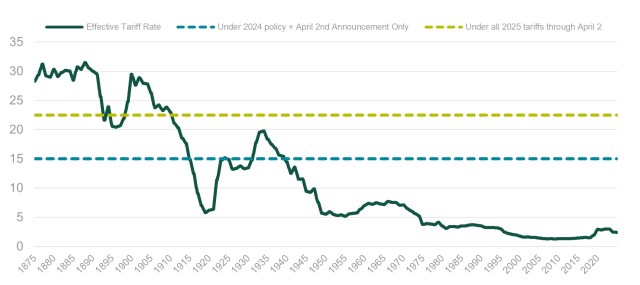
Trade tariffs are back — reshaping markets and raising critical questions for investors. In early 2025, the United States enacted broad-based tariffs on nearly all trading partners, reversing decades of liberalization. The result: renewed volatility, geopolitical tension, and a clear imperative for portfolio resilience. While today’s headlines feel new, the dynamics aren’t. Over the past 150 years, the United States has seen multiple high-tariff regimes — from the post–Civil War boom to the Smoot-Hawley fallout. The global economy has changed, but investor behavior and risk pricing remain governed by familiar patterns. In this blog, we examine those lessons through a data-driven lens, leveraging our proprietary database of 150 years of asset and economic data—the most comprehensive long-term dataset on tariffs, economic growth, and investment returns available to date ([3], [4], [5]). Our objective is not to suggest that history will repeat itself, but to uncover patterns that rhyme — providing context for investors seeking to navigate today’s uncertainty. The evidence shows that while tariffs can introduce stress into markets, systematic equity factors, particularly low-volatility, have historically provided stability and added value during periods of trade disruption. For investors facing a resurgence in protectionist policy, these lessons are both timely and actionable. The History of Tariffs Exhibits 1 and 2 trace the United States through multiple tariff regimes since 1875. From protectionism to liberalization and back again, tariff policy has reflected broader political and economic forces. This long-run view offers important context for today’s shifts. Exhibit 1:  US Effective Tariff Rate Since 1875 Yale BudgetLab and Northern Trust Asset Management – Quantitative Strategies. The effective US tariff rate is measured as customs duty revenue as a percent of goods imports. The sample period is 1875-2024. Exhibit 2: Historic Tariff Trends Yale BudgetLab and Northern Trust Asset Management – Quantitative Strategies. 1875-1913: Protectionist Peak In the Civil War the United States implemented the Morrill Tariff in 1861, raising average tariff rates on dutiable commodities to approximately 47% to generate revenue for the Civil War. From the post-Civil War era (which was 1861–1865) to World War I, tariffs remained high to protect flourishing industries. Tariffs on dutiable imports averaged between 30% and 50%, reflecting the Republican Party’s commitment to industrial development through trade barriers, amounting to effective tariffs of around 30%. Notable legislation includes the Morrill Tariff (1861), the McKinley Tariff (1890), and the Dingley Tariff (1897), the latter of which marked the height of protectionism in this era. 1913–1920s: First Liberalization The Underwood Tariff Act of 1913, enacted under President Woodrow Wilson, marked a turning point by reducing the basic tariff rates. In addition, many raw materials and groceries were added to the free of tariff list. This shift was driven by Democratic efforts to promote freer trade and encourage American manufacturers to produce more efficient and become more competitive with their prices, lowering the average cost for consumers. 1930s: Smoot-Hawley Era The 1929 stock market crash triggered a global downturn, prompting countries to protect domestic industries. In 1930, the United States passed the Smoot-Hawley Tariff Act, raising duties on over 20,000 imports—pushing average tariff rates to 45%. Instead of stabilizing the economy, the policy sparked global retaliation, with major trading partners like Canada, the United Kingdom, and Germany imposing countermeasures. The result: a trade war and a 60% drop in world trade by 1933. Post-WWII to 1970s: Trade Liberalization Era After World War II, U.S. policy pivoted toward multilateral liberalization through the General Agreement  on Tariffs and Trade (GATT). Through negotiation rounds, resulting in over 100 agreements, including  Geneva, Dillon, Kennedy, and Tokyo, average tariffs on industrial goods fell dramatically. By the 1970s, US tariffs were around 10% or lower, reflecting a global trend toward freer trade. 1990S–2000s: NAFTA and WTO Integration With the signing of NAFTA (1992) coming into force (1994) and the U.S. joining the WTO (1995), tariff barriers declined even further. By the 2010s, average tariffs on all US imports had dropped to  approximately 1.5–2.5%, reflecting the peak of US trade openness. 2018–2020s: Strategic Protectionism Beginning in 2018, the Trump administration imposed a 10% blanket tariff on imports, along with additional levies targeting countries with large trade surpluses with the United States, notably China. These measures marked a shift toward selective protectionism and initiated retaliatory tariffs by major trading partners. 2025: Escalation of Broad Tariff Policy In 2025, the United States enacted its most significant trade shift in a century: a 10% blanket tariff on all imports, plus an added levy based on each country’s bilateral goods deficit. Though a 90-day grace period softened the rollout, ongoing exemptions and reversals have created persistent policy uncertainty. The impact has been most acute for China, the primary target, with retaliatory tariffs from Beijing following quickly. The volatile and politically charged environment has complicated forecasting and increased caution among global investors. The threat now hanging over the global economy is that President Trump is orchestrating a return to the 1930s, when the infamous Smoot-Hawley tariffs set off a chain reaction of international retaliation, often blamed for deepening the Depression. This move contrasts sharply with the multilateral liberalization trend of the previous decades. These regimes of US trade tariffs also impact average global tariffs across the world, as other countries either had high tariffs (like European countries in the 19th century) or retaliated (for example during the Smoot-Hawley era). The figure below, taken from Bas, 2012 reveals the average level of global tariffs [2]. Exhibit 3: Unweighted World Average Own Tariff, 35 Countries, % Bas, M. (2012). Input-trade liberalization and firm export decisions: Evidence from Argentina. Journal of Development Economics, 97(2), 81-493. Tariffs are widely regarded as impediments to trade openness. By increasing the cost of cross-border transactions, high tariffs tend to restrict the flow of goods and services, thereby lowering a country’s trade-to-GDP ratio—a standard measure of openness [2]. Exhibit 3 illustrates the historical evolution of US trade openness, defined as the sum of imports and exports as a percentage of GDP, with key tariff regimes highlighted. Exhibit 4: Historical

Tariffs and Returns: Lessons from 150 Years of Market History Read More »

Asset Owner Perspectives: Building Investment Organizations Fit for the Future

What can the larger investment community learn from how asset owners are thinking about and building their multi-generational, long-horizon portfolios? At last month’s Alpha Summit GLOBAL by CFA Institute, Jaap van Dam, PGGM’s principal director of investment strategy, and Geoffrey Rubin, the senior managing director and chief investment strategist at CPP Investments, spoke with Josina Kamerling, head of regulatory outreach for CFA Institute for the Europe, Middle East, and Africa (EMEA) region about the future of pension fund management, how their organizations are adapting to meet the investment challenges ahead, and what they are looking for in the next generation of investment talent. Positioning Pension Funds for Long-Run Sustainable Performance PGGM is the investment organization of Pensioenfonds voor Zorg en Welzijn (PFZW), the second largest pension fund in the Netherlands. PFZW has about 2.4 million members in the health care and welfare sectors, of whom 80% are female. PGGM has roughly €280 billion in AUM and seeks to invest sustainably to achieve a high and stable return for responsible risk. PGGM is transitioning its investment process to a 3D framework that integrates risk, return, and impact. “To my mind, the investment process and theory of the past 30 years, when I entered finance, is not the one we should use in the next 30 years,” van Dam said. “[Modern portfolio theory (MPT)] and shareholder value maximization led to a narrow focus on purely financial outcomes. And because MPT tells us that financial markets are efficient, there was no need to deeply think about the question: how is this value actually created?” “We potentially have the power and means to steer and influence the outcomes in the real world, and this is partly our reason to exist,” van Dam continued. “So, that means to achieve long-term sustainable investment performance, we have to rebuild the investment paradigm. We have to supplement MPT with ‘Modern Investment Theory,’ where the financial and societal outcomes are the best possible.” van Dam recognizes that humanity now faces serious dilemmas — climate change and biodiversity loss, for example — and society expects asset owners to contribute to their solutions. PGGM plans to direct 20% of its investment portfolio to helping achieve the UN Sustainable Development Goals (SDGs) by 2025. It is also expanding its commitment to impact investing and moving toward “impact creation” — to actively and intentionally contribute to value creation from a financial and societal perspective.1 The PGGM board wants the fund’s financial and societal objectives to have equal weight. For CPP Investments, sustainability means the sustainability of the plan itself, according to Rubin. That sustainability is measured every three years with a 75-year forward look. “This is not about a five-year holding period, this is not about a near-term cycle,” he said. “This is about how our investments are going to support the sustainability of the plan and its financial standing over generations to come.” CPP Investments manages C$539 billion in assets for the Canada Pension Plan, which serves 21 million Canadian workers and retirees. The fund’s investment objectives, as established by legislation, are to maximize long-term investment returns without undue risk. Rubin explained that the focus is on risk-adjusted returns, but “risk” encompasses all the risks that the organization and the investment portfolio might face. Risk means more than just the market, credit, and liquidity risks that are typically considered in portfolio construction. When allocating capital, CPP Investments leverages its long-horizon advantage in selecting the sectors where it will compete and try to deliver outsized returns. Pure alpha or portable, zero-sum, incremental return is not always the target, Rubin remarked. Rather, it could be a combination of alpha and beta along with facilitating and growing investment opportunities in ways that benefit various stakeholders. “What we are focused on particularly sharply right now is how we can continue to deliver maximum returns at our chosen risk level in the face of a world that is not only growing more complex but also growing more competitive,” he said. Know Thyself The notion of “Know Thyself” is incredibly important for organizations like CPP Investments, Rubin noted. “You have to have a very keen understanding of what it is you’re trying to achieve and what are the constraints and risk appetites within which you should be pursuing your objectives,” he explained. “The first-order challenge in thinking about risk for our types of organizations is defining exactly what we mean by risk and what are the downsides. The answers are going to be different for every organization.” Rubin is not convinced there is any one particular risk metric that is better than the others. They are all imperfect measures, and he prefers to use several different tools in combination. “These are exciting times for us in our profession in terms of thinking about new ways to assess risk,” he said. “Let’s absolutely take best advantage of them all but also bring some humility to that exercise, be very deliberate and thoughtful around the tools that we use, and assemble them in ways that help us answer that bigger, first-order question of what risk really means at our organizations.” Rethinking Benchmarks PGGM is also reassessing its approaches to strategic allocation and benchmarking. To implement 3D investing, “You really have to start thinking about: Is there an alternative to this extreme benchmark orientation that we’re probably all caught up in?” van Dam said. PGGM is exploring “well-formed portfolios” — those that are well diversified, have exposure to all relevant forward-looking human activity, and are value generating, with at least the same risk premia as are embedded in the equity markets. “These ‘well-formed’ portfolios will be very far away from what we now consider to be a good benchmark,” van Dam explained. “Our board will have to agree that being in control [of policy and policy execution] no longer plays through by defining benchmarks but plays through different mechanisms. They’ve rightly asked very tough questions about how to be in control. So, that’s a big part of the research that we’re doing.” The Investment Professional of the

Asset Owner Perspectives: Building Investment Organizations Fit for the Future Read More »

Beyond the Marketing Pitch: Understanding Hedge Fund Risks and Returns

Hedge funds are often marketed as high-return, low-correlation investments that can provide diversification benefits to traditional portfolios. Investors must look beyond the marketing pitch, however, to fully understand the risks involved. Leverage, short selling, and derivatives can introduce hidden vulnerabilities, while fee structures may encourage strategies that generate steady gains but expose investors to occasional deep losses. This post is the second in a three-part series examining hedge fund literature to assess their risks and their diversification potential and offering insights on when and how they might fit into an investment strategy. In my first post, I show that the research suggests skill and alpha are scarce and difficult to obtain in the hedge fund market, especially among those listed in commercial databases. Hedge Fund Risks Due to the permitted use of leverage, short selling, and derivative product strategies, some hedge funds are highly volatile. Their asymmetric fee structures also incentivize the adoption of investment strategies with negatively skewed outcomes and high kurtosis. In other words, many hedge funds tend to deliver modest regular profits — possibly to generate performance fees —  at the cost of occasional deep losses. Hedge funds using leverage also bear financing risk, which materializes when the fund’s main lender ceases to provide financing, requiring the fund to find another lender or liquidate assets to pay off its debt. Investors should pay close attention to financing risk. Financing risk is significant, as Barth et al. (2023) report that almost half of hedge fund assets are financed with debt. Also important is liquidity risk, which materializes when too many investors redeem their shares simultaneously. This risk is particularly serious for hedge funds holding relatively illiquid assets. Under a high redemption scenario, the fund may have to sell its most liquid, highest-quality assets first, leaving the remaining investors with a less valuable portfolio, leading to more redemptions. Under another scenario, the manager may freeze redemptions to prevent a liquidation spiral. Hedge funds often reduce liquidity risk by imposing an initial lock-up period. While such restrictions hamper investors’ ability to dispose of their investment at will, Aiken et al. (2020) suggest hedge funds with a lock-up tend to outperform due to their higher exposure to equity-mispricing anomalies. Diversification Properties Research generally acknowledges modest diversification benefits with hedge funds. Amin and Kat (2009) found that seven of the 12 hedge fund indices reviewed and 58 of the 72 individual funds classified as inefficient on a stand-alone basis can produce an efficient payoff profile when mixed with the S&P 500 Index. Kang et al. (2010) found that the longer the investment horizon, the greater the diversification benefits of hedge funds. Titman and Tiu (2011) studied a comprehensive sample of hedge funds from six databases and concluded that low R-squared funds exhibit higher Sharpe Ratios, information ratios, and alphas than their competitors. In other words, low-correlation hedge funds tend to deliver higher risk-adjusted returns. Bollen (2013) also looked at low R-squared hedge funds and came to a different conclusion. He constructed large portfolios of multiple zero R-squared hedge funds. He found that these portfolios have up to half the volatility of other hedge funds, suggesting that, despite appearances, zero R-squared hedge funds may feature substantial systematic risk. The author also finds that the low R-squared property increases the probability of fund failure. Brown (2016) claims that hedge funds are legitimate diversifiers, but investing in this type of product without deep operational due diligence is outright dangerous. Newton et al. (2019) reviewed 5,500 North American hedge funds that followed 11 distinct strategies from 1995 to 2014. They report that six strategies “provide significant and consistent diversification benefits to investors, regardless of their level of risk aversion.” Four strategies offer more moderate benefits, and only one strategy does not improve portfolio diversification. Interestingly, their measure of diversification benefits accounts for skewness and kurtosis. Finally, Bollen et al. (2021) found that despite a severe decline in their performance since 2008, a 20% allocation to hedge funds still reduces portfolio volatility but fails to improve Sharpe Ratios. They conclude that a modest allocation to hedge funds may be justified for risk-averse investors due to their reliable diversification benefits. Beyond Traditional Risk Measures Research shows that hedge funds can help diversify portfolios. However, investors should not oversimplify the issue. First, traditional risk measures like standard deviation and correlation are incomplete. Skewness and kurtosis must be measured or estimated in some way. Products with low historical standard deviation may hide the possibility of occasional extreme losses or a negative expected return. Investors must thoroughly understand the fund’s investment strategy and how it may behave under adverse conditions. Investors must also reflect on what risk means under their specific circumstances. Sacrificing too much expected return for diversification could harm financial health in the long run. Key Takeaways Hedge funds can serve as legitimate diversifiers, but blind allocation is risky. While certain strategies have shown consistent diversification benefits, others introduce financing, liquidity and extreme loss risks that investors must evaluate carefully. Traditional risk measures like standard deviation and correlation don’t always capture the full picture — skewness, kurtosis, and tail-risk exposure are critical considerations. My final post in this series will explain why I do not recommend hedge funds. source

Beyond the Marketing Pitch: Understanding Hedge Fund Risks and Returns Read More »