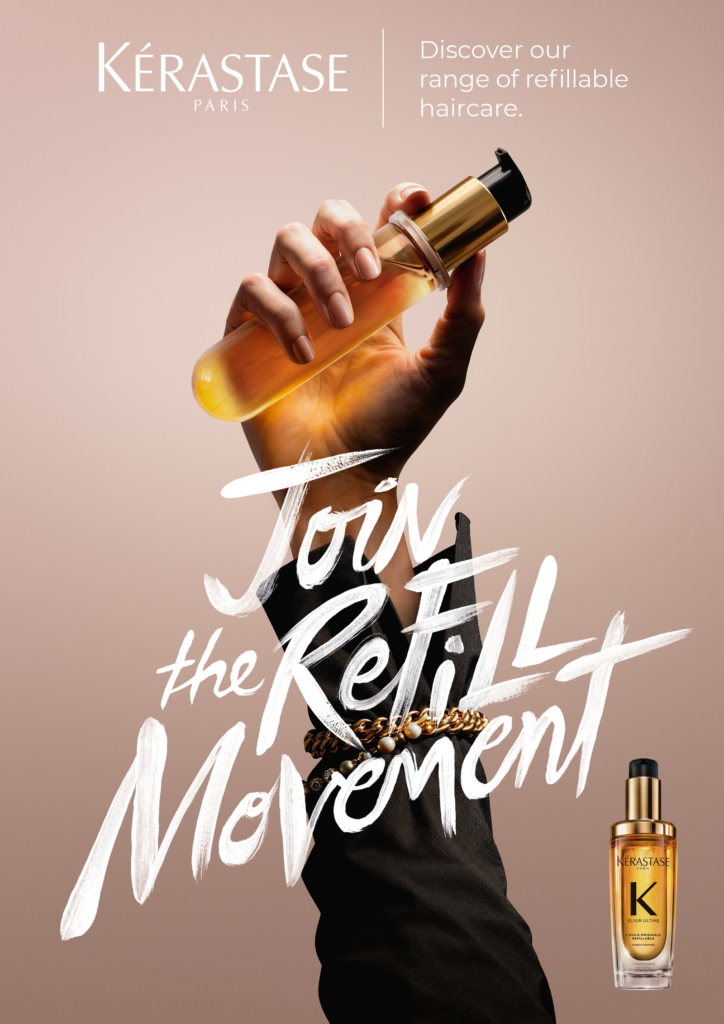
L’Oréal Groupe is doubling down on refillable beauty with the launch of the third edition of its global #JoinTheRefillMovement campaign, marking its largest corporate sustainability push to date.
Timed to coincide with World Refill Day, the campaign aims to make refillable beauty products more mainstream across South Asia Pacific, the Middle East and North Africa (SAPMENA). It spans skincare, fragrance, makeup and haircare, with more L’Oréal brands joining the initiative and working alongside retail partners to improve the visibility and availability of refill options both in-store and online.
The move comes as consumers increasingly seek more sustainable purchasing options. According to a KANTAR survey cited by L’Oréal, 84% of consumers want to make more sustainable choices, although awareness of refillable alternatives remains a challenge.
To bridge that gap, the campaign will focus on increasing discoverability, highlighting the convenience and performance of refill products, and making cost savings clearer to consumers.
Don’t miss: Why YSL Beauty’s ‘Block party’ at a KL kopitiam signals luxury’s cultural shift
Participating brands in the SAPMENA region include Yves Saint Laurent Beauty, Armani Beauty, Lancôme, Kiehl’s, La Roche-Posay, CeraVe, Kérastase and L’Oréal Professionnel. Refillable products featured in the campaign include Kiehl’s Ultra Facial Cream, Lancôme Génifique Ultimate Serum, La Roche-Posay Effaclar Foaming Gel, CeraVe Moisturising Cream, YSL Beauty Touche Éclat Mesh Cushion and Kérastase Elixir Ultime L’Huile Originale.

To help consumers understand the environmental impact of choosing refills, each product carries its own packaging reduction claim. For example, L’Oréal said opting for a Lancôme Absolue Longevity Soft Cream refill instead of repurchasing the standard jar reduces the use of glass by 100%, metal by 95%, plastic by 42% and cardboard by 36%.
Rohini Behl, chief sustainability officer at L’Oréal SAPMENA, said the region’s rapidly growing beauty market is being shaped by a young and increasingly conscious consumer base.
“With consumers in the region increasingly seeking more sustainable beauty options, we are actively expanding our refillable portfolio to cater to this growing demand,” said Behl.
“Sustainability is at the heart of everything we do at L’Oréal, and this campaign reaffirms our commitment to building a beauty industry in SAPMENA with circularity at its core,” she added.
Meanwhile, Ezgi Barcenas, chief corporate responsibility officer at L’Oréal, said making refills mainstream requires change across the industry’s value chain, from product design and manufacturing to retail partnerships and consumer engagement.
Refill products are available through official brand channels, department stores and eCommerce platforms including Lazada, Shopee, TikTok and Nykaa. L’Oréal is also partnering with retailers across the region, including Sephora in Singapore and the GCC, Bin Sina in the UAE, Adore Beauty in Australia, Amazon in India and Beauty Success in Morocco.
The campaign builds on L’Oréal’s wider investment in refill infrastructure and circular packaging innovation. According to the company, the number of refillable products across the Group increased 3.7 times between 2019 and 2025.
Refills also form part of L’Oréal’s broader packaging sustainability strategy, supported by its 100 million-euro “L’AcceleratOR” programme, which invests in next-generation packaging solutions such as seaweed-based materials, sugarcane-derived bioplastics and recyclable paper bottles.
The regional push follows similar market-level initiatives launched by L’Oréal in recent years. In Indonesia, the company used World Refill Day 2025 to promote refill adoption across its luxury and skincare portfolio, citing growing consumer demand for sustainable products and willingness among younger shoppers to pay more for refillable options.
Related articles:
Maybelline reimagines iconic jingle with Miley Cyrus as global face
Kiehl’s won’t beat around the bush following ad censorship
YSL Beauty’s IWD ad: A masterclass in authentic activism or a short-term ploy?