CFA Institute

6 Reasons to Avoid Hedge Funds

While most people will agree about holding traditional assets like stocks and bonds in their portfolios, hedge funds are more controversial. I generally recommend sticking to stocks and bonds. This post, the final in a three-part series, outlines a few observations in support of my position. The Returns Aren’t Great The best hedge fund managers are probably skilled. According to research, hedge fund managers created up to $600 billion in value-added from 2013 to 2019. However, this value-added was calculated before fees. Net of fees, this figure is much lower, as managers capture most of the value they create, leaving investors with the crumbs. One group of researchers recently found that hedge fund fees capture 64% of gross returns. Most studies reveal that hedge fund returns are mediocre, particularly post-2008. There is no way to predict if the higher performance observed before 2008 will reoccur. Some observers claim that rising assets under management make it difficult for hedge funds to perform due to declining returns to scale, but the evidence is limited. Overall, the best hedge fund managers may have skill, but that does not necessarily translate into outstanding returns for investors. Also worth considering is the fact that, while hedge funds generally do provide modest returns, investors tend to underperform the funds they hold by a wide margin due to poor timing of inflows and outflows. The Diversification Benefits Are Limited                      Adding hedge funds to a portfolio of stocks and bonds can improve risk-adjusted returns, as measured by traditional metrics such as the Sharpe Ratio. However, hedge fund returns have declined substantially since 2008, so replacing part of the portfolio’s equity component may lead to an undesired underperformance. Further, hedge funds have an asymmetrical fee structure: The manager receives performance fees when the fund makes a profit but does not have to compensate the fund when it loses money. Such a fee structure may induce some hedge fund managers to adopt strategies that offer regular modest profits at the cost of occasional steep losses. In other words, many hedge funds are riskier than they appear. The Fees Are Way Too High I find hedge fund fees horrendous. Paying performance fees beyond the already pricey 1.5% average base fee is bad enough, but 86% of hedge funds’ performance fees are not subject to any hurdle rate. There is no merit in earning a return that only exceeds base fees. In addition, one-third of hedge funds do not have a high-water-mark feature to prevent managers from charging performance fees on a losing fund. But even with a high-water mark feature, investors may pay performance fees on poor-returning funds when deep losses follow early successes. For investors looking to invest in a diversified hedge fund solution, funds-of-funds will increase the burden of costs with a second layer of fees over and above those of each constituent product. Another problem arises when investors hold a diversified pool of hedge funds, with winning and losing funds. While the winning funds may legitimately charge performance fees, the losing funds reduce the total pool of profits generated by the hedge fund portfolio in aggregate. As a result, the investor could be paying a much higher rate than the contractual performance fees. A study surveying a pool of almost 6,000 hedge funds found that while the average performance fee of this pool was 19%, investors paid nearly 50% of the aggregate funds’ gross profit. Complexity Is Not Your Friend Hopefully, this series has persuaded you that hedge funds are way more complex than basic stock and bond funds. Research has demonstrated that financial firms increase their profit margins by purposely creating complex financial products. Complex products create information asymmetry, enabling highly informed financial firms to negotiate from a position of strength with relatively less informed clients. Financial firms can make complex products look attractive by exploiting investors’ cognitive biases, such as myopic loss aversion, recency effect, and overconfidence. As economist John Cochrane once said: “The financial industry is a marketing industry, 100%.” Investors beware. Attempts to Predict Outperformers Will Likely Fail Research suggests characteristics such as manager ownership, strategy distinctiveness, or not being listed in a commercial database may help identify winning hedge funds. But any filtering strategy will likely produce dozens or even hundreds of candidate funds from which to choose. These candidates will include several false positives. For example, Swedroe (2024) highlights that a small minority of outperforming funds heavily influences the positive alpha observed in non-listed funds. Most hedge fund literature also finds performance persistence only over short horizons, which is not helpful for long-term investors’ fund selection. Even if you select a superior hedge fund, it will not necessarily accept money from you. Many choose to work only for large institutions, and others refuse new capital as they have reached their full capacity to generate alpha. Finally, even some of the most resourceful investment organizations gave up hedge funds, often because they couldn’t find enough alpha to justify their high fees, opacity, and complexity. Personal Experience Other reasons for shunning hedge funds come from personal observations. Financial success depends on disciplined saving and investing, not fancy investment products and high returns. Evidence suggests investors aren’t very good at picking winning active fund managers, and I haven’t seen evidence that hedge fund selection is any easier. Investors often build and preserve wealth because they sense “enough” and, to some extent, favour prudence over extra profit. In contrast, damaging losses sometimes occur when investors stretch their portfolio risk for “a little more return.” This is particularly true when dealing with opaque and complex investment products. You May Also Like Part I / Beyond the Hype: Do Hedge Funds Deliver Value? Part II / Beyond the Marketing Pitch: Understanding Hedge Fund Risks and Returns source

6 Reasons to Avoid Hedge Funds Read More »

The MENA Investment Puzzle: Why Regional Integration Still Eludes Capital Markets

Despite shared language, overlapping demographics, and ambitious development agendas, the Middle East and North Africa (MENA) remains one of the least financially integrated regions globally. Investors seeking exposure to MENA face disjointed regulatory systems, currency regimes, and unresolved political divides. The economic logic for integration is sound: scaling markets, lowering transaction costs, and improving price discovery. So why do MENA’s capital markets remain so fragmented? And what would meaningful integration mean for risk pricing, portfolio strategy, and regional growth? This article examines the structural, regulatory, and political barriers to that integration, outlines practical steps toward a more connected regional market, and explores how investors can position themselves in the meantime. The Promise vs. Reality Integration is not a new idea. The Arab Monetary Fund, the Gulf Cooperation Council (GCC) coordination platforms, and pan-regional economic summits have all attempted to promote capital connectivity. But on-the-ground realities tell a different story: FX friction: Hard pegs, managed floats, and parallel markets complicate currency settlement and hedging. Restricted listings: Cross-exchange activity is rare. Large firms in Egypt, the United Arab Emirates (UAE), and Saudi Arabia operate mostly within domestic boundaries. Capital controls: Foreign ownership limits, repatriation hurdles, and disclosure gaps deter fund structures that span multiple MENA markets. Indexing deficits: No credible regional equity benchmark captures diversified sector exposure across the Maghreb, Levant, Gulf, and now, Israel. Even well-capitalized and regionally headquartered sovereign wealth funds choose to allocate internationally rather than within MENA itself. Structural Barriers Three layers of fragmentation hinder integration: Capital account rigidity: Countries like Algeria and Tunisia maintain tight controls. Even liberalizing markets impose licensing thresholds for foreign investors. Divergent regulations: Listing standards, audit requirements, and governance frameworks vary widely. An offering cleared in Abu Dhabi may stall in Casablanca. Currency exposure without instruments: Derivatives markets are thin or nonexistent, leaving investors exposed to FX volatility without tools to hedge. These obstacles force asset managers to build exposure country-by-country, each with different legal structures, tax codes, and macro risk profiles. Integration in Name, Isolation in Practice GCC sovereign funds (e.g., PIF, Mubadala) manage more than $4 trillion. Yet most investments target Asia, Europe, and North America, not neighboring MENA markets. North Africa’s privatization progress is uneven. Egypt attracts global interest, but Algeria’s closed regime and Tunisia’s inconsistent reform path deter regional capital flows. Pan-MENA investment vehicles (REITs, ETFs) remain aspirational. Liquidity constraints and inconsistent regulations limit cross-border scale. Israel: A regional Anchor with Asymmetric Connectivity Historically excluded from MENA frameworks, Israel now maintains formal economic ties with the UAE, Bahrain, and Morocco under the Abraham Accords. Its financial ecosystem adds a new dimension: Market maturity: The Tel Aviv Stock Exchange offers deep liquidity, transparent governance, and robust investor protections. Capital corridor growth: Israeli VCs and Gulf sovereign funds are forging co-investment channels in infrastructure, fintech, and defense tech. Regulatory compatibility: While not harmonized, Israel’s standards align closely with global benchmarks, making cross-border partnerships feasible. Recent developments like the Abraham Accords have opened new economic corridors between Israel and Arab economies, yet full financial integration remains uneven across the region. The comparative table below summarizes fragmentation across key MENA markets, capturing differences in capital mobility, currency regimes, and listing infrastructure including Israel’s evolving position. Table 1: MENA Market Fragmentation Index Source: Author’s analysis based on publicly available regulatory and market data as of 2025. Fragmentation Score is a qualitative composite derived from assessments of capital mobility, FX regime flexibility, and cross-border listing infrastructure. Data references include IMF Article IV reports, World Bank Financial Sector Assessments, central bank publications, and regional stock exchange disclosures. Note: This index is author-constructed for illustrative purposes and does not represent a formal benchmark or investment recommendation. Investor Implications Fragmentation elevates risk premiums, even in stable economies, due to regional contagion and disjointed legal frameworks. Diversification is harder: Without true cross-border instruments, investors must manually construct region-wide exposure, a costly and inefficient process. Capital lacks scalability: Infrastructure, fintech, and logistics are growing in pockets, but lack of integration curtails cross-market scale. Outlook: Signals of Progress, Not Cohesion MENA’s financial integration remains uneven. Yet bilateral corridors, particularly post-Abraham Accords, suggest a pragmatic path forward: Harmonize disclosures and listing norms across exchanges. Build FX and clearing infrastructure to facilitate multi-currency transactions. Mobilize sovereign funds for joint ventures and regional ETFs. Engage supranational institutions to standardize frameworks and mitigate geopolitical friction. For investors, that means building strategies that reflect the region’s structural segmentation while staying alert to emerging corridors of progress that could redefine the opportunity set. Until then, investors must treat MENA not as a unified market, but as a strategic mosaic — rich with opportunity, but segmented by design. So What? The road ahead will require deliberate collaboration between regional leaders, regulators, and institutional investors. The prize is clear: lower costs, deeper liquidity, and scalable growth. The steps are known: align rules, build infrastructure, and deploy capital with a regional lens. Until that alignment happens, success in MENA will come to those who can navigate its many borders with precision and patience. The PNC Financial Services Group, Inc. (“PNC”) provides investment consulting and wealth management, fiduciary services, FDIC-insured banking products and services, and lending of funds to individual clients through PNC Bank, National Association (“PNC Bank”), which is a Member FDIC, and provides specific fiduciary and agency services to individual clients through PNC Delaware Trust Company or PNC Ohio Trust Company. PNC provides various discretionary and non- discretionary investment, trustee, custody, consulting, and related services to institutional clients through PNC Bank, and investment management services through PNC Capital Advisors, LLC, a wholly-owned subsidiary of PNC Bank. PNC does not provide legal, tax, or accounting advice unless, with respect to tax advice, PNC Bank has entered into a written tax services agreement. PNC Bank is not registered as a municipal advisor under the Dodd- Frank Wall Street Reform and Consumer Protection Act. “PNC” is a registered mark of The PNC Financial Services Group, Inc. Investments: Not FDIC Insured. No Bank Guarantee. May Lose Value. ©2025 The PNC Financial Services

The MENA Investment Puzzle: Why Regional Integration Still Eludes Capital Markets Read More »

Book Review: Plunder

Plunder: Private Equity’s Plan to Pillage America. 2023. Brendan Ballou. PublicAffairs. People stop in their tracks when they see the cover of the book I’m reading — Plunder — with its frightening depiction of skull and crossbones. “What are you reading? It must not be happy subject matter!” Private equity investing is not everyday talk among friends — but considering its size and growth among investment choices and its possible impacts on the broader economy, it should be everyday conversation among investment professionals. Author Brendan Ballou presents a meta-analysis of the worst of private equity investment practices, thus compelling investors to take a deeper look into their illiquid private equity commitments. With experience as a federal prosecutor and special counsel for private equity at the US Department of Justice, Ballou presents a comprehensive study that will influence decision makers’ analytical and ethical approach to the asset class. It will shake you up. It also serves as a call to action to monitor specific and repetitive activities of private equity that benefit the operators and no one else. Like me, you may have a substantially different personal history with private equity investing than the author. More than 30 years ago, corporate executives and investors were seeking systematic ways to improve operating and financial efficiency. The concept of kaizen was sweeping Corporate America, even though it originated in Japan. It specifically dealt with the “continuous improvement” of a business through the elimination of waste. Just-in-time (JIT) inventory management became a buzzword in corporate earnings calls. This sort of tough medicine was the cure for what ailed US business. Consider the plundering by such “pirates” as “Chainsaw Al” — Albert J. Dunlap, infamous corporate raider and author of Mean Business: How I Save Bad Companies and Make Good Companies Great. We read of him almost every day when he was active in his business dealings, which seemed so mean to existing employees, suppliers, and customers. Still, it was widely thought that such practices were needed. The present reality and possible future of private equity investing in the United States are Ballou’s focus. He presents industry-specific examples of private equity at its worst, prompting readers to evaluate their own experiences with it, both personal and professional. As he delves into the heavily affected industries— specifically housing, nursing homes, prisons, retailers, for-profit education, and health care — the persistent “tools of the trade” of typical private equity operation emerge: leasebacks, dividend recapitalizations, strategic bankruptcies, tax avoidance, roll-ups, and murky corporate structures. Yet, Ballou also acknowledges the possible benefits of private equity investment, such as providing access to funding (or access at a lower cost), expert management by industry specialists, efficient global sourcing, operational and financial improvements, and even improved corporate and employee relations. Customers may benefit from greater consistency in product, faster access, and better pricing. Private equity firms can potentially profit from economies of scale and professional management at all levels, but in the cases presented in Plunder, their way of doing business results in disastrous conditions for employees and clients and the death of once viable, cash-rich companies. The carried interest loophole is probably the most prized tax benefit of private equity; it affects a substantial portion of the money made in the business. The typical fee of 2% of assets under management is taxed as ordinary income, while the private equity firm’s 20% share of profits earned above a specified threshold is taxed at the lower capital gains tax rate. Talk of ending this tax advantage has been floating around Congress for at least 20 years. Notwithstanding Dodd–Frank regulations and the 2019 attempted passage of the “Stop Wall Street Looting Act,” the plunder continues. The author notes that private equity is a potent force in congressional matters; these firms have donated more than $896 million on a bipartisan basis to candidates and members since 1990. Additionally, private equity could pose systemic risk to the economy, particularly because of its expansion into insurance, retirement funds, and private credit. The author’s wish list of solutions to private equity abuses seems like a litany of impossible dreams to me, especially considering talk among some in Congress of achieving permanent spending cuts by reducing or eliminating certain departments that oversee business. Nevertheless, to constrain private equity firms’ abuses in specific industries and prevent private equity’s worst excesses, substantive actions could be taken through the Department of Justice, Department of Health and Human Services, the Securities and Exchange Commission, and most notably, the Internal Revenue Service and the Treasury Department. Some of Ballou’s suggested solutions are more realistic and practical than others. I commend the author for releasing this exceptionally well researched exposé of the industry. His extensive notes expand the book’s content and impact. Plunder has made me question the merits of private equity, an investment I originally considered to have a high level of investment integrity and a positive influence on corporate governance. If you liked this post, don’t forget to subscribe to the Enterprising Investor. All posts are the opinion of the author(s). As such, they should not be construed as investment advice, nor do the opinions expressed necessarily reflect the views of CFA Institute or the author’s employer. Professional Learning for CFA Institute Members CFA Institute members are empowered to self-determine and self-report professional learning (PL) credits earned, including content on Enterprising Investor. Members can record credits easily using their online PL tracker. source

Book Review: Plunder Read More »

Myth-Busting: The Economy Drives the Stock Market

Introduction Switch on Bloomberg TV or CNBC at any time of the day and there is a good possibility the host will be explaining the daily ups and downs of the stock market as a function of the latest economic news. Unemployment is down, stocks are up. Inflation is up, stocks are down. And so on. The underlying assumption is that the stock market represents the economy. Yet most economic data is released on a quarterly basis, and on many days there isn’t any significant news. So, what do stocks trade on on those days? And what about when the stock market gets carried away? After all, too much investor enthusiasm led to technology bubbles in 2000 and 2021, for example. While economic growth was strong during those times, in hindsight it hardly justified such sky-high returns and valuations. So, how much does the economy matter to the stock market? It may be that sometimes it matters very much and at others time much less. Let’s explore. US GDP Growth vs. Stock Market Returns The US economy is driven primarily by consumers whose spending accounts for 70% of GDP. The remaining 30% is split almost equally among private investment and government spending. Net exports are close to zero; the United States imports slightly more goods and services than it exports.  This composition is hardly analogous to the US stock market, where technology, health care, and financials are among the top three industrial sectors. Naturally, many companies sell directly to the consumer, but more tend to focus on businesses and international markets. For example, Apple, the public company with the largest market capitalization, generates close to 70% of its sales abroad. So, does the US stock market really represent the larger economy? Well, the annual change in real US GDP and the S&P 500 shows broadly the same trends over the last 20 years. When the economy crashed in 2008, so did the stock market. When the economy recovered from the global pandemic in 2021, so did the S&P 500. US Real GDP Growth vs. US Stock Market Returns, Since 2002 Sources: Finominal, Kenneth R. French Data Library, and St. Louis Fed But if we extend the lookback as far as the available quarterly real US GDP data will take us, then the relationship between US GDP and the S&P 500 becomes less clear. Between 1948 and 1962, they tracked each other closely, but not so much in the period thereafter: The US economy expanded rapidly, despite several stock market crashes, until the oil crisis in 1970. In later time frames, however, both GDP growth and S&P 500 returns again moved synchronously. US Real GDP Growth vs. US Stock Market Returns, Since 1948 Sources: Finominal, Kenneth R. French Data Library, St. Louis Fed Correlation between US Economy and US Stock Market To quantify the relationship between the US economy and the stock market, we calculated rolling 10-year correlations. Between 1958 and 1993, the correlation declined to zero from 0.7. It increased to 0.8 thereafter. The correlation decoupled again during the COVID-19 crisis in 2020, when the economy tanked, but the S&P 500 finished the year on a bull run thanks to massive fiscal and monetary stimulus. US Real GDP Growth vs. US Stock Market Returns: 10-Year Rolling Correlations, Since 1958 Sources: Finominal, Kenneth R. French Data Library, St. Louis Fed We extended our analysis back to 1900 using annual data from MacroHistory Lab. Since the stock market is forward-looking and tends to anticipate economic news flows, we instituted a one year lag. So for 2000, we compared that year’s GDP numbers with the performance of the S&P 500 in 1999. Again, the US economy and stock market showed high correlation throughout most of this period. Correlations only fell off considerably four times: during the Great Depression, World War II, the 1990s, and the global pandemic. All of which suggests the S&P 500 was a good proxy for the US economy for much of the last 120 years. US Real GDP Growth vs. US Stock Market Returns: 10-Year Rolling Correlations, Since 1900 Sources: Finominal, MacroHistory Lab International Evidence But thus far our analysis is confined to the United States. Does GDP growth and stock market performance show similar correlations in other parts of the world? The evidence from Asia Pacific tells a different story. China’s economy expanded at fairly regular and impressive rates from 1991 to 2019. The Shanghai Composite Index’s performance, however, was much less consistent. It has had some exceptional years, with gains in excess of 100%, as well as some dismal ones, with declines of more than 50%. What explains this divergence? Perhaps the Shanghai Composite, which only launched in 1991, has not yet reached the point where it reflects China’s modern and dynamic market-based economy. Historically, the Shanghai Composite has listed many state-owned enterprises (SOEs), which have different governance structures, for example. China’s retail investment market has also been bubble-prone, so much so that Chinese regulators have imposed a 10% daily limit on stock price movements. China GDP Growth vs. Shanghai Composite Index Sources: Finominal, MacroHistory Lab Other industrialized markets show different relationships depending on the country and timeframe under analysis. After calculating the 10-year rolling correlations for 14 developed markets from 1900 to 1959, 1960 to 1999, and 2000 to 2020 we found the median correlations between real GDP growth and stock market returns increased to 0.6 from 0.2. We attribute this to decades of relative peace combined with a trend towards more capitalistic economies with larger and more diversified stock markets.  Not all countries experienced the same trajectory, however: The Belgian GDP growth-to-stock-market-returns correlation changed little during the 1960–1999 and 2000–2020 periods, and the correlation in Australia has gone negative over the last 20 years with steady GDP growth combined with an up-and-down stock market. Real GDP Growth vs. Stock Market Returns: 10-Year Rolling Correlations Sources: Finominal, MacroHistory Lab Further Thoughts Given the lack of long-term data, our analysis is confined to developed markets, but we expect

Myth-Busting: The Economy Drives the Stock Market Read More »

Factor Premiums: An Eternal Feature of Financial Markets

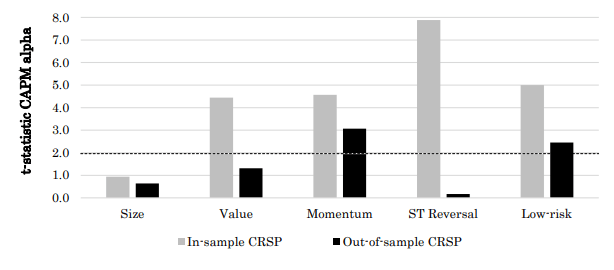
A broad segment of the industry invests based on established factors such as value, momentum, and low-risk. In this post, we share the key results from our study of out-of-sample factors over a sizable and economically important sample period. Using the longest sample period to date — 1866 to the 2020s — we dispel concerns about the data mining and performance decay of equity factors. We find that equity factors are robust out-of-sample and have been an ever-present phenomenon in financial markets for more than 150 years. Data Mining Concerns are Real Why did we conduct this study? First, more research on factor premiums is needed, especially using out-of-sample data. Most practitioner studies on equity factors use samples that date back to the 1980s or 1990s, covering about 40 to 50 years. From a statistical perspective, this is not a substantial amount of data. In addition, these years have been unique, marked by few recessions, the longest expansion and bull market in history, and, until 2021, minimal inflationary episodes. Academic studies on equity factors often use longer samples, typically starting in 1963 using the US Center for Research in Security Prices (CRSP) database from the University of Chicago. But imagine if we could double that sample length using a comprehensive dataset of stock prices. Stock markets have been essential to economic growth and innovation financing long before the 20th century. Second, academics have discovered hundreds of factors—often referred to as the “factor zoo.” Recent academic research suggests many of these factors may result from data dredging, or statistical flukes caused by extensive testing by both academics and industry researchers. A single test typically has a 95% confidence level, implying that about one in every 20 tests will “discover” a false factor. This issue compounds when multiple tests are conducted. It is critical given that millions of tests have been performed in financial markets. This is a serious concern for investors, as factor investing has become mainstream globally. Imagine if the factors driving hundreds of billions of dollars in investments were the result of statistical noise, and therefore unlikely to deliver returns in the future. Figure 1 illustrates one of the motives behind our study. It shows the test statistics for portfolios of size, value, momentum, and low-risk factors over the in-sample and out-of-sample periods within the CRSP era (post-1926). Consistent with earlier studies, most factors exhibit significance during the in-sample period. However, results look materially different over subsequent out-of-sample periods with several factors losing their significance at traditional confidence levels. This decline in the performance of equity factors can be attributed to multiple reasons, including limited data samples, as discussed in the literature. Regardless, it underscores the need for independent out-of-sample tests on equity factors in a sufficiently sizable sample. In our research paper, we tackle this challenge by testing equity factors out-of-sample in a sample not touched before by extending the CRSP dataset with 61 years of data. Figure 1. Source: Global Financial Data, Kenneth French website, Erasmus University Rotterdam Stock Markets in the 19th Century Before diving into the key results, let’s outline the US stock market in the 19th century. In our paper, we collect information from all major stocks listed on the US exchanges between 1866 and 1926 (the start date of the CRSP dataset). This period was characterized by strong economic growth and rapid industrial development, which laid the foundation for the United States to become the world’s leading economic power. Stock markets played a pivotal role in economic growth and innovation financing, with market capitalizations growing more than 50-fold in 60 years — in line with US nominal GDP growth over the same period. In many ways, 19th- and 20th-century markets were similar. Equities could be easily bought or sold across exchanges via dealer firms, traded via derivatives and options, purchased on margin, and shorted, with well-known short sellers. Major 19th century technological innovations such as the telegraph (1844), the transatlantic cable (1866), the introduction of the ticker tape (1867), the availability of local telephone lines (1878), and direct phone links via cables facilitated a liquid and active secondary market for stocks, substantial brokerage and market-making activities, quick arbitrage between prices, fast price responses to information, and substantial trading activities. Price quotations were known instantly from coast to coast and even across the Atlantic. Much like today, investors had access to a wide range of reputable information sources, while a sizable industry of financial analysts provided market assessments and investment advice. Further, trading costs in the 19th century were not very different from 20th century costs. Market information and academic studies reveal transaction costs on higher-volume stocks and well-arbitraged NYSE stocks to be around 0.50% but have traded at the minimum tick of 1/8th during both centuries. Further, in the decade prior to World War I, the median quoted spread at the NYSE was 86 basis points and a quarter of trades took place with spreads less than 36 basis points. Moreover, share turnover on NYSE stocks was higher between 1900 and 1926 than in 2000. Overall, US stock markets have been a lively and economically important source of trading since the 19th century, providing an important and reliable out-of-sample testing ground for factor premiums. The Pre-CRSP Equity Dataset   Constructing this dataset was a major effort. Our sample includes stock returns and characteristics for all major stocks since 1866. Why 1866? It’s the start date of the Commercial and Financial Chronicle, a key source also used by the CRSP database. You may wonder why CRSP starts in 1926. While the exact reason remains speculative, it seems arbitrary, ensuring the inclusion of some data from before the 1929 stock market crash. In our paper, we hand-collected all market capitalizations — highly relevant to study factor premiums and stock prices. In addition, we hand-validated samples of price and dividend data obtained from Global Financial Data — a data provider specialized in historical price data. Unlike CRSP, we focused our data collection on all major

Factor Premiums: An Eternal Feature of Financial Markets Read More »

Book Review: Milton Friedman

Milton Friedman: The Last Conservative. 2023. Jennifer Burns. Farrar, Straus and Giroux. If you were asked to identify a famous economist based on the following facts, whom would you name? Voted for Democrat Franklin Roosevelt for president in 1936. Supported significant portions of Roosevelt’s New Deal, which some critics deemedsocialistic. Favored moderate Dwight Eisenhower over conservative icon Robert Taft for the 1952Republican presidential nomination. Disdained anticommunist scourge Senator Joseph McCarthy. Attacked the fervently right-wing John Birch Society as “fundamentally wrong.” Considered the gold standard flawed. Said, in connection with public welfare, “[T]here are important functions that must be performed by the state,” too sensitive to be left “entirely to private charity or local responsibility.” Opposed “right to work” laws. Maintained that John Maynard Keynes was correct in arguing that the government must prop up demand during crises. Criticized supply-side economics and denied that tax cuts were consistently self- financing. Milton Friedman (1912–2008) may not be the first name that pops to mind. Connecting him with these bullet points seems especially paradoxical in view of the subtitle of Jennifer Burns’s biography of the Nobel laureate — “The Last Conservative.” Burns shows, however, that Friedman’s views on various issues evolved over time and that his libertarian outlook sometimes put him at odds with conservative orthodoxy, as in his advocacy of government-provided universal basic income. Friedman unquestionably influenced public policy, notably through his campaigns to abolish the draft and institute school vouchers. The rationale for reviewing this book in Enterprising Investor, however, springs from Friedman’s economic contributions rather than his political views. Most famously, Friedman, working with Anna Schwartz, found that controlling the quantity of money was the key to maintaining stable economic growth. This is not to say that the duo’s celebrated treatise on the topic settled the matter once and for all. As Burns documents, other prominent economists rejected the Friedman–Schwartz thesis or incorporated it into a synthesis dubbed the New Keynesianism. The Fed, for its part, alternated between managing interest rates and managing monetary aggregates. In short, Friedman did not entirely remake economic policy, yet he unquestionably remains a force to be reckoned with, someone whose ideals at the very least one might contrast to one’s own. On the first page of her introduction, Burns quotes Joe Biden on the campaign trail in 2020: “Milton Friedman isn’t running the show anymore!” Friedman achieved his enduring place in the discussion in no small part through forceful defense of his propositions and skewering of opposing views. Burns maintains that Kenneth Arrow, Paul Samuelson, and James Tobin all declined opportunities to join the University of Chicago faculty because they dreaded the thought of having to face Friedman daily. Tjalling Koopmans told colleagues that Friedman’s relentless criticism threatened his sanity, leading him to take a leave of absence at a therapeutic music camp. Ultimately, the value to investment professionals of Milton Friedman: The Last Conservative lies in the opportunity to gain a deeper understanding of economic theory by studying its history. Burns informatively traces the development of, and conflicts between, such concepts as Austrian economics, Keynes’s and Friedman’s (developed with Margaret Reid) contrasting theories of the consumption function, and the relative income and wealth-income hypotheses. Reading these narratives reminds the practitioner that any given economist’s forecast of GDP, inflation, or interest rates rests on premises that are far from being universally acknowledged as certainties. Neither will every economist concur with each of the author’s pronouncements. For instance, Burns blames the Great Depression–era bevy of bank failures primarily on fractional reserve banking. She does not mention state prohibitions of, or restrictions on, branch banking. Those unit banking laws led to vast numbers of banks being excessively concentrated in loans tied to a single industry that dominated the local economy. In addition, Burns calls the abstraction of perfect competition “an unrealistic yet useful assumption.” She does not point out that Friedrich Hayek, a prominent figure in the book, strenuously argued that perfect competition was in fact useless as a heuristic point of departure. Perfect competition assumes perfect knowledge, thereby ignoring the essential feature of fragmented information and the all-important acquisition of knowledge through the market process. Burns depicts Frank Knight explaining profits, which would not exist under conditions of perfect competition, on the basis of uncertainty. No less important, though, is the time value of money, which is absent from her discussion. Someone must advance the capital to construct the means of producing goods before they can be sold. The providers expect to be compensated for deferring the consumption that their money could alternatively fund. In the end, though, it is Friedman’s economic interpretations, rather than the author’s, that matter most to the reader. At 575 pages including her lengthy Notes and Index sections, Burns’s book is not a quick read, but it is a lively one. She adorns the text with the sort of verbal play for which her subject was known. “But in the long run,” she writes, “Bretton Woods was dead,” alluding to a frequently cited — and widely misunderstood — remark by Keynes. Burns embeds allusions in chapter titles, as well. For example, “Hidden Figures,” dealing with Friedman’s underrecognized female collaborators, borrows the title of a 2016 film about African-American women who played an important but, at the time, largely uncredited role in the US space program. All in all, conscientious participants in investment decision making will derive both pleasure and professional enrichment from Milton Friedman: The Last Conservative. If you liked this post, don’t forget to subscribe to Enterprising Investor and the CFA Institute Research and Policy Center. * The reviewer thanks Gene Epstein for his suggestions. Any errors or omissions are solely the reviewer’s responsibility. All posts are the opinion of the author. As such, they should not be construed as investment advice, nor do the opinions expressed necessarily reflect the views of CFA Institute or the author’s employer. Professional Learning for CFA Institute Members CFA Institute members are empowered to self-determine and self-report professional learning (PL) credits earned, including content on Enterprising

Book Review: Milton Friedman Read More »

Is the Copper–Gold Ratio a Dependable Leading Indicator on Rates?

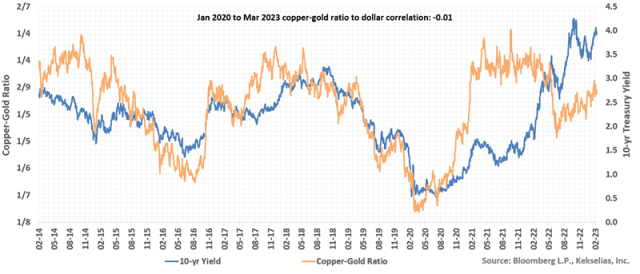
The Copper–Gold Ratio and Dollar Effects Institutional asset managers use the copper–gold ratio as one of the 10-year Treasury yield’s leading indicators. Indeed, as the spread between bond yields and the ratio widened in the third quarter of 2022, DoubleLine Capital CEO and Chief Investment Officer Jeffrey Gundlach cited the relationship, observing that “the 10-year US Treasury fair value yield is below 2%.” As the divergence persisted earlier this year, the copper–gold ratio was, in Gundlach’s words, “screaming that the 10-year should go lower.” Copper–Gold Ratio vs. 10-Year Treasury Yield But given asset managers’ focus on the ratio’s connection to Treasury yields, we need to understand the market catalysts that influence this relationship, particularly the US dollar, because there are signs that the ratio’s utility may weaken under certain market conditions. Copper and gold are both dollar-denominated commodities that exhibit negative correlations with the currency. Daily data from 2020 to 2023 indicate a correlation coefficient of –0.10 between copper futures and the Dollar Index. Gold’s correlation with the Dollar Index showed a coefficient of –0.31 over the same period. These metrics make intuitive sense: The dollar’s appreciation relative to local currencies should increase commodity prices for non-dollar buyers. Indeed, a strong dollar has a tightening effect on global economic activities, according to Bank for International Settlements (BIS) analysis. The following charts bear out this relationship. Copper Futures vs. Dollar Index Gold vs. Dollar Index Since the dollar is a shared input of both copper and gold valuations, the ratio of gold and copper largely neutralizes this effect as demonstrated by their –0.01 correlation with the Dollar Index. While this magnifies copper’s sensitivity to economic growth, it also increases tracking error relative to such dollar-influenced instruments as US Treasuries. Treasury Yield and Dollar Valuation: Nuanced Dynamics The correlation coefficient of the 10-year Treasury yield and the Dollar Index reached as high as 0.82 over our 2020 to 2023 analysis period. Despite such positive correlation, the dollar’s relationship with Treasury yields is much more nuanced. During an easing cycle instituted by a dovish US Federal Reserve, a weaker dollar tends to correlate with lower Treasury yields. Conversely, a hawkish Fed ought to strengthen the dollar and push short- and longer-term rates higher. In a Goldilocks economy with no policy shift, however, negative shocks should fuel flight-to-haven flows to both the dollar and Treasuries. This is what happened during the commodity rout of 2014 and 2015 and again during the 2019 “repo crisis.” The copper–gold ratio and other dollar-sensitive metrics should diverge from rates given their positive correlation with the dollar. 10-Year Treasury Yield vs. Dollar Index Copper–Gold Ratio Is Vulnerable to Macro Paradigm Shift Furthermore, shifts in global dollar demand driven by geopolitical factors could act as headwinds for both the dollar and Treasury securities. In “War and Peace,” Credit Suisse analyst Zoltan Pozsar said geopolitical currents could reduce foreign reserve managers’ appetite for dollar bonds. In such a scenario, a weaker dollar could co-exist with weaker Treasuries and exacerbate the divergence between the copper–gold ratio and the 10-year yield. Foreign holdings of US Treasuries have already declined in recent years, and Pozsar suspects this trend may persist. Foreign Holdings of US Treasuries As the dollar and Treasuries increasingly respond to global macro catalysts, the copper–gold ratio and other, less dollar-sensitive, indicators may overlook emerging drivers. And that could erode their utility as indicators. If you liked this post, don’t forget to subscribe to the Enterprising Investor. All posts are the opinion of the author. As such, they should not be construed as investment advice, nor do the opinions expressed necessarily reflect the views of CFA Institute or the author’s employer. Image credit: ©Getty Images / bodnarchuk Professional Learning for CFA Institute Members CFA Institute members are empowered to self-determine and self-report professional learning (PL) credits earned, including content on Enterprising Investor. Members can record credits easily using their online PL tracker. source

Is the Copper–Gold Ratio a Dependable Leading Indicator on Rates? Read More »

“Build, Partner and Buy”: AI and the New M&A Model

Amid the current artificial intelligence (AI) hype cycle, companies are jockeying for an edge in this fast-developing sector. So far this year, software M&A is staging a comeback. After bottoming out in the fourth quarter of 2022, it has accounted for more than 600 deals in the first quarter of 2023 as larger, deep-pocketed firms invest, partner, or simply mop up smaller, private, venture-backed companies. While these investment dollars are still a drop in the bucket relative to the dry powder in private equity and corporate coffers, serial acquirers are looking for opportunities to increase their capabilities. Nevertheless, the M&A playbook has changed. Mega deals face a complicated regulatory environment in Europe and North America. As such, Microsoft, Brookfield, Thomson Reuters, and other mega-cap serial acquirers have adopted a more nuanced AI-focused strategy: To quote Steve Hasker, president and CEO of Thomas Reuters, they are looking to “build, partner and buy.” Enghouse, Constellation Software, Brookfield, and Thomson Reuters are all among the firms funding or acquiring AI start-ups. Earlier this year, Brookfield Growth, Brookfield’s technology investment arm, invested in contract lifecycle management (CLM) firm SirionLabs; Thomson Reuters acquired Casetext, an AI-powered legal start-up that recently launched CoCounsel, an “AI-legal assistant”; and the finance automation platform Ramp purchased Toronto-based Cohere.io. Other large deals include the data-management company Databricks‘s US$1.3 billion purchase of MosaicML, a generative AI start-up whose technology enables businesses to create propriety versions of OpenAI’s ChatGPT. Today’s AI-driven technological disruption recalls the frenetic innovation of the early-pandemic era. Amid lockdowns, work-from home (WFH), and contact-free shopping, businesses needed to quickly acquire the tools to transact and compete in the new environment. This spurred robust M&A activity as businesses sought out the right technology and talent. Today, a new M&A cycle has developed, as companies that cannot build such capacities in-house seek to acquire them through investments, partnerships, or old-fashioned M&A. How the New M&A Playbook Boosts Incumbents AI has added sizzle to somewhat staid incumbents. Microsoft and Google are both sprinting to the front of the line through multi-year partnerships and investments in AI start-ups. Google invested US$300 million in Anthropic, and Microsoft spent US$1 billion on OpenAI. And, in a virtuous circle of revenue upcycling, such tech giants also earn “cash back” through the recurring revenues they generate from the very same start-ups. How? By providing cloud-based services, access to super-computing power, and other types of resources that AI requires in vast quantities. By partnering with but not necessarily acquiring these emerging young companies (yet), incumbents can sidestep thorny regulatory issues while leveraging the new technology to further reinforce their positions. They can accelerate their AI facility without the drags associated with M&A integration, such as legal work, data migration, contract and team management, and cultural fit. In another example of how the emerging ecosystem benefits incumbents, when the time comes for acquisitions, AI can help facilitate transactions. M&A deals require vast, resource-intensive efforts, and AI can help optimize each step of the transaction. Whether it facilitates deal sourcing, due diligence, risk assessment, deal structuring and valuation, or post-merger integration, AI is rapidly becoming an essential M&A tool. If you liked this post, don’t forget to subscribe to Enterprising Investor. All posts are the opinion of the author. As such, they should not be construed as investment advice, nor do the opinions expressed necessarily reflect the views of CFA Institute or the author’s employer. Image credit: ©Getty Images / MF3d Professional Learning for CFA Institute Members CFA Institute members are empowered to self-determine and self-report professional learning (PL) credits earned, including content on Enterprising Investor. Members can record credits easily using their online PL tracker. source

“Build, Partner and Buy”: AI and the New M&A Model Read More »

Women in Alts: Leading with Inspiration, Intuition, and Impact

Women investing in alternatives aren’t just building wealth — they’re reshaping the future. With capital comes power, and a growing number of women are using that power to back innovations, challenge the status quo, and invest in ways that reflect their values. For these investors, data still matters — but so do instinct, purpose, and long-term impact. Last month, I presented “Women & Alts: A Global Perspective” at an event in Kuala Lumpur hosted by CFA Society Malaysia. What followed was an insightful conversation with two trailblazing panelists, Adelena Lestari Chong, CFA, and Vinie Chong Pui Ling, CFA, about how women investors are adding three powerful value drivers to the investment process: inspiration, intuition, and impact. Inspired to Invest, Driven to Lead Adelena Lestari Chong: I’ve been drawn to finance since childhood, believing every woman should be financially empowered. Investing isn’t just about returns — it’s a way to fuel innovation, support communities, and build lasting impact. It challenges me intellectually and enables me to advocate for diversity in a male-dominated field. Often the only woman at the table, I saw how diverse voices strengthen decisions. That insight drives my work on corporate boards and my commitment to helping more women become CEOs and board members. Vinie Chong Pui Ling: I realized early on that those who control capital shape the future. Finance isn’t just a path to wealth—it’s a platform for influence. As I rose from analyst to CFO, that insight drove me to the decision-making table to challenge the status quo and drive change. Women bring fresh perspectives, ask better questions, and champion bold ideas rooted in lived experience. For me, success now means creating value that’s not just profitable, but meaningful. Barbara Stewart: In my early 20s, a boyfriend mocked me for not reading the news. Embarrassed but motivated, I started reading the Wall Street Journal cover-to-cover during my commute—and discovered a genuine fascination with finance. The relationship didn’t last, but my passion for the markets did. That moment set me on a path to the investment industry. A few years later, I landed my first role trading currencies—and I never looked back. Intuition as an Investment Edge Adelena Lestari Chong: Investing is often seen as a numbers game, driven by data and precision. But over time, I’ve learned that intuition plays a critical role. Early in my career, I relied heavily on metrics and models. As I gained experience, I realized that people—their character, vision, and resilience—matter just as much as the numbers. Some of my best decisions came from trusting my gut. In one case, I backed a team the data said to avoid, and the investment delivered strong returns in 18 months. Another time, I chose a property others dismissed—because I simply asked, “Would I want to live here?” It doubled in value within three years. Today, I combine analytics with instinct, knowing that successful investing often lies in what the numbers can’t tell you. Vinie Chong Pui Ling: Early in my career, I focused on perfect deals—strong IRR, clean models, all the right signals on paper. But when something felt off—community concerns, environmental red flags—I began to realize investing isn’t just technical; it’s deeply intuitive. Intuition, shaped by experience and values, now guides me when numbers alone don’t tell the full story. I assess leadership integrity, ethical alignment, and long-term impact. Real value isn’t just in returns—it’s in purpose and the broader outcomes we help create. Barbara Stewart: Intuition, to me, means doing what feels right—even without a spreadsheet to justify it. Two pivotal, life-changing moments shaped my career: in 2010, I invested in global travel to interview 50 women for my first Rich Thinking paper. In 2016, I left portfolio management to focus entirely on research. Neither decision was irrational—but neither came from data alone. They came from instinct, clarity, and conviction. So far, intuition has served me well. Where Women Are Investing Adelena Lestari Chong: Private equity in AI, cybersecurity, and health R&D are rapidly growing sectors—and women need a stronger presence in them. These aren’t just high-demand areas; they’re where the future is being built. Women bring unique perspectives that can be the X factor in investment success. There’s real opportunity here—not just to participate, but to lead and shape the future of global economies. Vinie Chong Pui Ling: Women are driving capital into climate tech, sustainable infrastructure, and ESG-aligned assets, where inclusive leadership is increasingly valued. In venture capital, Femtech and impact-driven start-ups offer opportunities to back solutions for underserved markets — especially women’s health and financial inclusion. Barbara Stewart: From my global interviews, one theme is clear: women are most interested in healthcare and Femtech. Historically, medical research and treatment have centered on men—but that’s changing fast. We are now seeing a surge in technologies focused on women’s health, and it’s creating powerful opportunities for innovation, investment, and impact. Women are increasingly open to including the defense sector in their investment strategies. Once viewed alongside sin stocks, defense is now seen through a new lens—as a provider of security for families and nations. With advancements in drone, radar, and tech-driven solutions, the sector feels less tied to traditional military stereotypes and more aligned with innovation and protection—values many women investors prioritize. Key Takeaway As women gain ground in alternative assets, their influence will grow. By tapping into their original inspiration for entering the industry, trusting their intuition, and staying focused on impact, women bring a powerful edge to investment decisions. These value-driven factors make them a distinct and transformative force in the alternatives space. source

Women in Alts: Leading with Inspiration, Intuition, and Impact Read More »

The Next 75 Years: Will Generalists or Specialists Prevail?

To generalize or specialize? From the vantage point of 11 June 1947, when four financial analyst societies joined forces to create the federation now known as CFA Institute, that question may have had a different answer than it does for investment professionals today. Concentrated in New York and London, finance was hardly the world-spanning sector of 2022. Frankfurt, Hong Kong SAR, Mumbai, Shanghai, Singapore, Tokyo, Toronto — such cities were a long way from emerging as the global investment hubs they are now. Of course, the differences between finance then and now aren’t just geographical. The financial theories, asset classes, products, and technologies we take for granted — the capital asset pricing model (CAPM), private equity, index funds, online trading, etc. — were still years away or at least in their infancy in 1947. So, while specialization was an option, generalization was the order of the day. But what about today? Seventy-five years after CFA Institute was established, how should investment professionals and aspiring investment professionals approach the choice? The Case for Specialists Adam Smith describes the benefits of specialization in The Wealth of Nations. He attributes “[t]he greatest improvements of the productive powers of labor, and the greater part of the skill, dexterity, and judgement” to “the effects of the division of labor.” Labor economists generally agree with this assessment: Specialization will continue to increase because it is in all our interests. The modern-day investment profession demonstrates how this process can transform an industry. When Warren Buffett started his investment partnership in the 1950s, he was a one-person team with a limited investment universe. This was the common experience for the founders of CFA Institute and the investors of their era. The institutionalization of the investment business and the rise of various types of mutual funds and investment trusts in the 1970s initiated an era of more formal specialization. Today, global multi-asset managers may invest in hundreds if not thousands of (underlying) investment instruments across a dozen or more asset classes in scores of countries and markets around the world. Specialization has become a necessity rather than an option.  If we measured professional investors’ degree of specialization on a continuum, those in the 1940s and 1950s were at or near zero; most were generalists, and investing was arguably more art than science. As the profession has evolved in the decades since, so too have the skill needs. In modern finance, most industry roles now involve some form of specialization. Investment professionals are assumed to have domain expertise, whether in an asset class, industry, or geography, or otherwise possess role-specific knowledge so that they can, for example, differentiate between a European REIT analyst and an Asian emerging market bond portfolio manager. Over time, as Smith’s division of labor theory predicted, the optimal skills mix in finance has moved rightward from the zero-specialization end of the continuum. Four investment industry factors have helped propel that shift: 1. Internationalization In recent decades, major asset owners, financial advisers, and retail brokers, with their model portfolios, have increased their international allocations. When Dennis Stattman, CFA, proposed a 40% international allocation for the Merrill Global Asset Allocation portfolio in the late 1980s, it was a revolutionary idea. Such an allocation to international stocks and bonds is far more common for US investors today as well as among international investors given the more limited size of their home markets. New markets require more distinctive knowledge. For example, access to the onshore renminbi (RMB) bond market demands expertise in local market conventions and dynamics, whether policy orientation or industry and company fundamentals. It also requires the ability to communicate that knowledge to a global investor base. Such attributes are often difficult to find. 2. New Asset Classes and Products Alternatives may be the most significant “new” asset class to emerge in the last 75 years. The endowment model pioneered by Yale’s long-time chief investment officer David Swensen was key to their ascent. His approach included a significant allocation to less-liquid assets like private equity, real estate, and absolute return strategies. Again, an investment team needs focused expertise if it is going to access these assets. For example, private equity investors need to understand deal structures and term sheets as well as the industries and companies they plan to invest in. This proliferation of new products further incentivizes specialization. Such innovations as exchange-traded funds (ETFs) have been investor-friendly, lowering fund management fees and improving liquidity for investors. Others — collateralized debt obligations (CDOs), for example — may have been ill conceived or misused. But whatever their strengths or faults, they require more than a generalist’s knowledge to master. 3. Industry Concentration The asset management sector has consolidated over the years. That trend isn’t going away. The Willis Towers Watson 2021 report found that the 20 largest asset managers controlled 44% of the industry’s assets under management (AUM), compared with only 29% in 1995. As firms grow, their product lines often expand as well. That requires new and more distinctive talent to manage. The size of these firms also helps provide the resources to support an army of specialists. The fund industry’s maturity in a market and its overall AUM correlates with its degree of concentration. The US fund industry is more concentrated than Europe’s, which is more concentrated than the Asia-Pacific region’s. 4. Quantitative Investing Quants began to join the investment profession en masse in the 1980s. They apply supreme mathematical rigor to price derivatives, measure and forecast risk, and even predict investment returns. The Black–Scholes model was a harbinger of the quant revolution. According to Myron Scholes, who developed the model with Fischer Black, quant investing requires much more specialized training in mathematics, science, and statistics than business majors received at the time. But no matter the depth of the underlying skills, quant investing is hardly an error-free discipline. Overall, the more factors that an investment team must consider, the more it will need team members with distinctive expertise, both at present and in the future.

The Next 75 Years: Will Generalists or Specialists Prevail? Read More »