CFA Institute

Navigating Troubled Waters: What the Surge in Bankruptcy Filings Means for the Economy

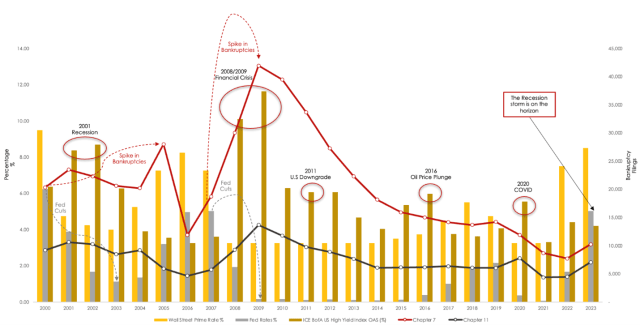
The financial landscape is showing signs of strain as bankruptcy filings surge, with businesses and consumers alike feeling the pressure of shifting economic conditions. Despite Federal Reserve rate cuts aimed at stabilizing the market, historical patterns suggest that monetary policy alone may not be enough to stem the tide. As cracks in the system become more apparent, understanding the drivers of the rise in bankruptcies is crucial for navigating the challenges ahead. Statistics reported by the Administrative Office of the US Courts show a 16% surge in bankruptcy filings in the 12 months before June 30, 2024, with 486,613 new cases, up from 418,724 the previous year. Business filings saw an even sharper increase, rising by 40.3%. These figures indicate growing financial stress within the US economy, but the real storm may be just around the corner. During the 2001 recession, the Federal Reserve’s aggressive rate cuts failed to prevent a sharp increase in corporate bankruptcies. Despite lower interest rates, the Option-Adjusted Spread (OAS) for high-yield bonds widened significantly, reflecting heightened risk aversion among investors, and increasing default risks for lower-rated companies.  Trend Analysis: Fed Rates and OAS Spread Compared to Bankruptcy Filings Image Source: Fred Economic Data, St Louis: The American Bankruptcy Institute and Author Analysis The Disconnect Between Monetary Easing and Market Conditions As a result, the period saw a sharp spike in corporate bankruptcies as many businesses struggled to manage their debt burdens amid tightening credit conditions and deteriorating economic fundamentals. This disconnect between monetary easing and market realities ultimately led to a surge in bankruptcies as businesses struggled with tightening credit conditions. A similar pattern emerged during the 2008 global financial crisis. For 218 days, the ICE BoFA US High Yield OAS Spread remained above 1000 basis points (bps), which signaled extreme market stress. This prolonged period of elevated spreads led to a significant increase in Chapter 7 liquidations as companies facing refinancing difficulties opted to liquidate their assets rather than restructure. ICE BoFA US High Yield OAS Spread Image Source: Fed Economic Data, St Louis and Author Analysis The sustained period of elevated OAS spreads in 2008 serves as a stark reminder of the crisis’s intensity and its profound impact on the economy, particularly on companies teetering on the edge of insolvency. The connection between the distressed debt environment, as indicated by the OAS and the wave of Chapter 7 liquidations, paints a grim picture of the financial landscape during one of the most challenging periods in modern economic history. The Federal Reserve’s interest rate policies have frequently lagged the Taylor Rule’s recommendations. The Taylor Rule is a widely referenced guideline for setting rates based on economic conditions. Formulated by economist John Taylor, the rule suggests that interest rates should rise when inflation is above target, or the economy is operating above its potential. Conversely, interest rates should fall when inflation is below target or the economy is operating below its potential. The Lag The Fed’s rate adjustments lag for several reasons.  First, the Fed often adopts a cautious approach, preferring to wait for clear evidence of economic trends before making rate adjustments. This cautiousness can lead to delayed responses, particularly when inflation begins to rise, or economic conditions start to diverge from their potential. Second, the Fed’s dual mandate of promoting maximum employment and stable prices sometimes leads to decisions that diverge from the Taylor Rule. For example, the Fed might prioritize supporting employment during economic slowdowns, even when the Taylor Rule suggests higher rates to combat rising inflation. This was evident during prolonged periods of low interest rates in the aftermath of the 2008 financial crisis. The Fed kept rates lower for longer than the Taylor Rule suggests to stimulate economic growth and reduce unemployment. In addition, the Fed’s focus on financial market stability and the global economy can influence its rate decisions, sometimes causing it to maintain lower rates than the Taylor Rule prescribes. The rule’s goal is to avoid potential disruptions in financial markets or to mitigate global economic risks. Historical Fed Funds Rate Prescriptions from Simple Policy Rules Image Source: Federal Reserve Board and Author Analysis The consequence of this lag is that the Fed’s rate cuts or increases may arrive too late to prevent inflationary pressures or curb an overheating economy, as they did in the lead-up to previous recessions. Cautious timing for rate cuts may also delay needed economic stimulus, which prolongs economic downturns. As the economy faces new challenges, this lag between the Fed’s actions and the Taylor Rule’s recommendations continues to raise concerns. Critics argue that a more-timely alignment with the Taylor Rule could lead to more effective monetary policy and reduce the risk of inflation or recession, ensuring a more stable economic environment. Balancing the strict guidelines of the Taylor Rule with the complexities of the real economy remains a significant challenge for policymakers. As we approach Q4 2024, the economic landscape bears unsettling similarities to past recessions, particularly those of 2001 and 2008. With signs of a slowing economy, the Federal Reserve has cut the interest rate by 0.5% recently to prevent a deeper downturn. However, historical patterns suggest this strategy may not be enough to avert a broader financial storm. Furthermore, easing monetary policy, which typically involves lowering interest rates, will likely shift investor behavior. As yields on US Treasuries decline, investors may seek higher returns in high-yield sovereign debt from other countries. This shift could result in significant capital outflows from US Treasuries and into alternative markets, putting downward pressure on the US dollar. The current global environment, including the growing influence of the BRICS bloc, the expiration of Saudi Arabia’s petrodollar agreements, and ongoing regional conflicts, make the US economic outlook complex. The BRICS nations (Brazil, Russia, India, China, and South Africa) have been pushing to reduce reliance on the US dollar in global trade, and petrodollar petrodollar contracts are weakening. These trends could accelerate the dollar’s depreciation. As demand for US Treasuries declines, the US dollar could face significant pressure, leading to depreciation. A weaker dollar,

Navigating Troubled Waters: What the Surge in Bankruptcy Filings Means for the Economy Read More »


Equity and Bond Correlations: Higher Than Assumed?

Introduction Investing can seem like an endless cycle of booms and busts. The markets and instruments may change — tulips in 1634, tech stocks in 2000, cryptocurrencies in 2021 — but the speculator’s drive to make fast money remains constant. Yet once investors have lived through a bubble or two, we tend to become more conservative and cautious. The ups and downs, the peaks and crashes, combined with the trial-and-error process, help lay the foundation for our core investment strategy, even if it’s just the traditional 60-40 portfolio. With memories of past losses, battle-worn investors are skeptical about new investing trends. But sometimes we shouldn’t be. Once in a while, new information comes along that turns conventional wisdom on its head and requires us to revise our established investing framework. For example, most investors assume that higher risk is rewarded by higher returns. But ample academic research on the low volatility factor indicates that the opposite is true. Low-risk stocks outperform high-risk ones, at least on a risk-adjusted basis. Similarly, the correlations between long-short factors — like momentum and the S&P 500 in 2022 — dramatically change depending on whether they are calculated with monthly or daily return data. Does this mean we need to reevaluate all the investing research based on daily returns and test that the findings still hold true with monthly returns? To answer this question, we analyzed the S&P 500’s correlations with other markets on both a daily and monthly return basis. Daily Return Correlations First, we calculated the rolling three-year correlations between the S&P 500 and three foreign stock and three US bond markets based on daily returns. The correlations among European, Japanese, and emerging market equities as well as US high-yield bonds have increased consistently since 1989. Why? The globalization process of the last 30 years has no doubt played a role as the world economy grew has more integrated. In contrast, US Treasury and corporate bond correlations with the S&P 500 varied over time: They were modestly positive between 1989 and 2000 but went negative thereafter. This trend, combined with positive returns from declining yields, made bonds great diversifiers for equity portfolios over the last two decades. Three-Year Rolling Correlations to the S&P 500: Daily Returns Source: Finominal Monthly Return Correlations What happens when the correlations are calculated with monthly rather than daily return data? Their range widens. By a lot. Japanese equities diverged from their US peers in the 1990s following the collapse of the Japanese stock and real estate bubbles. Emerging market stocks were less popular with US investors during the tech bubble in 2000, while US Treasuries and corporate bonds performed well when tech stocks turned bearish thereafter. In contrast, US corporate bonds did worse than US Treasuries during the global financial crisis (GFC) in 2008, when T-bills were one of the few safe havens. Overall, the monthly return chart seems to more accurately reflect the history of global financial markets since 1989 than its daily return counterpart. Three-Year Rolling Correlations to the S&P 500: Monthly Returns Source: Finominal Daily vs. Monthly Returns According to monthly return data, the average S&P 500 correlations to the six stock and bond markets grew over the 1989 to 2022 period. Now, diversification is the primary objective of allocations to international stocks or to certain types of bonds. But the related benefits are hard to achieve when average S&P 500 correlations are over 0.8 for both European equities and US high-yield bonds. Average Three-Year Rolling Correlations to the S&P 500, 1989 to 2022 Finally, by calculating the minimum and maximum correlations over the last 30 years with monthly returns, we find all six foreign stock and bond markets almost perfectly correlated to the S&P 500 at certain points and therefore would have provided the same risk exposure. But might such extreme correlations have only occurred during the few serious stock markets crashes? The answer is no. US high yields had an average correlation of 0.8 to the S&P 500 since 1989. But except for the 2002 to 2004 era, when it was near zero, the correlation actually was closer to 1 for the rest of the sample period. Maximum and Minimum Correlations to the S&P 500: Three-Year Monthly Rolling Returns, 1989 to 2022 Source: Finominal Further Thoughts Financial research seeks to build true and accurate knowledge about how financial markets work. But this analysis shows that changing something as simple as the lookback frequency yields vastly conflicting perspectives. An allocation to US high-yield bonds can diversify a US equities portfolio based on daily return correlations. But monthly return data shows a much higher average correlation. So, what correlation should we trust, daily or monthly? This question may not have one correct answer. Daily data is noisy, while monthly data has far fewer data points and is thus statistically less relevant. Given the complexity of financial markets as well as the asset management industry’s marketing efforts, which frequently trumpet equity beta in disguise as “uncorrelated returns,” investors should maintain our perennial skepticism. That means we’re probably best sticking with whatever data advises the most caution. After all, it’s better to be safe than sorry. For more insights from Nicolas Rabener and the Finominal team, sign up for their research reports. If you liked this post, don’t forget to subscribe to Enterprising Investor. All posts are the opinion of the author. As such, they should not be construed as investment advice, nor do the opinions expressed necessarily reflect the views of CFA Institute or the author’s employer. Image credit: ©Getty Images / BanksPhotos Professional Learning for CFA Institute Members CFA Institute members are empowered to self-determine and self-report professional learning (PL) credits earned, including content on Enterprising Investor. Members can record credits easily using their online PL tracker. source

Equity and Bond Correlations: Higher Than Assumed? Read More »

Are Your Data Governance and Management Practices Keeping Pace with the AI Boom?

As financial services firms scramble to keep pace with technological advancements like machine learning and artificial intelligence (AI), data governance (DG) and data management (DM) are playing an increasingly important role — a role that is often downplayed in what has become a technology arms race. DG and DM are core components of a successful enterprise data and analytics platform. They must fit within an organization’s investment philosophy and structure. Embracing business domain knowledge, experience, and expertise empowers the firm to incorporate management of BD alongside traditional small data. No doubt, the deployment of advanced technologies will drive greater efficiencies and secure competitive advantages through greater productivity, cost savings, and differentiated strategies and products. But no matter how sophisticated and expensive a firm’s AI tools are, it should not forget that the principle “garbage in, garbage out” (GIGO) applies to the entire investment management process. Flawed and poor-quality input data is destined to produce faulty, useless outputs. AI models must be trained, validated, and tested with high-quality data that is extracted and purposed for training, validating, and testing. Getting the data right often sounds less interesting or even boring for most investment professionals. Besides, practitioners typically do not think that their job description includes DG and DM. But there is a growing recognition among industry leaders that cross-functional, T-Shaped Teams will help organizations develop investment processes that incorporate AI and big data (BD). Yet, despite increased collaboration between the investment and technology functions, the critical inputs of DG and DM are often not sufficiently robust.   The Data Science Venn Diagram BD is the primary input of AI models. Data Science is an inter-disciplinary field comprising overlaps among math and statistics, computer science, domain knowledge, and expertise. As I wrote in a previous blog post, human teams that successfully adapt to the evolving landscape will persevere. Those that don’t are likely to render themselves obsolete. Exhibit 1 illustrates the overlapping functions. Looking at the Venn Diagram through the lens of job functions within an investment management firm: AI professionals cover math and statistics; technology professionals tackle computer science; and investment professionals bring a depth of knowledge, experience, and expertise to the team — with the help of data professionals. Exhibit 1. Table 1 deals solely with BD features. Clearly, professionals with skills in one area cannot be expected to deal with this level of complexity. Table 1. BD and Five Vs Volume, veracity, and value are challenging due to nagging uncertainty about completeness and accuracy of data, as well as the validity of garnered insights. To unleash the potential of BD and AI, investment professionals must understand how these concepts operate together in practice. Only then can BD and AI drive efficiency, productivity, and competitive advantage. Enter DG and DM. They are critical for managing data protection and secured data privacy, which are areas of significant regulatory focus. That includes post global financial crisis regulatory reform, such as the Basel Committee on Banking Supervision’s standard 239(BCBS239) and the European Union’s Solvency II Directive. More recent regulatory actions include the European Central Bank’s Data Quality Dashboard, the California Consumer Privacy Act, and the EU’s General Data Protection Regulation (GDPR), which compels the industry to better manage the privacy of individuals’ personal data. Future regulations are likely to give individuals increased ownership of their data. Firms should be working to define digital data rights and standards, particularly in how they will protect individual privacy. Data incorporates both the raw, unprocessed inputs as well as the resulting “content.” Content is the result of analysis — often on dashboards that enable story-telling. DG models can be built based on this foundation and DG practices will not necessarily be the same across every organization. Notably, DG frameworks have yet to address how to handle BD and AI models, which exist only ephemerally and change frequently. What Are the Key Components of Data Governance? Alignment and Commitment: Alignment on data strategy across the enterprise, and management commitment to it is critical. Guidance from a multi-stakeholder committee within an organization is desired.From an internal control and governance perspective, a minimum level of transparency, explainability, interpretability, auditability, traceability, and repeatability need to be ensured for a committee to be able to analyze the data, as well as the models used, and approve deployment. This function should be separate from the well-documented data research and model development process. Security: Data security is the practice of defining, labeling, and approving data by their levels of risk and reward, and then granting secure access rights to appropriate parties concerned. In other words, putting security measures in place and protecting data from unauthorized access and data corruption. Keeping a balance between user accessibility and security is key. Transparency: Every policy and procedure a firm adopts must be transparent and auditable. Transparency means enabling data analysts, portfolio managers, and other stakeholders to understand the source of the data and how it is processed, stored, consumed, archived, and deleted. Compliance: Ensuring that controls are in place to comply with corporate policies and procedures as well as regulatory and legislative requirements is not enough. Ongoing monitoring is necessary. Policies should include identifying attributes of sensitive information, protecting privacy via anonymization and tokenization of data where possible, and fulfilling requirements of information retention. Stewardship: An assigned team of data stewards should be established to monitor and control how business users tap into data. Leading by example, these stewards will ensure data quality, security, transparency, and compliance. What Are the Key Elements of Data Management? Preparation: This is the process of cleaning and transforming raw data to allow for data completeness and accuracy. This critical first step sometimes gets missed in the rush for analysis and reporting, and organizations find themselves making garbage decisions with garbage data. Creating a data model that is “built to evolve constantly” is far much better than creating a data model that is “built to last long as it is.” The data model should meet today’s needs and adapt to future change.

Are Your Data Governance and Management Practices Keeping Pace with the AI Boom? Read More »

The Alternative Investment Gender Gap: Marketing to Female Clients

Why do men allocate twice as much of their assets to alternative investments as women do? That’s one of the questions I asked 52 successful investors around the world for my “Women & Alts: A Global Perspective” white paper, which was released today. Some of the answers may surprise you. In this blog post, I identify women’s favorite alternative investments, the marketing strategies that do not resonate with women, and those that do.   I share insights from some of the 26 women and 26 men I interviewed in the global finance industry across 31 cities and 25 countries this summer. I asked each of them about their approaches to investing, and we discussed the current holdings in their portfolios. Why does the gender gap demand attention? Because alternative investments are important for any investor’s portfolio. Big money institutional investors have known this for years and male retail investors seem to be moving this way. Female retail investors, however, have been lagging. Global alternative assets under management will increase to US$24.5 trillion by 2028, up from an estimated US$16.3 trillion in 2023, Preqin’s Future of Alternatives 2028 report predicts. The defining characteristic of alternative assets is their relative lack of correlation with standard asset classes such as traditional equities and bonds. Adding alts to a portfolio improves overall diversification, reduces risk, and should lead to higher long-term returns. Nobody agrees on the definition of alternative investments, there are many kinds of alts, and the categories are expanding over time. Through my research this summer, I identified the top 10 alternative assets that resonate with women and list them, in no particular order. Women’s Top 10 Private equity Art Private credit/debt Gold Non-primary residence real estate Startups Angel investments Wine Collectables Infrastructure assets Do women want alts? The answer is a resounding Yes. Women need and deserve equal access to the world’s fastest-growing asset class. I deliberately selected male and female interviewees with diverse backgrounds and from a wide variety of senior roles: academics, corporate directors, founders, senior executives, institutional salespeople, traders, portfolio managers, economists, professional investors, and management consultants. This research was commissioned by Kensington Capital Partners and follows my 2024 Rich Thinking® research paper, “What’s in your investment portfolio?” I summarize the key findings from that research in my March Enterprising Investor blog post. Marketing to Women: What’s not Working Financial institutions around the world are rapidly realizing that women represent a lucrative business opportunity, and they are today’s largest, fastest growing, and most under-served new target market. Over the past few years, initiatives around women and wealth have proliferated — from bank-owned sites and standalone private platforms to educational in-person forums and communities for women. That said, much of the associated messaging is out of date, condescending, or just plain wrong. Saying that women lack confidence or that women are risk-averse is seriously lazy and inaccurate messaging. Here are some quotes and snippets from the white paper as to what’s not working. Alts are opaque. Caroline Miller, Independent Corporate Director, Montreal, Canada: “Whether we are talking about private credit or private equity, for women this is one big bucket that is perceived to be conceptually more opaque and logistically less liquid, thus requiring a deeper dive. For clarity, women’s need for greater explanations of alternative investment products is down to the industry’s marketing shortcomings, not women’s inability to comprehend them.” Miller points out that, even though a globally diversified portfolio requires a comprehensive cross-asset strategy, “people play the fiddle they know.” The farther you get from plain vanilla public market securities, the wider the information chasm. Outside of their core equity and fixed income holdings, women tend to allocate some capital to REITs for a steady income stream or maybe buy gold. “But what else would they invest in if they understood the full array of alternatives?” she asks. “Women have fiduciary responsibility for significant financial wealth. They want and need to know more.” The network effect is lacking for women. Diana Biggs, Partner, 1kx, Zug, Switzerland: “The world of private equity and alternative investments can feel daunting if you don’t have power. Lots of deals come via social circles, and you need to be invited in. The men who typically have access to invite people need to open the door, and the women also need to be interested in taking the opportunity to learn. We can onboard each other. Critically, I tell women not to be turned off…keep trying.” Biggs thinks men involved in alternative investments are not necessarily behaving with ill intention. They are very busy and probably don’t notice you, she advises. “When I go to funds conferences or trader chat gatherings, there are 20 men and maybe one to two other women in the room. It can be hard to get into the conversation. It would be nice for this huge majority of men to recognize what exactly is missing and help figure out how to bring women in.” Macho-themed sales and marketing falls short. Blair duQuesnay, Lead Advisor, Ritholtz Wealth Management, New Orleans, US: “The culture of the investment industry in the United States is still very male-centric. The dominant focus is on ‘us versus them’, ‘you either win or you lose’, and ‘eat what you kill.’ This attitude continues to be a turnoff to all women — just as I wrote about five years ago in my New York Times opinion piece,“ Consider Firing Your Male Broker.” Marketing in the financial services industry mirrors the culture of investing: macho, duQuesnay points out. “Investors have an expectation that as they accumulate more wealth, there have ‘better’ investments available to them. The attitude about alternative investments is, ‘Now that you have $X million net worth, you will have access to private opportunities with guaranteed higher returns.’ In reality, just because investors have $5 million, they don’t necessarily need to start investing differently. What about the person behind the money? Who is this woman? What is she trying to accomplish? For what purpose?” DuQuesnay

The Alternative Investment Gender Gap: Marketing to Female Clients Read More »

Vices, Virtues, and a Little Humor: 30 Quotes from Financial History

Why do smart investors repeat the same mistakes generation after generation? Because financial instincts — like fear, envy, and overconfidence — are ancient, stubborn, and terribly unsuited for modern markets. Fortunately, financial history leaves behind a paper trail of wisdom, wit, and hard-won lessons. Sometimes, a single quote can do more to correct a bad habit than a hundred charts. That’s what brought us together. On March 19, 2025, I met Rachel Kloepfer. It was right after my keynote presentation at the Second Annual Institute of Advanced Investment Management (IAIM) conference at the University of Utah. My talk emphasized how investors can use financial history to gain a deeper understanding of current financial events and a clearer vision of the future. I closed with a few quotes from the past — concise and enduring truths which I hoped attendees could use to make better decisions. Afterward, Rachel — a former journalist and fellow financial history enthusiast — suggested expanding the list. We sifted through hundreds of quotes. Some are serious, some are funny, but all come from people who lived through the financial highs and lows of the past 200 years. The result is a curated set of 30 quotes exclusively for Enterprising Investor grouped by the vices to avoid, the virtues to adopt, and a little humor to stay sane through it all. We chose timeless quotes designed to resonate across generations, reminders that whether you’re new to investing or decades into your career, history still has something to teach you. VICES The most tragic mistakes in finance are those we could have avoided — if only we had learned from the past. Yet these errors persist because our instincts, once essential for survival, often backfire in markets. Until evolution catches up, our best remedy is historical awareness. The quotes that follow highlight some of the most damaging investor vices. Committing them to memory can help you resist these patterns — and free the mental capacity needed to cultivate more productive virtues. Envy “Nothing so undermines your financial judgement as the sight of your neighbor getting rich.” —J. PIERPONT MORGAN, financier Impatience  “The delusion lies in the conception of time. The great stock-market bull seeks to condense the future into a few days, to discount the long march of history, and capture the present value of all future riches. It is [their] strident demand for everything right now — to own the future in money right now — that cannot tolerate even the notion of futurity.” —JAMES BUCHAN, author of Frozen Desire: The Meaning of Money Dishonesty “A business model that relies on trickery is doomed to fail.” —CHARLIE MUNGER, late vice chairman of Berkshire Hathaway Hubris “The weakness of human nature prevents men from being good judges of their own deservings.” —LOUIS BRANDEIS, author of Other People’s Money Overconfidence  “When a speculator wins, he don’t stop till he loses.” —GEORGE H. LORIMER, 19th century merchant Complacency “Always remember that somewhere someone is making a product that will make your product obsolete.” —GEORGES DORIOT, founding father of venture capital Denial “Faced with the choice between changing one’s mind and proving that there is no need to do so, almost everybody gets busy on the proof.” —JOHN KENNETH GALBRAITH, financial historian  Overthinking It’s remarkable how much long-term advantage people like us have gotten by trying to be consistently not stupid, instead of trying to be very intelligent.” —CHARLIE MUNGER, late vice chairman of Berkshire Hathaway Herd Behavior “Once a majority of players adopts a heretofore contrarian position, the minority view becomes the widely held perspective.” —DAVID SWENSEN, late CIO of the Yale University Endowment Blind Faith “The investing public is fascinated and captured by the great financial mind. That fascination derives, in turn, from the scale of the financial operations and the feeling that, with so much money involved, the mental resources behind them cannot be less.” —JOHN KENNETH GALBRAITH, financial historian  VIRTUES Shedding harmful instincts is only the beginning. The next step is to fill that space with virtues — a far more difficult task. Vices are common and instinctive; virtues are behavioral anomalies. The most powerful virtues are rare, easy to dismiss, and even easier to forget. The following 10 quotes come from financial minds who successfully navigated some of the most unforgiving markets in US history. Committing them to memory is a powerful next step toward becoming a more adept investor. Passion “All the genius I have lives in this: when I have a subject in hand, I study it profoundly. Day and night it is before me. My mind becomes pervaded with it. Then the effort that I’ve made is what people are pleased to call the fruit of genius. It is the fruit of labor and thought.” —ALEXANDER HAMILTON, first US Secretary of the Treasury Thrift “I smoke four-cent cigars and I like them. If I were to smoke better ones, I might lose my taste for the cheap ones that I now find quite satisfactory.” —EDWARD ROBINSON, father of Hetty Green, the Queen of Wall Street  Self-Discipline “Several decades would pass, and many vicissitudes to be undergone before I could master the simplest and most important of all the rules of material welfare: The most brilliant financial strategy consists of living well within one’s means.” —BENJAMIN GRAHAM, founder of the value investing philosophy  Competence “A small bunch of people who know what they are doing can accomplish more than a big group of people who don’t know what they are doing.” —ROBERT NOYCE, founder of Intel Corporation Historical Awareness “You can’t really understand what is going on now unless you understand what came before.” —STEVE JOBS, founder of Apple Computer Education “Proper education is one long exercise in augmentation of high cognition so that our wisdom becomes strong enough to destroy wrong thinking maintained by resistance to change.” —CHARLIE MUNGER, late vice chairman of Berkshire Hathaway Humility “There is a prudent maxim of the economic forecaster’s trade that is too often ignored: Pick

Vices, Virtues, and a Little Humor: 30 Quotes from Financial History Read More »

The Equity Advantage: Reinvestment of Earnings

Equities can compound in value in a way that investments in bonds, real estate, and other asset classes cannot: Companies can distribute anywhere from 0% to 100% of their profits to investors as dividends or share buybacks, while the remaining 100% to 0% can be reinvested in the business.  S&P 500 firms tend to retain about half their earnings and distribute the other half through dividends and buybacks. This reinvestment of earnings feature is unique to equity investing. By comparison, bond owners receive interest payments, but no portion of those interest payments is automatically reinvested back into that same bond or into other bonds. Landlords receive rental income, but that rental income is not automatically reinvested into the property.  Commodities and cryptocurrencies, among other asset classes, don’t pay cash flows to their owners since they have no cash flows to begin with. Owners can only redirect their investment into other assets by selling all or part of their stake. Thus, an “investment” in these asset classes is merely a punt that the prices will go up due to changes in supply and demand.1 Earnings reinvestment is unique to equities, but that quality alone is not what attracts investors. The appeal is the superior compounding that equities have relative to other asset classes.  The Median Quarterly ROE of US Nonfinancial Corporations Has Averaged 10.7% over 75 Years Source: St. Louis Fed US nonfinancial companies earn a return on equity (ROE) of around 11%, according to the St. Louis Fed. S&P 500 companies earn an average ROE closer to 13%, according to S&P data. (This is no surprise: The more profitable a company, the more likely it will grow large enough to be included in the S&P 500.) That means if the average S&P 500 company reinvests half its profits at a 13% return, then its profits should grow by 6.5%. The current dividend plus buyback yield on the S&P 500 is 3.5%, according to S&P data. Combining profit growth with the dividend plus buyback yield delivers a 10% expected return from the S&P 500. That’s before accounting for any changes in the index’s earnings multiple or any taxes on dividends or capital gains. The outcome is even better if rather than the entire index, we own several above-average companies that achieve above-average returns on capital. If we can buy them at an attractive yield on the cash profits they generate and if they can reinvest much of their retained earnings at high rates of return for a long time to come, we may very well outpace that 10% pre-tax, pre-multiple compression (or expansion) return figure. In fact, we’d rather our above-average companies not pay us taxable dividends at all when they could instead reinvest that money at high rates of return to drive business growth and create shareholder value.  And let’s not forget, dividends are subject to double taxation (once at the corporate level and again at the individual level), while retained earnings are only taxed at the corporate level. Depending on the index and time period, long-term US equity returns have ranged from 7% to 10%. So, between reinvesting earnings at 13% or distributing those earnings for shareholders to reinvest in stocks at a 7%-to-10% rate of return, the choice should be obvious. Internal reinvestment is the better bet. Of course, not all companies have such rich prospects for reinvestment. That’s why the choice to retain and reinvest earnings or pay them out to shareholders depends on four factors, in particular: The price that the company trades at relative to its future cash earnings potential. The attractive reinvestment opportunities available to the company. The expected returns on capital it can generate on those reinvestment opportunities. The prevailing corporate tax rates and tax rates on dividends vs. capital gains. If the dynamic among these inputs plays out well, companies should maximize the equity advantage and reinvest their earnings rather than distribute them as dividends or buybacks. For more on the equity advantage and stock buybacks, in particular, check out Stock Buyback Motivations and Consequences: A Literature Review by Alvin Chen and Olga A. Obizhaeva from the CFA Institute Research Foundation. If you liked this post, don’t forget to subscribe to the Enterprising Investor. 1. Investors in such asset classes are mere speculators in a Keynesian Beauty Contest. Gold can be turned into jewelry and other products and sold. So, there is value in gold. But cryptocurrencies must be sold at a higher price than was paid for them for the investment to be “successful.” Whatever value one investor extracts, another has to pay. Money has changed hands, net of transaction costs, but nothing productive has been delivered. All posts are the opinion of the author. As such, they should not be construed as investment advice, nor do the opinions expressed necessarily reflect the views of CFA Institute or the author’s employer. Image credit: ©Getty Images/Nikada Professional Learning for CFA Institute Members CFA Institute members are empowered to self-determine and self-report professional learning (PL) credits earned, including content on Enterprising Investor. Members can record credits easily using their online PL tracker. source

The Equity Advantage: Reinvestment of Earnings Read More »

Equity Risk Premium Forum: Gloom Looms?

For more insights on the equity risk premium (ERP) from Rob Arnott, Cliff Asness, Mary Ida Compton, Elroy Dimson, William N. Goetzmann, Roger G. Ibbotson, Antti Ilmanen, Martin Leibowitz, Rajnish Mehra, Thomas Philips, Jeremy Siegel, and Laurence B. Siegel, check out Revisiting the Equity Risk Premium, from CFA Institute Research Foundation. “How many here think the next 10-year equity returns are going to be below the long-run average? I certainly do. Is there anyone here who doesn’t?” — Jeremy Siegel In the latest installment of the Equity Risk Premium Forum conversation, Laurence B. Siegel, Rob Arnott, Cliff Asness, Mary Ida Compton, Elroy Dimson, William N. Goetzmann, Roger G. Ibbotson, Martin Leibowitz, and Jeremy Siegel conclude their earlier exploration of the CAPE ratio’s utility, or lack thereof, as a forecasting and market-timing tool and then take a broader look at their expectations around the direction of the equity markets and the equity risk premium. In particular, they focus on how to respond when equities are predicted to underperform their historical average. How should investors and pension funds adjust their allocations? How should the former change their spending habits when the returns they anticipated don’t look likely to materialize? From there, the participants move from the abstract to the particular and consider how equities will fare over the next 10 years. The consensus was not a bullish one. They all believe that stocks will fail to match their long-term average performance in the years ahead. What follows is a lightly edited and condensed transcript of this portion of the discussion. Will We Be in a Low-Return Environment? Cliff Asness: I think CAPE has been an empirical failure for timing. It has still been a success if all you want to know is whether you expect the next 10 years to be better or worse than average. Rob Arnott: Very much so. Laurence B. Siegel: I agree that CAPE is a tool for forecasting, not timing — but some people will use long-term forecasts as a timing tool, although they should not. Asness: We’ve all been guilty of that. When you are forecasting poor 10-year returns, even if you don’t explicitly say to underweight equities, sometimes that’s what it sounds like. But we should remember that CAPE is not that good for that. The forecast is, nevertheless, important. If you’re a pension plan and expect 2% instead of a 6% return on stocks in the next 10 years, that information might be relevant to you. L. Siegel: No kidding. Asness: It helps you answer questions like “How much do you have to save? How much can you spend?” It is an important number. It’s just not an important number for deciding when to get in and out of the market. Jeremy Siegel: But what happens if you say that stocks are going to return less, but bonds will return much less? William N. Goetzmann: Then Mary Ida has a problem when she talks to her clients. L. Siegel: She sure does. J. Siegel: That means you go into stocks. They’re going to return less, but you go into stocks. Mary Ida Compton: It’s a strategic asset allocation decision, not a tactical one. Stick with it over the long term, but what you as a pension plan sponsor are going to have to do is suck it up and put some more money into the fund. Asness: Yes, you’re exactly right. When expected returns on everything are low and you don’t have the ability to know when those low returns will be realized, you simply lower your expectations. L. Siegel: That’s what Jack Bogle said: budget for it. Asness: It’s important to note that saying “Returns on an asset will be lower than normal” is different from saying “They have a negative expected return.” So, when we say stocks will be worse than bonds, do we mean that stocks have a negative expected return? If you actually believe that, you should underweight them or short them. But if you believe that they have a healthy positive risk premium, just half of the normal amount — and if you underweight them now and overweight them later on when they’re more attractive — you could still make money, if the timing signal is any good. Underweighting a positive hurts you, but overweighting a positive helps you more. This is a very long game. Arnott: And it will be wrong at times. Martin Leibowitz: On the other side of that coin: How often have you heard the argument that “I have to be in stocks because bonds don’t give me any return”? Compton: A million times. Leibowitz: When will that argument be false? L. Siegel: When the expected return on stocks is lower than the expected return on bonds. J. Siegel: You’re right. Arnott: That was the case in the year 2000. J. Siegel: That was about the only time. Arnott: Mary Ida’s task is very challenging. Any sort of timing mechanism is going to be suggesting buying when equities are fiercely out of favor, unloved, cheap — and will suggest trimming when they’re relatively fully priced and people are comfortable with them. So, for far too many institutional investors, that sort of information, while useful, is not actionable. Compton: The problem with timing, which we never do, is that there just aren’t enough data points to prove anybody can do it. So, why bother? You’re just shooting yourself in the foot. L. Siegel: Mary Ida faces a situation that I believe most of us don’t, which is that her clients have fixed liabilities. As individual investors, we can adjust our consumption to the varying fortunes of our portfolios, but a pension fund really can’t. They have to come up with outside money. Moreover, the fortunes of markets and of pension plan sponsors are correlated. When the market’s down, the company is usually also not doing well. It really puts you in a terrible situation. You are supposed to earn something like 7% to meet your pension obligations,

Equity Risk Premium Forum: Gloom Looms? Read More »

Is the Outright Ban on a US Central Bank Digital Currency (CBDC) a Mistake?

Last month, the US House of Representatives passed a bill banning the Federal Reserve from issuing a central bank digital currency (CBDC), heading warnings from the American Banking Association about “unacceptable risks and costs to the US financial system.” While I don’t dismiss concerns raised by the American Banking Association and others, I argue in favor of a more measured approach that allows exploration and experimentation with guardrails. H.R. 5403 – the CBDC Anti-Surveillance State Act – has been referred to the Senate Committee on Banking, Housing, and Urban Affairs for consideration. My hope is that lawmakers will embark on a dispassionate review of the pros and cons of CBDCs and keep the door open for a pilot program that potentially could preserve our position as a global financial leader. A CFA Institute global survey of its members provides an objective view of the attitudes of a professional segment of potential CBDC end users. Instead of focusing on the preferences of central banks, the survey explores the demand side of the debate. To put things in a global perspective, 134 countries and regions now are exploring a CBDC, of which 68 are in the advanced phase of exploration; that is in development, pilot, or launch. The BRICS (China, Russia, India, Brazil, and South Africa) are piloting their own CBDCs. China is running the largest CBDC pilot in the world: the digital yuan e-CNY reaches 260 million wallets. China is considering expanding cross-border applications. Since Russia’s invasion of Ukraine and the resulting G7 sanctions, cross-border wholesale CBDC projects (i.e., used by financial institutions for transfers and settlements) have roughly doubled to 13. The absence of US leadership in setting global standards could have geopolitical consequences, and there are national security implications related to impaired ability to track cross-border flows and enforce sanctions. Perhaps being open to carefully weighing benefits against the costs — and maybe even considering running a pilot eventually — would be preferable to an outright ban on a US CBDC. Benefits One benefit would be in the US payments market, in terms of increased efficiency, lower transaction costs, and enhanced resiliency. Another is the ability to create programmable money bound to smart contracts. CBDC would also increase financial inclusion for the unbanked/underbanked. Not only could fiscal policy be optimized, but also monetary policy could be carried out more effectively and thus financial stability improved. According to a Bank for International Settlements (BIS) paper, CBDCs’ transmission mechanism makes it an especially effective tool at smoothing the effects of domestic financial shocks. The BIS researchers also point out that the effects of global financial shocks could be diminished because optimized CBDC policies could substantially reduce both exchange rate volatility and the volatility of gross cross-border banking balances. Last, CBDCs could help limit global and local illicit activity. CFA Institute survey respondents across all markets cited the acceleration of payments and transfers as the top reason to support launching a CBDC. Concerns I don’t deny that there are justifiable concerns about CBDCs. One is that traditional banks could be disrupted if too many people were to pull their deposits out at once. This could trigger bank runs, which in turn could escalate into a bank panic. This would be of particular importance to countries with unstable financial systems. In addition, CBDCs could be vulnerable to cyber-attacks, and there are privacy concerns due to CBDC’s transparency and traceability, but legislative guardrails could be put in place to address confidentiality concerns. Instead of outright banning a US CBDC, wouldn’t it be preferrable to establish clear and enforceable legislative guardrails for a CBDC? We could then focus on using one of our greatest competitive strengths — innovation. source

Is the Outright Ban on a US Central Bank Digital Currency (CBDC) a Mistake? Read More »

Did Inflation Kill the CAPM?

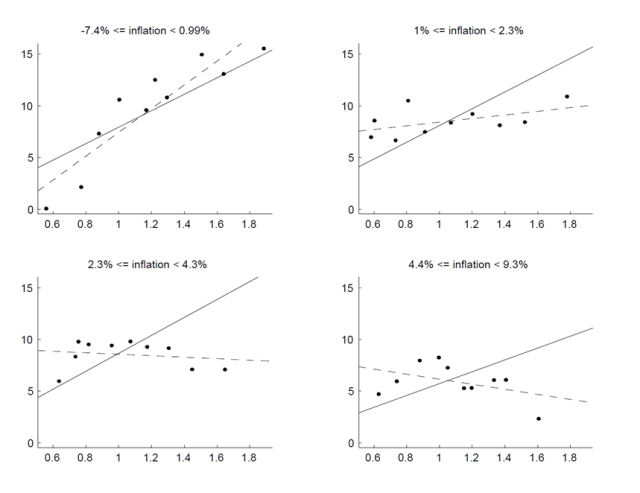
Pim van Vliet, PhD, is the author of High Returns from Low Risk: A Remarkable Stock Market Paradox, with Jan de Koning. High inflation and expensive equities lead to a negative risk-return relationship and shrink the equity premium to zero. In years following this “everything expensive” scenario, low-volatility, quality, value, and momentum factors yield sizeable positive premiums. Given today’s market dynamics, investors should avoid high-volatility stocks or hope for a different outcome than the historical reality illustrated in this blog post. I will demonstrate that, while the immediate future may not be promising for the equity premium, it looks bright for factor premiums. Money Illusion Money illusion means that investors fail to take inflation into account. It is a cognitive bias that makes it difficult to switch from nominal to real returns, especially when inflation is 3% or higher. A study by Cohen, Polk, and Vuolteenaho (2004) on inflation and the risk-return relationship remains relevant today. They use Gordon’s Growth Model, where an asset price is determined by G, the growth rate of future earnings, and R, the discount rate: Price = G / R They cite money illusion – the theory that investors discount real earnings with nominal rates rather than real rates. An example is the widely used “Fed model,” where a real stock earnings yield is compared with a nominal bond yield. Asness (2003) criticizes the Fed model. Academically, this is known as the Modigliani-Cohn inflation illusion hypothesis. And it leads to market mispricing, causing the empirical risk-return relationship to flatten. The figure from their paper, “Money Illusion in the Stock Market,” empirically supports their hypothesis. Exhibit 1. Source: Cohen, Polk, and Vuolteenaho (2004). Annualized returns on vertical-axis and betas on horizontal-axis. When inflation is low, the risk-return relationship is positive, but it turns negative when inflation is high. This explains the capital asset pricing model’s (CAPM’s) poor performance during high inflation periods like the 1950s and 1980s and it supports the Modigliani-Cohn inflation illusion hypothesis. Inflation: First Nail in the CAPM’s Coffin It has been 20 years since the Cohen et al. (2004) CAPM study was published, and US inflation has been above 3% for the past couple of years. Therefore, it is an opportune moment to update and verify these earlier results. We focus on predictive relationships, rather than contemporaneous ones, to provide practical insights for investment decisions. Using data for 10 portfolios sorted by volatility, going back to 1929 from paradoxinvesting.com, we can test how the CAPM relationship holds in different inflationary regimes. We split the sample into two parts using rolling one-year CPI with 3% as the threshold and consider the next one-year real returns. Exhibit 2. Source: Paradoxinvesting Using this extended database, we can confirm that the cross-sectional risk-return relationship is negative in periods following periods when inflation is above 3%. The relationship is not exactly linearly negative. Rather, it is at first slightly positive before becoming downward sloping for higher-beta stocks. Valuation: Second Nail in the CAPM’s Coffin In 2024, the Cyclically Adjusted Price Earnings (CAPE) ratio for the US reached 33, nearing the historical peaks seen in 1929 and 1999. The reciprocal of this measure, the equity yield, stands at 3.0%. With the real 10-year bond yield currently at 1.8%, the excess CAPE yield is 1.2%. This metric is free from the Fed model’s money illusion. Exhibit 3. Source: Robert Shiller Online Data In March 2009, the excess yield was 7.8%, marking the start of a prolonged bull market. Today’s value is much lower than in 2009 and has fallen below the historical median of 3.3%. This low CAPE yield suggests that equities are expensive and expected returns are extremely low. In addition, risk is higher when equity yields are low, as I explain in my 2021 paper. How does the CAPM relationship hold in years following high and low equity yields? The two graphs in Exhibit 4 illustrate the risk-return relationship when the excess CAPE yield is above 3% (“equities cheap”) and below 3% (“equities expensive”). Exhibit 4. Source: Paradoxinvesting High-risk stocks perform poorly in low-return environments that follow expensive markets (low excess CAPE yield). This relationship is stronger and more inverse than during periods of inflation above 3%. After inflation, valuation is the second nail in the CAPM’s coffin. Investors should either hope for a different outcome this time or avoid high-volatility stocks. Factor Performance in a Low-Return World If inflation and valuation have indeed undermined the CAPM — resulting in a negative risk-return relationship — it becomes interesting to evaluate the performance of value, quality, and momentum factor strategies. To do this, we supplement our data with data from Kenneth French. We consider long-only strategies with similar turnover, focusing on the top-quintile portfolios for low-volatility, value, and quality, and the top-half portfolio for momentum. Quality is defined as operational profitability and backfilled with the market portfolio. Value is defined by the price-to-earnings (P/E) ratio and backfilled with the market portfolio. Momentum is defined by 12 minus one month returns, and Lowvol is defined by three-year volatility. We analyze periods following 1) inflation above 3% and 2) the excess CAPE yield below 3%. These regimes have historically low overlap (-0.1 correlation) and both characterize today’s market environment. Exhibit 5. Sources: Kenneth R. French Data Library and Paradoxinvesting In the year following periods where inflation exceeds 3%, all factor premiums are positive, contributing about 3% to the equity premium. This aligns with a recent study in the Financial Analysts Journal, which shows that factor premiums — including low-risk, value, momentum, and quality — are positive and significant during high-inflation periods. In addition, in the year following expensive equity markets (excess CAPE yield <3%), the real equity return was a meager 0.5%, while strategies focused on low-risk, value, momentum, and quality still provided positive returns. When these two regimes are combined — representing 17% of the observations — the equity premium turns negative. However, all factor strategies continue to offer positive returns, averaging approximately 3%. Key Takeaway In this blog

Did Inflation Kill the CAPM? Read More »

Top 10 Posts from 2023: The 10 Greatest Investors, ChatGPT, and the Active Management Delusion

1. The 10 Greatest US Investors and the Virtues That Made Them Who are the greatest investors of all time? Andrew Mitchell, founder of Ophir Asset Management, asked ChatGPT to name the top 10. The artificial intelligence (AI) responded with its list. Mark J. Higgins, CFA, CFP, was intrigued by both the question and ChatGPT’s response. He’d just completed writing Investing in U.S. Financial History, and had many legendary investors on his mind. While ChatGPT’s list was not terrible, it included four people who he believes were undeserving and excluded several more who were very much worthy. So where did ChatGPT go wrong? 2. ChatGPT and the Future of Investment Management “So, do we human advisers and analysts stand any chance in the post-ChatGPT world?” Larry Cao, CFA, the editor of Handbook of Artificial Intelligence and Big Data Applications in Investments, asks. “Absolutely. But authenticity will be key. Originality has always come at a premium, and that premium will only increase in the ChatGPT era. In investment analysis or portfolio construction, if we’re offering little more than the conventional wisdom, then ChatGPT and similar applications could very well take our jobs.” 3. ChatGPT and Generative AI: What They Mean for Investment Professionals “ChatGPT has launched a new era in artificial intelligence (AI),” Michinori Kanokogi, CFA, and Yoshimasa Satoh, CFA, write. So, what does this mean for investment management and how will all the ChatGPT- and large-language-model (LLM)-related developments affect how investment professionals work? 4. A Sea Change: Howard Marks, CFA, on the End of Easy Money “I’m not saying that interest rates are going to go back up. I just think they’re done coming down,” Howard Marks, CFA, told Marg Franklin, CFA, as quoted by Mark Fortune. “One of the basic tenets of my thesis is that in the next five to 10 years, interest rates will not be constantly coming down or constantly ultra-low. And if that’s true, I think we’re in a different environment, and that’s a sea change.” 5. The Active Management Delusion: Respect the Wisdom of the Crowd That few active managers add value is a conclusion supported by numerous studies going back decades, Mark J. Higgins, CFA, CFP, observes. Yet many investors still refuse to believe that very few can regularly outperform a cheap index fund. Outside a small and shrinking group of extraordinarily talented investors, active management is a waste of money and time. So, why is the active management delusion so persistent? 6. The Six Stages of Asset Bubbles: The Crypto Crash Investors can protect themselves from the next bubble by recognizing the trajectory that most follow, Mark J. Higgins, CFA, CFP, contends. Using the cryptomania of the 2010s and 2020s as a guide, he lays out the path that most bubbles take. 7. ChatGPT: Copilot Today, Autopilot Tomorrow? “Based on what we have learned about the new, dark art of prompt engineering, how can quant and fundamental analysts apply LLMs like ChatGPT? How effective a copilot can these technologies be?” Dan Philps, PhD, CFA, and Tillman Weyde, PhD, pose and answer these questions. 8. The Predictive Power of the Yield Curve “The predictive power of the yield curve is a widely accepted causal narrative,” Joshua J. Myers, CFA, explains. “But the history shows that the causal correlation between long and short rates is actually quite weak.” 9. Redefining the Retirement Income Goal David Blanchett, PhD, CFA, CFP, discusses his research on perceptions around retirement spending flexibility for the Financial Analysts Journal and provides evidence that households can adjust their spending and that these adjustments tend to be less disastrous than success rates and other common financial-planning-outcomes metrics suggest. 10. ChatGPT: The Origins, the Hype, the Opportunity “What are the LLM opportunities and risks in investment management?” Dan Philps, PhD, CFA. and Tillman Weyde, PhD, writes. “To answer that question . . . we will introduce how to apply LLMs in investment management and explore the new dark art of ‘prompt engineering.’” If you liked this post, don’t forget to subscribe to Enterprising Investor. All posts are the opinion of the author. As such, they should not be construed as investment advice, nor do the opinions expressed necessarily reflect the views of CFA Institute or the author’s employer. Image credit: ©Getty Images/ JamesBrey Professional Learning for CFA Institute Members CFA Institute members are empowered to self-determine and self-report professional learning (PL) credits earned, including content on Enterprising Investor. Members can record credits easily using their online PL tracker. source

Top 10 Posts from 2023: The 10 Greatest Investors, ChatGPT, and the Active Management Delusion Read More »