CFA Institute

Private Equity: Five Lessons from the Global Financial Crisis

Up until the 2008 credit crunch, the conventional recipe for success in private equity (PE) was straightforward: Just pour in debt and stir. A generous dose of leverage typically spiced up the financing of a transaction.  But the global financial crisis (GFC) turned this money pie into mush. Government-backed purchases of toxic assets — funded by central bank purchases of government bonds — eventually engineered a comprehensive bailout of distressed borrowers and other heavy debt users. With loose monetary policies throughout the 2010s, leverage returned with a vengeance. What to Expect from a Downturn So if a recession comes, how can the lessons of the GFC inform PE practitioners facing a formidable debt wall and stubbornly high interest rates? Here’s what to watch for: 1. A Mass Shakeout  Post-GFC, one in four buyout firms never raised another fund, according to Bain & Company’s “Global Private Equity Report 2020.” Without the central banks’ rescue package of zero interest rates and quasi-unlimited credit, the damage would have turned into carnage. Some firms were forced into liquidation, including top 10 European buyout shop Candover. Others were sold out in distressed transactions or simply spun off, including the proprietary PE units of troubled banks Lehman Brothers and Bank of America Merrill Lynch. A capital drought forced many more to work deal by deal. The fund managers that survived the GFC know they had a lucky escape. To avoid leaving their fate in the hands of regulators and monetary authorities, the larger operators have morphed into financial supermarkets over the last 15 years. That transition had less to do with fostering economic growth than protecting and diversifying fee income.  Global consolidation is to be expected and US PE groups will once again lead the charge. In 2011, Carlyle bought Dutch fund of funds manager AlpInvest. Five years later, HarbourVest acquired the UK firm SVG, a cornerstone investor in Permira. More recently, general partner (GP)-stakes investors, such as Blue Owl, specialized in the acquisition of large shareholdings to provide liquidity to PE fund managers. Blue Owl’s former incarnation — Dyal Capital — took a stake in London-headquartered Bridgepoint in August 2018, for instance. Blackstone has been one of the most active acquirers of stakes in fellow PE firms and announced in April 2020, amid pandemic-related uncertainty, that it had $4 billion in cash available for such purchases. Today’s tight monetary policies offer similar opportunities. 2. Portfolio Cleansing  According to the UK-based Centre for Management Buyout Research (CMBOR), 56% of PE portfolio exits in Europe in the first half of 2009 were distressed portfolio realizations such as receiverships and bankruptcies. By contrast, at the peak of the credit bubble in the first half of 2005, this cohort accounted for only 16% of exits.  In the United States, the number of PE-backed companies filing for Chapter 11 was three times greater in 2009 than two years earlier. Likewise, in 2020, nationwide lockdowns caused almost twice as many bankruptcies among PE portfolio companies than in the prior year despite comprehensive government bailout initiatives. Because most credit deals in recent years applied floating rates, should the cost of credit remain high, zombie scenarios, Chapter 11 filings, and hostile takeovers by lenders could spike. Financial sponsors wary of injecting more equity into portfolio companies with stretched capital structures may emulate KKR’s decision earlier this year to let Envision Healthcare fold and fall into the hands of creditors. 3. Flight to Size  Although PE powerhouses came under pressure in the wake of the GFC, with some critics gleefully predicting their demise, capital commitments should keep on flowing as long as fund managers control the narrative around superior investment returns. The risk for prospective investors is confusing fund size or brand recognition with quality. The Pepsi Challenge proved years ago that, in a blind taste, consumers preferred Pepsi to Coca-Cola, yet they continued to buy the latter partly because they wrongly associated advertising spend with superior taste. There is no blind taste test in private markets, so don’t expect a flight to quality but instead a crawl to safety. Limited partners (LPs) will avoid the risk of switching to less well-known fund managers, irrespective of performance. 4. Reshaping Capital Deployment  If a potential recession is not coupled with a financial crisis, the private markets correction ought to be moderate. Fundraising, nevertheless, is already becoming a drawn-out process. Institutional investors, or LPs, are committing less capital and will do so less frequently. Firms will raise vintages every six to eight years as in 2008 to 2014 rather than every three to four years as during the money-printing bubble of 2015 to 2021. In anticipation, several fund managers have established permanent capital pools to reduce their dependence on LPs.  To address distressed situations, fund deployment will focus on portfolio bailouts, assuming some value remains in the equity. PE fund managers will pursue risk-averse strategies such as continuation funds and buy-and-build platforms, backing existing assets rather than closing new deals.  Secondary buyouts (SBOs) will still represent the main source of deal flow, even if, in a high-interest-rate environment, these often-debt-ridden businesses may struggle.  Corporate carve-outs may be another source of deals. In the wake of the GFC, many companies had to dispose of non-core activities to protect margins or repair their balance sheets. Five of the 10 largest leveraged buyouts (LBOs) announced in 2009 were carve-outs. This trend could re-emerge amid a higher interest rate climate in which a growing number of corporations qualify as zombies, with earnings not covering interest payments. The Bank of England predicts that half of non-financial companies will experience debt-servicing stress by year-end. 5. A Credit Squeeze  The immediate fallout of higher credit costs is falling debt multiples and a more complex syndication process. In the midst of the GFC, some practitioners criticized the pernicious business model adopted during the credit bubble. In a 2008 book, French PE firm Siparex remarked: “Siparex . . . did not apply excessive leverage on mega-buyouts that today prevents the syndication of bank loans .

Private Equity: Five Lessons from the Global Financial Crisis Read More »

The First US Real Estate Bubble and Three Lessons from the Mount Tambora Eruption

Mark J. Higgins, CFA, CFP, is the author, with Elliot Chambers, of “The Panic of 1819, Silicon Valley Bank and the Dangers of Bank Runs,” from the Summer 2023 issue of Financial History. “The demand for lands since the 1st July seems as great as ever; all payments are made in the Mississippi Stock — which is sold at 25 percent discount . . . the demand for lands is so great I have not time within office hours to attend to my returns or books.” — Nicholas Gray, Land Office Clerk, 1816 On 10 April 1815, Mount Tambora, a volcano on the Indonesian island of Sumbawa, exploded in the largest volcanic eruption in recorded history. The volcano ejected an estimated 31 cubic miles of rock and ash and claimed at least 70,000 lives. But the eruption’s effect on the climate was far more deadly and disruptive. The volcano sent an enormous cloud of sulfur dioxide into the upper atmosphere that repelled sunlight and temporarily cooled the planet by an estimated 1 degree Fahrenheit or around 0.5 degrees Celsius. The disaster’s impact peaked in the summer months of 1816, the so-called Year without a Summer. Crop yields collapsed throughout the world, creating a shortage of agricultural commodities and a sharp rise in prices — especially for wheat and cotton. European farmers were hit especially hard, and countries increased imports to feed their populations. The US experience was less catastrophic but still painful. New England suffered the most due to the harsher effects of cold weather in the northern latitudes. Thousands of US farmers sold their land and headed west. The appeal was twofold. First, they could purchase larger tracts of farmland. Second, crop prices went up. For example, wheat prices rose nearly 25% by year-end 1816 and more than 50% by year-end 1817. The combination of more acreage and higher prices looked like the ultimate win–win situation. The following graph shows the sharp rise in land purchases in just one county in what became the state of Mississippi. Total Land Sales, in Acres, Washington County, Mississippi Source: Malcolm J. Rohrbough, The Land Office Business: The Settlement and Administration of American Public Lands The First Great Depression “The bank bubbles are breaking . . . the merchants are crumbling to ruin, the manufacturers perishing . . . there seems to be no remedy but time and patience, and the changes of events which time affects.” — President John Quincy Adams The global cooling caused by the Mount Tambora eruption was intense but short-lived. Unlike carbon dioxide, sulfur dioxide naturally dissipates from the atmosphere within a few years. By 1818, sulfur dioxide levels returned to pre-eruption levels, and global temperatures normalized. Owners of Midwestern farmland suddenly faced financial ruin. Many had taken on enormous loans to purchase plots at prices that could only be justified if crops sold at elevated rates for many more years. Instead, robust harvests and the huge expansion in agriculture fueled a global supply glut, and prices plummeted. By 1820, wheat prices had fallen by approximately 60% relative to 1817. The decline of agricultural commodity prices triggered a collapse in US land values as farmers and speculators adjusted their revenue forecasts. At the same time, the Second Bank of the United States, which began operations in 1817, reversed many of its lending policies to keep its dwindling reserves from eroding further. This reduced the money supply and intensified the economic contraction. Falling commodity prices, collapsing land values, tight monetary conditions, and highly indebted landowners were too much for the economy to bear. No single event marked the beginning of the Panic of 1819, but the financial misery that followed rivaled anything that the nation had experienced before and is sometimes referred to as the first Great Depression. Lessons from the Eruption of Mount Tambora The eruption of Mount Tambora occurred more than 200 years ago, but it has many lessons that are still relevant today. I detail several of these in the Summer 2023 issue of Financial History magazine and a few more below. 1. The Danger of Herd Behavior “That’s the dilemma we face. Over the next 15 years, instead of having these beautiful fields and orchards [alternative assets] to ourselves, there’s going to be a lot more money and a lot more competition. One has to predict that it’s going to be much tougher for endowed institutions to preserve their performance advantage.” — Laurance (Laurie) R. Hoagland, Jr., former CIO of the Hewlett Foundation Humans have a strong instinct to follow the crowd. This bias was hard-wired into our brains over hundreds of thousands of years because it was critical to our survival. When early humans identified an attractive resource and harvested it or recognized a hidden danger and fled from it, their neighbors often did the same. For most of human history and in many different contexts, this approach worked and continues to work, and later arrivers gain just as much benefit as the first movers. But the herd instinct does not work in the investing world. In fact, it backfires. As the herd flocks to new investments, the price goes up and quickly exceeds the intrinsic value of the asset. Then, once the supply of new investors dries up, the asset crashes. A small number of early adopters may profit from undiscovered investment opportunities, but followers are virtually guaranteed to come up short. The farmers and speculators of the 1810s differ little from modern victims of herd behavior. They suffered the same consequences as retail investors who piled into dot-com stocks, residential real estate, cryptocurrencies, non-fungible tokens (NFTs), and now artificial intelligence (AI) stocks. This behavior is also common among institutional investors, who have substantially increased their alternative asset allocations only to be disappointed with the returns, as Laurie Hoagland all but predicted 15 years ago. 2. The Danger of Fighting the Current of Time “Their delusion lies in the conception of time. The great stock market bull seeks to condense the future into a

The First US Real Estate Bubble and Three Lessons from the Mount Tambora Eruption Read More »

Debunking the Myth of Market Efficiency

Sixty years after it was first formulated, the core tenet of the efficient market hypothesis (EMH) — that stock prices fully reflect all available information — is still considered gospel truth in many quarters: Investors can only expect to earn a normal rate of return because prices adjust before investors can trade on fresh information. Hypothesizing about Markets Another key postulate of the EMH is investor rationality. That is, investors will automatically adjust their valuation estimates to every new piece of information. The EMH acknowledges that individuals can independently deviate from rational behavior. But a third assumption of the theory is that irrationally optimistic investors are just as common as irrationally pessimistic ones and thus “prices would likely rise in a manner consistent with market efficiency,” as the authors of Corporate Finance explain. While arguing that such irrationality is invariably offset may seem a little too tidy and unrealistic, a fourth EMH assumption holds that irrational amateurs will face rational and intuitive professionals who will take advantage of any temporary mispricing through arbitrage. A fifth fundamental inference is that of perfect competition. No investor can control any segment of the market and extract monopoly profits for lengthy periods. As a consequence of the above, there are no patterns in share price changes and prices at all times express true value. Prices follow a random walk, and no investor can consistently make money from trend-following, momentum-buying, or any other investment style. To anyone with experience in the public markets, these axioms — perfect information, investor rationality, an irrationality-offsetting mechanism, systematic arbitrage, and perfect competition — are, at best, farfetched. But as sociologist Raymond Boudon observed, “people often have good reason to believe in dubious or false ideas,” which can be reinforced by flawless arguments based on conjectures. One particular belief Boudon flagged is that of homo economicus as a rational being, “almost God’s equal.” What makes the EMH so appealing is the premise that markets are optimal capital allocators and wealth creators. That capitalism trumps planned economies does not validate the theory, however. Here, Max Weber’s core research principle applies: “Statements of fact are one thing, statements of value another, and any confusing of the two is impermissible.” This is where the EMH erred. Deconstructing Market Efficiency Let’s review why the EMH’s economic interpretation is questionable. 1. Information Accuracy To start with, the notion of perfect information ignores the fact that information can be manipulated, inaccurate, misleading, fraudulent, or simply difficult or impossible to understand. Rigging markets is not a new technique. Creative accounting and outright fraud are common, particularly during bubbles and market corrections. The dot-com and telecom manias led to various scandals. The latest euphoria orchestrated by central banks’ zero interest-rate policies brought on Wirecard and FTX, among other excesses. In the days of fake news and instant messaging, the claim that market prices contain all available data fails to take into consideration the risk of misrepresentation. 2. Information Access Market prices can only reflect perfect information if all investors access the same data at the same time. In the United Kingdom, for instance, a fifth of public takeovers are preceded by suspicious share price movements. Insider trading is rife and has always been. In an April 1985 study of all takeovers, mergers, and leveraged buyouts from the year before, BusinessWeek magazine found that the stock price rose in 72% of the cases before the transaction was publicly announced. As Drexel CEO Fred Joseph put it: “the arbs [arbitrageurs] have perfected the technique of obtaining inside information.” Disparate data access does not solely affect stock and bond exchanges. Four years ago, the Bank of England and US Federal Reserve discovered that some traders and hedge funds received policymakers’ statements up to 10 seconds before they were broadcast. 3. Information Processing Sophisticated investors analyze information in a methodical, rigorous, and speedy way. Algorithmic tools give institutions an unassailable edge against less experienced investors. The success of quantitative trading at Jim Simons’s Renaissance Technologies and other hedge funds demonstrates that superior data analysis can help beat the market consistently, even if not all the time. Mass investor confusion is a real phenomenon. Investors mistook the Chinese company Zoom Technologies with the newly listed Zoom Video in 2019, sending the former’s stock soaring 70000%. A year later, as the world went into lockdown, it happened again. These are isolated anecdotes to be sure, but given such basic mistakes, is it credible to posit that stock prices accurately reflect all available information? Beyond Information A major shortcoming of the EMH is that it offers a narrow definition of market efficiency, focusing wholly on data availability. This oversimplification fails to acknowledge that the market is more than just a reflection of data flows. Other factors can create friction. 1. Trade Execution Once investors access, process, and analyze information, they must be able to execute trades seamlessly. Market makers and professional traders may have this ability, but individual investors do not. The front-running scandal at Robinhood, when customer order data was shared with high-frequency traders (HFTs), is just one example of the uneven playing field. This sort of practice is nothing new. In The Man Who Solved the Market, Gregory Zuckerman explains how in the mid-1990s, “shady traders were taking advantage” of Simons’s hard work by “watching [his fund] Medallion’s trades.” Michael Lewis described how HFTs speed up trade execution in Flash Boys. They deploy computer-driven trading robots, access private venues called “dark pools” to hide transactions, move physically closer to public exchanges to trade ahead of other participants, and pay intermediaries for early access to information — all to artfully maintain an unfair advantage. Superfast connections and algorithmic trading should democratize access to stock exchanges, improve liquidity, and lower spreads not rig markets by enabling front-running. 2. Price Setting According to the EMH, price changes are statistically independent from one another. They occur as new data emerges; there are no trends for investors to identify. The market’s response to new data includes no

Debunking the Myth of Market Efficiency Read More »

Book Review: The Paradox of Debt

The Paradox of Debt: A New Path to Prosperity without Crisis. 2023. Richard Vague. University of Pennsylvania Press. In 2004, Vice President Dick Cheney drew no small amount of derision when he opined that “[President Ronald] Reagan proved that deficits don’t matter.” Richard Vague suspects that Cheney may well have been right. In The Paradox of Debt: A New Path to Prosperity without Crisis, Vague — banker, venture capitalist, and Pennsylvania’s secretary of banking and securities — goes a long way toward making the case. The postcard version of the book’s “paradox” stipulates that without debt there can be no growth and that growing economies organically generate inexorably rising debt, both government and private. There is nothing particularly wrong with such gradually rising debt levels, Vague asserts; they are a normal part of the increasing prosperity wrought by technological advance that requires ever more funding. Yes, occasionally excessive debt does produce crisis, but only under specific conditions. Vague’s value added to this unconventional notion is his detailed examination of national money flows among its various compartments: households, the finance sector, nonfinancial businesses, government, and what he piquantly calls the ROW (rest of the world). For example, in 2021, the massive federal stimulus resulted in income “gains” of $1.77 trillion, $0.86 trillion, and $0.30 trillion that accrued to, respectively, the household, ROW, and nonfinancial business sectors, almost completely paid for by the “loss” sustained by the government sector. The author is no fan of Milton Friedman’s assertion that inflation is “always and everywhere a monetary phenomenon.” He maintains that the price increases of both the 1970s and the past few years were more likely the result of supply shocks. Vague adds that a more systematic examination of the relationship between inflation and monetary supply “demonstrates that periods of low inflation have sometimes been preceded by high money supply growth and that episodes of high inflation often occur without high money supply growth.” He further observes that when inflation finally fell to 2% by 1986, the money supply was exploding. At today’s higher debt levels, Vague posits, monetary tightening is likely to be far more painful than in the Volcker era, a prediction that has not been borne out — yet. Apropos of its title, most of the book examines “the paradox of debt,” the tension between debt as the lifeblood of a growing economy and of the dangers of too much of it, with a major focus on exactly what constitutes “too much.” Start with the most widely used metric, the ratio of debt — government, private (which includes both household and nonfinancial corporate), and their total — to GDP. Vague points out that the tolerable levels of these ratios need to be considered in relation to the size of the nation’s financial sector. On the one hand, Argentina’s underdeveloped financial sector in 2021 did not tolerate an 81% ratio of government debt to GDP; on the other hand, in 2021, Japan carried a government debt-to-GDP ratio of 221% without breaking a sweat. Similarly, while most high school students learn about the crippling US government debt overhang from the Revolutionary War, it amounted to only 25% of the new nation’s GDP, a huge problem indeed in a new nation without a functioning financial system. In Vague’s taxonomy, debt can be further broken down into Type I and Type II, dedicated to the purchase, respectively, of new and existing assets. Type I debt corresponds to economic growth, and Type II debt, such as for the purchase of existing real estate, gets added on top of it, so the overall debt-to-GDP ratio tends to increase inexorably, as manifested in nearly all developed nations over the past few centuries. See, for example, total US debt/GDP in the following graph. Total US Government and Private Debt to GDP Ratio Source: Tychos Group Growth can be fueled by three different sources of debt: government, business, and household. Is there a way to grow an economy without debt? Yes — with a trade surplus — but even nations that run large trade surpluses, such as Germany and China, still fuel the lion’s share of their growth with largely private debt. There is also a positive relationship between debt levels and asset prices. This relationship is most obviously demonstrated by the powerful bull market in the wake of the massive increase in US government debt incurred from the response to the COVID-19 pandemic. The author also notes that since Germany partially fuels its economic growth with an export surplus, its lower private and government debt levels result in lower stock prices. Vague examines the temporal patterns of government and private debt for the United States, the United Kingdom, Germany, France, China, Japan, and India. He develops a compelling cyclical model of the interplay between debt’s private and government components over four epochs in the United States, each beginning with a major and expensive conflict: the Revolutionary War, the Civil War, World War I, and World War II. All four cycles featured the buildup of a large government debt to pay for the war effort followed by a “debt switch” to private debt as the government leverage was replaced with private sector leverage, which powered the economy and helped pay down the government debt. The spectacular buildup of private debt relative to GDP following World War I, shown in the below fueled the Roaring ’20s stock bubble. Vague notes, as have others, that the rapid buildup of private debt is usually followed by a financial collapse attendant to rapid deleveraging in the buildup’s aftermath. US Government Debt to GDP and US Private Debt to GDP Ratios Source: Tychos Group The end of the first two cycles, occurring roughly in the 1840s and during the last two decades of the 19th century, saw devastating depressions that were likely as severe as that of the 1930s. There was no government rescue during these first two epochs. The last two cycles, however, saw a new, fourth phase of government rescue powered

Book Review: The Paradox of Debt Read More »

The Unspoken Conflict of Interest at the Heart of Investment Consulting

Mark J. Higgins, CFA, CFP, is the author of Investing in U.S. Financial History: Understanding the Past to Forecast the Future from Greenleaf Book Group Press. After World War II, the portfolios of US institutional investment plans began growing rapidly. As of 2021, the total assets held by US public and private pensions alone exceeded $30 trillion. Much like their predecessors in the mid-1900s, the trustees that oversee these assets have limited time and variable levels of expertise. This forces them to rely on the advice of staff and non-discretionary investment consultants. My purpose here is to reveal an especially pernicious bias of investment consultants. This revelation is important because it is often masked by the inaccurate claim that their advice is conflict-free.  The problem is that while investment consultants may claim their advice is conflict-free — and their clients may believe them — in reality, it is often heavily biased by the investment consultants’ own self-interest. The Origins of the Conflict The basic premise of the investment consulting profession’s “no conflicts of interest” claim is that their recommendations are unbiased because they have no financial interest in the funds that they recommend. Such a claim may have had been valid during the profession’s formative years in the 1970s and 1980s when investment consulting firms limited their services to performance reporting. But by the 1990s, competition had intensified to such an extent that most of these firms had added proprietary asset allocation and asset manager recommendations as a way to differentiate from competitors. Emboldened by their reputation as trusted advisers, they started to push actively managed funds in traditional asset classes even as evidence mounted that such investments were unlikely to add value. Making matters worse, they sought to emulate the success of the Yale Endowment at the turn of the 21st century and promoted the construction of increasingly complex portfolios with allocations to private investments in alternative asset classes. Despite the shift in their business models, consulting firms continued to provide performance reporting services, and their reports more and more came to resemble an evaluation of their own recommendations. Today, investment consulting firms still compete primarily on the depth of their resources in asset allocation, active manager selection, and alternative asset classes, among other areas. Many maintain that their recommendations are trustworthy because their business models remain “unconflicted.” The problem, however, is that this claim implicitly assumes that investing in complex portfolio allocations, active managers, and alternative asset classes will benefit clients in aggregate. What if the opposite is true? What if these strategies actually destroy value? Would investment consultants tell their clients? Just asking these questions presents an existential dilemma. If most clients are better off simplifying their portfolios, replacing active managers with low-cost index funds, and avoiding alternative asset classes, then the current investment consulting business model is obsolete. This is an understandably hard truth to accept, and investment consulting firms rarely discuss these issues for obvious reasons. The conflict of interest impairs their judgment. That’s why most firms continue to compete based on their (largely unfounded) asset allocation and manager selection capabilities. Trustees also have a difficult time challenging consultants’ claims. Why? Because investment consultants almost always choose the benchmarks against which plan performance — and, by extension, their performance — is evaluated. It is not in their interest to set the bar too high. In fact, Niklas Augustin, Matteo Binfarè, and Elyas Fermand found that private equity benchmarks have migrated toward lower and lower thresholds of outperformance. By any standard, this is a deeply conflicted practice, but the widely accepted claim that consultants are conflict-free makes it even more damaging. So, how does this conflict play out? One example occurs when investment consulting firms recommend actively managed funds yet bear almost no accountability for the outcomes. This may seem hard to believe but ask an investment consulting firm to provide a third-party assessment of their fund manager hire-and-fire recommendations. Few firms voluntarily provide this information because (a) they never thought to do the analysis; (b) they don’t want to do the analysis because of what it may reveal; or (c) they have done the analysis but won’t share it because of what it does reveal. None of these explanations inspire confidence. But investment consultants are rarely challenged because of their non-discretionary status. Since trustees are the final decision makers, consultants are unaccountable for proving whether their recommendations offer any value. Ironically, the “non-discretionary cloak of invisibility” protects consultants from providing the very transparency that prompted the profession’s formation in the first place. The late Charlie Munger once described a similar problem. Asked why irrational behavior was so common in the investment management profession, he told an anecdote about shopping for a fishing lure in Minnesota. He couldn’t fathom how the lure’s glittery, technicolor sheen would attract fish. So, he asked the store owner whether it actually worked. The owner confessed his ambivalence: “Mister, I don’t sell to fish.” Trustees of institutional investment plans find themselves in a similar position. They design complex allocations and purchase expensive alternative asset classes and actively managed funds despite mounting possibility that the corresponding fees are unlikely to produce attractive outcomes. So, What Is the Solution? Fortunately, a small but growing community of academics and investment professionals is asking the difficult questions and humbly accepting the answers. Over several decades, Charles D. Ellis, CFA, and Richard M. Ennis, CFA, among others, have followed the evidence and proposed a way forward. For trustees, the first step is to recognize that the firms they depend on for investment advice are anything but conflict-free. Once they acknowledge that, they can open their minds to the evidence that a less complex and less costly strategy may have benefits. For investment consultants, the first step is to let go of the obsession with portfolio complexity and the quixotic quest to outwit ruthlessly efficient markets. Those who accept this reality will discover that clients still need their services. In fact, by spending less time on

The Unspoken Conflict of Interest at the Heart of Investment Consulting Read More »

Climate Change Doesn’t Care What You Think About It

. Early in my investment career a senior colleague said to me, “Stocks don’t care what you think about them,” meaning that my opinion on a stock had no bearing on how it was going to behave. That was an extremely valuable insight because all too often individuals think that their opinions influence real-world outcomes, leading to very serious mistakes. Climate change is the same. What individuals think about it is not going to change the fact that we can observe, in real time, that climate change has real world consequences.  Let’s start with the influence of climate change on near-term weather. Scientists are debating whether the warming of the oceans and other phenomena are increasing the number and frequency of hurricanes, tornadoes, fires, and other natural disasters. We may or may not be able to tease out a scientific model that proves a connection with absolute certainty. Markets Don’t Care What You Think About Climate Change But the markets don’t care whether we can build a model or not, what we can observe is that there has been a building boom in Florida’s coastal areas, that hurricanes have caused hundreds of billions of dollars of damage, and that homeowner insurance is hard to get and much more expensive than the rest of the country. Florida homeowners face serious obstacles when it comes to homeowners insurance. Many insurers have reduced their presence in Florida through non-renewals and limited writing of new business. In addition, 16 companies have voluntarily withdrawn from the state, including AAA, Bankers Insurance, Centauri Insurance, and Lexington Insurance. A further 16 insurers have gone insolvent since 2017. Still, other companies like Liberty Mutual haven’t responded to quote requests for Florida ZIP codes, and Farmers Group has stopped writing new policies statewide. All this market volatility has left homeowners saddled with higher costs and a tough time finding the coverage they need. Proprietary data from Insurify reveals that Florida homeowners already pay an average annual insurance premium of $11,759 per year. This is the highest of any state, and rates are likely to rise even more next year.” Insurance Markets Don’t Care What You Think About Climate Change The insurance markets don’t care whether anyone thinks climate change is real or not, whether the Florida home insurance market is flawed, or whether it was bad planning to build on barrier islands. All it knows is that hurricanes have increased in frequency and power and that the losses sustained require much higher insurance rates. Or not quoting rates at all. The energy markets don’t care whether anyone really believes that wind turbines kill birds and whales, cause cancer, or any other unconventional ideas. All it knows is that the wind blows hard in Texas, a major oil producing state, and that wind turbines are very profitable.  The Texas Comptroller of Public Accounts notes that Texas is a 17-year leader in US wind energy production, accounting for more than a quarter of all US wind energy, more than 40 MW of production, and 25,000 jobs that pay more than $100,000 a year. Some 28% of all electricity in Texas is generated by wind, and its marginal cost is often the lowest in the state.  Climate change doesn’t care whether or not people prefer internal combustion cars over electric vehicles (EVs). What we observe is that EVs are now about 9% of the auto market (up from 5% in 2022) and that EVs and hybrids together are now about 30% of the auto market. As unit prices drop, batteries become cheaper, and charging infrastructure grows, the percentage of EVs will rise. The market doesn’t care if anyone objects to the rise of EVs or that  the trend can be marginally influenced by incentives. Objecting to horseless carriages as devil wagons[4] did not work. Just like early EVs, the first autos were curiosities owned by wealthy eccentrics. It took a while for them to become ubiquitous, but the trend was irreversible because they were cheaper, better, and faster than horse-drawn carriages. What is the lesson in all this? That the markets, the real world, and the economy do not care if anyone believes in climate change or not. There are direct consequences of climate change, many of which we aren’t yet able to observe, but the real-world is already adapting and changing because of the immediate consequences of climate change.  Climate activists can stop worrying about people who don’t believe in climate change. They can stop worrying because climate change doesn’t care what anyone thinks. You May Also Like: Navigating Net-Zero Investing Benchmarks, Incentives, and Time Horizons source

Climate Change Doesn’t Care What You Think About It Read More »

Frankenstein’s Index Fund

Arthur Frankenstein did not set out to create a monster. He had the best scientific intentions. He hoped to create a living being from, well, body parts. As Mary Shelley’s story plays out, we learn that Frankenstein’s experiment ended badly. A much less grisly experiment began in 1911 in Massachusetts. That’s where the first statewide pension fund in the United States came into being. It proved to be a much more successful experiment but not without its own unforeseen consequences. Today, all 50 states maintain at least one statewide pension plan. All but five have multiple statewide plans. And then there are all the city and county plans. Jurisdictions with multiple pension plans are the subject of this post. Diversification is a cardinal principle of prudent pension fund management. The principle is written into fiduciary law everywhere. Public plan trustees have been scrupulous in their efforts to diversify investments. They invariably establish an asset allocation plan for diversifying among asset classes. They hire multiple investment managers. They use index funds. Their returns hew to broad market indexes. For example, my studies indicate that, on average, large public fund returns have an R2 of 98% with those of the market. Public pension funds are diversified to the nth degree. Diversification Gone Haywire Here is where things begin to get sticky. Large public funds use an average of more than 150 asset managers.[1] A precept of efficient portfolio management is that the investor does not use active managers for diversification, which can be carried out much more cheaply with index funds. Hiring scads of managers is costly. I estimate that public pension funds, with their 35% average allocation to pricey alternative investments and 20% or less in index funds, incur investment expenses of 100 to 150 bps per year. And they underperform market indexes by a like amount. Trustees are getting their diversification, yes — but with woeful inefficiency.[2] The Monster We Built Things get worse when there are multiple pension funds in a single jurisdiction. This results in redundancy amounting to de facto consolidation of all the individual funds, for that is its bottom-line impact on taxpayers. Consider a taxpayer in Los Angeles. Their taxation is influenced by the performance of three city pension funds, one county fund, and three statewide funds. The consolidated fund incorporates more than 1000 actively managed portfolios with countless individual positions. One portfolio’s losers offset another’s winners; investment bets by the hundreds cancel one another out. The result is an unholy index fund, patched together without intention and giving rise to a monster of inefficient diversification. There are $5 trillion of public defined benefit assets in the United States. I estimate public plans waste $50 billion a year through inefficient diversification. The waste adds to the already enormous burden of funding public pension plans, which ultimately falls upon the taxpayers. What is the solution? A few states, such as Minnesota, have a state board of investment. Although Minnesota has several statewide pension plans, their assets are pooled for the purpose of investment. This is a step in the right direction. But, as noted, individual pension funds tend to be inefficiently diversified, so there is no assurance that simply pooling plan assets will achieve the desired result. And state boards of investment typically leave out local funds. A surer alternative is to index public pension assets in fact. Jumbo-size, government-run pension funds operating in a political goldfish bowl lack comparative advantages as investors. Passive investing at next to no cost transforms the game into one in which public funds can be consistent winners. Key Takeaways Public pension plans may use index funds or seem to follow market benchmarks, but in reality, they: Still employ hundreds of active managers Take on expensive alternative investments End up with aggregate portfolios that mirror the market but at much higher cost [1] See Aubry, J-P and K. Wandrei. 2020. “Internal vs. External Management for State and Local Pension Plans.” Center for Retirement Research, Boston College. [2] See Ennis, R.M. 2025. “The Demise of Alternative Investments.” The Journal of Portfolio Management (forthcoming). https://papers.ssrn.com/sol3/papers.cfm?abstract_id=5163511. source

Frankenstein’s Index Fund Read More »

Can Equal Weight Solve Our Concentration Crisis? Not So Fast…

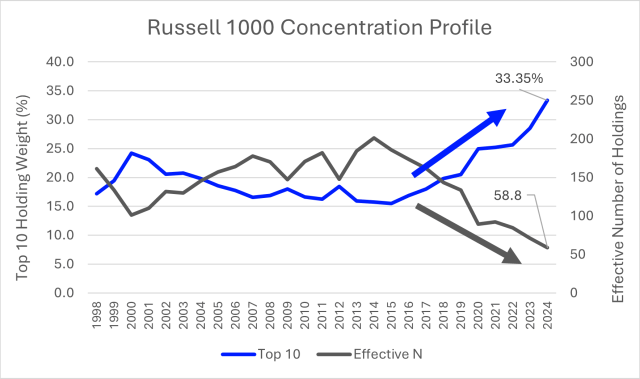
The US stock market has never before been this top heavy, and no easy solution, or indeed any solution, appears to be within the grasp of investors. The peak of the dot.com bubble seems quaint by comparison to the present market structure, with the top 10 weight currently standing at a resounding 33.35% of market capitalization. The diversification dilemma is real.  My goal in this blog post is three-fold. First and foremost, I will diagnose the illness pervading the US stock market. Second, I will examine why equal weighting — the back-up index strategy of choice — distorts a portfolio with far-from-equal exposures. Third, I will explain why a factor application can naturally distribute portfolio weights for ideal diversification. The factor portfolio has greater breadth than a market-capitalization portfolio, without the practical and performance liabilities of equal weighting.  Big Money, Bigger Problems Mega-cap concentration has exploded, increasing by 115% from a 25-year low in 2015, when top 10 holdings accounted for 15.52% of total index weight. Having first surpassed the historic dot.com bubble concentration levels in 2020, concentration now stands at a 38% premium to such excesses. US stocks have long since crossed the concentration Rubicon. The corollary to an increasingly top-heavy benchmark is that market diversification and breadth have never been more limited. This issue can be conceptualized by looking at the effective number of stocks provided by an index — the size of an equally weighted basket that provides equivalent diversification.  Exhibit 1. The startling conclusion is that, despite the Russell 1000 nominally providing exposure to its namesake number of stocks, the index affords an effective diversification of only 59 stocks. This figure represents a historic low and a decrease to only 29.2% of the effective number of holdings (N) of 202 stocks achieved in 2014. Not only does market-cap weighting induce substantial single-stock risk, but the diversification provided by this foundational asset class has evaporated by 70% over the past decade. Hence, the concentration crisis.   Equal Weight to the Rescue? Unlikely… If weighting by market cap is pushing portfolios to their breaking point, surely weighting companies equally can achieve the diversification for which investors are clamoring? For all the same reasons the market is so concentrated, the equal-weight methodology produces quite radical portfolio constructions, with outcomes perhaps even less desirable than the concentration itself. This is a classic case of the cure being worse than the disease. Exhibit 2. Notes: Relative returns of the Russell 1000 Equal-Weight Index and the Russell 1000 Comprehensive Factor Index to the Russell 1000 Index. Bottom window depicts the change in 10-Top index weight of the Russell 1000 from its minimum in 2015. Source: FTSE Russell Data, June 2024. This is not your grandfather’s equal-weight market. What is often perceived as a simple alternative is no longer a substitute benchmark, but instead an aggressive active strategy. Specifically, equal weight suffers from significant operational costs, underperformance, questionable assumptions, and skewed risk bets. As market-cap and equal-weight portfolios have diverged in structure, tracking error has soared to 8.05% on an annualized basis. This is the highest tracking error on record outside periods of market stress, even though volatility is only at the 21st percentile measured on a 20-year range. To illustrate just how extreme this tracking error is, the 60 largest active mutual funds in the US average 5.50% annualized tracking error. Yes, that’s correct, equal weight is far more active than the leading active funds owing to its onerous reallocation schema. As a card-carrying active strategy, equal weight exhibits the familiar encumbrances of high turnover and tepid performance. The need to countermand all share-price movements at each rebalance means that the Russell 1000 Equal Weight Index has averaged 71.0% two-way turnover since 2000. Moreover, this turnover is historically inconsistent ranging from a low of 44% in 2012 to a high of 132% at the height of the dot.com bubble. This imprecision is a resonating theme of equal weighting. Exhibit 3. Notes:  Decomposition of benchmark, equal-weight and multifactor returns around June 30 2014, the peak of equal weight returns. Source: FTSE Russell Data, June 2024. Yet, it is the performance drag that most indicts the equal-weight framework. When returns have been so inequitably distributed, owning companies in equal measure has been a perilous approach. The mega caps did not achieve stratospheric concentration by performing poorly.  Indeed, equal performance was maximized when the degree of market concentration was minimized. The halcyon days for equal weighting were a decade ago, the absolute peak notched on June 30, 2014. Since then, the strategy has underperformed relentlessly in nearly every market condition.  Exhibit 3 illustrates this stark bifurcation in performance juxtaposed against changes in top 10 index concentration. Whereas equal weight outperformed by 405 basis points (bps) annualized from 2005 to mid-2014, it underperformed by nearly identical measure (408 bps) over the subsequent 10 years. In fact, for every one-point increase to top 10 index concentration from 2015 levels, the Russell 1000 Equal Weight Index lost 2.17 points of relative performance to its market-weighted counterpart. Betting on Knowing Nothing Why does this schism in equal-weighted returns emerge starting in 2014? While cap weighting assumes markets are efficient, with asset prices accurately reflecting all information, equal weighting takes the opposite approach. It assumes we cannot know anything about the market.  When concentration rests at manageable levels, this “know nothing” assumption still looms large, but equal weighting is implementable, nonetheless. On the other hand, as the market cap of the largest companies expands to 7,658 times the average size of the smallest 10 stocks in the Russell 1000, equally weighting these companies has long since passed credulity. This size spread between largest and smallest companies is not only emblematic of the concentration dilemma, but indicative of why equal weighting fails in this market regime. In 2005, this size gap was a 224-fold multiple, increasing nine times to a 2,018 multiple by 2015, before expanding a further 3.8 times to present levels. This scale factor increase of 34 times means

Can Equal Weight Solve Our Concentration Crisis? Not So Fast… Read More »

How Can Family Offices Leverage Artificial Intelligence? Four Applications

For more on artificial intelligence (AI) in investment management, check out The Handbook of Artificial Intelligence and Big Data Applications in Investments, by Larry Cao, CFA, from the CFA Institute Research Foundation. Artificial intelligence (AI) has created substantial buzz and substantial fear in the business world and popular culture alike. Everyone has heard of ChatGPT and other generative AI platforms, and more and more people are using them in both their personal and professional lives. The investment world is no different, and financial professionals are searching for ways to both implement generative AI and protect themselves from it. While AI is a useful tool that can create powerful and positive outcomes, it also involves substantial risks. That’s why family offices need to understand its strengths and limitations and work to responsibly integrate AI into their practices while being mindful of the potential threats. How AI Can Help Serve Clients AI can generate investment recommendations, analyze scenarios, run simulations, and monitor various investment factors. Companies deploy AI for risk analyses, supply chain management, accounting exercises, and financial planning, among other purposes. By incorporating AI into their tech stacks, family offices can increase productivity and cut costs. After all, an adviser’s time may be better spent building client relationships, increasing innovation, and expanding market share rather than, say, data modeling. This improves efficiency without necessarily rendering human staff obsolete. By leveraging AI, family offices can reallocate their human capital to where it brings the most value. AI-Inspired Personalization AI’s chief value proposition for family offices is through investment software. By processing massive datasets, AI can help identify potentially alpha-generating trends and patterns. Augmented by human judgment and restrained by clear boundaries, AI can help fine-tune the investment process and deliver individually tailored client solutions. How Can Family Offices Best Leverage AI? Family offices can deploy AI wealth management models trained on historical financial data, market trends, and other relevant factors and apply them to the following tasks: 1. Investment Analysis AI-generated investment scenarios and simulations can help guide and inform family office investment strategies by providing insights into the potential risks and returns. Just as financial planners run through sequence-of-return-risk scenarios, family offices generate alternative investment scenarios and performance simulations based on massive datasets. By bringing AI to bear, they can make more sophisticated and data-driven decisions. 2. Portfolio Allocation Optimization AI can simulate different allocation strategies; account for risk preferences, return objectives, and constraints; and suggest optimal portfolio compositions that align with investment goals. As such, AI-driven investment analysis gives family offices the means to test assumptions and run through contingency plans. 3. Risk Management Risk management in family offices has always been challenging. But AI is helping to address this. By monitoring market data, macroeconomic indicators, and other relevant factors, AI can help flag risk scenarios. Enabled by AI, family offices can sandbox test catastrophic events against their datasets and model the magnitude of their risk. But AI’s value add goes beyond diagnosis; it provides a toolbox with which to monitor potential threats and respond at strategic times. 4. Alternative Data Analysis By using AI to process and analyze alternative data sources, such as social media feeds, news articles, and online sentiment, family offices can now identify emerging trends and investment opportunities, gaining insights that traditional analysis has overlooked in the past. There is massive potential to explore qualitative data and add nuance to datasets that previously were out of reach or too costly to analyze. Intentional — But Cautious — Adoption of AI AI will continue to grow in importance and capability. With that in mind, firms are right to explore the advantages that AI offers as well as its potential excesses and downsides. Executive teams need to devote resources to understanding how AI can strengthen or threaten the business and assign team members to monitor and explore these programs and their impacts on the organization. While AI’s strengths are many and obvious, AI applications are only just beginning to be deployed, and as with any new and largely untested technology, there is reason to be cautious. Indeed, family offices navigate highly regulated fields and often have sensitive intellectual property considerations to keep in mind. Each office will have to decide the boundaries to set around AI implementation. The risks are real: Samsung software engineers uploaded sensitive source code to ChatGPT servers. A lawyer who relied on ChatGPT received completely fabricated case law that exposed them to sanctions and ethics violations. Given these risks, family offices need to build in redundancies and quality controls to ensure their intellectual property is safe and the information they provide clients is accurate. AI will revolutionize family office operations. That’s why each office must be intentional about its AI adoption formula, governance procedures, and long-term AI roadmap. The tools are out there — it’s up to family office innovators to determine how best to deploy them. If you liked this post, don’t forget to subscribe to Enterprising Investor. All posts are the opinion of the author. As such, they should not be construed as investment advice, nor do the opinions expressed necessarily reflect the views of CFA Institute or the author’s employer. Image credit: ©Getty Images/dan Professional Learning for CFA Institute Members CFA Institute members are empowered to self-determine and self-report professional learning (PL) credits earned, including content on Enterprising Investor. Members can record credits easily using their online PL tracker. source

How Can Family Offices Leverage Artificial Intelligence? Four Applications Read More »

Private Capital: Lessons from the Conglomerate Era

Global private capital firms are charting a well-traveled course. With their sprawling empires, the largest alternative asset managers have adopted strategies that borrow extensively from the octopus-like corporate conglomerate business model. The Age of Private Market Empires Many private equity (PE) firms are building product lines that are adjacent if not necessarily complementary to their traditional buyout activities. These product lines all sit under one common umbrella: capital solutions. That is why the moniker “financial conglomerate” now applies. By aggregating multiple and sometimes loosely related businesses, these modern conglomerates achieve two main purposes: They consolidate market power and diversify away economic risks. Infrastructure, credit, life insurance, real estate, and venture capital have as much in common today as the General Electric (GE) domestic appliances line had with its aircraft engine production unit, or the General Motors (GM) former subsidiary Frigidaire had with its main automobile manufacturing business. For today’s financial conglomerates, as with their corporate predecessors in the last century, asset accumulation and revenue maximization have taken priority over strategic coherence. Fifty years ago, buyout pioneers believed corporate conglomerates were overly complex and that corporate carve-outs could create greater value. Yet today, in a bid to shed their reputation as financial engineers, PE fund managers are acting more like industrial owners, holding onto portfolio assets for a decade or longer rather than the conventional three to five years. They also play a more active role in portfolio management — with operating partners, sector experts, and when needed, turnaround specialists — than they did when they first emerged in the 1970s. Back then, they behaved more like holding companies: They were neither operationally nor strategically involved in the day-to-day running of investee companies. Though established to improve corporate governance and strategic focus, private capital firms now emulate old corporate conglomerates. But if this is the case, it is worth examining why the practice of vertical and horizontal integration so often led to failure in the past. What went wrong with the corporate conglomerate business model? The Conglomerate Discount Conglomeration is a good way to maintain control over family businesses, as Reliance, Mahindra, and Tata, among other firms, have demonstrated in India, and can also help governments set industrial policies in strategic sectors, as with some keiretsu in Japan, chaebols in South Korea, and jituan in China, as well as in much of Europe. But conglomerates have rarely maximized long-term shareholder value. Too often, whatever synergies they manage to create fail to compensate for the costs associated with the increased complexity. Such conglomerates seek out scope as well as scale, even when they lack expertise in the targeted sectors. In Europe, for example, the now-disbanded Hanson Trust group spanned retail fashion, typewriters, chemicals, gold mining, toys, tobacco, and beyond. The temptation to devise economies of scope is hard to resist, even when it stretches a conglomerate’s capabilities. Five years ago, the world’s largest telecom operator, AT&T, acquired the WarnerMedia entertainment group, for example, only to unwind the deal three years later. Like other industrial concerns, GE operated under the principle that centralized strategic planning and capital allocation was the most efficient way to run separate business units. Yet, during the global financial crisis (GFC), its GE Capital financial division faltered and starved the whole enterprise of cash. This helped force the sell-off of its mass media unit NBCUniversal. Giant corporate conglomerates often hire strategy consultants to help address the challenges posed by their size. Various management fads in the 1980s made way for operational solutions and systems implementation in the 1990s. Under CEO Jack Welch, for example, GE adopted Six Sigma process-improvement methods. But these practices ended up mostly overengineering management structures. In PE, financial engineering tends to drive investment performance. So, the corporate fixers in financial conglomerates are not management consultants but leveraged finance and turnaround experts, especially in distressed scenarios. Eventually, the corporate conglomerate came to suffer from a fundamental weakness: The whole was worth less than the sum of its parts, and unrelated divisions were “worth less than if they were stand-alone units,” as Michael E. Porter writes. The combination of business and market risks led public investors to assess most conglomerates at a discount relative to their breakup value. Risk Diversification and Return Dispersion Demergers became the most efficient way to extract the true value of the underlying assets and demonstrated that individual corporations did have an optimal structure. Therefore, the main challenge for modern-day private capital firms is achieving both horizontal cohesion and vertical integration. Many corporate conglomerates started out by building a dominant competitive position in one or a handful of businesses. Once the strong core was established, they expanded vertically and horizontally. The strategy became so popular that, by 1970, 20% of Fortune 500 companies were conglomerates. Private capital firms emulated this pattern, first refining their expertise in one or two asset classes — frequently leveraged buyouts, infrastructure, or real estate — before branching out into credit, venture capital, insurance, distress investing, and even natural resources. The rationale behind the emergence of private capital supermarkets is simple: They offer the convenience of one-stop shopping to investors that lack the wherewithal to execute a diversification strategy. Alleviating performance cyclicality is the obvious benefit of this approach. Diversification across a broad range of uncorrelated asset classes mechanically reduces volatility, as when infrastructure is paired with growth capital or when the steady income flows of the insurance business are counterbalanced by the unpredictable earnings of early-stage financing. Yet, conglomeration is not an efficient way to reduce investment risk. There is a fine line between diversification and dispersion. After all, investors can likely gain better diversification at lower costs across the entire spectrum of asset classes through an index tracker than by investing in the few assets identified and acquired by a financial or industrial conglomerate’s management team. Sponsors Benefit More Than Investors “The overriding drive among fund managers is for asset size, seemingly above all else, simply because piling assets on assets results in fees piled on

Private Capital: Lessons from the Conglomerate Era Read More »