CFA Institute

Return to Tradition? Three Reasons to Consider a Bond Allocation

US government money market funds have enjoyed record inflows this year as their 5%-plus yields — the highest in decades — and lower-risk status have obvious appeal for investors.  But we believe intermediate high-quality bonds may offer an important and compelling option for clients’ longer-term portfolio allocations thanks to their historically elevated yields, longer duration profiles, and potentially negative return correlation with equities and other higher-risk assets. 1. Yields are at a 16-year high. Yield is often the best predictor of a bond’s total return over the intermediate or longer term, and the yield of the Bloomberg US Aggregate Index (Aggregate Index) may represent an attractive valuation entry point for investors. In contrast, yield is not a good predictor of longer-term returns for money market funds. After all, money market interest rates can change on a daily basis and pose reinvestment risk over short time horizons. Moreover, the market has recently pushed out major rate cuts into the second half of 2024. But if the economic outlook deteriorates more quickly than is currently expected, the US Federal Reserve could slash short-term interest rates sooner, further compromising money market yields and total returns. Looking ahead, we believe investors should consider the value longer-duration bonds may offer in a future environment marked by federal funds rate cuts beyond what the market has currently priced in. While cash offers limited upside, as previous results indicate, the Aggregate Index could generate an intermediate-term total return in excess of today’s yield. 2. Duration has traditionally benefited from falling interest rate environments. While the Fed has pledged “higher for longer” short-term rates, should the economy fall into recession over the next year, they may choose to cut rates sooner than currently expected. High-quality bond market total returns have tended to outperform in falling interest rate environments. Why? In part, because of the longer interest rate duration profile. Money market funds, on the other hand, do not have significant duration exposure and will gain little benefit from a move lower in interest rates. As the following exhibit demonstrates, when the Fed has eased monetary policy over the past 25 years, it has cut interest rates quickly and sharply. In periods like the present, when rates exceed 5%, rate cuts have totaled 4.5% to 5% over an approximate 1.5-year period. The fixed-income markets currently forecast federal funds rate cuts of less than 1% over the next 1.5 years. During past Fed easing cycles, the Aggregate Index outperformed cash by a considerable margin, even amid the global financial crisis (GFC) when credit spreads widened significantly. When the Fed Cuts Rates, Intermediate Bonds Have Benefited Source: Bloomberg as of 5 May 2023 Data represent past performance, which is no guarantee of future results. Rate cut cycles begin with the date on which the Fed cuts rates and end with the lowest rate in each cycle. Bloomberg indices represented include three-month Treasury bills, five-year Treasury bills, and the US Aggregate Bond Index, a measure of the US bond market. Indices are unmanaged, and their returns assume reinvestment of dividends and do not reflect any fees or expenses. It is not possible to invest directly in an index. In other words, intermediate bond duration has tended to dominate credit spread movement in recent rate-cutting cycles. Once the Fed has reached its terminal rate, longer-term yields have usually declined as investors start to discount lower forward interest rate expectations. US 10-Year Treasury Yields after the Fed Paused 3. The value of the longer-term negative return correlation relationship between bonds and equities can be valuable for portfolio construction. Historically, high-quality bonds tend to act as the portfolio “anchor,” giving investors the stable income and relatively low or negatively correlated returns to equity market returns. That relationship was upended in 2022. During the fastest and largest interest rate increase cycle since 1974, bond and equity prices moved largely in tandem and sustained historic losses. As the Fed nears its terminal rate, we believe high-quality bonds are well positioned to reassume their traditional role as a portfolio “diversifier.” Bonds Have Shown Negative Return Correlation with Risky AssetsReturn Correlations of Bonds vs. Stocks Sources: Bloomberg and Amundi US as of 30 September 2023. The return correlation relationship displayed above illustrates the valuable role bond exposure can play in reducing portfolio return volatility relative to money market funds.  With higher yields and income, the classic 60/40 equity/bond allocation could once again become the dominant target for investors. Looking Ahead In the wake of the Fed’s unprecedented interest rate hikes in 2022 and 2023, investors are now presented with an opportunity to consider historically elevated yield options across the entire yield curve. While many investors understandably focused their initial attention on money market funds in search of safety and yield, intermediate bonds now offer a compelling alternative when considering potential benefits from elevated income, total return, and portfolio diversification. While the Fed’s ultimate short-term interest rate path is somewhat uncertain, we believe the current tightening cycle is nearing its peak and, in response, investors may be well served by extending the duration of their fixed-income exposures. If you liked this post, don’t forget to subscribe to Enterprising Investor. All posts are the opinion of the author. As such, they should not be construed as investment advice, nor do the opinions expressed necessarily reflect the views of CFA Institute or the author’s employer. Image credit: ©Getty Images / PashaIgnatov Professional Learning for CFA Institute Members CFA Institute members are empowered to self-determine and self-report professional learning (PL) credits earned, including content on Enterprising Investor. Members can record credits easily using their online PL tracker. source

Return to Tradition? Three Reasons to Consider a Bond Allocation Read More »

Can Tracking Error Boost Index Funds’ After-Tax Returns?

Investors tend to view an index fund’s tracking error in a purely negative light. When a fund fails to track its benchmark especially well, investors’ assumption is that the fund manager is probably bad at their job. But there could be another story here. Maybe the fund manager is allowing some tracking error as a means of avoiding taxable events. After all, every time a fund manager sells or rebalances a position to track the benchmark index, it constitutes a taxable event that will diminish the fund’s post-tax performance. So, do index funds with lower tracking error have better or worse post-tax performance? To investigate this issue, we pulled data on all US-dollar-denominated index mutual funds across six different asset categories: large-cap equities, emerging market equities, fixed-income, small-cap equities, US value, and US growth. We then assigned each fund with a tracking error designation: high, middle, or low. For each category, we calculated both the median return and the median post-tax return over the past five years. We defined tracking error as the standard deviation of the difference between the returns of the fund and those of the tracked index over an annual time frame. So, what did we find? Large-cap equity, emerging market, and fixed-income funds with high tracking error exhibited better post-tax performance than their low tracking error counterparts. Large-Cap Funds Tracking ErrorCategory Median Five-YearReturn Median Five-Year Post-Tax Return Low 9.66% 4.74% Middle 10.43% 7.83% High 10.44% 7.88% Emerging Market Funds Tracking ErrorCategory Median Five-YearReturn Median Five-Year Post-Tax Return Low 0.36% 0.08% Middle -0.53% -0.70% High 0.78% 0.35% Fixed-Income Funds Tracking ErrorCategory Median Five-YearReturn Median Five-YearPost-Tax Return Low 0.62% 0.17% Middle 0.90% 0.30% High 1.12% 0.66% For instance, the low tracking error category of large-cap equity funds had a 4.74% annualized post-tax return over the past five years, while its high tracking error counterpart generated 7.88%. But this isn’t the full story. In the small-cap, value, and growth fund categories, the results were completely different. For each of these asset classes, low tracking error funds did tend to exhibit better post-tax performance. For instance, high tracking error small-cap funds had a 4.99% median annual return over the past five years, compared with 5.77% for their low tracking error peers. Small-Cap Funds Tracking ErrorCategory Median Five-Year Return Median Five-YearPost-Tax Return Low 7.35% 5.77% Middle 5.36% 3.72% High 6.76% 4.99% US Value Funds Tracking ErrorCategory Median Five-YearReturn Median Five-YearPost-Tax Return Low 8.72% 6.11% Middle 7.84% 5.52% High 7.25% 4.34% US Growth Funds Tracking ErrorCategory Median Five-YearReturn Median Five-YearPost-Tax Return Low 11.37% 7.96% Middle 12.24% 9.44% High 10.67% 6.17% So all in all, our examination revealed mixed results. We didn’t find that a fund’s tracking error was a good predictor of post-tax performance. Low tracking error did not seem to be an indicator of index fund quality, although higher tracking error may, in certain situations, help funds avoid taxable events and thereby boost post-tax returns. If you liked this post, don’t forget to subscribe to the Enterprising Investor. All posts are the opinion of the author. As such, they should not be construed as investment advice, nor do the opinions expressed necessarily reflect the views of CFA Institute or the author’s employer. Image credit: ©Getty Images / matejmo Professional Learning for CFA Institute Members CFA Institute members are empowered to self-determine and self-report professional learning (PL) credits earned, including content on Enterprising Investor. Members can record credits easily using their online PL tracker. source

Can Tracking Error Boost Index Funds’ After-Tax Returns? Read More »

Social Norms Shape Investment Behavior. What Can Advisors Do About It?

As clients navigate complex markets and increasing uncertainty, financial advisors are rethinking how they guide investment behavior. Traditional economic models are giving way to behavioral finance, where psychological and social factors — especially social norms — play a powerful role. Understanding how these norms influence risk-taking can help advisors tailor strategies, build trust, and drive better client outcomes. What are social norms? Social norms are the generally unspoken expectations or shared understandings that influence what people consider acceptable behavior. Whether descriptive (what people believe others are doing) or injunctive (what people believe others expect them to do), social norms have the power to shape perceptions, attitudes, and actions. For financial advisors, understanding these dynamics is critical to crafting strategies that not only align with clients’ objectives but also inspire confidence and proactive decision-making. This blog explores how social norms influence investment behavior, particularly through their interaction with investment experience, risk tolerance, and psychological mediators like attitudes, subjective norms, and perceived behavioral control. It also highlights how these insights can be leveraged by financial advisors to build stronger relationships and drive better outcomes for their clients. Social Norms in Behavioral Finance At the heart of behavioral finance lies the recognition that human behavior often deviates from the rational, utility-maximizing models proposed by classical economics. Social norms, as part of this behavioral framework, influence decision-making by providing cues about what is considered acceptable or expected behavior. Descriptive norms guide individuals based on what they observe others doing. For example, when investors see their peers allocating significant portions of their portfolios to risky assets, they may feel encouraged to do the same. Injunctive norms exert influence by signaling societal or group expectations. An investor might feel compelled to conform to perceived standards within their professional or social circles, even if it contradicts their natural risk preference. The importance of social norms becomes particularly apparent in complex decisions like investing in risky assets such as equities, where uncertainty and information asymmetry create a reliance on external cues. Moderated Mediation Analysis: Insights into Investor Behavior My doctoral research thesis sheds light on how social norms influence the intention to invest in risky assets through three underlying processes:       1.   Attitude toward risky assets — The degree to which individuals view risky investments positively or negatively.       2.   Subjective norms — The perceived expectations from others regarding risky investment decisions.       3.   Perceived behavioral control — The confidence individuals feel in their ability to execute investment decisions successfully. However, these underlying processes through which social norms influence the decision to invest in risky assets are not uniform. They vary depending on the level of clients investment experience and risk tolerance. A deeper dive into the interplay of social norms, investment experience, and risk tolerance reveals some crucial behavioral patterns: Attitudes toward risky assets are most influenced at low levels of investment experience and high levels of risk tolerance. These individuals often lack the technical knowledge to make independent decisions and therefore rely heavily on social cues. By observing peers with similar characteristics investing successfully in risky assets, they develop a more positive attitude toward taking similar actions. Subjective norms play a more significant role at moderate levels of investment experience and low levels of risk tolerance. For these clients, perceived societal expectations can either encourage or discourage them from stepping out of their comfort zones. These clients may feel pressure to conform to societal or peer expectations but remain hesitant due to their risk aversion. Their investment decisions are more likely to be swayed by perceived approval or endorsement from trusted sources, such as financial advisors or influential peers. Perceived behavioral control is most impactful at high levels of both investment experience and risk tolerance. Experienced and risk-tolerant investors feel empowered when they perceive themselves as capable of making informed decisions. Social norms reinforce their confidence, especially when aligned with their personal investment goals and knowledge. 4 Actionable Strategies for Financial Advisors Understanding how social norms interact with investment experience and risk tolerance provides financial advisors with a powerful framework for influencing client behavior. Here are four actionable strategies:       1.   Segment Clients Effectively. Advisors should categorize clients based on their levels of investment experience and risk tolerance. For example, novice investors with high risk tolerance may require different communication strategies than seasoned investors with low risk tolerance.       2.   Leverage Social Proof for Novice Investors. For clients with limited investment experience, highlighting the behavior of peers can shape attitudes positively. Case studies, testimonials, or data showing how similar individuals have benefited from investing in risky assets can build trust and encourage action.       3.   Address Subjective Norms for Hesitant Investors. Risk-averse clients with moderate experience are often guided by perceived expectations. Advisors can create a sense of community through investor networks or peer forums, where clients can see others successfully navigating similar decisions.       4.   Empower Experienced Investors with Data and Tools. Clients with high investment experience and risk tolerance value control and confidence. Advisors should focus on providing sophisticated tools, personalized analysis, and actionable insights that align with their goals, reinforcing their perceived behavioral control. A Call to Action The integration of behavioral finance insights — particularly the power of social norms — is no longer optional for financial advisors. As clients demand more personalized and holistic guidance, understanding how social norms interact with factors like investment experience and risk tolerance offers a powerful way to shape behavior and improve outcomes. For advisors who can master the balance between behavioral insight and technical expertise, the payoff is twofold: stronger client relationships and greater differentiation in an increasingly competitive industry. It’s time to embrace the norm effect and rethink how we influence investment decisions. source

Social Norms Shape Investment Behavior. What Can Advisors Do About It? Read More »

Quit to Win? Six Reasons Why Winners Quit

Binod Shankar, CFA, is the author of Let’s Get Real: 42 Tips for the Stuck Manager. Sometimes quitting is the right thing to do, whether it is leaving a city, a relationship, or, yes, even a career. But as an executive coach, I find that most people have major issues with giving up on a career, even one that has grown stale and unfulfilling. We can hang on for years — even decades — after we should have just thrown in the towel.  Why? There are countless reasons, but these are the ones I encounter the most in my practice:  No one wants to be seen as a loser. After all, winners never quit and quitters never win. We believe greater success in our current career is just around the corner. That organizational shake-up or long-awaited promotion will finally materialize and set us on the right path. We do not know why we should quit. We cannot articulate a convincing reason. Quitting will take us outside our comfort zones and inject uncertainty into our lives. Starting a new career is hard, especially if it is in a totally different sector. Will we have to take a pay cut? What will it mean for our quality of life? We have dedicated too much of our time and human capital to succeeding in an industry or discipline — accounting, for example — and quitting feels like chucking all that away. What was the point of all that effort if we are now going to give up? I know how much these concerns matter. They keep us in jobs we no longer want and prevent us from finding the ones that we love. But they are all focused on the downside. That is why I try to convince my clients who are finance professionals that quitting can have an upside. How do I know? Because I am an experienced quitter who has quit to win many, many times. For example, I quit studying for CPA exams to focus on the CFA Program; I quit corporate life to co-found a financial training company that we subsequently sold; I quit that company to become a podcaster; I quit as a CFA exam prep trainer to become an executive coach; I quit marathon running for high-altitude hiking and mountaineering; and I quit those two disciplines to focus on strength training. Are you seeing a pattern? So, I’ve devised six perspectives that help underscore the reasons to quit. Inspired by episodes of The Big Bang Theory, these are framed in a way that investment professionals will understand. 1. The Sunk-Cost Fallacy  When we calculate the net present value (NPV) or the internal rate of return (IRR) of a project or investment, we ignore all sunk costs no matter how large. These include valuation and appraisal reports, market studies, etc.  Why do we do this? Because life moves forward, not backwards. It is the forecast — the future — that matters.  So, from a pure career perspective, the 10 or 15 years we spent in financial control at XYZ bank matters far less than where we will spend the next 10 to 15 years. So, why not consider a switch?  What holds us back is an emotional attachment to a historical fact that is nothing but a sunk cost. 2. The Opportunity Cost Alternative  Opportunity cost is the value lost by choosing one opportunity over the next best opportunity.  Say we own a commercial building and lease it out as an office. The opportunity cost is the rent we would have collected had we leased it for the next best use — retail, say. Now look at our careers from this vantage point. Every day we spend in accounting is a day we do not spend building a career in investment management. And that type of inertia comes with a price tag attached.  I live in Dubai where, by my estimates, a financial planning and analysis manager with 10 years of experience earns about $80,000 less per year than a CFA charterholder working in investment management at the same firm with the same amount of experience. So yes, there’s definitely an opportunity cost.  There are caveats to be sure. When we switch careers or organizations, we may lose our seniority. For example, someone with 10 years in financial planning and analysis who moves to equity research may be treated at par with a five-year associate and their compensation may be lower at first. They may need three to five years to return to their old salary and then begin to outearn it. So, think long term. In Dubai, at least, we may not see that incremental $80,000 the first year after quitting. 3. The Time Value of Money  This is one of finance’s most fundamental concepts. We cannot conduct any analysis without it. So, what does this framework have to show about our future career? We can look at either the present value or the future value of the additional money we would make if we switched careers.  For the example above, if we run a present value or future value analysis of the extra $80,000 over a five to seven year period, even assuming an initial decline in salary, the additional financial benefits are hard to ignore. 4. The Risk–Return Paradigm  Quitting comes with risk. Financial and career failure are foremost.  Imagine as a finance professional we quit a career in corporate banking to join a private banking firm. But we soon find we hate the sales part of the new job and that building a book of ultra-high net worth individuals from scratch is easier said than done. Did we make a mistake? No — we just escaped a stagnating career at a small, haphazardly managed bank. In our new private bank position, our pay is 50% higher. We also have more flexibility and access to a wider range of financial products. Our prospects for promotion have also improved. We are now on a ladder that

Quit to Win? Six Reasons Why Winners Quit Read More »

Is Widespread Crypto Adoption Inevitable?

We are on the cusp of a major shift in financial, political, and social power from Baby Boomers toward Millennials that, combined with digitization and monetary policy shifts, will continue to drive regulatory changes supporting the adoption of cryptoassets. Regulation is often cited as a key factor hindering adoption of this under-owned asset. A recent Campden Wealth survey cited the lack of regulation as the second-highest impediment to investing in crypto among family offices. This is understandable, given the regulatory landscape in the United States since the collapse of crypto exchange FTX. Gary Gensler’s Securities and Exchange Commission (SEC) came down on the crypto industry with an iron fist, executing enforcement actions against Coinbase, Kraken, and many other credible companies. In addition, Martin Gruenberg at the Federal Deposit Insurance Corporation (FDIC) made life difficult for the crypto industry by weaponizing the banking sector. It has been challenging for crypto businesses like ours to get the basic banking services we require to function. The good news is conditions have improved markedly in the last year, opening the door for the power of changing demographics to accelerate the adoption of cryptoassets. Removing Regulatory Obstacles Conditions began to change in June 2023 with a constructive judgment in the court case against Ripple (XRP), providing much-needed clarity on the application of securities law to crypto. It also showed that the courts could stand up to the SEC, holding the institution accountable for its judgments. In August 2023, the US Court of Appeals for the D.C. Circuit called the SEC “arbitrary and capricious” after its decision to reject Grayscale’s Bitcoin ETF. This decision led to the approval of 11 bitcoin ETFs in January 2024 and laid the groundwork for Ethereum ETF approval in May 2024. ETFs have proven important, not merely for flows but for institutional credibility, creating broad-based support. Some of the world’s largest asset managers with entrenched relationships in Washington have built Bitcoin products and are marketing the value proposition to their clients. Bipartisan Support The approval of Bitcoin ETFs was monumental, but uncertainty over crypto regulation remained in Washington. Regulatory actions by the Department of Justice against Tornado Cash and Samourai Wallet in 2024 suggested persistent regulatory resistance. Events in May, however, have firmly affirmed the pendulum is shifting more positively. In May 2024, the House of Representatives passed a resolution, H.J. Res. 109, which overturned the SEC’s Staff Accounting Bulletin (SAB) 121. SAB 121 introduced unfeasible actions on digital asset custodians, threatening their viability. President Biden subsequently vetoed the actions of Congress. But the more important news is the bipartisan support for the bill in Congress including from key Democrats like Nancy Pelosi. In addition, FDIC chairperson Gruenberg is set to resign, potentially ending Operation Choke Point. Although Gruenberg’s decision is related to his misconduct charges, it certainly contributes to a significantly more positive regulatory landscape than a few months ago. It now appears that the harsh regulatory actions against the crypto industry are more idiosyncratic, coming from specific lobby groups. A broader number of Congressional members including Democrats, are adopting a more pragmatic view of the crypto industry and the technology that underpins it. The Unstoppable Market Forces I have long argued that three powerful market forces — digitization, monetary shifts, and changing demographics — make crypto adoption inevitable: Digitization: The world is increasingly digital, yet banking and finance haven’t been heavily impacted. Bitcoin represents the advent of digital scarcity. Bitcoin and crypto are taking money and finance into the digital age. Monetary shifts: Monetary regimes don’t last forever. The US dollar global reserve system has been around since the 1970s and is creaking under excessive debt and ultra-low interest rates, suggesting it cannot persist indefinitely. An alternative monetary system is required, and there are not many viable alternatives. Demographics: Baby Boomers have dominated global economics, politics, and culture for the last 50 years. They account for approximately 70% of US disposable income and 50% of wealth. However, old age implies that the reins will pass from Boomers to Millennials in the next 10 years. By 2025, Millennials are projected to comprise 40% of the US workforce, driving changes in work culture, job expectations, and career trajectories. Millennials are far more tech-savvy and favorable toward crypto than Boomers. Some Millennials will have grown up spending a significant portion of their time online. Digital ownership and online security may be second nature to them. The Campden Wealth 2023 survey of family offices affirms this general shift, revealing “change in culture” as a key finding. Nearly half (46%) of family offices expect a leadership transition to the next generation to occur within the next decade. Crypto Will Ultimately Prevail “Truth will ultimately prevail where there is pains to bring it to light.” George Washington As these trends unfold, aggregate perceptions of crypto will evolve, driving adoption beyond mere allocation. Politicians will need to adopt more crypto-friendly stances to appeal to an increasingly influential constituency. The recent appointment of J.D. Vance and Vivek Ramaswamy to key roles in the Trump presidential campaign reflects the early stages of this trend. If Trump is elected, these two pro-Bitcoin officials would be the first Millennials in the White House. Companies will consider crypto as a cost of doing business to remain relevant in the digital age like PayPal. Investment managers will be forced to consider allocation as they assess underperformance potential. A Nomura 2023 investor survey suggested allocators expect to have between 5% and 10% in digital assets in the next three years, and that traditional finance (Tradfi) backing of crypto products is important. We now have that backing through ETFs. Nearly half (45%) of the survey respondents said their and/or their clients’ total percentage exposure to digital assets will be between 5% and 10% over the next three years, and just 0.5% say they will have no exposure. Notably, $150 billion flows are expected by the end of 2025. Money is a technology to facilitate trade and savings. Bitcoin and crypto are merely an

Is Widespread Crypto Adoption Inevitable? Read More »

The Financial Adviser Value Proposition: The Five Components

What can we do for our clients that they can’t do on their own? What can make us better at managing their money than they are? These aren’t always easy questions to answer as a financial adviser. But modesty aside, we need to be able to explain to potential clients how we can help them and why we are worth the cost. And once we convince them to make that decision, we have to demonstrate that we really do walk the walk. It’s a two-part process: explaining our value and then continually demonstrating that value in the months and years ahead. So, what is our value proposition? To me, it comes down to five key contributions that we can deliver that many clients can’t get without an adviser. 1. Managing Emotions and Controlling for Bias Even if the client is brilliant, a genius, and smarter than any adviser out there, chances are they may get emotional about their money and might have trouble staying focused and unbiased when it comes to managing their own wealth the way advisers can.  They might hold on to a stock as it goes up and up without any strategy to protect themselves, only to watch it crash. Or they might panic and go to cash if the Dow drops 3% for four days in a row without the discipline to recognize that they may miss the upswing. A good adviser will have the discipline to stick to an investment philosophy and follow the data. Historical data shows that over the past 20 years, seven of the best days happened within just about two weeks of the 10 worst days. As professionals, we need to help clients manage their expectations and emotions.  I have seen so many clients insist on holding on to a stock simply because they “like it,” even though its earnings and profitability tell another story. And I have seen so many clients try to bail out at a bad time. That’s where we come in. Advisers are driven by objective factors — no emotions allowed. We provide the process, the philosophy, and the discipline that clients often can’t exercise on their own. 2. Resources As advisers, we have resources that clients can’t access themselves. This could be in the form of investment opportunities, proprietary research and insights, or access to specialists who can help with more complex situations, such as estate planning or liquidity events. Everyone’s financial situation is different. Financial goals and investing timelines vary from person to person. Creating a financial strategy is not one-size-fits-all, which is why it’s so important to have a personalized investment strategy. Advisers can sit down with a client and help outline a customized financial road map that is tailored to their personal needs and goals. Some advisers also specialize in particular areas, which can help clients who are navigating unique situations. 3. Brainstorming and Listening As advisers, we take and return our clients’ calls. We listen to their thoughts, whether it’s their worries and complaints or their hopes and dreams. This is significant and it matters. We can serve as sounding boards, even if we don’t always have the answers. Clients may have complex issues that we haven’t seen before. But simply talking through the pros and cons can be a great way to build a good client-adviser relationship. I had a client who struggled with whether to retire. She was so concerned about cash flow but no longer enjoyed the expensive city she called home. We brainstormed what it would mean to retire somewhere with a lower cost of living. At first, she merely mentioned it in passing — almost like a dream. It had little to do with her finances. Rather, she thought about missing her local friends but being closer to family as she aged. Ultimately, she went through with the plan. She now enjoys a stress-free life in retirement, with no cash flow issues. Our years of back-and-forth discussions went beyond the numbers. I listened and made sure I heard her concerns clearly. 4. Explaining Don’t downplay how important and helpful it is to simply explain things to clients. We should be spending a tremendous amount of time here. Good advisers will describe to their clients, in clear, direct language, exactly what is going on in their investment portfolio — the portfolio they created — as well as in the market and the broader economic landscape. A good adviser knows how to communicate and breaks things down to a level that’s easy to understand. We shouldn’t condescend and use big words and impenetrable jargon. We just need to be kind and polite and truly stand behind what we have created so that the client understands from start to finish. I think to myself, “If I were a client, what would I like to know?” And then I try to provide those answers.  At every quarterly meeting with a client, I make a point of going through what I think is obvious. How much money did the client start with? How much is there now? What is the dollar increase, the percentage increase, and how do these returns compare to the benchmark? What is the appropriate benchmark, anyway? What were the fees paid, down to the penny? What is the income estimate and what was the income earned? How much can be drawn out without touching the principal?  When describing our relationship, we hope clients would say, “I meet with my adviser regularly, and they explain my money to me clearly. I understand what is going on. I even understand what is happening in the markets.” I always shudder when I onboard a client who says, “I really have no idea what’s in my portfolio.” Be the adviser that takes the time to explain — it is invaluable. 5. Being Close Confidantes A good adviser functions as a trusted partner. I serve as a partner not only to my clients, but alongside the other advisers in their life. For example, I work with clients’ tax and legal professionals, to help them craft strategies to prepare for all stages of life. I have walked clients through what will happen when they

The Financial Adviser Value Proposition: The Five Components Read More »

Bitcoin Valuation: Four Methods

For more on crypto valuation, read Valuation of Cryptoassets: A Guide for Investment Professionals by Urav Soni and Rhodri Preece, CFA, from CFA Institute Research and Policy Center. “On behalf of the professional investment community, I am respectfully asking any crypto expert to put together some cogent, coherent concept of how to make buy and sell decisions in a cryptocurrency portfolio.” — Franklin J. Parker, CFA, “Crypto’s Unanswered Question: At What Price?” Introduction Before diving into the bitcoin valuation task, we must first acknowledge that this is no ordinary undertaking. Unlike traditional assets such as stocks and bonds, bitcoin lacks the typical characteristics required for traditional valuation methods. It doesn’t generate cash flows, pay dividends, or otherwise offer yields, and thus may be more reminiscent of commodities, which are both cyclical in nature and notoriously difficult to value. Nevertheless, there are a number of sensible frameworks through which to view this evolution in money and finance.  So, in response to the question posed by Franklin J. Parker, CFA, here are four bitcoin valuation methods that highlight different ways of exploring the cryptocurrency’s worth and offer insights into this nascent yet powerful technology. 1. Compare It with the Alternatives One way to gauge bitcoin’s value is to determine what asset classes or securities it competes with and compare their potential value. So, to extend our commodity metaphor, where does bitcoin — so-called digital gold — stand relative to actual gold? Both are fixed-supply, counterparty-free assets with rare and desirable monetary characteristics and used by investors as long-term safe havens for capital preservation. Today, gold has a market capitalization of roughly $11.5 trillion. If bitcoin reached a similar market capitalization, then the price per coin would exceed $500,000. Bitcoin Valuation: Alternatives Comparison Sources: Glassnode, World Gold Council, Trading Economics, Savills, Visual Capitalist, and Sound Money Of course, bitcoin has something of a technological edge over gold. It is digital, decentralized, and free from government influence. So, if its market capitalization reaches $11.5 trillion, why would it stop there? And is gold its only competition? Couldn’t bitcoin stand in for other financial collateral and store-of-value assets like global bonds or even residential property? To be sure, definitive answers to these questions are elusive, but trying to find them can enhance our understanding of bitcoin, bitcoin valuation, and the crypto phenomenon more generally. 2. Base It on Production Costs We hear all the time about the electricity and equipment required to mine bitcoin. These associated expenses provide another means of determining the cryptocurrency’s value. While estimates of these costs are highly variable and inevitably inaccurate, Cambridge University researchers have compiled some of the most reliable data. Bitcoin Production Costs Source: Capriole Investments. Created with Data Wrapper Of course, bitcoin is a store-of-value asset and an alternative monetary technology. But few users are pricing bitcoin based on the latter quality. That’s why bitcoin production costs serve a purpose similar to those of gold: They set a floor on the price, which can help determine whether the underlying is undervalued. Historically, bitcoin’s price has tended to bottom out at around its production cost, as in the second half of 2016, the first half of 2019, March 2020, and the second half of 2022. By helping determine whether bitcoin is undervalued, production costs are a critical input to its valuation. But since they can hardly quantify the upside price potential associated with bitcoin’s monetary premium, they are also a limited input. 3. Look at the US Dollar So, how do we value bitcoin’s monetary premium? As an alternative monetary technology, bitcoin has to be assessed in the context of the prevailing monetary system: the US dollar. Real interest rates, money supply growth, and fiscal policy, among other factors, all influence bitcoin’s valuation. Elevated real interest rates and constrained money supply growth are indicators of sound monetary and fiscal policy. They help gauge whether the authorities are protecting the value of the dollar. Such factors should constitute headwinds for bitcoin prices. If policymakers are looking after the existing monetary regime, investors are less likely to look for an alternative. For Bitcoin Valuations, Dollar Policy Prudence Matters Sources: Glassnode, Google Finance, and Sound Money Of course, monetary policymakers often adopt profligate measures that debase the value of the dollar. The quantitative easing (QE) and other monetary stimulus of the last 15 years created low and negative real interest rates and rapid growth in the money supply. These were ideal conditions for bitcoin and fueled the crypto boom. Under tighter macro conditions, bitcoin is less valuable. Under loose conditions, it is more valuable. 4. Measure the Conviction of Bitcoin Holders Taking a more behavioral approach, we can also evaluate the underlying conviction of long-term vs. short-term bitcoin holders for clues to bitcoin’s value. The share of long-term holders tends to increase during bear markets and decrease during bull markets. Long-Term Bitcoin Holder Percentages Indicate Under/Overvaluation Sources: Glassnode and Sound Money This suggests that bitcoin is overvalued when short-term speculators hold more of the supply and undervalued when long-term holders predominate. Those accustomed to discounted cash flows, price-to-earnings ratios, and other traditional metrics may find bitcoin valuation methods unconventional. But unconventional or not, they offer a way to move forward. The outputs and outcomes may vary, but that is no surprise when it comes to emerging and potentially transformative technologies. Bitcoin’s many detractors could very well be right. Bitcoin and crypto in general could all end in failure, with an intrinsic value of effectively zero. But crypto advocates could also be on to something when they anticipate bitcoin becoming a global reserve asset. Few assets have ever sparked such divergent opinions. As the financial industry delves deeper into the crypto-valuation question, we should remember that the printing press, the steam engine, the internet, and other revolutionary technologies have always been difficult to value, particularly in their early stages. But these innovations eventually transformed the world in ways people did not initially imagine. Crypto may do the same. Or it may not. We’ll

Bitcoin Valuation: Four Methods Read More »

Is the PEG Ratio a Reliable Market-Timing Tool?

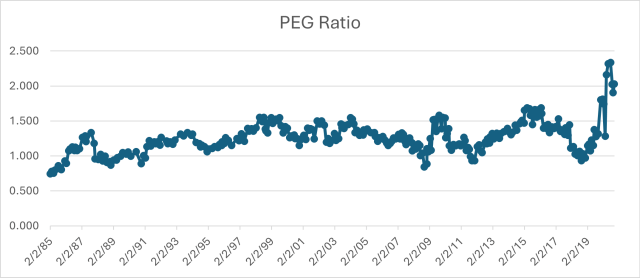
Investors rely on valuation metrics to gauge whether a stock is fairly priced. Among these, the PEG ratio is popular for its ability to adjust a stock’s valuation based on future earnings expectations. Unlike the standard P/E ratio, which simply compares price to current earnings, PEG incorporates growth projections. It is simply a company’s P/E ratio divided by its growth rate. Theoretically, this makes it a more refined tool for assessing whether a stock is under- or overvalued. But does the PEG ratio provide meaningful insights for broad market trends? To find out, we analyzed historical PEG data for the S&P 500 (1985 to 2020) and tested its effectiveness as a trading strategy. We used Yardeni Research’s PE ratio and its estimates of forward growth rates for the same period.  Exhibit 1. Mapping of the PEG ratio over time. The conventional wisdom is simple: PEG < 1.0 → The stock is undervalued relative to its expected growth. PEG > 1.0 → The stock is overvalued relative to its growth. Many investors consider 1.0 to be a key threshold. If a stock trades at a PEG below 1.0, it is seen as an opportunity. If it is above 1.0, caution is advised. If we use PEG to gage broad market trends, how often do these “undervalued” opportunities appear, and do they signal strong returns? Using the S&P 500 data from 1985 to 2020 and forward growth estimates from Yardeni Research, here’s what we found: PEG < 1.0 is Rare: Throughout the 1980s, there were a handful of months when the PEG ratio dipped below 1.0. In the 2000s, this happened only three times. In the 2010s, it occurred just five times. The PEG ratio almost never provides consistent buying opportunities at this threshold. PEG as Market Timing Tool: We tested a strategy where an investor would buy the S&P 500 when the PEG ratio was below 1.0 and sell when it moved above 1. While this worked well in some periods—like the 1980s—it was far less effective in the 2000s and beyond. Expanding the threshold to 1.25 or 1.5 showed similarly mixed results. Volatility is High: The returns associated with different PEG levels varied significantly across decades. What worked in one period often failed in another, making it difficult to use the PEG ratio as a standalone market signal. Table 1. While the PEG ratio remains a useful tool for evaluating individual stocks, our analysis suggests that applying it as a market-wide signal is far less reliable. Historically, opportunities to buy when the PEG ratio falls below 1.0 have been rare, and the strategy of trading based on PEG thresholds has yielded inconsistent results, particularly since 2000. While valuation metrics are valuable in investment decision-making, no single ratio should dictate market timing. Instead, investors should consider the PEG ratio as one piece of a broader analytical framework — complementing it with other fundamental and macroeconomic factors to make well-rounded investment decisions. If you liked this post, don’t forget to subscribe to the Enterprising Investor. All posts are the opinion of the author. As such, they should not be construed as investment advice, nor do the opinions expressed necessarily reflect the views of CFA Institute or the author’s employer. Image credit: ©Getty Images / Ascent / PKS Media Inc. Professional Learning for CFA Institute Members CFA Institute members are empowered to self-determine and self-report professional learning (PL) credits earned, including content on Enterprising Investor. Members can record credits easily using their online PL tracker. source

Is the PEG Ratio a Reliable Market-Timing Tool? Read More »

The Alchemist’s Paradox, Central Bank Sovereignty, and the Fate of Crypto

“It is difficult not to marvel at the imagination which was implicit in this gargantuan insanity. If there must be madness something may be said for having it on a heroic scale.” — John Kenneth Galbraith The cryptocurrency exchange FTX filed for bankruptcy on 11 November 2022 as Sam Bankman-Fried’s estimated net worth plummeted from $16 billion to roughly $0. While I’ve always been a crypto skeptic, I tempered my opinion because I did not understand the technical underpinnings or fully grasp the broad use cases. This led me to discount what was obvious: That the crypto craze had all the signs of a speculative bubble and that cryptocurrencies fulfilled none of the critical requirements needed to replace major currencies or serve as “digital gold.” Whatever the value of the technical innovation that minted them, cryptocurrencies suffer from two major and insoluble problems that make it extremely doubtful they will ever supplant fiat currencies or be used as the underlying commodity to which the value of a currency is pegged. Problem 1: The Alchemist’s Paradox One of the keys to crypto’s value proposition is the concept of supply constraint. According to their proponents, cryptocurrencies cannot be minted ad infinitum the way paper currencies ostensibly can. Each cryptocurrency can supposedly be reined in by programmatic constraints that prevent arbitrary increase in supply and preserve a cryptocurrency’s scarcity value. This sounds great in theory, but it only applies to single cryptocurrencies. Because crypto technology is so easily replicated, nothing prevents entrepreneurs from launching new cryptocurrencies. Which is precisely why there are now roughly 12,000 varieties circulating in cyberspace. This is the same problem ancient alchemists would have encountered had they discovered how to create gold out of lesser elements. Once the secret was out — and it would get out — gold would lose its scarcity value and no longer serve as a reliable store of value. The same rule applies to cryptocurrencies. The technology that gave rise to bitcoin was novel, but other cryptocurrencies have since emulated it. This distinct lack of supply constraint has made cryptocurrencies, in aggregate, a poor store of value. Problem 2: Central Bank Sovereignty The next hurdle to broad cryptocurrency adoption is the central banks. They must accept cryptocurrencies as a viable form of reserves. For that to happen, they would first need to abandon the current system of fiat currencies that most employ and repeg their currencies to some other commodity. No major central bank is likely do this willingly and, contrary to popular belief, for good reason. Doing so would significantly reduce their ability to adjust the money supply in response to financial crises. It was precisely this constraint under the gold standard that prolonged the Great Depression in the 1930s and caused repeated panics and depressions throughout the 1800s and early 1900s. Central bankers will not voluntarily reintroduce this structural weakness into their financial systems. Second, even if central banks retired fiat currencies, they would have to determine that a cryptocurrency, rather than gold, silver, or something else, was the best commodity to which to link their currency. In what sort of scenario would any major central bank willingly harness its currency to something over which it could exercise no control of the supply? At least with gold, the supply is limited by formidable natural constraints. The last time a major sovereign country relinquished control over its money supply to my knowledge was in early 18th-century France, when the regent for Louis XV handed the money supply, tax collection system, and control of Mississippi Company shares to John Law. The Mississippi Bubble that followed decimated the French economy and reverberated for the remainder of the century. Louis XV suffered a tremendous loss of wealth, and his successor, Louis XVI, lost his life. This is not something central bankers would dare repeat. Relegation to the Shadows of Finance Without broad-based central bank acceptance, cryptocurrencies will be permanently exiled to the fringes of the financial markets. The black market, failed or failing nation states, and the 24-hour casinos run by FTX-like firms may find limited use cases. But even if these are viable, we can only guess how large the potential market might be and which or how many cryptocurrencies will emerge as viable mediums, which makes buying and selling them no more than speculation. What’s worse, those who play this game will need to accept the risk of bank runs, bank robberies, and fraud without the protections of a well-regulated banking system. For those who made their fortunes in this shadowy market, I bear no ill will. Every bubble has its share of winners. But those looking to make crypto fortunes should be aware that there are more Bankman-Frieds lurking in the shadows, and whether or when they divulge the real value of their assets or steal yours is anybody’s guess. If you liked this post, don’t forget to subscribe to Enterprising Investor. All posts are the opinion of the author. As such, they should not be construed as investment advice, nor do the opinions expressed necessarily reflect the views of CFA Institute or the author’s employer. Image credit: ©Getty Images/ undefined undefined Professional Learning for CFA Institute Members CFA Institute members are empowered to self-determine and self-report professional learning (PL) credits earned, including content on Enterprising Investor. Members can record credits easily using their online PL tracker. source

The Alchemist’s Paradox, Central Bank Sovereignty, and the Fate of Crypto Read More »

CAPE Is High: Should You Care?

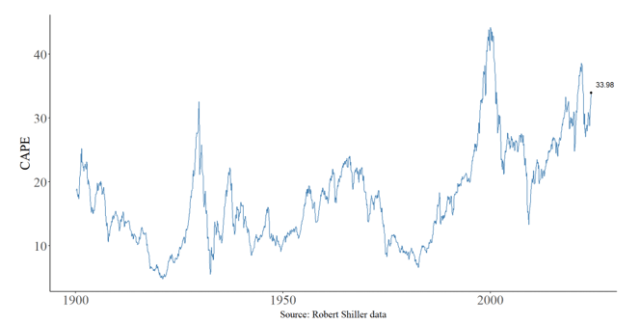
Robert Shiller’s cyclically adjusted price-to-earnings ratio (CAPE) is approaching historically high levels. In fact, CAPE’s current value has been exceeded only twice since 1900. But should you care? Investment professionals know that despite CAPE’s historical tendency to anticipate equity market returns, it isn’t a reliable market-timing tool. The evidence discussed here offers a possible explanation why. As shown in Figure 1, CAPE was trendless for most of its post-1900 history, with run ups typically followed by “compression.” For most of its history, it would have been natural to think that periods of high CAPE will be followed by periods of low CAPE. Figure 1: CAPE, 1900-2024 And there’s a familiar if unnerving empirical regularity linking CAPE and future equity market returns. Figure 2 plots annualized 10-year returns for the Ibbotson Large Cap stock index®. Points are filled by CAPE starting value (red = high, blue = low). As is clear from the downward sloping pattern, CAPE values are strongly negatively correlated with future returns (correlation coefficient = -0.7). Longer term, the relationship is weaker but still negative. The correlation between initial CAPE and subsequent 20-year annualized returns is -0.3. Combined, Figures 1 and 2 suggest that episodes of expanding CAPE are followed by episodes of contracting CAPE and subdued equity market returns. Figure 2: CAPE (horizontal axis) and next 10-year’s annualized return, 1926-2024. Could This Time be Different? The question is whether the current period of expanding CAPE will be followed by a period of contraction and low equity market returns may depend on CAPE’s stability in a time series sense. My own work suggests that CAPE isn’t “stationary” and therefore shouldn’t be expected to mean revert. See “A Time-Series Analysis and Forecast of Cape” in the Journal of Portfolio Management. I revisit that question in this blog. Testing For a CAPE Break Since the growth rate of P (price) divided by E (earnings) is just the difference between the growth rates of P and E, the idea that CAPE might rise without bound may make investment professionals uncomfortable. To avoid this discomfort, it is helpful to think of CAPE as a single quantity and consider how that quantity has behaved over time and whether the process that animates it has changed. That is the approach I take here. It’s obvious from casual visual inspection of Figure 1 that CAPE changed at least once in its long history. CAPE has been elevated since the 1990s. Prior to 1990, CAPE’s mean value was 14.1. Since then, it has averaged 26.6. At 34, today’s CAPE is in 95th percentile of observations since 1900. A critical issue for practitioners is therefore: Did CAPE “change” in the 1990s, making its behavior prior to then less relevant than since? A statistical test of a change in a time-series over a range of dates, the Quandt Likelihood Ratio (QLR) test, can help answer this question. To estimate a break date using this test requires regressing CAPE on time and possible but unknown break dates (months, in this case) that fall within a particular window of time. I chose the window 1980 to 1999. By including a candidate break-date interval as dummy right-hand side variables in the regression model along with their interaction with time, a simple test of joint significance on a series of regressions (one for each date) can help identify changes in a time-series process. (R code for this test and other results cited in this blog can be found here.) Figure 3 shows the test statistics (technically, F-statistics) that result. The highest test-statistic value is the best candidate for a break in CAPE. That date, marked with a red dot in Figure 3, is August 1991. It coincides nicely with the date eyeballed from visual inspection of Figure 2. Figure 3: Test for date break in CAPE, 1980 to 1999. With a candidate break date in mind, we can then test whether CAPE’s behavior changed after that point. Specifically, we want to know if CAPE’s tendency to mean revert was more pronounced before 1991. To test this, I used a definition of mean reversion common in empirical finance: existence of negative serial correlation. One serial correlation test is straightforward. Changes in CAPE over one period are regressed on the change in an immediately prior period of equal length. If the estimated coefficient is negative and significant, CAPE may be mean reverting. To estimate CAPE’s serial correlation, I regressed the five-year change in CAPE on its prior five-year change. Results confirm a change in CAPE’s behavior after 1991. Prior to 1991, the estimated relationship between CAPE’s change in successive five-year periods is indeed negative (coefficient = -0.19) and significant (t = 5.8). After the estimated break year (1991), however, the estimated coefficient increases to a far less meaningful -0.06, and is insignificant (t = 1.4). Notably, results for tests over longer periods are less compelling, but also less reliable. The potential change in serial correlation is suggested by the scatterplots in Figure 4. The relationship in the right panel, which shows the more recent period, is weaker than in the earlier period, which is shown in the left panel. This is underscored by the slopes — flatter in the later period — of the linear regression fit lines drawn through each set of points. Figure 4: CAPE 5-year change serial correlation, 1900-91 (left panel) and 1992-2024 (right panel) Implications Most practitioners probably feel that CAPE changed in the 1990s. It has been above its 1900 to 1989 mean value of 14.1 a remarkable 99.8% of the time since the start of that decade. That elevated CAPE is associated empirically with lower returns is unsettling. But empirical regularities may not be reliable for forecasting if underlying relationships are unstable. My simple analysis offers evidence that CAPE changed in the 1990s and that and mean-reversion concerns may be misplaced. If CAPE changed three decades ago, however, there is nothing to prevent it from doing so again. Should you worry that CAPE is high? That depends on whether you

CAPE Is High: Should You Care? Read More »