CFA Institute

Renewable Energy Funds: Through a Gender Lens

Climate crises disproportionately affect women and girls across all demographics, but especially in developing economies. Subject to persistently higher poverty (and extreme poverty) than men, women and girls are also more likely to be impacted by climate disasters. In fact, 80% of those displaced by climate change are women, according to UN statistics. Due to ongoing worldwide gender gaps, climate events exact a toll on women’s job security and education as well as their access to health care, potable water, and food resources, among other necessities. Yet, research shows that with their local knowledge, women have much to contribute to climate change adaptation even if gender gaps in legal resources and economic participation hamper their involvement. As environmental, social, and governance (ESG) investing continues its rapid growth, applying a gender lens to public funds focused on climate solutions is critical. Why? Because higher levels of women in leadership (WIL) benefit corporate performance, operations, and risk management. Indeed, gender diverse ACWI Index companies are better at reducing carbon emissions, according to a 2021 MSCI report, while 2020 research found that gender diversity on the boards of US companies correlated with higher renewable energy consumption, which in turn, boosted financial performance. Gender Lens Equity Funds: Steady Growth Gender lens investing directs resources to women-focused initiatives, women-owned businesses, and firms that demonstrate a commitment to gender and broad-based equality internally and through their external relationships, products, and services. Thirty-two gender lens equity funds are available to individual investors. There are 14 global and 18 regional funds in the Parallelle Finance coverage universe with mandates to invest in higher WIL and related gender metrics. These funds hold anywhere from 30 to more than 400 stocks. As of 31 March 2022, their assets under management (AUM) totaled $4.1 billion, having grown by 51% in 2021. The 12 Largest Gender Lens Equity Funds, in US Millions, as of 31 March 2022 Are Climate Funds Investing with a Gender Lens? Renewable energy is a cornerstone of global efforts to address climate change. Renewable energy funds invest in solar, wind, and other clean energy producers as well as related technology and services providers. The 17 US-listed and three European- or UK-listed funds in our dataset have AUMs ranging from $5.6 billion, for the iShares Global Clean Energy exchange-traded fund (ETF), to less than $5 million, as of 31 March 2022. The average track record for the funds is six years. The 12 Largest Renewable Energy Funds in the Dataset, in US Millions, as of 31 March 2022 These funds are not capturing the benefits of diverse leadership and wider corporate equality. Only 11% of US portfolio managers are women. That figure hasn’t notably improved in 20 years. According to the available data, only 13% of the portfolio managers at renewable energy funds are women, and 14 of the 20 funds have no women on their portfolio management teams. In contrast, our research found that over 50% of gender lens equity fund portfolio managers are women. There are 110 unique top 10 holdings among the 20 renewable energy funds. The chart below lists the 21 firms that overlap with the leading gender lens equity indexes and datasets. Only seven appear on any of the Solactive Equileap gender lens equity indexes, which are constructed from Equileap analysis of leadership and workforce equality metrics, pay equity and transparency, and workplace benefits and policies at public companies. Among the top clean energy holdings of the 400 companies on the Bloomberg Gender Equality Index, only 16 appear on both lists and only 5 among the Forbes-Statista list of female-friendly companies. Top Holdings Overlaps: Renewable Funds and Gender Lens Indexes, Datasets, and Equity Funds Of the top renewable energy holdings, only three — Enbridge, Meridian Energy, and Schneider Electric — appear among the 164 unique top 10 holdings of gender lens equity funds. These three are also on at least one of the index and dataset lists. The results are clear: Unless renewable energy companies improve their WIL and other equality metrics, the sector will miss out on the related performance and operational benefits. The Way Forward: Incorporate Equality Criteria Climate change will set gender equality back 20 years, according to BCG forecasts. Why? Because climate change disproportionately affects women and because women are underrepresented in the global economy. Indeed, women are being left out of the industries emerging in response to climate change, and with forecasts of global net-zero investments ranging from $100 to $150 trillion by 2050, according to BCG, that is bad news for both women and net zero. The data doesn’t lie: WIL is material to all sectors and industries. Climate-focused equity and fixed-income funds must apply WIL and broad-based equality criteria. That should include: Investing in women-led clean energy innovators, producers, and product and services providers. Seeking greater gender equality in leadership, workforce, pay, and workplace policies across all demographics in all their funds and encouraging fund holdings to develop supplier diversity programs. Investing in innovations to reduce climate-related displacement. Applying shareholder advocacy tools to advance corporate gender equality. For more analysis from Marypat Smucker, CFA, visit Parallelle Finance. If you liked this post, don’t forget to subscribe to the Enterprising Investor. All posts are the opinion of the author. As such, they should not be construed as investment advice, nor do the opinions expressed necessarily reflect the views of CFA Institute or the author’s employer. Image credit: ©Getty Images / SDI Productions Professional Learning for CFA Institute Members CFA Institute members are empowered to self-determine and self-report professional learning (PL) credits earned, including content on Enterprising Investor. Members can record credits easily using their online PL tracker. source

Renewable Energy Funds: Through a Gender Lens Read More »

Why Your Portfolio Should Include Scarce Assets

Most investable assets and strategies tend to cluster into two broad groups: productive and scarce. This is an important concept for the asset-owner-level portfolio construction and asset allocation process, since productive assets and scarce assets tend to have, respectively, concave and convex profiles with respect to the major risk factors. Practitioners who are aware of the concave and convex nature of productive and scarce assets and strategies can better hedge their risks in deflationary, and — especially — inflationary crises. We suggest that portfolios including both productive and scarce assets can deliver performance similar to the S&P 500 with less risk than portfolios holding only productive assets.   The Nature of Productive and Scarce Assets The raison d’être of productive assets is to finance, support, and provide the means for productive activities in the economy, in exchange for promised future cash flows. For example, equities promise future dividends, and credit promises future coupons. The issuance of equity and debt is externally constrained mostly by what the capital markets can bear. Shocks hit these assets with a downward asymmetry, suggesting concave supply curves. The returns of these assets arise from the economic growth they exist to finance. Scarce assets and strategies, on the other hand, exist for reasons other than financing productive activities. They exist in limited supply or capacity and may or may not promise any regular cash payments. Examples of scarce assets include gold, some other commodities and natural resources, high-end art, and other collectibles. “Safe” government bonds with low or negative yields, reserve currencies, and some global macro strategies are also scarce assets. The returns of these assets arise from their scarcity, which is often associated with convex supply curves. How to Quantify Productivity and Scarcity Since directly modeling — or even conceptualizing — the “supply curves” in many cases may be difficult or impossible, we instead measure the asymmetric risk statistics of observed asset returns. The findings are detailed in our paper, “The Concave and Convex Profiles of Productive and Scarce Assets.” We use coskewness to measure the convexity of asset returns with respect to a set of major risk factors: inflation, rates, credit, and equity. We also use the standard skewness to measure the “convexity of an asset to itself,” or “auto-convexity.” These coskewness and convexity measures tell us the tendency of an asset to appreciate or depreciate when risk factors become volatile. In our paper, we quantify the investable assets’ and strategies’ place in the productive-to-scarce spectrum based on their skewness and coskewness with respect to the major risk factors. Such an overall spectrum is laid out, for top-level asset classes, in Exhibit 1. Empirically, equities, duration-hedged credit — and more generally “higher beta” and “positive carry” strategies — tend to be concave with respect to the major risk factors, and auto-concave (negatively skewed), belonging in the productive group. By contrast, “safe” government bonds, gold, the US dollar versus a broad basket, and fast-moving momentum strategies, tend to be empirically convex with respect to the major risk factors, and auto-convex (positively skewed), belonging in the scarce group. We observe that an asset or strategy must have some intuitive economic scarcity to be convex. Exhibit 1. Productivity, Scarcity, Convexity, Concavity Convex or scarce assets and strategies tend to have low beta to equities. But low beta does not guarantee convexity, as we demonstrate empirically in our paper. The coskewness to inflation risk serves to complement and enrich the traditional set of risk metrics, such as equity beta and bond duration. Though many assets may feature low correlation to inflation, their coskewness may be more significant and persistent, showing large potential losses (or gains, for scarce assets) during periods of macroeconomic instability. Inflation itself is a highly skewed, non-normal process with high-impact tail events. Exhibit 2 depicts monthly excess returns of high yield bonds and Barclay CTA Index, plotted against the S&P 500 excess returns. High yield bonds exhibit concave response to the S&P 500 returns, while Barclay CTA Index is convex with respect to the S&P 500. Exhibit 2. High Yield Bonds Concave to S&P 500, CTAs are Convex Notes: Left panel: High Yield Bonds vs S&P500, Right panel: Barclay CTA index vs S&P500. Period 1990-2022. Horizon=1M. Quadratic model fit is depicted for each asset. Exhibit 3 depicts monthly returns of four productive and four scarce assets, plotted against the inflation risk factor. The upper panel shows the broad US equity market (S&P 500), investment grade bond returns (duration hedged), high yield bonds, and the Bloomberg Commodity Index, each plotted against CPI month-over-month. Except for the Bloomberg Commodity Index, the assets show generally weak correlations to inflation, but all have a marked negative convexity. By contrast, the four assets in the lower panel, namely US Treasuries, Gold, the US Dollar index (DXY), and a simple four-asset momentum strategy (with one-month lookback), show a convex response to inflation innovations. We believe that the convex responses arise from an underlying scarcity of the asset or strategy. In practice, the convexity metrics can tell us which assets are likely to perform above and beyond their linear or beta exposure, during times of great risk and uncertainty—that is, in a crisis. Exhibit 3. Productive Assets are Concave to CPI, Scarce Assets are Convex Notes: Upper panel for four productive assets, Lower panel for four scarce assets. Period 1973-2022. Horizon=1M. Quadratic model fit is depicted for each asset. Convex and concave responses to price action are very familiar from textbook option payoffs: most assets are empirically concave or convex with respect to major risk factors. Recalling the pioneering work of Arrow and Debreu, as well as Black and Scholes, and Merton, these convexities are central to asset-return profiles in a world of multi-dimensional risks and uncertain outcomes. Exhibit 4. Concave and convex Black-Scholes option prices and payoffs In Practice From an investor’s perspective, productive assets generally provide exposure to nominal GDP growth, while scarce assets are key for resilience in recessionary and inflationary environments. In a traditional 60/40 portfolio, for example, stocks

Why Your Portfolio Should Include Scarce Assets Read More »

Presidential Election Cycle Theory: A Bullish 2023?

This year, 2023, is the heralded third year of the presidential election cycle. It has kicked off with nervous markets eyeing political drama in Washington, DC: contentious votes to elect the Speaker of the House of Representatives, a combative State of the Union presidential address, partisan threats not to raise the nation’s debt ceiling, and posturing and positioning by lawmakers ahead of the 2024 election. Nevertheless, according to presidential election cycle theory, which was first referenced in the Stock Trader’s Almanac, this third year of the four-year cycle should generate well-above-average stock returns. So, what are the strengths, limitations, and nuances of presidential election cycle theory and what does the current political context foretell regarding whether 2023 will follow the predicted trend? The conventional election cycle theory narrative, and why it augurs so well for 2023, goes as follows: “Presidents do the heavy lifting in their first and second year in office and then pivot to preparing for reelection in the fourth year by being friendly to markets in the third year.” Though the data around this may be compelling, the overall narrative warrants some refinement. The Presidential Election Cycle and S&P 500 Returns “Trifecta” is when a single party holds the presidency and majorities in both houses of Congress.Source: Bloomberg Since 1928, the third year of the presidential cycle has produced positive S&P 500 returns 78% of the time, generating 13.5% average returns vs. an all-year average of 7.7%. We did not find other coincident indicators in the monetary and fiscal policy signals — rising vs. falling rate environments, for example — that might also offer insights on 2023, but we do believe a party’s degree of government control may be a critical factor. A single party held the “trifecta” of the presidency and House and Senate majorities two-thirds of the time in the first and second years of the cycle, as the Democrats did in 2021 and 2022, but only about one-third of the time in the third and fourth years. This is a familiar phenomenon in US politics: The president’s party often faces setbacks in the midterm elections. But it also implies that the relevant election cycle may be congressional rather than presidential. Markets may simply be rewarding gridlock. Third years that followed a switch from unified to split government averaged 15.0% returns compared to 10.7% for third years in which the trifecta was preserved. The gridlock question seems important given the likely contrast between 2022’s ambitious legislative agenda and anxiety about potential deadlock in 2023. The sequence also may be important in anticipating how presidential election cycle theory will play out in 2023. With their glass-half-full outlook, commentators tend to focus on above-average returns in the third year and pay less attention to below-average returns in the second. Second years have accounted for more than one-third of the S&P 500’s total negative return years since 1928 and an even higher proportion of years with materially negative returns, or those like 2022, with worse than –10% performance. The rebound pattern from bearish second to bullish third years is the key sequencing feature. Two down years in a row have only occurred eight times since 1928, and only once, in 1930 and 1931, during the Great Depression, did it happen in the second-to-third-year sequence. So, the second-to-third-year signal may be especially powerful and predictive following such a gloomy 2022. As such, all the leading indicators of presidential election cycle theory — third year, split government, and dismal second year — would seem to augur well for 2023. But are there any current conditions that might inhibit this predicted strength? Put simply, while the markets may respond well to gridlock, a complete breakdown in government functioning may be a bridge too far. While fiscal restraint in 2023 after the sizable government largesse of 2022 could have its benefits, total government paralysis and dysfunction — not raising the debt ceiling and not funding the government –may be too much for the markets and economy to bear. Of course, debt ceiling debates are nothing new in US politics and have yet to lead to catastrophe. But just because they haven’t doesn’t mean that they won’t. So, is this time different? If it is, a particular congressional cohort could be the threshold reason. In the tightly divided House of Representatives with its narrow Republican majority, the House Freedom Caucus wields considerable influence and can impede legislation in the interest of both diminishing the scope of government and reducing spending. These efforts can also have a performative element that helps caucus members raise their profiles and campaign funds and otherwise build their brands. This latter component may be what most differentiates 2023 from previous third years in the presidential election cycle. In 2023, as in 2011 and 2013, political drama’s path to economic significance runs squarely through the debt ceiling and federal budget negotiations. The House Freedom Caucus has positioned itself as a key power base in that regard and extracted considerable concessions during the efforts to elect Rep. Kevin McCarthy as Speaker of the House. Among the more significant of these were securing the single-member motion to vacate and gaining several of the nine Republican seats on the 13-seat Rules Committee. These constitute an effective blocking position, or a veto, that will make it very difficult to pass any legislation to raise the debt ceiling without the group’s agreement or acquiescence. There are few examples in recent political history of similar groups gaining such influence. The difference here is just how performative congressional politics today have become. Amid the rise of social media and a host of other politically centrifugal forces, the threshold for differentiation has moved ever higher, especially amid the 2020 election’s lead-up and aftermath. To understand just how this performative power may have become the differentiating factor in this presidential cycle’s third year, it helps to conduct a recall experiment. Think of 10 members of Congress. How many of them do you remember for their accomplishments? How many do you

Presidential Election Cycle Theory: A Bullish 2023? Read More »

From No to Yes: Persuading Clients with the 3Ps Method

The following is adapted from the recent book Small Actions: Leading Your Career to Big Success, by Eric Sim, CFA, and Simon Mortlock. Nobody likes rejection. Which is why, over the years, I’ve developed a three-step process to transform situations from hopeless to hopeful. I call it the 3Ps approach: Perseverance Perspective Positivity Let me give you some examples of how to put the 3Ps into action. Leaving by 7 pm Getting a table on a weekend at some of Hong Kong’s most popular restaurants can feel, with only mild exaggeration, like winning the lottery. But hope springs eternal, and like all those people who patiently queue up at lottery counters hoping to buy the winning ticket, I can’t help but try my luck at my favorite Italian restaurant chain. Its thin-crust pizzas and aglio e olio pasta are just that irresistible. My family loves to have Sunday dinner at the busy Kennedy Town branch. Of course, we usually make spur-of-the-moment decisions to go, and it’s all but impossible to reserve a table on the same day. But that’s where the 3Ps came in. One Sunday afternoon, I called the restaurant. “Good afternoon!” a woman with a cheerful voice answered. “Do you have a table for four tonight?” I asked hopefully. “No sir, we’re fully booked,” she replied with a tinge of regret. “How about at 6 pm?” I countered. “Sir, we’re fully booked,” she repeated, probably thinking, “Which part of ‘fully booked’ do you not understand, sir?” But I wasn’t deterred. “What if we leave by 7 pm?” I asked. There was a slight pause on the other end of the line. “Let me check,” she said. A few seconds later, she replied, “Yes sir, we have a table.” I used the 3Ps to change her mind. Here’s how it works: Perseverance: Show Your Effort I didn’t hang up after she said “fully booked.” Instead, I came up with a counter proposal. When I suggested leaving the restaurant early, I showed her I could be flexible on timing. Perspective: Understand the Other Person’s Priority The restaurant employee’s main concern wasn’t catering to my needs; it was ensuring that customers who had reservations were seated by the allotted time. She didn’t care whether I wanted a table to celebrate my child’s birthday or my boss’s resignation. Getting angry, saying how much business I’d given the restaurant, or threatening never to go there again weren’t going to work with her. Instead, I helped her do her job by offering her the restaurant hostess equivalent of an options trade in finance. I gave her a contract establishing her right (but not obligation) to chase me out at 7 pm. But that Sunday night, I wasn’t shooed away: The restaurant had enough room, so the option holder didn’t need to exercise her option. Positivity Call me an eternal optimist, but I always hope I can flip a situation from unfavorable to favorable. Many people would have given up at “we’re fully booked.” Not me. I sought a compromise that was a win–win solution for both sides. The restaurant is rarely full during the early evening, so I helped it use its resources more efficiently. Can I Drop By? The ability to change a “no” to a “yes” is even more critical in our careers. When I was working for a bank, a corporate client based in Taipei asked for a renminbi (RMB) construction loan to build an office tower in Shanghai. This was a 10-year loan, and my colleague from the loans department priced it accordingly, using the People’s Bank of China’s (PBOC’s) five-year or longer rate, which was then 5.94%. In the cutthroat world of finance, that wasn’t enough. Another bank offered the client a more “creative” loan structure. Instead of the standard 10-year loan, the bank proposed a six-month arrangement that would be continually extended until the loan was paid off at the end of 10 years. This shorter loan period had a much lower interest rate of 4.86%. My colleague came to me for advice on how to resurrect the deal. I suggested a loan in US dollars (USD) as well as a USD–RMB currency hedge to create a synthetic RMB loan with an all-in interest rate of 4.5%. It was cheaper than the other bank’s offer but was still a 10-year loan. We proposed our solution to the client’s finance team. They liked it and submitted the idea to their CFO. The feedback was positive. I had saved the deal! Or so I thought. A week later, the client told us that they couldn’t accept our proposal. Their CFO had already verbally committed to the other bank before he heard our innovative offer. We were devastated. I couldn’t understand why the client had gone with our competitor’s pricier solution, so I asked if I could “drop by” for a coffee meeting in Taipei. Over our lattes, I explained that under Mainland regulations, banks in China weren’t allowed to price a long-term construction loan using the six-month PBOC lending rate. Should the “creative” bank run into trouble with the regulator, its clients could be impacted. The finance manager from the client firm took what I said to heart. I left the meeting and flew back to Hong Kong the same afternoon. The next day, the client called to say we’d won the deal. Again, the 3Ps worked. Perseverance: Show Your Effort I continued to engage with the client even after they turned down our solution. Perspective: Understand the Person’s Priority There were two potential “no’s” here. First, the client could have refused to take the face-to-face meeting. Had I stressed the business trip was just to see them, they might have turned down the meeting. Taking it might have made them feel obligated to reverse their decision. But when I asked, “Can I drop by?” they didn’t feel as pressured. I gave them the option to say they weren’t going to change their loan decision. This brings me to the

From No to Yes: Persuading Clients with the 3Ps Method Read More »

Climate Risk and the Future of US Commercial Real Estate

Introduction The imperatives of climate change demand enhanced risk management in the commercial real estate (CRE) loan market: Investors and lenders must refine their strategies and conduct meticulous property-level risk assessments as part of their credit analysis. Community and regional banks are particularly susceptible to climate-related financial risk due to their CRE loan balance sheet exposure and must navigate unpriced climate risks to ensure balanced and resilient loan portfolios. To maintain portfolio health and overall stability, these institutions must exercise ongoing vigilance in their risk monitoring. In this conversation, we — Adam W. Sandback, CFA, FRM, CPA, CMA, and Andrew Eil — assess how climate could affect CRE loans in the most at-risk areas in the United States. Climate Risk and Community and Regional Bank CRE Loan Portfolios: What Are the Implications? Adam W. Sandback, CFA, FRM, CPA, CMA: Property values in California, Texas, and Florida are poised to decline due to rising sea levels, heat waves, water stress, and increasingly frequent and severe natural disasters, among other unaccounted climate risks. Insurers have retreated from natural peril coverage in key geographic markets. The shift to remote work and the extensive CRE debt held by privately owned community and regional banks, combined with persistently high interest rates, heightens the systemic risks — a concern that the US Federal Reserve highlighted in its May and October 2023 reports. Andrew Eil: Recent real estate activity suggests climate concerns aren’t deterring buyers. Florida’s CRE market is thriving, and residential values soared 80% over five years and more than 170% in a decade to March 2023. The housing markets in Texas cities and California also remain robust. Historically, there’s little precedent for climate risk affecting CRE value, yet with unprecedented climate events becoming frequent, this emerging risk may soon challenge historical norms. For example, certain highly vulnerable areas in Houston, Miami, and Norfolk, Virginia, are exhibiting local softness in market values that are starting to price in sea level rise as a risk. Sandback: Post-2008 financial reforms have widened the risk-modeling chasm between large and small banks; the latter, more vulnerable to climate-related risks in CRE loans due to large and concentrated portfolios, struggle with less-stringent regulation, the constraints of personnel expertise, and inadequate technology for complex in-house modeling. The recent regional banking crisis underscores this issue. Andrew, how should privately owned community and regional banks implement manageable climate-risk modeling and enhance data management and system controls to mitigate potential capital losses in a manner their resources can support? Eil: Community and regional banks, like their larger counterparts, must integrate climate risk management because they face similar if not greater climate risk exposure due to geographic and asset class concentration in their portfolios. New standard disclosure guidelines, such as the Task Force on Climate-Related Financial Disclosures (TCFD) and International Financial Reporting Standards (IFRS) S2 Climate-Related Disclosures on governance, strategy, risk management, and metrics and targets, are a good place to begin. This involves integrating climate change into risk appetite statements, aligning strategies and risk management policies with climate realities, and adjusting risk models to account for climate factors. Even without extensive specialized teams, banks can undertake climate risk assessments and monitor related financial risks cost effectively as climate risk data, analytics, and expertise rapidly become more affordable and accessible amid the maturing market and the proliferation of open-source data and tools. Sandback: Rising interest rates and climate risks are converging, threatening to destabilize the commercial real estate (CRE) loan market, especially for community banks where such loans constitute half of their assets. This circumstance augurs an uptick in delinquencies and potential forced sales at reduced prices. Yet, despite $1.4 trillion in CRE loans facing maturity by 2027, evidence of climate-related discounts remains elusive. What explains the absence of visible climate discounting in the market? Eil: One explanation is that pressing near-term concerns, such as housing affordability, low taxes, and jobs, drive consumers to the Sun Belt and climate-vulnerable locations. Another is that CRE is more regional and less neighborhood based than residential real estate, where climate factors do show up in market indicators in some areas. Given the recent ubiquity of extreme climate events, such as heat waves, droughts, floods, wildfires, and severe storms — US natural disasters with losses of $1 billion or more occurred at a record pace in 2023, despite mild hurricane and wildfire seasons — we can expect that at some point these trends will be reflected in CRE market dynamics. Indeed, a 2022 Redfin survey found that 62% of respondents consider climate and extreme weather as factors when they decide where to live. Sandback: The combined impact of regulations and climate change could undermine property values and loan repayments, raising the risk of defaults, especially in climate-sensitive states like California, Florida, and Texas. Could these regulatory changes lead to increased defaults in these areas in the coming years, given that climate change’s effects on CRE will become more visible? Eil: Real estate values tend to hinge on market demand and consumer outlook, but climate-related regulations may also increasingly affect them. Climate-related government policies toward the real estate sector extend far beyond required retrofits to such domains as mandatory disclosure of home flood risk exposure, adopted by both New Jersey and New York in the summer of 2023, and state-level regulation to ensure that insurance against climate-related perils is both available and affordable, such as was recently proposed in California. Local governments facing climate hazards are also prioritizing investments in climate-resilient infrastructure and enacting climate-smart building codes, which may influence perceptions of the safety and desirability of communities from now on, driving market sentiment. Climate risk disclosure and management, as well as government backstops for the real estate and insurance sectors, should help to reduce risk exposure and avoid market panic and acute repricing events. Sandback: Given more frequent extreme weather, retrofitting buildings in climate-vulnerable states becomes essential, but financial and regulatory hurdles make it challenging. The benefits, which may far exceed the costs according to OECD research, are elusive

Climate Risk and the Future of US Commercial Real Estate Read More »

Measuring Corporate Impact: The Gold Is in the Details

Measuring corporate impact is time-consuming and resource intensive. Until recently, I worked at UN PRI and witnessed first-hand the significant challenges investors, employees, and customers face in finding trustworthy, comparable data to assess the net impact of companies. CFA Institute Research and Policy Center’s Climate Data in the Investment Process cites inconsistent and unreliable data as key challenges for stakeholders including investment professionals interested in assessing and managing the financial risks and opportunities posed by climate change. Upright Project – a Finnish impact data company — significantly influenced my perspective on data modeling, and I joined the company four months ago. Upright’s approach structured all scientific evidence in an organized manner and created a unique dataset that enabled comparisons of companies worldwide from an outside-in perspective. Upright’s net impact model classifies more than 150,000 products and services. This classification is used to define the business models of every company in its database. The model leverages more than 250 million academic articles to determine the science-based impact of each product and service. The data are aggregated at the firm and portfolio level to quantify the total material impact of an investment. Notably, a significant portion of this data is publicly accessible: more than 10,000 company impact data profiles are available on its platform using a free-use policy. With my academic background, I was inspired by a solution that not only leverages scientific evidence but also delivers practical applications for investment practitioners and investors. Applications Are Unfolding At Upright, we have learned a great deal from investors, but the potential applications of this data are still unfolding. Since the modeling approach is outside-in, private equity and venture capital investors have been early adopters of the data. In addition, the model’s transparency and objectivity make it useful for asset managers and asset owners — particularly for disclosure purposes — whether for fund-level requirements or to demonstrate the overall impact of their investments. Granular Data: The Challenges and Opportunities The full potential of this data is not yet clear. The granular nature of the data allows investors to pinpoint which business units of a company drive positive or negative financial and non-financial material impacts. This creates opportunities for risk assessment and stewardship. Furthermore, the model’s applicability to both private and public companies enables comparisons across all asset classes held by an investor. This can help identify high exposures to specific impact categories. While many investors have sought more detailed information, the use cases for this new, holistic approach to understanding and evaluating companies are still emerging. Because Upright’s modeling approach is new to most investors, I will illustrate how they can use the platform to evaluate a company’s impact. Step 1: Assess the business model of a company using a products- and services-based approach. Let’s use an example company, Siemens. Based on the latest publicly available version of the Upright model, Siemens sells more than 165 products and services. The total revenue of the company is 77,769 million euros, and it has 320,000 employees. Some 28% of its total revenue is generated by products and services within digital industries, which comprise electric motor control devices, gas turbines, generators, electric actuators, linear motors, and more. Details of the full product mix are visible on the Upright platform.  Siemens’ Digital Industry Products Source: List of Siemens’ products and services on the Upright platform. Step 2: Choose an impact category that you’re interested in. The Upright model currently covers four main impact categories: Society, Knowledge, Health, and Environment. Each category has sub-categories. For example, under Health, there exist physical diseases, mental diseases, nutrition, relationships, as well as meaning and joy. Impact categories can be negative and positive. In the case of Siemens, we can see that their products and services are creating both negative and positive impacts within the physical diseases sub-category. Siemens’ Health Impact Siemens’ public net impact profile on the Upright platform. Step 3: Choose whether you’re interested in upstream, internal, or downstream impact. Products and services do not exist in isolation. Often, one product is required to make another or for a user to create an impact using a product. The Upright model has mapped all products and services so that you can assess where in the value chain the associated impact occurs. In the case of Siemens, 94% of the positive impact on physical diseases or life years saved, associated with its products and services happens downstream from the company.  Siemens’ Downstream Impact Source: Upright platform. Step 4: Examine the products and services that are associated with the impact category you’ve chosen. In the case of Siemens, the products and services that contribute most to the positive impacts on physical health are radiation therapy machines, cardiac resynchronization therapy devices, private oncology diagnostics services, ultrasound machines, and mammography machines. Combined, these five products contribute the most to Siemens’ positive impact both because they compose a substantial proportion of the company’s revenue and because the latest scientific consensus suggests a high positive causal relationship between these products and services on physical health.  Upright’s Bayesian inference machine learning model finds causal relationships by classifying and translating from more than 250 million scientific articles, as well as from other sources. These insights form the foundation for defining whether the products and services that companies sell create negative or positive material outcomes, which together provide investors with a full view on the impact of their companies and portfolio. source

Measuring Corporate Impact: The Gold Is in the Details Read More »

Generational Wealth: Does the Apple Fall Far From the Tree?

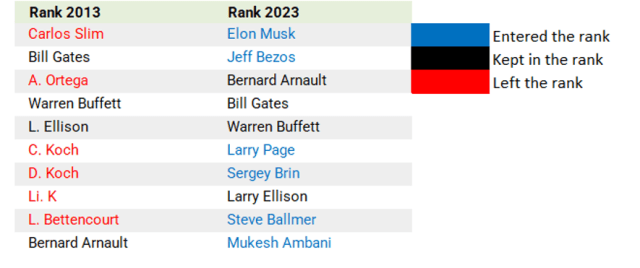
Will the son of a billionaire perpetuate his inherited wealth? Apparently not, if history is any guide. In fact, there is strong evidence that most “rich families” will be poorer after several generations. Some of the reasons for this are systemic. Taxes, for example, chip away at a family’s wealth. But most factors that diminish a family’s wealth over generations are the choices that heirs make. These include how they invest their inheritance, how many children they have, whether they get divorced, and other lifestyle choices. Figure 1. The 10 richest people in the world in 2013 and 2023. Source: Forbes As Figure 1 illustrates, six of the 10 richest people in the world were “created” in 10 years. And these were all men, which is why I use the term “patriarch” throughout this blog. Of course, this is too small a sample to be statistically significant. But at first glance, the Forbes Top10 List shows that capitalism has the capacity to create new billionaires and generate wealth. Another way to look at it is that capitalism replaces billionaires who either failed to increase their fortunes as quickly as others or lost it somehow. This raises an intriguing set of questions: what does it take for someone who was yesterday’s TOP10 billionaire to not be today’s TOP10 billionaire? Are the causes applicable to other affluent investors? If there is no single formula for getting rich, is there a single formula for losing a family’s wealth? When it comes to generational wealth, does the apple fall far from the tree? A Model to Explain Accumulation Capacity of an Affluent To test the capacity of an affluent person to perpetuate his or her wealth for the next five generations, we created a mathematical model that explains accumulation capacity in seven variables: Amount of heritage received (H) Number of heirs to split the wealth (Q) (i) Number of years of accumulation (N) Annual affluent’s expenditure, as a % of his family income (G) Divorce rate among affluents and, therefore, wealth split in the process (D) Wealth tax (T) Considering these variables, the future value that a patriarch will transmit to the second generation of their family will be: FV= [(H x (1+i)N) + ((H x i) x (1-G)/Q) x ((1+i)N – 1)/i)] x (1-T) And this cycle continues, from the second to the third generation, from the third to the fourth, and henceforth. Three factors in the accumulation process stand out: inheriting a lot of money, having more time in the accumulation phase, and realizing a higher return on investments. Conversely, four out of seven variables constrain accumulation: having more kids, spending too much, getting divorced, and living in a country with a high wealth tax. We test this question: Can an affluent family accumulate wealth for several generations, even if it has more kids, lives a lavish lifestyle, splits wealth in a divorce, and pays a wealth tax? You will notice that the variable “divorce” is not present in the basic formula. This is because it is random and binary. To test this effect in dynamic scenarios, we ran a Monte Carlo Simulation, considering 10,000 scenarios. We considered the following values and probability distributions: Amount of Inheritance received We begin at US$1 billion. This number was arbitrarily chosen and assumes that the family’s patriarch left $1 billion upon death and left all of it to his relatives (no philanthropy, no further donations, no relative denial nor exclusion of an heir). And consequently, we can determine the amount that his son would accumulate upon his death, the amount his grandson would inherit, and henceforth, until the family’s fifth generation. We acknowledge that each person will have his own propensity for leaving an inheritance, and that it varies according to cultural norms. It is not solely dependent on great wealth accumulation during a lifetime. The propensity to leave this inheritance also varies according to the type of heritage. Heritage can be tangible (buildings, cars, boats) or intangible (human values, personal branding, political power). We also know that a billionaire’s propensity to leave an inheritance doesn’t correlate with his wealth. Jeff Bezos and Elon Musk donate less than 1% of their wealth, and the more they enrich, the less they donate, in percentage terms. Number of heirs to split the wealth How many children does a billionaire have? Is it significantly different from an ordinary middle-class person? Elon Musk, for example, has nine children (when this article went to press) with three different women. According to Forbes, Elon Musk is an outlier, as the 700 richest people in America have on average of 2.3 kids, and only 22 of those  700 billionaires have seven or more children. Interpolating this and assuming a normal distribution, we reach a 2.39 standard deviation. Affluent’s annual net return This is probably the hardest variable to model. What is the average annual return of a billionaire? High returns are the variable that made Elon Musk go from anonymity to the top of the billionaire’s list in less than 10 years and Carlos Slim to fall from the top of the list to below number 20. In practice, we see that a billionaire’s return is volatile. First, many have leveraged returns. They own businesses that take on debt and some even leverage their own estates. Second, many of them allocate their wealth to private equities and venture capital, assets that may produce high returns or perform dismally. Using the Dimson-Marsh-Staunton database (2017), returns from 1900 to 2017 for the wealthiest segment of the population averaged 4.8% per annum with a 15.1% standard deviation. Number of years of accumulation How many years are necessary to accumulate the first million dollars? And the first billion? According to the financial planners Brian Preston and Bo Hanson, it takes approximately 27 years for a person to accumulate her first million (5.3 million Americans) and 14 more years to hit a billion (700 Americans). We know, however, that this probability of becoming a millionaire is

Generational Wealth: Does the Apple Fall Far From the Tree? Read More »

Retirement Readiness in Focus: Key Actions for DC Plan Success in 2025

As defined contribution (DC) plans continue to evolve, plan sponsors face increasing complexity in managing retirement benefits. With $12.5 trillion in assets (3Q 2024) and accounting for one-third of all US retirement assets, DC plans carry significant responsibility for ensuring strong financial outcomes for participants​. In 2025, plan sponsors must focus on optimizing investment strategies, reducing costs, and enhancing participant education to improve retirement readiness. The top priorities for DC plans in 2025 include critical areas such as target date fund selection, fee transparency, investment lineup evaluation, and staying ahead of regulatory and litigation trends. Targeting Target Date Funds (TDFs) The Department of Labor’s guidance, Target Date Retirement Funds — Tips for ERISA Plan Fiduciaries, outlines best practices for TDF selection. Key takeaways include: Establishing a process for selecting and comparing TDFs and for periodic review Understanding the TDFs’ underlying investments and the glidepath Reviewing the TDFs’ fees and investment expenses Taking advantage of all available information in the review and decision-making process Documenting the process Developing effective employee communications. Implicit in this guidance are three key points to consider. First, as with any investment process, it is important to understand the purpose of the investments is to help your unique group of employees invest for retirement. Second, analyze the characteristics of the workforce by collecting workforce demographics, investment behavioral trends — commonly found in reports produced by the recordkeeper — and other workforce data. Finally, establish the plan sponsor’s goals for the plan and overall investment beliefs that will serve as a guide when evaluating various TDFs. Making prudent investment decisions requires these elements to drive the analysis and identify TDFs that are suitable for your workforce. Understanding Investment Fees and Share Classes We often see situations where the plan sponsor goes through the effort of finding a great investment strategy and then selects a less-than-optimal investment vehicle. For example, a plan sponsor or its advisor might select a mutual fund share class for which the expense ratio includes revenue-share dollars, which are paid to the advisor or collected by the recordkeeper to credit against its fees, rather than using a zero-revenue share class. In other cases, a plan might be eligible (meet the minimum investment threshold) for a collective investment trust (CIT) vehicle with a lower expense ratio than the mutual fund version(s) of the investment strategy. Often, these choices or oversights result in plan participants paying higher investment fees and recordkeeper fees than if the plan sponsor had optimized the choice of investment vehicle. We suggest plan sponsors consider the impact on participants of their current mutual fund share classes, if not zero revenue, and whether the plan qualifies for same CIT strategy. We recommend plan sponsors use zero-revenue share classes of mutual funds or collective investment trusts, as applicable, as they provide greater fee transparency and often lower overall fees, all else equal, than plans utilizing revenue-sharing share classes. Evaluating Investment Lineup Structure Most committees’ routine investment reviews follow a similar format: a look at the economy and capital markets followed by a review of the performance and risk metrics of the investment menu. If there are funds on watch or in need of replacement, changes are discussed. While routine reviews of plan fiduciaries are expected, we suggest supplementing with a periodic review of the investment lineup structure, meaning investment categories (Figure 1) and whether they are implemented with active management or passive management. We suggest this type of review at least every three years or earlier if workforce demographics change in a meaningful way. Figure 1: General Investment Structure. In Figure 1, we show a generic investment lineup structure. To evaluate the appropriateness of the lineup structure, plan sponsors should start by plotting the existing investment menu using the columns shown. This visualization can facilitate discussion about whether the current structure is appropriate or whether investment categories should be altered. Factors for the discussion could include participant group investment knowledge, age, demographics, and extent of retiree population in the plan. Offering Comprehensive Financial Education Resources In our 2024 Financial Wellness in the Workplace Study, employees reported spending at least three hours per week worrying about personal finances, with 68% stating that financial stress negatively impacts their mental health. And three out of four employers recognized that workers’ financial stress negatively affects workplace operations. We have seen firsthand how financial wellness benefits can help employees improve their financial health and reduce these challenges. While traditional group meetings have historically played a significant role — particularly for workforces where a large percentage of the population is not at a desk – there is a meaningful increase in the number of plan sponsors and their employees looking for individualized one-on-one meetings with financial educators. These private meetings enable employees to have candid conversations about their unique financial challenges. Examining Committee Structure and Responsibilities Employment trends from “the great resignation” to “the big stay” and “the great reshuffling” illustrate the mobility of today’s workforce. These changes also negatively impact a company’s retirement plan committee. Reasons might vary from changing positions to leaving the company or retirement. Committees should get back to the basics in 2025 by doing the following: Document the committee structure and responsibilities Build an onboarding education checklist for new committee members Maintain a calendar structure for fiduciary continuing education Confirm the fiduciary file is up to date, including the investment policy statement, executive summaries, and investment reporting Monitoring Trends in Litigation and Regulation With significant provisions of the 2017 Tax Cuts and Job Acts expiring at the end of 2025, there is the potential for new tax legislation. Changes to tax-advantaged retirement programs can come with tax legislation, so it will be important for plan sponsors to stay current on potential changes. From a litigation standpoint, two major trends shaped 2024: plan fees and usage of forfeiture assets. Plan fees remain a perennial focus. Has the committee fulfilled its fiduciary duty to monitor plan expenses so that they are reasonable for the services provided? It

Retirement Readiness in Focus: Key Actions for DC Plan Success in 2025 Read More »

How Technology Enhances Investor Trust

Trust, in some form, is at the center of all financial transactions, and technology can enable and enhance that trust. How do we know? Because 50% of retail investors and 87% of institutional investors say greater use of technology in financial services has increased trust in their adviser/manager. That’s among the key findings of “Enhancing Investors’ Trust: 2022 CFA Institute Investor Trust Study,” the fifth edition in the biennial series. “Enhancing Investors’ Trust” zeroes in on the relationship between technology and trust in finance. It demonstrates that trust in financial services is both seen and unseen: It is the ever-present backbone of financial transactions and the outward interface through which those transactions are conducted.  Greater tech integration in finance helps establish two kinds of trust that are essential to investing: “execution trust” and “relationship trust.” The former refers to the knowledge that transactions are secure, accurate, and appropriately managed, while the latter describes the additive value better investing tools and product personalization create for investors. Technology improves access to financial markets and strengthens representative equality among different market participants. It drives the development of new products and services that open up the markets to more people and counteracts the trust divide, or the trust differential among retail and institutional investors, across geographies and demographics, and between retail investors with and without an adviser. Execution Trust and Fundamentals Execution trust encourages market participation, and all market participants, regardless of demography, require it. By fostering execution trust, technology bridges the trust divide among all types of investors and helps ensure a level playing field.   As the World Bank observes: “Fintech can democratize access to finance and the world can move closer to achieving financial inclusion. . . . Fintech has the potential to lower costs, while increasing speed and accessibility, allowing for more tailored financial services that can scale.” Globally, the first point of entry to financial services is often digital payment providers. In some markets, particularly those that lack traditional banking infrastructure, they are the primary mode of transaction. As such, trust in digital payment providers — Apple Pay, Venmo, Alipay, Zelle, etc. — was ranked highest among all financial services industry subsectors in most markets. Trust in Digital Payment Providers* Source: “Enhancing Investors’ Trust“Note: The exhibit shows the percentage of respondents selecting 4 or 5 on a scale of 1 (completely distrust) to 5 (completely trust).* “China” refers to Mainland China. Retail trading accounts and apps are further addressing the disparity in access to financial services. The survey found that 71% of respondents believe these tools improve their understanding of investing. Institutional investors are equally bullish: 89% say that they increase trust in financial information. These developments directly influence industry sentiment: Respondents with retail trading accounts are more than twice as likely to say they trust financial services than those without them.  Relationship Trust and Personalization Relationship trust is an additive value that builds on execution trust and describes what advisers can deliver when they understand, connect, and align with a client’s personal values and motivations. As with retail trading accounts, whether an investor has an adviser influences how much they trust financial services. Of those with an adviser, 69% have high or very high trust in financial services compared with 45% of those without an adviser. Technology can guide the form and frequency with which advisers communicate with clients and help them adapt accordingly to provide the right information at the right time for each client. It also can facilitate the development of more tailored products. Ultimately, technology-fueled personalization — direct indexing, AI investment strategies, etc. — strengthens the connection between investors and the investment industry. Demand for such products is high. The survey found that 78% of all retail investors and approximately 90% of those under age 45 are interested in more personalized investment products and services. Percentage of Respondents Who Want More Personalized Products/Services to Better Meet Their Investing Needs, by Age Group Source: “Enhancing Investors’ Trust“ Implications for the Future That financial technology adoption skews toward younger investors is no surprise, but as more assets are held by these “digital natives,” technology integration becomes ever more embedded in the client–adviser relationship. This influences how investors participate in the markets overall. For the first time in the Investor Trust series, access to the latest technology platforms and tools was cited as more important (56%) than having someone to navigate and execute the investment strategy (44%). As trust increases in financial technology, so too does the potential for new financial product and services providers to enter the market. The survey found that 56% of retail investors would be more interested in investing in financial products created by Amazon, Google, Alibaba, and other large technology firms than by financial institutions.  Of course, technology’s ubiquity in financial services creates certain challenges. Data privacy is a key consideration. More than one in four respondents (27%) say they are less willing to use online platforms that require inputting personal data than they were three years ago. Technology’s behavioral effect is another concern: Of survey participants with a retail trading account, 57% say it increased their trading frequency, while 74% say they believe acting upon digital “nudges” will improve their investment performance/decision making. Of course, such cautions are necessary reminders that unchecked technology can have unintended consequences. That’s why tech integration in finance must be approached with intent and oversight to maximize its trust-building effects on the industry. If you liked this post, don’t forget to subscribe to the Enterprising Investor. All posts are the opinion of the author. As such, they should not be construed as investment advice, nor do the opinions expressed necessarily reflect the views of CFA Institute or the author’s employer. Image credit: ©Getty Images/Ilya Lukichev Professional Learning for CFA Institute Members CFA Institute members are empowered to self-determine and self-report professional learning (PL) credits earned, including content on Enterprising Investor. Members can record credits easily using their online PL tracker. source

How Technology Enhances Investor Trust Read More »

Mind the Inflation Gap: Hedging with Real Assets

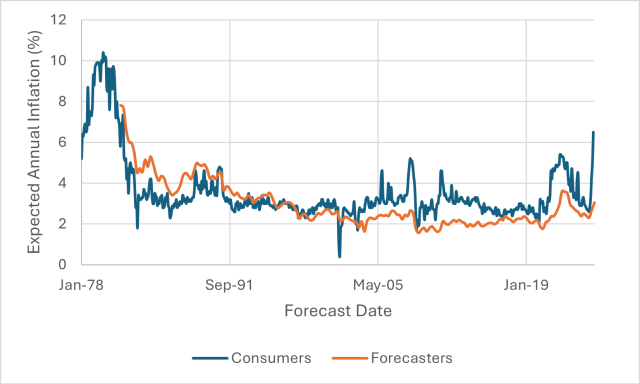
Inflation expectations are skyrocketing. The University of Michigan Survey of Consumers[1] shows that median forecasts jumped to 6.5% in April from 3.3% in January, and professional forecasters have also revised their projections upward. But history shows that both groups frequently miss the mark. The gap between expected and actual inflation has been wide and persistent, making it difficult to anticipate when and how inflation will hit portfolios. For investors, this uncertainty underscores the value of real assets, which have historically helped hedge against the surprises that traditional assets often fail to absorb. Historically, realized inflation levels have often been quite different than consumer and forecaster expectations. This is a topic we tackle in some recent research, “Expecting the Unexpected With Real Assets.” In it, we document the historical correlation between expected inflation and actual inflation (one year later). From the third quarter of 1981 to first quarter of 2025, the correlation has been relatively low at 0.20 for consumers and only slightly higher for professional forecasters at 0.34. This piece explores the performance of real assets in different inflationary environments, with a particular focus on performance during periods of high expected and unexpected inflation. Historical evidence suggests that real assets, which include commodities, real estate, and global infrastructure, have been especially effective diversifiers for investors concerned with inflation risk. Therefore, maintaining allocations to real assets, regardless of inflation expectations, is an excellent way to prepare a portfolio for the unexpected. Expecting Inflation Expectations of future inflation vary both over time and among different types of investors. There are a variety of surveys that are used to gauge these expectations. For example, the Federal Reserve Bank of Philadelphia[2] has been conducting its “Survey of Professional Forecasters” quarterly since the second quarter of 1990.[3] Respondents, including professional forecasters who produce projections in fulfillment of their professional responsibilities, are asked to provide their one-year-ahead expectations of inflation (as measured by the CPI). In addition, the University of Michigan’s monthly survey of US households asks, “By about what percent do you expect prices to go up/down, on the average, during the next 12 months?”  There are also more aggregated models such as those by the Federal Reserve Bank of Cleveland[4]. Exhibit 1 includes inflation expectations for professional forecasters (defined as responses to the Federal Reserve Bank of Philadelphia survey) and consumers (from the University of Michigan survey) from January 1978 to May 2025. Exhibit 1: Inflation Expectations: January 1978 to May 2025 Source: Federal Reserve Bank of Philadelphia, the University of Michigan and Authors’ Calculations. We can see that inflation expectations have varied significantly over time. While expected inflation from forecasters and consumers is often similar, with a correlation of 0.49 over the entire period, there are significant differences over time. For instance, while inflation expectations from forecasters have been relatively stable, consumer expectations have exhibited a higher level of variability — especially recently. Expectations around inflation — like those for investment returns — play a critical role in portfolio construction. Inflation assumptions often serve as a foundational input in estimating asset return expectations (i.e., capital market assumptions). As a result, when inflation expectations are low, some investors may question the value of including real assets that are typically used to hedge inflation risk in their portfolios. A consideration, though, is that historically there has been a decent amount of error in forecasting inflation. For example, in June 2021, the expected inflation for the subsequent 12 months among professional forecasters was approximately 2.4%, while actual inflation during that future one-year period ended up being approximately 9.0%. This gap, or estimation error, of approximately 6.6% is called unexpected inflation. The correlation between expected inflation and actual inflation (one year ahead) has been 0.34 for forecasters and 0.20 for consumers, demonstrating the sizable impact unexpected inflation can have. Put simply, while forecasts of future inflation have been somewhat useful, there have been significant differences between observed inflation and expected inflation historically. Real Assets and Inflation Understanding how different investments perform in different types of inflationary environments, especially different periods of unexpected inflation, is important to ensure the portfolio is as diversified as possible. Real assets, such as commodities, real estate, and infrastructure are commonly cited as important diversifiers against inflation risk. They don’t always appear to be that beneficial, however, when the risk and returns of these assets are viewed in isolation. This effect is illustrated in Exhibit 3. Panel A shows the historical risk (standard deviations) and returns for various asset classes from Q3 1981 to Q4 2024. Panel B displays expected future returns and risk, based on the PGIM Quantitative Solutions Q4 2024 Capital Market Assumptions (CMAs). Exhibit 2: Return and Risk for Various Asset Classes Source: Morningstar Direct, PGIM Quantitative Solutions Q4 2024 Capital Market Assumptions and Authors’ Calculations. We can see in Exhibit 2 that real assets, which include commodities, global infrastructure, and REITs, appear to be relatively inefficient historically when compared to the more traditional fixed income and equity asset classes when plotted on a traditional efficient frontier graph (in Panel A).  However, while they may still be relatively less efficient when using forward-looking estimates (in Panel B), the expectations around lower risk-adjusted performance have narrowed. When thinking about the potential benefits of investments in a portfolio, though, it’s important to view the impact of an allocation holistically, not in isolation.  Not only do real assets have lower correlations with more traditional asset classes, but they also serve as important diversifiers when inflation varies from expectations (i.e. periods of higher unexpected inflation). This effect is documented in Exhibit 3, which includes asset class return correlations with both expected and unexpected inflation levels, based on professional forecasters’ expectations (Panel A) and consumer expectations (Panel B). Exhibit 3: Asset Class Return Correlations to Expected and Unexpected Inflation Levels: Q3 1981 to Q4 2024 Source: Morningstar Direct, Federal Reserve Bank of Philadelphia, the University of Michigan and Authors’ Calculations. We can see in Exhibit 3 that more traditional investments, such as cash and

Mind the Inflation Gap: Hedging with Real Assets Read More »