
CFA Institute

How Technology Enhances Investor Trust

Trust, in some form, is at the center of all financial transactions, and technology can enable and enhance that trust. How do we know? Because 50% of retail investors and 87% of institutional investors say greater use of technology in financial services has increased trust in their adviser/manager. That’s among the key findings of “Enhancing Investors’ Trust: 2022 CFA Institute Investor Trust Study,” the fifth edition in the biennial series. “Enhancing Investors’ Trust” zeroes in on the relationship between technology and trust in finance. It demonstrates that trust in financial services is both seen and unseen: It is the ever-present backbone of financial transactions and the outward interface through which those transactions are conducted.  Greater tech integration in finance helps establish two kinds of trust that are essential to investing: “execution trust” and “relationship trust.” The former refers to the knowledge that transactions are secure, accurate, and appropriately managed, while the latter describes the additive value better investing tools and product personalization create for investors. Technology improves access to financial markets and strengthens representative equality among different market participants. It drives the development of new products and services that open up the markets to more people and counteracts the trust divide, or the trust differential among retail and institutional investors, across geographies and demographics, and between retail investors with and without an adviser. Execution Trust and Fundamentals Execution trust encourages market participation, and all market participants, regardless of demography, require it. By fostering execution trust, technology bridges the trust divide among all types of investors and helps ensure a level playing field.   As the World Bank observes: “Fintech can democratize access to finance and the world can move closer to achieving financial inclusion. . . . Fintech has the potential to lower costs, while increasing speed and accessibility, allowing for more tailored financial services that can scale.” Globally, the first point of entry to financial services is often digital payment providers. In some markets, particularly those that lack traditional banking infrastructure, they are the primary mode of transaction. As such, trust in digital payment providers — Apple Pay, Venmo, Alipay, Zelle, etc. — was ranked highest among all financial services industry subsectors in most markets. Trust in Digital Payment Providers* Source: “Enhancing Investors’ Trust“Note: The exhibit shows the percentage of respondents selecting 4 or 5 on a scale of 1 (completely distrust) to 5 (completely trust).* “China” refers to Mainland China. Retail trading accounts and apps are further addressing the disparity in access to financial services. The survey found that 71% of respondents believe these tools improve their understanding of investing. Institutional investors are equally bullish: 89% say that they increase trust in financial information. These developments directly influence industry sentiment: Respondents with retail trading accounts are more than twice as likely to say they trust financial services than those without them.  Relationship Trust and Personalization Relationship trust is an additive value that builds on execution trust and describes what advisers can deliver when they understand, connect, and align with a client’s personal values and motivations. As with retail trading accounts, whether an investor has an adviser influences how much they trust financial services. Of those with an adviser, 69% have high or very high trust in financial services compared with 45% of those without an adviser. Technology can guide the form and frequency with which advisers communicate with clients and help them adapt accordingly to provide the right information at the right time for each client. It also can facilitate the development of more tailored products. Ultimately, technology-fueled personalization — direct indexing, AI investment strategies, etc. — strengthens the connection between investors and the investment industry. Demand for such products is high. The survey found that 78% of all retail investors and approximately 90% of those under age 45 are interested in more personalized investment products and services. Percentage of Respondents Who Want More Personalized Products/Services to Better Meet Their Investing Needs, by Age Group Source: “Enhancing Investors’ Trust“ Implications for the Future That financial technology adoption skews toward younger investors is no surprise, but as more assets are held by these “digital natives,” technology integration becomes ever more embedded in the client–adviser relationship. This influences how investors participate in the markets overall. For the first time in the Investor Trust series, access to the latest technology platforms and tools was cited as more important (56%) than having someone to navigate and execute the investment strategy (44%). As trust increases in financial technology, so too does the potential for new financial product and services providers to enter the market. The survey found that 56% of retail investors would be more interested in investing in financial products created by Amazon, Google, Alibaba, and other large technology firms than by financial institutions.  Of course, technology’s ubiquity in financial services creates certain challenges. Data privacy is a key consideration. More than one in four respondents (27%) say they are less willing to use online platforms that require inputting personal data than they were three years ago. Technology’s behavioral effect is another concern: Of survey participants with a retail trading account, 57% say it increased their trading frequency, while 74% say they believe acting upon digital “nudges” will improve their investment performance/decision making. Of course, such cautions are necessary reminders that unchecked technology can have unintended consequences. That’s why tech integration in finance must be approached with intent and oversight to maximize its trust-building effects on the industry. If you liked this post, don’t forget to subscribe to the Enterprising Investor. All posts are the opinion of the author. As such, they should not be construed as investment advice, nor do the opinions expressed necessarily reflect the views of CFA Institute or the author’s employer. Image credit: ©Getty Images/Ilya Lukichev Professional Learning for CFA Institute Members CFA Institute members are empowered to self-determine and self-report professional learning (PL) credits earned, including content on Enterprising Investor. Members can record credits easily using their online PL tracker. source

How Technology Enhances Investor Trust Read More »
Mind the Inflation Gap: Hedging with Real Assets

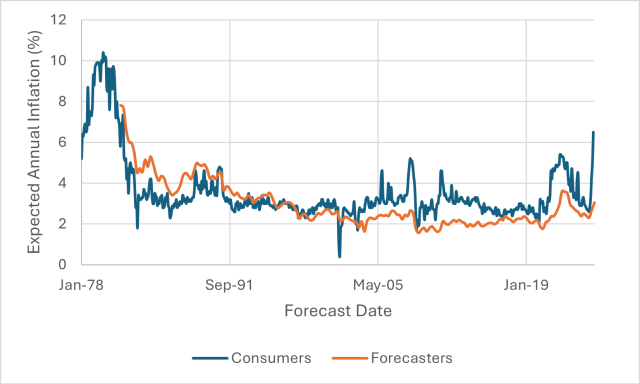
Inflation expectations are skyrocketing. The University of Michigan Survey of Consumers[1] shows that median forecasts jumped to 6.5% in April from 3.3% in January, and professional forecasters have also revised their projections upward. But history shows that both groups frequently miss the mark. The gap between expected and actual inflation has been wide and persistent, making it difficult to anticipate when and how inflation will hit portfolios. For investors, this uncertainty underscores the value of real assets, which have historically helped hedge against the surprises that traditional assets often fail to absorb. Historically, realized inflation levels have often been quite different than consumer and forecaster expectations. This is a topic we tackle in some recent research, “Expecting the Unexpected With Real Assets.” In it, we document the historical correlation between expected inflation and actual inflation (one year later). From the third quarter of 1981 to first quarter of 2025, the correlation has been relatively low at 0.20 for consumers and only slightly higher for professional forecasters at 0.34. This piece explores the performance of real assets in different inflationary environments, with a particular focus on performance during periods of high expected and unexpected inflation. Historical evidence suggests that real assets, which include commodities, real estate, and global infrastructure, have been especially effective diversifiers for investors concerned with inflation risk. Therefore, maintaining allocations to real assets, regardless of inflation expectations, is an excellent way to prepare a portfolio for the unexpected. Expecting Inflation Expectations of future inflation vary both over time and among different types of investors. There are a variety of surveys that are used to gauge these expectations. For example, the Federal Reserve Bank of Philadelphia[2] has been conducting its “Survey of Professional Forecasters” quarterly since the second quarter of 1990.[3] Respondents, including professional forecasters who produce projections in fulfillment of their professional responsibilities, are asked to provide their one-year-ahead expectations of inflation (as measured by the CPI). In addition, the University of Michigan’s monthly survey of US households asks, “By about what percent do you expect prices to go up/down, on the average, during the next 12 months?”  There are also more aggregated models such as those by the Federal Reserve Bank of Cleveland[4]. Exhibit 1 includes inflation expectations for professional forecasters (defined as responses to the Federal Reserve Bank of Philadelphia survey) and consumers (from the University of Michigan survey) from January 1978 to May 2025. Exhibit 1: Inflation Expectations: January 1978 to May 2025 Source: Federal Reserve Bank of Philadelphia, the University of Michigan and Authors’ Calculations. We can see that inflation expectations have varied significantly over time. While expected inflation from forecasters and consumers is often similar, with a correlation of 0.49 over the entire period, there are significant differences over time. For instance, while inflation expectations from forecasters have been relatively stable, consumer expectations have exhibited a higher level of variability — especially recently. Expectations around inflation — like those for investment returns — play a critical role in portfolio construction. Inflation assumptions often serve as a foundational input in estimating asset return expectations (i.e., capital market assumptions). As a result, when inflation expectations are low, some investors may question the value of including real assets that are typically used to hedge inflation risk in their portfolios. A consideration, though, is that historically there has been a decent amount of error in forecasting inflation. For example, in June 2021, the expected inflation for the subsequent 12 months among professional forecasters was approximately 2.4%, while actual inflation during that future one-year period ended up being approximately 9.0%. This gap, or estimation error, of approximately 6.6% is called unexpected inflation. The correlation between expected inflation and actual inflation (one year ahead) has been 0.34 for forecasters and 0.20 for consumers, demonstrating the sizable impact unexpected inflation can have. Put simply, while forecasts of future inflation have been somewhat useful, there have been significant differences between observed inflation and expected inflation historically. Real Assets and Inflation Understanding how different investments perform in different types of inflationary environments, especially different periods of unexpected inflation, is important to ensure the portfolio is as diversified as possible. Real assets, such as commodities, real estate, and infrastructure are commonly cited as important diversifiers against inflation risk. They don’t always appear to be that beneficial, however, when the risk and returns of these assets are viewed in isolation. This effect is illustrated in Exhibit 3. Panel A shows the historical risk (standard deviations) and returns for various asset classes from Q3 1981 to Q4 2024. Panel B displays expected future returns and risk, based on the PGIM Quantitative Solutions Q4 2024 Capital Market Assumptions (CMAs). Exhibit 2: Return and Risk for Various Asset Classes Source: Morningstar Direct, PGIM Quantitative Solutions Q4 2024 Capital Market Assumptions and Authors’ Calculations. We can see in Exhibit 2 that real assets, which include commodities, global infrastructure, and REITs, appear to be relatively inefficient historically when compared to the more traditional fixed income and equity asset classes when plotted on a traditional efficient frontier graph (in Panel A).  However, while they may still be relatively less efficient when using forward-looking estimates (in Panel B), the expectations around lower risk-adjusted performance have narrowed. When thinking about the potential benefits of investments in a portfolio, though, it’s important to view the impact of an allocation holistically, not in isolation.  Not only do real assets have lower correlations with more traditional asset classes, but they also serve as important diversifiers when inflation varies from expectations (i.e. periods of higher unexpected inflation). This effect is documented in Exhibit 3, which includes asset class return correlations with both expected and unexpected inflation levels, based on professional forecasters’ expectations (Panel A) and consumer expectations (Panel B). Exhibit 3: Asset Class Return Correlations to Expected and Unexpected Inflation Levels: Q3 1981 to Q4 2024 Source: Morningstar Direct, Federal Reserve Bank of Philadelphia, the University of Michigan and Authors’ Calculations. We can see in Exhibit 3 that more traditional investments, such as cash and

Mind the Inflation Gap: Hedging with Real Assets Read More »

Machine Learning Algorithms and Training Methods: A Decision-Making Flowchart

Machine learning is set to transform investment management. Yet many investment professionals are still building their understanding of how machine learning works and how to apply it. With that in mind, what follows is a primer on machine learning training methods and a machine learning decision-making flowchart with explanatory footnotes that can help determine what sort of approach to apply based on the end goal. Machine Learning Training Methods 1. Ensemble Learning No matter how carefully selected, each machine learning algorithm will have a certain error rate and be prone to noisy predictions. Ensemble learning addresses these flaws by combining predictions from various algorithms and averaging out the results. This reduces the noise and thus produces more accurate and stable predictions than the best single model. Indeed, ensemble learning solutions have won many prestigious machine learning competitions over the years. Ensemble learning aggregates either heterogeneous or homogenous learners. Heterogeneous learners are different types of algorithms that are combined with a voting classifier. Homogenous learners, by contrast, are combinations of the same algorithm that use different training data based on the bootstrap aggregating, or bagging, technique. 2. Reinforcement Learning As virtual reality applications come to resemble real-world environments, trial-and-error machine learning approaches may be applied to financial markets. Reinforcement learning algorithms distill insights by interacting among themselves as well as from data generated by the same algorithm. They also employ either supervised or unsupervised deep neural networks (DNNs) in deep learning (DL). Reinforcement learning made headlines when DeepMind’s AlphaGo program beat the reigning world champion at the ancient game of Go in 2017. The AlphaGo algorithm features an agent designed to execute actions that maximize rewards over time while also taking the constraints of its environment into consideration. Reinforcement learning with unsupervised learning does not have either direct labeled data for each observation or instantaneous feedback. Rather, the algorithm must observe its environment, learn by testing new actions — some of which may not be immediately optimal — and reapply its previous experiences. Learning occurs through trial and error. Academics and practitioners are applying reinforcement learning in investment strategies: The agent could be a virtual trader that follows certain trading rules (actions) in a specific market (environment) to maximize its profits (rewards). Nevertheless, whether reinforcement learning can navigate the complexities of financial markets is still an open question. Machine Learning Decision-Making Flowchart Footnotes 1. Principal component analysis (PCA) is a proxy for the complexity of the prediction model and helps reduce the number of features, or dimensions. If the data has many highly correlated Xi features, or inputs, then a PCA can perform a change of basis on the data so that only the principal components with the highest explanatory power in regards to the variance of features are selected. A set of n linearly independent and orthogonal vectors — in which n is a natural number, or non-negative integer — is called a basis. Inputs are features in machine learning, whereas inputs are called explanatory or independent variables in linear regression and other traditional statistical methods. Similarly, a target Y (output) in machine learning is an explained, or dependent variable, in statistical methods. 2. Natural language processing (NLP) includes but is not limited to sentiment analysis of textual data. It usually has several supervised and unsupervised learning steps and is often considered self-supervised since it has both supervised and unsupervised properties. 3. Simple or multiple linear regression without regularization (penalization) is usually categorized as a traditional statistical technique but not a machine learning method. 4. Lasso regression, or L1 regularization, and ridge regression, or L2 regularization, are regularization techniques that prevent over-fitting with the help of penalization. Simply put, lasso is used to reduce the number of features, or feature selection, while ridge maintains the number of features. Lasso tends to simplify the target prediction model, while ridge can be more complex and handle multi-collinearity in features. Both regularization techniques can be applied not only with statistical methods, including linear regression, but also in machine learning, such as deep learning, to deal with non-linear relationships between targets and features. 5. Machine leaning applications that employ a deep neural network (DNN) are often called deep learning. Target values are continuous numerical data. Deep learning has hyperparameters (e.g., number of epochs and learning rate of regularization), which are given and optimized by humans, not deep learning algorithms. 6. Classification and regression trees (CARTs) and random forests have target values that are discrete, or categorical data. 7. The number of cluster K — one of the hyperparameters — is an input provided by a human. 8. Hierarchical clustering is an algorithm that groups similar input data into clusters. The number of clusters is determined by the algorithm, not by direct human input. 9. The K-nearest neighbors (KNN) algorithm can also be used for regression. The KNN algorithm needs a number of neighbors (classifications) provided by a human as a hyperparameter. The KNN algorithm can also be used for regression but is omitted for simplicity. 10. Support vector machines (SVMs) are sets of supervised learning methods applied to linear classification but which also use non-linear classification and regression. 11. Naïve Bayes classifiers are probabilistic and apply Bayes’s theorem with strong (naïve) independence assumptions between the features. References Kathleen DeRose, CFA, Matthew Dixon, PhD, FRM, and Christophe Le Lannou. 2021. “Machine Learning.” CFA Institute Refresher Reading. 2022 CFA Program Level II, Reading 4. Robert Kissell, PhD, and Barbara J. Mack. 2019. “Fintech in Investment Management.” CFA Institute Refresher Reading, 2022 CFA Program Level I, Reading 55. If you liked this post, don’t forget to subscribe to the Enterprising Investor. All posts are the opinion of the author. As such, they should not be construed as investment advice, nor do the opinions expressed necessarily reflect the views of CFA Institute or the author’s employer. Image credit: ©Getty Images/Jorg Greuel Professional Learning for CFA Institute Members CFA Institute members are empowered to self-determine and self-report professional learning (PL) credits earned, including content on Enterprising Investor. Members can record

Machine Learning Algorithms and Training Methods: A Decision-Making Flowchart Read More »

IFRS Accounting Standard Will Support Better Investment Decisions

IFRS 18 Presentation and Disclosure in Financial Statements will usher in the most significant change to the statement of profit or loss since IFRS Accounting Standards were introduced more than 20 years ago to make the financial statements of public companies consistent and transparent.   The new Standard responds to investors’ concerns about challenges in comparing companies’ financial performance. Today, companies’ statements of profit or loss vary considerably in content and structure. IFRS 18 will give investors more transparent and comparable information about companies’ financial performance and support better investment decisions. IFRS 18 is not effective until 1 January 2027, but companies can apply the Standard early. Regardless, there are several steps they should take to prepare. Companies can assess necessary changes to internal systems and processes, for example. And they can consider how to communicate changes in reported information to investors. It is possible that early adopters of IFRS 18 will share some of this information with the market next year. IFRS 18 responds to market demand for greater comparability and transparency with a focus on information about financial performance in the statement of profit or loss. And all companies that apply IFRS around the world will be expected to use the new Standard beginning in 2027. IFRS 18 introduces three sets of new requirements, comprising: two new subtotals in the statement of profit or loss; disclosures about management-defined performance measures (MPMs); and enhanced guidance on the grouping of information in the financial statements. Subtotals in the Statement of Profit or Loss IFRS 18 improves the comparability of information in the statement of profit or loss by introducing: three new defined categories — operating, investing, and financing; and two new required subtotals to enable analysis — operating profit and profit before financing and income taxes. Among the challenges that investors face in comparing companies’ financial performance is the inconsistency in reporting operating profit. Operating profit is one of the most frequently used subtotals. However, companies apply various definitions to this subtotal because, until now, IFRS had not defined operating profit. For example, in a sample of 100 companies, 61 presented operating profit using at least nine different definitions. The structure of the statement of profit or loss set out in IFRS 18 requires companies to consistently classify their income and expenses as operating, investing, or financing. These requirements are illustrated in Figure 1 for a company that presents its operating expenses predominantly by function. The subtotals highlighted in dark grey are required by IFRS 18 and the subtotals in light grey are additional subtotals that are presented to provide a useful structured summary of the company’s income and expenses. Figure 1. Companies that present operating expenses predominantly by function. The operating category, together with the operating profit or loss subtotal: consists of all income and expenses not classified in the other categories; provides a complete picture of a company’s operations; and serves as a starting point for the statement of cash flows. The investing category: includes income and expenses from cash and cash equivalents and stand-alone investments, i.e., rentals from an investment property or dividends from shares in other companies; also includes shares of profits or losses from equity-accounted associates and joint ventures; and enables investors to analyse returns from these investments separately from a company’s operations. The financing category, together with the profit before financing and income taxes subtotal: includes income and expenses on financing liabilities such as bank loans and bonds; also includes interest expenses on any other liability, i.e., lease and pension liabilities; and allows investors to analyse the performance of a company before the effects of its financing. IFRS 18 also includes specific requirements to ensure that, for all companies, operating profit includes the income and expenses from a company’s main business activities. These requirements will mean that some companies like banks and insurers would otherwise classify some income and expenses in the operating category, rather than the investing or financing categories. Management-Defined Performance Measures Companies often provide company-specific measures, commonly referred to as alternative performance measures or non-GAAP measures. IFRS 18 requires companies to disclose company-specific measures related to the statement of profit or loss in the notes to their audited financial statements, along with accompanying explanations and reconciliations. Not all company-specific measures will be required to be disclosed in the financial statements. Only those measures that meet the definition of management-defined performance measures (MPMs) will be disclosed. MPMs are subtotals of income and expenses, such as adjusted operating profit, that are included in a company’s public communications outside financial statements and communicate management’s view of the company’s performance. Companies will be required to disclose information about MPMs in a single note. A crucial aspect of the disclosures is that each MPM will be required to be reconciled to the most directly comparable subtotal or total defined in IFRS Accounting Standards. Figure 2 illustrates the reconciliation of adjusted operating profit (MPM) to IFRS 18 operating profit and adjusted profit from continuing operations (MPM) reconciled to IFRS 18 profit from continuing operations. Figure 2. MPM disclosure. These reconciliations will increase investors’ understanding of how MPMs compare with subtotals defined by IFRS Accounting Standards. The package of disclosure about MPMs will bring transparency and discipline to these measures. Companies are also required to provide: explanations of why each MPM is reported and how it is calculated; for each adjusting item, the amount included in each line item in the statement of profit or loss together with the tax effect and effect on non-controlling interests; and explanations of any changes to reported MPMs. Companies welcome the disclosure requirements for MPMs because they can provide their view of performance in the financial statements, and investors like them because they expect greater transparency about management’s view. Grouping Information IFRS 18 introduces enhanced guidance on grouping information in the financial statements, otherwise known as aggregation and disaggregation. Companies will be required to reconsider how they group information in the financial statements. They will be required to consider: whether information

IFRS Accounting Standard Will Support Better Investment Decisions Read More »

Meir Statman: Your State of Mind Influences Your Investing Success

Editor’s Note: Our Enterprising Investor podcast features intimate conversations with some of the most influential people from the world of finance about the topics that matter most to investment professionals. This post summarizes the key talking points from a conversation between the show’s host, Mike Wallberg, CFA, MJ, and Meir Statman. In this episode of Enterprising Investor podcast, we delve into the relationship between money and happiness, and how your state of mind can influence investing success. Our esteemed guest, Meir Statman, a professor at the Levy School of Business at Santa Clara University and author of A Wealth of Well-Being: A Holistic Approach to Behavioral Finance, shared his insights on the broader aspects of financial well-being and its interconnection with life satisfaction. Statman emphasized that while money is necessary for supporting a family and ensuring financial stability, it is not sufficient for overall happiness. Life well-being encompasses various domains such as family, work, health, education, and religion, and it’s crucial to balance these to achieve a holistic sense of well-being. The conversation also touched upon the generational differences in risk tolerance and portfolio construction. Statman emphasized the importance of striving for long-term goals and taking calculated risks that can lead to rewards, such as investing in education or career changes. He advised against the pursuit of quick riches through speculative investments like Bitcoin or lottery tickets, advocating instead for a disciplined and science-based approach to investing. Statman shared his simple portfolio strategy, which is based on the dual goals of avoiding poverty and aspiring to be rich — not just in monetary terms, but in overall well-being. He discussed the benefits of diversification and the power of compounding over time, suggesting that investors should focus on being with the market rather than trying to beat it. In closing, Statman offered advice to his younger self and to the younger generation: sacrifice some present comfort for future well-being, take useful risks, and remember that enhancing the well-being of others can enhance your own well-being. If you liked this post, don’t forget to subscribe to Enterprising Investor. All posts are the opinion of the author. As such, they should not be construed as investment advice, nor do the opinions expressed necessarily reflect the views of CFA Institute or the author’s employer. Image courtesy of Nick Webb. This file is licensed under the Creative Commons Attribution 2.0 Generic license. Cropped. source

Meir Statman: Your State of Mind Influences Your Investing Success Read More »

Book Review: The Price of Time

The Price of Time: Interest, Capitalism, and the Curse of Easy Money. 2022. Edward Chancellor. Atlantic Monthly Press. Few areas of macroeconomic policy are as important and generate as much heat as monetary policy. Were a freshman economics major to inquire about the subject, I would tell them to start with the marvelously entertaining video called “Fear the Boom and Bust: The Original Keynes vs. Hayek Rap Battle.” I’d then hand the student a copy of Edward Chancellor’s The Price of Time. It is no secret that productivity growth is slowing worldwide; for example, in the United States, it fell from 2.8% per year between 1947 and 1973 to 1.2% after 2010. Things are worse in Europe and Japan, with productivity growing at less than 1% per year for a generation. Most famously, Robert Gordon of Northwestern University primarily blames the slowing pace of technological innovation. Professor Gordon and I must be exposed to different versions of the scientific literature, which to my reading bursts at the seams with evidence of technological progress. One unsexy, unremarked, but nonetheless momentous example: The Bosch–Haber process supplies most of the world’s fertilizer. This high-temperature chemical reaction consumes enormous amounts of fossil fuel, but the past decade has seen enormous advances in low-temperature catalysis that promise to both increase agricultural productivity and cut down on greenhouse gas emissions. Larry Summers (and before him, Alvin Hansen), however, blames “secular stagnation,” which ascribes falling productivity to an aging and thus less vigorous and intellectually nimble workforce. The problem with this explanation is that it does not fit the demographic data. Anecdotally, for example, the Roaring Twenties followed a long period of slowing population growth, and more systemic data show no relationship between population growth and the economic variety of growth. Chancellor provides a different, more compelling, and more frightening explanation of the world’s slowing economies: central banks’ now decades-long love affair with artificially low interest rates. He starts by discussing Swedish economist Knut Wicksell’s concept of the natural rate of interest, r* (r-star), below which inflation results and above which deflation occurs. While a skeptic might point out that r* is unobservable, it has been eminently clear for the past two decades that we are in monetary terra nova with prevailing rates well below r*. Chancellor’s central thesis, buttressed by extensive academic research, particularly from the Bank for International Settlements’ Claudi Borio, is that interest rates below r* promote a number of macroeconomic evils. Call them the “Four Horsemen of Cheap Money.” The first horseman is malinvestment. Rates below r* drive capital into projects with lower-than-normal expected returns; in other words, cheap money decreases the natural “hurdle rate” for investment. Think about the billions in investor cash that trained an entire generation of millennials that a crosstown ride should cost about $10 or, more generally, about the overinvestment in real estate, one of the least productive sectors of the economy. The second horseman is bloated asset prices. Again, think especially of the societally corrosive effects of unaffordable housing or, more generally, of the increasing concentration of financial assets in the upper percentiles of wealth, whose relatively low marginal propensity to consume further depresses economic growth. After all, if you direct income to poor people, they will only blow it on food and shelter. The third horseman, the financialization of the developed world’s economies, is perhaps the most insidious of all. Chancellor points out that by 2008 in the United States, “the output of the finance, insurance, and real estate sectors (FIRE) rose to be 50 per cent larger than manufacturing. The country possessed more [real estate] agents than farmers.” This financialization drove companies to load up on cheap debt, with disastrous unintended consequences. Prime among these were buybacks that starved ongoing operations, capital investment, and R&D. Additionally, debt-fueled acquisitions increase industry concentration, which, in turn, savages consumers. Moreover, the natural response to cheap debt is to incur more of it, thus guaranteeing an eventual conflagration. The fourth horseman of cheap money is the “zombification” of companies that in a normal interest rate environment would have gone bankrupt. One of the book’s most enjoyable and edifying sections compares properly functioning Schumpeterian creative destruction with a healthy forest. When forests are left to themselves, fires cull the least healthy trees and permit resilient young ones, whose growth would otherwise be stunted by bigger but diseased older ones, to flourish. For many decades, the US Forest Service aggressively fought fires, only to realize that this eventually resulted in giant conflagrations in acreages allowed to grow ecologically senile. Chancellor makes a convincing case that something similar has happened with monetary policy and that much of the fault for today’s low-productivity global economy can be laid at the feet of the overgrown forest of unhealthy zombie companies kept alive on low-interest life support. Perhaps the book’s most profound observation about low interest rates is that while their salutary effects on asset prices are plainly visible, the newly wealthy are far slower to perceive that the same thing has happened to the present value of their liabilities. Another fascinating observation: Low rates, by allowing manufacturers to push the production process further into the future, encourage the lengthening of global supply chains that can encompass multiple intercontinental voyages. If and when rates rise, globalization will of necessity go into a hard reverse. Chancellor, who well understands that Schumpeterian creative destruction requires a vigorous social welfare system, is no jumping-up-and-down libertarian. He approvingly quotes Tyler Cowen’s observation that “over the last few decades, we have been conducting a large-scale social experiment with ultralow savings rates, without a strong safety net beneath the high-wire act.” Chancellor follows Cowen’s observation with that of Michael Burry, lionized in Michael Lewis’s The Big Short: “The zero interest-rate policy broke the social contract for generations of hardworking Americans who saved for retirement, only to find their savings are not nearly enough.” Chancellor himself then observes that “an increasing number of Americans were forced to work beyond the traditional

Book Review: The Price of Time Read More »

Building a CAPM That Works: What It Means for Today’s Markets

The capital asset pricing model (CAPM) is one of the marvels of 20th century economic scholarship. Indeed, its creators took home Nobel Prizes for their efforts, and its insights have helped drive asset allocation decisions since the 1960s. To this day, many graduate school finance professors consider it the gospel on how to value equities. The problem, of course, is that it doesn’t always work in practice. So, we fixed it. Measuring the Equity Risk Premium (ERP) Correctly My team and I have spent the past five years studying the behavior of the US stock market over the past century and a half. Our efforts culminated in a new approach to equity and Treasuries valuations: We call it the Holistic Market Model. This model stretches well beyond the boundaries of traditional finance to include accounting, big data and analytics, history, and sociology. In developing it, we had to first re-engineer the CAPM to make it work both for the past 150 years and for the 2020s and beyond. The CAPM fails mainly because both components of the equity risk premium (ERP) are flawed. First, traditional earnings yields rely on inconsistent earnings figures. Second, risk-free rate calculations ignore the hidden risk premia embedded in US Treasury bonds. Therefore, to better understand the forces driving equity prices, we reconstruct these measures from the ground up. First, we determine which earnings figures are the best inputs to calculate equity earnings yields. We leverage the concept of “owner earnings,” which Warren Buffett originally devised for single stocks, and extend it to the S&P 500 Index, while accounting for investor personal taxes. Building on Buffett’s comparison of a stock index with a real perpetual bond, we convert the S&P 500’s earnings yield into its real perpetual bond yield equivalent. That requires us to address the fact that equities generally benefit from growth over time, but bonds do not. Second, we rethink the real risk-free rate, which is traditionally derived from nominal US Treasuries minus expected inflation. Our research shows that this measure is a poor approximation. Indeed, we uncover as many as 10 Treasury risk premia that most fixed-income investors don’t know about but should. These two steps allow us to calculate the ERP in a consistent fashion over the past 150 years by subtracting the real risk-free rate from Buffett’s real perpetual bond-equivalent earning yield. The resulting ERP is quite different and much more stable from that found in the Fed model and other traditional measures. Building an Explanatory Model of the ERP Because our ERP is consistent and reliable, we generate a CAPM that works in practice. Its variations can be explained by a four-factor model: The first factor is cyclical/sub-cyclical; the latter three are secular. They quantify often-referenced valuation drivers: Business cycle and sub-cyclical variations in economic and financial risk. Quantified levels of extreme inflation and deflation that are associated with poor equity performance. Intergenerational increases in risk aversion driven by long secular bear markets. Variations in the risk arbitrage between equities and Treasury bonds depending on real risk-free rate levels. To summarize, our re-engineered CAPM is based on the correctly calculated real risk-free rate and the four-factor ERP model and is a powerful explainer of equity valuations. The model has a single framework that covers the 150-year period: It indicates that the rules that govern stock prices have been surprisingly stable despite massive changes in the structure of the US economy. Re-Engineered CAPM Model: S&P 500 Real Price per Share, in US Dollars, January 1871 to December 2021 Source: S&P, Cowles Commission, Oliver Wyman What It Means for Managing Future Uncertainty The work has yielded numerous insights that have critical implications for portfolio construction and asset allocation, among them: Equity prices have been high in recent years not because of a bubble but rather because of highly favorable and unusual trends that have driven secular corporate profit margins to a 100-year high and the secular real risk-free rate to an all-time low. A crash is less likely now than if the ERP were unsustainably compressed due to a bubble. However, a financial crisis, large-scale geopolitical event, or natural disaster could trigger a crash if and when the fear of severe consequences from such an occurrence on the real economy and on inflation becomes overwhelming. Cyclical bull and bear markets are common. They are driven by the ever-changing dance between the economic cycle, the Fed cycle, and the mood of Mr. Market. As of this writing, we are already in a cyclical bear market if the 20% decline is measured in real terms, and on the verge of one if measured in nominal terms. Absent future P/E or margin expansion, secular forward-looking risk-adjusted returns are at an all-time low. But this is not enough to conclude that the 40-year secular bull market that started in 1982 is coming to an end. That also does not mean, however, that some new paradigm has rendered the current secular bull market immortal. Indeed, our work shows that this secular bull market will die for one or a combination of three reasons: The 30-year uptrend in corporate profit margins is unlikely to persist for another 40 years; neither is the post–global financial crisis (GFC) downtrend in the secular real risk-free rate; and even a milder form of 1970s-style inflation could also sound its death knell. There is a big difference between these three assassins, however. The first two are not yet within sight but will strike sometime in the next 40 years — the ballot box will largely determine when. The third, inflation, is in plain view right now, but it will kill the secular bull market only if it defeats the US Federal Reserve rather than the other way around. So, is there room for optimism in 2023 and beyond? Yes, because despite cyclical headwinds and gloomy headlines, the evidence to reliably call the end of the secular bull market has not yet appeared — and may not for many years. Until it does,

Building a CAPM That Works: What It Means for Today’s Markets Read More »

Unlocking Stock Market Success: Why You Should Embrace the Skew

When we talk about stock returns, most people assume that individual stocks should yield positive returns. That’s because the stock market has historically outperformed other asset classes like bonds. But surprisingly, the median monthly return for a large sample of individual stocks is — drumroll, please – zero. That’s right. A study conducted by Henric Bessembinder and published in the Financial Analysts Journal in April 2023 found that on a monthly basis, individual stocks generate returns centered around zero. In fact, this paints a “half-full, half-empty” scenario. Half the stocks produce positive returns, while the other half have negative returns. As an investor or advisor, how do you and your clients react to this? If this zero-median return statistic were the only way to look at stock performance, it would be hard to justify investing in stocks at all. Convincing clients to invest in equities would be an uphill battle, especially if they’re seeking short-term gains. Volatility In fact, there are many ways to evaluate stock returns beyond just focusing on median monthly performance. One common approach is to measure stock returns in terms of volatility. Volatility refers to how much a stock’s price fluctuates, and it’s often measured using standard deviation. On average, the annual standard deviation for stock returns is about 50%, which means that the price of an individual stock can swing wildly throughout the year. If we apply the 95% confidence interval often used in statistics, this implies that an individual stock’s return could vary by roughly +/- 100% in a given year. This is huge. Essentially, an individual stock could double or lose all its value within 12 months. This level of uncertainty can make stocks seem daunting, especially for those looking for stability. The idea that individual stocks are a “half-full, half-empty” proposition monthly, and are even more volatile annually, can scare away potential investors. But it’s important to remember that stocks are primarily intended to be long-term investments. The short-term ups and downs, while nerve-wracking, are part of the journey toward long-term wealth creation. So, what happens when we shift our focus to long-term individual stock returns? Shouldn’t we expect more consistency over time? Bessembinder also looked at long-term stock performance, and the findings weren’t exactly comforting. Over the long run, 55% of US stocks underperformed US Treasury Bill returns, meaning that more than half of individual stocks did worse than the safest government-backed investments. Perhaps even more alarming is the fact that the most common outcome for individual stocks was a 100% loss — complete failure. These findings suggest that investing in individual stocks is a high-risk endeavor, even when taking a long-term approach. Typically, when investors and financial analysts assess stock performance, they focus on two key statistical measures: central value (such as the mean or median return) and volatility (as measured by standard deviation). This traditional method of analysis often leads to a negative or at least discouraging narrative about investing in individual stocks. If returns are largely zero in the short term, highly volatile in the medium term, and risky in the long term, why would anyone invest in stocks? The answer, as history shows, is that despite these challenges, stocks have significantly outperformed other asset classes like bonds and cash over extended periods. But to truly understand why, we need to look beyond the typical first two parameters used in analyzing stock returns. The Third Parameter for Assessing Stock Performance: Positive Skew While traditional analysis focuses heavily on the first two parameters — central value and volatility — it misses a crucial component of stock returns: positive skew. Positive skew is the third parameter of stock return distribution, and it’s key to explaining why stocks have historically outperformed other investments. If we only focus on central value and volatility, we are essentially assuming that stock returns follow a normal distribution, similar to a bell curve. This assumption works well for many natural phenomena, but it doesn’t apply to stock returns. Why not? Because stock returns are not governed by natural laws; they are driven by the actions of human beings, who are often irrational and driven by emotions. Unlike natural events that follow predictable patterns, stock prices are the result of complex human behaviors — fear, greed, speculation, optimism, and panic. This emotional backdrop means that stock prices can shoot up dramatically when crowds get carried away but can only drop to a limit of -100% (when a stock loses all its value). This is what creates a positive skew in stock returns. In simple terms, while the downside for any stock is capped at a 100% loss, the upside is theoretically unlimited. An investor might lose all their money on one stock, but another stock could skyrocket, gaining 200%, 500%, or even more. It is this asymmetry in returns –the fact that the gains can far exceed the losses — that generates positive skew. This skew, combined with the magic of multi-period compounding, explains much of the long-term value of investing in stocks. Learn to Tolerate Tail Events If you examine stock return distributions, you’ll notice that the long-term value from investing in the market comes primarily from tail events. These are the rare but extreme outcomes that occur at both ends of the distribution. The long, positive tail is what produces the outsized returns that more than make up for the smaller, frequent losses. For stocks to have generated the high returns we’ve seen historically, the large positive tail events must have outweighed the large negative ones. The more positively skewed the return distribution, the higher the long-term returns. This might sound counterintuitive at first, especially when traditional portfolio management strategies focus on eliminating volatility. Portfolio construction discussions often center around how to smooth out the ride by reducing exposure to extreme events, both positive and negative. The goal is to create a more-predictable and less-volatile return stream, which can feel safer for investors. However, in avoiding those unnerving tail events, investors eliminate both the

Unlocking Stock Market Success: Why You Should Embrace the Skew Read More »

The Size Factor Matters for Actual Portfolios

The size factor is among those equity risk factors that have provided a premium over the longer term. Recently, however, some researchers have expressed doubt about its utility based on a comparison of its performance with other well-known factors. For example, Ron Alquist, Ronen Israel, and Tobias Moskowitz as well as Noah Beck, Jason Hsu, Vitali Kalesnik, and Helge Kostka have argued that there is neither strong empirical evidence nor robust theoretical support for a persistent size premium. But there are reasons why most investors should question the relevance of these conclusions. Statistical analyses by Joel L. Horowitz, Tim Loughran, and N.E. Savin show that the stand-alone outperformance of small-cap stocks over large-cap stocks is weak and may even disappear when exposure to the market factor is taken into account. In particular, augmenting the set of independent variables with the lagged market return, in addition to the contemporaneous market return, leads to an insignificant size premium. While of marginal statistical interest, this result has little if any practical implication for investors. Indeed, the lagged market “factor” is an artificial construct that investors cannot hold in their portfolios and so has only hypothetical statistical applications. As such, measuring the alpha of such a non-investable factor does not make economic sense. For us, the more important question is: Does the size factor add value to an investor’s portfolio? Factor performance should be assessed from a portfolio perspective The simplest way to determine whether a factor adds value to a portfolio is to compare the portfolio’s Sharpe ratio with and without the factor. The higher the Sharpe ratio, the higher the risk-adjusted return of the overall portfolio. A stand-alone factor premium will not answer this question, since this does not account for the factors’ risk characteristics, namely the correlations between the factor under consideration and the other factors in the portfolio. Furthermore, gauging exposure to the market factor alone does not give a complete picture of how the factor will impact the portfolio because it ignores correlations with other factors. Adding the lagged values of the market factor in the regression does not resolve this problem and also assumes that an investor’s choice is limited to holding only the market or holding the market and size. To properly analyze the size factor, we must evaluate its utility within a set of economically relevant factors. Examining the size factor alongside economically meaningless or redundant factors hardly yields any statistical or economic insight. Consequently, to determine whether size adds value and improves the Sharpe ratio of a portfolio, we need to integrate exposures to all these other factors into our analysis. In work previously published in The Journal of Beta Investment Strategies, Scientific Beta researchers Mikheil Esakia, Felix Goltz, Ben Luyten, and Marcel Sibbe conducted several tests to determine whether the size factor does indeed improve the Sharpe ratio of a multi-factor investor. The results presented in the chart below illustrate that it clearly does and are consistent with findings from other researchers. The graph shows the factor weights that maximize the Sharpe ratio of an investor who can choose from a factor menu featuring the market, size, value, momentum, low-risk, high-profitability, and low-investment factors, which have been widely used in both academic and practitioner research. This is a straightforward way to assess a factor’s impact on the risk/return characteristics of a portfolio. Any deviation from these weights would lower the Sharpe ratio. The size factor received a weight of more than 9% in the portfolio, which is greater than that of value (2.9%) and close to those of momentum (11.4%) and low risk (11.7%). Weights in Mean-Variance Optimal Portfolio, July 1963 to December 2018 In the same study, the researchers also reported that the stand-alone size factor had the lowest return among the factors on the menu over the analysis period. Momentum and low risk had average stand-alone premia that were about three times as high. However, the weights of the momentum and low-risk factors in the optimal portfolio are not much higher than that of the size factor. What explains these results? Ultimately, optimal factor weights depend on more than just returns. They also rely on risk properties, notably factor volatilities and the correlations of each factor with factors other than the market factor. Taking these risk properties into account is particularly useful since we can measure them with a fair degree of reliability, while expected returns are notoriously hard to estimate. The size factor’s positive weight in the optimal portfolio demonstrates that including exposure to size improves the risk/return profile of a multi-factor portfolio. In particular, the size factor contributes to the Sharpe ratio because it has a particularly low correlation with other traditional factors, which makes it an effective diversifier of the portfolio. Indeed, its diversification benefits are so strong that even with close to no premium, the size factor would still be a valuable addition to a multi-factor portfolio. The size factor may not have stellar returns, but it is a valuable addition to a portfolio When a portfolio’s exposures to factors other than the market factor are taken into account, adding the size factor clearly improves the portfolio’s risk/return characteristics. Size is a strong diversifier of other traditional factors and consequently adds value to a multi-factor portfolio. Analysis that doesn’t consider exposures to momentum, profitability, and other factors is of little use to investors. Finally, there is a size effect. Claiming otherwise contradicts the various academic asset pricing models that show the size factor adds explanatory power in the cross-section of returns. These models, by including factors other than the market, provide meaningful conclusions for investors and bear out the size factor’s important contribution to portfolio diversification and risk control. If you liked this post, don’t forget to subscribe to Enterprising Investor. All posts are the opinion of the author. As such, they should not be construed as investment advice, nor do the opinions expressed necessarily reflect the views of CFA Institute or the author’s employer. Image credit: ©Getty Images /Liudmila Chernetska Professional Learning for CFA Institute Members CFA Institute

The Size Factor Matters for Actual Portfolios Read More »

Is the Euro Uninvestable? The FX Question du Jour

The euro’s value relative to the US dollar (EUR/USD) recently dipped below parity for the first time since 2002. So precipitous and rapid has been the decline in EUR/USD over the past year that many mean reversion/short gamma funds have had to liquidate and return the remaining capital to investors. Hence the question posed in the title above. While charged buzzwords like “uninvestable” should be used with caution, the Russia–Ukraine war has clearly exposed and exacerbated the eurozone’s vulnerabilities. But to answer the underlying question, we need first to explore the literature on exchange rates and see what explanatory model (or models) works best. The Suite of Models: Different Horses for Different Courses Is there an overarching gestalt framework for currencies? Or do distinctions among developing and emerging markets, major and minor markets, and reserve currencies like the USD and the EUR necessitate multiple frameworks? The balance of payments (BOP) method offers key insights in all cases, with its classic accounting identity for economic adjustment: Savings − Investment = Income − Expenditure = Exports – Imports.  But the differences in the financial/capital accounts — mobile vs. restricted as allowed by regulations — and the nature and scope of monetary policies, from the traditional to the unconventional, make certain models more applicable in some domains than others. What does the purchasing power parity (PPP) approach, which measures the relative price of goods, tell us about the EUR? Could the portfolio balance approach, which gauges the relative price of assets, help us understand how quantitative easing (QE) has affected the transmission channel of international portfolio investments?  A Hamstrung ECB  Needless to say, the eurozone, currently comprising 19 member states that have adopted the EUR, is far more complex to analyze than a single sovereign state. Importantly, the eurozone is a monetary union without a fiscal union. Given the lack of a federal fiscal authority, the European Central Bank (ECB), along with its  price stability mandate, has also assumed de facto responsibility for countering financial fragmentation risk through containing core-periphery credit spreads. Then-ECB president Mario Draghi made that especially explicit in his famous “Whatever It Takes” speech of July 2012. Indeed, the interest rate spread between the German and Italian bonds, or the Bund–BTP spread, is currently a top concern. The ECB’s added role in reducing the redenomination risk premia on the periphery gives it extra leeway during easing cycles but makes it harder to tighten amid resurgent inflation. REER vs. NEER vs. EUR/USD  FX professionals gauge the value of one currency against a set of other currencies. So, the question is not so much whether the EUR is uninvestable but, rather, how well the EUR compares with other currencies — USD, JPY, GBP, CHF, CNH, etc. With multiple crosses available for trading, FX, as an asset class, seeks to monetize relative value. In popular parlance, the search is for the cleanest dirty shirt. Broad trade-weighted real effective exchange rate (REER) readings for the eurozone show that the EUR has been significantly undervalued since mid-2014 and remains so today. It currently stands at 92, with a reading below 100 indicating the currency is undervalued. What are we to make of this? To assume that the EUR is the currency of the future and always will be is not enough. Rather, we need to explore how the ECB’s unconventional monetary policies contributed to this outcome. Since mid-2014, the EUR’s trade-weighted nominal effective exchange rate (NEER) has shown a flattish return, and the EUR/USD pair has fallen by 27%. To be fair and consistent, we must compare REER to NEER trade-weighted indices, not bilateral EUR/USD performance. Still, this begs the question: Are there structural reasons for the EUR’s outsized underperformance compared with the USD? That depends on how the ECB’s policies have affected the eurozone’s balance of payments (BOP) through its current and financial accounts. Portfolio Rebalancing as a QE Transmission Channel The ECB’s balance sheet has more than tripled, to 82% of the eurozone’s GDP since 2015, due to both QE and targeted longer-term refinancing operations (TLTROs). By comparison, the US Federal Reserve’s balance sheet stands at 36.5% of GDP. The ECB now owns about 30% of all outstanding sovereign bonds as well as a sizeable share of private-sector bonds through the corporate sector purchase programme (CSPP). The ECB’s buying spree has had such a profound effect that net sovereign issuances were consistently negative from 2015 to 2021. The ECB effectively pushed the nominal long-term risk-free rates in the eurozone much lower. For example, the 10-year German Bund yield fell from 1.40% in mid-2014 to an all-time low of –0.85% in 2020.  The ECB has effectively created a shortage of EUR-denominated bonds and compressed the nominal long-term risk-free rates in the eurozone. Cross-border portfolio rebalancing has been a key transmission channel for these unconventional policies. In fact, in mid-2014, historic portfolio outflows commenced as both resident and non-resident investors moved out of EUR-denominated debt securities and into the closest substitutes outside the EU. The largest cumulative net purchases were of long-dated debt securities issued by US entities. The Portfolio Balance Approach  The portfolio balance approach focuses specifically on the bond market as a driver of exchange rates. The model is better suited to currency pairs in developed markets, such as EUR/USD, since portfolio flows are very sensitive to market variables. In this model, monetary and fiscal conditions lead to changes in the supply and demand for domestic currency bonds relative to foreign currency bonds, which in turn, impacts the FX rate. Given the relative size and scale of the ECB’s unconventional monetary policies and the historic levels of cross-border portfolio rebalancing, the portfolio balance approach provides an elegant explanation for the massive collapse in EUR/USD between 2014 and 2015 — a peak-to-trough depreciation of 25% — and marks the inflection point where the EUR/USD gapped away from the EUR NEER. Fast forward to today: With the widening divergence between the ECB and the Fed responses to inflationary pressures, another dramatic period in the EUR/USD pair has begun. In the past 12 months, the EUR has depreciated by 16% against the USD but only by about 6% in NEER terms. Although

Is the Euro Uninvestable? The FX Question du Jour Read More »