CIO CIO

Kyndryl: The largest manager of VMware assets is busier than ever in the cloud

With around 80,000 employees and serving most of the Fortune 100 and customers in more than 60 countries, Kyndryl is uniquely qualified to speak to the rapidly evolving infrastructure needs of enterprises. It’s a reality David Simpson, senior vice president of Cloud Practice growth at Kyndryl, knows well. “At Kyndryl, we have a long and extensive track record of designing, building, managing, and modernizing the complex, mission-critical information systems organizations around the world rely on every day,” says Simpson. “Working with a strong and extensive cadre of partners and many thousands of customers – from new innovators to the world’s most established and successful brands – our teams are hard at work addressing the challenges and the opportunities emerging in light of transformative computing trends that are accelerating and growing in importance across the globe.” The depth of the company’s solutions suite and services offerings reflect the scope and breadth of these challenges and opportunities and encompass applications, data and AI, the digital workplace, core enterprise systems, networks, the edge, and cyber resilience and security. All are supported by a deep bench of IT and cloud experts within Kyndryl Consult, a global network of technology strategy and implementation consultants with extensive experience helping customers create a winning digital transformation strategy, an enterprise architecture that ideally addresses their unique needs, and the culture required to realize its full potential. This applies to all of the industries Kyndryl serves. These include the automotive; banking and finance; energy; government; healthcare; insurance; manufacturing; retail; technology, media and telecommunications; travel and transportation; and chemical, oil and gas. Kyndryl’s cloud portfolio consists of a full range of offerings in four focus areas: cloud consult, public cloud, private cloud, and modern operations. Kyndryl’s experts also provide the insights and real-world experience needed to help organizations across the spectrum of cloud maturity, from those who want to start their cloud journey to stalwarts committed to refining their IT infrastructure with an extensive portfolio of managed cloud services. “We pride ourselves on being a trusted partner our customers can turn to when they must navigate an IT environment that is marked by new developments that impact each organization in unique ways,” adds Simpson. “That reality is particularly apparent when you look at the hybrid, multi-cloud approach that is increasingly prominent today.” The need for hybrid, multi-cloud acumen – is greater now than ever Simpson stresses that as many customers have matured in their cloud migration journeys, many have already moved most of their easy “lift-and-shift” workloads to the cloud and are now looking at second- and third-wave workloads that demand a more nuanced and specific approach that takes into account the particular strengths and limitations not only of different cloud approaches – private, public and hybrid or multi-cloud – but also the specific clouds offered by major hyperscalers and niche or industry-specific cloud providers. “As customers have come to look at deeply integrated and expansive workloads, most have come to realize that using one cloud is not an option,” says Simpson. “We recommend they look at the characteristics of the workload, the data requirements, and determine the best platform for each workload across a public, private, and traditional IT landscape. We provide the capabilities to help organizations be productive, secure, technically and financially manage across a hybrid landscape.” Simpson notes that enterprises are rightly being more strategic. More specifically, he stresses that a true multi-cloud program empowers organizations to seek best-of-breed technologies, experiment with new innovations, fill performance gaps – for example, those related to quantum computing – engage with cloud providers in specific geographies to address sovereignty, performance, and latency needs, and importantly to keep certain mission-critical workloads on premises. “On one hand, we are living in a time in which edge computing is driving more than half of data and infrastructure outside of the data center according to IDC,” says Simpson. “On the edge is where workloads and use cases drive revenue and customer sentiment, but they all require local or on-premise resources to perform well. When you also consider efforts to mitigate data privacy laws, embrace new applications of high-performance computing, utilize virtual desktop infrastructure, and continue to get the most out of existing core, on-premises systems – among them customer relationship management, enterprise resource planning, and business intelligence assets, we clearly also live in a time when there is a corresponding drive to keep data within enterprises’ four walls. This, and AI workloads that require self-learning applications and intellectual property not be exposed to the internet, is driving private cloud adoption even as the hybrid cloud approaches proliferate.” Notably, Kyndryl’s work to address the needs of public,  hybrid, and private cloud strategies draws on its experience with customers. It also relies on partnerships, such as the extensive relationship with VMware, and its expertise and use of VMware by Broadcom Technologies. “Over the past two decades we amassed many thousands of VMware certifications and created a corps of VMware experts – all while working closely with VMware’s development teams,” adds Simpson. “Today, we oversee more VMware assets than any other provider and are more excited by their future than ever, particularly as we look at the singular capabilities of VMware Cloud Foundation and its application with Kyndryl Bridge, our AI-powered open-integration platform that lets enterprises observe, integrate and orchestrate their entire technology environment with ease. As a Broadcom Pinnacle Partner, we can further help our customers realize the full benefits of our collaborative efforts and innovations while still using the proven technologies they know and trust.” To learn more, visit us here. source

Kyndryl: The largest manager of VMware assets is busier than ever in the cloud Read More »
Putting AI to work in your organization: You’ve got to adapt your processes

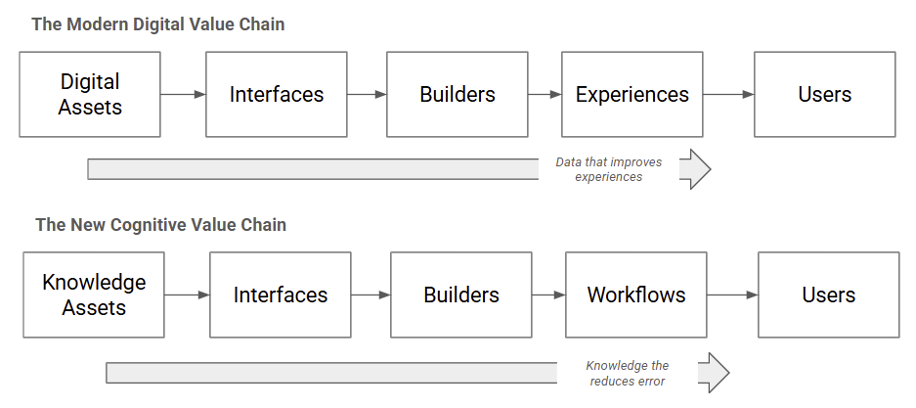
By Bryan Kirschner, Vice President, Strategy at DataStax In a previous article, I advocated for taking a personal growth mindset toward generative AI (genAI). I ended it with a promise to offer a guide to adapting processes, building alignment, and pursuing organizational excellence to those in a position to lead an organization-wide genAI journey. That’s my focus here. It’s an urgent and important job to be done, because while history isn’t exactly repeating itself right now, I see it rhyming. Here’s what the impact of web and mobile can teach us about where the puck is going with genAI. From retention and exposure to connection and consumption After decades of replacing paper-based processes and records, big retailers entered the dawn of digital transformation with a lot of data generated in the course of doing business. Customer purchase histories and store inventories, for example, were reliably retained. Employees could access them as needed to process a return or place the next month’s orders to suppliers, respectively. What incumbent retailers could not count on, however, was a rapid round trip from the creation of that sort of information back into real-time e-commerce experiences. In the new world of Web 2.0 and mobile, customer experiences lacking (for example) personalization or suggested substitutes for out-stock items quickly became unsatisfying and uncompetitive. Processes and tools built for retention and exposure were no longer fit for purpose. New ones needed to drive connection and consumption of what now needed to be managed not simply as business records but also as digital assets that were critical to improving every interaction. Something similar now applies to every company, regardless of industry, now that we’re at the dawn of the age of genAI. Leveraging your organization’s knowledge assets Every company is entering this era with a lot of unstructured data generated in the course of doing business. All the documents, presentations, and analyses (as well as the email chains and Slack threads) used to make business decisions and document subsequent results are reliably retained. Teams know where to find (for example) QBRs, MRDs, and PRDs. And genAI makes it possible to leverage them as knowledge assets that can be connected to and consumed to improve every employee workflow. Here’s why and what to do about it. With e-commerce customer interactions, leveraging digital assets solved for “I wish you’d told me” missed opportunities that lead to lost revenue. (And frustration: It’s tongue-in-cheek, but I often suggest imagining an app today telling you “this item could have shipped free from a different seller” five seconds after you hit the “buy” button.) In employee workflows, leveraging knowledge assets using genAI solves for “I wish we’d known” missed opportunities that lead to disappointment (and frustration). We can get an intuitive handle on this from an insight by organizational learning pioneer Chris Argyris. He defined error in the  business context as a gap between intended and actual outcomes. It’s both brilliant and actionable, because, in business, we rarely do things out of idle curiosity. From preventing regretted attrition to juicing back-to-school sales, we’ve got metrics or other success criteria in mind. And if we reflect on postmortems on occasions when there was indeed a gap between what was intended and what was achieved, it points us toward knowledge as both the prophylaxis and remedy. Those conversations likely included statements like these: “We drew the wrong conclusion from…” “We never even imagined…” “If only we’d known…” GenAI enables conversational access to any codified knowledge, and it makes possible agentic systems that can do work on people’s behalf. These two capabilities make it perfect for incorporating into workflows that would otherwise become unsatisfying and even uncompetitive. An HR example Let’s consider the potential for helping prevent regretted attrition if knowledge assets are accessible to retrieval-augmented generation (RAG) and agentic genAI apps. An HR business partner (HRBP) could get a weekly comparison of trending topics and sentiment comparing internal channels like Slack and email with external sources such as Glassdoor and LinkedIn. Levels and trends in the latter might be benchmarked against top competitors. The HRBP and each of his client people managers could get a weekly diagnosis of internal comms sentiment among high performers, accompanied by an analysis of how they’ve spent their time in the last week (e.g., percent of time in meetings) and positive and negative events (e.g., a feature shipped versus a feature timeline that slipped). Each high performer might have a customized plan taking into account internal and external sources that are updated on an ongoing basis. For example: One employee might write frequently on Substack about work-related topics, while also posting Medium about a hobby. GenAI could note if the tenor of the former turns negative or if the frequency of the latter declines coincident with this employee taking an unusual number of sick days. An “High Performer Risk Synthesizer Analyst” agent could put all these pieces together into briefings for an “HRBP Attention Assistant” agent, a “Manager Attention Assistant,” and an “HR-Manager Coordinator”—the latter providing informed recommendations with rich context that the HRBP and manager could discuss with it about where they might best devote their (finite human) attention to as they wrap up the week or begin the next. For indications of low risk, that action might entail approving a pre-drafted check-in email. For indications of high risk, it might entail agreeing to a 1:1 meeting for which time has already been found on the employee’s calendar. The cognitive value chain This example of “agentic flows” of previously latent or hard-to-assemble knowledge is well within the power of genAI technology as it stands today. Rallying around changing behaviors and putting the right tools in place is the next job to be done. DataStax The result will be a cousin and complement to the modern digital value chain that we call the new cognitive value chain. I’ll cover the components and competencies required for the latter in an upcoming article. Learn more about DataStax. About Bryan Kirschner:Bryan is Vice

Putting AI to work in your organization: You’ve got to adapt your processes Read More »

How CIOs can help the future suck less than the present

According to Mark Andreessen, sometime between 2006 and 2013, incoming freshmen at Harvard bought into the mantra that “tech is evil.” This has trickled into the general IT mindset. For many outside the profession, IT resembles the portfolio of televised advertisements during Super Bowl LIX: “very little creativity,” “not much in the way of simple, effective storytelling,” “not worth the money,” and “not targeted at me.” IT’s brighter future starts with stakeholders The other day I saw a bumper sticker that read, “Your company culture is not words on your website or posters on the wall. It’s how your people feel on a Sunday night.” On Sunday night, are stakeholders thinking positively about putting their hands back on your systems? source

How CIOs can help the future suck less than the present Read More »

Musk’s plan to replace government workers with AI could create chaos

“These aren’t hypothetical scenarios — they’re the inevitable result of treating government service as merely a data-processing problem,” says Piscione, author of the new book Employment Is Dead: How Disruptive Technologies Are Revolutionizing the Way We Work. Some replacements now possible Right now, AI can replace some data processing, compliance checking, and customer service roles, says Manuj Aggarwal, founder and CIO at TetraNoodle Technologies, a digital transformation company focused on AI and other emerging technologies. However, there are many other types of jobs in government. “Government work isn’t just about efficiency. It’s about understanding people, making judgment calls, and building trust,” he says. “AI can process data, but it can’t empathize, negotiate, or truly connect with citizens.” source

Musk’s plan to replace government workers with AI could create chaos Read More »

6 reasons so many IT orgs fail to exceed expectations today

As Swartz says: “If you’re underspending compared to others, then it should not be a surprise the organization is behind and that IT suffers.” Moreover, he says in such scenarios CIOs usually must commit a high percentage of their limited resources to keep-the-lights-on costs, leaving little to spend on innovation and transformation that can really dazzle their colleagues and deliver big wins for their business. There’s no easy fix for that, but having the CIO reporting to the CEO, not the CFO, can get IT more focused on driving business objectives and land it the money required to deliver, Swartz says. CIOs can exceed expectations even if they’re not able to change reporting structure, he adds, by “finding ways to make ‘less’ [resources] work more effectively” and putting any savings to those tech-driven business projects that will deliver the most benefits. “I would call that an exceed,” Swartz says. 6. Misplaced accountability Confusion about accountability — that is, who is really accountable for what results — is another obstacle for CIOs and IT teams as they aim high, according to Swartz. “The question of what keeps CIOs from exceeding expectations assumes that everyone knows what the CIO is accountable for, and I have seen, in fact, that the answer to that question varies,” he says. Too often, CIOs are held accountable for failures not of their making. CIOs in organizations where business teams turn problems over to IT to fix, where there’s no joint ownership, often won’t have the authority needed to effectively find solutions and drive change. At the same time, the IT department is often still held accountable for the delivery when it inevitably falls short. Worse still, Swartz says, is when the business gets credit in the cases where the project succeeds or exceeds expectations — even if IT drove the positive results. Joshi sees similar issues. “CIOs aren’t appreciated for what they do, and many aren’t recognized until something goes wrong,” he says. Joshi says the solution involves better alignment between IT and business teams on objectives and priorities, more collaboration, and better change management practices. “The challenge lies on both sides: the way business behaves and runs, and the way the technology organization runs,” Joshi adds. Swartz recommends the use of agile development principles, DevOps teams, and a product mindset — all of which, when properly implemented, require business-IT partnerships and joint accountability. He and others say those steps go a long way in helping IT successfully work on tech-driven business initiatives that stand out and get IT the credit it deserves for doing so. source

6 reasons so many IT orgs fail to exceed expectations today Read More »

IT infrastructure complexity hindering cyber resilience

The complexity of IT and security infrastructure was highlighted as the greatest obstacle to achieving cyber resilience according to new research, Unlock the Resilience Factor from Zscaler. Forty-three percent of 1,700 IT and security leaders worldwide ranked the challenge as a major barrier to an improved ability to recover from serious cyber events, nine percentage points above the second-placed issue: legacy security and IT issues. The survey results underscore the pressing need for organizations to rethink their approach and shift towards resilience by design. Resilience red flag Despite the obstacles, nearly half of IT leaders (49%) believe their infrastructure is highly resilient, and a further substantial portion (43%) consider it somewhat resilient. However, this perception of resilience must be backed up by robust, tested strategies that can withstand real-world threats. One major gap in the findings is that four in ten respondents admitted their organization had not reviewed its cyber resilience strategy in the last six months. Given the rapid evolution of cyber threats and continuous changes in corporate IT environments, failing to update and test resilience plans can leave businesses exposed when attacks or major outages occur. The importance of integrating cyber resilience into a broader organizational resilience strategy cannot be overstated. With cybersecurity now fundamental to business operations, it must be considered alongside financial, operational, and reputational risk planning to ensure continuity in the face of disruptions. Expectation of disruption Limited investment in cyber resilience remains a challenge, despite rising security budgets overall: nearly 49% of U.S.-based IT leaders globally believe their budget for cyber resilience is inadequate. India (67%) expressed the greatest concern. A lack of budget cannot be put down to a lack of evidence of need. Over the past six months, 45% of respondents worldwide said their organization experienced a cyber incident, with the highest rates reported in Sweden (71%) and Germany (53%). Leaders also expect to face adversity in the near future with 60% anticipating a significant cybersecurity failure within the next six months, which reflects the sheer volume of cyber attacks as well as a growing recognition that cloud services are not immune to disruptions and outages. Expectations vary by region—ranging from 68% in Sweden to 33% in France and the UK & Ireland—but the overall consensus is clear: resilience is no longer optional, but essential. Resilience by design: A path forward Improving an organization’s ability to rebound after an incident starts with moving to a modern zero trust architecture, which achieves several key outcomes. First and most importantly, it removes IT and cybersecurity complexity–the key impediment to enhancing cyber resilience. Eliminating traditional security dependencies such as firewalls and VPNs not only reduces the organization’s attack surface, but also streamlines operations, cuts infrastructure costs, and improves IT agility. Zero trust allows security teams to focus on strategic initiatives rather than maintaining outdated security controls. The second big win is the inability of attackers to move laterally should a compromise at an endpoint occur. Users are verified and given the lowest privileges necessary each time they access a corporate resource, meaning ransomware and other data-stealing threats are far less of a concern. The potential for a cloud outage due to natural or human-made disruptions, including cyber attacks and sabotage, persists, and cloud service purchasing decisions are often driven by feature sets rather than resilience. A nuanced approach is needed: while a four-hour outage of an internal HR platform may be tolerable, the same disruption to core communication systems could be catastrophic. Due to the criticality of its services, Zscaler prioritizes security and reliability in its development strategy. Through building and owning its cloud infrastructure, Zscaler maintains complete control over its core offerings, meaning no single data center outage can disrupt customer operations. Identify shortcomings through testing By designing for scale and automation, Zscaler provides tools that help businesses minimize downtime. Many of its 7,500 customers experience 100% uptime because they fully leverage the resilience and reliability best practices, integrations, and automation tools that Zscaler offers. Further, customers can host their own private failover cloud instances should the Zero Trust Exchange become unreachable, allowing for continued access and policy enforcement, even if Zscaler experiences an outage. Regardless of safeguards, regular disaster recovery exercises—conducted twice yearly—should define roles, responsibilities, and communication protocols to prepare teams for potential crises. Exercises identify shortcomings that can be addressed ahead of a real incident. Organizations must move beyond a reactive mindset. By embedding resilience into their cybersecurity DNA—through Zero Trust, vendor scrutiny, and continuous testing—businesses can safeguard operations against inevitable disruptions. To learn more, visit us here. source

IT infrastructure complexity hindering cyber resilience Read More »

Unlocking AI’s full potential in procurement with smarter data management

Supply chain operations are often stymied by inefficiencies that result in higher costs, longer lead times, and dissatisfied customers. These inefficiencies stem from manual processes that slow operations down, data silos that worsen decision making and a lack of visibility into supply chain activities, including procurement. By implementing cutting-edge AI solutions into supply chain operations, procurement teams can overcome these challenges. Since data is the fuel for AI, unlocking its full potential is only possible when organizations have mastered data management. “Over the next decade, AI and data management will redefine procurement by automating complex decision-making, enhancing supplier collaboration, and improving risk management,” says Santosh Nair, chief product officer at GEP. However, according to Foundry research conducted for GEP, weak internal data management capabilities were the most common challenge organizations face when preparing data for AI initiatives (45%). Moreover, internal resistance and caution over sharing data (43%) and complexity in managing unstructured data (4o%) were the second and third ranked answers. With a robust data management strategy, organizations can overcome these challenges, avoiding financial pain and outpacing their peers. “AI in procurement thrives on high-quality, structured, well-governed data,” Nair says. “Smarter data management ensures that AI models can generate accurate insights, automate decision-making, and drive efficiency.” Procurement challenges & how AI can help Entering the age of AI, procurement teams face several profound challenges. A lack of visibility into supply chain operations makes it difficult to anticipate disruptions, optimize inventory, or identify reliable suppliers. Manual tasks — like processing purchase orders and managing invoices — limit scalability and waste valuable time that could be spent on strategic initiatives. On top of this, data silos hold teams back. “Despite AI’s potential, many procurement teams struggle with data-related obstacles that hinder adoption,” Nair explains. “For example, procurement data is often scattered across ERP systems, suppliers’ portals, and spreadsheets — making it difficult for AI models to access comprehensive insights.” AI solves these challenges by offering real-time visibility, automating manual tasks, and eliminating data silos through integration. This enables teams to better predict risks, streamline workflows, and otherwise operate more efficiently. Data management: The key to AI success AI success starts with strong data management — a capability most organizations aspire to possess. “To maximize AI’s impact in procurement, organizations must adopt proactive data management strategies,” Nair says. To do this, Nair believes companies should implement centralized procurement data strategies, standardize and cleanse data regularly, strengthen data governance and security, and leverage AI for data enrichment. Almost all businesses in the study are thinking about or enacting training programs to address data management challenges. The study found that 34% of organizations are investing in data management training already, with 65% planning to follow suit. Meanwhile, 56% are conducting regular data audits while 39% plan to do so. Another way to accelerate time to value is by partnering with third-party experts; 55% intend to collaborate with AI vendors to maximize their investments in the technology. Learn more about how AI can optimize your supply chain, end to end. source

Unlocking AI’s full potential in procurement with smarter data management Read More »

Sundar Pichai: Google's AI Vision takes center stage in Dubai

At the 2025 World Government Summit in Dubai, Google & Alphabet CEO Sundar Pichai joined H.E. Omar Al Olama, UAE Minister of State for Artificial Intelligence, Digital Economy, and Remote Work Applications, for a virtual fireside chat. The discussion centered on Google’s AI-first strategy, its dedication to long-term investments in foundational technologies, and the cultural elements driving Google’s innovation. Pichai emphasized Google’s commitment to making AI broadly accessible, stating, “Intelligence is going to be widely available. This technology is going to be at everyone’s fingertips, and it’s going to impact the world profoundly.” He highlighted Google’s AI-powered products, reaching over 2 billion users, from Maps and Search to Android, and its recent advancements with the Gemini models. The conversation touched upon Google’s progress in Quantum computing, with Pichai expressing excitement about its potential: “The progress in Quantum is palpably exciting…In a 5 to 10 year time frame, I think you will see start practically useful quantum computers.” He noted Google’s ability to perform a computation in 5 minutes that would have taken the world’s fastest supercomputers over 10 septillion years, signifying a major breakthrough in error correction for large-scale quantum computers. source

Sundar Pichai: Google's AI Vision takes center stage in Dubai Read More »

SAP builds new business suite in the cloud

It remains to be seen whether SAP users will follow the path of their software supplier. The German-speaking SAP user group (DSAG) is under no illusions. “SAP has not built any new software,” says Thomas Henzler, DSAG Board Member for Sales, Production & Logistics. “The Business Suite is first and foremost a target image, but not a product.” SAP is building “managed integration” In future, customers will buy a Cloud Enterprise Resource Planning (ERP) system, either Cloud Public or Private Edition, explains the user representative. The new Rise and Grow journeys announced as part of this process are intended to guide customers towards this goal. From SAP’s perspective, the strategic ERP product is the S/4HANA Cloud, Public Edition or now Cloud ERP Public. With regard to integration, the DSAG representative states: “In the past, SAP developed a technical platform with the Cloud Integration Suite and a corresponding mapping. However, customers had to implement, pay for and operate this themselves.” In future, SAP wants to offer more and more “managed integration”, where the software group also takes over the technical operation. Henzler cites the announcement at Sapphire 2024 regarding the customer relationship management (CRM) solution Sales Cloud, which became part of the Grow-with-SAP bundle, as an example of this. Such a “managed integration” already exists here — albeit in the context of S/4HANA Cloud, Public Edition. source

SAP builds new business suite in the cloud Read More »

CIO Leadership Live with Kory Jeffrey, Principal and VP, Technology, Inovia

00:00 Welcome to CIO Leadership Live. I’m Lee Rennick, Executive Director of CIO Communities for cio.com and00:00:11:15 – 00:00:16:00UnknownI’m very excited and honored today to welcome and introduce Kory Jeffrey, Principal and VP, Technology, Inovia. Kory please introduce yourself and tell us about your current role.00:00:16:00 – 00:00:48:03UnknownSure. Thanks for having me, Lee. I’m Kory, I, like you said I’m a Principal and VP technology. I know, yeah, Inovia is a, full stack, and venture capital investment firm and headquartered in Canada. Full stack. Just meaning we invest as early as company information all the way through to pre-IPO. So, it’s been around about 20 years.00:00:48:05 – 00:01:12:04UnknownOne of the the largest VC firms in the country. And I know I wear two hats. One hat is the principal hat, and that means I do, early stage tech investing. So for me particularly, that’s sort of the company formation to series B, where I focus, mostly on practical applications of artificial intelligence companies like Cahir Spell, spellbook, Reliant, Venture IQ and others that I’ve been involved with.00:01:12:06 – 00:01:39:07UnknownAnd then I also wear a hat, which is a VP of technology, where I work, in the CTO office, where, that’s across the entire portfolio company. So that’s working, with companies, we’re very small or very, very large, and helping them build world class, tech and product organizations.00:01:39:09 – 00:01:40:04UnknownYeah.00:01:40:04 – 00:01:48:13UnknownSo congrats for that. And just yeah, sharing about your role. I think it’ll be really informative for our listeners who are listening in today.00:01:48:15 – 00:02:05:18UnknownAnd I really appreciate you joining us, Corey. So as I mentioned, we’ve really developed this series to support the technology leader and CIO in their tech and leadership journey. And so the first question that I ask everyone this question on the show, could you please tell me a little bit, perhaps about your own career path and leadership journey to date?00:02:05:20 – 00:02:09:06UnknownAny lessons learned along the way that you could share with our audience?00:02:09:18 – 00:02:49:03UnknownYeah, sure. So I like to describe my career as sort of like sitting in the back of a moving truck, looking backwards and not. It’s not super intentional. I actually started my career academically, in, studying English literature and philosophy, epistemology and metaphysics. I was actually on my way to do my PhD in, in metaphysics, when, guy named Ian Clubman from Communitech pulled me aside and said, hey, why don’t you come and, help run this, startup technology accelerator with me and a couple other people?00:02:49:05 – 00:03:09:19UnknownYou know, I said, I don’t know anything about that. And he said, oh, you’re smart, you’ll figure it out. And so that got me into the startup world where I spent two years investing in companies. And this was at the time when Y Combinator had just started. So it was like this, like accelerator boom. Through that, I learned all about technology, fell in love with products, you know, started becoming technical.00:03:09:19 – 00:03:30:07UnknownI was then, introduced to Steve Woods, who ran engineering in Canada for Google, and was recruited to join Google, where I spent the better part of a decade, did a couple of things. So I ran developer relations in Canada. So that was you know, running developer communities, launching developer products, things like that.00:03:30:07 – 00:03:49:23UnknownI then spent a bunch of time in emerging markets where the next billion users were coming on to the internet Indonesia, India, Brazil, and got to understand what markets that were skipping, who had skipped the desktop revolution and went straight to mobile, how they were coming online and how they were building products. And then I started having kids.00:03:50:03 – 00:04:21:15UnknownThat was around 2016. And so it was time to have more of, a local role than spending. I think in 2016, I spent 100 days on an airplane, out of country, and I almost ran into tax problems, actually. So, then I switched over to be the chief of staff of engineering for Canada, where I helped grow the engineering organization in Canada for Google, for, about 200 when I started to just over 2000 when I left across all sorts of different product areas, research areas, all of the things the the transformer paper was published when I was there.00:04:21:15 – 00:04:44:03UnknownWe got to see that go through first party products, work a little bit with Jeff Hinton’s team. All those sorts of things. I would say a major lesson through all of that is that it’s all about people. You can do some really amazing, hard, inspiring things with great people and have it feel, fun and not easy.00:04:44:03 – 00:05:12:03UnknownBut, you know, it’s, invigorating. And you can do some really easy things, that feel absolutely terrible with crappy people. And so, you know, trust matters, people matters. Investing in people matters. So when past mentors of mine, Steve Woods being one of them, who had mentioned and then another guy named Patrick Bouchard, who is the CFO at Google, when I started there, they came and pitched me, I know, and I followed that and became took that opportunity to work with some great people that I’d worked with in the past.00:05:30:21 – 00:05:57:03UnknownYeah.00:05:57:05 – 00:06:05:19UnknownYep.00:06:05:21 – 00:06:42:01UnknownI mean.00:06:42:03 – 00:07:04:01UnknownYeah. I think that’s a that’s a good question. And it. I spent a lot of time doing due diligence on tech companies at various stages. You know, what they’re missing often is dependent on the stage they’re in and the levels of sophistication and how early versus later you are. But there’s a lot of themes. And so we sort of break it down into four buckets.00:07:04:03 – 00:07:22:07UnknownThe first is always and this is in order of importance in my in my view, the first is always people. And we talked a little bit about that and I’ll dive into it a little more. Then it’s product and product thinking and then it’s your engineering practice and then

CIO Leadership Live with Kory Jeffrey, Principal and VP, Technology, Inovia Read More »