CIO CIO

12 reasons to ignore computer science degrees

Does the tech world need computer science? Not the computers or the chips, but the abstract collection of theories taught in universities with departments sporting that name. Not science in general, but the idea of thinking about programming with a theoretical lens.  The question becomes trickier now that AI will be quickly putting us all out of business. AI will be able to think deeply about computing ideas so we don’t need to. They can already keep track of billions of tidbits of knowledge. Is there any point to computer science as a discipline if we can ask the AIs to build something majestic while we nap? It’s not that the field of computer science hasn’t delivered. There are petabytes of LaTeX files filled with brilliant ideas, like new programming languages, clever search algorithms, machine vision algorithms, and millions of notions in between. Many are even wonderful. The problem is that few of us really need much of it. One friend confessed he’s watched a development team flourish by passing over CS graduates and hiring only physicists, accountants, or any other math-savvy person. These new employees are more practical about getting the machines to deliver, which is all most businesses want to do. source

12 reasons to ignore computer science degrees Read More »

State of the CIO Survey 2025

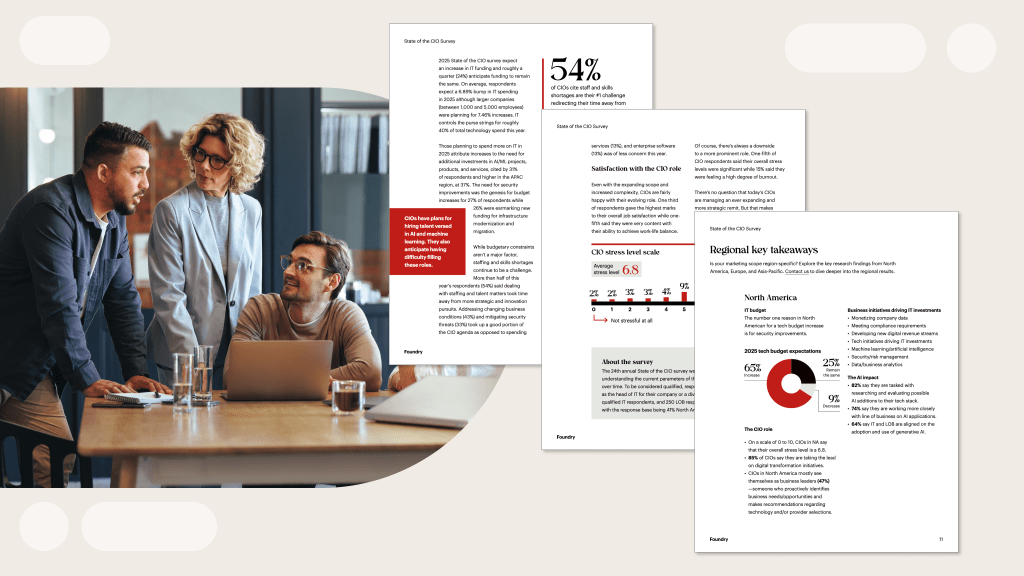
The CIO has never mattered more. As businesses shift from experimentation to execution in the age of AI, CIOs are stepping into their most strategic role yet. CIO’s annual State of the CIO Survey, now in its 24th year of publishing, highlights how IT leaders shaping enterprise strategy, enabling growth, and leading cultural change.  This year’s report, based on insights from over 900 heads of IT and 250 line-of-business (LOB) professionals, reveals a significant pivot toward AI-driven innovation, customer experience, and data monetization.  What You’ll Learn: Top technology investments and business initiatives for 2025  How CIOs are balancing innovation with operational demands Where AI is having the biggest impact on operations and customer engagement  How CIOs are overcoming talent gaps and resourcing challenges  Trends in reporting structures, influence, and stress levels  Key findings  CIOs are leading the AI charge: 80% of CIOs are responsible for researching and evaluating AI products, positioning them as central figures in their organizations’ AI strategies.   Driving business growth through technology: CIOs are increasingly being held accountable for business outcomes such as data monetization and improved customer experience.   The CEO agenda is shaping the CIO mandate: CIOs are now expected to lead initiatives around AI, customer experience, and digital transformation.   Evolving roles of the CIO: Across regions and sectors, CIOs are expanding their scope, with many managing more than one title.   Strategic leadership beyond operations: While operational excellence remains important, 52% of CIOs anticipate maintaining a strategic leadership focus over the next 3–5 years.   View the report in PDF format, or click download to save a copy.   FAQ 1. What is the biggest technology priority for CIOs in 2025? AI and machine learning are the top technology priorities, with 42% of CIOs indicating major investment and strategic focus in this area. 2. Are CIOs still seen as technical leads or business strategists? A growing number (52%) view their role as strategic, shifting from traditional IT to leading innovation and digital transformation. 3. How are CIOs addressing AI adoption? 80% of IT leaders are tasked with evaluating AI technologies, and 71% report that AI initiatives are tightly aligned with business goals. 4. What are the main challenges CIOs face? Staffing and talent shortages, especially in AI, cybersecurity, and data science, remain a significant hurdle, as cited by 54% of respondents. 5. What areas are CIOs spending more time on in 2025? Besides AI/ML, CIOs are focusing on cybersecurity, product innovation, and business strategy alignment. 6. What industries are leading AI investment? High-tech, healthcare, and financial services industries are the front-runners in prioritizing AI both internally and customer-facing. 7. How is IT budget allocation changing? Most companies (65%) plan to increase IT funding, particularly for AI/ML projects, infrastructure modernization, and security enhancements. source

State of the CIO Survey 2025 Read More »

ServiceNow reimagines platform for agentic AI

AI Agent Fabric: the communication backbone ServiceNow describes the AI Agent Fabric as the communication backbone for enterprise AI ecosystems, and says what sets it apart from traditional AI solutions is it enables native collaboration between agentic systems leveraging common protocols like Model Context Protocol (MCP) and Agent2Agent protocol (A2A), thereby empowering agents, tools, and systems to exchange information, coordinate tasks, and take action in real-time. “It’s really the backbone of the entire AI ecosystem, standardizing agent to agent, orchestrator to orchestrator, and agent to tool communication, making sure both ServiceNow and third-party agents can dynamically exchange information,” said Dorit Zilbershot, group VP of AI experiences and innovation at ServiceNow during the press conference. “We look at it as distributed intelligence across the enterprise.” The AI Agent Fabric also allows ServiceNow’s thousands of AI agents to work side by side with third-party agents as part of a coordinated system. Customers can create their own domain-specific agents with ServiceNow AI Agent Studio, use ServiceNow Agents, and bring in AI Agent Fabric integrations from the likes of Adobe, Cisco, Google Cloud, IBM, Microsoft, UKG, Zoom, among others, via the ServiceNow Marketplace. source

ServiceNow reimagines platform for agentic AI Read More »

Enabling AI with real-time data integration

Deep within nearly every enterprise lies a massive trove of organizational data. An accumulation of transactions, customer information, operational data, and all sorts of other information, it holds a tremendous amount of value. That data, when paired with artificial intelligence (AI) models, can give businesses new insights into the way they make decisions and where to find opportunities for growth. But that data is also spread out across platforms ranging from mainframes to cloud to distributed environments. While not uncommon in modern enterprises, this reality requires IT leaders to ask themselves just how accessible all that data is. Particularly, are they achieving real-time data integration? Impactful AI hinges on the answer to this question. For AI to deliver accurate insights and enable data-driven decision-making, it must be fed high-quality, up-to-date information. This is where real-time data integration becomes critical. Combating this challenge starts with synchronization. By ensuring data is synchronized across platforms and systems as it changes, organizations can create a consistent, accurate foundation that AI can trust. Understanding the challenge of data integration So, what makes data integration so difficult? It’s an enterprise’s own data, so it should be readily accessible, right? The truth is not that simple. In many organizations, data exists in a number of locations including mainframe, cloud, and distributed environments. Often, data experts don’t have an understanding of what data lives in which system, and how it’s all related. The age-old problem of siloed data means the understanding of data is also siloed. If organizations are going to get the full value from their data, they first need to put it all into a common context. Automated metadata scanning and stitching can provide that context as a first step in any integration effort. This context is essential to discovering data that might be useful to AI initiatives, and also to making sure it is aligned properly with other data to create a comprehensive business understanding. As AI continues to permeate every aspect of IT operations, the key to successful implementation is still rooted in solving foundational data challenges. Achieving real-time data integration requires an emphasis on modernizing data infrastructure. And that modernization is built on the right solutions and tools to support IT teams. Unlocking AI with real-time data When AI models and tools have access to real-time data, the impact on business performance is substantial. Operational decisions become more precise, customer interactions more relevant, and forecasting models more accurate. Organizations can reduce costs by avoiding overproduction or resource misallocation, and they can increase agility by responding faster to market changes. To enable AI in a meaningful way, organizations need real-time, bi-directional data synchronization. This means data updates in one system are instantly reflected in all connected environments—be it analytics dashboards, AI models, or customer-facing applications. So, where should enterprise leaders look to accomplish this? One place to start is with tools that provide no-code, bi-directional data movement that works seamlessly between mainframe, distributed, and cloud platforms, meaning changes made in one system are instantly reflected across the organization. That’s what solutions like Rocket DataEdge, brings to IT teams. This robust suite brings capabilities that span data replication, synchronization, data intelligence, and visualization, to name just a few. All of these solutions work to ensure AI models consistently operate with full visibility into an organization’s data landscape. Intelligent integration tools can also discover and map enterprise data automatically, creating a contextual understanding of information across the hybrid cloud. This enhances the relevance of the data being used by AI, making it easier to pinpoint what matters most to decision-makers and models alike. The path to impactful AI runs through real-time data integration The quality of any AI model is directly linked to the data that fuels it. Incomplete datasets and siloed information leave those models with only a partial picture of what’s actually happening within an organization. That means the output is likely to be just as faulty. Real-time data integration ensures business leaders are making decisions based on the most up-to-date information, AI models are generating more impactful insights, and IT teams have greater visibility and support for managing complex IT environments.   As businesses continue to invest in AI, the foundation they build on matters more than ever. Enabling real-time data integration ensures organizations are better equipped to support the proliferation of AI.  Learn more about how Rocket Software is fueling AI with real-time data integration. source

Enabling AI with real-time data integration Read More »

ServiceNow puts Salesforce in the crosshairs with expanded CRM tools

“CRM needs to transition from an internally focused, sales-driven, customer data management system designed for monologue communication, process efficiency, and cost reductions, to an externally focused, conversation-driven, customer engagement solution designed to engage customers in dialogues across channel,” Schaeffer said. ServiceNow has been looking to expand into CRM for several years, with a potential for huge growth in the space, said Andrew Miljanovski, a vice president advisor in the sourcing, procurement, and vendor management team at Gartner. From system of record to ‘system of action’ The company is now positioning itself as an AI-driven “platform of platforms,” where several enterprise systems, including ITSM, IT operations management, contract lifecycle management, HR solutions, and now CRM, all work together, when necessary, Miljanovski added. ServiceNow sees its platform as a “control tower for AI” that’s running IT-related services across the enterprise. source

ServiceNow puts Salesforce in the crosshairs with expanded CRM tools Read More »

ServiceNow unveils AI workflow automation partner ecosystem, autonomous IT capabilities

At its Knowledge 2025 customer and partner event today, ServiceNow unveiled Workflow Data Network, a robust ecosystem of corporate partners supporting workflow automation with AI. “It enables a cohesive view of enterprise data, whether connected to other enterprises, any apps, any data, any data aggregators, so the data is always available for AI actions,” said the company’s VP and GM of workflow data fabric Amit Saxena at a press conference last week. “Workflow Data Network is going to empower our organizations to be able to connect AI to not only ServiceNow data, but to a dynamic ecosystem of partners that make that data accessible and actionable across the entire ServiceNow AI Platform.” Saxena said Workflow Data Network, which is available now, offers more than 100 integrations across data sources, whether structured, unstructured, real-time, historical, internal, or third-party. Also, there are no copy connectors to platforms including Amazon Redshift, Databricks, Google Cloud BigQuery, Microsoft SQL Server, Snowflake, Cloudera, and Teradata. source

ServiceNow unveils AI workflow automation partner ecosystem, autonomous IT capabilities Read More »

How OneSpan secures digital signatures with AI & passkeys

Overview In this episode of DEMO, host Keith Shaw sits down with Will LaSala, Field CTO at OneSpan, to explore the cutting edge of secure digital agreements. From identity verification to multi-factor authentication using FIDO-based passkeys, Will demonstrates how OneSpan is transforming electronic signatures for banking, healthcare, and beyond. 🔒 See how OneSpan enhances trust with features like: * Smart Forms and drag-and-drop onboarding * AI-powered ID verification * Unphishable authentication using biometrics and passkeys * A full audit trail with geolocation, OFAC checks, and more 🚀 Whether you’re still using paper signatures or want to upgrade your e-signature workflow, this demo shows what’s possible with next-gen security. 📍 Try OneSpan’s free sandbox: https://www.onespan.com 👉 Don’t forget to like, comment, and subscribe for more weekly tech demos! #DigitalSignatures #Cybersecurity #Passkeys #IdentityVerification #FIDO #OneSpan #DEMO #KeithShaw #ESignature #Authentication #TechDemo #SecureOnboarding Register Now source

How OneSpan secures digital signatures with AI & passkeys Read More »

Kiwis embrace AI at work, but trust and governance pose challenges

However, the report also showed some use of AI at work was creating complex risks for organisations. For example, 51% of workers reported that they do not check on the accuracy of AI output before using it for work. Employers could also be increasing that risk through inaction; only 25% of respondents reported that their work had a policy for generative AI use. The report, “Trust, attitudes and use of Artificial Intelligence: A global study 2025”, was led by the University of Melbourne in collaboration with KPMG and surveyed more than 48,000 people across 47 countries. source

Kiwis embrace AI at work, but trust and governance pose challenges Read More »

Johnson Controls rethinks IT for the cloud-native and AI era

“We’re focused right now on building our internal capabilities,” he says. “We’ve been a heavy externalized organization, and we made a decision that we needed more in-house talent to give us a solid understanding of our business processes, our data, and the analytics as we begin to drive forward. We’re looking at our overall set of investments across all technology stacks and making sure we’re getting a good ROI on that.” Bringing transformation home Johnson Controls now has roughly 4,500 IT pros internal and external, many based in India, working on the next transformation. The goal is to streamline, simplify, and align the company’s cloud-based workloads, data, and analytics to be far more efficient and “optimized like a technology organization,” Sankaran says, adding that cybersecurity is another key focus. The CDIO established a centralized AI team that will build applications using Microsoft OpenAI Azure as its core platform, adding related tools for efficiency. The software engineering teams are now using tools such as Github Copilot for greater efficiencies and are working with Microsoft to teach all employees about using Copilot for document summarization, though it’s still early in the process.   source

Johnson Controls rethinks IT for the cloud-native and AI era Read More »