Forrester

Croissance Ou Crise Budgétaire ? Soyez Prêt​s​​ ​À Affronter Les Deux En 2026

La volatilité d’aujourd’hui se transformera demain en stagnation. Du moins en ce qui concerne les prévisions budgétaires pour l’année à venir. Droits de douane, guerres commerciales, cybermenaces, clientèle divisée et incertitudes économiques rendent les ​respo​nsables​​ et ​devideurs​​ ​de la​ tech nettement moins optimistes qu’ils ne l’étaient à la même période l’an dernier. C’est ce que révèle notre récente enquête mondiale, menée auprès de plus de 2 600 décideurs. Cependant, si ces derniers mois nous ont appris quelque chose, c’est bien que la situation peut (et va) évoluer, du jour au lendemain. Même s’il faut rester prudents, ces informations doivent être prises en compte.  Forrester vient de dévoiler son Guide Budget Planning 2026. Il ​​apporte des conseils pratiques, basés sur les données, pour faire face au tumulte de cette année lors de la planification budgétaire. Notre guide comporte des analyses et des recommandations pour aider les ​resp​onsables​ tech, ​​marketing, de l’expérience client, du digital et des ventes à identifier où investir, où réduire leurs dépenses et où expérimenter pour stimuler la croissance. (Les clients de Forrester peuvent accéder à nos Budget Planning Guides dédiés à la technologie, au marketing, à l’expérience client, au digital et aux ventes ici. Quant aux non-clients, ils peuvent consulter une sélection de guides ici.) Chaque guide inclut des recommandations spécifiques à chaque rôle, mais l’objectif principal cette année est d’aider les ​d​écideurs​​​ à rester agiles et adaptables.  Voici les actions clés à mener en priorité en 2026 :  Renforcez vos efforts en matière de formation à la data et à la préparation des collaborateurs à l’IA. Actuellement, moins de 20 % des entreprises utilisent réellement les outils analytiques en pratique. Cela doit changer, car former les collaborateurs à l’IA est essentiel pour assurer le succès à long terme. Les organisations doivent s’assurer que leurs équipes comprennent comment exploiter les données et les outils d’IA de manière efficace et éthique.  Concentrez-vous sur les données clients et sur la gestion des données. Les dirigeants, qui, en période de crise, arrivent à mieux comprendre leurs clients, auront un avantage sur les autres. Pour avoir une vision plus complète et actualisée de votre clientèle, investissez dans des technologies de gestion des données clients. Complétez vos outils de gestion du feedback client avec les enseignements issus des plateformes d’intelligence consommateur et des données comportementales digitales de première main. Mettez en place une stratégie rigoureuse de collecte des données, définissant quelles données sont nécessaires, à qui elles appartiennent et avec quels systèmes elles doivent s’intégrer.  Mettez à jour votre stratégie cloud-first. Les nouvelles réglementations en matière de souveraineté et de résilience, les cas d’usage d’IA générative (genAI), de plus en plus nombreux, et bien d’autres facteurs, ont fait évoluer le discours sur le cloud : on est passé du “cloud-first” au “cloud-as-necessary”. Envisagez le rapatriement ou le maintien sur site pour les charges de travail aux profils d’utilisation stables, ainsi que pour la genAI localisée, afin de réduire les coûts liés aux données soumises à des réglementations souveraines ou sectorielles, ou encore pour les scénarios fortement consommateurs de calcul (comme la genAI) pour limiter la latence.  Utilisez l’IA agentique pour l’automatisation des tâches au sein d’une seule application, puis élargissez progressivement à l’ensemble des applications métier. Explorez tout le potentiel disruptif de l’IA agentique en expérimentant avec des agents IA autonomes capables d’exécuter des tâches et, à terme, de prendre des décisions de manière indépendante. Commencez par des agents IA qui automatisent uniquement des tâches dans une seule plateforme, puis ajoutez petit à petit d’autres plateformes et fonctionnalités. Portez une attention particulière aux protocoles de communication utilisés pour l’orchestration multiplateformes des agents, car ces standards sont encore en cours d’évolution.    Le guide de Forrester Budget Planning explore toutes ces recommandations plus en profondeur. Il comporte aussi de nombreuses analyses complémentaires, spécifiques à chaque fonction ou service, pour éclairer vos démarches de planification et de budgétisation. Vous pouvez aussi rejoindre nos analystes lors des webinaires Budget Planning Guide que nous organiserons dans les prochaines semaines. L’année à venir sera marquée par davantage de volatilité : nos guides peuvent vous aider à planifier 2026 en toute confiance.  source

Croissance Ou Crise Budgétaire ? Soyez Prêt​s​​ ​À Affronter Les Deux En 2026 Read More »
Comment Maîtriser Le “Chaos” Technologique ? Le Technology & Innovation Summit Arrive À Londres

Blues post-pandémie, conflits géopolitiques, volatilité du marché international… Vous pensiez avoir tout vu ?  Voici venir la révolution technologique portée par l’IA, annonciatrice de transformations encore plus décisives. En tant que dirigeant de la tech, vous devez faire votre choix : allez-vous rester réactif et attendre que la tempête passe ? Ou bien allez-vous saisir l’opportunité de définir une stratégie et une feuille de route qui exploitent le potentiel de l’IA, tout en maîtrisant les risques et en générant des résultats concrets pour l’entreprise ?  Certes, je sens déjà poindre une certaine lassitude vis-à-vis de l’IA au sein des ​responsables ​tech européens. Cependant, il est encore temps d’intégrer l’IA dans votre entreprise de façon responsable et éthique, de dépasser le simple cas d’usage et de libérer la puissance du calcul IA ainsi que des systèmes d’agents afin de favoriser l’automatisation intelligente, d’accélérer la prise de décision et de réinventer les expériences digitales. Dans le même temps, vous devez repenser votre stratégie cloud autour de la composabilité, de la cybersécurité et de la souveraineté. Utilisez les plateformes de génération d’applications pour transformer rapidement les besoins métiers en réalité, réduire l’escalade des coûts fournisseurs et vous affranchir d’une dette technologique paralysante. ​  Unis face aux défis  Savoir que vous n’êtes pas le seul à vous sentir dépassé face aux défis actuels est toujours rassurant. Alors, pour traverser ensemble cette nouvelle ère et élaborer les stratégies essentielles à adopter, je vous invite à rejoindre nos experts Forrester ainsi que vos pairs lors du Technology & Innovation Summit EMEA. Il se tiendra à Londres du 8 au 10 octobre. Lors de ce salon, nous donnerons aux responsables technologiques et de la sécurité toutes les clés pour maîtriser ce nouveau “chaos” technologique. Compétences, bonnes pratiques,  outils et plateformes nécessaires… Vous apprendrez comment générer de la croissance dans un environnement instable.  Durant le T&I Summit, plus de 40 sessions spécialisées, ateliers et discussions approfondies, vous permettront d’acquérir des connaissances pratiques, avec des stratégies concrètes à mettre en œuvre au sein de votre entreprise. Que vous soyez en train de bâtir votre stratégie IA, de moderniser votre stack technologique ou de sécuriser votre organisation dans un contexte difficile, découvrez comment accélérer l’innovation et créer de la valeur dans votre entreprise.  Découvrez ci-dessous les trois grands thèmes que nous aborderons lors de cette édition du Summit.  Reprenez le contrôle  Avec tous les changements en cours et à venir, de nombreux dirigeants du secteur de la tech ont le sentiment de perdre le contrôle. Lors du T&I Summit, nous vous présenterons les cadres stratégiques dont vous avez besoin pour reprendre la main et créer de la valeur pour votre entreprise. Les participants apprendront ainsi à :  Élaborer des stratégies IT solides et des feuilles de route opérationnelles tirant parti des technologies émergentes, en mettant l’accent sur l’impact transformateur de l’IA sur l’architecture d’entreprise et les capacités IT essentielles.  ​​Maîtriser une approche pragmatique de la création de valeur et de la gestion financière, adaptée à un monde en constante évolution. Déconstruire et anticiper les risques actuels et émergents ; s’attaquer aux enjeux de souveraineté numérique, d’IA et autres complexités réglementaires et agir avec détermination pour sécuriser votre entreprise.  Levez les barrières organisationnelles  Au sein d’une entreprise, les opérations ‘’en silos’’ sont depuis longtemps un frein important à la mise en œuvre réussie de la technologie. Les ​responsables​​​ tech et leurs partenaires métiers doivent unir leurs forces et instaurer une culture d’alignement permanent avec l’évolution des besoins changeants de l’entreprise. Au T&I Summit, vous découvrirez comment les stratégies technologiques les plus récentes permettent de reconfigurer des systèmes centraux cloisonnés en plateformes évolutives et comment exploiter les technologies émergentes pour se différencier et générer de la croissance. Nous partagerons avec vous les meilleures pratiques pour réduire la dette technique, ainsi que les schémas directeurs permettant de transformer les infrastructures traditionnelles en actifs modulaires capables d’expansion.  Comment déployer l’IA à grande échelle  Avec l’IA, les entreprises seront transformées en profondeur. Mais comment dépasser le premier cas d’usage isolé ? Cela reste souvent un défi. Pour ce faire, les entreprises doivent s’appuyer sur une vision ambitieuse de la refonte des processus, associée à des infrastructures avancées de données et d’automatisation.  Rendez-vous à Londres, où nous vous aiderons à bâtir une stratégie solide en matière de data et d’IA, à mettre en place une bonne gouvernance et à choisir les technologies adaptées pour exploiter pleinement les données de votre entreprise et piloter l’orchestration des processus.  La clé du succès de l’IA ? Elle réside dans la capacité à impulser une véritable transformation en passant à l’échelle : déployer l’IA et les technologies émergentes au-delà du cas d’usage unique, et instaurer une culture d’innovation continue au service de la croissance de l’entreprise.  Nous espérons vous voir à Londres  Au moment où je rédige ces mots, l’équipe Forrester est en pleine préparation du Summit, avec les répétitions de nos sessions du Technology & Innovation Summit EMEA. Cet événement s’annonce une fois de plus exceptionnel. J’espère sincèrement que vous pourrez nous rejoindre et me réjouis de vous y retrouver.      source

Comment Maîtriser Le “Chaos” Technologique ? Le Technology & Innovation Summit Arrive À Londres Read More »

Europe-5 Markets Chart Their Own Path To Commerce Growth

Announcing “The Future Of Commerce (Europe-5)” Vision Report: Strategies From The US And Asia Pave The Road To Intelligent Commerce By front-loading exports and remaining largely insulated from US tariffs in H1 2025, Europe-5 (France, Germany, Italy, Spain, and the UK) businesses are planning for 10% US tariffs on many UK goods and 15% US tariffs on many EU goods for the next several years. Profitability pressure and the increasing costs of running digital businesses with stricter data and AI policies are forcing European leaders to look at new e-commerce strategies to grow. For example, 42% of German and 39% of Italian online adults report that they have exercised their right to restrict the use of certain types of cookies. Through data and executive interviews across businesses, technology vendors, and service providers in Europe, our new vision report, The Future Of Commerce (Europe-5), uncovers the following key takeaways: Compared to the US, European consumers’ purchase decisions are based on distinct factors. Europe-5 online adults particularly value product quality and sustainability when making a purchase. They also rely more on peer validation and community feedback — social proof — compared to US consumers, who rely more on media, influencers, and celebrity endorsements. Commerce strategies common in both the US and APAC are helping Europe-5 businesses grow. Business leaders in Europe-5 markets use distributed (social commerce or marketplaces) and dynamic (contextualized digital experiences using data) strategies, like in the US, to drive growth across channels and experiences. Simultaneously, live (video stream-enabled shopping for new product drops) and quick (fulfillment and delivery within a few minutes) commerce strategies, like in APAC markets, introduce loyalty and fulfillment as levers to drive growth, as well. Businesses are beginning to automate next-gen commerce. If Amazon’s recent “Buy for Me” shopping agent is any indication, business agents are starting to support return flows in chat experiences for customers. Of course, commerce intelligence is a lot more than completing individual tasks: Rather, it is the synthesis of information from multiple sources to make the best decisions for consumers and businesses. There’s much talk today about “agentic commerce” — and there will be more AI innovations tomorrow. As these innovations evolve, commerce leaders must develop an intelligent commerce strategy that can evolve and adapt over time. This strategy will be your bedrock for competitive advantage as digital commerce scales across yet more touchpoints in the coming years. What Do Commerce Strategies Look Like For Your Business? Let’s talk! If you are assessing new commerce strategies for your business in Europe, please get in touch with us — Forrester’s commerce team — for an inquiry or guidance session to explore the right strategy and tactics for your business. source

Europe-5 Markets Chart Their Own Path To Commerce Growth Read More »

Lessons From APAC’s Forrester Women’s Leadership Program: Choose Your Advisers, And Nuggets Of Advice, Wisely

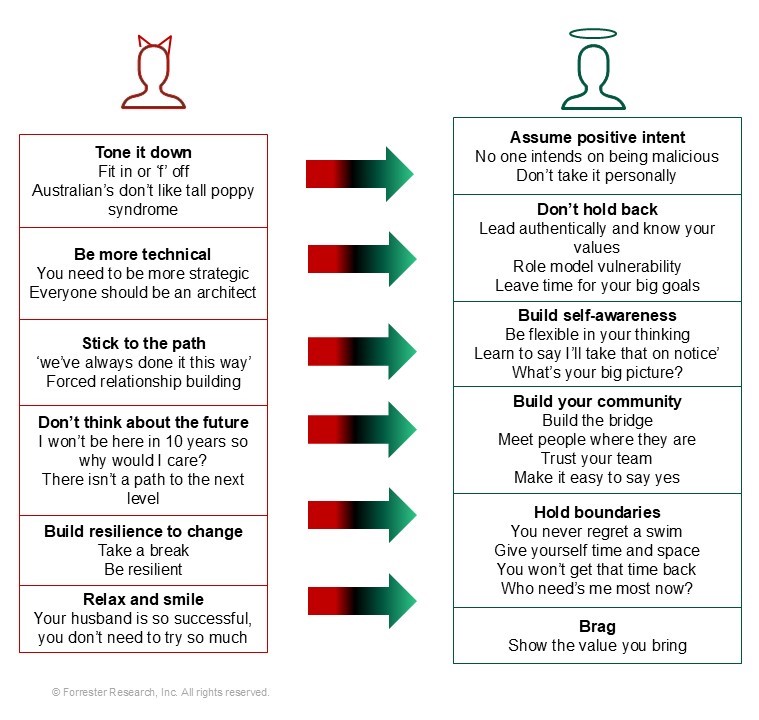
Despite the continuous gender disparity in technology and cybersecurity — just 9% of the top 100 listed companies in APAC have female CISOs, and only 36% of Australian public service STEM roles belong to women — women continue to innovate, contribute, and lead amazing careers. As has now become tradition at our Technology & Innovation Summit APAC, a room full of accomplished women and a few brave men gathered as part of our Forrester Women’s Leadership Program to celebrate successes and posit solutions for the many challenges that women face in this field. The theme? “Choose your advisors — and nuggets of advice — wisely”; a theme inspired by the hugely successful event led by our amazing colleague Amy DeMartine at our 2024 Security & Risk Summit. We asked the attendees to share some of the best and worst advice they received over their careers (see the image below). What resulted was an inspiring, interactive, and thought-provoking session. We discussed how: Determining whom to trust, and when, is an underdiscussed art, with significant impact. I moderated a discussion with senior technology and security leaders Cassandra Highfield and Sulata Bhattarcharjee, who provided unique and powerful insights into their careers. We discussed the people who influenced their careers, with unusual suspects emerging: from parents who tried to discourage constant career changes to life partners who advised them to “go in there with the confidence of a middle-aged white man.” We touched on the loneliness of senior leadership, but our leaders reminded us that it doesn’t always have to be this way if you have the courage to be vulnerable and trust the team that you’ve worked hard to build and grow. Sulata provided a piece of wisdom shared with her at a pivotal moment in her career that will stay with many of us after the session: “Just because something is hard doesn’t mean it’s toxic.” Adapting to, and leading, constant change in the workplace is a nebulous task, requiring strategy, tactics, and time. Throughout your career, you’ll encounter transitions, whether it’s a new leader, emerging technologies (AI, anyone?), or changes in organizational culture. Sometimes you initiate these shifts, and other times they’re driven by the business. These moments can be challenging; being told to “fit in,” “rise to the occasion,” or “be resilient” often oversimplifies reality and can undermine your confidence. The panel recommended distinguishing what’s within your control from broader systemic or cultural issues. We can also prepare early for major transformations, lean on our support networks, and work with a coach to build the emotional strength needed. A powerful insight shared: “Ask yourself: ‘What would it take to make this work?’ If the honest answer is ‘nothing,’ that’s a clear red flag.” By modeling your own commitment and mindset to working in ways that allow you to thrive, you give others permission to do the same. Working excessive hours doesn’t equate to being irreplaceable. Today’s women leaders were raised on yesterday’s belief that they needed to work more, a problem exacerbated by today’s hustling “do more for less” culture. A reflective and heartfelt discussion revealed that this led many to sacrifice meaningful moments with family. One resonant insight came from a participant who shared a guiding question she asks herself during overwhelming moments to help navigate competing personal and work-life demands with compassion: “Who needs me most now?” The group expressed a collective sense of difficulty in switching off from work, questioning the true value of striving to be “the best” professionally at the expense of personal well-being. The biggest mindset shift: Move from proving worth through overwork to embracing presence, balance, and intentionality. Managing stakeholders to build influence and gain advocacy is a must-have, not a nice-to-have. It starts with reading the audience and truly understanding the stakeholders you’re trying to engage with. What drives them? What do they value? And most importantly, why should they care about what you’re bringing to the table? The session highlighted the importance of demonstrating value in a way that resonates while remembering that a “no” isn’t the end; it’s often just part of the dance. Timing, persistence, and adaptability are your partners in this process, and learning the rhythm of your stakeholders can be the difference between resistance and advocacy. A standout takeaway? Forget vague advice like “be more strategic”: Relationships thrive on authenticity, not manipulation or force. To create lasting impact and influence, embrace this truth: “Focus on fostering trust, not imposing control.” I want to leave you with this: Don’t underestimate the power of taking time to share and learn from others. If this year’s edition of the program at T&I Summit APAC reminded us of anything, it’s that the power of community, vulnerability, and sharing can lift us all. This blog, and the Forrester Women’s Leadership Program, proudly benefited from a collaboration across the Forrester ecosystem. Women from our consulting, sales, research, and research operation organizations, traversing seniority, age, cultural backgrounds, cities, and countries, collaborated in delivering this experience to our clients. I thank my co-lead, VP of APAC Consulting Alisha Coates, as well as Senior Research Associate Chiara Bragato, Senior Account Director Candice Deppeler, and Principal Analyst Zhi-Ying Barry for their time, energy, partnership, and friendship for this session and all the work we do together. source

Lessons From APAC’s Forrester Women’s Leadership Program: Choose Your Advisers, And Nuggets Of Advice, Wisely Read More »

My highlights for Forrester's upcoming B2B Summit EMEA

Scrolling through my LinkedIn feed lately, it’s clear that B2B marketers are feeling the fatigue — especially when it comes to buzzwords like “volatility,” “ever-evolving,” and “pace of change.” And I get it: It’s exhausting to be a B2B marketer these days. The pressure to grow never lets up, even as everything around us keeps shifting. (Oh, and let’s not forget that you’re expected to do it all with less budget. Don’t you just love your job?!) That’s why, at this year’s B2B Summit EMEA (October 6–8 at the O2 InterContinental in London), my keynote will dive into adaptive growth strategy. We’ll explore how to lead through change, hit aggressive targets, and guide execution teams with clarity — even when resources are tight. I’ll cover the directions you need to provide, the controls to put in place, and the actions that actually move the needle. I’ll also be busting some myths about planning and whether it’s good to have flexibility in planning — because the truth is that when plans change all the time, people cease to rely on them, so I’ll talk about what you can do instead. And yes, I’m going to mention AI (but I promise not to overdo it). One of the things I’m most excited about this year is our revamped AI Hackathon. We’ve seen companies evolve rapidly — one of last year’s winners already went from being an AI novice to building their own agent! So we’re leveling up. This year, delegates will bring their own AI tools and work with a synthetic dataset that we’ll provide. The challenge? Delivering the best analysis and recommendations to the board. For the winning team: glory, bragging rights, and possibly chocolate! Hope to see you at B2B Summit EMEA, October 6–8 at the O2 InterContinental in London. source

My highlights for Forrester's upcoming B2B Summit EMEA Read More »

2026 Budget Planning: Keys To Success For B2B Marketing, Sales, And Revenue Operations Leaders

For most B2B organizations, budgeting season is either just beginning or already in full swing. If you’re leading marketing operations, sales operations, or revenue operations functions, there are few guarantees about what 2026 has in store. With turbulent global markets, shifting trade alignments, and AI transforming businesses and buying, much of what we know is at risk of being upended. But one thing is certain: 2026 will test the resilience of B2B operations leaders. In this post, I’ll draw from Forrester’s Budget Planning Guide 2026: Revenue Operations report (client-only access) to highlight what our team believes will help operations leaders adapt faster, invest smarter, and unlock new ways to drive value for your customers. What Will Matter For Operations Leaders In 2026 Experienced marketing and sales leaders are heading into 2026 undeterred by the uncertainties of the larger business environment. Forrester’s Budget Planning Survey, 2025, showed that most are approaching 2026 with cautious optimism as the majority expects modest budget growth. Whether that optimism will endure amid systemic disruptions — impacting bookings volume or order fulfillment — remains to be seen. In the meantime, we expect go-to-market (GTM) leaders to proceed carefully and avoid investments that can’t be easily unwound as conditions fluctuate. Operations will need to play a critical role, ensuring that GTM functions are able to rapidly adjust as conditions shift. What should operations leaders do? Three imperatives stand out: Boost agility to confront uncertain conditions. One thing we know is that revenue operations leaders don’t believe their processes are flexible or efficient enough to allow them to respond to changing market conditions. Forrester’s Revenue Operations Survey, 2024, found that 49% of revenue operations leaders believe their processes aren’t flexible enough for fast response when conditions change, and 46% believe their processes are mostly manual and lack automation. If the business climate fluctuates, flexibility will become B2B’s most coveted asset in 2026 — the organizations most able to adapt will be best positioned to succeed. Become the linchpin for GTM teams to win with AI. Advances in AI technologies promise productivity gains, game-changing breakthroughs, and a complete reimagining of what’s possible across all corners of GTM efforts. Yet organizations count on revenue operations functions to align longer-term vision with smooth execution by taking charge at the intersection of GTM process, technology, and people to drive value for customers and internal stakeholders. Isolating generative AI (genAI) efforts as a prime example, GTM leaders anticipate lack of understanding, difficulty of integration, data infrastructure, and employee readiness to be among their greatest challenges in making genAI work for them. Revenue operations must steer the vision by purposefully applying AI across GTM processes to reap the promised rewards. Overcome insufficient data and process friction holding back GTM functions. To take advantage of AI’s promise of increased productivity and lower costs, organizations require data of quality, texture, and substance suitable to the task. Forrester’s Revenue Operations Survey, 2024, found that B2B organizations aren’t there yet, with 38% of revenue operations leaders believing that data lacking in accuracy and quality is among data users’ top challenges. Revenue operations must build a secure foundation of GTM data and processes to ensure readiness to support AI-enabled innovations. What Does This Mean For 2026 Budgeting? There’s no better expression of an organization’s priorities than where it applies its resources. To align resources with 2026 imperatives, operations leaders should: Invest in adaptability. AI is expected to unlock a host of new potential, but to take advantage of this moment, operations leaders need to stay focused on applying it to make their organizations more flexible, nimble, and adaptable. Consider investments such as using AI to enhance your analytics with better indicators of the buyer’s true experience, adding efficiency by automating account research, and placing resources against upskilling operations folks to lead the GTM organization in applying AI. Avoid lugging inefficiencies of the past into a more demanding future. Many outdated B2B practices persist due to the entrenched mindset of “that’s the way it’s always been done.” But creating more adaptable, efficient, and customer-obsessed GTM processes require B2B organizations to make room for the new by rooting out legacy investments that keep them locked in the past. Operations leaders can look for savings by moving away from antiquated sales role-plays, tactic-level marketing attribution, and fruitless pursuit of a single source of truth cutting across data sources. Experiment with ways to create even greater agility. Revenue operations teams that dedicate their time to continuously resolving crises incessantly encounter new ones waiting for them. Now’s the time for forward-looking revenue operations leaders to experiment with new approaches that could drive adaptability. Develop experiments around adaptive planning, pilot new techniques for effort prioritization, and work on data ontologies that can power AI efforts. Forrester clients can read our detailed recommendations in the report, Budget Planning Guide 2026: Revenue Operations, or register to join me and my colleagues for a webinar where we’ll discuss our budget recommendations in detail and answer your questions. source

2026 Budget Planning: Keys To Success For B2B Marketing, Sales, And Revenue Operations Leaders Read More »

What I Now Know About Task Intelligence—and Why Leaders Need to Pay Attention

As you would expect, I am fielding a lot of questions from clients about how to deploy, embed, and integrate AI into their workforce. Some of the questions imply a hasty workforce replacement strategy, while others are more nuanced about how to prepare their workforce to use AI in their evolving work. But all of these leaders are flying blind, because AI doesn’t replace jobs; it replaces tasks. And no leader we talk to has an easy way to look at the tasks being done. Enter task intelligence, an emerging use case for AI. Task intelligence draws on task-level data, then offers insights about those tasks, such as automation potential, duplication across teams, transferability, cost to outsource, etc. It sits at the elevation that makes sense to leaders — more tangible than job titles but more visible than granular skills data. This level of task intelligence will be key to unlocking meaningful workforce optimization. It’s a lens for understanding how work happens now— and how it can happen better. Gratefully, tools now exist that can extract and analyze task-level data at scale, from public and proprietary job descriptions. This isn’t just a technical breakthrough — it’s a strategic one. Task intelligence helps leaders answer questions they’ve long struggled with: Where are we duplicating effort across teams? Which tasks are ripe for automation? How do we redeploy talent after a merger or restructuring? What invisible work is keeping our organization running? It also shifts the conversation from abstract workforce planning to actionable decisions. Instead of debating whether a role should exist, we can ask whether the tasks it performs are still relevant, efficient, or necessary. Are there ways that task intelligence needs to improve? Of course. Employees do work outside of their job description all the time, so we need an approach like classic job analysis or ethnographic observation of work to fill out the full picture of valuable work and make sure that we don’t cut so much that our organization can’t function or handle pivots and change. Vendors are working on scalable approaches to that as we speak, using, you guessed it, AI. Task intelligence will become a foundational capability for any leader serious about workforce strategy. I’m excited to have a front-row seat as organizations tackle this underlying challenge, central to the future of work. Stay tuned for more from me on this topic, and feel free to share what you’re learning as you explore and test different approaches. source

What I Now Know About Task Intelligence—and Why Leaders Need to Pay Attention Read More »

Robotics in Data Centers: A Strategic Lever for Scalable & Resilient Infrastructure

As we progress through the Fourth Industrial Revolution — an era defined by seamlessly integration of people, machines, and systems — there’s an increasing demand for scalable, intelligent, and resilient compute environments.  At the core of these technology-driven transformations are data centers — the foundational infrastructure that allows all these advancements to happen at scale. As the need for faster, more efficient data processing and adaptive thermal management grows, data centers are evolving to meet these complex and critical demands. Automating The Routine, Empowering The Strategic To meet these growing demands, data centers are turning to the expanding — but not completely new — field of robotics and automation. Robots are being deployed to assist with a wide range of routine tasks, including security and environmental monitoring, server installation and maintenance, cable organization, hard drive replacement, and even to support liquid cooling systems by automating the insertion and removal of servers from immersion tanks. By offloading these repetitive and physically intensive tasks, data center teams can redirect their focus toward higher-value initiatives like infrastructure planning, performance optimization, and sustainability strategy. This shift not only enhances productivity but also improves workplace safety by reducing human exposure to high-decibel noise, extreme temperatures, and cooling fluids — conditions that increasingly make data centers inhospitable for prolonged human activity. To fully capitalize on these benefits, organizations should consider investing in continuous workforce development by strengthening employees’ technical skills, enhancing behavioral competencies (e.g. collaboration, leadership, conflict resolution skills), and fostering a culture of innovation. A Gradual Shift, Not A Lights-Off Leap As with any emerging technology, the adoption of robotics in data centers comes with its own set of challenges, especially when the gold standard is five-nines availability (99.999% uptime). This level of reliability leaves little room for error, making it critical that any robotic systems integrated into operations are thoroughly tested, highly reliable, and seamlessly interoperable with existing infrastructure. Robotics integration won’t happen overnight, nor is a fully autonomous, lights-off data center the immediate goal. But incremental integration of robotics can deliver measurable gains in operational efficiency, cost reduction, and workforce productivity. More importantly, it establishes a foundation for future automation, enabling data centers to scale intelligently and meet rising energy demands and sustainability goals without compromising performance or resilience. Learn More Do you have some thoughts or would like you in-depth insights into the role of robotics in data centers? Forrester clients can access our exclusive reports and set up guidance sessions to continue to explore current trends and solutions. source

Robotics in Data Centers: A Strategic Lever for Scalable & Resilient Infrastructure Read More »

Feedback And CX Measurement Programs Must Boost Their Impact

Generative AI for CX measurement and VoC is gaining traction. But most CX teams still don’t get stakeholders to act on insights and don’t earn stakeholder confidence. This is the sobering insight from Forrester’s 2025 global survey. The Problem? Outdated Practices And Missed Opportunities Our research identified the following six gaps – not many are about generative AI for CX… For all insights, read our summary report (Forrester access required). 1. Feedback Collection Is Stuck In The Past Surveys dominate, but few teams effectively tap into emails and calls. Worse, only half feel confident in their ability to analyze what they collect. If you have Forrester Decisions access, read more here: VoC And CX Measurement Teams Need More Robust Feedback And Data Practices. 2. Metrics Don’t Drive Action Teams most commonly measure CX at the touchpoint level, followed by relationship level measurement. Only half of teams can successfully link CX metrics to business outcomes, less than a third can set realistic targets, and even fewer report the ability to find signals in data. If you have Forrester Decisions access, read more here: CX Measurement Must Be A Stronger Force In Guiding CX Work And Fostering A CX Culture. 3. Journey Measurement Is In Its Survey-Dependent Infancy Journey-level measurement is still a gap and those who do measure journeys rely mostly on surveys at the end of journeys instead of building journey performance metrics. Very few track customers’ emotions — key drivers of loyalty. And because journey accountability is a gap, journey measurement falls flat. If you have Forrester Decisions access, read more here: Journey Measurement Is Survey-Dependent And Needs More Shared Accountability. 4. Insight Identification And Communication Falls Short Root cause analysis is rare. Even fewer can identify behaviors that improve CX or rally internal champions to act on feedback. Less than 1/3 (27%) effectively communicate insights in a timely way. If you have Forrester Decisions access, read more here: VoC And CX Measurement Teams Need More Effective Practices For Communicating Feedback And Driving Action. 5. Closing The Loop Stops Halfway Programs respond to negative feedback, but ignore neutral or positive voices. One-on-one follow-ups are common, but broader communication about organizational actions in response to feedback is rare. If you have Forrester Decisions access, read more here: Close-The-Loop Practices Show Promise — But Could Be More Effective. 6. Tech Is Evolving — But Practices Lag BI and CFM tools dominate, but genAI for CX is emerging as a powerful ally. Over half of programs already see value in genAI for summarizing feedback. If you have Forrester Decisions access, read more here: Feedback Management Tech Adoption Reflects Survey Dominance And GenAI Uptake. The Path Forward To boost impact, VoC and CX teams can’t keep running the same playbook. Yes — they need to double down on the basics: diversifying feedback sources and link metrics to business outcomes. But, more importantly, these teams need to transform into strategic partners for key stakeholders: improve relevance and cadence of reporting, apply more analytical rigor to analysis, and experiment with AI to find efficiencies and increase effectiveness. Thank you to all the practitioners who took our survey this year! We can’t produce this research without you! If you participated and left your contact information, you should have received a thank you email with the forrester reports and the read out deck. If you haven’t received that, let us know please. Want a deeper dive?   About the methodology Forrester’s 2025 State Of Feedback Management (VoC) And CX Measurement Practices Survey was fielded online in March and April 2025. The goal of the survey was to gather global insights about feedback management, VoC and/or CX measurement programs. Key survey topics included program maturity and challenges, measurement practices and culture, feedback sources and analysis practices, journey metrics and accountability, closing the loop, sharing data, driving action, and technology. Three hundred and eleven global respondents participated the survey. Exact sample sizes are provided in this report on a question-by-question basis. This survey used a self-selected group of respondents knowledgeable about feedback management, VoC, and CX measurement and is therefore not random. The data is not guaranteed to be representative of the population, and, unless otherwise noted, statistical data is intended to be used for descriptive and not inferential purposes. Although nonrandom, the survey is still a valuable tool for understanding where users are today and where the industry is headed. source

Feedback And CX Measurement Programs Must Boost Their Impact Read More »

The Key to Securing Machine Identities Starts with The Human Element

It is no secret that the volume of machine identities — aka nonhuman identities (NHIs) — is increasing exponentially and rapidly outpacing the number of human identities. According to the Cloud Security Alliance, the ratio of machine to human identities in 2024 was 20 to 1, with some estimates now placing that ratio as high as 92 to 1. Shorter digital certificate lifespans, ephemeral cloud workloads, and the rise of agentic AI further compound the snowballing complexity of managing and securing machine identities and their associated credentials, at a time when these machine identities are being more frequently targeted by attackers and more heavily depended upon to keep businesses running. As NHIs grow at breakneck speed, new NHI vendors flood the market, and emerging requirements for contextual access expand, it becomes easy to forget that modern machine identity security strategy success depends on human elements. Obviously, architectural frameworks and technical tools are instrumental and indispensable to addressing the challenges that machine identities bring, but these technical elements need to be aligned with these three human elements: Strong executive sponsorship. Establishing an executive-level sponsor that can ensure proper visibility, funding, and support is essential. Identity and access management (IAM) and security leaders must develop a compelling business case for machine identity security that speaks in business and financial terms. This case should be one the executive sponsor can confidently endorse and effectively communicate. It must emphasize reduced security and compliance risks, improved business agility and resiliency, and how machine identity security supports strategic priorities such as digital transformation, agentic AI adoption, and Zero Trust. A well-defined machine identity governance model. For most organizations, machine identity security involves managing a prolonged and complicated transformation full of competing priorities and trade-offs. It necessitates the formation of a machine identity governance committee, ideally unified with an existing IAM governance structure, that can lead through influence, set strategic objectives, define policy, drive ownership and accountability, and monitor progress. Continuous cross-functional collaboration. Because machine identity security is complicated by a diversity of environments, use cases, and identity types, it becomes even more important for the IAM team to collaborate across the organization, including IT/OT infrastructure, cloud, security, DevOps, developer, and line-of-business teams. Continuous collaboration helps maintain alignment as priorities shift and requirements evolve. These cross-functional relationships also aid with discovery and inventory activities, facilitate machine identity lifecycle processes and integrations, and provide an ongoing internal network of machine identity security champions. As you evaluate your organization’s current machine identity security posture and formulate your strategy, consider how these three human aspects can align with your existing IAM program and determine where reinforcement is needed to promote, develop, and sustain effective machine identity security. Want to learn more? I’ll be discussing machine identity security at Forrester’s upcoming Security & Risk Summit in Austin, Texas, on November 5–7. My track session, “The Secret(s) Life Of Machine Identities,” will explore machine identity lifecycle in more detail and provide recommendations for approaching the machine identity security journey. I hope to see you there! And as always, if you’re a Forrester client and want to know more, please reach out and set up an inquiry or guidance session. source

The Key to Securing Machine Identities Starts with The Human Element Read More »