Forrester

Navigate With Confidence The Migration Options For SAP ECC Customers

With the impending end-of-support deadline for SAP ECC in 2027, many existing SAP customers find themselves urgently needing to move to SAP S/4HANA cloud. Whether it’s private edition or public edition, many questions loom large that must be addressed to navigate your best path forward. When it comes to transitioning from ECC, the right choice is often complicated by your organization’s complexity, budget, and risk appetite. Here are some potential options for SAP ECC customers: Migrate to SAP S/4HANA Cloud. This is SAP’s recommended path and is considered the future of its ERP system. The migration can be done via a brownfield approach (technical conversion of your existing system), a greenfield approach (a fresh implementation), or a bluefield approach (a selective data transition). You can still choose to run S/4HANA on-premises – although SAP is increasingly growing reluctant to continue offering this option. The preferred SAP options for hosting are in a private cloud (through RISE with SAP), or in the public cloud. Opt for extended maintenance. SAP offers extended maintenance for SAP Business Suite 7 (including ECC) until the end of 2030. This option comes with an additional cost on top of the standard maintenance fee. It provides a temporary solution for companies that need more time to plan and execute a migration. Switch to third-party support. Some companies, such as Rimini Street, offer third-party support for SAP ECC beyond 2030. This can be a significant cost-saving alternative to SAP’s extended maintenance and allows you to continue using your existing system for many years without migrating. Additionally, it buys organizations time to plan their ERP and innovation roadmap on their own timeline and potentially consider other alternatives for ERP transformation. In June 2025, Rimini Street announced it has extended full support coverage for all SAP ECC 6.0 and S/4HANA releases through 2040. Transition to SAP ERP, private edition. This is a new transition option under RISE with SAP for very large and complex customers. It allows you to stay on a version of ECC on SAP HANA in a private cloud environment until 2033, providing a longer runway for your S/4HANA migration. The details of this plan were recently released by SAP in early August 2025. We encourage you to watch SAP news releases frequently on this option as it will likely evolve over time. Navigating Changes To RISE With SAP Post-June 2025 Effective July 2025, SAP has introduced significant changes to the RISE with SAP offering to streamline its packages. The three-tiered structure (Base, Premium, and Premium Plus) has been replaced by a new model. If you are negotiating new contracts, dig deeper with SAP on understanding the packages and entitlements. Unpacking RISE With SAP SLAs RISE with SAP provides service-level agreements (SLAs) that are often a key point of discussion for customers. It’s crucial to evaluate if these SLAs align with your business needs and risk tolerance. With RISE, it’s not just about the underlying infrastructure; it’s about application resiliency. Standard availability: The standard SLA for RISE with SAP is 99.7% availability for production systems and 99.5% for nonproduction systems. Uptime guarantees: These SLAs cover the application layer, meaning SAP guarantees the availability of your S/4HANA application itself, not just the underlying infrastructure. This is a significant distinction from a pure infrastructure-as-a-service provider, as it consolidates accountability with SAP. Negotiating higher tiers: A 99.9% SLA may be available for an additional cost, which is important for companies with mission-critical systems that require near-perfect uptime. It’s essential to discuss and negotiate these higher-tier SLAs with your SAP sales team. Disaster recovery: Standard subscriptions do not include a disaster recovery service. This must be purchased as an additional SKU to ensure business continuity. When assessing the SLAs, consider your organization’s required uptime for critical business processes and whether the standard offering is sufficient or if a higher tier is necessary to meet your operational requirements. Take The Next Step All of these are crucial decisions that technology leaders face, and more often than not, these decisions have a lasting impact on not only your organization’s business operations and strategic initiatives but also long-term technology and architecture roadmap. To hear what others think, Forrester clients have the opportunity to join me and Linda Ivy-Rosser, Forrester VP and research director, for a peer discussion on this very topic. Leave the conversation with new ideas for how to tackle challenges on your journey to SAP Cloud ERP. Conversely, if you are a Forrester customer who recently completed the migration, your industry peers would appreciate hearing your insights. Date: September 3rd, 2025Time: 9:00 AM – 10:00 AM PDT Registration link: Navigating SAP ECC To S/4HANA Migrations — Let’s Compare Notes (Forrester Peer Discussions are available exclusively to Forrester Decisions VIP Leaders and Leader license holders for their participation.) source

Navigate With Confidence The Migration Options For SAP ECC Customers Read More »

“Velocity IS The ****ing Strategy”: What Citizen Development Means For AI-Enhanced Businesses

AI continues to be hard. Our research (and that of others) shows clearly that deploying even a single, substantive generative AI application or agent is exceptional. There are two antipatterns that complicate adoption: first, when engineers go off and build solutions without significant business collaboration; second, when parties do collaborate and teams contribute their own special dysfunction to the inevitable bottlenecks and meeting hell. To be fair, everyone’s trying their best. AI apps are a legitimate frontier, and being a pioneer is hard. In this light, we share new data: In Forrester’s Developer Survey, 2025, 89% of development executives indicated that their firm is either currently implementing or actively planning a citizen developer strategy. Low-code platforms, having long proved their value, got us here. Now, trends in AI-assisted software development such as prompt-based vibe coding and emerging application generation platforms make the long-term case for citizen development even more compelling. But making software development easier is only part of the AI-plus-citizen development story. The movement now has another raison d’être: Citizen development is arguably the most practical strategy for discovering and scaling AI’s business value in the real world. Democratizing Development Is A Pragmatic Path To Unlocking AI’s Business Value Large language models (LLMs) and their “applied” forms, such as AI agents, hold significant, unexploited value to digitize and automate many of the “squishy” judgment calls and garden-variety creative tasks that humans do imperfectly — and that traditional software cannot. For most firms, however, unlocking this value in a reasonable time frame requires that three conditions be met: AI experimentation is scaled to many (hundreds or thousands) of use cases in a given company in the context of its specific processes and opportunities. Many or most will fail, but some will yield significant returns. These experiments take the form of applications — for example, narrow “agents” to perform one or more actions as part of an orchestrated process — and not just isolated personal productivity tricks such as content generation. These experiments are led by business domain experts who can imagine what a solution might look like, have the domain knowledge both to direct LLMs (e.g., through prompts or lightweight context engineering) and judge the output in the context of their applications, and can monitor and adjust these applications to ensure their continued effectiveness beyond the janky POC stage. In this light, serious and scaled citizen development — where businesspeople are systematically empowered (with pragmatic governance) to deliver applications themselves — provides both precedent and an obvious strategic framework for AI-enhanced apps. Real-World Examples — And Data Our research shows that empowered citizen developers are indeed successful when experimenting with delivering AI apps and agents. Some examples: A strategist at a global law firm delivered a database and workflow application that used AI to perform complex legal reasoning required in private-equity contract reviews. A marketing manager at a Fortune 10 firm delivered an app for managing the process of marketing content production. An LLM now generates copy as part of this process instead of third-party agencies. A mechanic at a national railroad wrote a mobile railcar inspection app, incorporating AI to analyze railcar photos for maintenance and safety needs and then kick off and manage remedial work orders. Now, the railroad’s data scientists are refining and scaling the mechanic’s work by having AI analyze video feeds from its railyards and kick off remedial actions proactively. It is only the smallest extrapolation from examples like these to envision hundreds or thousands of ideas for AI applications put into action by systematically empowered domain experts — i.e., citizen developers. Our data supports this vision: In Forrester’s Developer Survey, 2025, when development executives were asked what types of low-code apps their citizen developers are (or will be) allowed to deliver, AI-infused applications topped the list. Remarks From A Real-World Practitioner Let’s close with the (lightly censored) remarks of an unusually perceptive citizen developer we interviewed: “What we need, and what the business world needs, is an easy way to deploy capabilities against specific problems. That’s one of the key ways we’re using low-code … This never would have happened if I had to direct an engineer. It would have been like trying to direct a movie through the big end of the telescope … Citizen development is a compression of the development process. I view it as allowing the expert to get ever closer to the result. That compression makes way better products because the expert is able to create the feature themselves without explaining it to five different people … Why does that matter? Because velocity is the ****ing strategy.” source

“Velocity IS The ****ing Strategy”: What Citizen Development Means For AI-Enhanced Businesses Read More »

Beyond The Hype: Why Big Tech Economic Impact Studies Fall Short

Big tech economic impact headlines are engineered for attention. Apple recently announced a staggering US$600 billion investment in US manufacturing over four years — complete with fanfare around domestic chip and glass production. But dig deeper, and you’ll find most of the activity was already planned, funded, or happening. It’s more repositioning than reinvention, as Business Insider and others have pointed out. Closer to home, we see the same playbook from hyperscalers across APAC when it comes to major infrastructure plays. AWS, Google, and Microsoft frequently announce local region investments tied to promises of billions in GDP uplift, job creation, and workforce development. These are strategic moves, yes. They’re also branding exercises. The recent announcements as part of AWS’s new data center region launch in New Zealand are another example: NZ$7.5 billion in investment, NZ$10.8 billion in GDP impact, 50,000 people trained, 1,000 jobs created. As I noted in a recent article by iStart, “these headline GDP claims often become rallying cries for market share rather than anything designed to prove the delivery of real or measurable outcomes.” Don’t misquote me — it’s not just Apple or AWS; name a vendor, and I’ll find you an example. Microsoft’s US$2 billion-plus pledge in Malaysia, Google’s US$1 billion investment in Japan, and Oracle’s planned US$14 billion cloud push in Saudi Arabia all follow the same pattern: headline-grabbing numbers, vague timelines, and economic impact projections that rarely face scrutiny after the press release has been archived. Economic Impact Studies: All Promise, No Proof At the core of these big claims are economic impact study (EIS) tools built on input-output models originally developed in the 1930s. They work by applying multipliers to direct spending (for example, construction or wages) to estimate wider economic benefits. But these models often assume: No supply constraints. No price changes. Perfect conversion of spend into local value. That’s not how economies actually work. Academic reviews by institutions such as Cornell University show that EIS often overestimates benefits by 30–60%, especially when they include indirect effects like supplier activity or worker spending without separating what’s truly new from what would have happened anyway. Or sadly, this can even occur through plain old poor estimation. Worse, these studies are rarely revisited. There’s no formal tracking of whether the jobs, GDP, or upskilling ever materialize. The model looks forward but never backward. Computable General Equilibrium: Better Economics But Not Built For Speed There is a more sophisticated alternative: computable general equilibrium (CGE) models. These simulate how changes ripple across the economy over time, adjusting for prices, capacity limits, and behavior. Public sector analysts use CGE for evaluating major policy changes or environmental impacts. CGE isn’t without its own issues, however: It’s slow, expensive, and opaque. Its complexity makes it inaccessible to most tech and business leaders. It can be shaped by hard-to-audit assumptions. In one comparative study of disaster impacts in Italy, CGE, input-output, and hybrid models delivered up to a sevenfold difference in estimated economic loss. The message? The model you choose shapes the story you tell. Why Forrester’s TEI Is The Better Middle Ground At Forrester, we take a different approach with the Total Economic Impact™ (TEI) methodology. Our methodology: Starts with real customer data. Interviews, cost baselines, and quantified use cases form the foundation. Adjusts for risk. Every benefit is discounted based on likelihood and implementation risk. Focuses on what matters to your decision-makers. ROI, net present value, and payback matter — not hypothetical GDP boosts. Is tailored to your context. TEI doesn’t assume national impact; it shows value based on your workloads, staffing, and strategic goals. Put simply, the Forrester TEI models what’s real, not what’s hoped. And yes, you can and should measure the actual results. For our clients, we will be at your side and by your side when the actuals roll in. Don’t Be Seduced By The GDP Halo There’s nothing wrong with companies investing in digital infrastructure or governments welcoming it. Still, let’s not confuse those investments with a universal good. A new cloud region may unlock value — but not for every organization and not at any cost. My advice? Organizations evaluating these investments shouldn’t rely solely on sweeping economic claims or fall for the idea that jumping into an onshore cloud automatically contributes to some imagined national benefit. Instead, assess the value based on your own cost structures, workloads, and strategic priorities. By all means, make it a total economic impact! Just make sure it serves you and your outcomes. Macroeconomic splash statements? More often than not, they serve the branding and demand generation needs of the firms that sponsor them. And the headlines that follow? They’re just the sugar coating. source

Beyond The Hype: Why Big Tech Economic Impact Studies Fall Short Read More »

Learnings From Knowledge Summit Dublin 2025

After being in the shadows for years, knowledge management (KM) has suddenly taken on a much more prominent role as a key strategic function. This shift is mainly thanks to the rapid and widespread adoption of artificial intelligence across many organizations. There is a fantastic opportunity for KM professionals to make a real difference, but at the same time, organizations still grapple with some long-standing challenges that technology alone can’t solve. We had some insightful and inspiring conversations during Knowledge Summit Dublin 2025. From those lively sessions, three main ideas stood out, and they’ll influence how we approach knowledge management in the years ahead. Shifting Views On AI And Knowledge Management The summit shared some exciting insights about how organizations are changing their views on knowledge management and AI. Many speakers highlighted that successful AI projects depend on having a strong foundation of knowledge, something that’s often overlooked when people think that AI can just be plugged into existing systems. They also discussed how AI is seen differently, as a handy tool or as a key part of a strategic transformation. Organizations that treat AI as part of a bigger plan tend to do much better than those that see it as just a tool. For example, one speaker pointed out that “54% of all AI projects fail at the pilot stage,” mainly because they fail to establish the proper knowledge and information structure from the start. The summit also brought up a fascinating paradox. While generative AI aims to make organizational knowledge more accessible to everyone, it also shines a light on weaknesses in current knowledge databases. A tech leader mentioned that AI systems are “only as good as the content” they analyze, so taking care of knowledge curation and validation has never been more critical. Attendees shared some inspiring success stories where organizations invested time in organizing content, improving metadata, and streamlining workflows before deploying AI tools; these steps made a big difference. On the other hand, failures often stemmed from rushing into AI deployment without addressing core knowledge management principles. Lastly, the discussions touched on a significant concern: cognitive offloading. When we rely too much on AI, it can weaken human skills, affecting not just how we find information but also how we make decisions. This raises important questions about how to keep human judgment sharp in workplaces that are increasingly supported by AI. The People And Culture Foundation Even with the exciting focus on new technologies in organizations today, everyone at the summit kept coming back to the importance of culture in making knowledge management successful. Companies tend to appreciate employees for what they know, but authentic knowledge sharing asks us to value what everyone is willing to share. This can create some natural resistance, as hiring, promoting, and rewarding staff based on their individual expertise sometimes conflicts with the idea of shared knowledge. When employees are asked to contribute their expertise to shared systems, they might see it as a threat to their professional worth. The summit underscored that overcoming these cultural hurdles calls for a big-picture approach that goes well beyond just installing new tech. To truly transform how knowledge is managed, organizations need to develop new ways of measuring performance, rewarding people for sharing, not hiding, knowledge. Hiring practices should focus more on teamwork skills, and incentive programs should celebrate group achievements rather than just individual success. Trust emerged as the secret ingredient for cultural change. Without believing in the organization’s good intentions and leadership’s dedication, efforts to promote knowledge sharing are likely to fall flat. The summit repeatedly pointed out that “AI will never build trust,” reminding us that genuine knowledge transfer still depends on human connections and face-to-face interactions, a point that is especially important as workplaces become more digital. For successful cultural change, organizations should identify and support passionate advocates, those natural champions who exemplify cooperation and a willingness to share. These individuals can serve as inspiring proof points and champions for broader change, helping to overcome resistance and showing the real value of investing in knowledge management. Tacit Knowledge Is The Hidden Asset The summit’s most exciting theme was all about storytelling as a way to share and understand tacit knowledge. These discussions showed a deep understanding of how we transfer knowledge. Instead of just sharing information, good knowledge management should inspire new questions and ideas. This approach recognizes that learning often sparks innovative thinking and creative solutions that go beyond the initial information. Social media platforms such as TikTok are perfect examples of powerful knowledge transfer in action. The quick, genuine, and interactive nature of social sharing is very different from traditional company methods that rely on formal documents and structured databases. The summit also explored new ways to capture this hidden knowledge, including AI-powered mentor systems that use Socratic questioning to help people recognize and express knowledge they have but struggle to articulate. These innovations move beyond traditional knowledge management, focusing on discovering and developing knowledge rather than just storing it. The storytelling theme also looked at the important issue of transferring knowledge between generations, especially as seasoned workers with decades of experience approach retirement. Organizations need to find ways to capture this valuable knowledge quickly while also creating fresh strategies that resonate with younger employees who think and learn differently. The Next Phase Knowledge Summit Dublin 2025 showcased an exciting moment for the profession. With AI rising and competition intensifying, the importance of knowledge management has never been more vital. Yet success truly comes from organizations being willing to embrace deeper cultural and human aspects that influence whether knowledge flows smoothly or gets held up. Let’s Connect Have questions? That’s fantastic. Let’s connect and continue the conversation! Please reach out to me through social media or request a guidance session. Follow my blogs and research at Forrester.com. source

Learnings From Knowledge Summit Dublin 2025 Read More »

Fueling Revenue Process Transformation Through B2B Events

Alignment is more critical than it’s ever been in today’s hyper-competitive landscape. B2B organizations must transform their revenue processes by aligning marketing, sales, and customer success teams to meet buyers’ needs. Events should play a critical role here. To maximize event impact, organizations need to rethink their planning in four key areas. 1. Break Down Silos One of the biggest barriers to leveraging events effectively is siloed planning. According to Forrester’s Q1 2025 State Of B2B Events Survey, 17% of organizations reported that different teams — including event, field, demand, and sales — were running events independently. This fragmented approach leads to inconsistent execution and suboptimal attendee experiences. Success requires collaboration across departments to create an integrated event strategy that places the audience at the center. 2. Harness B2B Event Data Another common misstep is undervaluing event data. Functional silos leave valuable insights stuck in spreadsheets or disconnected platforms, limiting their potential. Leading organizations, on the other hand, aggregate event data and analyze it to better understand buyer behavior and preferences. This data-driven approach ensures that events deliver relevant content and experiences at every stage of the customer journey. 3. Treat B2B Event Technology Strategically Event technology is too often treated as a tactical execution tool rather than a strategic component of the technology stack. Forrester’s survey revealed that just one in four enterprises integrate their primary event platform into their wider technology stack. To unlock the full potential of events, organizations should centralize event technology selection and management and build deep, bidirectional integrations into CRM systems and customer data platforms. 4. Tailor Events To The Customer Lifecycle The most successful organizations align event formats with where buyers are in their journey — from pre-sale awareness to post-sale engagement. For example, webinars and virtual events are cost-effective ways to educate large numbers of buyers and capture early-stage data for pre-sale stages. Field events, on the other hand, excel at helping buyers in the pipeline stage evaluate solutions and close deals. For post-sale relationships, customer conferences and user groups deepen engagement, provide opportunities for cross-sell and upsell, and help sales teams extend their reach within client organizations. Learn More B2B events are powerful vehicles for driving revenue process transformation, but their success hinges on internal alignment, thoughtful data capture, and strategic use of technology. By breaking down silos, leveraging event data, and tailoring event formats to buyer needs, organizations can create meaningful experiences that fuel growth and build lasting customer relationships. Forrester clients can read the new report, Build An Integrated, Aligned, And Data-Centric Event Plan To Power Revenue Process Transformation, to learn more about the four focus areas. I’ll also be running a session on this topic at Forrester’s B2B Summit EMEA on October 6–8 in London and look forward to talking with attendees about how to adapt event plans to support revenue process transformation. source

Fueling Revenue Process Transformation Through B2B Events Read More »

The Partner Sales Divide: Why 51% Of Vendors Succeed And Others Don’t

Basic Sales Training Is Failing Your Partner Account Managers When partner sales numbers fall short of expectations, the blame game begins: Fingers point at partners, products, or market conditions. Yet a common, overlooked cause is your own partner account managers (PAMs). If your PAMs are operating with only basic sales training, you’re leaving revenue on the table. The data doesn’t lie: A staggering 62% of sales leaders admit that they do not provide their PAMs with anything beyond basic sales training. Among companies struggling to reach even 71% of their partner sales targets over the past two years, only 29% invested in PAM-specific training. In contrast, 51% of high performers — companies that consistently hit their partner sales goals during the same period — provided their PAMs with specialized training. This gap isn’t a coincidence; it is cause and effect. PAMs Aren’t Glorified Sales Reps Let’s be real. Partner account managers and direct sales representatives might both sell, but that’s where their similarities end: Direct reps close deals; PAMs enable partners to close deals. Direct reps sprint to the close; PAMs build strategic, long-term relationships. Direct reps control the sales process; PAMs influence and support partner sales cycles. Direct reps must master product specs; PAMs must master business strategy. Direct reps rely on personal selling skills; PAMs rely on collaboration and coaching. What Great PAM Training Looks Like (What The 51% Invest In) Given the differences in the roles, PAMs need a training program that goes far beyond basic sales skills. High-performing companies report that effective PAM training should include: Partner economics fluency. PAMs must speak the language of partner profitability. Training covers partner P&Ls, margin structures, and practice-building economics. PAMS must learn to position your solution as a profit center, not just another vendor SKU. Influence-based sales management. Unlike direct sales managers, PAMs lead through persuasion, not control. Training focuses on stakeholder mapping, coaching, and the art of driving behavior in organizations that don’t report to you. Strategic partner assessment. Top PAMS recognize that not all partners deserve equal attention. They use data-driven frameworks to evaluate partner performance and potential, assess real commitment levels, and allocate resources appropriately. Training covers capability scoring and the math of ROI. Joint growth planning that delivers. Training teaches PAMs how to lead the creation of actionable plans that partners actually implement. The focus is on measurable commitments, clear accountability, and regular quarterly business reviews that drive course correction and uncover new opportunities. Effective PAMs use these sessions to maintain momentum, not just report numbers. Co-marketing that drives the needle. The focus of the training is not on making PAMs marketing experts; it is on teaching them how to identify and leverage partners’ existing marketing capabilities. The training focuses on identifying the partners who can execute meaningful campaigns, aligning on a few high-ROI activities annually, and measuring real business impact rather than vanity metrics such as total leads or email open rates. The Brutal Cost Of Undertrained PAMs For the 62% of you who are not training your PAMs properly, your hesitation has a price tag. Basic sales training produces PAMs who manage partner relationships. Comprehensive PAM enablement creates revenue architects who can build lasting growth. As partnerships become the backbone of global B2B commerce, the question isn’t whether you can afford to invest in this level of training; it’s whether you can afford to skip it. The partners — and the profits — will follow those who deliver true strategic value. source

The Partner Sales Divide: Why 51% Of Vendors Succeed And Others Don’t Read More »

Are We Ready To Talk AGI Yet? Yes. Maybe. No. All Of The Above.

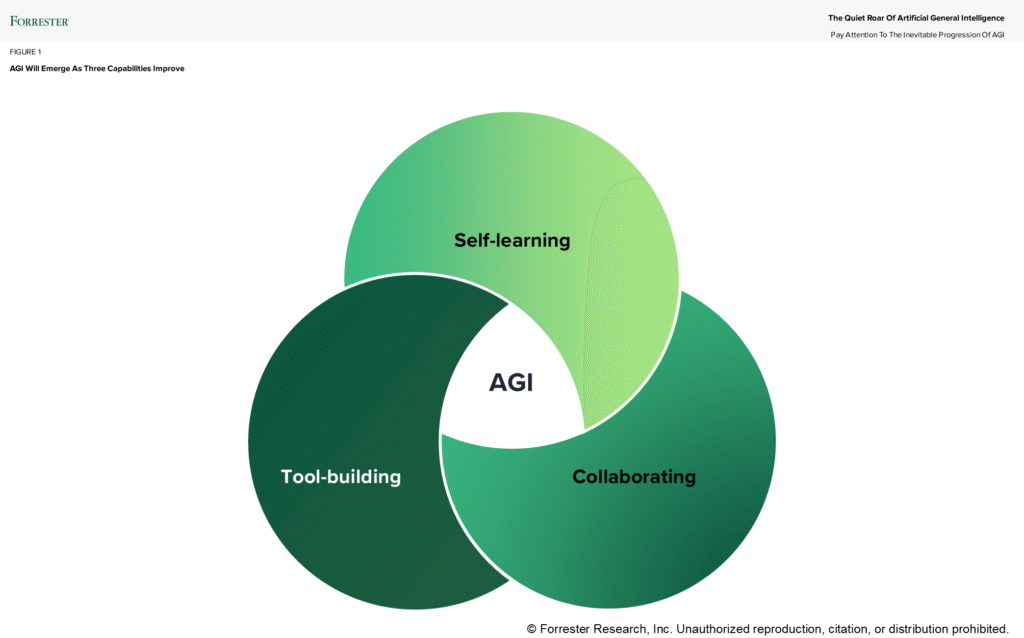
All of the above, because the conversation about artificial general intelligence (AGI) as a serious research topic is happening at the very moment the AI market is wobbling over a perceived bubble, with a lack of returns on generative AI projects and GPT-5 having a lackluster showing. Despite these headwinds, now is not the time to be dismissive but rather to look at the long view of what’s to come: AI is the seventh big wave of technological change, and AGI is the ultimate progression of that engine of disruption. Our latest report, The Quiet Roar Of Artificial General Intelligence, makes it clear that AGI is inevitable. It will not arrive in one explosive leap but as a progression of capabilities that can be tracked, measured, and prepared for. The question is not if but when and how — and that is why you should care. But you need to know exactly what it is first and cut through the noise to plan for what’s next. A Clearer Way To Talk About AGI Until now, the language around AGI has been muddled. Hollywood and pundits have blurred it with superintelligence, while software vendors are busy “agent-washing” their products with inflated claims that sound like AGI is already here. The media, meanwhile, is now hyping an inevitable AI winter. None of this helps enterprise leaders make decisions for the long term. We define AGI through a pragmatic and functional lens: software that can autonomously act in pursuit of goals across domains by learning new skills, collaborating with humans and machines, and building software tools. This capabilities-focused definition avoids fuzzy comparisons to human intelligence or economic abstractions. Instead, it gives leaders observable criteria with which to track AI progression, especially its relevance in an enterprise context. AGI As A Trend, Not An End We believe that AGI is a trend, not a destination. Over the last couple years, the AGI debate has been stuck on speculative questions of when machines might surpass humans. That framing is unhelpful. What matters is the observable path of progress already underway, which we map across four stages: Competent AGI: effective within one domain under supervision, executing multiday tasks, critiquing its own work, and refining outcomes Independent AGI: operating across related domains with minimal oversight, negotiating priorities, and building departmental-scale systems Strategic AGI: managing long-running initiatives across multiple domains, leading cross-functional efforts (e.g., supply chain optimization, R&D), developing new knowledge, and even founding businesses Superintelligent AGI: if AGI ever surpasses humans in most intellectual endeavors, we cannot predict its impact and recommend that clients avoid focusing here — it is pure speculation Normalizing The AGI Conversation The goal of this research is not just definition but normalization. By providing a clear definition, a staged progression with some key inflection points, and business implications, we are giving leaders the tools to start planning today. This is just the beginning of Forrester’s work on AGI. We invite technology vendors, research labs, adopters, and business leaders to join us in this effort. The risks are real, but so are the rewards. Want to hear more about AGI? I’ll be presenting a keynote called “Agentic To AGI — It’s The Journey, Not The Destination” at Forrester’s upcoming Technology & Innovation Summit North America, November 2–5 in Austin. Check out the full agenda and make plans to meet us there — and start preparing now for the quiet roar of AGI. source

Are We Ready To Talk AGI Yet? Yes. Maybe. No. All Of The Above. Read More »

Commercial Software Spend Will Reach $1.7 Trillion By 2029 And See Double-Digit Growth

As the global economy braces for slower trade growth and geopolitical tensions, the software industry is defying economic headwinds with robust expansion. According to Forrester’s Global Commercial Software Forecast, 2025 To 2029, software infrastructure growth is set to achieve a strong compound annual growth rate (CAGR) of 13.3% while application software growth will see a more subdued 9.5% CAGR. Key drivers, trends, and opportunities within the commercial software market include: Security software is seeing the fastest growth. Forrester’s research highlights investments in cloud security, identity and access management, and security operations. The market capitalization of Palo Alto Networks and Fortinet across 2023 and 2024 greatly exceeded their average revenues. As cyberthreats grow more complex, security spending remains a cornerstone of infrastructure investment. There’s strong database demand driven by AI, data storage, and governance. Spending for off-the-shelf AI software will be four times greater in 2030 than in 2024 largely due to increasing demands around data governance. MongoDB’s revenues from its Atlas database more than doubled during the past two years, and there is strong growth for Snowflake due to its consumption-based pricing model. Databricks’ Lakehouse architecture and AI governance capabilities are transforming how businesses handle structured and unstructured data. Tech operations management is seeing the fastest growth in application software. ServiceNow, Atlassian, and Datadog are redefining tech operations management with AI-powered tools. ServiceNow’s AI Agent Orchestrator harmonizes teams of AI agents, while Atlassian Intelligence helps users navigate organizational data more efficiently. In 2024, Datadog more than doubled the number of customers who spent more than $1 million in annual recurring revenues. There are new AI-driven opportunities. OpenAI expects its revenues to triple in 2025 and to see an astounding 33% CAGR through 2029 to reach $125 billion in revenues, and Microsoft’s AI business reached a $13 billion annual run rate in 2024. This past January, ServiceNow launched an AI-enabled CRM offering that includes CRM agents, data, and workflows. HubSpot differentiated its CRM through the 2024 launch of Breeze Copilot and Breeze customer and content agents along with AI features that provide campaign summaries, call sentiment analysis, engagement scoring, and analysis of buyer intent. Zendesk plans to automate 50% of customer engagements by 2027 through the use of autonomous agents. Despite strong commercial software spending growth, the economic slowdown requires enterprises to tighten software spend controls through regular audits of software use, more consolidation of software functionality to reduce redundancy, more use of open source, and more negotiations with software vendors to reduce price hikes — notably to take advantage of the decline in value of the US dollar. Forrester’s forecast shows commercial software spend will reach $1.7 trillion by 2029 and maintain double-digit growth. Have any thoughts? Contact me, Michael O’Grady. Forrester clients can schedule a Forrester guidance session for more insights and to explore the narratives within this forecast. source

Commercial Software Spend Will Reach $1.7 Trillion By 2029 And See Double-Digit Growth Read More »

Ongoing Government Uncertainty Around Cybersecurity Initiatives Is Putting Your Business At Risk

Let’s Cut Funding For What’s Working … And Then Demand More Programs??? In April 2025, Erik Nost and team discussed how planned cuts to CISA would have crippled MITRE’s CVE cataloging, and recent news shows that even the instability caused by the actions of DOGE have negatively impacted the US CyberSentry program. For a short explanation, CISA’s CyberSentry deploys monitoring modes to voluntarily participating critical infrastructure partners, which provides threat intelligence on both IT and operational technology (OT) infrastructure. This intelligence enhances the information shared by organizations like MITRE to improve defensive cybersecurity as well as identify vulnerabilities across all industries. While DHS reviewed CyberSentry related contracts this year, the contract with Lawrence Livermore National Laboratory expired, meaning the lab cannot legally analyze the data collected by CyberSentry, introducing new risks into their threat detection and response processes for their infrastructure. But this also means any other companies with contracts for CyberSentry could have the same issues. While these cuts to CISA are sowing their own levels of chaos, new White House directives on AI security run counter to this reduction, as they would necessarily require additional resources to ensure CISA is able to meet the detailed directives. A lot of the AI security guidance is tied to protecting critical infrastructure industries, which are rife with OT environments, including energy generation and transmission, oil and gas production, healthcare, and transportation. This point is important because of how much uncertainty we’re dealing with. OT Requires Stable Threat Detection And Response To Maintain Safe Operations In 2024, we saw what happens when detect-and-respond offerings go awry in IT infrastructure. But when placed within OT, the risks of unstable threat detection or AI utilization, especially within cybersecurity, can go from loss of business to loss of life. In 2021, Colonial Pipeline shut down operations because malicious actors had compromised components of the IT network and the operators didn’t know if the attackers had the ability to attack the OT environment, so to reduce the risk of something catastrophic, they ceased operations until they could confirm it was safe to come back online. Any cybersecurity platform used within OT infrastructure must always be accessible to the operators of that environment to maintain safe operations. Operators have to trust the information they’re viewing is accurate and precise, and they need a complete understanding of the risks in their environment before making a decision on their cybersecurity posture. Uncertainty can force the business to take the wrong action, which can be as safe as ceasing operations based on false positive alerts, which negatively impacts customers who rely on that service — or maintaining operations based on false negative alerts, which allows an attacker to further compromise that infrastructure. This applies to threat intelligence as well as the use of AI to assist in cybersecurity operations. Government-Sponsored Cyber Risk A major issue with relying solely on CyberSentry for threat detection is it breaks the model of cybersecurity defense in depth. The same could be said if your only avenue of threat detection was from your network firewalls or your EDR. You’ve concentrated your risk into one program that, if unavailable, will leave you vulnerable to attack until you can restore operations or, in a parallel incident, the contract with your security vendor expired and you can no longer access its platform. This isn’t to say that the CyberSentry program is bad, but like any threat detection tool it should be one part of a comprehensive threat detection and response program within your organization and not a sole source. For AI in cybersecurity, there is certainly a desire to utilize generative, agentic, or explainable AI within security solutions to replace menial human tasks and provide autonomous functions. While there have already been some genAI adoptions, for critical infrastructure the AI models must be augmented by analyst oversight to weed out hallucinations and incomplete assessments or else operations like patient care or railway service can grind to a halt. You also need to account for the uncertainty that is inherent in any government-sponsored program because these programs are subject to the whims and demands of the governing bodies, which means it can change after every election cycle. This injects programmatic instability and can reduce the trust level of the solution. You should be viewing the actions of the federal government with regards to programs like CyberSentry or guidance on AI as augmenting your primary, secondary, and tertiary methods of threat detection and response and security operations. Planning The Way Forward Our earlier blog post discussed the other global initiatives that are working on alternatives to the CISA-sponsored vulnerability information, and that’s a good thing. While the MITRE CVE cataloging has been immensely beneficial at identifying the endless list of cyberthreats, businesses around the world benefit from multiple parties validating those CVEs to reduce the risks brought on by consolidation and ensure that disruptions within one program don’t break the whole system. There will be requirements for those who use these sources to validate the intelligence feeds and reduce duplication, but in the long run it adds a level of stability into the risky world of geopolitics. Connect With Us If you’re a Forrester client and need assistance in navigating these changes and their implications, we’d love to help. Please reach out and schedule an inquiry or guidance session. If you want to learn more, be sure to check out my session “Protecting The Global Workforce In A Geopolitically Risky World” at our upcoming Security & Risk Summit in Austin, Texas, on November 5–7. This session is part of the prevention, detection, and response track at the event. Check out the agenda. source

Ongoing Government Uncertainty Around Cybersecurity Initiatives Is Putting Your Business At Risk Read More »

Clari-Salesloft Merger: A Bold, High-Stakes Bid For Market Dominance

Few saw this coming, but the announced merger of Clari and Salesloft, set to close in early Q4, has shaken up the usually quiet August news cycle. Combining two leaders in revenue orchestration platforms (ROPs), the deal promises a comprehensive platform spanning engagement (Salesloft) through forecasting and orchestration (Clari). While it positions the new entity more favorably for potential IPO further down the road and signals investor confidence, it’s undeniably a high-risk, high-reward gambit requiring exceptional leadership to navigate product and commercial challenges. Product Strategy: Overlaps, Questions, And AI Potential From a product standpoint, to me the merger raises more questions than answers at this point. Both platforms have overlapping functionalities — Clari dominates forecasting, while Salesloft added forecasting in recent years. Salesloft offers leading engagement capabilities, though Clari already acquired Groove (a well-respected engagement vendor) for sales engagement in 2023. Neither closes the gap to Gong in conversation intelligence, and no major new AI capabilities emerge from the deal. However, the expanded data corpus presents a longer-term opportunity for innovative AI-driven insights, setting the stage for significant differentiation. ROPs help B2B firms more easily adopt AI within familiar environments, but the merger’s success hinges on balancing integration efforts with AI innovation. Startups are rapidly advancing sales tech, and established players like Clari and Salesloft must ensure that they remain competitive by experimenting and evolving to meet changing enterprise demands across a broad range of sales use cases for AI. Integration Challenges And UX Risks Integrating these two overlapping platforms would appear to be potentially a lengthy, iterative process, requiring tough decisions on technology consolidation while keeping customers satisfied. Maintaining UX advantages — critical to ROPs’ value proposition over CRM vendors and for continued frontline adoption — will be paramount, especially as Salesloft’s ease of use contrasts with Clari’s ongoing efforts to integrate existing sales engagement tools. This merger brings the continuation of those Groove integration efforts into question. In the near term, a bifurcated approach may emerge, with Salesloft serving frontline users and Clari supporting management insights. It’s a fascinating product strategy challenge to be resolved. Commercial Logic: Scale And Momentum While product strategy challenges are real, the merger’s business rationale is clear. Together, Clari and Salesloft boast over 5,000 customers, a combined ARR of about $450 million, and soon the largest go-to-market organization in the ROP category. This deal is fundamentally about scale — accelerating growth, closing earnings-to-valuation ratio gaps, and paving the way for eventual IPO. Organic growth to this level would have taken years, a luxury neither company likely has. This merger shortcuts that process and changes the investment dynamics, allowing the new organization to set a new narrative and leverage its combined commercial strengths (and significant potential cost synergies) to grow its market share. The Stakes: Redefining Revenue AI Platforms This merger is a bold attempt to define the next wave of revenue AI, combining data, insights, and AI augmented execution into one system. The potential is immense — but success hinges on meaningful, swift integration. High risk, high reward indeed. source

Clari-Salesloft Merger: A Bold, High-Stakes Bid For Market Dominance Read More »