Forrester

What's Hot For Identity And Access Management (IAM) In Asia Pacific In 2025?

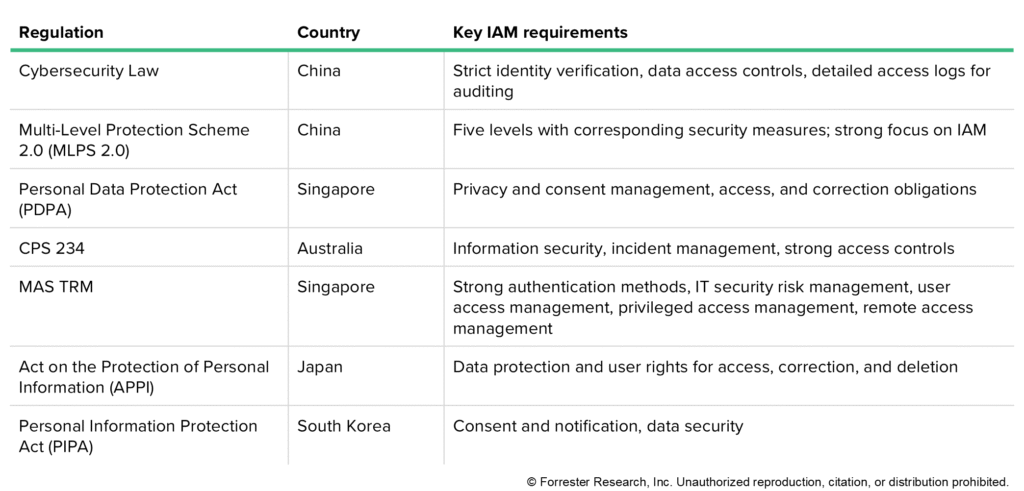
In my most recently published report, I discuss the key adoption drivers, technologies, and use cases for identity and access management (IAM) in Asia Pacific (APAC). Organizations In APAC Will Increase Their IAM Spend Forrester’s 2025 data shows that APAC technology decision-makers anticipate an increase in spend on customer and workforce IAM (CIAM and WIAM, respectively). This is due to: A growing need to compete on digital experiences. Effective IAM orchestration supports seamless and secure customer journeys. Customers benefit when companies leverage IAM solutions to enhance digital onboarding with features, such as biometric authentication, that provide convenience and security for building customer trust. Companies migrating to cloud and hybrid environments. IAM solutions help to facilitate smooth and secure transitions to cloud with features like cloud-native integrations, scalable identity management, and hybrid environment support. SaaS-based IAM solutions also offer rapid deployment and scalability to accommodate fluctuating workloads and user access needs. Risk from reliance on ecosystem partners. As organizations in APAC increasingly rely on ecosystem partners for cloud services, IT outsourcing, and digital business transformation, they run the risk of major data breaches. Effective IAM solutions help to mitigate risk through features like multifactor authentication, continuous monitoring, and least-privilege access. Fragmented regulatory requirements. Countries in APAC have varying IAM requirements (see figure below). Businesses that operate in multiple countries across APAC need IAM solutions that support compliance, data protection, and security to avoid penalties. Consumer Behavior And Security Needs Are Driving CIAM Growth While WIAM is relatively mature in APAC, CIAM is still rapidly evolving. Consumer behavior is driving this growth: customers are engaging with brands across devices, platforms, and channels, making it challenging for firms to manage identities and protect data. Furthermore, high mobile adoption and tech-forward cultures in markets like India, China, and Southeast Asia are shaping APAC consumers to be more comfortable with biometrics than their Western counterparts. At the same time, increasingly sophisticated cyberthreats — such as deepfakes — are encouraging APAC businesses to adopt modern CIAM solutions that enhance security. This is especially crucial as APAC’s rapid digital growth, alongside its mobile-first mindset, makes it vulnerable to identity fraud and cyberattacks. Select IAM Technologies Based On Your Use Case Firms are adopting a variety of IAM technologies to address different use cases and challenges. We highlight some key technologies below: Unified identity governance. Many multinationals in APAC struggle with fragmented identity governance across multiple regions and cloud environments. Unified identity governance solutions can help businesses to standardize these identities across global operations, while better complying with differing regulations across countries. Machine identity management. The rapid increase in cloud-native applications, APIs, IoT devices, and continuous integration and delivery pipelines has made machine identities the most vulnerable and fastest-growing attack surface. As generative and agentic AI become more widely adopted in APAC, we expect that businesses will leverage machine identity management solutions to manage identities and access. Cloud identity entitlement management (CIEM). CIEM is an essential aspect of IAM strategies in APAC, owing to the region’s swift adoption of cloud services. To manage the risk of overprivileged access and configuration errors, CIEM enforces least-privilege access, automates policy enforcement, and monitors entitlements. Decentralized digital identity (DDID). As more firms in APAC look to improve privacy and reduce reliance on centralized providers, adoption of DDID is gaining traction. By using DDID technologies, firms can reduce identity fraud and improve operational efficiency by reducing identity verification times. Single sign-on (SSO). APAC firms are prioritizing SSO for CIAM to better serve digital-savvy customers with seamless login experiences across channels and platforms. This is table stakes for firms who want to compete on digital CX and retain customers. To explore these insights in greater detail — and learn more about specific IAM use cases and examples — read our full report, The State Of Identity And Access Management In Asia Pacific. Forrester clients can schedule a guidance session or inquiry with me for further sharing and discussion. source

What's Hot For Identity And Access Management (IAM) In Asia Pacific In 2025? Read More »

Social Commerce Shows Promise, But Still Hasn’t Hit Critical Mass In The US

Forrester’s 2022 assessment of the state of US social commerce uncovered widespread consumer mistrust in social media, which fizzled social media platforms’ commerce ambitions. In our latest report, taking a look at The State Of Social Commerce for 2025, we maintain our reservations around social commerce “taking off” in the US, especially compared to emerging markets. The barriers are still high for in-platform purchasing, making it hard to drive significant sales volume for brands. Creators Seamlessly Weave Entertainment And Commerce In Content Social media plays an increasingly important role in the shopping journey. The boom of the creator economy layered atop highly personalized algorithms paved the way for TikTok Shop’s successful launch, which boasted $100 million in gross merchandise value on Black Friday last year. As such, we believe creators will drive social commerce into its next evolution. Creators bring entertainment value to the social shopping experience, effortlessly threading this needle between entertainment and commerce in the content they create. In fact, more than one-third of Gen Z and Millennial US online adults report purchasing a product directly from a creator or influencer post on social media. To fine-tune your social commerce strategy for relevance and effectiveness, we recommend that you: Test and refine product categories. Social media platforms are best suited for low-stakes, impulse purchases rather than those with involved research or deliberation. Consider limited-time offers or exclusive drops. Generate buzz and an urgency to transact to engage and entertain consumers. Implement a system to capture CRM data. Leverage work-arounds to stay connected to customers in the post-purchase journey. Expand your affiliate program to include creators. Take advantage of creator management platforms’ integrations into established affiliate platforms. Read the full report to dive deeper into Forrester’s latest findings, insights, and best practices for activating a commerce strategy on social. Forrester clients, schedule a guidance session with me to discuss the best-fit social commerce strategy for your brand. source

Social Commerce Shows Promise, But Still Hasn’t Hit Critical Mass In The US Read More »

Public Sector: Will Agentic AI Solve Your Integration Problems?

Forrester’s government clients struggle with integration. It’s difficult, and it’s even more so for the public sector, where underfunded budgets and federated fiefdoms with limited shared services are the norm. The pressure is on as digital systems demand greater connectivity, especially as customers (citizens and beyond) expect a connected government experience. Add in major cuts in resources, and it seems even more like an impossible challenge to conquer. Or is it? As governments tighten budgets and prioritize their limited time and resources, they face an important question: Is this a problem that no longer requires spending cycles to solve? With the onset of AI, and agentic AI in particular, our government clients are asking if integration is a challenging, expensive, and painful problem they will no longer have to solve in two years’ time. Will agentic AI bridge the gap between siloed systems? Will it finally deliver the seamless integration government agencies have been waiting for, thus making interoperability a problem of the past? No, AI Makes Your Integration Problems Worse Sorry, it’s not good news. AI is not magic fairy dust. How is AI supposed to access your data and digital operations without integration? The fact is AI amplifies the urgency to do integration well. Agencies that have cut corners on integration will find executing on AI will be more difficult than those that built a robust integration foundation. For AI to be more than a chatbot, it needs events and APIs: Events notify AI agents when a decision is needed and keep them up-to-date on the latest state of your systems in real time. AI agents evaluate what just happened and the current state across systems — and make a decision. APIs are invoked by the agent to retrieve additional data when needed to aid making a decision and to actualize that decision. Agentic AI Will Fail With Traditional Integration Architecture The principles of good integration are not new, but AI makes them more necessary than ever. To enable AI action, you need: Definitions. APIs and events must be documented with a schema definition and plain-English semantic meaning of what they do. Otherwise, AI won’t have a clue. Business architecture. APIs and events must reflect your agency’s capabilities as defined by capability mapping. They should not reflect technical applications as happens in point-to-point integration commonly found in the public sector. Otherwise they will be too low-level for AI to figure out how to use them to accomplish a goal. High-quality API design. APIs with schemas and error messages that confuse humans will confuse AI agents. But unlike humans, AI agents can’t spend a few hours experimenting with an API and chatting with its owner sitting in the next cubicle aisle. AI agents don’t have memory to recall the weird quirks of an API that human developers discover and remember during the SDLC. Tight security. Whatever security holes you have in your APIs will be found much faster by an AI agent than by a human. It’s Time To Stop Neglecting Integration The facts listed above are nothing new. They were best practices before AI. They are even more critical with AI. Now is the time to pay down the tech debt of point-to-point integration. Yes, integration is difficult, but if the public sector can figure out how to send a man to the moon, it can solve its integration problems with the right will and incentives. source

Public Sector: Will Agentic AI Solve Your Integration Problems? Read More »

B2B Marketing Budgets 2026: Markets Are Volatile, But Planning Needn’t Be

As B2B marketing executives prepare for 2026 planning, one thing is clear: Optimism about budget growth is high, but so is the pressure to deliver results in an unpredictable environment. Forrester’s latest Budget Planning Guide for B2B marketing executives reveals that 83% of B2B marketing decision-makers expect increased investment over the next 12 months. Despite this hope, persistent economic and geopolitical volatility demands a strategic, focused approach to planning. More than ever, success will hinge on where marketers choose to invest, divest, and experiment. Regional Budget Insights Global volatility is affecting regional markets differently. Here’s some of what we learned from the respondents, based in North America, Europe, and Asia Pacific, of Forrester’s Budget Planning Survey, 2025: North America: In the US, 37% of marketing decision-makers are quite optimistic, expecting a budget increase of 5% or more. Whether that materializes or not, Forrester recommends a focused approach to resource allocation. Europe: In addition to uncertainty about the political and socioeconomic environment stemming from the US political landscape and the possibility of tariffs and other disruptions to supply chains, French, German, and UK B2B marketers must navigate a more complex regulatory landscape and sluggish economic recovery. Nonetheless, many remain optimistic and report that they invest 9% of revenue in marketing, with 37% expecting budget increases over the next 12 months. Asia Pacific: These marketing leaders are behind their counterparts in other regions with respect to marketing investment as a percentage of revenue. Just under half of respondents indicated they plan to invest 7.1% or more of revenue in marketing, significantly less than their North American and European counterparts. Yet across the board — in programs, personnel, and technology — Asia Pacific marketers express the highest planned investment increase in the next 12 months. Strategic Advice For 2026 Planning We group our annual client guidance into three areas: items to increase investment in, those to divest from, and experiments to consider. Beyond regional considerations, here’s how we are guiding clients heading into 2026 generally: Invest: Focus on resilience and buyer adaptation. Start by reassessing your target markets. Use relative targeting to prioritize segments where your organization can win — those with high market attractiveness and strong execution readiness that are less exposed to global trade and political disruption. If the potential exists to lose customers in disrupted markets, we recommend emphasizing new customer acquisition via demand generation in these more stable domestic markets. Next, adapt revenue processes and audience strategies to reflect the rise of buying networks and AI-assisted decision-making. Invest in upskilling your team, especially in AI tools, data analysis, and human-centered storytelling. Divest: Exit risky segments and eliminate inefficiencies. Now is the time to walk away from unstable or unprofitable segments. For example, acquisition programs targeting certain US government agencies may no longer be viable due to budget constraints and decision-making uncertainty. Replace manual tasks with AI wherever possible — data entry, content creation, and email sequencing are all ripe for automation. Shut down “spray and pray” campaigns and unfocused brand efforts that lack strategic alignment. Finally, rationalize your tech stack by eliminating redundant tools and cutting nonstrategic operational costs. Experiment: Test for efficiency and future growth. Even in tight budget environments, experimentation is essential. Apply a layered measurement strategy that combines traditional metrics with predictive analytics and mines conversational intelligence for insights. Reallocate at least 15% of your content or digital spend to improve AI search visibility through modular content, schema markup, and expert profile optimization. Explore product-led growth strategies to drive renewals and upsell opportunities by leveraging user behavior data and in-app engagement. Turn Insights Into Action Whether you’re a Forrester client or not, this year’s Budget Planning Guide for B2B marketing executives is more than just a report — it distills the collective guidance from our marketing analysts and executive advisors who meet with CMOs and other marketing leaders every day. Download our complimentary copy of Budget Planning Guide 2026: B2B Marketing Executives, along with the accompanying worksheet to help you put the report’s recommendations into action. Then, register for our upcoming webinar to dive deeper into the advice and ask questions of our experts. Already a Forrester client? Access the full report and reach out to schedule a guidance session to apply the research in your business’s specific context. source

B2B Marketing Budgets 2026: Markets Are Volatile, But Planning Needn’t Be Read More »

Continued Growth In Scale And Complexity: The State Of Partner Ecosystems In 2025

B2B organizations are increasingly relying on partner ecosystems to fulfill buyer and customer expectations, advance innovation opportunities, and achieve corporate revenue and growth objectives. Forrester data reveals the 2025 partner ecosystem landscape and underscores its continued importance and growth. Customer Obsession Is Fueling The Expansion Of Partner Ecosystems As B2B organizations seek higher levels of customer obsession to maximize customer value and value to their business, both the internal awareness and strategic importance of partner ecosystems are increasing. B2B buyers and customers continue to highlight preferences for working with partner ecosystems. This is leading supplier organizations to turn increasingly to a diverse array of partners to meet evolving buyer expectations and to accelerate innovation. This includes not only traditional partners but also expands to include digital routes to market (RTMs), innovators, and influencers. Forrester Data Reveals A Trifecta Of Future Partner-Ecosystem-Driven Growth Forrester’s most recent Partner Ecosystem Marketing Survey reveals: Growth in the size of partner ecosystems. A majority of B2B partner ecosystem and channel marketing decision-makers report that they expect expansion in the number of partners within their partner ecosystems. This growth is anticipated across all partner types/business models. The highest percentage of growth is expected with technology partners, distribution partners, and digital RTMs. Growth in indirect revenue. A significant portion of B2B revenue is now driven through partners, and that is expected to increase. Sixty-seven percent of those surveyed plan for their indirect revenue — revenue transacted by partners — to grow above or significantly above that of last year’s (i.e., they expect growth to be over 30% greater than the previous year). Growth in partner influence to revenue. Partners are playing a more strategic role in shaping and assisting B2B customer decisions. Two-thirds of those surveyed report that they expect partner-influenced revenue to grow above or significantly above that of last year’s (i.e., they expect growth to be over 30% greater than the previous year). What This Means For B2B Leaders To continue to drive growth, B2B leaders must prioritize and invest in their partner ecosystem strategy and supporting functions to meet buyer and customer needs and preferences. The organizations that embrace this strategy will be better positioned to drive innovation, accelerate growth, and beat the competition in their industries. Take The Next Step To explore these insights in more detail, Forrester clients can read the full report, The State Of B2B Partner Ecosystems, 2025, and reach out to [email protected] to schedule a guidance session to review your partner ecosystem marketing strategy. source

Continued Growth In Scale And Complexity: The State Of Partner Ecosystems In 2025 Read More »

CX Leaders: Optimize Spending And Boost Impact In Volatile Times

Budget planning season is approaching, and this year, it’s particularly like preparing for a high-stakes expedition into uncharted territory. As a CX leader, you’re the navigator, facing unpredictable weather (volatile markets), dwindling supplies (internal resource constraints), and shifting terrain (the evolving landscape of AI and tech complexity). Your mission? Chart the smartest course — knowing where to invest for the greatest impact and where to lighten the load. Forrester’s Budget Planning Guide 2026: Customer Experience is your map and compass, helping you build a high-impact, AI-ready CX function that can thrive in any climate. CX Leaders Are Optimistic About Budgets Despite Market Volatility CX budgets vary widely across the globe — from $20,000 to over $5 million, with most teams reporting budgets of between $1 million to less than $2.5 million. In terms of outlook, CX leaders are optimistic; three-quarters of CX decision-makers anticipate budget increases that match or exceed inflation. CX leaders plan to allocate their budgets in four categories: technology; data and research; initiatives, projects, or improvements; and services — with some regional differences: CX leaders in North America are the most optimistic about budget increases. Thirty-seven percent anticipate budget growth of between 5–10%, which exceeds inflation. They plan to invest 28% of their budget in technology, followed closely by initiatives, projects, or improvements. They follow their global peers in focusing tech investments on foundational tech tools such as customer relationship management, digital intelligence, and business intelligence tools. Australian CX leaders are cautiously aiming to match inflation. Forty-two percent of CX leaders in Australia expect budget increases in the 1–4% range. Most of CX leaders in Australia plan to focus on optimizing their existing team: 36% expect their budget for personnel to remain flat. In contrast, CX leaders in India anticipate more substantial budget increases, reflecting a more aggressive growth mindset. Across Europe, CX leaders’ spending power is growing. While UK-based teams are optimistic, with 11% expecting double-digit increases, French CX leaders see their budgets under the most pressure, with two-thirds expecting budgets to remain flat or increase by less than 5%. But against a background of low inflation, this means increased spending power for most teams. Meanwhile, German CX teams are significantly more focused on culture change than their European peers. Double Down On AI-Fueled Experimentation In 2026 As you plan for 2026, it’s increasingly important to focus spending on building a high-impact, AI-ready CX function and to decrease efforts that lack alignment and measurably positive impact: Invest: AI and data literacy to ensure success with AI-powered tools. Although CX leaders increasingly incorporate AI into research and design workflows, only one-third of CX teams have mastery of data literacy skills — a prerequisite for using AI responsibly for CX measurement tasks. According to our recent Forrester’s State Of AI Survey, 2025, Indian firms lead the way globally in terms of adopting production-ready generative AI capabilities for functions such as summarizing customer feedback or identifying patterns in customer feedback and data. US and UK firms are fast followers, while French and German firms lag. Divest: financial incentives for CX metrics. Tying bonuses to CX metrics can promote score obsession over genuine customer obsession. It’s expensive, hurts your firm’s culture energy and ability to improve CX, and wastes the CX team’s time defending scores and managing exceptions rather than driving real change. Firms in Singapore in particular tie executive bonuses to CX metrics, potentially exacerbating the potential of score manipulation. Indian teams, however, top out in terms of using a CX score to prioritize where they give internal awards and recognition, doubling down on highlighting cultural bright spots. Experiment: turning efficient gains into CX innovation. As you gain efficiencies from AI adoption, you must plan where and how to use those gains to maximize impact. Reinvest a portion of savings from AI-powered efficiency gains to fund disciplined experimentation that drives long-term differentiation and growth. For example, you could use savings from post-call AI summarization in your contact center to pilot synthetic data and predictive analytics initiatives to identify CX interventions that deepen loyalty. Take The Next Step In Your 2026 Budget Planning Interested in more insights on where to invest, pull back, and experiment for success in the year ahead? Download our complimentary copy of Budget Planning Guide 2026: Customer Experience and the accompanying worksheet to put the recommendations into action. Then, register for our upcoming webinar, where our analysts will dive deeper into the recommendations and provide an overview of peer spending benchmarks. Already a Forrester client? Read the report and schedule a guidance session to go further into the recommendations. Also, join us for our peer discussion happening tomorrow, July 16. source

CX Leaders: Optimize Spending And Boost Impact In Volatile Times Read More »

Bringing AI To The Core: IBM’s Bets On In-Platform Intelligence

IBM’s 2025 infrastructure refresh — z17, LinuxONE 5, and Power11 — isn’t just a silicon upgrade. It’s a performance, TCO, and sovereignty play. In-platform AI acceleration, post-quantum cryptography (PQC), and hybrid cloud integration make a bold case for keeping your data — and your AI — close to home and hopefully on IBM hardware. While the vision is strong, execution will be key. IBM’s challenge isn’t just technical; Big Blue will need to convince buyers that mainframe-class infrastructure is relevant in a cloud-native world. Spyre accelerator: AI where it belongs. IBM announced the Spyre accelerator, an AI accelerator card with 32 AI-optimized NPU cores, with the z17 launch this spring. In July, IBM revealed that Spyre will be available for Power11, as well. The new accelerator will deliver a cost-effective AI inferencing alternative to cloud-hosted NVIDIA H100 or Intel Gaudi 3 AI solutions by eliminating data movement (and egress fees), reducing latency for inference, leveraging a more power-efficient architecture, and simplifying compliance by keeping data local. Post-quantum cryptography: IBM leads while others lag. IBM has led the market in hardware-accelerated PQC (Kyber and Dilithium) since its 2022 z16 and corresponding LinuxONE iterations. With z17 and LinuxONE 5, it has expanded PQC support and extended capabilities into the OS layer for a full-stack solution. Competitors such as HPE, Dell, and Lenovo lag with either partial portfolio coverage or software-only implementations, forcing a trade-off between leaving critical workloads vulnerable or slowing performance to apply complex encryption algorithms in software. AI-assisted operations: watsonx Assistant for Z and beyond. The latest watsonx Code Assistant for Z supports Linux on Z and integrates with Z Operations Unite, enabling natural language queries for real-time system insights and automation. IBM also released COBOL Upgrade Advisor for Z (CUAZ) to accelerate the transition to the newly released COBOL version 6.5. CUAZ, Automatic Binary Optimizer (ABO), and IBM watsonx Code Assistant for Z are all part of IBM’s app modernization lifecycle. Similar capabilities are being extended to Power11 and LinuxONE via watsonx Orchestrate and Code Assistant. HashiCorp: an integration that matters. IBM’s $6.4 billion acquisition of HashiCorp brings Terraform, Vault, Consul, and Boundary into its ecosystem, embedding secrets management, service discovery, and identity-aware access across z/OS, PowerVS, and LinuxONE. This streamlines the integration of IBM Z and Power-based workloads with enterprise cloud infrastructure by strengthening hybrid cloud security and automation. Value: “Big Blue” still means big green, at least up front. While IBM platforms have high up-front costs, they offer unmatched uptime, energy-efficient AI inferencing, clear privacy and compliance advantages, and long-term TCO savings, especially when you factor in the Telum II + Spyre combo — though IBM must still simplify pricing and clearly communicate the benefits of running AI on-prem versus cloud alternatives. What It Means For Enterprise Buyers My take? Here’s what I am advising clients to do: Run AI where your data lives. With Spyre and Telum II, IBM enables low-latency, secure AI inferencing directly on-platform — eliminating data movement, reducing power use, and avoiding cloud egress fees for better TCO. Secure the future with PQC. IBM leads in post-quantum cryptography with full-stack support, making it a strong choice for industries such as finance, healthcare, and government that manage long-lived, sensitive data. Modernize operations with automation and control. The integration of HashiCorp’s control plane tools and watsonx Assistants brings scalable automation, secrets management, and AI-driven ops to IBM’s legacy platforms. Bridge the adoption gap. IBM’s vertically integrated stack and AI-assisted tools help reduce complexity, but broader adoption still hinges on improving developer experience, simplifying pricing, and attracting cloud-native teams. IBM is working to make its Z mainframe and Power midrange platforms relevant again with compelling AI-driven updates. But success will depend on how well it can translate technical differentiation into operational simplicity, developer accessibility, and economic clarity. If you are looking to understand how IBM’s recent announcements affect your mainframe strategy, please reach out for a guidance session to help figure out your next steps. source

Bringing AI To The Core: IBM’s Bets On In-Platform Intelligence Read More »

Budget Boom Or Budget Bust? Be Ready For Both In 2026

Today’s volatility is turning into tomorrow’s mediocrity, at least when it comes to budget expectations for next year. Tariffs, trade wars, cyberthreats, divided customers, and economic concerns have business and tech leaders feeling markedly less bullish than they did last year at this time, our recent global survey of more than 2,600 leaders suggests. But if the past few months have taught us anything, it’s that things can (and will) change on a moment’s notice. So while conservative expectations are a fair starting point, it would be a mistake to place too much stock in them. Forrester’s just-released 2026 Budget Planning Guides provide data-driven, actionable advice for navigating the tumult of this year’s planning season. The guides include insights and recommendations to help technology, marketing, customer experience, digital, and sales leaders know where to invest, pull back spending, and experiment to fuel growth. (Clients can access our Budget Planning Guides for technology, marketing, customer experience, digital, and sales leaders here; nonclients can read select guides here.) While the recommendations in each guide are role-specific, the overarching focus this year is helping leaders stay nimble and adaptable. The key actions we recommend prioritizing in 2026 include the following: Double down on data literacy and employee AI readiness programs. Anecdotal but strong evidence shows that less than 20% of all enterprises use analytical tools hands-on. That needs to change, as training employees for AI readiness is essential for long-term success. Organizations must ensure that their workforce understands how to leverage data and AI tools effectively and ethically. Focus on customer insights and data management. Leaders with a clearer grasp of their customers in uncertain times will have a distinct advantage over leaders who lack this. To get a fuller, timelier picture of your customer, invest in customer data management technologies and augment customer feedback management tools with insights from consumer intelligence platforms and first-party digital behavioral data. Develop a rigorous data collection strategy based on what data you need, who owns that data, and what systems it needs to integrate with. Revisit your cloud-first strategy. New sovereignty and resilience regulations, the growing number of production-ready generative AI (genAI) use cases, and other factors have switched the public cloud conversation from cloud-first to cloud-as-necessary. Consider repatriation or staying on-prem for workloads with consistent usage profiles and localized genAI to reduce spending for data that falls under sovereign or industry-specific regulations or for high-compute scenarios such as genAI to minimize latency. Try agentic AI for task automation first within a single app, then across business apps. Explore the disruptive potential of agentic AI by experimenting with autonomous AI agents that can perform tasks and make decisions (eventually) independently. Start by experimenting with AI agents that only automate tasks within one platform, then slowly add more platforms and capabilities. Pay close attention to the communication protocols used for multiplatform agent orchestration, as these standards are still evolving. Forrester’s 2026 Budget Planning Guides explore these recommendations in greater depth and provide many additional function-specific insights to inform your planning and budgeting. You can also join our analysts for Budget Planning Guide webinars that we’ll be hosting in the coming weeks. Though the year ahead will bring more volatility, our guides can help you plan with confidence. source

Budget Boom Or Budget Bust? Be Ready For Both In 2026 Read More »

Reimagining ITSM: How Refresh Europe 2025 Propels Freshworks Amid A Fierce Competitive Landscape

At Refresh Europe 2025, the message was unambiguous: The complexity of enterprise IT is stifling productivity, and simplification is no longer optional; it’s a strategic imperative. Speaker after speaker emphasized that the modern CIO is no longer just a custodian of infrastructure. They are also architects of the employee experience, now judged not by SLAs but by the moments that matter — the last-mile interactions where users form their perceptions of IT. This last mile, whether it’s a password reset or a seamless onboarding journey, is where IT either builds trust or loses it. Employees don’t remember systems; they remember how systems make them feel. The conference made it clear: Businesses can’t afford to frustrate users with fragmented tools and convoluted processes. With over a thousand tools in use in some enterprises, the operational burden is massive. Yet ironically, adding more systems in the name of productivity often leads to diminished returns and increased security risk. Freshworks and its partners offered a roadmap for change: Simplify aggressively, reduce tool sprawl, and center IT around intuitive, responsive, and empathetic service experiences. Freshworks’ Focus On AI And Simplification In ITSM Freshworks drove home its vision of transforming IT service management (ITSM) through automated, intuitive employee experiences powered by its Freddy AI. Built into Freshservice, Freddy supports seamless ticket summarization, multilingual assistance, knowledge article generation, and suggested next-best actions. But how does this compare to industry peers? The competitiveness of ITSM today hinges on seamless AI integration and out-of-the-box governance. Freshworks is clearly catching up in AI capabilities, especially with no-code Freddy agents. Its distinct advantage lies in packaging robust, rapid-deployment features at a lower entry cost and targeting the midmarket while market leaders aim at large-enterprise complexity. Experience-Led ITSM: XLAs Vs. Traditional SLAs A key shift highlighted at Refresh Europe was the pivot from service-level agreements (SLAs) to experience-level agreements (XLAs), moving beyond uptime to measure how users feel about IT interactions and then embedding continuous feedback loops. Major vendors are racing to align with this trend. Freshworks is firmly in step, integrating multilingual Freddy agents, experience-level triggers, and unified HR/IT onboarding, all enabled by its recent acquisition of Device42 and the embedding of Freddy into Freshservice. Freshworks may not be leading here, but it is strategically competitive, aligning with the broader industry shift toward emotional metrics. ITSM Automation The market’s leaders are converging ITSM with enterprisewide workflows, embracing hyper-automation, human-in-the-loop approval, identity governance, security orchestration, and HR/procurement automation. Automation through AI significantly enhances efficiency across various business functions. HR processes benefit from automated onboarding, offboarding, and communication workflows, reducing inefficiencies and compliance risks while providing personalized experiences for new hires. ​In customer support, AI agents handle routine and complex queries across multiple channels, freeing up human agents to focus on high-value tasks and improving customer satisfaction. ​Additionally, purpose-built AI solutions for smaller businesses simplify operations and accelerate growth, showcasing the transformative impact of automation in streamlining processes and driving scalability. All this demonstrates that AI automation is no longer limited to IT. By simplifying deployment and avoiding overcustomization, Freshworks positions itself as a lean, agile alternative to heavyweight platforms such as ServiceNow or BMC Helix. Freshworks isn’t the innovation leader, but its approach smartly balances AI automation with low operational overhead, aiming to outpace competition in usability. Is Freshworks Leading Or Following? Freshworks is highly competitive, particularly for midmarket companies seeking AI-driven service management at an enterprise level of speed and cost. With sophisticated Freddy agents, Device42-powered IT asset management, and a push toward XLAs, it matches many industry trends head on. Yet in sheer breadth, cross-functional orchestration, global identity governance, and large-enterprise complexity, Freshworks mirrors these innovative trends but with a sharp midmarket focus, avoiding the bloat associated with mega-platforms. In this race, Freshworks isn’t the fastest or most feature-heavy, but it is the strategically streamlined product offering intelligent AI, modern experiences, and rapid deployment — catching up fast, especially in experience-led and AI-first service, and poised to overtake legacy incumbents in agility and value. Freshworks should continue to strengthen hyper-automation beyond IT, adding deeper analytics around AI ROI, governance, and identity. It should also highlight XLA success metrics to fully claim the experience-led mantle. Let’s Connect Have questions? That’s fantastic. Let’s connect and continue the conversation! Please reach out to me through social media or request a guidance session. Follow my blogs and research at Forrester.com. source

Reimagining ITSM: How Refresh Europe 2025 Propels Freshworks Amid A Fierce Competitive Landscape Read More »

Forrester

Success in business doesn’t come with a manual — especially in today’s fast-evolving world. But you’re not alone. Countless executives have faced the same challenges you’re navigating, from crafting winning strategies to investing in cutting-edge technologies and attracting the customers who matter most. The difference? They partnered with Forrester. Through a unique continuous guidance model that blends research, consulting, and live events, we ensure you stay ahead of every curve. Equipped with the latest trends, innovations, and data, our tailored interactions empower you to act swiftly and decisively. With insights drawn from surveying over 500,000 consumers, executives, and tech leaders annually, Forrester consultants and analysts are unrivaled in understanding the challenges you face. Whatever hurdles you encounter, we’ve seen them — and solved them.   source

Forrester Read More »