Forrester

Is AI Coming For Your Team Next? How AI Hype Is Becoming The Hot Layoff Excuse

If headlines are any indication, AI-driven downsizing is accelerating across B2B organizations. It seems that many senior executives have found “the perfect justification” for the workforce optimization they’ve been contemplating. The AI revolution isn’t only changing how work gets done — it’s providing cover for workforce reductions that may have little to do with actual capabilities. Corporate Leaders Embrace AI As Their Preferred Workforce Reduction Rationale Andy Jassy, Amazon CEO, indicated that “[with AI, we] will need fewer people doing some of the jobs that are being done today” in a note to employees. Meanwhile, AI is enabling Hewlett Packard Enterprise to reduce staff that it once needed. For example, the company has deployed AI agents in finance that are already displacing workers. Marie Myers, the company’s finance chief, recently spoke to investors as she justified eliminating 2,500 jobs (or 5% of HPE’s workforce): “Our ambition is clear: a leaner, faster, and more competitive organization. Nothing is off limits.” IBM’s CEO has also gone on record, stating that the company has laid off 8,000 workers already, mostly in HR, in favor of using AI agents. The Scale Of AI-Justified Cuts These and other job reduction numbers expose the growing scope of the AI-justified downsizing wave. US public companies have slashed professional staff by 3.5% over the past three years, and the recent AI-justified reductions are poised to balloon this figure further, according to The Wall Street Journal’s analysis of Live Data Technologies’ tracking across the labor market. Yes, we’ve also been operating in a volatile economic market, but here’s what makes this different from typical recession-driven layoffs: This isn’t about cuts for economic survival — it’s about workforce optimization disguised as technological inevitability. Beyond Economic Necessity: AI As Strategic Cover The high-profile examples at Amazon, HPE, and IBM aren’t isolated incidents. They’re part of a growing trend where AI hype is fueling permanent staffing decisions based on limited pilots and, mostly, theoretical technological promises rather than full-fledged implementation realities. The heart of the problem? Most executives can’t actually distinguish between what AI can do and what requires human judgment, creativity, and relationship management. Executives May Not Actually Believe What They’re Saying Here’s the twist: The executives making these cuts often don’t believe that AI is a replacement for employees. According to Forrester’s State Of AI Survey, 2025, 75% of business leaders agree that AI isn’t a replacement for employees, and 80% agree that AI will mostly augment capabilities rather than replace them. Yet paradoxically, 58% have slowed their hiring until they know more about how AI will impact their operations. This disconnect between stated beliefs and actual decisions reveals the real motivation for AI-driven downsizing — it’s not solely about AI capabilities; it’s about AI as cover for workforce optimization, too. AI Is Delivering Value, But AI Strategy Must Be Grounded In Human Experience This contradiction highlights why organizations need to ground their workforce AI strategy in human experience rather than chasing theoretical efficiency gains that are likely to fail to materialize or backfire. But let me be clear: AI is delivering value today. In B2B marketing, we see it being used for content development, competitive intelligence, routine task automation, mining customer data insights, and other use cases. But it is far too early to justify major across-the-board headcount changes based on nascent efforts. Your Preparation Starts Now Organizations and individuals who want to survive this shift must move beyond reactive thinking. Here’s what you should do in the next 30–90 days: Document AI benefits and limitations with hard data. Stop accepting theoretical claims about what AI can replace and show what it’s actually accomplishing and how significant that is (or isn’t). In most cases, you’re likely to find that AI works better as a job aid than as a full replacement (especially in the near term). Create detailed analyses of which roles genuinely benefit from AI augmentation versus those that require human judgment, creativity, and relationship management. Track revenue per employee now. If you’re not measuring this in your department or role, you’re operating blind. Establish baseline measurements and identify specific ways that your position, team, or department contributes to revenue generation (or cost reduction). Prepare personnel analytics for the next cut cycle. Build data-driven cases for critical positions before the pressure hits. Document productivity metrics, revenue contributions, and unique value propositions that can’t be easily automated. Shift from headcount thinking to value thinking. Stop justifying roles based on traditional workload arguments. Instead, frame positions around measurable business outcomes and competitive advantages. Ready to future-proof your marketing organization against the next wave of workforce optimization? Contact me to discuss data-driven strategies for navigating the AI personnel and automation revolution in B2B marketing. source

Is AI Coming For Your Team Next? How AI Hype Is Becoming The Hot Layoff Excuse Read More »
Leverage Cocreation To Accelerate Sustainability Innovation

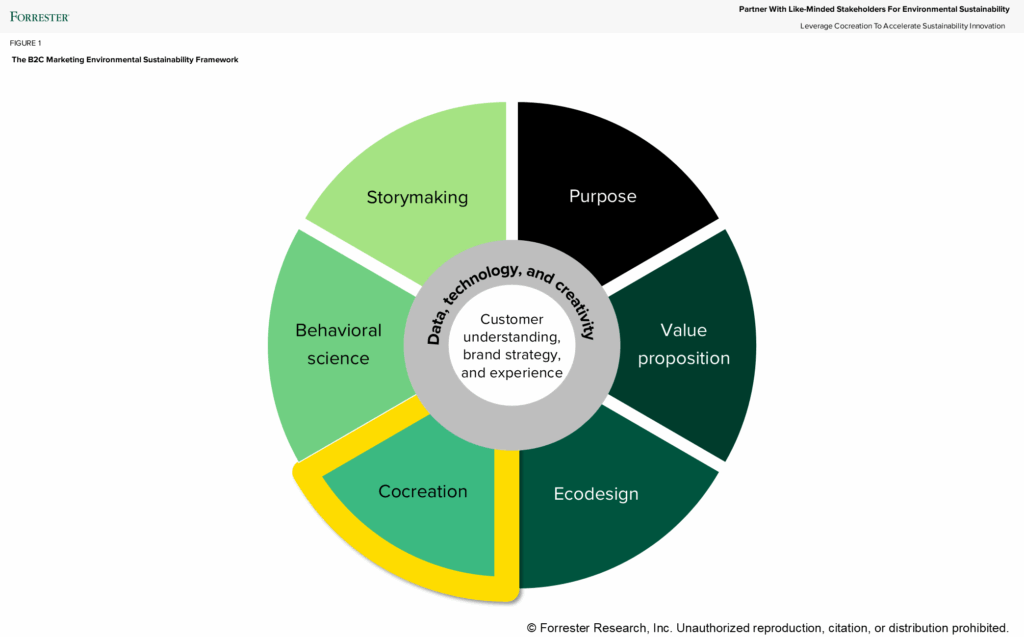
Cocreation is a powerful tool to help CMOs orchestrate multiple internal teams and external partners to drive innovation. Because environmental sustainability demands a systemic approach with multiple stakeholders, CMOs can apply some of the lessons learned to help drive an ambitious cocreation agenda for environmental sustainability. The CMO’s position — at the intersection of business strategy, customer engagement, and brand reputation — uniquely equips them to contribute to efforts that align sustainability goals with consumer values and stakeholder expectations. Cocreation Accelerates Green Innovation The green market revolution is fueled by complex and systemic challenges that demand major, urgent collaboration and innovation. Beyond accelerated time to market, there are other obvious benefits in revisiting the concept of cocreation for environmental sustainability: access to a wider range of talent, resources, and perspectives; reduced risk; and deeper stakeholder engagement and satisfaction. More broadly, cocreation generates both positive externalities for the planet and significant business benefits by: Unleashing creativity to reconcile marketing and planet boundaries. Developing trust to enable sustainability storymaking. Aligning your key stakeholders to improve business and environmental resilience. Cocreation Aligns Key Stakeholders On Your Sustainability Efforts Cocreation is one of the six pillars of the B2C Marketing Environmental Sustainability Framework (see figure below).   CMOs at sustainable B2C brands should engage directly or indirectly with many different stakeholders, such as: Consumers: Unlock environmental value throughout the customer journey. Employees: Align internal stakeholders to reduce the green experience gap. Suppliers: Turn them into strategic partners to reduce carbon emissions. Public authorities and governments: Open the dialogue on green regulation. Civil society, scientists, and NGOs: Let them challenge your initiatives. Shareholders: Prove the financial value of your business-model pivot. Competitors: Cooperate with peers to solve industry solutions. Clients who want to know more can access the new report, Partner With Like-Minded Stakeholders For Environmental Sustainability, and can also schedule time for a conversation to discuss examples, best practices, and our three-step approach for cocreation. source

Leverage Cocreation To Accelerate Sustainability Innovation Read More »

Social Commerce Shows Promise But Still Hasn’t Hit Critical Mass In The US

Forrester’s 2022 assessment of the state of US social commerce uncovered widespread consumer mistrust in social media, which fizzled social media platforms’ commerce ambitions. In our latest report, taking a look at The State Of Social Commerce for 2025, we maintain our reservations around social commerce “taking off” in the US, especially compared to emerging markets. The barriers are still high for in-platform purchasing, making it hard to drive significant sales volume for brands. Creators Seamlessly Weave Entertainment And Commerce In Content Social media plays an increasingly important role in the shopping journey. The boom of the creator economy layered atop highly personalized algorithms paved the way for TikTok Shop’s successful launch, which boasted $100 million in gross merchandise value on Black Friday last year. As such, we believe creators will drive social commerce into its next evolution. Creators bring entertainment value to the social shopping experience, effortlessly threading this needle between entertainment and commerce in the content they create. In fact, more than one-third of Gen Z and Millennial US online adults report purchasing a product directly from a creator or influencer post on social media. To fine-tune your social commerce strategy for relevance and effectiveness, we recommend that you: Test and refine product categories. Social media platforms are best suited for low-stakes, impulse purchases rather than those with involved research or deliberation. Consider limited-time offers or exclusive drops. Generate buzz and an urgency to transact to engage and entertain consumers. Implement a system to capture CRM data. Leverage work-arounds to stay connected to customers in the post-purchase journey. Expand your affiliate program to include creators. Take advantage of creator management platforms’ integrations into established affiliate platforms. Read the full report to dive deeper into Forrester’s latest findings, insights, and best practices for activating a commerce strategy on social. Forrester clients, schedule a guidance session with me to discuss the best-fit social commerce strategy for your brand. source

Social Commerce Shows Promise But Still Hasn’t Hit Critical Mass In The US Read More »

Why B2B Customer Service Is Now Part Of My Research Agenda

When B2B survey respondents say that 73% of their revenue originates from current customers, retaining and growing those accounts must be a top priority, one that is well coordinated across all postsale motions, from onboarding to servicing and expanding business on the back of attained goals. Especially in volatile economic markets and geopolitical times, every business needs its customers to continue using its offerings to achieve positive business outcomes. But what happens when buyers encounter a problem and come to you for help? Isn’t reactively solving customer issues an essential part of the B2B postsale customer experience? Of course, it is! And that’s one of the reasons I’m now covering B2B customer service — technical support, field support, support services, and the like — in collaboration with Forrester analysts Kate Leggett, Christina McAllister, Max Ball, and Vasu Srinivasan, who have all been deeply involved with this market. I say “and the like” because I’ve just begun to explore what makes B2B customer service special. I’m curious to learn how AI-backed automation and changing customer expectations are altering this key business function in which every B2B company invests but often treats as a cost of simply doing business. In this new role, I look forward to exploring the following: 1) Differences that matter in a B2B postsale support motion. B2B support volumes are typically much lower than B2C, yet each call can put tens or hundreds of thousands of dollars’ worth of customer value at risk if it goes awry. How, then, do service elements such as the knowledge base, queuing/routing, customer service representative (CSR) collaboration, quality management, feedback gathering, and omnichannel communications flex to serve unique B2B use cases? Which technology providers best accommodate these differences, and how well are they doing it? 2) The impact of AI on customer service. Before ChatGPT came along, automating even routine service interactions over the phone or by email/chat was an onerous task. Today, generative AI and AI agents let service teams achieve a workable, practical balance between reducing the cost to serve and enhancing the customer’s experience. As more tier-one interactions benefit from automation, how does AI now improve the way that service teams and their technologies interact with customers? How will this next generation of service teams measure its impact on the business — and on customers’ experiences — because of these trends? 3) Changing CSR roles and skill sets. Where are B2B service teams in their evolution from reactive problem-solving to proactively identifying, addressing, and resolving service failures or potential issues before customers formally complain about or get impacted by them? How will the ability to mine data, capture signals, build context, and synthesize insights about — and for — customers make B2B customer experience better? As AI becomes commonplace, how much — and what type — of human interaction will still matter in B2B? (Hint: I think it’s a bigger opportunity than budget-pressured customer service managers may recognize today as the changing role of CSRs becomes a lever for creating competitive differentiation and brand distinction.) 4) Ways to create self-service experiences that customers prefer. Historically, B2B companies lagged their B2C counterparts in digital delivery and self-service capabilities. What do B2B companies that excel at providing an outstanding self-service experience do differently? How do self-service and digital channels help them create a tiered service model that customers pay for willingly? How does this support a broader B2B postsale digital experience that extends across all phases of the customer lifecycle? 5) The use of data-driven insights to keep pace with change and demonstrate impact. Compared to other customer-facing functions, customer service has adopted and benefited from AI and automation to a great degree. What new data sources and signals will these teams need to integrate to continue to increase their understanding of the issues that each specific customer account faces? Or to provide more personalized interactions that satisfy changing buyer behaviors? What new objectives and metrics will define best practices in tomorrow’s B2B customer service? These are exciting times for B2B customers and their providers. I am thrilled to look ahead as I begin to work on research that will help customer service teams bypass timeworn practices to focus instead — along with their customer success and customer marketing peers — on creating delightful customer experiences. Feel free to schedule some time with me to explore the service challenges you face and your plans for addressing them. I would love to share with you what I’ve learned so far. source

Why B2B Customer Service Is Now Part Of My Research Agenda Read More »

Beyond The Lakehouse: Databricks’ Bold Play For The Business Persona

The 2025 Databricks Data + AI Summit showcased a wave of new capabilities to an in-person audience of over 22,000. The announcements reinforced Databricks’ commitment to open lakehouse architecture and its mission to democratize AI across the enterprise. Of significance is Databricks’ intention to allure the business persona, a natural progression for growth given its already strong foothold on technical personas. The emphasis on business persona manifests in the redesign of user experience, a simplified no-code experience to build agents and data pipelines, and updates in the catalog for better governance. Here are some key announcements and what they mean for data, AI, technology, and business personas: Lakebase extends the Databricks platform to support broader AI use cases. Lakebase augments its platform by embedding a fully managed, open-source PostgreSQL OLTP engine built on Neon (Databricks’ billion-dollar acquisition earlier in 2025), deeply integrated with Unity Catalog and the lakehouse. It delivers a unified “translytical” platform that converges transactional and analytical workloads to simplify data architecture and accelerate AI development. With PostgreSQL’s surging popularity, Lakebase provides existing Postgres deployments a seamless bridge to lakehouse integration, built-in analytics, and multiworkload optimization, making it ideal to support agentic AI scenarios. Databricks One aims to connect edge business users to data. This is a new interface for last-mile business users with a familiar search-bar layout to help users ask questions and get answers through Databricks’ connected knowledge resources. The intention is to help make data easier to work with than previous exploratory interfaces. The potential lies in going beyond search and suggesting the next action or actually taking action through methods such as using search results to populate a slide deck for a board meeting. Agent Bricks unveils AI agents at scale with no-code deployment. Agent Bricks is a no-code platform that enables users to build, evaluate, and deploy AI agents directly on their enterprise data. It allows both technical and nontechnical users to create agents without writing code. By integrating tightly with the lakehouse, it brings generative AI closer to real-world enterprise workflows and decision-making. The one-stop-shop experience, combining vast repositories of enterprise data and a simple no-code experience to build agents, is the holy grail. This is the gold standard every large vendor is seeking. Databricks distinguishes itself by automating the entire AI agent lifecycle, from task definition and data integration to evaluation, optimization, and deployment, within a unified, no-code platform that ensures governance and leverages deep integration with the lakehouse architecture. Unity Catalog provides deepening unified governance. Unity Catalog has expanded to include full read/write governance support for Apache Iceberg tables, on par with Delta Lake, and Unity Catalog Metrics was introduced as a semantic layer for defining, storing, and governing business metrics. Attribute-based access control (in beta) enables fine-grained security at scale. Built-in data quality monitoring (in beta) tracks freshness and completeness, offering proactive visibility into data health. The Discover experience (in private preview) will be a curated internal marketplace of trusted data and AI assets. While these enhancements extend governance capabilities, true unified governance would require seamless cross-platform interoperability, operational maturity, and tighter integration with other governance tools, which remain in early stages. Lakeflow Designer helps empower everyone to build data pipelines. The launch of Lakeflow Designer, a no-code ETL pipeline builder, is designed to remove traditional bottlenecks in data engineering. With an intuitive drag-and-drop interface, it enables nontechnical users to create and manage production-ready data pipelines without code. Powered by genAI, this simplifies complex data transformations and promotes collaboration across technical and business teams, accelerates data initiatives, and shortens the path from raw data to actionable insights. This marks a significant step forward in empowering business users and expanding the reach of data-driven decision-making across organizations. Databricks Free Edition is a game-changer. Free access to the complete Databricks Data Intelligence Platform running on a serverless environment (with some resource limitations) allows users to learn and experiment with a full suite of features for data ingestion, pipeline creation, and AI model training. It’s designed for students, developers, and hobbyists, putting data and AI capabilities in the hands of users who may otherwise be precluded from getting their hands dirty. This offering is deeply routed in Databricks’ commitment to academic, open-sourced opportunities. We believe other vendors will also follow suit by offering free-tier data platforms for AI and analytics, enabling organizations to explore their capabilities at no cost. If the end goal is AI adoption by all, Databricks must recognize that changing end user behavior will require more than a simplified UI. It will also need investments in ongoing training, communication on where to go to ask questions, and natural language lessons on how to use its offerings. Since end users have not historically been Databricks’ primary target persona, achieving last-mile adoption may prove more challenging than anticipated. To succeed, the company must look beyond a “build it and they will come” mindset. It needs to clearly articulate the unique value that it will provide vis-à-vis already widely adopted products targeting business personas and outline a clear roadmap that demonstrates how it will engage broader user groups and further evolve its platform moving forward. Share your thoughts and discuss any of these announcements with us by scheduling an inquiry/guidance session. source

Beyond The Lakehouse: Databricks’ Bold Play For The Business Persona Read More »

Where Technology Executives Will Be Investing In 2026

In 2025, enterprises around the world are navigating a difficult set of circumstances that include unpredictable macroeconomic factors, tense geopolitical situations, and shifting consumer behavior. At times like this, it can be a challenge to plan for the future. So where are tech leaders focusing their technology and IT budgets in 2026? Our 2026 Budget Planning Guides lay that out based on the results of Forrester’s recent Budget Planning Survey. For technology executives in 2026, spending priorities vary by region, but globally, it’s clear that increasing staff is a low priority due to AI-driven efficiency gains. Across all regions and most sectors, staffing was the area where the lowest percentage of respondents expected to increase spend. But let’s look into each region individually to find out where technology executives will be spending their budgets. North America In North America, tech decision-makers are most focused on investing in cloud, data centers, and security. In fact, over 75% expect to grow spend in all three of these areas in 2026. Explosive use of AI is driving growth in cloud and data center spend, while high-profile security breaches and emerging security threats like post-quantum and bring your own AI (BYOAI) are forcing leaders in North America to spare no expense when it comes to security. Europe The focus on cloud and security is similar in Europe, as data sovereignty and security top the list of areas where tech decision-makers indicate budgets will grow. With cloud, a heavy focus on data sovereignty is driving investment toward private cloud and industry/sovereign-specific public cloud offerings. But growth in data center spend in Europe is expected to be slightly lower than in North America and APAC due to the less mature European market, even as Europe works to develop its own proprietary data center infrastructure. APAC APAC is expected to see the highest rate of IT spending growth in 2026. According to our survey, 88% of tech decision-makers anticipate growth in IT spend in 2026, compared to 82% for both North America and Europe. They have slightly different priorities, as well: Tech decision-makers in APAC are more focused on software and digital strategy than their counterparts in North America and Europe. This reflects a broader shift as the region moves from being a fast adopter to a bold innovator, setting global trends in areas such as multilingual generative AI and humanoid robotics. After security (25% of respondents), the most significant challenge for APAC tech leaders when executing their software strategy remains lack of alignment between IT and the business (20% of respondents). This alignment is key because it ensures that technology investments translate into tangible business and customer value. Success In 2026 And Beyond So what do technology executives and leaders need to do to win in 2026? In our new Budget Planning Guide 2026: Technology Executives, we recommend focusing investments on cloud and data center investments. Thanks to AI’s impact on future cloud demand and capacity, along with enterprises becoming more savvy with cloud cost management, there are a lot of moving parts with cloud that tech leaders need to optimize. Also focus on getting benefits from your AI program. AI should allow you to reallocate 10% or more of your workforce — just make sure to be strategic about what your new normal operating model should look like. Our latest research on successful operating model transformation can help — stay tuned for more on AI-driven operating model redesign coming soon. Lastly, don’t forget to look beyond 2026 and continue to experiment with technologies that could benefit your organization in the future. Our Budget Planning Guide calls out several areas where you should continue to experiment. For example, have you thought about how autonomous mobility could benefit your organization’s operational processes? Most people know it as self-driving cars, but as autonomous mobility finds more enterprise use cases, there are significant implications not just for adopters but for downstream suppliers and service providers. Another emerging technology to keep an eye on is vertical-specific edge intelligence. Tech leaders should prepare now for the impact that advancements in chipset functions, 5G networks, and on-device/on-chip ML models will have over the next few years on data from the edge for your specific industry. Next Steps Interested in more findings from Forrester’s Budget Planning Survey, 2025, along with more bold calls from our experts on where to invest, divest, and experiment in 2026? Download our complimentary copy of the 2026 Budget Planning Guide for technology executives and the accompanying worksheet to help you put the report’s recommendations into action. Then, register for our upcoming webinar, where our analysts will discuss how CIOs and CISOs can align their budgets and priorities to ensure success in 2026. source

Where Technology Executives Will Be Investing In 2026 Read More »

Why Every Engineering Leader Needs A Knowledge Management Playbook

The Strategic Role Of Knowledge In Developer Productivity In the evolving landscape of software development, knowledge is not merely a byproduct of engineering work — it is a critical asset that underpins team performance, innovation, and operational continuity. As development teams become increasingly distributed and the pace of technological change accelerates, the ability to effectively manage and share knowledge has emerged as a key differentiator. Organizations that capture, structure, and disseminate institutional knowledge well directly improve the developer experience, often measured in terms of productivity, satisfaction, and velocity. The Forrester report, Knowledge Management And The Developer Experience, underscores the strategic importance of knowledge management (KM) in modern software organizations. It argues that KM is foundational to reducing friction in development workflows, accelerating onboarding, and preserving organizational memory. When knowledge is accessible and actionable, developers can focus on solving new problems rather than rediscovering old ones. Conversely, when knowledge is fragmented or inaccessible, developers face inefficiencies, duplicated efforts, and a decline in software quality. In this context, KM is not a support function; it is a core enabler of software delivery performance. The Hidden Friction Points Undermining Developer Efficiency Despite the strategic value of knowledge management, many organizations fall short in execution. Developers often face fragmented documentation, scattered across tools and teams, making it challenging to find the information they need. This leads to duplicated work, slower problem-solving, and missed opportunities to reuse proven solutions. When experienced engineers leave, undocumented knowledge goes with them, creating gaps that stall progress and erode team continuity. Inconsistent documentation practices further compound the issue. Agile teams, in particular, may prioritize informal documentation over formal documentation, resulting in outdated or incomplete artifacts. Distributed teams suffer even more, as time zone differences and informal communication channels create silos and misalignment. These inefficiencies are rarely visible in dashboards but are deeply felt in developer frustration, onboarding delays, and rising technical debt. Building A Resilient Knowledge Management Practice To address the systemic inefficiencies caused by poor knowledge management, organizations must adopt a deliberate and structured approach that aligns with the realities of modern software development. Cultivate a knowledge-sharing culture. KM transformation begins by cultivating a culture where knowledge sharing is not only encouraged but embedded into daily workflows. Developers need to feel that documenting insights, sharing lessons learned, and contributing to shared repositories are valued contributions, not distractions from “real” work. Leadership plays a critical role in reinforcing this mindset by recognizing and rewarding knowledge-sharing behaviors. Prioritize guardrails. Standardization is another foundational element. When documentation follows a consistent structure, developers can navigate information more efficiently, and likewise, with consistent task, reference, and troubleshooting sections for all content, developers can navigate information more efficiently. A shared business glossary across teams further reduces ambiguity, especially in large or distributed organizations where terminology will drift if unconstrained. This consistency lowers the cognitive load on developers and accelerates onboarding and cross-team collaboration. Make KM part of every developer workflow. Tools such as internal development portals, wikis, and document management systems serve as the backbone of an effective KM strategy. These platforms should be tightly integrated into development environments, allowing seamless access to documentation as part of the workflow. Automation can play a key role here — AI-driven tools that update documentation during pull requests or flag outdated content help ensure that repositories remain current and relevant. Prioritize continuous learning. Developers operate in a rapidly changing landscape, and staying current with new tools, frameworks, and best practices is essential. Organizations should provide access to online learning platforms, encourage certifications, and host internal workshops or “lunch and learn” sessions. These initiatives not only enhance technical capabilities but also foster a culture of curiosity and professional growth. Create a KM strategy for developers. Effective management and mobilization of knowledge is a strategic advantage in a competitive software landscape. Regular knowledge audits help identify gaps, outdated materials, and underused assets. These reviews should include developer feedback to ensure that KM practices remain aligned with real-world needs. Practices such as pair programming and code reviews also serve as informal yet powerful mechanisms for knowledge transfer, reinforcing shared standards and accelerating the learning curve for new team members. When implemented thoughtfully, these strategies transform KM from a reactive support function into an active enabler of developer productivity, innovation, and resilience. In a competitive software landscape, the ability to manage and mobilize knowledge effectively is not just a best practice — it’s a strategic advantage. Let’s Connect Have questions? That’s fantastic. Let’s connect and continue the conversation! Please reach out to me through social media or request a guidance session. Follow my blogs and research at Forrester.com. source

Why Every Engineering Leader Needs A Knowledge Management Playbook Read More »

Security Planning 2026: Budget To Manage Volatility, Seize Opportunities, And Avoid Threats

Security and risk leaders face an uncertain road ahead. While cybersecurity by its very nature has always been unpredictable, the current business environment is more volatile than what we’ve come to think of as normal. Markets are swinging wildly, geopolitical tensions are brewing, and trade disruptions are rewriting what we knew as the accepted rules. This year, security and risk leaders across the globe must enter budget planning season with boldness, build resilient plans, make strategic moves, and turn volatility into opportunity. Use our annual Budget Planning Guide 2026: Security And Risk report for an overview of priorities for security tech, staff, and services spend across regions and our recommendations for the technologies to invest in, divest from, and experiment with. Budget Outlooks And Allocations Vary By Region Our planning guides all provide some global spending benchmark for the relevant role. According to Information Services Group, organizations globally are projected to allocate 40% of their cybersecurity budgets to software in 2025. This outpaces spending on hardware and outsourcing combined and exceeds personnel-related costs by 11%. Additionally, more than half of global security technology decision-makers surveyed in Forrester’s Budget Planning Survey, 2025, anticipate significant budget growth in the coming year. Specifically, 15% predict an increase of more than 10%, while 40% expect budget growth ranging between 5–10%. Just 9% of North American respondents, however, expect increases of more than 10% in the next 12 months, indicating an assumption of flat budgets or modest increases due to increased economic and geopolitical uncertainty. European Security Leaders See Differentiated Investment In 2025 The picture for security leaders in Europe is a little different. European security leaders also expect an overall increase in security budgets, with 81% reporting expected increases in their security budgets over the next 12 months. Furthermore, half of European security pros see an increase of more than 5% of their budget, with 14% seeing an increase of more than 10%. European organizations are slightly less cautious about investing in cybersecurity than their peers in North America. This likely reflects a requirement to correct historical underinvestments in cybersecurity, rather than radically different expectations of the overall economic and geopolitical-uncertainty risk outlook. European security leaders are also spending more of their budgets on increasing staffing levels (69% expect to see an increase in staffing levels, compared to 58% in North America). In addition, managed security services (MSS) spending is higher than in North America (63% expect an increase in MSS in Europe versus 54% in North America). APAC Aspires To Uplift Staffing And Security Culture Security budgets are also on the rise across the Asia Pacific (APAC) region, with 92% of security leaders in the region anticipating increases over the next 12 months and 22% expecting growth of more than 10%. While APAC has been catching up on cybersecurity spending in comparison to North America and Europe, this momentum will eventually slow, prompting CISOs in the region to justify their budgets and demonstrate ROI amid complex economic and geopolitical challenges. Staffing is a key focus in this region, with 80% of APAC security leaders planning to expand their teams despite persistent skill shortages. Spending priorities in APAC include on-premises security technologies, managed security services, and security awareness initiatives. These signal a response to the growing threat posed by generative AI (genAI)-enabled scams that bypass traditional language barriers. Investments in awareness and training are foundational to building a cybersecurity culture and fostering long-term resilience in a region working to overcome years of underinvestment. Future Investments Security organizations must prioritize investments in tools and technologies that safeguard their organization’s infrastructure, applications, and products as they evolve while also addressing critical customer, regulatory, and cyber insurance requirements. As industries race to establish standards for sensitive data usage by AI models, the time for experimentation is over. Forrester recommends focusing on expanding enterprisewide AI and ML security, securing genAI deployments, and preparing for post-quantum cryptography to future-proof your operations. Additionally, it’s time to tackle the long-standing challenge of data discovery and classification by leveraging AI-driven solutions that improve accuracy and provide visibility into data risks. Stop Standalone Tools From Eating Your Budget It’s also time to ditch standalone security tools that don’t integrate well or offer enough visibility. While single-function tools work for niche needs, relying too heavily on them creates inefficiencies — especially now that multipurpose platforms are more common. Focus instead on solutions that prioritize integration, automation, and productivity. Drop outdated interactive application security testing (IAST) tools and shift budgets to combined IAST/dynamic application security testing (DAST) solutions or tech that secures modern architectures such as APIs and containers. Move away from security service edge (SSE) tools and embrace unified secure access service edge (SASE) platforms to streamline operations and strengthen Zero Trust. And skip standalone cybersecurity risk rating (CRR) products. They often lack the integration needed for a full picture of your risk profile. Instead, invest in integrated third-party risk management (TPRM) and continuous monitoring solutions for better visibility and control. Experiment Boldly Embrace the innovation happening across your organization to keep security strategies sharp, whether budgets are expanding, holding steady, or shrinking. GenAI features already in your tech stack can help boost efficiency, cut down mundane tasks, and fill critical skills gaps — especially if hiring is frozen or teams are reduced. Investing selectively in tools that drive resilience and differentiation is key. Trust centers are becoming a must-have beyond the tech industry, centralizing compliance and security info while automating responses to security questionnaires. Automated remediation tech streamlines fixes for vulnerabilities, such as patch management and blocking risky applications, while tailored solutions for DevOps keep operations agile. And as deepfakes grow harder to detect, advanced tools that analyze artifacts, lighting, and device reputation in real time are essential to protecting identity verification and transactional integrity. Volatility isn’t your enemy — it’s your chance to innovate. Small, strategic experiments could help your organization gain a competitive edge over those stuck in security budget planning paralysis. Next Steps Interested in more findings from Forrester’s

Security Planning 2026: Budget To Manage Volatility, Seize Opportunities, And Avoid Threats Read More »

Build Trust in Your Agency’s AI

As AI adoption accelerates across the public sector, so do the questions from stakeholders and employees: Can I trust this system to treat me fairly? Will it help me do my job — or replace me? Who’s accountable when it gets something wrong? Who is controlling the answers? These aren’t just technical questions. They’re human ones. And they demand a human-centered response. The AI Trust Gap In Government Government agencies face a unique trust challenge. Unlike private-sector firms, they must uphold empathy, transparency, and accountability while navigating complex regulatory environments and diverse stakeholder needs. AI’s “black box” nature — its opacity, probabilistic logic, and tendency to reflect societal bias — only deepens the trust gap. To bridge it, public agencies must go beyond compliance. They must build AI systems that are not only lawful but lovable systems that people want to work with and believe in. The Seven Levers Of Trust: A Framework For Government AI Forrester’s seven levers of trust — accountability, competence, consistency, dependability, empathy, integrity, and transparency — offer a practical blueprint for building AI that earns confidence from both constituents and employees. Let’s explore how each lever applies in a government context and some action steps for building trust: Accountability: the willingness to take responsibility for outcomes Take ownership of AI outcomes. Establish ethics boards, audit systems regularly, and communicate openly when errors occur. Competence: the ability to do something effectively and reliably Ensure that your AI is fit for purpose. Quantify uncertainty and adopt best practices such as model risk management. Consistency: the ability to deliver stable, repeatable results over time Use ModelOps to monitor and retrain models. Standardize deployment protocols to ensure reliable performance. Dependability: the assurance that systems will perform as expected under real-world conditions Simulate AI outcomes before real-world use. Stress-test systems to uncover vulnerabilities. Empathy: the capacity to understand and reflect stakeholder needs and values Involve stakeholders in design. Use “bias bounties” to crowdsource fairness checks. Integrity: the commitment to act ethically and avoid harm Appoint a chief trust officer. Proactively mitigate bias and uphold ethical standards. Transparency: the openness to explain how decisions are made and why Invest in explainable AI. Make decision-making traceable and communicate clearly with the public. From “Two Beers And A Puppy” To “Gaps And Discord”: A More Practical Trust Test In workshops, I used to reference the “two beers and a puppy” test — a metaphor for likability and reliability. But in the context of AI in government, we need something more actionable. Trust isn’t just about how AI makes us feel; it’s about how it behaves in the real world. Let’s reframe the trust test through two communication dynamics that consistently erode confidence in both people and systems: Gaps in communication: silence or delayed responses, unclear expectations, missing context Discord in communication: tense tone or defensiveness, misalignment of messaging, frequent conflict When AI systems fail to explain themselves — or when their outputs contradict human expectations — they create gaps. When they deliver results that feel misaligned with values or tone, they create discord. Both erode trust. Agencies must design AI systems that communicate clearly, consistently, and empathetically — just like a trusted colleague would. NIST & CISA’s Role In Building AI Trust The Cybersecurity and Infrastructure Security Agency (CISA) is helping agencies operationalize these principles. Its AI roadmap emphasizes responsible use, assessment and assurance, and protection against malicious use. CISA’s recent guidance on AI data security and trust calibration training provides actionable tools for agencies to build trustworthy systems from the ground up. Building Trust With Employees Employees aren’t just users of AI — they’re stewards of it. Agencies must: As I often say in storytelling sessions, “documents we create today will be read by AI tomorrow.” That means we must say the quiet parts out loud — clarify our intent, surface our values, and help others understand where their curiosity can lead them. Final Thought: Trust Is A Strategy Trust isn’t a soft skill. It’s a strategic asset. Agencies that lead with trust will unlock AI’s full potential — serving constituents more equitably, empowering employees more effectively, and fulfilling their public mission with integrity. To learn more about AI adoption, check out my research on curiosity velocity and schedule an inquiry session with me by emailing [email protected]. source

Build Trust in Your Agency’s AI Read More »

What Can I Do To Appear In Zero-Click Search?

With AI-powered search expected to drive at least 20% of B2B organic traffic before the end of 2025, providers want to redirect their efforts to ensure that they appear in zero-click search. Traditionally, SEO has been the responsibility of the digital and content teams. This was a satisfying process, as Google provided definitive reporting on search volume and ranking, enabling very clear goal-setting and success measurement. AI search optimization is a much less certain endeavor, as the engines are by their nature unreliable and metrics are hard to come by. Successfully engaging buyers in zero-click search will require coordination of a broader team including portfolio marketing, customer marketing, and communications, with a much less deterministic feedback loop. Does SEO Still Matter In The Age Of Zero-Click Search? Yes. SEO still matters. Most AI-powered search responses are the result of retrieval-augmented generation (RAG). The engines parse the natural language question, generate a series of keyword search prompts, and then draw on those responses as well as their model to compose an answer. When the traditional SEO optimization platforms (Ahrefs, Semrush, and Similarweb) and the new AI search tracking startups (Otterly.AI, Profound, and ZipTie.dev) look at the data from across their clients, they find that references and citations in AI search response are usually from the top 10 to 30 Google or Bing results. The traditional criteria of E-E-A-T (experience, expertise, authoritativeness, and trust) still hold for AI search, but companies need to change their goal from ranking at the top of search responses to saturating the response list. What Kinds Of Content Work Best For Zero-Click Search? While responses are sourced from the top keyword results, the algorithms governing summary, mention, and citation weigh different factors to create as accurate and satisfying an answer as possible. Some engines (notably ChatGPT) privilege semantic proximity — drawing on content that closely mimics the question that was asked. Note the way I’ve stated the header titles in this blog series as potential AI search questions rather than statements such as “content best practices for zero-click search.” Most engines continue to value the “authority” of the source, but the biggest shift is the way they balance authority with “authenticity” — looking to cite human voices, whether those be experts, users, or Reddit posters. In addition to reworking owned content, providers looking to rank in AI-powered search will need to invest in expert communications, influencer relations, public relations, and customer advocacy to see their brand mentioned with an authentic voice. What Kind Of Messaging Works Best For Zero-Click Search? Being mentioned in zero-click search is the first job. Providers will soon realize that being mentioned positively and accurately is just as important. Just as with content and digital, many age-old best practices remain valid but with some new additions and twists. Providers need to create simple messaging that avoids jargon and uses industry language rather than branded language to ensure findability. It will be more important than ever that providers have a strong perspective on their industry or their category to stand out as worthy of citation. With buyers having access to more perfect information, marketers will need to be clear about the market segments and buyer needs they focus on and best fulfill. For an overview of how to engage buyers through AI-powered search, Forrester clients can see my new report, Messaging For A Zero-Click World, or register for my upcoming webinar, Engaging B2B Buyers In The Age Of Zero-Click Search. source

What Can I Do To Appear In Zero-Click Search? Read More »