Forrester

Drowning In Security Data Costs? You Get A Data Lake

A common client request I’ve gotten over the past several years is how to best manage growing data costs in the security information and event management (SIEM) system. For most, it requires a strategic approach to storing and accessing the data; either use cold/frozen storage, separate analytics, and ingest using a data cloud like Snowflake; or use a data pipeline management tool to reduce data volumes and potentially route it to a lower cost storage option. Since Amazon Security Lake popped onto the scene in 2023, many have used it as a low-cost option to store long-term data in the Open Cybersecurity Schema Framework for easy access. Other vendors have also introduced storage solutions for low-cost, long-term data storage (e.g., Cribl Lake), which can be especially useful if you are already using the tool for data routing. Data, Data Everywhere, And No Perfect Solution Still, security data management issues have persisted. In The Forrester Wave™: Security Analytics Platforms, Q4 2022, one piece of customer feedback Microsoft Sentinel customers gave was that the offering is costly because its pricing model is based on the volume of data ingested and predicting costs can be difficult. Similar concerns came up across vendors in the recently-released update of that report, The Forrester Wave™: Security Analytics Platforms, Q2 2025. Although it’s not the only SIEM system in which customers have had this challenge, it’s the one we are talking about today, as Microsoft just announced the Microsoft Sentinel Data Lake. Microsoft Takes The Data Lake Plunge Microsoft Sentinel Data Lake is now a feature of Microsoft Sentinel, providing a low-cost data storage option that is still accessible in the platform. In a major architectural change, it shifts the platform to having two data tiers: the analytics tier (more expensive, used for detections, investigation, etc.) and the data lake tier for long-term storage. According to Microsoft, data retention in the data lake tier is priced at less than 15% of its traditional analytics logs. You can still access the data in the data tier using KQL and create retrohunts (scheduled or otherwise) across the data that promote the data into the analytics tier (for a fee, of course). Users can also interact with the data using the Microsoft Sentinel Visual Studio Code extension and PySpark. This can aid better data exploration through Jupyter notebooks, a pivotal change that speaks to users’ growing need to have better control and understanding of their data for detection engineering. Carry Your Own Water To Learn The Value Of Every Drop An African proverb says, “Once you carry your own water, you will learn the value of every drop.” This also applies to security data. Even with a security data lake like Microsoft Sentinel Data Lake, you still need to be strategic with the data you bring into the platform. Before this, we saw some customers make sacrifices with the data they ingested into Sentinel versus the data they put into Azure Log Analytics so they could have that long-term storage accessible in some form. This simplifies the equation by giving an option in which long-term data is made to be used and potentially promoted in Sentinel directly. It’s still critical to decide what data you need immediately for detection and response versus what data should be stored long term for access for compliance and threat hunting. But Wait, There’s More Another part of the Microsoft announcement that may have slipped under the radar is that Microsoft Defender Threat Intelligence will be converged into Defender XDR and Sentinel at no additional cost, starting in October 2025. This is in line with changes from Cisco Splunk, which now integrates Cisco Talos threat intelligence into the enterprise security license for free. It’s also in line with much of the security industry’s evolution to a platform approach. Let’s Connect To discuss your options and strategize on how to make the best use out of these announcements, Forrester clients can set up a guidance session or inquiry with me. I’ll also be speaking at Forrester’s Security & Risk Summit 2025 in Austin, Texas, from November 5–7. source

Drowning In Security Data Costs? You Get A Data Lake Read More »
The AI-Centric Service Desk: A Blueprint For Modern IT Operations

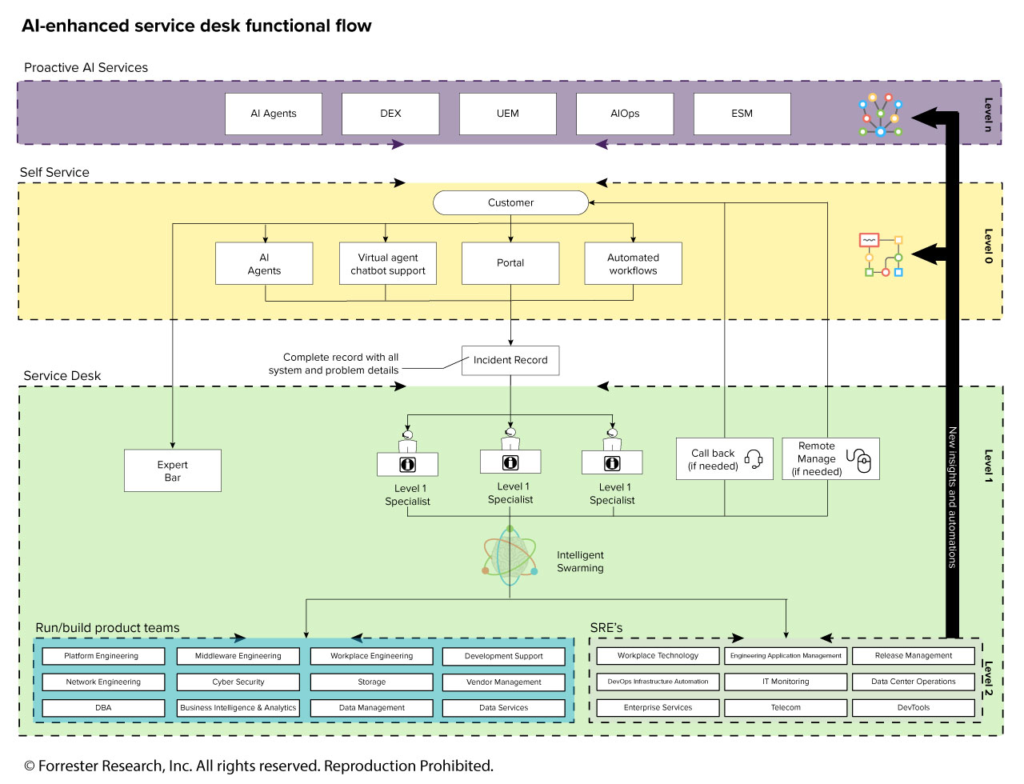
As digital transformation accelerates and employee expectations evolve, the traditional IT service desk model has reached a critical inflection point. The new report, The Forrester Guide To The AI-Centric Service Desk, outlines a compelling case for a fundamental redesign of IT support operations. Legacy service desks, which are structured around tiered human escalation and manual workflows, are no longer sufficient to meet the demands of a hybrid, digital-first workforce. Instead, organizations must embrace an AI-first approach that is pain-free, productive, personalized, pervasive, predictive, and product-centric. This transformation is not simply about deploying new tools; it requires a reimagining of the service desk as a strategic product. The AI-centric model integrates automation, agentic AI, and intelligent workflows to deliver seamless, context-aware support embedded directly into the user’s digital environment. By shifting from reactive ticket-based systems to proactive, data-driven operations, IT leaders can significantly enhance digital employee experience (DEX), reduce operational costs, and improve service quality at scale. Challenges Undermining Traditional IT Support Models The traditional three-tiered service desk structure, comprised of generalists, technicians, and subject matter experts (SMEs), has become a bottleneck in modern IT operations. Each handoff introduces delays, increases costs, and diminishes end-user productivity. Legacy systems also suffer from a lack of contextual awareness and personalization. Users are often forced to navigate complex portals or repeat information across channels, leading to frustration and disengagement. Moreover, the absence of predictive capabilities means that IT teams are constantly firefighting rather than preventing issues before they arise. Another critical limitation is the siloed nature of IT operations. Without unified endpoint management (UEM), digital experience monitoring, and AI for IT operations (AIOps), service desks struggle to effectively leverage data. This fragmentation hinders automation, limits scalability, and prevents IT from aligning support delivery with business outcomes. A Peek At The Future Service Desk While these challenges are not new to support organizations, the way we solve them is undergoing a dramatic change. This image illustrates the evolving service desk structure, featuring new levels of support delivered only through technology, some with the customer in the loop and others without.   To realize the full potential of the AI-centric service desk, IT leaders must adopt a multilayered strategy that integrates technology, process, and culture. At the foundation is a restructured support model that replaces traditional tiers with intelligent automation and specialized roles. Level n support, for instance, delivers no-contact resolution through proactive automation, combining AIOps, DEX, and UEM to detect and remediate issues before they impact users. Level zero support expands self-service capabilities through conversational AI (CAI), AI-enabled knowledge bases, and virtual agents embedded in collaboration platforms such as Teams and Slack. Level one specialists, equipped with advanced knowledge and intelligent swarming capabilities, handle complex issues that automation cannot resolve. Their collaboration with SMEs ensures faster root cause identification and minimizes unnecessary escalations. Meanwhile, level two site reliability engineers and product teams focus on building and maintaining automation, embedding security, and continuously improving support workflows. Do you notice what is missing? Build An AI-First Support Model First Emerging technologies enable this transformation. Enterprise service management platforms automate routine tasks and enhance agent productivity. DEX tools deflect incidents through proactive remediation, saving millions in operational costs. CAI and AI agents streamline workflows and reduce the number of human-handled requests. UEM platforms unify endpoint management and security, while AIOps reduces IT noise and accelerates incident resolution. Experience-level agreements shift performance measurement from infrastructure uptime to user satisfaction, aligning IT with business value. In conclusion, the AI-centric service desk is not a future aspiration — it is a present-day necessity. By adopting this model, IT leaders can transform support operations into a strategic enabler of productivity, resilience, and digital experience. The path forward demands bold leadership, cross-functional collaboration, and a relentless focus on user outcomes. Let’s Connect Have questions? That’s fantastic. Let’s connect and continue the conversation! Please reach out to me through social media or request a guidance session. Follow my blogs and research at Forrester.com. source

The AI-Centric Service Desk: A Blueprint For Modern IT Operations Read More »

Beyond the Metrics: How B2B Marketing Pros Should Use Storytelling Techniques To Communicate Value

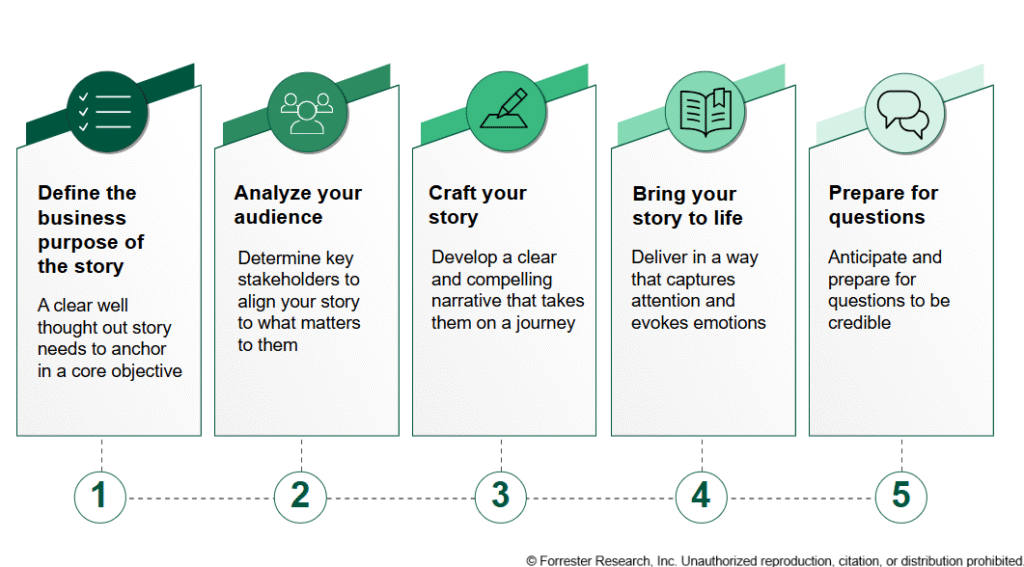
As a marketing professional, you live and breathe metrics: website traffic, leads generated (although you should be talking about buying groups engaged), pipeline contribution, engagement rates, and more. But when it comes to communicating marketing’s business value, the numbers alone just don’t cut it. They either aren’t understood by marketing’s stakeholders or they’re too disconnected from what those stakeholders personally care about. To truly resonate with stakeholders, B2B CMOs and other marketing leaders must do more than recite KPIs off their dashboards. You need a compelling story. Why Storytelling Matters In Marketing It’s a sad thing to say, but most marketers aren’t very good at the marketing of marketing. They’ve honed their craft with storytelling in brand campaigns and portfolio and product messaging yet often fail to apply those same storytelling skills to communicate marketing’s value. It’s a strategic skill that helps translate data into business impact, shift perceptions of marketing from cost center to growth driver, and inspire action and investment with stakeholders. At Forrester, we’ve defined a five-step framework to help CMOs and marketing leaders craft compelling, data-informed narratives that elevate their role and marketing’s contribution.   Start With The Business Purpose Of Your Story Before you build your story, ask: What am I trying to achieve? Are you shifting perceptions of marketing? Justifying budget or headcount? Preparing for a strategic pivot? Define your objective, then identify the marketing initiatives that best support it. These are your narrative anchors. Know Your Audience To Align Your Story You already segment your customers — do the same with your stakeholders. Executives want to see how marketing drives revenue and growth. Sales wants to know how you’re helping them close deals. Finance wants to understand ROI and efficiency. … and so on. Tailor your message to what each group cares about. Don’t rely on marketing jargon — use their language. Aim to inspire, not just inform. Build A Narrative, Not A Report Structure your story like a campaign: Beginning: What was the challenge or opportunity? Middle: What actions did marketing take? End: What were the outcomes, and why do they matter? Use data to support your points, but don’t let it dominate. Add emotional hooks — such as customer wins, team milestones, or market shifts — to make your story stick. Bring Your Story To Life How you tell the story matters as much as what you say. Choose the right delivery format: presentation, video, dashboard, or report. Use visuals to simplify complex data. Create contrast (before vs. after), tension, and resolution. Invite interaction by asking questions and encouraging feedback. Think of it as a performance, not just a presentation. And practice beforehand. Anticipate And Embrace Questions A good story sparks curiosity. Be ready to: Address objections and clarify assumptions. Reinforce your key messages through answers. Stay calm and adaptable when the unexpected comes up. Treat questions as engagement, not interrogation. They’re a sign that your story is landing (or at least being heard). A Final Thought: Storytelling Is A Power Skill As a marketing professional, you already know how to craft compelling messages for customers. Now it’s time to apply that same skill internally. By mastering storytelling, you’ll influence strategic decisions, secure greater investment, and elevate the perception of marketing. Because when you tell the right story, marketing isn’t just seen — it’s believed. Forrester clients can read my latest research and schedule a guidance session to discuss how to drive change in the way you tell marketing’s value story. source

Beyond the Metrics: How B2B Marketing Pros Should Use Storytelling Techniques To Communicate Value Read More »

AMD Advancing AI 2025

At AMD’s Advancing AI 2025, event highlights included details about AMD’s strategic momentum — with a series of focused announcements spanning data center growth, product innovation, and ecosystem expansion. Specific points of emphasis included the unveiling of new AI-optimized hardware, enhancements to AMD’s open AI software stack, and the introduction of a purpose-built AI rack system designed for scalable enterprise deployment. AMD also spotlighted key partners on stage, underscoring the real-world traction and significance of its solutions. Inferencing And Agentic AI AMD is strategically aligning its portfolio to meet the surging demand for AI inferencing. It anticipates that by 2028, the total addressable market for data center AI accelerators will reach $500 billion — with inferencing workloads surpassing training in demand for compute. To address this, AMD is positioning its portfolio of products (CPUs, GPUs, DPUs, and SoCs) as foundational infrastructure for these AI workloads. In parallel, AMD is closely tracking the rise of agentic AI — autonomous, goal-driven AI systems designed to deliver business outcomes. These intelligent agents are expected to significantly amplify enterprise demand for scalable, high-performance compute, thus reinforcing the need for the robust, future-ready AI infrastructure that AMD provides. Data Center Market AMD is delivering a comprehensive compute portfolio designed to meet the evolving demands of enterprise AI. This is reflected in the data center market share gains seen by AMD in both CPUs and GPUs. AMD offers a broad spectrum of data center CPUs, enabling organizations to align compute capabilities with specific AI model requirements. AMD is aggressively expanding its footprint in the AI accelerator space, positioning its MI350 Series as a competitive alternative to NVIDIA’s latest offerings. By publicly benchmarking performance against both its previous generation (MI300A/X) and NVIDIA’s GB200 and B200, AMD is signaling strong confidence in its architecture and execution. Open Ecosystem And Collaboration AMD is strengthening its AI software position with ROCm 7, the latest evolution of its open software stack, engineered to enhance developer productivity and streamline integration with leading AI frameworks and libraries. This continued investment in open ecosystems reflects AMD’s commitment to enabling scalable, enterprise-grade AI solutions. In parallel, the introduction of the AMD Developer Cloud marks a strategic move to democratize access to AI infrastructure. By offering a managed, cloud-based development environment, AMD is lowering the barrier to entry for developers and open-source contributors — accelerating innovation and adoption across the AI landscape. Key Takeaway These announcements reinforce AMD’s successes and momentum in the AI, data center, and workplace markets. Although the event did not provide any surprise reveals, AMD showed confidence in its strategy and performance — prioritizing delivery over hype. If you have any questions about AMD or how its solutions address your needs, Forrester clients can request a guidance session or reach out to your account team. source

AMD Advancing AI 2025 Read More »

Build Your Proactive Security Program By Matching Attacker Velocity

Organizational opacity, bad defaults, compliance-driven security, and institutional inertia render your security initiatives less effective than one might hope, and attackers are keenly aware of this. Attackers ship hourly. Defenders hold quarterly reviews. That delta is your breach window. While you perceive your organization as a collection of security controls, threat actors take a more holistic view and regard the gaps between — as opposed to merely within — the controls as a veritable catalog of opportunities. Your security information and event management (SIEM) platform dutifully logs every failed login attempt, yet attackers employ valid credentials with the audacity of a most unwanted guest at an exclusive soirée. Your endpoint protection blocks malware with commendable efficiency, but they live off the land with PowerShell. Your network segmentation stops lateral movement, but they pivot through trusted service accounts with remarkable dexterity. This fundamental mismatch isn’t merely technical in nature and can stem from sluggish or high-friction operational tempos. By the time you’ve identified a gap, documented the risk, and convened five change review sessions with three different teams to deliberate upon what the fix should be (because everyone sees a different slice of your ecosystem due to your siloed operations), attackers have already moved through numerous vulnerabilities unseen. One might say they’ve been quite busy. Effective security must mirror attacker agility, and this author has it on good authority that such approaches yield the most favorable results. Red-teaming and penetration tests are important but hardly a panacea: Real security continuously challenges assumptions and constantly validates. One must embed attacker-style experimentation directly into daily processes. Want to hear more? At Forrester’s Technology & Innovation Summit EMEA 2025, we will have a dedicated security and risk track. In my session, we’ll explore proactive security from the lens of threat actors and how to obtain and utilize a holistic view of the threats and opportunities within your ecosystem — a pressing matter for the discerning security professional. Attendees can expect to learn how to: Shift from reactive controls to proactive defense. Think like an attacker to stop threats before they escalate. Turn every breach simulation into a faster, stronger response blueprint. Ensure that your current security program will survive contact with tomorrow’s threats. Join us in London on October 8–10 to build defenses that work when it matters most. source

Build Your Proactive Security Program By Matching Attacker Velocity Read More »

What’s Hot For Identity And Access Management In Asia Pacific In 2025?

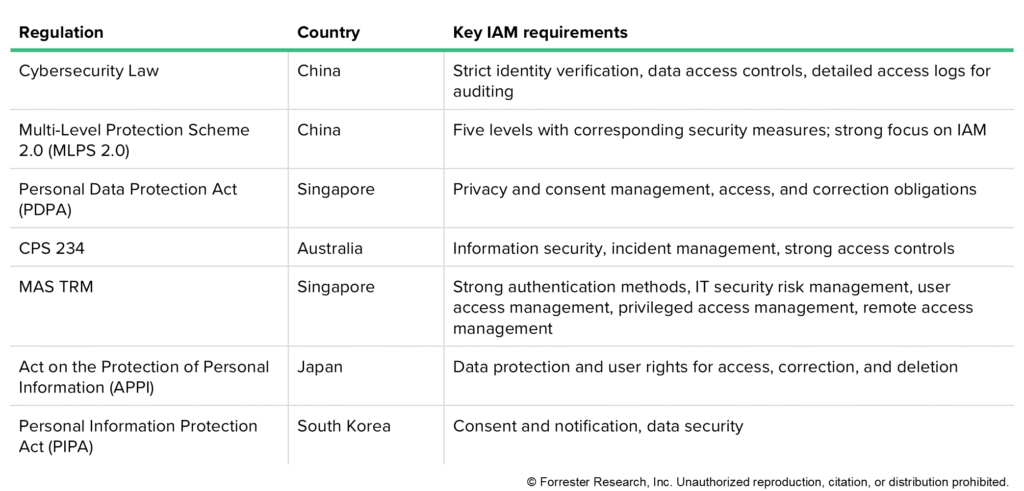
In my most recently published report, I discuss the key adoption drivers, technologies, and use cases for identity and access management (IAM) in Asia Pacific. Organizations In APAC Will Increase Their IAM Spend Forrester’s 2025 data shows that APAC technology decision-makers anticipate an increase in spend on customer and workforce IAM (CIAM and WIAM, respectively). This is due to: A growing need to compete on digital experiences. Effective IAM orchestration supports seamless and secure customer journeys. Customers benefit when companies leverage IAM solutions to enhance digital onboarding with features, such as biometric authentication, that provide convenience and security for building customer trust. Companies migrating to cloud and hybrid environments. IAM solutions help to facilitate smooth and secure transitions to cloud with features like cloud-native integrations, scalable identity management, and hybrid environment support. SaaS-based IAM solutions also offer rapid deployment and scalability to accommodate fluctuating workloads and user access needs. Risk from reliance on ecosystem partners. As organizations in APAC increasingly rely on ecosystem partners for cloud services, IT outsourcing, and digital business transformation, they run the risk of major data breaches. Effective IAM solutions help to mitigate risk through features like multifactor authentication, continuous monitoring, and least-privilege access. Fragmented regulatory requirements. Countries in APAC have varying IAM requirements (see figure below). Businesses that operate in multiple countries across APAC need IAM solutions that support compliance, data protection, and security to avoid penalties.   Consumer Behavior And Security Needs Are Driving CIAM Growth While WIAM is relatively mature in APAC, CIAM is still rapidly evolving. Consumer behavior is driving this growth: Customers are engaging with brands across devices, platforms, and channels, making it challenging for firms to manage identities and protect data. Furthermore, high mobile adoption and tech-forward cultures in markets like India, China, and Southeast Asia are shaping APAC consumers to be more comfortable with biometrics than their Western counterparts. At the same time, increasingly sophisticated cyberthreats — such as deepfakes — are encouraging APAC businesses to adopt modern CIAM solutions that enhance security. This is especially crucial as APAC’s rapid digital growth, alongside its mobile-first mindset, makes it vulnerable to identity fraud and cyberattacks. Select IAM Technologies Based On Your Use Case Firms are adopting a variety of IAM technologies to address different use cases and challenges. We highlight some key technologies below: Unified identity governance. Many multinationals in APAC struggle with fragmented identity governance across multiple regions and cloud environments. Unified identity governance solutions can help businesses to standardize these identities across global operations while better complying with differing regulations across countries. Machine identity management. The rapid increase in cloud-native applications, APIs, IoT devices, and continuous integration and delivery pipelines has made machine identities the most vulnerable and fastest-growing attack surface. As generative and agentic AI become more widely adopted in APAC, we expect that businesses will leverage machine identity management solutions to manage identities and access. Cloud identity entitlement management (CIEM). CIEM is an essential aspect of IAM strategies in APAC, owing to the region’s swift adoption of cloud services. To manage the risk of overprivileged access and configuration errors, CIEM enforces least-privilege access, automates policy enforcement, and monitors entitlements. Decentralized digital identity (DDID). As more firms in APAC look to improve privacy and reduce reliance on centralized providers, adoption of DDID is gaining traction. By using DDID technologies, firms can reduce identity fraud and improve operational efficiency by reducing identity verification times. Single sign-on (SSO). APAC firms are prioritizing SSO for CIAM to better serve digital-savvy customers with seamless login experiences across channels and platforms. This is table stakes for firms that want to compete on digital customer experience and retain customers. To explore these insights in greater detail — and learn more about specific IAM use cases and examples — read our full report, The State Of Identity And Access Management In Asia Pacific. Forrester clients can schedule a guidance session or inquiry with me for further sharing and discussion. source

What’s Hot For Identity And Access Management In Asia Pacific In 2025? Read More »

Capgemini’s $3.3B Bet On WNS: The End of Traditional BPO As We Know It

Capgemini’s recent announcement of its intent to acquire WNS for $3.3 billion represents more than just consolidation in the business process outsourcing (BPO) space. This deal reflects a decisive shift in the industry: The traditional, labor-intensive outsourcing model is giving way to intelligent, AI-powered service delivery. In today’s BPO market, AI is no longer a differentiator; it’s the foundation for staying relevant. The AI Disruption: A Tectonic Shift In BPO We know that AI is fundamentally reshaping the BPO landscape. But what exactly is changing? What began as a gradual evolution — intelligent document processing, predictive analytics, conversational AI — has accelerated into full-scale transformation. Agentic AI and autonomous workflows are redefining the very nature of outsourced work. Legacy BPO providers, built on the promise of service delivery excellence, are now struggling to keep pace. Operational strength is table stakes. Siloed AI and analytics initiatives deliver incremental value, but they fall short of creating transformational experiences. In contrast, modern BPO providers are becoming strategic partners. They help clients unlock value through real-time insights, data-driven decision-making, and AI-powered services. A Broader Industry Movement Capgemini’s move is part of a larger trend. Leading IT and BPO service providers are racing to build AI-first offerings. IBM acquired Neudesic to strengthen AI and cloud capabilities. Accenture acquired Analytics8 and Sentelis to boost its data and AI consulting capabilities. Tata Consultancy Services and Infosys have also doubled down on AI investments, embedding machine learning and automation into their delivery models. BPO service providers are also expanding their AI footprint through acquisitions and partnerships. Concentrix acquired VoiceWorx.ai, a conversational AI platform, and BlinkCX, a customer experience consulting firm, to expand its iX product suite. Movate acquired Prescience, a data science company, to bolster its data and AI services. Teleperformance (TP) recently partnered with Sanas, an AI-powered accent softening technology. These moves reflect a clear trend: BPO providers that fail to evolve into AI-first service providers risk irrelevance. How Do You Respond To These Changes And Identify Partnerships For This AI Future? While many enterprises are embracing AI-first delivery models, sourcing and performance management frameworks haven’t kept pace. Traditional procurement-led RFPs often fail to assess AI maturity or innovation potential. To stay ahead, tech leaders must rethink how they evaluate and engage service providers. Here’s how: Prioritize AI And Innovation Competencies Move beyond traditional RFP metrics. Assess providers on AI maturity, innovation roadmap, and ability to co-innovate. Use Forrester’s research and RFP templates to guide your evaluations. Redefine Service Levels Shift from SLA-based contracts to outcome-based models. Focus on KPIs that reflect business impact, and evaluate cultural fit and co-innovation competencies. Outcome-based contracts are essential to unlocking value from AI investments. Build AI-Ready Governance Models Ensure that your internal teams can manage AI-powered services. This includes strengthening data governance, ethical AI practices, and change management capabilities. Capgemini’s acquisition of WNS is a wake-up call for traditional BPO providers. The future of outsourcing is intelligent, automated, and outcome-driven. Tech leaders must reengineer their sourcing strategies to be AI-first and AI-proof. Read Forrester’s report, Four Forces Shape Technology Services In 2025, to scale and outperform with AI. If you are a Forrester client, you can also access A Blueprint For Selecting The Right Technology Or Service Partner. Visit my Forrester bio page and click “Follow” to receive notifications. You can also follow me on LinkedIn here. Forrester clients can also schedule an inquiry or guidance session with me to delve deeper into this topic. source

Capgemini’s $3.3B Bet On WNS: The End of Traditional BPO As We Know It Read More »

AdTech’s Inflection Point Signals More Compelling Customer Experiences

Advertising technology (adtech) is overcomplicated. It started as a simple scaffolding for delivering and managing banner ads. Now, it’s a sprawling, tangled matrix of ad servers, ad exchanges, supply-side platforms, demand-side platforms, customer data platforms, data clean rooms, brand safety tools, mobile measurement partners, and more. Advertisers are fed up with becoming system integrators, consumers are fed up with audience targeting’s status quo, ad platforms are illegally dominant, and some adtech is commodifying. Convergence, data deprecation, curation, and supply path optimization are adtech’s new currencies. Going forward, adtech must right-size and (re-)focus on compelling customer experiences by enabling: Deeper customer understanding. Adtech is only as valuable as the actionability, structure, and strength of the data powering it. Without inferring intent and predicting performance, adtech becomes dumb pipes. Data deprecation diminishes adtech’s ability to glean insights from browsing and shopping signals but also incentivizes solutions to signal loss. Solutions demand identity resolution, the authenticated internet, and clearly measuring ads’ full-funnel impacts. Adtech enables all these elements that empower advertisers to have sequential, resonant dialogues with prospects. Advertising so relevant that it feels organic. Sergey Brin and Lawrence Page theorized that “advertising funded search engines will be inherently biased towards the advertisers and away from the needs of the consumers.” Now, Alphabet is the world’s biggest ad platform trying to reconcile consumers’ needs with those of advertisers, publishers, and regulators. To its credit, Google’s ad revenue grows more than twice as fast as Google.com’s traffic; the relevance of Google’s machine learning-powered ads enables Google to sell more ads without commensurately growing traffic. Others must follow suit by developing or renting robust machine learning to serve increasingly relevant advertising. A streamlined supply chain. The supply chain built for display ads is increasingly applied to advertising’s two fastest-growing channels — CTV and commerce media — to maximize yield and response rates. But that chain is convoluted by stakeholders robbing Peter to pay Paul, necessitating standards such as ads.txt and sellers.json. In that vein, initiatives like The Trade Desk’s OpenPath, Magnite’s ClearLine, and GroupM’s Premium Marketplace promise to maximize working media and minimize supply chain costs. With help from technology and service providers as well as standard-setting bodies, advertisers must get as close as possible to consumers by identifying and eliminating unnecessary hops in supply paths. Creative and media to be more than the sum of their parts. Deep customer understanding, excellent machine learning, and a streamlined supply chain are moot without compelling creative, which is the strongest determinant of media’s performance. For decades, creative was separate from media and fraught with arbitrary taste-making. Then, iOS 14 limited audience targeting, and creative automation gained currency. Now, creative advertising technologies are end to end, spanning creative production, testing, and optimization. Next, creative adtech must close the loop between creative intelligence and media planning to make creative the key factor in media decision-making. Introducing The Forrester Tech Tide™: Advertising Technology, Q3 2025 The Forrester Tech Tide™: Advertising Technology, Q3 2025, forms and reflects adtech’s inflection point. It analyzes the maturity and business value of adtech categories that support modern advertising and provides example use cases and vendors. Let us know what you think. As always, feel free to contact us. source

AdTech’s Inflection Point Signals More Compelling Customer Experiences Read More »

What If Half Your Employees Were Robots?

The broader manufacturing sector has led the adoption of robots for decades. When I’m speaking with clients about adding robots to their operations, I frequently quote a useful metric called robot density. This is the number of industrial robots operating in a country, divided by the number of humans employed in that country’s manufacturing sector. Germany tops the ranking in Europe (and comes fourth globally), with 429 industrial robots per 10,000 human workers. That’s one robot for every 23 people employed in German factories. Even South Korea, which currently holds the top spot, only manages 1,012 industrial robots for every 10,000 human workers. That’s one robot for every 10 people. Amazon Now Employs Almost As Many Robots As People I returned from my summer holiday to see that a non-manufacturer — e-commerce company Amazon — now claims to operate 1 million robots in its warehouses. That’s a big number, but what’s more interesting is Sebastian Herrera’s subsequent observation in The Wall Street Journal that the company today employs around 1.5 million people. In other words, there are almost as many robots as people at Amazon. What happens when every second manufacturing worker isn’t human? Image: Hexagon’s new humanoid robot, Aeon (photograph by Paul Miller) Honestly, we don’t know, and we’re nowhere near that point in manufacturing yet. Most manufacturing jobs are very different from most order fulfilment jobs in an Amazon warehouse. Those manufacturing jobs are complex, diverse, and made up of many discrete tasks. Some of those discrete tasks are well-suited to physical automation (so a robot could do them), some are well suited to software or cognitive automation (so AI could do them), and some are still very much the preserve of human beings (either because they’re cheaper than a robot or smarter than a robot, depending on the task and the human). The trick is to find the right balance between the three, and that’s what Forrester’s automation triangle tries to do. One area we need to watch as automation becomes more prevalent is the effect this has on how the human workforce is managed and treated. As the number of robots approaches (or even passes) the number of people, it becomes easier to rationalize designing workspace and workflow for the benefit of the robots. I’ve already seen early examples of this, where the human workforce essentially becomes a group of flesh-and-blood robots: Their every task is rigidly defined and every workflow is constrained and regimented, mostly so the humans don’t confuse or inconvenience the robot-dominated process. Ingenuity, creativity, flexibility, and humanity are programmed out, with immediate implications for the human workforce and longer-term consequences for the manufacturer and the wider society of which it is part. Some caveats to close The robot density metric is not mine; it comes from the International Federation of Robotics (IFR), which gathers data on industrial robots around the world, publishing interesting statistics each year on sales, robot density, and more. The numbers I cited are for 2023 and are the latest generally available to nonmembers of IFR. IFR also tracks metrics for service robots, which include automated guided vehicles (AGVs) and autonomous mobile robots (AMRs). Many of the robots operating in Amazon warehouses are actually service robots and not industrial robots, so we shouldn’t read too much into this near-milestone … yet. If that caveat didn’t make sense, then my report, Focus On The Use Case When Evaluating Physical Automation, describes some of the differences between eight forms of physical automation, including industrial robots, AMRs, AGVs, and more. source

What If Half Your Employees Were Robots? Read More »

Announcing The Forrester Wave™: Zero Trust Platforms, Q3 2025 — Choosing A Platform Solution For Your Zero Trust Journey

The latest edition of our Zero Trust platform vendor evaluation, The Forrester Wave™: Zero Trust Platforms, Q3 2025, published today. It highlights how this market continues to improve upon delivering unified solutions that help simplify and operationalize Zero Trust for organizations. Beginning with The Zero Trust Platforms Landscape, Q1 2025, we researched major players in this market to identify the platform solutions that best serve the alignment of Zero Trust architecture to support security outcomes. We evaluated 10 vendors in this Wave: Akamai Technologies, Broadcom, Check Point Software Technologies, Cisco, Cloudflare, Fortinet, Microsoft, Palo Alto Networks, Trend Micro, and Zscaler. We evaluated each vendor against three core inputs: a questionnaire for the vendors to complete, executive strategy briefings and demos, and interviews of up to three reference customers. The Wave included scores for 14 current-offering criteria and eight strategy criteria. Read the full report. Forrester defines Zero Trust platforms as: A unified set of core security technologies that serve as the foundation to enable the Zero Trust model of information security. These platforms deliver a variety of functionalities across data, workloads, networks, users, and devices, improving automation, orchestration, and visibility for analytics. Zero Trust platforms optimize native, integrated products and third-party integrations to support a cohesive Zero Trust technology ecosystem. Zero Trust is a foundational security model, now widely embraced across industries. While its value is well understood, the real challenge lies in effectively implementing it. This is especially true for organizations navigating misalignment across various disciplines or business functions in addition to the complex technology landscape. Many of the vendors in this evaluation have positioned their platform solution as being aligned to Zero Trust. It is important to note, however, that none of these vendors should be viewed as your one-stop shop. Products or platforms don’t deliver Zero Trust by themselves. After all, Zero Trust is a strategy, not a product. Nevertheless, organizations evaluating Zero Trust platforms to enable their Zero Trust implementation should focus on: Balancing best-of-breed and platform solutions: A hybrid approach, using platforms for core controls and best-of-breed tools for specialized needs, helps avoid excessive complexity or vendor lock-in. Prioritizing integration and data correlation: Strong native and third-party integrations are essential for unified visibility, streamlined policy management, and effective incident response. Understanding AI capabilities: Distinguish between AI-enhanced tools that support human analysts and AI-driven platforms that automate decisions. The right fit depends on an organization’s maturity, risk tolerance, and skill sets. While the Zero Trust platforms market is established, it’s still maturing. The expansiveness of solutions and the added complexity of new risks or threats, such as the presence of AI agents, makes achieving an advanced Zero Trust architecture more complicated. Making it difficult to achieve the ideal state, however, is sort of the point. Zero Trust was never meant to be an end state — it’s a continuous journey and a mindset that prioritizes verification over assumption. For this market to mature, it must continue to innovate in areas that will help reduce complexity, ease deployments, and streamline security tasks to ensure that enterprises are future-proofed to defend against tomorrow’s new threats. For a deeper look into the market, Forrester clients can read the full report, The Forrester Wave™: Zero Trust Platforms, Q3 2025. Check out the results for all 10 vendors, including the specific criteria that differentiated them and why. If you have questions about the changes happening in the Zero Trust platform market, schedule an inquiry or guidance session with me. source

Announcing The Forrester Wave™: Zero Trust Platforms, Q3 2025 — Choosing A Platform Solution For Your Zero Trust Journey Read More »