Forrester

Google Cloud And Oracle Aggressively Discount To Keep US Federal Business

Over the past few days, both Google Cloud and Oracle announced massive price reductions in their contracts. The General Services Administration (GSA), which oversees federal procurement, has been pushing for more competitive pricing from the cloud providers. Google has yet to announce discounting specifics, but Oracle’s discounting terms are listed below; its previously announced temporary 71% discount on specific Workspace contracts likely set the precedent. Oracle’s federal government discount offering is available until November 30 this year and includes the following: A 75% discount on Oracle’s license-based technology, which includes database, integration, security, and analytics Substantial base discounts on Oracle Cloud Infrastructure (OCI) No data egress fees to another cloud provider’s FedRAMP Moderate, High, or DoD IL4 and IL5 A 33% discount on each dollar spent on eligible Oracle Cloud services that can be put toward Oracle technology or tech support (this also likely helped set the precedent) Pricing parity with commercial offerings, with no additional security or government uplifts charged in OCI Access to white-glove migration services for modernizing legacy Oracle services to OCI GSA indicated that discussions with Amazon Web Services and Microsoft Azure are already occurring but in earlier stages as compared to Google. Notably, both Oracle and Google’s recent Workspace discounts are short-lived, lasting only through November and September of this year, respectively. Why is the federal government such a coveted customer? The US government stands as one of the world’s largest consumers of IT services. From the Department of Defense to the IRS, federal agencies demand cloud infrastructure that is secure, scalable, and resilient. Securing a federal contract often translates into multiyear engagements with predictable revenue. These contracts also serve as strategic footholds. Once a provider is embedded within one agency, it becomes significantly easier to expand into others. The federal ecosystem is uniquely conducive to this “land and expand” approach, thanks to shared procurement frameworks and inter-agency collaboration on best practices. So why have the short timeline and deadlines been set out? The end of the federal fiscal year approaches (Sept. 30), and budget holders in federal government will be looking to spend any extra budget before then. These discounts give them this opportunity and can also be used to align with one of the govt.’s overarching goals: operational efficiency. It is clear that these cloud players are priming the arena for last-minute contracts before the end of September. That said, the path to federal business is far from straightforward. Providers must navigate a labyrinth of procurement rules, heightened scrutiny around data privacy and national security, and the ever-shifting landscape of political influence. Anyone not already positioned to do work with the federal government won’t meet these deadlines. Many of those seeking to gain advantage during this era of government efficiency are busy repackaging and discounting. What it means If you’re in the public sector, the GSA’s move to gain discounts has set a precedent for other government groups. The OneGov consolidation initiative is set to expand into more IT service categories, such as hardware, cybersecurity, and platform engineering, going forward. There may be options to renegotiate or newly sign additional contracts that could power migrations or help your group navigate this landscape with new, smaller teams (if your group has been impacted by DOGE). As agencies explore alternatives to traditional procurement in a tight budgetary environment, taking advantage of these consolidated vehicles should be top of mind. Even internationally, there is more precedent to push hard at your cloud partners for at least short-term discounts, even if you’re not using GSA as a contracting vehicle. source

Google Cloud And Oracle Aggressively Discount To Keep US Federal Business Read More »
The Secret To Martech Success? Think Like A Product Manager

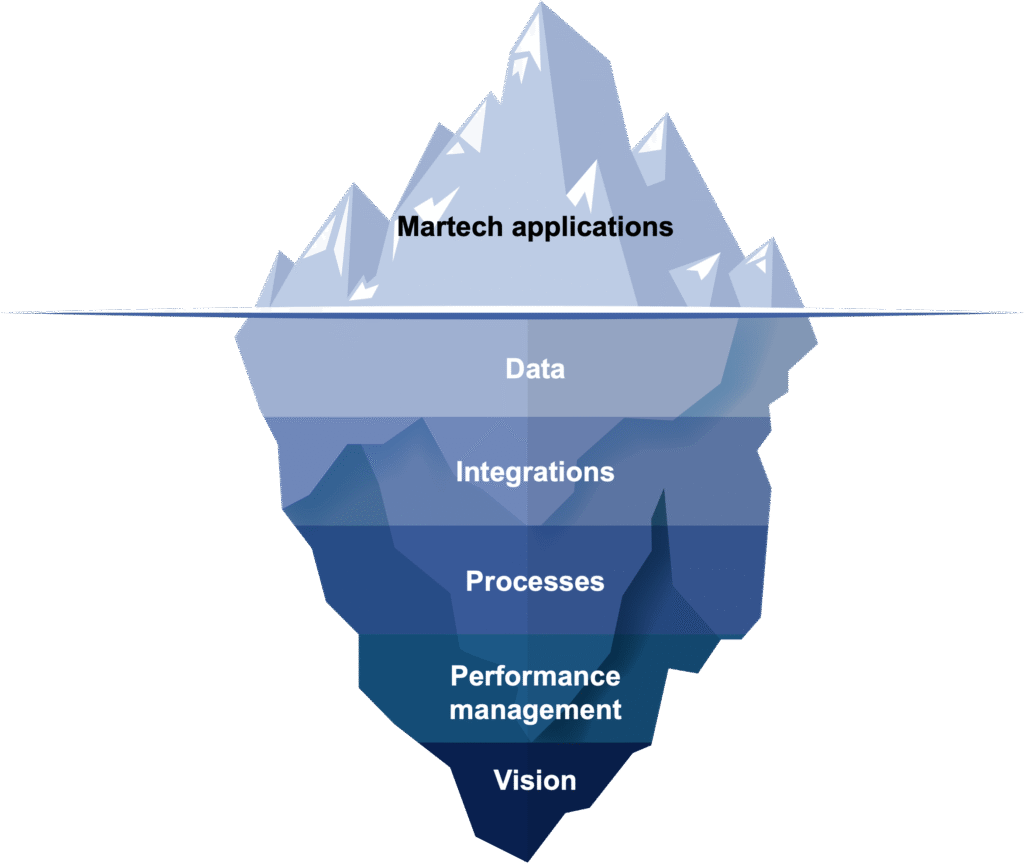
Marketing technology is the backbone of modern customer engagement. It enables businesses to generate customer insights, personalize experiences, and orchestrate campaigns. Our attention often focuses on the technology itself, with a tendency to overindex on features and functionality; however, raw technology isn’t the arbiter of success. Maintaining an advantage is dependent on the people and organizational model that supports the martech ecosystem and transforms disparate technologies and data into a cohesive system.   Martech’s Organizational Challenge: A High-Maintenance, High-Value Ecosystem Today, the martech landscape is far from static. Martech is built on a dynamic ecosystem of data, integrations, processes, measurement, and strategy. And corporate efficiency mandates, ever-changing consumer trends, and the growing role of AI are just some of the factors driving technical evolution in marketing. This complexity and continuous change makes martech management increasingly labor- and resource-intensive. Companies must hire, train, and organize staff to deploy, manage, and utilize martech. And here’s the catch — none of this is optional. Business growth depends on your ability to effectively leverage marketing technology. The stakes are high, and companies need a future-proof strategy for navigating this environment. Martech’s Organizational Solution: Deliver Marketing Technology Like A Product Business What if we stopped thinking about martech as simply a collection of tools, projects, and systems to manage? Instead, imagine treating it like a product — intentionally designed, iteratively improved, and continuously evolving to meet user needs. Conceptualizing martech as a product acknowledges an important reality: Businesses are well positioned to build products when they deploy, integrate, and arbitrate multiple tools and systems. A product approach ensures alignment between these capabilities and the goals of the business. Product teams act as the connective tissue between marketing, IT, and other stakeholders by centralizing martech knowledge and skills, tracking martech delivery and business value, managing vendors, streamlining processes, and balancing short- and long-term plans. Read Optimize The Organization Behind Your Martech to explore Forrester’s guidance on creating a product-driven martech mindset that maximizes business growth. To learn more about martech and organizational best practices, please request a guidance session or inquiry. source

The Secret To Martech Success? Think Like A Product Manager Read More »

Master Tech Mayhem: Why Technology Leaders Can’t Miss Forrester’s 2025 Technology & Innovation Summit North America

Geopolitical volatility is reshaping global markets, AI is rewriting the rules of business, and boards are demanding measurable business impact from every technology investment. Technology leaders must do more than execute five-year plans that deliver incremental improvements and barely pay the interest on tech debt. They need to get comfortable navigating relentless technology disruption, making bold decisions in the face of uncertainty, and building organizations that are not just resilient but ready to thrive, no matter what comes at them. Forrester’s Technology & Innovation Summit North America is designed to take you where you need to go. Visionary keynotes provide inspiration and lay out the future of tech, while various breakout sessions, workshops, and special programs deliver the practical strategies, roadmaps, case studies, and tools that will help you apply what you learn faster. So how do tech leaders transition from a reactive to a proactive posture in the face of relentless mayhem? Here are some of the topics we’ll cover at the Summit in our keynote presentations. Take Agentic AI From Hype To High Performance The only force rivaling the chaos of geopolitical tensions and trade wars is the whirlwind pace of AI innovation. From the sudden rise of generative AI to the rapid emergence of agentic systems, tech leaders are navigating a wave of disruption unlike any before. As excitement around agentic AI intensifies, so do concerns about artificial general intelligence (AGI); its potential for misuse; the ethical challenges it raises; and, as with every major AI leap, the fear of being left behind. In a keynote entitled “Agentic To AGI: It’s The Journey, Not The Destination,” Brian Hopkins, Forrester VP of emerging technology and principal analyst, will explain the importance of taking practical steps today while preparing for tomorrow’s AGI inflection points. To excel with AI, leaders must align initiatives with business goals, focus on foundational priorities, and build trust through strong data foundations. Resist the temptation to chase every possible use case; instead, operationalize AI with pragmatism and collaboration. Don’t fixate on AGI but rather leverage agentic systems that are already reshaping business and IT. Use AI To Transform Your Own IT Operating Model I started off my career in tech as a consultant on enterprise resource planning (ERP) implementations and then as a presales technical architect for one of the largest infrastructure vendors in IT. We’re still struggling with some of the same issues, such as end-to-end visibility, tech stack optimization, technology lifecycle management, asset management, and incident management. AI might be the missing ingredient to solve some of these most basic and intractable challenges. In his keynote “AI Inside: The Rise Of The Intelligent IT Operating Model,” Charles Betz, VP and principal analyst, will examine how intelligent agents are becoming active participants in IT operations. This is bigger than just AIOps; it’s the transformation of the IT operating model, its governance, its architecture, and the systems we use for IT management itself. Scale Your Ambitions Without Breaking The Bank I’m sure many tech leaders reading about the power of agentic AI are thinking, “Wow, that’s great, but who is going to pay for the significant IT modernization needed for AI success?” With innovation accelerating — while budgets are tightening due to economic uncertainty — financial stewardship is fast becoming a core leadership skill. In her keynote “FinOps And Beyond: Scaling Tech For The Future Without Breaking The Bank,” Tracy Woo, principal analyst, will describe the secret to managing spiraling cloud costs: for example, FinOps practices that emphasize cross-functional collaboration to handle the constantly fluctuating, usage-based pricing. But don’t give up on IT financial management (ITFM) just yet. Organizations such as Samsung are reimagining ITFM by using FinOps approaches, and Tracy will have a guest from Samsung with her at the keynote to explain how. Address Your Data Readiness If You Want AI Success Without clean, governed, and accessible data, AI initiatives stall. Data strategy can no longer be an afterthought — it must be embedded in every AI effort from the start. Right now, data-related challenges from Forrester clients run the gamut from the strategic (“How do we establish robust data governance processes?”) to the technical (“How do we build advanced architectures to improve data quality and insights?”). There are also questions about skills and culture, especially around fostering a culture of data literacy or identifying the essential steps in enabling better decision-making and unlocking the full potential of analytics. Why are tech, data, and AI leaders struggling so much? There are a few reasons: They’re under immediate pressure to deliver, so strategy often seems like a “nice-to-have” and not a must-have; data teams become “order takers” rather than strategic partners; and many leaders are too focused on the technology (data platforms) without considering the broader organizational and people-related challenges. Michele Goetz, VP and principal analyst, will address all of these issues in her keynote, “Data Readiness Is The Number One Factor For AI Results.” We’ll also show attendees how to overcome these challenges with real-world case studies from organizations that have done it, including an interview between Sharyn Leaver, Forrester’s chief research officer, and our inaugural winner of Forrester’s Data & AI Impact Award. Reimagine Your Enterprise Applications As An Agentic Business Fabric AI agents aren’t just enhancing business applications, such as ERP, CRM, SCM, and HCM; they’re dismantling and rebuilding them from the ground up into something completely unrecognizable. In the future, your agentic business fabric will offer experiences that adapt to the user and their context: It will erode application silos. AI agents will increase the strategic importance of structured processes by making enterprise data more complete and processes more accessible. I wouldn’t be surprised if the monolithic, siloed ERP systems I helped implement 25 years ago are still deployed, holding businesses back. In her keynote “The AI Agent Revolution Is Reshaping Business Applications Into An Intelligent Business Fabric,” Kate Leggett, VP and principal analyst, will discuss why tech leaders must rethink the value proposition of enterprise business apps and

Master Tech Mayhem: Why Technology Leaders Can’t Miss Forrester’s 2025 Technology & Innovation Summit North America Read More »

Revolutionizing IT Management With Generative AI: The Future Is Here

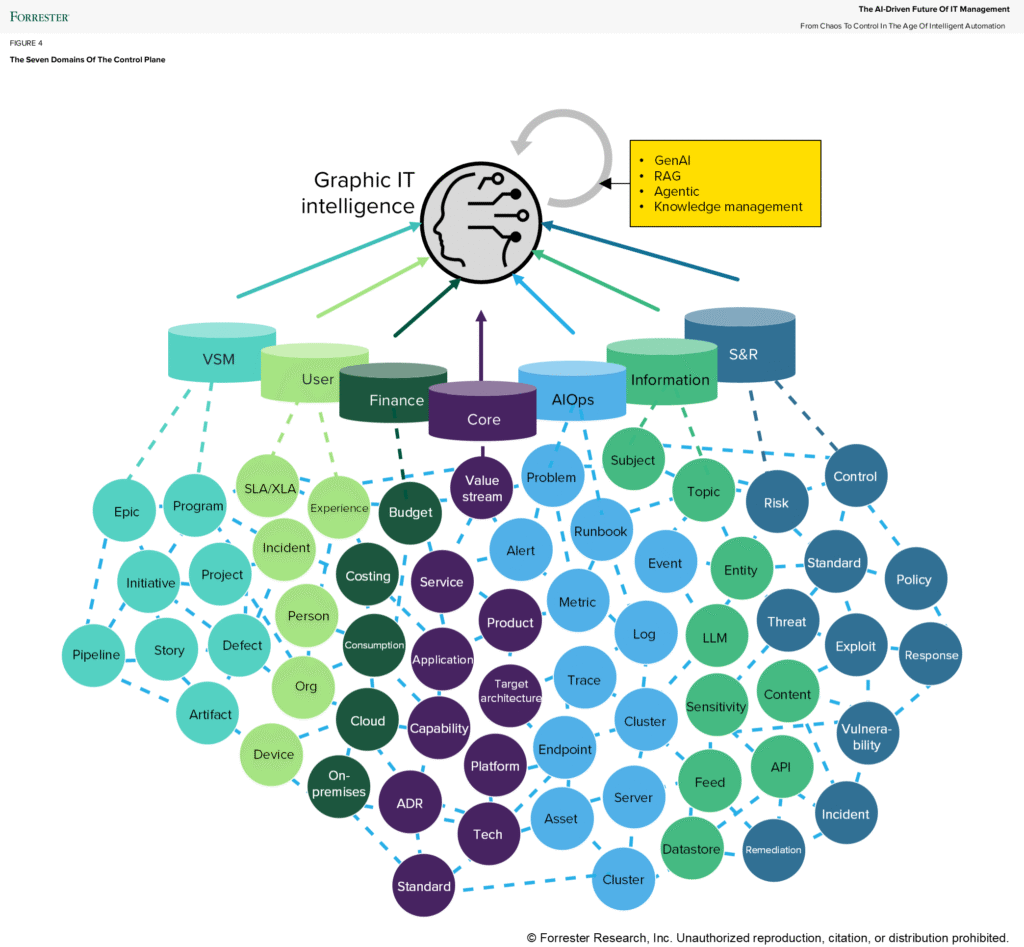
  The world of IT management is undergoing a seismic transformation, driven by generative AI (genAI). While much of the discussion around genAI has revolved around its business-facing applications, the technology is poised to reshape IT operations themselves. From improving visibility and collaboration to accelerating learning and decision-making, genAI offers IT leaders a unique opportunity to rethink how their organizations operate and thereby gain strategic digital advantage. For CEOs and CIOs, genAI promises more than incremental productivity gains; it provides a new layer of instrumentation that enhances visibility, velocity, and adaptability across the digital enterprise. This isn’t just about automating tasks or streamlining workflows. GenAI enables organizations to sense, decide, and act with greater precision and speed, transforming strategic decision-making into a continuous, real-time process. Take, for instance, the way genAI collapses cycle times. Ideas that once took weeks or months to move from inception to implementation can now be executed in days. Teams empowered by AI tools can brainstorm, prioritize, and deliver solutions with unprecedented efficiency. GenAI is also proving invaluable in breaking down silos, fostering collaboration, and amplifying collective intelligence. IT leaders must recognize the paradox at play here: While managing billion-dollar portfolios and cutting-edge customer-facing systems, many IT departments still rely on outdated processes such as spreadsheets and email for internal operations. GenAI exposes these inefficiencies, highlighting the need for modernization and structure. Without well-defined processes and resilient architectures, the acceleration that genAI brings risks amplifying chaos instead of streamlining workflows. The key lies in building a robust IT operating model that integrates genAI into the fabric of management systems. Graph databases and retrieval-augmented generation are foundational technologies for this transformation. Graphs represent entities and relationships flexibly, allowing genAI to reason across complex data landscapes. By investing in graph-based knowledge infrastructure, organizations can unlock the full potential of AI while ensuring transparency, traceability, and alignment. Major vendors such as Atlassian, SAP, ServiceNow, and many more are embedding genAI deeply into their platforms, offering solutions that span the software development lifecycle, financial operations, security, and risk management. These innovations enable IT leaders to unify disparate datasets, streamline governance, and make informed decisions in real time. Success requires more than adopting shiny new tools, however; it demands a strategic focus on semantics, data hygiene, and architectural coherence. Governance is another critical area. Who governs the graph — and the data it connects — will shape the future of genAI-enabled IT management. Organizations must define roles, ensure semantic alignment across domains, and anticipate challenges such as vendor competition and graph sprawl. A control plane architect, skilled in knowledge engineering and genAI design, will be indispensable to navigating this complex landscape. The seven convergence domains represent the pillars of a genAI-enabled IT control plane, each integrating AI to deliver actionable insights and operational efficiency. Value stream management unifies software development lifecycle data, enabling teams to track performance and alignment with business priorities. Experience and service focuses on end-user satisfaction, aggregating insights from digital employee experience telemetry to enhance service delivery. IT financial management and FinOps consolidates cloud costs, budgets, and usage metrics, leveraging AI to optimize spending and resource allocation. Portfolio, architecture, and configuration management database tools converge into a graph-centric layer that detects architectural drift, technical debt, and misalignment. AIOps, observability, and automation synthesizes IT telemetry to identify patterns, correlate root causes, and recommend remediations. Data and information management employs AI for metadata governance, anomaly detection, and conversational data search. Finally, security and risk platforms use graph-based models to map vulnerabilities, simulate attack paths, and enable AI-powered risk awareness across the enterprise. Together, these domains form the backbone of a unified, intelligent IT ecosystem. Most if not all IT management vendors are moving fast to implement AI, which provides clear benefit to IT professionals tasked with managing large IT estates. Ultimately, genAI is not just a technology; it’s a forcing function that both enables, as well as demands that IT leaders address silos, technical debt, and misalignment. The organizations that embrace “AI plus graph” as a foundational architecture will gain a long-term competitive edge, while those that hesitate risk being left behind. The future of IT management is intelligent, connected, and fast. The question is: Are you ready to lead the charge? For more, Forrester clients can view the new report, The AI-Driven Future Of IT Management. source

Revolutionizing IT Management With Generative AI: The Future Is Here Read More »

AI Regulations Clear Major Hurdles On Both Sides Of The Atlantic

July marked a defining moment for global AI regulation, as momentum shifted decisively toward responsible innovation with an emphasis on guardrails. Both in the US and in the EU, policy makers removed or abandoned some heavy roadblocks that stood in the way of laws mandating transparency and regulations enshrining risk management. The US AI Moratorium Is Defeated, For Now On July 1, the US mega bill became federal law — without a controversial moratorium on state-level AI regulations. The moratorium would have banned enforcement of state rules on AI models and systems for 10 years. It had been added to the bill because of AI tech companies’ frustrations with the patchwork of state-level regulations. The removal of this state-level AI regulation moratorium from the final law reaffirms that lawmakers can’t serve two masters: their constituents and big AI companies. States like California, Colorado, and New York are now free to continue pioneering their own AI safeguards and states that have delayed similar rules can now accelerate their efforts. The White House’s new AI Action Plan, released on July 23, doesn’t fundamentally change the situation. The White House plan once again links federal funding to state AI laws perceived as “burdensome” or “restrictive to innovation.” However, it doesn’t define these terms, it is unlikely to affect states like California and New York who are less dependent on federal funds, and even if the White House plan does influence some states’ AI regulations, it won’t wipe them away. It’s Not “Stop The Clock” On EU AI Regulations. Rather, Set Up The Alarm! Meanwhile, on the other side of the Atlantic, the European Commission formally rejected technology lobbyists’ favorite “stop the clock” doctrine, ending speculations that went on for months. The EU Commission reaffirmed that the timeline for the enforcement of the EU AI Act will continue as originally announced. To the further despair of those who hoped for a delay in the implementation of the law, the EU also published the Code Of Practice for General-Purpose AI Models last Thursday. The EU AI Act’s enforcement timeline remains intact. If you operate your AI in the EU or use AI-generated insights on the EU market, you must comply with this regulation. Some requirements are already under enforcement — including AI literacy requirements and those on prohibited AI use cases, and some will become enforceable on August 2. Among these, focus on the rules related to general-purpose AI providers, in particular. Providers, such as those of generative AI (genAI) models, are directly responsible for meeting these rules. But, these requirements will impact the value chain and the third-party risk management practices of any company using genAI models and systems — those directly purchased from genAI providers or embedded in other technologies. The Code of Practice for General-Purpose AI Models supports compliance. This voluntary code of practice, crafted by 13 independent experts and reviewed by over 1,000 stakeholders, helps providers of genAI models to prepare to meet their requirements. It covers safety and security, copyright, and transparency. These are all critical priorities for every company — not just genAI providers — and this code of practice can help every company develop their compliance practices in these areas. This material can also indirectly support companies redesigning their third-party risk management practices for AI providers. Check it out along new guidance for the Commission on the implementation of the associated requirements. A Turning Point For Every AI Compliance Strategy As multinationals and organizations that operate in or have customers abroad must also comply with regulations in those regions, these twin AI regulatory developments will impact your company’s AI risk and compliance strategy. For risk and compliance pros, that means business as usual — you’ll have to make AI regulatory decentralization in the US and AI enforcement reinforcement in the EU work for your organization. In doing so, you’ll need to: Continue to monitor state AI laws in the US. Track state-level AI proposals, monitor regulation statuses, pending dates for implementation, and timeframes for compliance. Keep abreast of upcoming state AI laws like the NY State RAISE Act, and prepare for AI laws placed on hold, to now be fast tracked. Use the EU AI Act as a means to a trustworthy AI goal. Despite being very imperfect, many of the EU AI Act’s requirements can be useful steps toward building trustworthy AI frameworks, including robust data privacy, security, data governance, and elements of effective risk management. All these disciplines require that organizations assess the risks of their AI use cases. The risk pyramid in the Act is a powerful way to get your risk assessments and the associated mitigation going. If you are a Forrester client, schedule a guidance session with us to continue this conversation and get tailored insights and guidance for your AI compliance and risk management programs. source

AI Regulations Clear Major Hurdles On Both Sides Of The Atlantic Read More »

The Forrester Wave™: Data Governance Solutions, Q3 2025 Shows That Governance Entered The Agentic Era

The Forrester Wave™: Data Governance Solutions, Q3 2025 is now live. This evaluation captures a market in transition — one where governance is no longer just about control and compliance, but about enabling trust, agility, and AI readiness at scale.  Over the past six months, we evaluated 13 of the most significant data governance solution providers. We assessed each vendor across a set of 30 criteria, including product capabilities, strategic vision, and customer feedback. The result: a comprehensive view of how the market is evolving, and which vendors are best positioned to support specific governance ambitions.  What’s Driving The Shift?  The market is moving fast — and so are customer expectations. This year’s evaluation highlights three key dynamics shaping the future of data governance:  Agentic AI is redefining data governance. Vendors are embedding AI across the governance lifecycle — from classification and policy detection to rule generation and remediation. While capabilities vary, the direction is clear: governance is becoming more autonomous, more intelligent, and more scalable.  Governance is powering trusted data products. Advanced platforms are enabling governed, reusable data assets to be packaged and shared as products — often through internal marketplaces — to support AI model development, accelerate insights, and ultimately unlock new business value.   Business users are demanding more. From intuitive UIs to embedded guidance, customers want governance tools that empower stewards and domain experts — not just central data teams.  What We Heard From Customers? Customers emphasize that success with data governance platforms depends not just on capabilities, but on the strength of the partnership behind them. While many praised responsive support and collaborative product development, others noted that onboarding and enablement could be more consistent. Especially when it comes to translating features into real-world value. What they valued most was a vendor that stayed engaged beyond implementation. And that translates into offering strategic guidance, sharing lessons from other industries, and helping teams scale adoption and impact. Common pain points still include manual documentation, limited visibility into policy enforcement, and a desire for more explainable, business-friendly AI governance.  Why This Wave Matters? Whether you’re scaling federated governance, enabling data product thinking, or preparing for AI at scale, this report helps you take a step forward in identifying the right partner. We provide a detailed breakdown of each vendor’s strengths and gaps, along with guidance on how to align solutions with your business priorities.  For a better understanding of the market, Forrester clients can read the full report, The Forrester Wave™: Data Governance Solutions, Q3 2025. Check out the results for all the vendors in the evaluation, including the interactive tool deep diving into the specific criteria that differentiated them and why. Have questions about the findings or how to apply them to your context? Book an inquiry or a guidance session with me.    source

The Forrester Wave™: Data Governance Solutions, Q3 2025 Shows That Governance Entered The Agentic Era Read More »

How 116 Retailers Competed With Amazon’s July 2025 Prime Day Event

Amazon’s 11th annual Prime Day event this year spanned July 8 to July 11, and the company reported that the four days of deals and special offers “ … [delivered] record sales and savings.” As in years past, we reviewed the websites of 116 brands and retailers to see how they did — and didn’t — choose to compete with the four-day sale. Following are some of our key findings from this review of 116 brands. We saw that: 76 of the 116 we reviewed participated in some way in the event. This number is up from the 64 that participated in the October 2024 event. Most of these brands ran some sort of discount on their site, with 16 running sitewide sales. Other brands offered customers incentives such as gifts with purchase and double the loyalty points. Yeti offered shoppers free customization on its products if they were a loyalty account member. Twelve brands offered free shipping this year to shoppers as part of Prime Day promotions, in addition to product discounts. Other retailers continue to lean into exclusive member sales. During the October 2024 Amazon Prime event, nine retailers offered members-only perks. This July, 19 retailers promoted similar benefits to loyalty account holders and paid members. Perks ranged from being the only way to shop the sales event to free standard shipping. For many of these retailers, the members-only sales events were marketed as their own version of Prime Day, such as LEGO’s Insiders Days, Lowe’s Member Week, and Target’s Circle Week. Promotional language included Prime Day buzz. Brands and retailers rode the “prime” wave with the sales language on their sites. Eighteen used “prime” in some way to market their promotions or similar “two/four days only” offers to drive excitement. Other retailers used season-specific messaging, with “Black Friday in July” popular for numerous brands (e.g., HP, KitchenAid, and P.C. Richard & Son) to promote offers. Some brands actively took steps to counter inventory hoarding. In a handful of instances, we encountered visible challenges when entering the brand sites or adding merchandise to our carts. Usually, shoppers enjoy frictionless and invisible challenges from these bot tools when they visit their favorite brand sites. But during special events, brands also must manage the risk of inventory hoarding by bots. Brands and retailers avoid this with bot management tools that differentiate between humans and bots through invisible and visible challenges such as CAPTCHA. When asked, 21% of US online adults said they often abandoned a transaction due to this kind of challenge. As bots and AI agents continue to become part of the shopping experience and grow in their use as a tool, retailers looking to avoid the challenges should also remember to reduce the friction in experience to human shoppers. If you’re interested in our Prime Day key findings from previous years, you can review our analyses from 2020, 2021, 2022, 2023, and 2024. Now that one of the biggest retail events of the year has concluded, stay tuned for Forrester’s end-of-year holiday season planning and advice for retailers and brands in the coming months. Connect with us and other Forrester analysts to learn more about holiday strategies and tactics as we dive into the second half of 2025. source

How 116 Retailers Competed With Amazon’s July 2025 Prime Day Event Read More »

Jekyll And Hyde: The Dual Role Of Disruptive Technologies In Sustainability

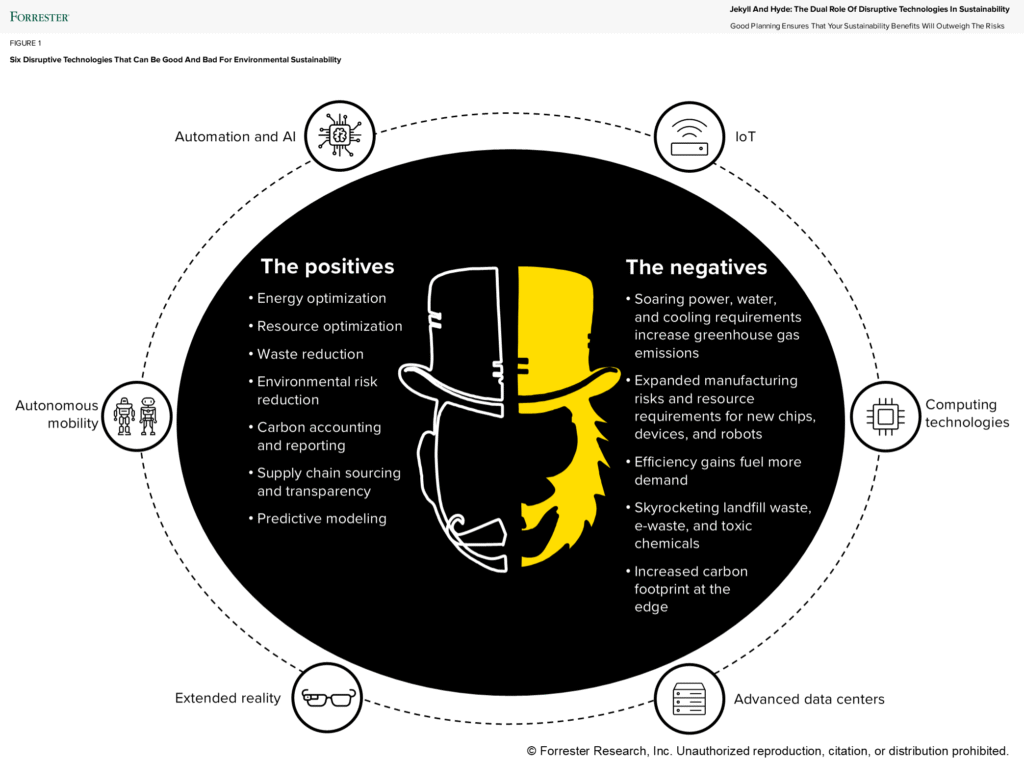
Disruptive technologies such as automation and AI and autonomous mobility boost efforts toward some strategic priorities but can also work against environmental sustainability goals. For example, these technologies bring high compute demands, increased electronic waste, reliance on critical raw materials, complications to the supply chain, and substantial infrastructure required for deployment. But these disruptive technologies also boost environmental sustainability if used in savvy ways. They enhance energy and resource efficiency, support climate resilience and compliance, enable real-time tracking of environmental KPIs, enable new sustainable business models and products, and advance conservation efforts. For business leaders, the challenge lies in maximizing the optimization potential of these technologies while actively managing their lifecycle impacts and resource intensity. In our latest report, Jekyll And Hyde: The Dual Role Of Disruptive Technologies In Sustainability, we identified the dual role played by six of the most important disruptive technologies poised to shape sustainability in 2025: automation and AI, IoT, computing technologies, advanced data centers, extended reality, and autonomous mobility.     For a deeper dive, let’s look at AI. An immediate positive is that it transforms sustainability reporting by automating data analysis, aligning disclosures with regulatory frameworks, and customizing content for diverse stakeholders. Beyond reporting, AI can support core sustainability initiatives such as climate risk forecasting, energy optimization, emissions reduction, and supply chain resilience. But AI also introduces significant environmental challenges. The water demand to cool and energy to train and run large models raise concerns about resource use, especially in constrained regions. As AI adoption accelerates, sustainability and technology leaders have a critical role to play in guiding its use. In the report, we examine some of the most interesting and beneficial use cases and how to curb their environmental impact. These disruptive technologies are reshaping industries and sustainability. Now is the time for business leaders to scrutinize the balance between scale, maturity, and correct use of these disruptive technologies to ensure business resilience, compliance, and long-term profitability. This report is a collaboration among Forrester’s specialists in each individual topic area: Abhijit Sunil, Paul Miller, Craig Le Clair, Renee Taylor-Huot, and Michele Pelino. Forrester clients can read our report and schedule a guidance session to learn more. source

Jekyll And Hyde: The Dual Role Of Disruptive Technologies In Sustainability Read More »

Upskilling The Public Sector Workforce For The AI Era

Unlocking AI value in the public sector starts with people, not technology. While investments in AI solutions accelerate, many organizations overlook the critical human capabilities that enable them. Without a workforce that understands, trusts, and can act on data, even the most advanced AI initiatives will underdeliver. The foundation lies in developing a deliberate triad of agency capabilities: data literacy, AI fluency, and a pervasive culture of continuous learning and improving — all of which are prerequisites for AI readiness. Forrester’s Data And Analytics Survey, 2025, reveals that over a quarter of public sector data leaders cite a lack of data literacy as one of the top key barriers to success. That signals an imperative: Upskilling must be designed, executed, and measured as a strategic imperative — not treated as a tactical task. Make Improving Data Literacy The Starting Point Begin with a targeted push on improving data literacy for all employees, moving beyond technical know-how. Focus on cultivating a mindset shift. Build programs that embed curiosity, creativity, and mission-driven critical thinking. Don’t outsource this. Internal training must be grounded in your agency data, use cases, and workflows — not generic examples. Specifically: Craft and deploy an effective training program to create a strong link between data insights and tangible real-world outcomes. Encourage a fail-fast mentality, encouraging staff to test, learn, and improve. It should also position employees as collaborators with AI systems — not passive recipients of automated outputs. Accelerate curiosity velocity — the ability of employees to independently explore data, ask smarter questions, identify insights, and convert those insights into timely action — to drive action. Increasing curiosity velocity reduces the time in an individual’s journey from knowledge seeker to insights acquisition to action. Curiosity velocity is a leading indicator of data cultural maturity and the biggest indicator to AI readiness and insights adoption. Leverage data literacy, technology, data, analytics, and AI-specific courses available to the public sector from vendors (AWS, Microsoft, Google) and learning platforms (Coursera). But don’t forget to layer in domain-specific learning. Introduce workshops tailored to key data use cases within branches/departments of the public sector. Contextual learning shortens the distance between knowledge acquisition and operational impact. Apply A Role-Based Approach To AI Fluency Upskilling is not one-size-fits-all. First, define and prioritize AI and generative AI use cases such as advanced (predictive, causal) analytics, automation, content generation, natural language processing, and data/analytics. Then map use cases to the skills. For example, technical teams need to go deep on prompt engineering, retrieval-augmented generation (RAG), and guardrail design to reduce hallucinations and ensure responsible output. Business teams need fluency in assessing AI tools, identifying high-impact use cases, and applying ethical frameworks. Everyone should understand the dimensions of explainability, scalability, and risk — and know how to choose between building, buying, or automating. Measure What Matters, Learn, And Improve Measurement of your progress in data literacy and AI fluency is nonnegotiable. Establish baselines with pretraining assessments (such as the Forrester AIQ Assessment), then embed microcertifications, scenario-based tests, and capstone projects that use real agency data. Monitor tool adoption, insight sharing, and engagement in internal data communities. Track curiosity velocity directly by embedding continuous learning into daily operations. Incentivize participation with recognition, certification, and visibility. Activate internal mentors, data ambassadors, and peer learning forums to reinforce habits. When learning becomes part of the culture, not just the curriculum, AI becomes operational — not theoretical. Invest In People To Unlock AI Value Agencies that treat upskilling as a core transformation lever will outpace those that rely solely on technology upgrades. A workforce trained in data, fluent in AI, and driven by curiosity will unlock impact at scale. For more information, set up a call with one of our analysts covering AI. source

Upskilling The Public Sector Workforce For The AI Era Read More »

Accessibility In 2025: Prepare For New Regulations With The Right Tools

There’s a lot happening in the realm of digital accessibility. The European Accessibility Act (EAA), a landmark piece of legislation requiring equal access for people with disabilities, took effect on June 28. It requires new products and services sold in the EU to be accessible, with deadlines for existing products coming in 2030. Businesses that don’t comply risk being fined. Unfortunately, recent data suggests most organizations aren’t ready. For example: Just 60% of design professionals say that their firm’s executives are committed to creating accessible products and that work to deliver on that commitment is underway, according to Forrester data. What’s worse, less than 50% of these “committed” organizations are implementing best practices, such as conducting accessibility reviews of design concepts or making accessibility a formal requirement on projects. In the US, where lawsuits are the primary mechanism for enforcing accessibility laws, lawsuits are on track to increase by 20% in 2025, according to UsableNet’s Midyear Accessibility Lawsuit Report. Many US-based businesses also sell in the EU, making it even more vital that they shore up their accessibility practices. This comes at a time when there is more digital content to make accessible than ever before due to the proliferation of AI-generated content. While not the only ingredient for an effective accessibility program, having the right accessibility technologies in place is critical, and evaluating the options available is the focus of my current research. What’s A Digital Accessibility Platform? While free accessibility testing tools exist, they don’t enable the testing and monitoring necessary to create accessible experiences at scale in an enterprise organization. Digital accessibility platforms (DAPs) help organizations integrate and scale the practices required to achieve and maintain compliance with accessibility standards. Forrester defines digital accessibility platforms as: Platforms used by companies to identify accessibility issues, facilitate remediation of issues, and monitor and report on the accessibility of their digital experiences. DAPs help organizations achieve and maintain compliance with accessibility requirements set by the EAA and other laws and regulations in regions the organization operates in. Specifically, they help organizations: Conduct automated and manual accessibility testing. DAPs facilitate the accurate detection and speedy remediation of Web Content Accessibility Guidelines (WCAG) violations and accessibility best practices. To do this, these platforms use a combination of automated testing, guided manual testing, and — in a few instances — usability testing. While all DAPs offer static guidance on how to fix issues, many now include AI-generated remediation suggestions, as well.  Prevent accessibility issues during design and development. The cheapest and most effective path to an accessible experience is to prevent accessibility barriers in the first place. Many DAPs include tools to help developers test and fix issues when coding in their integrated development environment (IDE), reviewing a pull request, or conducting unit testing, for example. Some include tools for designers to test their work in design workflow tools, such as Figma.  Monitor and report on compliance with accessibility standards. A DAP helps the employees managing accessibility programs measure progress by understanding where each digital experience stands, how health scores and issue types are trending over time, and what the organization’s overall progress is. It provides companies with the data needed to demonstrate compliance and meet contractual requirements when selling products to companies or government organizations that require accessibility.  My latest report, The Digital Accessibility Platforms Landscape, Q2 2025, helps you understand the benefits you can expect from a DAP and decide what platform is right for your company. While this report highlights the 15 largest DAP vendors, I recommend buyers also keep an eye on smaller, emerging vendors based in the EU, such as Accessibility Cloud and inSuit, whose platforms are more tailor-made for that market. Up Next: The DAP Forrester Wave Evaluation Next on my research agenda is a Forrester Wave™. This in-depth evaluation of the top DAP vendors will serve as a detailed guide for buyers considering their options. Get In Touch If you’re a Forrester client, check out the full report. Then, if you’d like to talk about which digital accessibility platform is right for you, set up a conversation with me. If you like, you can also follow or connect with me on LinkedIn here. source

Accessibility In 2025: Prepare For New Regulations With The Right Tools Read More »