Forrester

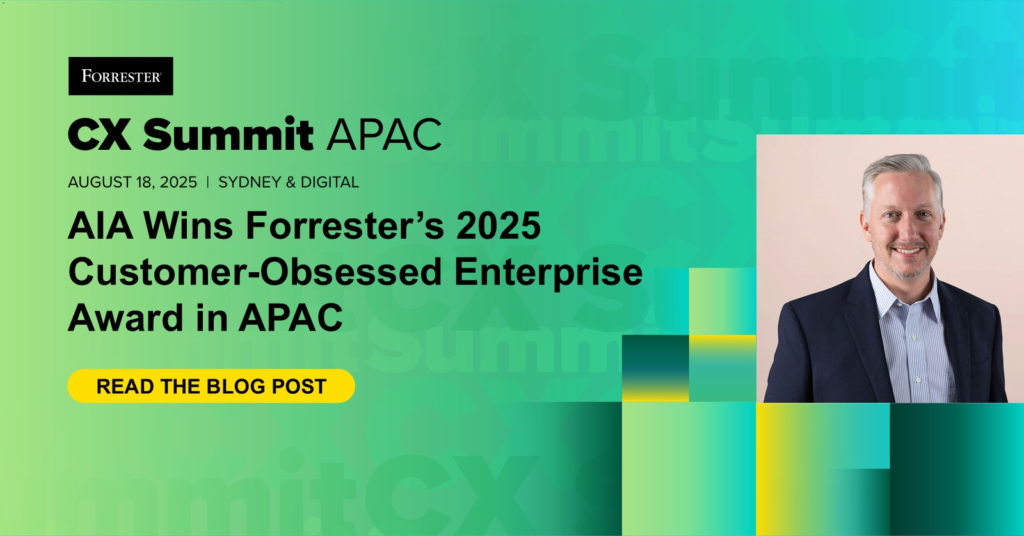
AIA Wins Forrester’s 2025 Customer-Obsessed Enterprise Award In APAC

Forrester’s annual Customer Obsession Awards recognize organizations that place their customers at the center of their business strategy, operations, and leadership to accelerate growth, customer loyalty, and employee engagement. I’m pleased to announce that AIA won this year’s award in APAC, standing out among tough competition from diverse industry sectors across the region.  A market leader in the APAC region (excluding Japan) based on life insurance premiums, AIA is the largest independent publicly listed Pan-Asian life insurance group. It operates in 18 markets across the region and serves over 40 million policyholders, offering a range of products and services including life insurance, accident and health insurance, and savings plans. AIA also provides employee benefits, credit life, and pension services to corporate clients. Our judges were impressed with the comprehensiveness and results of AIA’s customer obsession across such a vast and diversified organization.   Leadership Commitment  AIA’s EASE program — built around empathy, automation, simplicity, and engagement — reflects the leadership’s commitment to customer obsession. Sponsored at the highest levels, EASE integrates customer-centric KPIs into leadership and employee performance targets, ensuring accountability across the organization. Governance frameworks, including monthly market reviews and quarterly group updates, enable leaders to stay aligned and action oriented. To further embed customer-first thinking, AIA launched the aCXelerate program with London Business School, providing its leaders with the skills to drive customer obsession.  Governance Balancing Oversight With Localized Execution  The company’s hybrid governance model balances centralized oversight with localized execution, allowing countries to adapt to customer needs while maintaining strategic consistency. It has developed capabilities through centers of excellence and communities of practice focused on Agile, AI, data and analytics, and human-centered design. AIA implemented an enterprisewide customer feedback management system, collecting 905,000 responses across 15 markets in 2024 for key customer journeys. Real-time insights, AI-powered analytics, and 48-hour closed-loop processes enable swift action and informed decisions, including reopening claims when necessary. AIA’s approach has driven impactful solutions like 85% straight-through processing (STP) across 18 markets (as of December 2024), simplified underwriting rules, and AI-powered decision-making.  Cross-Functional Collaboration   Our judges keyed in on how well AIA has driven collaboration across the CX, marketing, digital, operations, and technology functions to benefit customers. Through its highly effective teamwork, AIA has implemented AI-driven underwriting and automation, enabling 99% of new business applications to be submitted digitally and improving claims settlement to a level of 80% within one day (as of December 2024).  Harnessing Technology, Digital, and Analytics  AIA has invested $800 million in its TDA (technology, digital, and analytics) initiative to create frictionless omnichannel experiences. Digitizing journeys across buy, serve, claim, and call processes has allowed it to deliver faster, more personalized interactions that adapt to customer preferences. From instant coverage and claim payouts to proactive communication during key life events, AIA has found that its approach drives satisfaction by empowering customers.  Quantifiable Outcomes  AIA was able to share impressive results (as of December 2024) from its customer obsession efforts:  Ranked #1 in Net Promoter Score℠ in seven markets, with 98% customer satisfaction for contact centers.  85% STP across buy, service, and claims processes, with 95% digital submissions and 88% one-day turnaround rates.  Recurring expense and claims efficiencies of over $180 million, +61% annualized new premium growth from digital leads, and 100% end-to-end digital distribution capabilities.  To hear more about AIA’s inspiring work directly from Damien Mu, AIA Australia CEO, be sure to join us at Forrester’s CX Summit APAC in Sydney, Australia, on August 18, 2025.  source

AIA Wins Forrester’s 2025 Customer-Obsessed Enterprise Award In APAC Read More »

100% Accuracy On Weather Predictions? Well, No, But You Are In Control Of Your Organizational Resilience

This week the UN court said countries must address the “urgent and existential threat” of climate change. It’s easy to see from weather events why this is more urgent than ever before. 2025 has seen wildfires in southern California and South Korea; flooding in Texas, Bolivia, and New South Wales; and heat waves in the US, Pakistan, India, and Europe, including Finland, Spain, England, and Greece. Infrastructure itself has taken a toll due to heat. Concrete and asphalt react to heat by expanding and warping. For example, roads in Milwaukee and Green Bay, Wisconsin and Cape Girardeau, Missouri buckled. At the same time, federal agencies that organizations use for notification and response in the US such as NOAA and FEMA have experienced significant budget and staff cuts. This is in accordance with the Executive Order “Achieving Efficiency Through State and Local Preparedness” that pushes resilience down to state and local levels. Taken as a whole, what does this mean? Your organization must be more resilient now more than ever. While you can’t affect the weather, your organization can prepare to reduce this recipe for disaster’s effects on your organization. Waffle House, for example, is well known for its business continuity planning and execution. How do they do it? It’s a combination of planning, monitoring, and tracking, reducing services when needed (such as limited menu and cash transactions only), and employee support. Additionally, they improve based on feedback and prior responses and work with their supply chain including local suppliers and authorities to minimize disruptions. Be like Waffle House and: Reevaluate your climate risks. Although an emerging market, Forrester has been tracking climate risk analytics software for several years. Use this software to identify what climate risks your assets are most prone to in both the short- and long-term. This will not only prioritize what impacts to plan for, but also helps identify what risks are material. This is especially useful to comply with regulations that mandate this reporting such as the upcoming California SB 261, the Climate-Related Financial Risk Act, that will be in force January 1, 2026. Augment your weather feeds and get a map. NOAA and its National Weather Service are the data sources that most other weather intelligence uses. However, you can augment with weather feeds such as AccuWeather, Tomorrow.io, or even from Mexico and Canada if the weather impacts are near boarders. Finally, make sure you have a dashboard that executives and heads of business can all see where assets (including personnel) are in relation to severe weather.  This will mean you need to layer weather on top of a physical map of assets. Work with HR to ensure employee communication even when traveling. If you can notify groups of employees by location, even when traveling, then you’ve solved one of the trickier problems of weather-related events. Although some weather events will not invoke a business continuity or operational resilience plan, HR will appreciate the ability to have advanced warning and the ability to not only notify employees of severe weather, but also get responses back giving the all clear. Shore up core business continuity processes. If you haven’t already, document your critical services, identify the key risks to these services, identify how long they can be down, and develop plans including any possible workarounds. Then test the plans where these services are fragile to weather-related events. From the Forrester/Disaster Recovery Journal Q4 2024 Global Business Continuity Management Survey, nine percent of respondents said they didn’t ever run a tabletop exercise and 59% said they ran a tabletop exercise only once per year. What are the odds that this single test was a weather-related one? Don’t forget your supply chain. The physical supply chain is especially prone to weather-related disasters. For example, Hurricane Helene disrupted the Spruce Pine mine in North Carolina where approximately 70% of the global supply of high-quality quartz for semiconductor manufacturing is sourced. To prepare, boost your third-party risk management practice to identify your most important third parties and come up with alternates or accept the risk. Want to talk more about the intersection of sustainability and resilience? Forrester clients can schedule an inquiry/guidance session with me. source

100% Accuracy On Weather Predictions? Well, No, But You Are In Control Of Your Organizational Resilience Read More »

IT Governance As A Secret Weapon: A Blueprint For Thriving In Chaos

Picture this: Your CEO announces a major AI initiative that must launch in the upcoming quarter. Simultaneously, regulatory compliance demands immediate attention, a key acquisition requires technology integration, and your cloud migration timeline just accelerated by six months. How does your IT organization respond? If you’re like most technology executives, the answer involves fragmented roadmaps, competing priorities, and the uncomfortable reality that your governance framework — designed for predictability — has become a liability in a volatile and unpredictable world. The Hidden Cost Of Outdated Governance Today’s technology executives face a perfect storm of market disruptions that emerge overnight, business priorities that shift mid-quarter, and the relentless pressure to deliver innovation while maintaining operational excellence. Yet most are operating with governance models built for a different era. The symptoms are unmistakable: Strategic fragmentation: Different domains pursuing conflicting agendas Decision paralysis: Critical initiatives stalled in misaligned approval processes Resource waste: Duplicated efforts across teams who should be collaborating Eroding trust: Business stakeholders questioning IT’s ability to execute predictably It’s no coincidence that 76% of leaders in Forrester’s latest research identify strengthening governance as a top priority. The question isn’t whether change is needed — it’s whether your organization will lead that change or be forced to catch up. The Transformation Imperative Here’s what most governance “fixes” get wrong: they add more controls, create new committees, or implement additional oversight layers. These solutions treat the symptoms while ignoring the fundamental challenge. Modern governance must do two things simultaneously: Safeguard strategic alignment while enabling rapid pivots. It must unify decision-making across the entire value creation flow and actively prevent the reemergence of silos during periods of disruption. The prize for getting this right? Governance transforms from a bureaucratic bottleneck into your organization’s competitive advantage — the engine that sustains business trust through transparency, predictability, and speed. Your Blueprint For Resilient Governance Interested in hearing more about this topic? At this year’s Technology & Innovation Summit North America, we’ll be hosting a session that challenges conventional thinking and provides a practical roadmap for governance transformation. This isn’t theoretical — it’s based on real-world success stories from organizations that have turned governance into a strategic weapon. In this session, you’ll learn: Why traditional models fail: The specific characteristics that make legacy governance frameworks liabilities in dynamic environments The resilience architecture: Essential structures and leadership behaviors that maintain unified governance under pressure The value of prevention over reaction: How to build systems that actively prevent conflicting plans and wasted resources before they occur Trust as currency: Practical steps to preserve and strengthen business confidence even during rapid pivots Plus, we’ll share the compelling case study of a global enterprise that successfully navigated major market shocks by completely reimagining their roadmap approach — without sacrificing trust or losing momentum. Don’t Let Disruption Define You If you’re responsible for strategy execution, portfolio planning, or enterprise architecture at your organization, this session will equip you to: Protect strategic coherence across all technology initiatives Accelerate decision-making without compromising oversight Transform governance from cost center to competitive differentiator Build unshakeable trust with business stakeholders In an era where change is the only constant, your governance model will either amplify your organization’s agility or become its greatest constraint. The choice — and the opportunity — is yours. Check out the full Summit agenda for Technology & Innovation Summit North America on November 2–5 in Austin and reserve your seat today. Because in volatile times, the organizations that thrive are those that turn uncertainty into advantage. source

IT Governance As A Secret Weapon: A Blueprint For Thriving In Chaos Read More »

America’s AI Action Plan

The White House just released its long-awaited AI Action Plan. There is significant chatter about its broader implications; I’m just here to focus its infrastructure implications. This action plan highlighted in the 28-page document is a clear, powerful message: The US wants to lead in AI not just through algorithms and models, but also by building the physical and digital infrastructure. To execute on that vision, other priorities are pushed aside — some with direct implications to infrastructure, others with indirect implications. Whether this plan reflects true speed to execute or purely political agenda is being debated. Aspects like sustainability will have significant direct implications to data centers and infrastructure alike if they come to pass; others may sway vendor selection and the marketplace depending on the values and LLM principles used to create offerings, which in turn will have infrastructure implications. However, it is likely that many of the actions and stances will face legal battles before any of these actions come into effect. If you’re building, managing, or investing in AI, here are five infrastructure shifts from the plan that you need to keep an eye on: Data centers are now strategic assets. The plan puts AI data centers in the same league as semiconductor fabs and energy infrastructure. It pushes for: 1) fast-tracked permits; 2) streamlined (or skipped) environmental reviews; and 3) secure federal zones for sensitive workloads. Here’s what I’m seeing: If you’re in cloud or colocation, expect a wave of incentives and support — especially near power corridors. CIOs, it’s time to revisit your (or your providers’) location strategy. Although the news may seem to open up possibilities; there is a long road ahead before any of this truly comes to pass. Expect a lengthy process for this to pass and local pushback in these areas, which might delay timelines significantly. Ask yourself: Are your infrastructure/data center plans ready for national-level attention? AI needs a smarter energy backbone. AI isn’t just compute-intensive — it’s power-hungry. The federal government wants to modernize the grid, remove red tape for renewable power, and encourage energy-aware AI infrastructure. My take: Energy is now at the core of AI planning with potential changes in cost due to these regulations. Firms need to design AI systems by partnering with utilities, reducing carbon, and optimizing for sustainability, not just scale and performance. Compute access becomes a national asset. The plan aims to expand the National AI Research Resource (NAIRR), unlock federal compute for public research, and prioritize GPU access for strategic value, not just cost. Why it matters: Compute is now geopolitical. Whether you’re a cloud provider or a startup, you’ll need to think about how compute is provisioned, priced, and justified — and how open-source and public-good efforts will be prioritized. Security is core to AI and infrastructure. The Action Plan reframes AI misuse or collapse as a national cyber risk — not just a technical failure. CIOs must embed model governance, red-teaming, and failure response protocols into their infrastructure strategy. Treating AI resilience as part of your core infrastructure — not an afterthought — will be essential for enterprise trust and regulatory readiness. What this means: Security by design will be table stakes. Boards will start asking about your AI failure modes and how your infrastructure recovers from them, not just how models are trained. The White House wants to export AI infrastructure — globally. Perhaps the most strategic move: The US will support allies in building AI stacks aligned with US values and standards. That means exporting entire infrastructure patterns: data centers, safety frameworks, and control layers. Key takeaway: If your AI platform is going global, you’ll need to build with regulatory portability in mind. The rules of the US (and its allies) may soon define the bar for trusted infrastructure worldwide. Infrastructure is the new first-mover advantage Infrastructure used to be a backstage player not so long ago. Not anymore. This action plan focuses on building the fastest, safest, and most scalable systems. It focuses on energy to data to trust to lead the AI race. The infrastructure you design today isn’t just enabling AI; it’s shaping its trajectory for years to come. Whether you’re in the boardroom, data center, or a strategy role, now is the time to ask: Is our infrastructure AI-ready? Want to discuss what this means for your infrastructure roadmap? Let’s connect. Forrester clients can raise an inquiry/guidance session. I’d be happy to discuss this your team or speak at your next leadership meet. source

America’s AI Action Plan Read More »

The Forrester Wave™: Data Governance Solutions, Q3 2025, Shows That Governance Has Entered The Agentic Era

The Forrester Wave™: Data Governance Solutions, Q3 2025, is now live. This evaluation captures a market in transition — one where governance is no longer just about control and compliance but about enabling trust, agility, and AI readiness at scale. Over the past six months, we evaluated 13 of the most significant data governance solution providers. We assessed each vendor across a set of 28 criteria, including product capabilities, strategic vision, and customer feedback. The result: a comprehensive view of how the market is evolving as well as which vendors are best positioned to support specific governance ambitions. What’s Driving The Shift? The market is moving fast — and so are customer expectations. This year’s evaluation highlights three key dynamics shaping the future of data governance: Agentic AI is redefining data governance. Vendors are embedding AI across the governance lifecycle — from classification and policy detection to rule generation and remediation. While capabilities vary, the direction is clear: Governance is becoming more autonomous, more intelligent, and more scalable. Governance is powering trusted data products. Advanced platforms are enabling governed, reusable data assets to be packaged and shared as products — often through internal marketplaces — to support AI model development, accelerate insights, and unlock new business value. Business users are demanding more. From intuitive UIs to embedded guidance, customers want governance tools that empower stewards and domain experts — not just central data teams. What We Heard From Customers Customers emphasize that success with data governance platforms depends not just on capabilities but on the strength of the partnership behind them. While many praised responsive support and collaborative product development, others noted that onboarding and enablement could be more consistent — especially when it comes to translating features into real-world value. What they valued most was a vendor that remained engaged beyond implementation. And that translates into offering strategic guidance, sharing lessons from other industries, and helping teams scale adoption and impact. Common pain points still include manual documentation, limited visibility into policy enforcement, and a desire for more explainable and business-friendly AI governance. Why This Wave Matters Whether you’re scaling federated governance, enabling data product thinking, or preparing for AI at scale, this report helps you take a step forward in identifying the right partner. We provide a detailed breakdown of each vendor’s strengths and gaps, along with guidance on how to align solutions with your business priorities.  For a better understanding of the market, Forrester clients can read the full report, The Forrester Wave™: Data Governance Solutions, Q3 2025. Check out the results for all the vendors in the evaluation, including the interactive tool that provides a deep dive into the specific criteria that differentiated them and why. Have questions about the findings or how to apply them to your context? Book an inquiry or a guidance session with me. source

The Forrester Wave™: Data Governance Solutions, Q3 2025, Shows That Governance Has Entered The Agentic Era Read More »

Agentic AI In Healthcare: A New Era Of Intelligent Automation

The US healthcare system spends over $1 trillion annually on administrative costs. Much of this burden stems from knowledge work: tasks that focus on problem-solving, decision-making, and generating new ideas or insights. From prior authorizations to drug discovery, these workflows are not only expensive but also mentally taxing for clinicians and staff. Agentic AI offers a breakthrough — intelligent automation that acts independently, learns over time, and adapts to changing conditions. Unlike other mature (and older) automation technology, these agents can automate complex workflows such as utilization management and compliance documentation by retrieving, transforming, and enriching data from diverse sources like clinical records, emails, and claims history. Their ability to reason, plan, and take goal-directed action across systems positions them as a transformative force in healthcare. What This Means For The Healthcare Industry Agentic AI is ushering in a new era for healthcare by enabling systems that can act autonomously, monitoring performance, making decisions, and initiating actions without constant human input and oversight. By taking over routine, repetitive tasks, it frees healthcare staff to focus on higher-order thinking, clinical judgment, and patient-centered care. When human empathy and expertise are combined with AI’s analytical power, healthcare organizations (HCOs) can create a more responsive, efficient, and intelligent system of care. This shift will take shape in many forms across the ecosystem: Health systems will leverage smarter workflows and expect better outcomes. For healthcare providers, agentic AI can reduce clinician and staff workload by managing complex workflows autonomously. By offloading time-consuming administrative tasks, agentic AI gives clinicians and administrators more time to focus on strategic, high-impact work. For example, Jorie AI improves revenue cycle operations by automatically routing denials: It monitors claims, classifies denial reasons, tags them, and assigns them to the correct queue with supporting documentation — without human intervention. Insurers will drive faster, more accurate decisions and improve operational scalability. Health insurers will look for AI agents that can autonomously flag anomalies in claims, detect fraud, and ensure compliance in real time. These systems should also streamline prior authorization and member engagement processes. Companies like Autonomize AI are already reporting up to 55% time savings. Employers’ expectations for savings will grow. As health insurers adopt agentic AI to boost operational efficiency, employers will look for them to pass those savings on to consumers. Employers will also expect more personalized, proactive engagement models for their employees. Employers and their benefit partners can look to use agentic tools to analyze utilization patterns and uncover additional opportunities for cost savings in plan design. Consumers will gravitate toward health navigation tools. Consumers will expect smarter virtual assistants that guide them through plan selection, help manage claims, and offer real-time health insights leveraging their data. Naaya’s Claims Advocate tool replaces the manual denials process and empowers members to tackle a major source of frustration — one that often leads to overturned decisions but previously demanded extensive manual effort. Pharma will accelerate drug discovery and streamline regulatory processes. Pharmaceutical companies can use agentic AI to accelerate product development, regulatory navigation, and drug discovery by autonomously analyzing vast datasets and identifying promising compounds. Tools like Writer’s FDA guidance agent are already helping teams interpret complex policies in real time. Proceed With Innovation — And Caution While the potential is vast, agentic AI also brings risks—unintended outcomes, unpredictable behavior, and safety concerns. Failures could lead to legal, reputational, or patient harm, making safeguards like emergency shutdowns, human oversight, and fallback mechanisms essential. HCOs must be disciplined and deliberate with AI-related experiments. In their journey to leverage cloud as a strategic engine driving transformation, become intelligent organizations, and adopt agentic AI, HCOs should start with low-risk, high-impact workflows and use simulation tools to validate agent behavior. Like new hires, agents must be trained, supervised, and gradually granted autonomy. Though agentic AI won’t replace entire processes overnight, it will augment human capabilities and unlock new efficiencies — one workflow at a time. This is more than automation; it’s a paradigm shift toward sustainable transformation in healthcare. Take The Next Step The shift to agentic AI is already underway, and HCOs that act now will shape the future. For a deeper dive into how agentic AI can revolutionize your HCO, Forrester clients can schedule an inquiry or guidance session to dig deeper and learn how to implement agentic AI effectively and stay ahead in the AI revolution. source

Agentic AI In Healthcare: A New Era Of Intelligent Automation Read More »

Don’t Let Your B2B Pricing Devalue Your AI Innovation

Nearly every day, I’m asked about pricing challenges, most of them stemming from the complexities and constant evolution of AI. Pricing models are evolving nearly as quickly as AI technologies. AI Is Driving The Evolution Of B2B Pricing Models Usage-based pricing is rapidly gaining momentum as an alternative to traditional flat-fee and subscription models. This shift reflects the reality that value doesn’t always scale with user count. For example, security tools often deliver value based on endpoints or data volume, not the number of users. APIs and AI agents are accelerating the shift away from user-based pricing by delivering value through automation, integration, and scale rather than human interaction. APIs create value based on call volume or task automation, not user count. Similarly, AI agents now perform tasks autonomously, reducing the relevance of user-based metrics. As AI continues to decouple usage from value, buyers will increasingly favor outcome-based pricing. In light of these changes, organizations should reassess their pricing models to ensure that they align with how value is delivered. The Evolving Range Of B2B Pricing Models In my new report, Rethinking Pricing: How To Choose Models That Reflect AI-Era Value, I provide an overview of different B2B pricing models, the pros and cons of each model for both customers and providers, as well as recommendations on when each model is best suited. Below is a recap of the pros and cons of each for suppliers. Fixed/Subscription Pricing Definition: Charges a set amount monthly or annually, regardless of usage. Often seat-based. Pros: Predictable cash flow Enables deeper user engagement Allows for new paradigm or new concept offerings to demonstrate value Cons: Must help customers identify users who will realize value Customers may not see the connection to value AI automation will replace users and thus seats Usage-Based Pricing  Definition: Tracks a customer’s usage of the offering and bills accordingly. May also track events (e.g., API calls). Pros: Broaden market potential Unlock revenue from heavy users No revenue ceiling Shortened procurement cycle Cons: Can generate viral adoption without the artificial barrier of users Less predictable revenue Susceptible to revenue loss during downturns Billing systems and sales compensation must be more complex Sales and success teams must drive adoption for “nice to have”/less established offerings May promote “spend anxiety” among customers Hybrid Pricing Definition: Base subscription plus usage-based charges. Could be over and above the base allocation. Can also combine subscription and outcome-based charges. Pros: Ensures a baseline of predictable revenue Scales with heavy usage Ease customers into usage-based spending Encourages adoption and provides upsell opportunity Cons: Harder to communicate and manage Billing systems must be more complex Sales and success teams must track consumption to prevent surprises More challenging for sales compensation Adds complexity to the sales process Outcome-Based Pricing Definition: Ties pricing to tangible success metrics. Can be structured as event-based (e.g., charging per resolved customer support call). Pros: Builds customer trust Provides a strong incentive for increasing product quality Competitive differentiation Cons: Must define and track customer KPIs Can be complex to measure and monitor Potentially higher risk Longer sales cycle For custom guidance on which pricing model will work best and implementation tips for AI offerings, set up an inquiry with analyst Lisa Singer. source

Don’t Let Your B2B Pricing Devalue Your AI Innovation Read More »

Orchestrating Product Success: The Role Of The Director Of Product Management

In a symphony orchestra, the conductor doesn’t play every instrument — but without them, there’s a cacophony rather than a symphony. Conductors interpret the score, set the tempo, cue the musicians, and shape the sound of the ensemble. Their leadership transforms individual talent into a unified performance. In the same way, a director of product management is the conductor of their section of the product organization and knows how to lead, align, and scale. This role isn’t just about managing roadmaps — it’s about grounding the entire product function in business goals, customer needs, and long-term growth. The Director Of Product Management: Conductor Of Product Success The director of product management provides the guidance and guardrails for their portfolio by enabling product managers and cross-functional teams to deliver meaningful outcomes. From ideation to launch, they guide the organization through the full product lifecycle, grounding work in user needs and business goals. If your organization is planning to hire a new director of product management, don’t treat the job description lightly. It’s a key role for enabling a resilient, innovative, and customer-obsessed product function. Photo by Ramon Karolan The Job Description Sets The Stage In Forrester’s High-Performance IT Survey, 2024, 95% of respondents said their organization’s leaders nurture a cooperative mindset that applies collaboration to a common purpose. The description should highlight leadership success as orchestration, especially for senior roles like director of product management. The job description serves as your first opportunity to: Align on organizational goals and success indicators. Set the tone for collaboration from day one with values of teamwork and cross-functional alignment. Develop a commitment to mentoring and upskilling for an innovation-focused team. Accelerate The Hiring Process A symphony conductor transforms a group of skilled practitioners into a cohesive musical unit. Similarly, a director of product management brings clarity, coherence, and momentum to the product organization. The Role Profile: Director, Product Management report provides a ready-to-use, optimized job description with the right competencies and expectations. It’s a resource designed to help you accelerate hiring not just a manager — but a strategic leader. Want to take it a step further? Let’s talk about how to build a high-performing product management function tailored to your organization’s goals. source

Orchestrating Product Success: The Role Of The Director Of Product Management Read More »

Announcing The Forrester Wave™: Collaborative Work Management Tools, Q2 2025

Recently, we published The Forrester Wave™: Collaborative Work Management Tools, Q2 2025, showcasing how collaborative work management (CWM) platforms are rapidly evolving to meet the needs of modern enterprises. Over the past couple of months, we researched the top CWM vendors in the market to gain a better understanding of current vendor offerings and identify the best product fit for our clients. This Forrester Wave evaluated 11 vendors: Adobe, Airtable, Asana, Atlassian, ClickUp, monday.com, Quickbase, ServiceNow, Smartsheet, Wrike, and Zoho. Each vendor was evaluated on three inputs: a questionnaire for the vendors to complete, executive strategy briefings and demos, and interviews of up to three reference customers. The Wave included scores for 15 current-offering criteria and eight strategy criteria. Read the full report here. Forrester defines collaboration work management (CWM) tools as: Software tools that support the confluence of project and process work by allowing users to create personal and team workspaces; invite other users, internal and external to the organization, to collaborate on digital artifacts; identify workload requirements and capacity; and allocate activities to other users to deliver on work items and then track progress. What Should You Look For? With expanded functionality and the continued rise of AI-driven capabilities, these tools are no longer just about project or task planning — they empower users to act, drive outcomes, and perform work more proactively. These changes are leading to numerous impacts. Organizations are starting to implement these tools as a system of record for work. As a result, clients should consider these key insights when making a purchase decision: Integration is crucial. The CWM market continues its fast-paced growth with expanded capabilities. It is essential to consider not only the core capabilities of the platform but also how well it integrates with the rest of your tech ecosystem. Look beyond surface-level integrations and assess the depth, flexibility, and scalability of each vendor’s ability to support your integration needs. AI depends on data quality. AI can be a powerful accelerator for productivity, but its value is only as strong as the data it relies on. Before you leverage AI, you must first understand the current state of your data. Clean, well-structured, and accessible data is essential for generating reliable outputs and building trust in AI-driven recommendations. Project portfolio management is still essential. CWM solutions are flexible and allow for proactive work, but they are not yet full replacements for traditional PPM systems. Portfolio management, especially for organizations that are scaling enterprise planning, requires more robust data models, governance, and scalability — capabilities that are still maturing in many CWM platforms. For a deeper look into the market, Forrester clients can read the full report, The Forrester Wave™: Collaborative Work Management Tools, Q2 2025. Check out the results for all 11 vendors, including the specific criteria that differentiated them and why. If you have any questions about the changes happening in the collaborative work management market, book an inquiry or guidance session with me. This blog was written with Melissa Chhay, senior research associate. source

Announcing The Forrester Wave™: Collaborative Work Management Tools, Q2 2025 Read More »

Shrinking Budgets And Rising Expectations Challenge B2B Agency Partnerships

In 2025, B2B marketing leaders are navigating a complex landscape shaped by economic uncertainty, rising performance expectations, and the rapid evolution of AI. According to Forrester’s 2025 B2B Brand And Communications Survey, agency partnerships remain nearly universal among large companies, but the nature of those relationships is shifting. Many marketers are under pressure to deliver more with less, and that’s prompting a closer look at where agency support truly adds value. Agency Investments Expected To Slow As AI And In-Housing Take Hold As AI capabilities mature, more companies are shifting work in-house — particularly in areas like digital production and content creation. This move isn’t just about cost savings; it’s about speed, control, and efficiency. The result is an expected slowdown in agency investment momentum, with marketers reevaluating which agency services are essential. Expectations for digital marketing and content creation investment are cooling. The percentage of marketers expecting increases in agency investment for digital marketing fell 14 points year-over-year, while the percentage of those expecting increases in agency investment for content creation dropped 10 points. At the same time, the percentage of marketers expecting investment decreases in both categories rose by 8 points. Brand strategy is also under pressure. The percentage of marketers expecting agency investment increases for brand development and management are down 11 points, indicating more companies are likely pulling this work in-house to gain control and reduce costs. Satisfaction Gaps Undermine Agency Value Even as agencies remain essential partners, many are falling short of expectations. Forrester’s survey reveals significant gaps between what marketers value and what agencies deliver: Communication is the biggest disconnect. While 80% of marketing leaders say clear communication is critical, only 55% are satisfied — a significant 25-point gap. Value supersedes price, but still disappoints. Seventy percent of respondents prioritize value over cost, yet just 53% feel they’re getting it. Specialized skills are lacking. A 15-point gap between importance and satisfaction suggests agencies are struggling to keep pace with evolving B2B needs. B2B marketers are under pressure, and they’re responding by expecting to tighten their agency budgets, shift work in-house, and demand more from their partners. Agencies that want to stay relevant must adapt quickly and demonstrate not just efficiency but also strategic value that can’t be replicated internally. Forrester clients can explore the full data in our report, The State Of B2B Brand And Communications Agency Investments And Preferences, 2025. View additional research by Karen Tran or schedule a guidance session today. source

Shrinking Budgets And Rising Expectations Challenge B2B Agency Partnerships Read More »