Forrester

Now Live — The Forrester Wave™: Customer Analytics Services, Q2 2025

I am excited to announce The Forrester Wave™: Customer Analytics Services, Q2 2025. The customer analytics services market has always evolved alongside emerging technology — from big data to cloud to AI. Like other service providers, customer analytics service providers (CASPs) have kept pace through tech adoption and strategic partnerships, but they face a distinct challenge: bringing their customers along for the ride. Today’s enterprises expect seamless experiences, fast support, and intuitive interfaces. And if a vendor brand falls short, enterprise buyers know they can easily find one that doesn’t. As end users become increasingly comfortable using applications such as ChatGPT or Gemini every day, enterprises are looking for ways to embed the same level of intuitive experience into their customer-facing channels. Similarly, enterprises — the buyers of customer analytics services — are now demanding this same seamlessness and demonstrable effectiveness from their analytics services and solutions. Their key questions reflect this urgency: How do I determine high-value customer segments and deliver next-best experiences in real time? How do I reduce time between campaign cycles? How do I communicate insights or quantifiable measurement of analytics effectiveness to executive teams? The list goes on. This shift in end-user and enterprise expectations has revealed several notable capabilities to look for in a customer analytics service provider, such as: Depth of insights. While the commoditization of customer analytics — churn and propensity models, lifetime value analyses, segmentations — has accelerated insights, vendor differentiation now depends largely on the depth of those insights. Advances in technologies such as graph databases and vector embeddings enable richer contextual understanding by incorporating diverse data types (text, image, video, audio, document, etc.). For example, service providers help retailers leverage graph databases to analyze customer emotion and personalize creative content, resulting in a significant increase in customer engagement. When choosing a CASP, look for providers that can help you uncover deep insights from traditionally elusive data sources. Impact and actionability. Beyond data processing, leading providers distinguish themselves by focusing on impact. They apply advanced decision optimization, real-time feedback mechanisms, and explainable AI to drive smarter, faster outcomes. Budgeting constraints have further driven businesses to emphasize value measurement to justify spend on analytics, something many service providers do very well. As one customer reference mentioned about their customer analytics partner, “One successful project could pay for the entire engagement.” Several participants in this year’s Wave offer interactive dashboards and data hubs that enable real-time value measurement of their analytics initiatives. These tools help clients monitor key aspects of their insights operations and more effectively calculate ROI. Preparation for agentic AI. The aim of many leading CASPs is to prepare themselves and their clients for an agentic shift. Agentic systems refer to automated processes and systems that can perform tasks independently, reducing the need for human intervention. A shift toward AI agents will place far more emphasis on building automation pipelines and far less emphasis on consulting services. Consulting will always have a role to play to integrate agents, monitor performance, and consult enterprises on their agentic priorities. Even so, leading CASPs foresee their role shifting to aid businesses in making the transformation to become more automated. Forrester clients can read our full Wave evaluation and our market overview research on the 2024 CASP landscape. Please schedule a guidance session with me to learn how to use this research to identify best-fit providers for your needs. I can guide you through my findings and help you identify the vendors that should make your shortlist. Customer analytics vendors: Please schedule an inquiry or advisory session with me to discuss what my findings mean for the industry and your offering. source

Now Live — The Forrester Wave™: Customer Analytics Services, Q2 2025 Read More »

Lassen Sie sich nicht von isolierten CX-Kennzahlen bremsen, sondern treten Sie in Aktion – auf dem CX Summit EMEA

Hier sind einige Fakten, die Ihnen zu denken geben sollten: Der zweithäufigste Grund, den uns CX-Führungskräfte dafür nennen, dass ihre Unternehmen in CX-Initiativen investieren, ist die Verbesserung ihrer CX-Bewertung. Ja, Sie haben richtig gelesen. Der zweitwichtigste Treiber für Investitionen in die Customer Experience (CX) ist nicht das Bestreben, die tatsächlichen Erfahrungen der Kunden zu verbessern, sondern die Bewertung zu verbessern, die Kunden über ihre Erfahrungen abgeben. Zwar trifft es natürlich zu, dass in den meisten Fällen die Verbesserung der tatsächlichen Customer Experience (ist sie einfacher, effektiver, emotional ansprechender als zuvor?) zu einer besseren CX-Bewertung führen wird, der kausale Zusammenhang ist hier jedoch unklar. Wir alle kennen Beispiele dafür, wie um gute Bewertungen gebettelt wird – von nicht allzu subtilen Net Promoter Score℠ (NPS)-Umfragen, bei denen die Punktzahlen 9 und 10 fettgrün hervorgehoben sind, bis hin zu so krassen Aussagen wie „Alles unter 9 ist ein Misserfolg.“ Bei der obsessiven Beschäftigung mit Bewertungen werden gerne drei entscheidende Lücken übersehen: Die Qualifikationslücke: In den meisten CX-Teams gelten Messungen als Kernkompetenz. Die Definition von CX-Kennzahlen ist die häufigste Kernkompetenz der von uns weltweit befragten CX-Teams. Und diese Entwicklung wird sich noch verstärken, denn die „Definition von CX-Kennzahlen“ ist die zweithäufigste Kompetenz, die Teams nach eigenen Angaben hinzufügen wollen.  Die Technologielücke: Die Budgets für CX-Technologie legen den Schwerpunkt auf Kennzahlen, nicht auf Maßnahmen. Fast die Hälfte aller CX-Teams und drei Viertel der auf Messungen fokussierten Teams nutzen Technologie für das Management von Kundenfeedback, während nur ein Fünftel Technologien nutzt, die auf Reaktion und das Vorantreiben von Maßnahmen ausgerichtet sind, wie beispielsweise die Orchestrierung von Journeys.  Die Prozesslücke: Teams fehlt es an Prozessen, um Maßnahmen zu ergreifen. Nur etwa fünf Teams für Voice-of-the-Customer und CX-Messung sagen, dass sie über effektive oder sehr effektive Prozesse verfügen, um Ergebnisse voranzutreiben, wie z. B. die Fähigkeit, CX-Initiativen zu priorisieren oder auf Insights zu reagieren. Es gibt eine deutliche Lücke zwischen Wahrnehmung und Realität: Während eine überwältigende Mehrheit der CX-Verantwortlichen angibt, dass ihr Unternehmen nach Meinung der Führungskräfte „customer obsessed“ sei, trifft diese Einschätzung laut unserer Customer Obsession-Bewertung tatsächlich nur auf 3 % der globalen Firmen zu. Erfahren Sie auf dem CX Summit EMEA, wie Sie Marke und CX verbinden können Viele Firmen halten Akquisitionen und Kundenbindung immer noch für zwei unterschiedliche Bereiche. In seinem aktuellen Blog-Beitrag, Introducing Forrester’s Brand Experience Index — Drive Growth With Both Brand And Customer Experience, zeigt Forrester VP und Principal Analyst Dipanjan Chatterjee den multiplikativen Wert auf, der aus der Kombination von Marke und CX-Messung entsteht. Durch den Vergleich der Ergebnisse unseres Brand Experience Index (BX Index) mit denen des Customer Experience Index (CX Index™) veranschaulicht er, wie Marken, die in beiden Bereichen führend sind (d. h. die sich stark auf Kunden konzentrieren, maßgeschneiderte Angebote bieten, ein hohes Vertrauen genießen und Erfahrungen bereitstellen, die einfach, effektiv und emotional ansprechend sind), im Durchschnitt eine 2,3-fache Umsatzsteigerung im Vergleich zu Unternehmen verzeichnen, die in beiden Indizes niedrige Werte erzielen.  Dieses Konzept werden wir auf unserem diesjährigen CX Summit EMEA näher beleuchten. Vom 2. bis 4. Juni werden Experten für CX, Digitales und Marketing zusammenkommen, um sich mit der Zukunft der Kundenbeziehungen zu beschäftigen und zu erfahren, wie sie ein Gesamterlebnis gestalten können, bei dem Markenerlebnis und CX aufeinander abstimmt sind, um nachhaltiges Wachstum zu fördern. In einer Mischung aus Keynote-Vorträgen, Track Sessions, interaktiven Erlebnissen, Workshops, Diskussionsrunden und mehr wollen wir folgendes Know-how vermitteln: Messung und Verbesserung der Gesamterfahrung mithilfe des BX-Index und des CX-Index von Forrester, um Kundenbindung und Umsatz zu steigern.  Nutzung von KI und Emerging Technology, um intuitive, menschenähnliche Kundeninteraktionen zu schaffen.  Nutzung datengestützter Insights zur Verfeinerung von Designstrategien und Verbesserung digitaler Erlebnisse.  Nutzung von Metriken, um eine kundenfokussierte Kultur zu formen und sicherzustellen, dass Transformation unterstützt und nicht behindert wird.  Positionierung als Vorreiter für Veränderungen, indem Sie den organisatorischen Wandel effektiv verwalten und gleichzeitig den Fokus auf Personen und Prozesse bewahren. Hier können Sie die vollständige Agenda ansehen und sich anmelden, um mit der Ergreifung von Maßnahmen zu beginnen, die ihren Kunden – und ihrem Unternehmen – wirklich nutzen. Dieser Blog wurde aus dem Englischen übersetzt. source

Lassen Sie sich nicht von isolierten CX-Kennzahlen bremsen, sondern treten Sie in Aktion – auf dem CX Summit EMEA Read More »

Supply Chain Mastery Delivers Superior Earnings

Over the weekend, I’ve been taking a break from research and reading someone else’s for a change. I came across the 2025 Supply Chain Earnings Impact Report. It reviews more then 1,000 quarterly earnings reports during the supply chain disruption between between 2019 and 2025 and concludes that enterprises prioritizing technology integration, real-time visibility, and operational resilience consistently outperformed the market. If you want to compare your own supply chain agility and effectiveness with peers and chart your course to improved earnings through supply chain mastery, please don’t forget the tools and guidance available here for your supply chain digital transformation. New Tariffs Pose Threats, But They Also Offer Opportunities Speaking of disruption, my inbox has been full of questions about tariffs. Most have focused on preparing supply chain applications for the changing environment or digitizing and diversifying enterprise supply chains. But this item on tariff-driven venture capital opportunities reminded me of our research on technologies to support the pivot from manufacturing economies of scale to manufacturing economies of scope. This could mean rethinking product lifecycle management to focus on sustainability, innovation, and resilience as much as cost; deploying smart manufacturing technologies to adjust your mix of offshore, nearshore, and onshore manufacturing to changing circumstances; or laying the foundations for software-defined factories.   Please keep an eye open for further research on forging a supply chain and manufacturing ecosystem that is resilient to global shocks and responsive to local market demand. We have work in the pipeline on agentic AI in the supply chain as well as research on IT support for microfactory-based manufacturing strategies. In the meantime, we would love to hear your thoughts and provide guidance sessions on how to apply our research to the decisions that you face. source

Supply Chain Mastery Delivers Superior Earnings Read More »

If Your Job Is At Risk To AI, It May Not Be Your Fault

How do you spend your workday? If your value to the organization is to process paperwork, take an order and fulfill it, manage data and people’s access to it, report out a status, regurgitate templated or documented information, or have the same conversations over and over, I can confirm some hard news that you may already suspect: You’ll be replaced by AI — and soon. It’s not really your fault, either. Your job description isn’t usually the result of a “choose your own major” scenario. Your organization created a lot of paperwork to process and needed a processor. You did the job as outlined in the job description that the org created. And the more paper, orders, numbers, and status reports that were produced, the busier you got, the more time you spent processing those things, and the more that task became your whole job, whole role, and whole value as an employee. Now that AI, and especially agentic AI, can take on more of that paper processing, the same leaders who wrote that job description and put you in that role are hunting through the organization for the low-hanging fruit for easy replacement. HR, this affects a lot of you specifically. An announcement this week gives us a rich example of how AI can help leaders rebalance their workforce but also showcases how vulnerable support functions are to being replaced by AI. In The Wall Street Journal, IBM announced its move to AI agents to “replace the work of a couple hundred human resources workers.” This job-shrinking in HR made space for job adds in areas that “[International Business Machines Chief Executive Arvind] Krishna calls ‘critical thinking’ focused domains, where people need to do things that ‘face up or against other humans, as opposed to just doing rote process work.’” To IBM, those areas of opportunity include sales, marketing, and software engineering. But IBM HR could also benefit from streamlining and efficiencies by leveraging AI to improve skills detection, learning, workforce planning, recruiting, inclusion, resource management, career-pathing, and the myriad other AI use cases within HR. This opportunity is also why I offer the same warning to any employee: Make sure that your value is more than just your time and ability to process paper, forms, and orders. If it’s not, make moves to demonstrate your (human) capabilities, build your artificial intelligence quotient (AIQ), and prepare for change. I see a huge opportunity for HR to guide their organizations through AI transformation — something I hope IBM also sees — but HR leaders must rise to the occasion and demonstrate why they deserve to be part of AI governance and use case selection, not the next group packing up their boxes. source

If Your Job Is At Risk To AI, It May Not Be Your Fault Read More »

Tackling Cloud Security: US Federal Edition

Back in 2007, the first US federal CIO, Vivek Kundra, was appointed. Shortly after in December of 2010, he launched one of the world’s first “cloud-first” initiatives, making many US federal agencies such as the General Services Administration (GSA) some of the earlier innovators in this arena. At the heart of this push was better experiences for government customers and leapfrogging tech advancement to achieve faster innovation and greater efficiency. Governments around the world have since followed suit with cloud-first/cloud-smart programs. This momentum, combined with unique government infrastructure and contracting requirements, led the first industry-specific cloud offerings, which remain active today. US federal agencies are still heavy cloud users, with examples such as the Department of Defense’s US Air Force Cloud One program and the GSA’s Healthcare.gov website. Although much of these use cases are entirely public-facing, aspects of each represent highly secure information. Do industry clouds take care of all government security needs? No, not by a long shot. While cloud security operates on a shared responsibility model across all industries, federal agencies navigate an even more intricate landscape of compliance mandates, fragmented authority structures, and procurement complexities that favor operational expenditures over capital investments — creating additional hurdles for implementing hybrid cloud solutions that meet stringent government security requirements. Government clouds listed in government marketplaces such as FedRAMP focus on data center certifications and contracting requirements, but this is a far cry from security across the entire stack. Forrester has observed that maintaining cloud security is difficult for US federal groups because of: Reductions in force and contract cancellations straining the federal workforce. This risk is highlighted by the cuts at the Cybersecurity and Infrastructure Security Agency (CISA), which terminated active security initiatives leading to the dismissal of a significant number of probationary employees. Cuts of this nature exacerbate existing shortages of skilled cybersecurity personnel and challenges in competing with private-sector salaries. Impact levels/security tiering. Many government groups classify data and applications by impact/clearance levels. This creates additional layers of complexity in crafting out security plans and sourcing strategies. Governments with their eyes set on large-scale data migrations will need to pay particular focus on data tiering and security of data in movement. Need for adaptivity due to changing policy. As government personnel shift with party changeups, so do policies. Government technology and security leaders find that shifting policies make it difficult to commit to a platform or plan. Sometimes leaders select additional abstraction that adds costs, limited capabilities, and/or constrained agility to prepare for these changes. At times they may choose to insource to avoid rework despite slower initial delivery and reduced capabilities. Certification costs for third party security tools. Achieving FedRAMP and National Institute of Standards and Technology certifications is a costly and complex process for vendors, period. Now imagine that you are a small cloud security vendor; this makes it even harder. Forrester estimates that obtaining a moderate authorization-to-operate level can take at least a year and require significant financial investment. This high cost and complexity often lead to the exclusion of otherwise suitable solutions from federal agency shortlists, impacting the adoption of effective security measures. FedRAMP 20x may reduce some of this burden. Cloud infrastructure complexity. The increasing adoption of multicloud platforms makes it challenging to understand adversaries’ activities and translate them into coherent risk and threat models. Misconfiguration risks are high due to the large number of human and machine identities; numerous compute, storage, and network instances; and difficulties in determining effective access to data and configuration policies. Some are available via GovCloud; many aren’t. Many government agencies must approve each specific service for use, and your security vendors may also struggle to keep up with what is live on the platform. SaaS application adoption. SaaS apps are now central to organizational and US federal government operations, but they pose risks such as data exposure and rogue IT integration. Cloud-based solutions challenge federal agencies that restrict cloud use. Agencies must follow stringent Department of Defense (DoD) security controls beyond FedRAMP to protect national security systems. And this list is ever-increasing. Cloud Security Federal Essentials: Governance, Zero Trust, SaaS Solving for these challenges will take diligence. Start with the basics by looking at the categories of cloud security and specifics of the uneven handshake. This will give you the fundamentals of cloud security players and get an initial sense of what is mandatory versus areas where you may opt to provide additional due diligence. At this specific moment in time, with significant change and uncertainty, standardization and automation is key as it helps with reducing cloud administration work and rework as well as with improving the accuracy of cloud security policy posture and remediation. In addition to developing a business case or metrics up front, Forrester recommends the following: Become familiar with the federal regulations. The US DoD published its Security Requirements Guide documentation for cloud security and the CISA released its Cloud Security Technical Reference Architecture — each give a review on the requirements for US federal agencies. Zero Trust principles, a shared responsibility model between cloud service providers and federal agencies, robust cloud security posture management, and protecting data during cloud migration and within cloud environments are each key callouts in these materials. Define and refine their cloud governance processes. Until an agency has limited inventory and understanding of its cloud resources, protecting those resources and the data in them will be next to impossible. Forrester recommends defining then annually refining a cloud governance framework that controls not only the security but also the cost, uptime, and resilience of cloud workloads. Establishing and maintaining cloud Zero Trust posture (i.e., limiting and eliminating administrative cloud admins’ privileges) is a must. As a direct measurement of the above, agencies should be looking to improve their US Federal Information Technology Acquisition Reform Act score. Next up and closely tied to this effort? Data governance. Limit SaaS app and data proliferation and SaaS shadow IT. Protecting data in interconnected but insufficiently controlled and monitored software-as-a-service

Tackling Cloud Security: US Federal Edition Read More »

Highlight Reel: Insights From The Latest OMS Forrester Wave™

The Forrester Wave™: Order Management Systems, Q1 2025, our most recent evaluation of OMS providers, highlighted the evolution of a market that’s reinventing itself as we speak. Our new report, Lessons Learned From The Forrester Wave™: Order Management Systems, Q1 2025, identifies notable lessons from the evaluation, feedback from customer references, and generative AI (genAI) use cases in order management systems. Three Biggest Takeaways From The OMS Wave Vendor complacency leaves them open to replacement. Most reference customers we interviewed didn’t champion their vendor partner, yet we don’t expect many digital businesses to seek a full OMS replacement in the near future. Still, OMS vendors can’t stay complacent and must tackle rifts. Customer complaints we heard included poor communication and unfulfilled promises that vendors made during the sales cycle. GenAI use cases focus on the business user. Our evaluation also reviewed piloted and recently launched genAI initiatives from OMS vendors. Many of these genAI features center on tools to improve the experiences in the OMS user interface. Vendors leverage genAI particularly for workflow automation, order orchestration, and summarization features in the UI. Less commonly, chatbot assistant features help clients with merchandising and analytics. Businesses realize that “the way they’ve done it for years” isn’t enough anymore. To solve their business needs, business leaders must identify the key functions that are missing from their commerce tech ecosystem. The required core functions for OMS — such as order orchestration, inventory visibility, customer service, and store fulfillment tools — don’t change. But the market’s expectations do change, so an OMS that doesn’t provide near-real-time inventory availability just won’t cut it anymore. Zooming in on the functionality rather than the software can help businesses identify whether replacing a platform is the right choice for them. For further insights, read our latest report. Want to talk more about your own OMS or commerce solution needs? Let’s catch up — Forrester clients, please book a guidance session or inquiry with me! source

Highlight Reel: Insights From The Latest OMS Forrester Wave™ Read More »

The Marketer’s Guide To Volatility

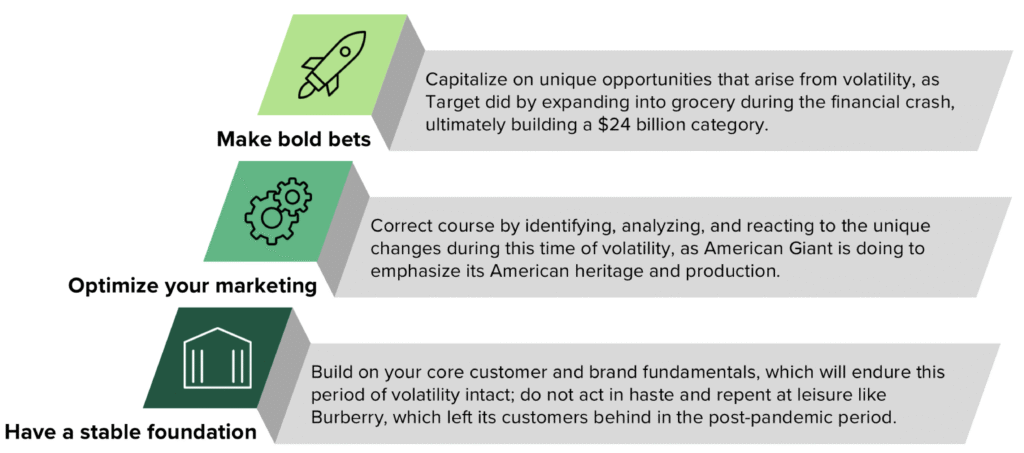
Navigating Volatility Businesses are no strangers to volatility. In the past two decades, the dot-com bubble burst, the financial crisis triggered the worst recession since the Great Depression, and the COVID-19 pandemic precipitated a global shutdown. But the level of confusion during this bout of economic volatility is unlike anything CMOs and other business leaders have experienced in past crises. To help marketing and growth leaders better manage their brand and business through this period of uncertainty and shifting consumer behaviors, we have a new report, Choose Precision, Not Panic, When Marketing During Volatility. A Three-Pronged Approach As marketers navigate this period, they can rely on some tried-and-tested recipes from their crisis cookbook, but they must alter the flavor of their approach to adapt to some unique characteristics. In this revised playbook for CMOs, we recommend a threefold “good, better, best” additive approach:   Good: Stick to a solid long-term strategy. Keep a cool head and resist knee-jerk reactions to upend your marketing. The foundational elements of your customer segmentation and brand value proposition will, in all likelihood, endure this period of volatility intact, so be careful not to undo the carefully considered brand you’ve built. Better: Optimize your marketing for the new environment. Correct course by discerning the unique and meaningful changes in the environment. For example, unlike during the pandemic years, most consumers today are stretched financially, which has significant implications for affordability. Throw in the likelihood that tariffs will raise import costs, and many CMOs need to revisit their pricing and messaging strategies. Best: Make bold bets if available and feasible. Severe volatility creates anomalies in the market, which can present opportunities to make a bold play to seize new territory. For example, during the financial crisis, Target took a big bet in launching a grocery business that is now worth $24 billion. But be aware that it takes gumption to do this. Five Precise Marketing Plays To optimize marketing for this new era of volatility, we recommend five precision plays: Apply a financial resilience filter to customer segmentation. Scrutinize and optimize advertising spend, and plan, buy, and measure media to maximize cross-channel halo effects. Revisit the five levers of growth — salience, product, experience, price, and access — and retune your marketing tactics. Double down on loyalty and focus on the most loyal of customers: the “devotees.” Step hard on the AI pedal to be more effective and better use resources. For more details on implementing these plays, clients can read our new report, Choose Precision, Not Panic, When Marketing During Volatility. How Forrester Can Help To get a broader sense of how marketing, CX, and digital leaders can thrive through volatility, please read Consumer Marketing, CX, And Digital Leaders: How To Thrive Through Volatility (US). This new report, Choose Precision, Not Panic, When Marketing During Volatility, is a follow-up to the earlier report and is specific to marketing and growth leaders. Forrester clients can schedule time with me for an inquiry or guidance session or talk to their account team about workshops and strategy days on planning through uncertainty. To learn more, visit my Forrester bio and click “Follow” to be notified whenever I publish research. source

The Marketer’s Guide To Volatility Read More »

SLED CIOs: Brace For DOGE Impact

Your Response To DOGE Practices Matters In early 2025, federal agencies found their worlds vastly changed under the Department of Government Efficiency (DOGE). But this isn’t just an efficiency era for federal agencies — state and local organizations will be impacted by changes and must prepare for new reality. Federal funding increasingly carries new requirements and funding sources have been slashed, leaving states needing to fund more programs. For example, DOGE terminated $2 billion in K–12 education grant funding, $880B (across 10 years) in Medicaid cuts, $11.4B from state health services, and more. Some state governments are even pushing their own efficiency initiatives: In Florida, Governor Ron DeSantis launched a state DOGE effort tasked with surfacing duplicative spending and advancing tech adoption; Wisconsin launched its GOAT committee, targeting inefficiencies in service delivery; and Iowa also is targeting digital waste and fraud. Even beyond the US, it is likely that other governments will similarly seek opportunities to aggressively push new efficiency efforts. With global volatility driven by inflationary pressure, talent shortages, and escalating citizen expectations, many state and local governments are under renewed pressure to deliver more with less — and to prove it. As massive as these recent changes are, efficiency isn’t a new ambition in the public sector or for many tech professionals in general. There’s always a drive to do the same (or slightly more) with less resources. It’s just that the current framing is shifting fast, especially for US government across both the federal and local landscape. So what should we do? State CIOs now stand at a critical junction — caught between the promise of streamlined, citizen-centric government and the peril of hollowed-out public institutions dressed in the language of reform. Efficiency, when wielded with strategy and safeguards, can modernize legacy systems, rebuild trust in public services, and empower frontline staff to focus on what truly matters. But when used as a blunt instrument — chasing optics over outcomes — it can entrench digital fragility, compromise security, and erode public confidence. The stakes couldn’t be higher. You’ve got governors looking for fast wins, legislatures seeking savings, and citizens demanding digital services that just work. Your next move determines whether your DOGE effort becomes a blueprint for smart reform — or a cautionary tale. First, understand your situation by defining three things: Your sphere of control and influence. For many state, local, and education (SLED) leaders, budget cuts are being done to your group without the ability to say where and what. That’s not necessarily a bad thing. The first step is understanding what you as a leader can control and some broader decisions that you may be able to influence. Your mission. In some situations, it’s not about doing the same with a little less — it’s redefining what you do, as cuts are so severe. Depending on the severity of the cuts, you may need to redefine the business and IT capabilities that your organization must be able to deliver given your resources. This can help make tough decisions to free up spend for more critical capabilities. Your approach. These are defining moments in professional careers. Amid radical cuts is a unique opportunity for radical change with cultural appetite to shake things up using performance, transparency, and startup efforts such as digital modernization to drive out waste and scale mission outcomes. But the line between smart reform and self-defeating austerity is razor-thin. How do you land on the right side of the divide? You must define and communicate your approach to get your teams on board to serve the mission. SLED CIOs Should Follow Three Principles To Set Themselves Up For Success Efficiency, when done well, accelerates — not inhibits — service performance and trust. It requires intention, investment, and strategic discipline. Below are three high-impact, research-backed plays that every state CIO should lead with: Anchor efficiency in mission alignment. Efficiency gains amplify mission outcomes, not just cut costs. Start by aligning technology investments with agency priorities. Use outcome-driven metrics to ensure that IT and business strategies remain tethered through machinery-of-government changes and budget reshuffles. Rationalize and modernize core platforms with momentum, consolidate redundant systems, and elevate shared services using cloud-native architectures. Many SLED leaders will also choose to pause upgrades to major platforms that are not of central focus. Where possible, shift from bespoke builds to composable digital services. Consider whether moving to outcome-based contracts that reward value, not volume, could be valuable for your larger, more strategic services contracts. Lastly, operationalize AI for value, focusing on high-friction, high-volume touchpoints such as help desks and form triage. Look for reusable, non-constituent-facing use cases, as these are lower-risk and easier to execute on with reduced staffing. Augment staff with skills and automate viable tasks to free up staff for complex cases and innovation. Protect against classic mistakes/challenges. Rapid AI deployment without policy scaffolding leads to poor decisions and public backlash. Public trust is hard to regain, placing even a higher weight on getting AI right in the public sector. To combat this, embed responsible AI principles, including explainability and human review, into procurement processes and solution design. Prioritize use cases with minimal ethical complexity and high transparency. Implementing AI without clear objectives is like buying a plane with no flight path. Define mission-linked AI goals up front and invest in data readiness, ensuring that data is accurate, labeled, governed, and representative. Don’t greenlight projects until data maturity matches ambition. AI isn’t plug-and-play; without training, even the best models underperform. Upskill technical and policy teams through formal AI literacy programs, championed by chief AI officers. Lastly, and most critically, build communities of practice to share lessons and avoid repeating preventable mistakes. Keep an eye on the horizon for larger risks. Change leaves us vulnerable. Efficiency without security is a false economy. Baseline cyber posture against federal frameworks such as CISA’s Zero Trust Maturity Model and invest in automated compliance tools. Make cyber hygiene table stakes for any efficiency initiative, not an afterthought. Emerging threats from

SLED CIOs: Brace For DOGE Impact Read More »

How Kraft Heinz Is Using GenAI To Reimagine The Future Of Creative Content

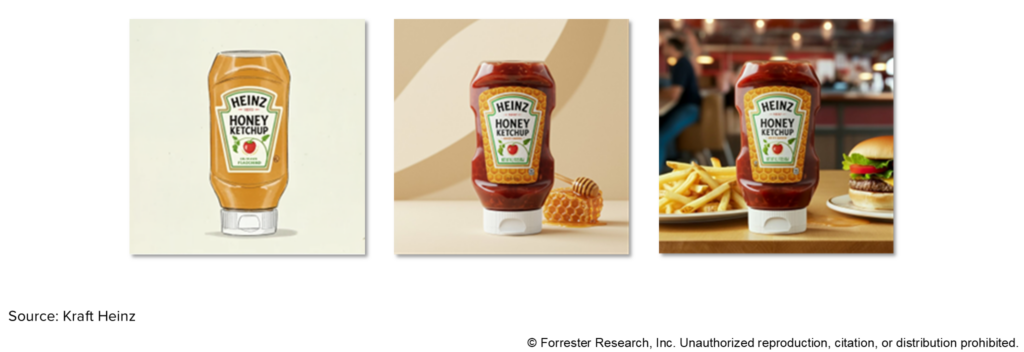
If you haven’t seen it yet and have 55 seconds to spare, I highly recommend you take a look at Heinz’s “A.I. Ketchup” campaign. By asking Dall-E 2 to generate an image of a ketchup bottle, the firm provided creative and entertaining proof that Heinz is not just another ketchup brand. Ketchup is indeed synonymous with the Heinz brand. But Kraft Heinz didn’t stop at marketing campaigns when it comes to using generative AI (genAI) for design and innovation. In a bold move to modernize its internal design processes, Kraft Heinz embraced genAI to scale content creation and personalization. The result? A complete reimagining of how one of the world’s largest food and beverage companies brings its iconic brands to life. From Bottlenecks To Breakthroughs: The Creative Challenge With over 100 brands and a global footprint, Kraft Heinz faced a familiar but formidable challenge: how to keep packaging and marketing content fresh, personalized, and on brand message — without the long lead times and high costs of traditional agency workflows. Justin Thomas, Kraft Heinz’s head of digital experience and growth, described the problem as follows: “How can we leverage AI to create more engaging personalized content at scale, reduce costs and time-to-market for product concepts, and do so while maintaining brand consistency and data security?” Enter the TasteMaker, the company’s custom-built retrieval-augmented generation (RAG) engine. Developed in partnership with Apply Digital and powered by Google’s Vertex AI, TasteMaker is more than a tool — it’s an innovation and design engine. Examples Of Kraft Heinz Product Content Produced By The TasteMaker RAG Engine   What Makes TasteMaker A Game Changer? Speed-to-market: Kraft Heinz slashed design timelines for its product content from weeks to hours, reducing time by 8x. Personalization at scale: Whether creating new assets or versioning image, motion, and video creative, TasteMaker enables the generation of content on demand. Brand consistency and data security: By codifying internal brand assets and using a proprietary AI instance, Kraft Heinz ensures that the results are on brand and that its IP remains secured. The Playbook: Experiment, Pilot, Expand Kraft Heinz didn’t wait for perfection. The team launched fast, starting with four use cases and scaling quickly after early wins, focusing on: Solving real business problems, not just showcasing tech. Getting data AI-ready, from brand IP to consumer insights. Empowering teams, with training, prompt engineering, and hands-on support. What’s Next? In parallel to deploying the solution across product lines, Justin Thomas and the TasteMaker team have established an ambitious roadmap: Continuous improvement through refining image generation and integrating more proprietary data Adding further capabilities and use cases, such as video generation Moving further down the innovation funnel by adding synthetic users and user testing features While the current results and the roadmap are impressive, the real story is the mindset shift. TasteMaker isn’t just a tool; it’s a new way of working and driving creative design. Do you want to dive deeper into the details of how a 150-year-old brand is leading the AI-powered future of creativity? Read the full case study to explore how Kraft Heinz is turning generative AI into a competitive advantage. source

How Kraft Heinz Is Using GenAI To Reimagine The Future Of Creative Content Read More »