Forrester

RSAC Conference 2025: Welcome To The Petting Zoo

If you walked the RSAC Conference 2025 show floor this year, you could be forgiven for thinking you were at the world’s strangest petting zoo or furry convention. There were goats! There were puppies! And if real animals on the conference show floor isn’t your thing (social media posts from RSAC 2025 attendees revealed mixed opinions), you also had robot dogs or your pick of people in furry animal costumes. Both on the expo floor and on the streets outside the Moscone Center, we found people dressed in full costume as rabbits, ducks, bees, and even a yeti. Read on for our key takeaways from this year’s RSAC Conference and find out which of these numbers were greater: the number of Forrester analyst steps taken at RSAC 2025 or the number of mentions of agentic AI (see the answer at the end of the blog).   Agentic AI Was Everywhere This year’s unofficial RSAC Conference theme seemed to be: AI agents and agentic AI are the future … as long as people don’t mind the additional work of teaching, training, and supervising them. Today’s version of agents and agentic AI mostly consists of a smattering of half-complete processes dropped into a human’s lap. It’s a lot like living with a productive but easily distracted DIY’er, where many projects get started, few ever finish, and you learn to live with the messy results. In short: Agents will do some work and complete tasks but not workflows. This will leave people with more alerts and activities to perform. Some of the manual toil will be removed, if your environment is ready for automation (something most vendors ignore for now). The RSAC sessions focused on skills and talked about how the cyber workforce did not consider the human challenges around agentic AI. Agents will create more alerts, but those alerts will need a mid- to senior-level practitioner to 1) check the agent’s work and 2) take action on the alert. At the same time, the increased usage of copilots and large language models by current early-career practitioners and the vendor promise and roadmap of agents as a replacement for those practitioners (such as tier 1 and 2 security operations center analysts) will eliminate the hands-on work needed to build domain and institutional knowledge. The trade-off here sets us up for potential issues down the line. In the hopes of solving today’s — supposed — early-career skills shortage, we will create a shortage of skills in the mid- to senior levels in the long term. Efficiency Drove Vendor Messaging Aside from an overload of agentic AI (and a few uses of AI that just didn’t make sense), most of the messaging was rather bland (not necessarily a bad thing). A lot of vendors emphasized platformization, automation, and intelligence. When considered together, this emphasized an underlying theme of helping security leaders do more with less in a struggling economy, although vendors avoided coming right out to talk about economic uncertainty. They also avoided any discussion of the geopolitical volatility and tariff mayhem gripping the world and the implications for everything from nation-state attacks and less cooperation and unity on fighting insidious ransomware to dealing with other rising risks such as deepfakes and undermining trust in tech and traditional government and societal institutions. Related to various security markets, we found that: Application security messaging shifts to platformization and application detection and response. Application security (AppSec) is still prominent at RSAC Conference, but the key messages have changed. API security signage dropped significantly, with only a couple of vendors highlighting API security capabilities, even though APIs remain a common cause of major breaches. The most precipitous drop in the AppSec world, though, was application security posture management (ASPM). Eight months ago at Black Hat while walking through Startup City, we saw four or five early-stage vendors pitching ASPM. Walking through the RSAC Early Stage expo last week, there were none. It wasn’t that the early-stage vendors had graduated to the main expo, as we didn’t notice any ASPM signage there either. Instead, emerging companies pitched runtime application security, sometimes called application detection and response, while established vendors touted their unified web application protection platforms. Identity maintains a strong showing. Identity vendors of all shapes and sizes were present, including a healthy dose of non-human identity management and identity verification offerings. Identity vendors featured heavily in the Early Stage expo. Announcements from identity vendors were muted, however, as many vendors are holding product announcements for the upcoming Identiverse event. The FIDO Alliance’s seminar on the state of passkeys was lightly attended compared to previous years. Quantum security has a light presence on the show floor, with signs of growth. Some smaller vendors in the quantum security space could be found on the outskirts of the expo pitching post-quantum, cryptographic agility, or quantum key distribution solutions. We also noticed one quantum security vendor at the Early Stage expo. As we get closer to 2030 and some of the first deadlines for quantum migration, we expect these vendors to be more prominent and for quantum security messaging to grow. The combination of insider risk management + DLP grows. The convergence of insider risk management solutions with strong data loss prevention (DLP) controls was showcased at some very large booths. Insider risk continues to be a primary use case for data protection solutions, and employee monitoring solutions (for security and productivity) are enjoying a moment in the limelight. DLP itself had a strong presence across the show floor as existing providers continue to push AI capabilities into their offerings or different ways to enforce DLP policies, such as through a browser. MIND, one of the startups showcased in Innovation Sandbox, also focused on an AI-driven approach to DLP. Cyber resilience has an even stronger showing than last year. A modern data resilience strategy today includes security as a core component. Your data resilience platform must be architected with Zero Trust principles and have additional security integrations. Major data resilience, backup, and

RSAC Conference 2025: Welcome To The Petting Zoo Read More »

Power Growth With Your Total Experience

Earlier this year, Forrester’s Priorities Survey, 2025, collected data among 4,519 global private-sector business and technology professionals across many different industries. We asked them a simple question: “Which of the following objectives will be your organization’s most important business priorities over the next 12 months?” The top three priorities were: Improve the experience of our end customers (60%). Achieve growth targets (58%). Improve brand (53%). These three priorities are tightly linked, with both customer experience (CX) and brand vital to driving growth. And success requires tight alignment across functions. Marketers are often wrongly perceived as overfocusing on acquisition, media, advertising, and promotion. But acquisition is the lifeblood of most companies, fueling revenue and business growth. Marketers are also tasked with creating memorable brand experiences. After all, consumers experience your brand whether you build it intentionally or not. CX professionals, you are already thinking about how to build an awesome customer experience. You recognize the importance of serving customers well to create stickiness, retain customers, and monetize the relationship over time. When companies improve both brand equity and CX together, there is a significant revenue uplift. We analyzed the relationship between creating brand equity and solidifying this brand perception through experiences that serve customers and found that both brand experience (BX) and CX not only act as powerful drivers of business value but also have a compounding effect: up to 3.5x higher revenue impact. Delivering the promises you made fuels your growth engine. How do you do this? By delivering a total experience. The total experience shapes the perception that consumers (prospects and customers) form based on their cumulative interactions with your brand. It’s not fixed. It’s fluid — shaping and evolving over time as consumers continuously recalibrate their expectations based on their experiences. Consistent, additive, anticipatory — these are the three principles that make up a total experience mindset: Consistent. When brands deliver consistent experiences, they become reliable. Consumers expect something from them, and they keep delivering that thing each time. Consistent experiences across CX and BX feel unified and connected, where the tone or message of the brand aligns to the actions it takes or services it delivers. Additive. Additive experiences build over time, and they take context into account. They build upon a consumer’s experience with the brand, so interactions feel like a continuation of the relationship, not a reset. They use data to adapt the experience as the consumer evolves. Anticipatory. When a brand delivers anticipatory experiences, they read the moment and flex based on real-time customer signals. Anticipatory experiences leverage predictive analytics to anticipate consumer needs and deliver a message, service, product, or experience before they even ask for it. Now, the real magic happens when all three of these principles come together and a brand fully adopts a total experience mindset. Join Us At CX Summit EMEA 2025 To Learn More To learn more about how to power growth with your total experience, join us at CX Summit EMEA on June 2–4, 2025, in London. I am delighted to deliver the opening keynote of our event, “The Total Experience: Your Brand, Their Journey.” The Summit brings together leaders in CX, digital, and marketing to explore the future of customer relationships and learn how to build a total experience that aligns brand experience and CX to drive sustainable growth. You’ll be able to learn from Forrester experts but also from many inspiring guest speakers — CEOs, chief experience officers, chief client officers, and chief digital officers from leading brands such as Bank of Ireland, Bupa, Fujitsu, Lloyds Banking Group, Philips, and many more. We also have special programs for you such as an AI hackathon, the Executive Leadership Exchange (a curated experience for C-level executives), the Forrester Women’s Leadership Program, and our CX certification course. You can deep-dive into critical topics with track sessions organized around three themes: Leverage Tech For Stellar CX — And EX Optimize Journey Value With Data Empower The People That Make Great Experiences You can explore the full agenda and register here. If you are a Forrester client, stay tuned for additional research on the total experience and Forrester’s upcoming Total Experience Score. Go to my Forrester bio and click “Follow” to be notified. You can also follow me on LinkedIn here. Also, as a client, you can schedule time with me for an inquiry or guidance session or talk to your account team about workshops and strategy days on how to align your brand, customer, and employee experiences. source

Power Growth With Your Total Experience Read More »

Lead Yourself (Before Leading Others) In Volatile Times

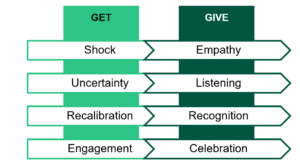
Things are crazy right now: The level of volatility in the market, politics, and our organizations threatens to overwhelm us into paralysis. And yet, as a leader, you are expected to lead others through it all. How well can you lead others when you are drowning in uncertainty? You can’t. Repressing your misgivings and presenting a facade to your team won’t work because people can smell inauthentic leadership from a mile away. You must take steps to restore your own optimism, confidence, and calm before your misgivings inspire panic in others. To lead your people through volatility, first take the time to lead yourself. For example, here’s a framework that my colleague Katy Tynan created for her change leadership SURE model:   This framework was originally meant for leaders to use with their teams, guiding leaders to know what to “give” when they “get” certain responses from their people. But you can apply this same approach to yourself and restore your own calm and confidence: When you feel shock, give yourself empathy. Acknowledge your feelings, and tell yourself that it’s understandable and normal to feel this way. Accept it; don’t suppress it. When you feel uncertainty, listen to yourself. Explore your uncertainty with intent curiosity. Ask “What’s driving my uncertainty? What am I unsure about? What would help me feel more certain about things?” It’s the general fog of unspecific uncertainty that creates the most disruption. When you can pinpoint exactly what makes your confidence falter, you can take steps to address it. When you are ready to recalibrate, recognize that in yourself and give yourself a pat on the back for making that turn. Mark your mindset shift and congratulate yourself for starting a more positive flywheel of thoughts and behaviors. When you feel engaged and “in it,” celebrate your progress and success. Reward yourself for reengaging. Model your mindset shift and positive energy with others so that they see the benefits of engaging. Influencing their behavior will be the biggest reward of all. Now you’re ready to lead through change sustainably and authentically. From my work in coaching, another tool that’s helpful in restoring confidence and reducing anxiety is the three-step process: Step 1. Recall a time when you were in a similar situation of uncertainty or doubt — feeling stuck, listless, whatever — and were still ultimately successful. Step 2. Ask yourself, “What about me [not the situation or related to someone else but a personal attribute about you] helped me be successful that time?” Step 3. Think to yourself, “How can I apply my [personal attribute that helped me be successful in the past] to my situation now?” Ta da. Now you’ve reminded yourself that no matter what knocks on your door next, you’ll be able to handle it because of who you are, your experience, your skills, and your unique gifts. Take these simple steps to get your bearings first, like putting the oxygen mask on before then guiding others around you to do the same, using some of these same tools to restore their “oxygen.” I’d say good luck, but with good, mindful practices like these, you won’t need it! Let me know if I can help along the way. source

Lead Yourself (Before Leading Others) In Volatile Times Read More »

B2B Summit EMEA Awards

The race is on! Entries are now open for the Forrester B2B Summit EMEA Awards, taking place in London from October 6–8, 2025. The deadline for submissions is June 30, 2025, and you can find the entry form here. What Makes A Winning Entry? To stand out, focus on showcasing measurable results — especially pipeline growth and closed revenue. Improvements in win rates, deal size, and deal velocity are strong indicators of success. However, be cautious when presenting percentage changes without context. For example, stating that your conversion rate improved by 50% may seem impressive, but if it shifted from 0.05% to 0.075%, the impact is less compelling. Combine such metrics with broader achievements to strengthen your case. To give you a well-rounded perspective, I asked several Forrester analysts — our esteemed judges — what they look for in a winning entry: Christina Schmitt, principal analyst and CMO adviser recommended: “I want to see alignment across disciplines. Groundbreaking transformations that deliver great results always involve teamwork — it’s never just marketing working in isolation.” Paul Ferron, head of international B2B research said: “Tell a captivating story. Share the challenges, the hurdles, and the mountains you had to climb to achieve success. I want the audience on the edge of their seats!” Conrad Mills, principal analyst specializing in demand and account-based marketing added: “I love a big reveal — a moment where everyone’s phone cameras go up to capture a framework that worked for you. Share actionable insights others can take home and apply.” Join The Hall Of Fame Previous winners — such as Cora Systems, Dun & Bradstreet, Infocert, Keysight Technologies, NTT, and Shell Fleet Solutions — have earned a place in our prestigious hall of fame. Now it’s your turn! Start crafting your entry and showcase your achievements. Find FAQs here and the entry form here. Remember, the deadline is June 30, 2025 — don’t miss your chance! source

B2B Summit EMEA Awards Read More »

The Verdict Is In: It’s Buying Groups For The Win

We’ve just wrapped up another great B2B Summit event, and buying groups was all the buzz … again. Marketing leaders have built their plans, budgets, metrics, and success based on the lead (marketing-qualified lead, or MQL) for decades now. But for most organizations we talk to, it’s not working like it used to. That decision-maker who sales wants to talk to isn’t working alone and definitely isn’t taking cold calls or emails. In fact, Forrester’s Buyers’ Journey Survey, 2024, says that on average, 13 people are involved in making a purchasing decision. If your organization is aiming to enhance performance and foster sustainable revenue growth, it’s time to pivot from individual leads to engaging multiple members of the buying group. This shift is not only beneficial but essential. The Real Opportunity Is Buying Groups Organizations must shift to looking beyond the lead to the group of individuals involved in making buying decisions. The typical B2B buying group is made up of individuals from different parts of the organization, each with their unique needs and roles in the buying process, including decision-maker, champion, influencer, ratifier, and user. Engaging with the entire buying group, understanding the roles that each member plays, and catering to their specific needs is the key to unlocking more opportunities and driving growth. Providers that have shifted their focus to buying groups have seen significant benefits, from uncovering more opportunities from hidden prospects and existing engagement to improving sales efficiency. “It’s all about adding buying group members with the right titles or more deeply qualifying the existing members with the right titles,” said Jeremy Schwartz, senior manager of global lead management and strategy at Palo Alto Networks and Forrester 2025 B2B Program Of The Year Awards Winner. “Our revenue process transformation approach resulted in significant improvements. During the pilot stage, win rates doubled. Upon fully scaling, we saw an 800% increase in opportunity progression to forecast. We also saw a large increase in business development rep conversions and average deal sizes for the quarter that, if applied to our previous year’s results, would have generated an estimated 13% increase in revenue.” Three Steps To Shift To Buying Groups Today Ready to make the shift? Here are three steps to get you started today: Outline the buying group and roles. Think of it as moving from a simple game of checkers to a strategic game of chess. Each member of the buying group plays a different role, from the champion pushing for change to the decision-maker holding the budget. How will your product or solution help each of them? Connect and package signals for revenue development teams. Once you’ve got a good sense of the buying group, pass that info along to your revenue development reps (also known as business development reps or sales development reps). Equip them with the insights needed to identify and engage other members of the group. Assemble buying groups and signals in early-stage opportunities. The sooner you can get a clear picture of the buying group in your sales and marketing systems, the better, as your visibility into potential revenue will improve. Why You Should Make This Shift And Begin Your Revenue Process Transformation In today’s world, it shouldn’t be a surprise that buyers have more power than ever before and expect more personalized experiences. By focusing on buying groups rather than individual leads, we can meet these expectations, uncover more opportunities, and drive sustainable growth. Plus, aligning marketing, sales, and customer success around the buyer’s journey ensures that we’re all working together to deliver value and a consistent, relevant experience every step of the way. Making the move to buying groups is not just about improving conversion rates; it’s the shift from being revenue-obsessed to being truly customer-obsessed and better aligned to how businesses make purchasing decisions today. Making the shift to buying groups isn’t new news, but after Summit this year, it’s buying groups for the win. To learn more about how to embrace the shift to buying groups, check out our latest research, Buying Groups For The Win. Want to know about some of the organizations that have already begun this shift? Hear directly from them in this webinar with Siemens, Palo Alto Networks, and Zendesk. source

The Verdict Is In: It’s Buying Groups For The Win Read More »

Now Live — The Forrester Wave™: Customer Analytics Service Providers, Q2 2025

I am excited to announce The Forrester Wave™: Customer Analytics Services, Q2 2025. The customer analytics services market has always evolved alongside emerging technology — from big data to cloud to AI. Like other service providers, customer analytics service providers (CASPs) have kept pace through tech adoption and strategic partnerships, but they face a distinct challenge: bringing their customers along for the ride. Today’s enterprises expect seamless experiences, fast support, and intuitive interfaces. And if a vendor brand falls short, enterprise buyers know they can easily find one that doesn’t. As end users become increasingly comfortable using applications such as ChatGPT or Gemini every day, enterprises are looking for ways to embed the same level of intuitive experience into their customer-facing channels. Similarly, enterprises — the buyers of customer analytics services — are now demanding this same seamlessness and demonstrable effectiveness from their analytics services and solutions. Their key questions reflect this urgency: How do I determine high-value customer segments and deliver next-best experiences in real time? How do I reduce time between campaign cycles? How do I communicate insights or quantifiable measurement of analytics effectiveness to executive teams? The list goes on. This shift in end-user and enterprise expectations has revealed several notable capabilities to look for in a customer analytics service provider, such as: Depth of insights. While the commoditization of customer analytics — churn and propensity models, lifetime value analyses, segmentations — has accelerated insights, vendor differentiation now depends largely on the depth of those insights. Advances in technologies such as graph databases and vector embeddings enable richer contextual understanding by incorporating diverse data types (text, image, video, audio, document, etc.). For example, service providers help retailers leverage graph databases to analyze customer emotion and personalize creative content, resulting in a significant increase in customer engagement. When choosing a CASP, look for providers that can help you uncover deep insights from traditionally elusive data sources. Impact and actionability. Beyond data processing, leading providers distinguish themselves by focusing on impact. They apply advanced decision optimization, real-time feedback mechanisms, and explainable AI to drive smarter, faster outcomes. Budgeting constraints have further driven businesses to emphasize value measurement to justify spend on analytics, something many service providers do very well. As one customer reference mentioned about their customer analytics partner, “One successful project could pay for the entire engagement.” Several participants in this year’s Wave offer interactive dashboards and data hubs that enable real-time value measurement of their analytics initiatives. These tools help clients monitor key aspects of their insights operations and more effectively calculate ROI. Preparation for agentic AI. The aim of many leading CASPs is to prepare themselves and their clients for an agentic shift. Agentic systems refer to automated processes and systems that can perform tasks independently, reducing the need for human intervention. A shift toward AI agents will place far more emphasis on building automation pipelines and far less emphasis on consulting services. Consulting will always have a role to play to integrate agents, monitor performance, and consult enterprises on their agentic priorities. Even so, leading CASPs foresee their role shifting to aid businesses in making the transformation to become more automated. Forrester clients can read our full Wave evaluation and our market overview research on the 2024 CASP landscape. Please schedule a guidance session with me to learn how to use this research to identify best-fit providers for your needs. I can guide you through my findings and help you identify the vendors that should make your shortlist. Customer analytics vendors: Please schedule an inquiry or advisory session with me to discuss what my findings mean for the industry and your offering. source

Now Live — The Forrester Wave™: Customer Analytics Service Providers, Q2 2025 Read More »

Driving IT Excellence with AIOps: Key Insights for future success

In the rapidly evolving landscape of IT operations, artificial intelligence for IT operations (AIOps) has emerged as a transformative force. My report, Drive IT Excellence With AIOps, provides a comprehensive overview of how AIOps can revolutionize IT operations, detailing essential functionalities, advanced capabilities, and the challenges faced in adoption. Here, I summarize the key points from the report across four areas. Essential AIOps Functionalities Five core functionalities are crucial for leveraging AIOps effectively. These five items have already become table stakes for enterprise-class AIOps platforms: Session replay: widely available for front-end diagnostics but less critical than real-time anomaly detection and automated root-cause analysis Synthetic transaction monitoring: essential for assessing application performance Infrastructure and device discovery and monitoring: foundational, with real value in leveraging data for automation and proactive issue resolution Deterministic automation: highly valued for its reliability and efficiency, reducing errors and increasing productivity by ensuring consistent, predictable outcomes Outlier and anomaly automated alerting: varies in effectiveness based on the sophistication of the AI models used by different vendors Advanced Capabilities Five advanced capabilities set leading AIOps solutions apart. These five developing features are shaping the AIOps market: Generative AI: GenAI serves to provide autonomous assistance and summarizations, emphasizing explainability and transparency for trust building. Predictive analytics and proactive operations: Effective prevention requires leveraging comprehensive data analysis, emphasizing the strategy of “prevention, not just fast correction.” Tool consolidation/unified platform: Enterprises prefer full-function platforms for IT simplification, optimization, and tech debt reduction with a growing convergence of operations and security. Security integration in AIOps: The integration of security operations with AIOps is crucial for a unified approach to IT and security management, enhancing resilience, threat detection, and compliance. Self-Healing and autonomous remediation: The vision for self-healing systems highlights the importance of transformative automation in maintaining strict service-level agreements and reducing manual intervention. Overcoming Adoption Challenges Despite the promising capabilities of AIOps, there are several challenges that organizations must address to fully leverage its potential: Data quality and integration: Addressing data silos and governance is critical, and overcoming cultural resistance to data integration is essential for success. Trust and explainability of AI: Building confidence in AI tools necessitates clear communication on how AI decisions are made. Integration with existing tools and systems: Standardization and ensuring interoperability are key to simplifying integration efforts across the IT landscape. Proving business value and ROI: Clear metrics and alignment with business objectives are crucial for demonstrating AIOps’ value and securing investment. Security and compliance concerns: Rigorous security and compliance measures are essential to mitigate risks and ensure the safe deployment of AIOps technologies. Future Market Disruptions It’s a dynamic market, and developments in AI/ML are fast to surface. Five future disruptions in the AIOps market are anticipated. These five disruptive concepts are poised to reshape the AIOps market by introducing new capabilities, fostering innovation, and challenging existing market leaders: Agentic AI and AI assistants: Agentic AI extends the capabilities of IT teams, offering scalable mentorship and operational alignment with organizational policies. Autonomous remediation and self-healing systems: Growing trust in automated, data-driven decision-making allows for more sophisticated AI involvement in problem resolution. Edge computing: Edge computing demands AIOps solutions capable of managing and analyzing data in less reliable connectivity environments, enhancing decision-making and resilience. Data privacy and compliance: Adapting AI operations to focus on data privacy and compliance is crucial for sustaining AI adoption in IT operations amidst growing security concerns. Unified platforms: Foster collaboration among AIOps, DevOps, DevSecOps, and SREs, enabling data-driven decisions and enhancing enterprisewide collaboration. Conclusion Forrester’s Drive IT Excellence With AIOps report provides invaluable insights into the transformative power of AIOps. By understanding and leveraging essential functionalities, advanced capabilities, and strategies to address adoption challenges, organizations can achieve IT excellence and stay ahead of future disruptions. Explore additional Forrester research content on AIOps: Join The Conversation I invite you to reach out to me through social media if you want to provide general feedback. If you prefer more formal or private discussions, email [email protected] to set up a meeting! Click Carlos at Forrester.com to follow my research and continue the discussion. A big note of appreciation goes out to Madeline Cyr, who did most of the heavy lifting to pull this research together. source

Driving IT Excellence with AIOps: Key Insights for future success Read More »

US Economic Trends And Outlook: New Quarterly Series Tracks Growth Indicators For 2025

We’ve just released Forrester’s new report, US Economic Trends And Outlook, Q2 2025. This quarterly report reviews how the US economy is evolving across numerous indicators and sectors. Organizational leaders can use this analysis to chart and adjust their course over the coming months to adapt to market changes, run effectively, and successfully serve their customers. What US organizations must prepare for: In Q1 2025, we saw that evolving trade tariffs and policy uncertainty led to subdued economic growth indicators. US real GDP declined by 0.3% quarter over quarter SAAR (seasonally adjusted at annual rates) in Q1 2025, per the advanced estimate from the US Bureau of Economic Analysis on April 30, 2025. To navigate the rest of 2025, business leaders must now prepare for: Slower economic growth. The US Federal Reserve predicts that real GDP growth in the US will slow to 1.8% over the next three years, significantly lower than the 2.5% growth in 2019 and the 2.9% average growth in 2023 and 2024. Consumer spending growth follows a similar pattern. As a result, tech spending growth from businesses and government and from consumers will slow; changes to real GDP is a strong predictor for spending in both arenas. A slowdown in government spending. Bloomberg data suggests that by 2027, government spending will see growth under the 2% mark — compared to the 3.4% growth seen in 2024. By the end of 2024, federal debt equaled 98% of US GDP, and by 2029, that’s forecasted to reach an all-time high of 107% of GDP, which will likely constrain future government spending. Sticky inflation and higher unemployment. US headline inflation was 2.7% in Q1 2025, unchanged from Q4 2024. Per the US Bureau of Labor Statistics’ Consumer Price Index data analyzed by Forrester, the prices of durable and nondurable goods increased during Q1 2025 while services inflation continues to come down. The Federal Reserve estimates that it will take until 2027 for core inflation to reach its 2% target. Furthermore, the Federal Reserve predicts that US national unemployment will climb to 4.4%, up from 4.0% in 2024, while Bloomberg consensus estimates predict 4.3%. Forrester clients: Forrester continues to monitor economic indicators as well as consumer spending growth and changing consumer behavior. Watch for our quarterly insights into the macroeconomic indicators impacting consumers and businesses and what these mean for your business. Explore our first report in this series, US Economic Trends And Outlook, Q2 2025, and please schedule a guidance session or inquiry with us to discuss implications for your organization. source

US Economic Trends And Outlook: New Quarterly Series Tracks Growth Indicators For 2025 Read More »

The Marketer's Guide To Volatility

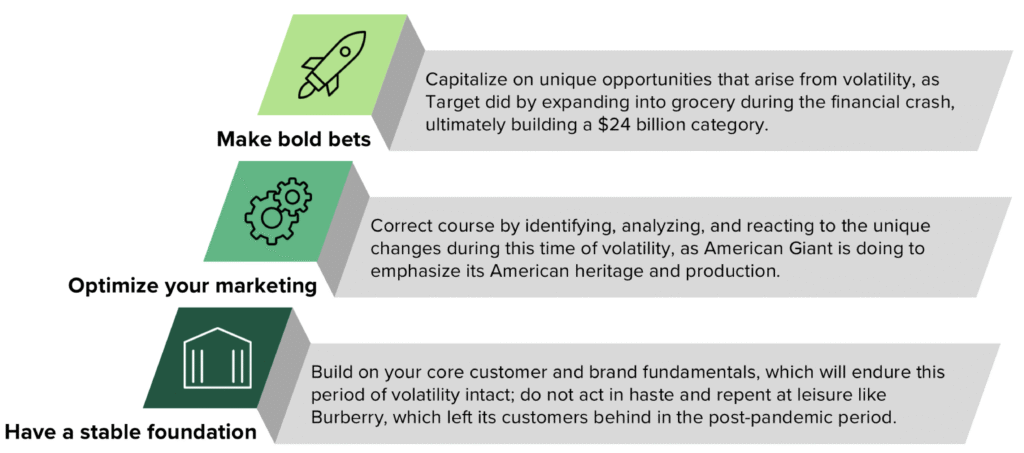
Navigating Volatility Businesses are no strangers to volatility. In the past two decades, the dot-com bubble burst, the financial crisis triggered the worst recession since the Great Depression, and the COVID-19 pandemic precipitated a global shutdown. But the level of confusion during this bout of economic volatility is unlike anything CMOs and other business leaders have experienced in past crises. To help marketing and growth leaders better manage their brand and business through this period of uncertainty and shifting consumer behaviors, we have a new report, Choose Precision, Not Panic, When Marketing During Volatility. A Three-Pronged Approach As marketers navigate this period, they can rely on some tried-and-tested recipes from their crisis cookbook, but they must alter the flavor of their approach to adapt to some unique characteristics. In this revised playbook for CMOs, we recommend a threefold “good, better, best” additive approach:   Good: Stick to a solid long-term strategy. Keep a cool head and resist knee-jerk reactions to upend your marketing. The foundational elements of your customer segmentation and brand value proposition will, in all likelihood, endure this period of volatility intact, so be careful not to undo the carefully considered brand you’ve built. Better: Optimize your marketing for the new environment. Correct course by discerning the unique and meaningful changes in the environment. For example, unlike during the pandemic years, most consumers today are stretched financially, which has significant implications for affordability. Throw in the likelihood that tariffs will raise import costs, and many CMOs need to revisit their pricing and messaging strategies. Best: Make bold bets if available and feasible. Severe volatility creates anomalies in the market, which can present opportunities to make a bold play to seize new territory. For example, during the financial crisis, Target took a big bet in launching a grocery business that is now worth $24 billion. But be aware that it takes gumption to do this. Five Precise Marketing Plays To optimize marketing for this new era of volatility, we recommend five precision plays: Apply a financial resilience filter to customer segmentation. Scrutinize and optimize advertising spend, and plan, buy, and measure media to maximize cross-channel halo effects. Revisit the five levers of growth — salience, product, experience, price, and access — and retune your marketing tactics. Double down on loyalty and focus on the most loyal of customers: the “devotees.” Step hard on the AI pedal to be more effective and better use resources. For more details on implementing these plays, clients can read our new report, Choose Precision, Not Panic, When Marketing During Volatility. How Forrester Can Help To get a broader sense of how marketing, CX, and digital leaders can thrive through volatility, please read Consumer Marketing, CX, And Digital Leaders: How To Thrive Through Volatility (US). This new report, Choose Precision, Not Panic, When Marketing During Volatility, is a follow-up to the earlier report and is specific to marketing and growth leaders. Forrester clients can schedule time with me for an inquiry or guidance session or talk to their account team about workshops and strategy days on planning through uncertainty. To learn more, visit my Forrester bio and click “Follow” to be notified whenever I publish research. source

The Marketer's Guide To Volatility Read More »

Maximizing Financial Services CRM Value: Strategic Alignment And AI Adoption

A modern CRM is core to connecting organizational silos to drive customer and business value. Today, CRMs are integrating AI and adding intelligent agents to boost productivity and deliver personalized customer experiences at scale. This makes modern CRM an indispensable tool for financial services firms aiming to enhance customer experience, streamline operations, and drive growth. But despite the benefits, I frequently hear two consistent messages from financial services firms: 1) They struggle to justify the investment in CRM modernization, especially in the current economic environment and 2) firms that have modernized their CRM say they are struggling to extract value from it. The common thread is that financial services firms are underutilizing their CRM, especially AI capabilities — which, in a way, is akin to buying a high-performance car and only using it to drive to the grocery store. The reason? They often cite a lack of internal resources, partner support, and/or vendor assistance, making it more important than ever to choose the right vendor. The Financial Services CRM Market Is Bifurcating, Making Vendor Choice Harder In a competitive market dominated by a few global leaders, and amidst an intense battle over AI to optimize and automate almost everything, the CRM market is bifurcating. This makes CRM purchasing decisions more complex for financial services firms. Some vendors are deepening their industry-specific capabilities, including AI offerings purpose-built for financial services firms. Others are moving away from financial services-specific capabilities and instead focusing on the industry-agnostic AI and automation building blocks that firms can use to develop their own solutions or work with partners to customize. So what should financial services firms do? Given that CRM is a critical piece of technology infrastructure that underpins a firm’s ability to deliver next-generation financial services, firms need to: Treat CRM as a strategic purchasing decision. Align with vendors and partners that have the vision, innovation, roadmap, support, and capabilities to support short- and long-term strategic business goals. Ensure support for extracting value and optimizing ROI. Seek vendors with strong support services that can help continually optimize the system and extract more value from purchased capabilities. Choose a CRM vendor that can accelerate AI adoption. Prioritize vendors that have a cohesive toolset for predictive AI, generative AI, and AI agents, along with robust AI trust, compliance, and security practices. Faster adoption and ROI may necessitate out-of-the-box financial services AI capabilities. Forrester clients can review The Forrester Wave™: Customer Relationship Management Software For Financial Services, Q1 2025, in which we evaluate the most significant CRM providers for financial services, and read about The Customer Relationship Management Software For Financial Services Landscape, Q3 2024. If you need help understanding the financial services CRM market, modernizing your CRM, or extracting more value from your existing CRM, connect with me via a guidance session. source

Maximizing Financial Services CRM Value: Strategic Alignment And AI Adoption Read More »