Forrester

Igniting Partner Advocacy: A Strategic Imperative For B2B Marketers

In today’s fast-evolving B2B landscape, partner ecosystems have emerged as a cornerstone of sustainable growth. No longer just a “nice to have,” partnerships are now a strategic imperative woven throughout the buyer’s journey. The role of partner ecosystems has never been more critical. According to Forrester’s Marketing Survey, 2024, 82% of B2B marketing decision-makers at high-growth companies (those growing revenue 10%+ annually) say their customers prefer to buy through multiple sales channels — including ecosystem partners. What’s more, 80% report that buyers increasingly seek third-party validation before making a purchase. Yet despite this shift, many organizations overlook a powerful lever for maximizing partner ecosystem impact: a formal partner advocacy program. Partner Advocacy Drives Insights, Expertise, And Influence Across Multiple Audiences Partner advocacy is more than just a buzzword; it’s a strategic imperative. It encompasses the activities in which partners share their invaluable insights, experiences, and expertise about a supplier’s offerings, partnership value, and more across a variety of audiences. B2B organizations that formalize programs can significantly amplify the power of advocacy to create new business value, reach new markets, promote third-party validation, and drive supplier and partner ecosystem awareness, influence, and trust by leveraging partners to educate, enlist, engage, excite, and elevate audience awareness. This, in turn, drives mutual growth and success for suppliers, partners, and buyers/customers. The potential audiences for partner advocacy efforts are extensive and extend across internal teams, prospective partners, existing partners, and buyers and customers, as well as industries and markets. Partner Advocacy Offers Undeniable Benefits To Suppliers, Their Partners, And Buyers/Customers Supplier benefits. A well-designed partner advocacy program offers a wealth of value for suppliers including advocacy amplification, trust validation, and loyalty attainment. Partner benefits. A structured partner advocacy program provides significant ongoing value to participating partners across the partner ecosystem with key benefits such as partner value recognition, status elevation, and experience advancement. Buyer and customer benefits. Key buyer and customer benefits from a formalized partner advocacy program include buyer preference alignment, solution innovation awareness, and customer community expansion. It’s Beyond Time To Move From Ad Hoc, Reactive Partner References To Proactive Partner Advocacy Despite the clear benefits, many organizations struggle to develop or formalize their partner advocacy programs. Only half of global partner ecosystem and channel marketing decision-makers reported that their organization has established a formal partner advocacy program, according to Forrester’s Partner Ecosystem Marketing Survey, 2024. The lack of a structured approach often results in missed opportunities and underutilized advocacy impact and value potential for the partner ecosystem. Formalizing a partner advocacy program is not just a strategic move; it’s a necessity for B2B marketing leaders looking to thrive in today’s dynamic market. A partner advocacy program enables B2B suppliers to exponentially increase their advocacy potential and scale their voice-of-the-partner efforts across a wide variety of audiences to achieve a vast array of advocacy goals and objectives and amplify their and their partners’ brand value and thought leadership impact. Learn More And Get Started If you are a Forrester client, I invite you to: source

Igniting Partner Advocacy: A Strategic Imperative For B2B Marketers Read More »
Forrester’s Top 10 Emerging Technologies For 2025: Automation Evolves, Robots Rise, And Synthetic Data Steps Forward

Emerging technology isn’t just speeding up — it’s splintering into newer, riskier, and more powerful directions. Last year, in our top 10 emerging technologies list, we split generative AI into two: one track for language, one for visual content. That split still holds for the 2025 list, but the timelines are shifting. Generative AI for language is here now, while generative AI for visual content will eventually transform digital experiences — just not overnight. Meanwhile, the rest of this year’s list reflects the relentless pace of change, with big updates in how we cover automation, data innovation, and embodied AI. Below, we highlight three noteworthy changes to this year’s top 10 emerging technologies list — and one foundational truth that hasn’t changed. To get a full deep dive on all 10 technologies, be sure to attend our upcoming webinar on May 21 if you’re in Europe or North America or June 4 if you’re in APAC. 1. Agentic AI: Automation Gets A Brain (And A Warning Label) Since first introducing intelligent agents in 2020, Forrester has tracked automation’s evolution with AI closely. Last year, we refined this to “AI agents.” But in 2025, we go even deeper — spotlighting agentic AI technologies as a distinct emerging technology. Why? Because a new wave of architectures and orchestration tools is making AI agents significantly more flexible and capable — but also more unpredictable. These technologies are enabling automation to take on open-ended tasks, respond adaptively, and operate independently. That opens new possibilities for enterprises — and new doors for risk. Clear boundaries, governance, and trust frameworks must evolve alongside the tech. We have already published an important foundation report on this technology. 2. Synthetic Data: From Privacy Tool To Performance Driver While 42% of firms say they are already using synthetic data as a privacy-preserving technology, its true potential is now coming into focus — and launching it into the top 10. Beyond its role in data minimization and bias mitigation, synthetic data is rapidly becoming a critical training and tuning tool for foundational models. Enterprises are using it to create high-fidelity datasets where real data is limited or unavailable, to stress-test AI behavior, and to ensure fairness at scale. The result? A more robust path to responsible AI — and a new lever for innovation. 3. Humanoid Robots: From Factory Floor To Frontline Humanoid robots were absent even from our top 20 list last year but show up on the top 10 this year. So what changed? Several forces converged in 2025: falling component costs, advances in robotic dexterity, and rapid progress in language AI. Together, they’ve made human-form robots feasible for frontline work across industries. From warehouses and restaurants to elder care and security, new use cases are gaining traction fast. If current trajectories hold, humanoid robots could disrupt many physical-service industries significantly by 2030. Robotics is not just about automation anymore — it’s about presence, interaction, and embodiment. What Hasn’t Changed? Trust Still Comes First. The most important message from last year remains unchanged in 2025, despite the increased volatility this year: To be ready for tomorrow’s innovation, tech leaders must invest today in trusted, secure technology foundations. Technology innovation thrives on speed — but trust is what enables scale. Are You Ready For The Full Picture? Attend one of our webinars to explore all 10 technologies shaping the future of innovation — and how to turn them into strategic advantage. Bring your questions for me to answer about your own emerging technology plans. source

Forrester’s Top 10 Emerging Technologies For 2025: Automation Evolves, Robots Rise, And Synthetic Data Steps Forward Read More »

Les indicateurs CX isolés vous ralentissent — Passez à l’action lors du CX Summit EMEA

Voici une information, qui peut vous faire réfléchir… La deuxième raison la plus fréquemment avancée par les responsables CX pour les investissements de leurs organisations dans des initiatives CX est… l’amélioration de leur score CX. Oui, vous avez bien lu. Le deuxième facteur principal d’investissement dans l’expérience client (CX) n’est pas l’amélioration réelle de l’expérience des clients — mais plutôt l’amélioration de ce que les clients disent au sujet de cette expérience. Il est vrai que, dans de nombreux cas, améliorer l’expérience vécue (la rendre plus simple, plus efficace, ou plus engageante émotionnellement) peut entraîner une amélioration du score CX. Mais le lien de cause à effet reste fragile. Nous avons tous déjà vu des exemples de “chasse au bon score” — des enquêtes Net Promoter Score℠ (NPS) qui mettent en évidence les notes 9 et 10 en vert vif, ou des phrases plus explicites comme :  « Toute note en dessous de 9 est un échec. » Trois autres lacunes majeures renforcent cette ‘’obsession’’ des scores : Le déficit de compétences : la plupart des équipes CX visent principalement la capacité à mesurer comme une compétence clé. Savoir définir des indicateurs CX est la compétence la plus fréquemment citée par les équipes que nous interrogeons à l’échelle mondiale. Et cette tendance se renforce : « définir les indicateurs CX » est aussi la deuxième compétence la plus ajoutée par ces équipes. Le déficit technologique : les budgets tech consacrés à la CX se concentrent sur les indicateurs, pas sur l’action. Près de la moitié des équipes CX — et trois quarts des équipes dédiées à la mesure — utilisent des outils de gestion des retours clients. En revanche, seulement une équipe sur cinq utilise des technologies permettant de réagir ou de piloter des actions, comme l’orchestration des parcours clients. Le déficit de processus : les équipes manquent de méthodes pour passer à l’action. Environ une équipe sur cinq, parmi celles en charge de la “voix du client” ou de la mesure, affirme disposer de processus efficaces ou très efficaces pour transformer les insights en résultats concrets — par exemple, pour prioriser des initiatives CX ou agir sur les retours clients. Il y a un fossé évident entre la grande majorité des responsables CX qui nous disent que leurs dirigeants pensent que leur entreprise est “customer-obsessed” – et la réalité des 3 % d’entreprises mondiales qui, selon notre évaluation de l’approche ‘’obsession client’’, le sont réellement. Découvrez comment associer marque et expérience client (CX) lors du CX Summit EMEA. Beaucoup d’entreprises considèrent encore l’acquisition et la fidélisation comme deux activités distinctes et séparées. Dans un récent billet de blog intitulé Stimulez votre croissance en alliant marque et expérience client, Dipanjan Chatterjee, VP Principal Analyst chez Forrester, nous présente les avantages obtenus lorsque l’on associe la mesure de la marque et celle de l’expérience client. En comparant les résultats du Brand Experience Index (BX Index) et du Customer Experience Index (CX Index™), on constate que les marques sont performantes sur ces deux volets. Cela signifie qu’elles sont reconnues, perçues comme adaptées et dignes de confiance, tout en offrant des expériences fluides, efficaces et émotionnellement engageantes — Elles enregistrent en moyenne une hausse de chiffre d’affaires 2,3 fois supérieure à celles qui obtiennent de faibles scores sur les deux indices. Forrester mettra ce concept à l’honneur lors du CX Summit EMEA cette année. Du 2 au 4 juin à Londres, les leaders de l’expérience client, du digital et du marketing se réuniront pour explorer l’avenir de la relation client. Nous apprendrons comment construire une expérience totale — c’est-à-dire un alignement stratégique entre expérience de marque et expérience client, au service d’une croissance durable. À travers un programme mêlant conférences plénières, sessions thématiques, expériences interactives, ateliers, tables rondes et bien plus encore, Forrester partagera des clés concrètes pour : Mesurer et améliorer l’expérience totale en utilisant les indices BX et CX de Forrester, afin de favoriser la fidélisation et la croissance des revenus ; Exploiter l’IA et les technologies émergentes pour créer des interactions client intuitives et plus humaines ; Utiliser des insights fondés sur les données pour affiner les stratégies de design et améliorer les expériences digitales ; S’appuyer sur les indicateurs pour façonner une culture véritablement centrée client, en veillant à ce qu’ils soutiennent la transformation au lieu de la freiner ; Le programme complet est disponible en ligne — l’occasion de s’inscrire et de passer à l’action au service des clients… et de l’entreprise. Note: Cet article a été traduit. Langue originale : anglais. source

Les indicateurs CX isolés vous ralentissent — Passez à l’action lors du CX Summit EMEA Read More »

Featured CX Executive: Brad Smith, Enterprise Insights & CX Leader At Securian Financial

We’re four months into 2025, and there has been no shortage of volatility to challenge even the most seasoned CX executives. To stay on course, we recommend keeping a ruthless focus on customers while also balancing disciplined spending, change leadership, and risk management. But what has this looked like, in practical terms, for CX leaders? I recently asked Brad Smith, who leads enterprise insights and CX at Securian Financial, to share what’s been top of mind for him in 2025. Below, Brad describes Securian’s CX transformation journey, including the evolution of its CX org structure, headwinds and tailwinds created by AI, and work underway to establish links between CX, EX, and business outcomes. Brad, thanks so much for sharing your insights! How Brad Is Leading Securian’s CX Efforts During Turbulent Times Brad Smith, Securian Financial As a CX leader, what headwinds and tailwinds are you facing as you enter 2025? You probably won’t be surprised to hear that Securian Financial is navigating the complexities of integrating AI into its CX strategies, and I’d call AI both a headwind and a tailwind. When thinking about how and where AI can help Securian, the company needs to answer three main questions: What tasks can be trusted to AI, and which ones should be kept within human control? How can we overcome challenges related to compliance, data management, technology adoption, and even expense management? How should we evaluate AI as a productivity tool for customers and associates while considering the cultural change required? Securian is a 145-year-old company built on trust and relationships, so fully leveraging the capabilities of AI will need to be done with extreme care, and it will require a huge cultural change to be successful. What are your top CX priorities for 2025? How have you established the link between CX initiatives and broader organizational objectives? In select areas of the business, we have found a direct correlation between the customer experience and repeat business/revenue. In other areas, we are taking a leap of faith for now that there is a correlation until we have a larger dataset to confidently conduct the analysis. Philosophically, the leadership team agrees that providing enhanced experiences to our customers will result in a win-win for Securian and our customers. We continue to reinforce customer-centric behaviors to demonstrate our belief that every role in the company impacts our customers in some way. Valuing empathy and creating an emotional connection with customers is crucial to the long-term sustainability of a customer-focused business model. Additionally, we are evolving our CX measurement capabilities to more broadly leverage AI. Having quicker access to deeper insights will transform our measurement approach, especially if we can push those insights to the correct decision-makers without a lot of heavy lifting. Currently, we are testing migrating from static dashboards to query-driven insights and recommendations created by the user. Many organizations are just getting started on their CX transformations. Where is Securian on its CX journey? Securian has been on its CX transformation journey for nearly five years. We started slowly by targeting one business line that was a willing business partner. Initially, we focused on CX measurement and formed a team to map out a priority journey aligned with the CX measurement work. By leveraging SWAT teams to tackle top pain points, we improved the overall customer experience scores, shortened cycle times, and reduced defects/rework. Building on these wins, we gradually expanded our focus while simultaneously building our expertise. Since our CX maturity still varies across business units, we are currently focusing on bringing the less mature areas up to speed with our leading areas. In 2025, we will continue the journey to better understand the impact that the Securian associate experience has on our customers and channel partners. We’ve spent the last few years understanding and improving the associate experience, and now we will take it a step further to understand the linkage between employee experience and customer experience. Describe your CX org structure. How did you land on this structure? What makes it effective today, and how do you see it evolving in the future? We began with an advisory model, where a centralized team of CX professionals advised the business on CX strategy, conducted measurements, and shared insights. Initially, business units were responsible for prioritizing and improving the experiences with their existing staff. After achieving significant activation wins, we transitioned the CX strategy roles into the business units. This allows them to better develop a vision for the customer experience within their respective areas. Currently, the design of specific experiences is handled by shared services such as enterprise technology and operations, with experience improvement as a formal goal. As we evolve toward a matrixed model, business units will leverage insights to prioritize improvement areas in a more formal, collaborative manner. For example, a digital product owner leads a cross-functional pod to enhance the product to better meet customer needs. Pod members represent CX measurement, Adobe analytics, data analytics, and UX design. Although we have considered implementing formal journey owners, we continue to be effective using the matrix model. Each stage of our CX evolution has been successful due to strong communication, clear roles and responsibilities, and a one-team mindset. What has made you personally successful as a CX leader? What resources would you recommend to other CX leaders? Traits that have served me well in CX include curiosity, a collaborative mindset, and strong change management skills. Being a certified Lean Six Sigma Black Belt has also been beneficial, as it has given me a strong process focus. I have also learned a lot from partners like the folks at Heart of the Customer, as well as experts at Forrester, Qualtrics, and Medallia. Most importantly, I have learned from the highly skilled associates on the Securian team. They bring diverse experiences to the table that enrich our CX offering and thought leadership. Additionally, the ability to identify and collaborate with a willing business partner cannot be stressed enough. Working

Featured CX Executive: Brad Smith, Enterprise Insights & CX Leader At Securian Financial Read More »

US Federal Workforce Layoffs: Can AI Agents Step In?

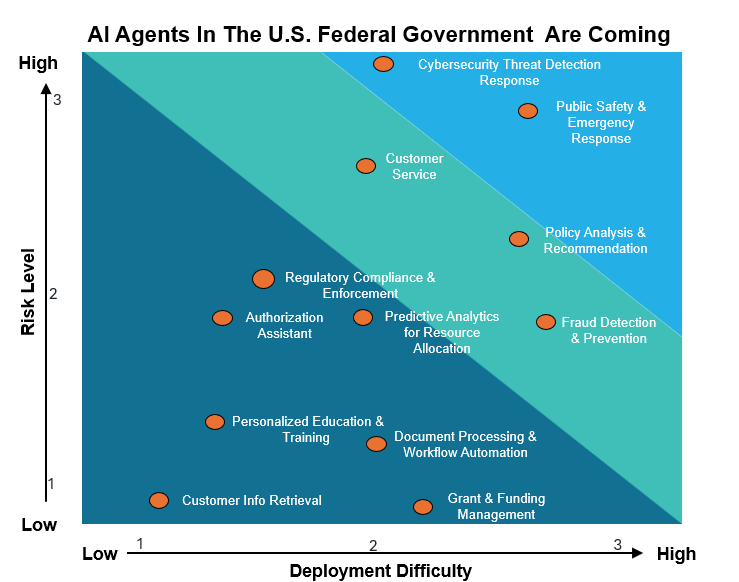
US federal government organizations are facing massive budget cuts, contract cancellations, and, yes, layoffs. Those facing this new reality are deeply affected, losing colleagues they’ve worked with for decades and valuable partnerships that help them execute. Despite the challenges, they must find a way to continue with their mission. The constant drumbeat: achieving greater outcomes with fewer resources. What might be able to help? Mission leaders are looking to emerging AI agent technologies to offer a pathway to meet this challenge. These automations can perceive their environment, make decisions, and take actions. By deploying AI agents, agencies can automate complex tasks, enhance efficiency, and deliver more impactful services without a proportional increase in personnel or expenditure. Agents won’t be able to replace valuable members of your team, but they can help you get key mission tasks complete and bolster the remaining workforce. Success lies in identifying the right applications and thoughtfully integrating these intelligent assistants into existing workflows. But beware: Silent substitutes can have loud consequences. The risks of poor implementation, oversight, or design of AI agents in government are high. For example, biased training data and opaque AI deployments for fraud detection could disproportionately affect vulnerable populations. How do you go about selecting the right use cases? US federal agencies are no strangers to AI use cases; in fact, federal inventories of AI use cases are vast. Much of what has been done is predictive AI, with few generative examples even for workforce productivity. The spectrum of potential use cases for AI agents across the federal landscape is also promising. AI agents have the potential to provide 24/7 customer support, answer inquiries, guide individuals through complex processes, and direct them to the necessary resources. This not only enhances customer experience (for constituents, citizens, visitors, residents, etc.) but also frees up human agents to handle more intricate or sensitive cases. AI agents can also bolster security. Their ability to analyze massive datasets makes them adept at detecting and preventing fraudulent activities and flagging potential violations for human review. The high-impact area of cybersecurity also stands to benefit, with AI agents offering real-time threat detection. In critical areas such as public safety and emergency response, AI agents can analyze real-time data to provide insights, potentially leading to safer communities and more effective crisis management. Beyond customer-facing and security applications, AI agents can streamline internal government operations. From automating the often-cumbersome processes of grant and funding management to intelligently processing documents and automating workflows, these agents can reduce administrative burdens and accelerate timelines. In the longer term, their analytical capabilities extend to policy analysis, where they can sift through complex data to provide valuable insights for policymakers. As AI advances in the federal government, expect to see personalized education and training programs powered by AI agents to enhance employee skill development in a cost-effective and tailored manner. By strategically embracing these diverse applications, the US federal government can leverage the power of AI agents to do more with less, ultimately better serving the American people. The goal? Aim for low risk and high value until you’ve gained experience. Here is Forrester’s analysis of the top 11 AI agent use cases for the US federal government:   The next generation of AI agents is defined by autonomous goal setting, dynamic reasoning, real-time learning, enhanced model control, and the ability to execute complex actions. Widespread deployment will be tempered, however, by a significant gap between these technological capabilities and organizational trust. Critical design challenges, including explainability, bias mitigation, reasoning guardrails, and robust data governance, must be addressed. Ambition must also be tempered with reality. History will repeat itself. AI agents will take longer than we think to be productive, just like the internet, mobile, and cloud, but finding the right use case has never been more critical. It’s not like the “cloud,” where you know what you are going to get but just in a different way. Finding the app that drives value is the most important thing. For mission leader, the imperative is clear: Embrace the AI agent movement, understand both its transformative potential and inherent challenges, and actively develop the skills to become creators of this powerful new automation. Automation will be your path to your agentic future. This will be one of the most meaningful steps that your agencies can take now. If you are a US government mission, business, or technical leader looking to get savvy on AI and automation for government agencies, Forrester is hosting a meeting on May 14 for clients and prospects alike. This session will feature me, Craig Le Clair, in a discussion of AI agents for US federal agencies, as well as our CTO, Michael Facemire, going step by step through how Forrester built its own genAI tool. If you’re interested in joining your peers, register now! source

US Federal Workforce Layoffs: Can AI Agents Step In? Read More »

Three Signs We’re In A Consumer Spend Slowdown

Tariffs? Layoffs? Empty ports? A possible recession in the US? As these headlines dominate the media cycle, consumer sentiment is falling, and behavior often follows — albeit at a slower, “wait and see” pace. But since 2020, consumers have been no strangers to volatility and uncertainty, and they’re no longer waiting for the headline to officially announce a “recession.” Here are a few signals that consumers are already acting: The usage of “buy now, pay later” (BNPL). BNPL is most used in medium- to bigger-ticket items such as clothing, electronics, and furniture — but a growing number of consumers are starting to use it in everyday household items like groceries. There has also been an increase of consumers who have stated that they’ve made late payments on BNPL loans. An economic slowdown will likely affect lower-income consumers more, and the Consumer Financial Protection Bureau finds that it is the consumers who have credit records, who have lower credit scores, and younger borrowers who are the most likely to be BNPL users. The types of content they consume. If we are what we consume, then the types of content that creators are creating tell us a whole lot. Recession recipes are going viral. YouTube channels are covering topics such as how to create a “recession-proof” garden (and consumers tell Forrester that “growing my own food — getting chickens” is something they’re doing). Influencers who post about their lavish lifestyle are facing backlash. The heightened interest in recession-related content is a response to their perception of today’s economic climate, driven by their desire to understand, prepare for, and cope with uncertainty. The sentiment and perceptions of their world. The perception that the economy will enter a recession in 2025 is slowly creeping up — from 45% of US consumers agreeing that it will in February to 48% in March, according to Forrester’s Consumer Pulse Surveys in those months. And economic growth indicators are slowing down, with consumer sentiment falling more than 30% since November 2024. The signals are everywhere, but don’t panic. See my colleague Dipanjan Chatterjee’s new report about strategies to take when marketing during volatility: Choose Precision, Not Panic, When Marketing During Volatility. Clients, schedule a guidance session to talk about the trends around your consumers and signals to watch out for. source

Three Signs We’re In A Consumer Spend Slowdown Read More »

How Kraft Heinz Is Using GenAI to Re-Imagine the Future of Creative Content

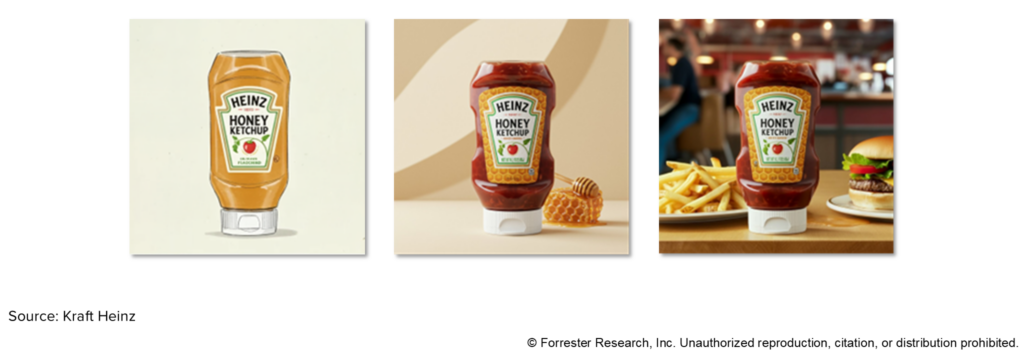
If you haven’t seen it yet and have 55 seconds to spare, I highly recommend you take a look at the Heinz’ “AI Ketchup” campaign. By asking Dall-E 2 to generate an image of a Ketchup-Bottle, the firm provided creative and entertaining proof that Heinz is not just another Ketchup brand. Ketchup is indeed synonymous with the Heinz brand.       But Kraft Heinz didn’t stop at marketing campaigns when it comes to using Generative AI (GenAI) for design and innovation. In a bold move to modernize its internal design processes, Kraft Heinz embraced GenAI to scale content creation and personalization like never before. The result? A complete reimagining of how one of the world’s largest food and beverage companies brings its iconic brands to life.  From Bottlenecks To Breakthroughs: The Creative Challenge With over 100 brands and a global footprint, Kraft Heinz faced a familiar but formidable challenge: How to keep packaging and marketing content fresh, personalized, and on-brand message — without the long lead times and high costs of traditional agency workflows.  Justin Thomas, Kraft Heinz’ Head of Digital Experience & Growth, described the problem as follows: “How can we leverage AI to create more engaging personalized content at scale, reduce costs and time-to-market for product concepts, and do so while maintaining brand consistency and data security?”  Enter the TasteMaker, the company’s custom-built retrieval-augmented generation (RAG) engine. Developed in partnership with Apply Digital and powered by Google’s Vertex AI, TasteMaker is more than a tool — it’s an innovation and design engine.  Examples Of Kraft Heinz Product Content Produced By TasteMaker RAG Engine What Makes TasteMaker A Game Changer? Speed-to-Market: Kraft Heinz slashed design timelines for their product content from weeks to hours, reducing time by 8x. Personalization at scale: Whether creating new assets or versioning image, motion, and video creative, TasteMaker enables the generation of content on demand.  Brand consistency and data security: By codifying internal brand assets and using a proprietary AI instance, Kraft Heinz ensures that the results are on-brand and their IP remains secured.  The Playbook: Experiment, Pilot, Expand Kraft Heinz didn’t wait for perfection. They launched fast, starting with four use cases and scaling quickly after early wins. The team focused on:  Solving real business problems, not just showcasing tech.  Getting data AI-ready, from brand IP to consumer insights.  Empowering teams, with training, prompt engineering, and hands-on support.  What’s Next? In parallel to deploying the solution across product lines, Justin Thomas and the TasteMaker team have established an ambitious roadmap:   Continuous improvement through refining image generation and integrating more proprietary data.  Adding further capabilities and use-cases such as video generation.  Moving further down the innovation funnel by adding synthetic users and user testing features.   While the current results and the roadmap are impressive, the real story is the mindset shift. TasteMaker isn’t just a tool, it’s a new way of working and driving creative design.   Do you want to dive deeper into the details of how a 150-year-old brand is leading the AI-powered future of creativity? Read the full case study to explore how Kraft Heinz is turning generative AI into a competitive advantage.  source

How Kraft Heinz Is Using GenAI to Re-Imagine the Future of Creative Content Read More »

Schneider Electric Data Center Summit 2025: AI, Power, Cooling, Services, And More

Schneider Electric’s 2025 industry summit focused on data centers and exhibited presentations covering a variety of data center topics, along with a tour of its manufacturing facilities showcasing the company’s production and testing expertise, as well as the following in-depth topics and session: The data center landscape How the rapid growth of generative AI has impacted data centers Where the company sees AI going How the race for AI leadership is occurring at a national level, not just corporate; increasing power densities Leveraging reference designs; emerging tech means developing best practices Motivair providing a comprehensive portfolio in terms of products and global coverage; liquid cooling is new for a lot of organizations, so this experience and expertise in cooling infrastructure and deployment helps them answer customer questions and concerns Unprecedented growth of AI driving data center challenges; need for data centers to be energy stabilizers, not just energy consumers Schneider Electric no longer sitting in the background, starting to emphasize itself more; partnering with OEMs and chipmakers, since power drivers are growing closer to compute Shortage of skilled personnel; growing demand (need is growing 7%) outpacing workforce (growing 1%); leveraging AI to increase the effectiveness of personnel and eliminate administrative tasks Digitizing a data center requires a combination of DCIM, BMS, EPMS, ITSM, and more; no one right answer — there are many design trade-offs, and one is to support different needs with optionality What’s on the horizon for data centers Discussion of several technologies, such as quantum, photonics, and AIOps Key Differentiators At the event, we saw a few key differentiators from others in the market: Power purchase agreements The availability of power purchase agreements (PPAs), considering the demand for energy worldwide, makes Schneider Electric a strong consideration; its PPAs can make the difference between powering a data center in the next few months or waiting for a new power plant years down the line The breakdown of roles and responsibilities between data engineers, data scientists, and subject-matter experts is clean, sensible, and scalable, making it easy to integrate with customers; similarly, Schneider’s layered view of AI in terms of assets, systems, and people should make it easier to deploy AI if customers are willing to follow its approach If you have any questions about Schneider Electric or how its solutions address data centers and sustainability, please submit an inquiry request or reach out to your account team. source

Schneider Electric Data Center Summit 2025: AI, Power, Cooling, Services, And More Read More »

Overregulation Forges A CISO Coalition With The G7 Letter

A coalition of over 40 chief information security officers (CISOs) from leading companies, including Salesforce, Microsoft, AWS, Mastercard, and Siemens, sent a letter to the G7 and OECD, urging them to take action on aligning international cybersecurity regulations. This move signals a strategic shift: CISOs are no longer only responsible for internal controls but are now calling for change on the geopolitical stage. This indicates a new phase of collaboration between CISOs and a new phase in cyber leadership, where CISOs are acting collectively across industries and borders, speaking directly to heads of state and global institutions, and demanding political — and not just technical — solutions to systemic cybersecurity risks. Cybersecurity has thus become a global governance challenge. The letter comes at a critical time. Security teams are facing growing regulatory complexity, with new rules emerging in different countries such as the US, the UK, EU countries, Australia, and beyond with industry- or vertical-specific guidelines and requirements. These rules often contradict each other, adding complexity for security teams, slowing incident response, and draining resources that should be going toward defense, not documentation. This underlines that CISOs are operating in the era of regulatory FOMO. This letter stands out because it combines public advocacy, policy specificity, multinational representation, and a direct call to the most influential global regulators. It is the first coordinated global policy intervention by CISOs of this scale. The CISOs are not lobbying for reduced oversight. Instead, they are calling for smarter, harmonized regulation to allow for faster incident response, better international collaboration, and more efficient use of strained security resources. Cybersecurity leaders are no longer just bracing for regulation. They realize regulation is inevitable but that influence over it is still up for grabs, so they are jumping on the opportunity to guide the rules rather than be steamrolled by them. Here’s what you need to know and what you should do next: Prepare for this letter to result in absolutely no changes. Good intentions are rarely enough when it comes to government action, so prepare for the likely reality that this letter will not have a demonstrable effect on global regulatory policy. Continue what you are doing. The geopolitical risk team and security team must work closely together to map regulatory exposure and build harmonized controls. Catalog regulations that apply to your business, identify regulations overlap, and simplify where you have redundancies or gaps. Design a harmonized control framework where you standardize risk and control language to build toward global audit readiness. Expect global regulatory disharmony. Despite this letter, the world continues to move away from regulatory convergence. For example, there’s demand worldwide to rely on encryption and other safeguards to transfer personal data from Europe to the US, but the UK is asking tech companies such as Apple to build backdoors and provide government access to users’ data on demand — which is at odds with idealized global standards. In the US, the current administration is deprioritizing consistent, national cyber policies and shifting the responsibility to individual states. The regulatory patchwork won’t go away overnight, but leaders can harmonize their own requirements by rationalizing their security controls and aligning them to common regulatory obligations while standardizing on a common control framework. Get the board and the business behind you. Regulatory risk is a strategic issue, not just a security or compliance one. The open letter to the G7 is a timely tool to raise visibility at the top. Use it to brief your board or executive team on why global cyber regulation is diverging, what operational risks this introduces, and how harmonized controls and proactive alignment have the potential to reduce costs associated with compliance. Board and C-suite backing delivers additional influence and attention to the issues raised in the letter, with government entities involved with decision-making at the policy level. Regardless of the initial outcome, support the global effort. Don’t just observe; participate. If you want your voice to be heard in the next phase of cyber policymaking, you must be in the rooms and peer networks pushing for change. Take a more active role in public policy discussions. If you haven’t already joined working groups through ISACs, industry councils, ENISA, or national cyber alliances that engage with regulators, find the org that best fits you and your organization’s needs and get involved. If your organization has already signed the open letter, amplify it. If not, consider how you can support the momentum through your own communications and peer interactions. source

Overregulation Forges A CISO Coalition With The G7 Letter Read More »

Firing On All Cylinders: Turning Product Launches From A Whimper To A Bang

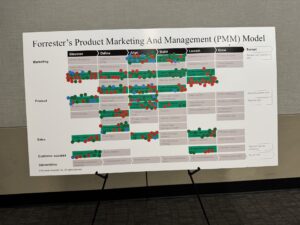
At Forrester, we frequently hear from clients struggling with product launches. Common issues include an overwhelming volume of minor launches that fail to make an impact, marketing teams receiving last-minute notifications about launches, or a lack of innovation — often relying on recycled spreadsheets from previous launches. Recognizing that only a quarter of firms employ a launch process even vaguely approaching best-in-class, we set out to address these challenges through a certification workshop at our recent B2B Summit. We began by introducing attendees to our proprietary Product Marketing And Management (PMM) Model (client login required). The PMM Model outlines key responsibilities for marketing, product, sales, and customer success teams at every stage of bringing an offering to market. While we typically conduct very comprehensive maturity assessments with clients, the Summit’s packed agenda led us to adopt a lighter approach. Participants used sticky notes to identify areas where they excelled and those needing improvement. One delegate shared, “It was so useful to think about marketing’s role in the product development lifecycle and where we could add value throughout. Usually, we’re an afterthought.” With marketers making up most of the audience, they identified key areas for improvement, including business opportunity proposals, market requirements, and launch dashboards. Alarmingly, more attendees lacked a clear target audience for their launches than those who did. Sales teams also faced critique for weak target-setting, while product teams were urged to focus more on competitive differentiation to ensure that new offerings stand out.   Next, we tackled the launch process itself, offering guidance on launch tiering and its implications for resource allocation. Participants quickly realized that not all launches warrant equal attention — a bug fix or technical debt resolution doesn’t always justify a tier-one launch. One delegate noted, “I loved the launch tiering. It was so simple yet actionable.” The workshop concluded with an exercise for attendees to complete the Forrester Launch-Plan-On-A-Page Template. This outlined launch goals, target audiences, metrics, timelines, buyer needs, competitive differentiation, and overall strategy. As one participant remarked, “I love that we left with a template we can take back to the office and use repeatedly.” In just over an hour, attendees walked away with actionable ideas and the reassurance that they weren’t alone in facing launch challenges. If you’re a Forrester client looking to refine your launch processes, contact your account team to schedule a guidance session. source

Firing On All Cylinders: Turning Product Launches From A Whimper To A Bang Read More »