Forrester

The End Of Sales Force Automation As A Tech Category

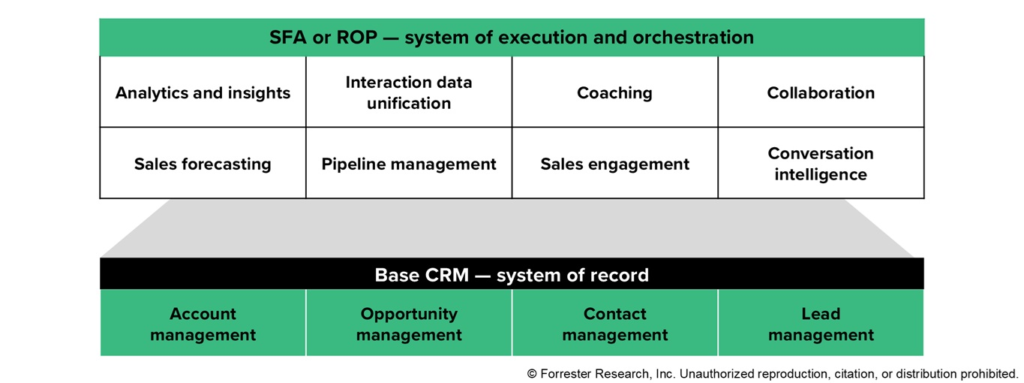
Sales organizations face a significant challenge in the current technology market: an overwhelming number of solutions vying for their attention and promising to solve similar business problems. Core platforms like CRM and sales force automation (SFA) compete now alongside newer categories such as revenue orchestration and a multitude of other categories focused on capabilities like sales content management, sales intelligence, AI-powered sales agents, and CPQ (configure, price, quote) software. The Evolution From SFA To Comprehensive CRMsSales force automation evolved from the fractured market of low-tech digital Rolodexes. Tom Siebel’s vision helped scale a new market for software to meet the needs of growing B2B organizations. With Oracle and Salesforce entering the market in the late 1990s, what started as a productivity tool for sellers rapidly expanded into applications to support customer 360, giving rise to the concept of CRM. CRMs now support a wide array of business processes within B2B to acquire customers and manage customer relationships across all customer-facing roles in the organization. The Seller Experience Got Lost In CRM’s Ever-Expanding HorizonAs the scope of CRM platforms expanded to support an ever-increasing swath of touchpoints and business models, CRM innovation focused on foundational capabilities, such as process automation and management reporting, while innovation for frontline sales capabilities stagnated. In that vacuum, a swath of point solutions including sales engagement, conversation intelligence, and others emerged that integrated and enhanced the value of CRM and fulfilled the promise of automation for frontline sellers. SFA Has Become An Increasingly Ambiguous Tech CategoryThe range of capabilities captured under the umbrella term “sales force automation” has become vast, bringing a level of complexity in terms of SKUs, pricing, and sales tech-stack management. This has further distanced SFA from its core purpose of supporting sellers. Forrester believes that SFA needs to be distributed into categories that enable buyers to properly evaluate their capabilities to determine the best sales tech stack for their organization. These categories are: Core CRM data management. A CRM is a foundational technology that every organization must have to support its customer relationships. The foundation of SFA is business management of four core objects: leads, contacts, accounts, and opportunities. CRM purchases are increasingly led by technology leaders in partnership with the business, as they must meet the requirements of different parts of the organization. As a result, sales organizations often conflate the labels SFA and CRM. Extended sales tech technologies. These technologies extend the power of CRM to guide sellers through complex product configuration and pricing, optimized territory design and quota management, incentive compensation management, and sales content management to uplevel the effectiveness of frontline sellers. They also support new business and revenue models like partner relationship management, recurring billing, and revenue lifecycle management. However, CRM vendors frequently bundle such capabilities in various SFA license tiers or offer them as add-ons, leading organizations to only evaluate the bundled capabilities of different SFA vendors instead of assessing the full range of offerings in the market. Revenue orchestration. The core purpose of revenue orchestration platforms (ROPs) is to deliver on the promise of a single pane of glass for the seller. Combining sales engagement capabilities for prospecting, conversation intelligence insights, and forecasting and pipeline management into a unified seller experience (theoretically), ROPs aim to maximize sales productivity and performance by placing the seller’s daily workflow and experience front and center. These platforms are primarily purchased by sales organizations with the support of IT. CRM And ROP Vendors Face OffCRM vendors bundle revenue orchestration capabilities with certain tiers of their SFA, adding to the confusion of what is and isn’t part of SFA. However, the highly integrated revenue orchestration solutions have thrown down the gauntlet to CRMs by matching their integrated user experience and capabilities that are designed to deliver real frontline impact. Decouple CRM And Sales Tech Investment DecisionsToo many are overspending on sales technologies that are bundled within their CRM. Often, sales organizations don’t use technologies that they’ve licensed because of a lack of focused adoption, lagging capabilities, or even a lack of awareness that they have access to extended technologies. Unconscious bundling, which may be lucrative for vendors in the short term, ultimately reduces the effectiveness of sales organizations by driving up technology costs, limiting user adoption, and potentially driving complex customizations that reduce CRM agility. To choose the right capabilities to support the seller experience, ensure that you: Understand CRM license tiers and add-ons. Map out the overlap between CRM and sales tech categories. Determine whether the function you need already exists in your CRM. Assess best-in-class vendors. Use our Landscape and Forrester Wave™ evaluations to understand the advanced capabilities of solutions like ROPs and others. Include additional license and integration costs and vendor management overhead in your analysis. Aim to adopt the smallest possible tech footprint that you need to support your operations.   source

The End Of Sales Force Automation As A Tech Category Read More »

Navigating Tariff Uncertainty: A Looming Threat To IT Services And Their Customers

Much ink has already been spilled about the impact of US President Donald Trump’s tariff policy on IT products and services. This week’s announcement that US GDP was down 0.3% for the first quarter indicates that some imbalances are developing. Of course, any economic damage incurred by industry (and governments) will ultimately be reflected in the fortunes of service providers, but when and how? One of the chief aspects of the policy lies in its indeterminateness. It’s fair to say the element of surprise has been a characteristic of the Trump administration’s approach to tariff negotiations. Here’s how this uncertainty will impact the IT services market: Unlikely direct impacts on IT services themselves — at least in India. Despite significant revenues associated with services exports, services themselves probably won’t be impacted directly by tariffs (unless the Indian government places a tariff on services exports, which is considered unlikely). The same cannot be said, however, about all relevant import markets, such as EMEA. Large global consulting firms like KPMG have already been consolidating their disparate organizational structures through a process it calls “clustering,” a move that might help them address European supply chain concerns more easily through unified consulting service offerings. Further reduction of discretionary budgets. Following a post-pandemic boom, IT services providers already face a slowdown. Tariff-induced economic uncertainty will only intensify this trend. Suppliers have already cited weakness in the crucial small-to-medium-sized engagement range as a constraint on their revenues and have relied on large deals while the small and medium deal flow has not picked up the slack. At Wipro’s latest earnings call, CFO Aparna Iyer revealed that even major players are witnessing a lag in smaller deal flows, relying heavily on large contracts to maintain momentum. Difficulty in planning will make a rebound in those deal segments that are unlikely in the near term. Slowing of large transformational projects. The reliance on large deals may also prove frustrating. Transformational projects lacking immediate returns or demonstrable cost savings will face increased scrutiny in an uncertain economic climate. This includes extensive modernization initiatives with value propositions that are becoming harder to justify. Even secured deals may encounter hurdles in revenue recognition. Fortunately, a significant portion of large-scale migrations has already been completed. Even parts of the portfolio where enterprises desire to maintain current investments — including regulatory maintenance, M&A integrations, AI productivity, CX improvements, and critical tech modernizations — could experience delays in bookings and revenue realization. Acceleration of internal AI adoption. Slack demand and reduced bookings and revenues will likely translate to reduced hiring and accelerated efforts to improve internal productivity using AI-infused tools and processes, including agentic AI, which will accelerate the widely anticipated restructuring of service providers’ staffing pyramids to more diamond-shaped structures. Increased investment in global capability centers (GCCs). With the help of global systems integrators (GSI) partners, enterprises are doubling down on “captive” investments. We expect prevailing uncertainty to sustain and even amplify interest in establishing and expanding GCCs. In collaboration with GSI partners, GCCs offer enterprises a flexible resourcing strategy amid constrained hiring budgets. Take Advantage Of The Opportunity To Reengage With Strategic Providers The current uncertainty opens the door to closer collaboration with services providers as they themselves adapt to the new realities and opportunities. These include, but are not limited to, successful adaptation to generative AI, where service providers can add significant guidance that can increase trust in this transformative technology. It is also a good time to revisit unsatisfactory engagements, considering that service suppliers will be anxious to shed unprofitable contracts in favor of greener pastures. If your organization is sorting through this, set up an inquiry to understand how you can best meet the moment. Related Research source

Navigating Tariff Uncertainty: A Looming Threat To IT Services And Their Customers Read More »

US Economic Outlook By GDP Components, Q2 2025

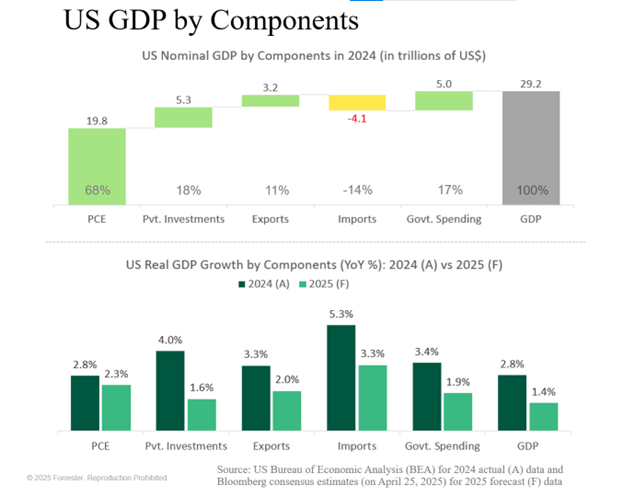
Tariff impacts, trade wars, market volatility, business uncertainty, recession risk, and rebounding inflation — these developments have dominated recent US business and economy news headlines. Economists have been revising their US GDP growth forecasts downward and raising the probability of a recession. They expect inflation to rise again as the cost of imported goods increases and retailers pass these costs on to consumers. We expect both businesses and consumers to slow spending until the cloud of uncertainty around trade policy clears. How We See GDP Components Evolving To monitor economic activity, we continue to examine GDP growth through its major components, along with a few key economic indicators. Our analysis considers both historical trends and forward-looking projections for the coming quarters and years. Following is a summary of GDP and its component trends: Nominal GDP: US nominal GDP reached $29.2 trillion in 2024. US consumer spending, also known as personal consumption expenditures (PCE), is the largest component of GDP, totaling $19.8 trillion and accounting for 68% of GDP in 2024. US business spending, also referred to as fixed investments in nonresidential and residential assets, totaled $5.3 trillion. In 2024, US exports of goods and services reached $3.2 trillion while imports totaled $4.1 trillion. Government consumption expenditures and gross investments reached $5.0 trillion (see figure below). Real GDP growth: Real GDP, which strips out the effects of inflation, is the key metric that economists use to assess true economic growth. Real GDP in the US grew by 2.8% in 2024. Current consensus forecasts project real GDP growth of 1.4% in 2025. Consumer spending growth: US PCE grew by 2.8% in 2024, and the consensus forecast for 2025 is 2.3%. The growth in real consumer spending on services has outpaced growth in spending on goods for the past three years, and this trend will likely continue in 2025. Business spending growth: Business investments in assets to support future production is another critical driver of GDP. Real business spending grew by 4.0% in 2024. Economists currently forecast 1.6% growth in 2025 as businesses delay investment decisions due to trade policy uncertainties. Exports and imports growth: Net exports (exports minus imports) are a key part of GDP calculation. When exports exceed imports, the result is a positive contribution to GDP. Consensus expectations for 2025 point to 2.0% growth in real exports (down from 3.3% in 2024) and 3.3% growth in real imports (down from 5.3% last year). Government spending growth: Real government spending grew by 3.4% in 2024, and current projections suggest 1.9% growth in 2025.   Forrester clients: To help you navigate this uncertain environment, we will continue to publish quarterly insights on the US economy, what it means for your business, and how best to prepare. Please see our recently published report, US Economic Trends And Outlook, Q2 2025, and reach out with any questions or schedule a guidance session. Please also check out this page to explore our research on how to lead through volatility. source

US Economic Outlook By GDP Components, Q2 2025 Read More »

Measuring What Matters: Answering Key Questions From Our Webinar

Metrics are at the heart of every successful customer experience (CX) strategy. Knowing what to measure, how to measure it, and how to act on that information can help businesses transform their CX efforts into tangible outcomes. In a recent webinar, we explored these critical points and provided actionable insights into how organizations can use metrics to elevate CX and advance business goals. We received many questions during the webinar, so we thought we’d recap the key takeaways and some of the recurring themes from those questions. What Types Of Metrics Should I Be Tracking? To truly understand your customer experience and its impact, it’s important to track three main types of metrics: Perception Metrics: These capture how customers feel about their interactions with your brand. Perception metrics help you gauge whether your CX promise aligns with customer sentiment and expectations. Data sources include surveys, reviews, social media comments, and call recordings; metric examples include satisfaction, ease, and confidence. Outcome Metrics: These measure customers’ actual or intended behaviors following their experience. Outcome metrics help build a business case for CX investments when you use them to understand which perceptions cause the desired behaviors. Sample outcome metrics track actual behaviors, like retention, or intended behaviors (as Net Promoter Score℠ [NPS] does). Interaction Metrics: Tracking what happens during customer interactions, these metrics are drawn from operational data or analytic systems. Interaction metrics contextualize perception results and reveal inefficiencies or pain points. For example, they might highlight when customers experience wait times, which could lower their perception of ease. It’s not enough to look at these three types of metrics on their own. For a more complete picture of CX performance, you need to consider them in the context of the three levels of experience: Relationship Level: This refers to the customer’s overall relationship with a firm — for example, what it’s like to be a customer of a bank. Measuring at this level allows you to gauge overall CX and predict customer behaviors. Journey Level: Journeys are customers’ path and perception as they pursue a goal. Continuing with the bank example, one such journey is opening an account. Measuring at the journey level helps you understand journeys holistically, including the effect of different touchpoints and the interactions between them. This view is useful for identifying friction for customers. Touchpoint Level: This level homes in on a concrete step within a journey and the channel in which that happens (e.g., evaluating different bank account options online or applying for a new account in person at a branch). Measuring these key moments can unearth specific improvement opportunities, which then feed into journey-level CX improvements. They also provide opportunities to respond quickly to customer complaints. One attendee asked us about the best tool to map or track metrics across these three levels. We’ve seen companies have some success with journey-based dashboards that include metrics for the relationship that the journey is part of, along with journey metrics and touchpoint metrics. (Our colleague Joana de Quintanilha has published evaluations of journey orchestration tools that include functionality to show metrics on customer journeys — access to this research is available to Forrester clients.) What’s The Right CX Metric, Or Metrics, For My Organization? We heard several variations of this question in the webinar. First, we need to warn you that using “industry best practice” metrics is only the right strategy when your customers, strategy, capabilities, and priorities are the same as those of every other firm. Don’t choose a metric simply because other companies are using it. The right CX metric for your organization will depend on your specific goals. For example, if your goal is to satisfy people, measure customer satisfaction. If you are concerned with ease, measure that. Second, decide what to focus on after you’ve identified the goals your firm is pursuing. Work backward from those goals. Choose outcome metrics that measure customer behaviors that contribute to those goals, then perception metrics and interaction metrics that are leading indicators of those behaviors. A word here about NPS, as it’s one of the most commonly used metrics: NPS does not measure CX quality; it measures loyalty — an outcome of good CX quality. If you want to use it as a proxy metric for CX, ask yourself whether likelihood to recommend is the most appropriate and useful question. Is NPS correlated to a desired business impact? Will employees rally around it? NPS might not be the best metric in some cases — for example, for utility companies with a monopoly within a certain market. Why Don’t Our Business Results And Customer Survey Responses Align? The reason for this is usually that you didn’t define the right metrics or that there is so much pressure to achieve the metric that customers are asked to give a good rating. In any case, it probably doesn’t reflect everything that they feel about a business. This is one of the shortcomings of surveys — so it’s important to widen your focus to understand how customers feel about your company. How Can I Use Metrics To Prove The Business Value Of CX? Identifying metrics that show how CX improvements contribute to desired business outcomes is key. Company boards will likely want quantifiable results — you might give these by connecting metrics such as NPS or customer satisfaction scores (CSAT) to business outcomes like increased retention or decreased churn rates. When you try to link NPS to business outcomes, consider more than just the score. But you also need to recognize that numbers alone aren’t enough. Pair numbers with compelling customer feedback or stories to illustrate how CX improvements positively impact the bottom line. (For more tips on building an effective CX business case, check out this on-demand webinar.) How Can I Prove That Changes In Our Outcomes Were Driven By CX (And Not The Latest Marketing Campaign, Sales Push, Etc.)? CX teams can do two things. First, be narrower in what you connect — for instance, don’t try to connect customers’ overall

Measuring What Matters: Answering Key Questions From Our Webinar Read More »

US GDP Forecast by Components 2025

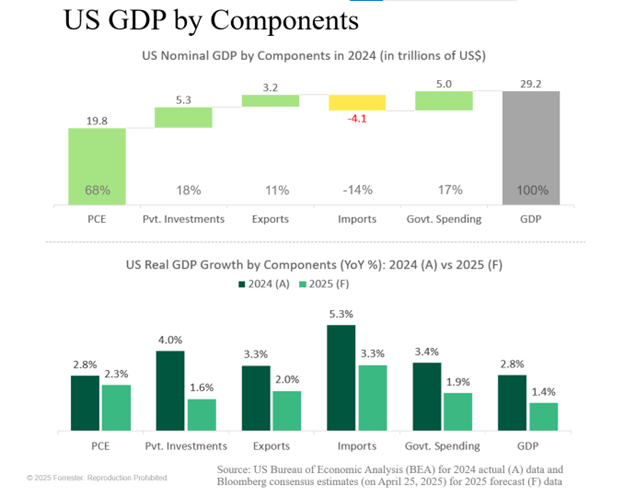
Tariff impacts, trade wars, market volatility, business uncertainty, recession risk, and rebounding inflation — these developments have dominated recent US business and economy news headlines. Economists have been revising their US GDP growth forecasts downward and raising the probability of a recession. They expect inflation to rise again as the cost of imported goods increases and retailers pass these costs on to consumers. We expect both businesses and consumers to slow spending until the cloud of uncertainty around trade policy clears. How We See GDP Components Evolving To monitor economic activity, we continue to examine GDP growth through its major components, along with a few key economic indicators. Our analysis considers both historical trends and forward-looking projections for the coming quarters and years. Following is a summary of GDP and its component trends: Nominal GDP: US nominal GDP reached $29.2 trillion in 2024. US consumer spending, also known as personal consumption expenditures (PCE), is the largest component of GDP, totaling $19.8 trillion and accounting for 68% of GDP in 2024. US business spending, also referred to as fixed investments in nonresidential and residential assets, totaled $5.3 trillion. In 2024, US exports of goods and services reached $3.2 trillion while imports totaled $4.1 trillion. Government consumption expenditures and gross investments reached $5.0 trillion (see figure below). Real GDP growth: Real GDP, which strips out the effects of inflation, is the key metric that economists use to assess true economic growth. Real GDP in the US grew by 2.8% in 2024. Current consensus forecasts project real GDP growth of 1.4% in 2025. Consumer spending growth: US PCE grew by 2.8% in 2024, and the consensus forecast for 2025 is 2.3%. The growth in real consumer spending on services has outpaced growth in spending on goods for the past three years, and this trend will likely continue in 2025. Business spending growth: Business investments in assets to support future production is another critical driver of GDP. Real business spending grew by 4.0% in 2024. Economists currently forecast 1.6% growth in 2025 as businesses delay investment decisions due to trade policy uncertainties. Exports and imports growth: Net exports (exports minus imports) are a key part of GDP calculation. When exports exceed imports, the result is a positive contribution to GDP. Consensus expectations for 2025 point to 2.0% growth in real exports (down from 3.3% in 2024) and 3.3% growth in real imports (down from 5.3% last year). Government spending growth: Real government spending grew by 3.4% in 2024, and current projections suggest 1.9% growth in 2025.   Forrester clients: To help you navigate this uncertain environment, we will continue to publish quarterly insights on the US economy, what it means for your business, and how best to prepare. Please see our recently published report, US Economic Trends And Outlook, Q2 2025, and reach out with any questions or schedule a guidance session. Please also check out this page to explore our research on how to lead through volatility. source

US GDP Forecast by Components 2025 Read More »

Agentic AI Strengthens Digital Adoption Platform Offerings

Digital adoption platform (DAP) providers have been at the forefront of integrating automation into workflows to streamline user effort and enhance software experiences. Today, many DAPs come equipped with native robotic process automation capabilities and are continuously developing more sophisticated automation use cases. Additionally, these providers are enthusiastic about incorporating AI into DAPs, offering copilots, builder assistants, and bots to drive personalization and contextualization. With the emergence of agentic AI, vendors are now exploring new use cases to further boost the performance of DAPs. The Case For Agentic AI In DAPs But what role do AI agents play within the context of DAPs? DAPs’ core use case is to improve the usage and adoption of software applications with personalized nudges and interactive support across journeys configured within the supported application. There, AI agents can automate processes or workflows that are designed to empower users — giving them more control, personalization, and “automated ease” — in how they interact with the supported applications and digital tools to perform their tasks. Agentic workflows, though still in their early stages, hold promise for enhancing platform capabilities by introducing both incremental and significant improvements to software experiences. Individualized Learning Experiences DAPs serve as guided learning and knowledge delivery tools that provide in-the-moment guidance, support, and engagement across systems such as customer relationship management, human capital management, and enterprise resource planning. These journeys and walkthroughs are typically configured for a user cohort that has similar adoption challenges. With AI agents, DAPs can now, with relative ease, configure and deliver: Tailored learning paths. Tailoring the learning experience at a user level based on their role, experience, and past interactions with the application ensures that users are not overwhelmed with irrelevant information, making the learning process more efficient. Adaptive support. This entails dynamically adjusting the support level provided based on the user’s proficiency and behavior patterns. This could mean offering more detailed guidance to a novice or streamlining prompts for an experienced user. Agentic workflows can also be programmed to integrate security best-practices training tailored to the user’s interactions with the platform. Automated And Efficient Support DAPs help deploy automation to improve user experience with reduced clicks for tasks, automated form fills, and automated service ticket management. Agentic frameworks give DAPs increased agility in discovering opportunities for automation and creating autonomous workflows for: Task automation. This involves identifying repetitive tasks within workflows that can be fully or partially automated, thereby saving time for the user and allowing them to focus on more value-added activities. Automated content management. Advanced DAPs have started to leverage generative AI to enable automated content creation by learning from user journeys and clicks. With agentic workflows, DAPs can configure AI assistants to generate, validate, and organize content for specific roles or modules within a content workflow, significantly reducing manual content management efforts. Integration Management The true power in DAPs is building journeys and walkthroughs that span different applications that are part of a workflow to enable continuous guidance and support for users navigating their systems of work. But most enterprises struggle to identify and build these connected journeys and lose momentum after the initial deployments. With AI agents, enterprises can vastly optimize the manual effort in solving the complexities of cross-application adoption management with: Cross-platform support. AI agents can be leveraged to identify connected journeys and workflows during initial implementation to help build a roadmap for cross-application use cases and seamlessly scale from single-application use cases for digital adoption. Integration and interoperability management. In environments where multiple digital tools need to work together seamlessly, AI agents can be leveraged to identify and resolve dependencies, as well as build specialized training sessions focused on the integration points and interoperability between different systems. Security And Privacy Enforcement Experimenting with AI requires enterprises to continuously build awareness of sound and ethical use of AI among user groups, particularly with bring-your-own-AI (BYOAI) frameworks. DAPs have begun helping enterprises do more with AI by improving user adoption of AI tools through contextual learning and guidance. With AI agents, they can also help establish robust governance policies to drive responsible usage of AI through: User consent and shadow AI. Deploying AI agents that provide users with clear options regarding data collection, usage, and personalization improves enterprise trust in working with AI. DAP vendors have started to build agents to specifically identify and report on shadow AI usage and can now deploy agents to apply better controls and guardrails for BYOAI frameworks. Bias mitigation. AI agents can help enterprises actively identify and reduce biases in AI algorithms and data sets to ensure fairness and inclusiveness in automated recommendations and decisions. Deploying AI agents within DAPs represents a forward-thinking approach to enhancing digital adoption, user engagement, and overall productivity within organizations. With AI agents, DAPs can help organizations solve usage, adoption, and experience challenges with highly optimized human oversight. If you’re a Forrester client, you can access The Forrester Wave™: Digital Adoption Platforms, Q4 2024. Visit my Forrester bio page and click “Follow” to receive notifications. You can also follow me on LinkedIn here. Forrester clients can also schedule an inquiry or guidance session with me to delve deeper into this topic. source

Agentic AI Strengthens Digital Adoption Platform Offerings Read More »

Firing All Cylinders: Turning product launches from a whimper to a BANG

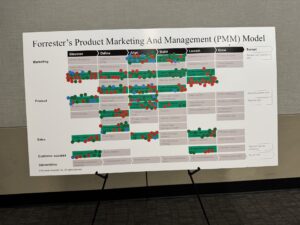
At Forrester, we frequently hear from clients struggling with product launches. Common issues include an overwhelming volume of minor launches that fail to make an impact, marketing teams receiving last-minute notifications about launches, or a lack of innovation — often relying on recycled spreadsheets from previous launches. Recognizing that only a quarter of firms employ a launch process even vaguely approaching best-in-class, we set out to address these challenges through a certification workshop at our recent B2B Summit. We began by introducing attendees to our proprietary Product Marketing And Management (PMM) Model (client login required). The PMM Model outlines key responsibilities for marketing, product, sales, and customer success teams at every stage of bringing an offering to market. While we typically conduct very comprehensive maturity assessments with clients, the Summit’s packed agenda led us to adopt a lighter approach. Participants used sticky notes to identify areas where they excelled and those needing improvement. One delegate shared, “It was so useful to think about marketing’s role in the product development lifecycle and where we could add value throughout. Usually, we’re an afterthought.” With marketers making up most of the audience, they identified key areas for improvement, including business opportunity proposals, market requirements, and launch dashboards. Alarmingly, more attendees lacked a clear target audience for their launches than those who did. Sales teams also faced critique for weak target-setting, while product teams were urged to focus more on competitive differentiation to ensure that new offerings stand out.   Next, we tackled the launch process itself, offering guidance on launch tiering and its implications for resource allocation. Participants quickly realized that not all launches warrant equal attention — a bug fix or technical debt resolution doesn’t always justify a tier-one launch. One delegate noted, “I loved the launch tiering. It was so simple yet actionable.” The workshop concluded with an exercise for attendees to complete the Forrester Launch-Plan-On-A-Page Template. This outlined launch goals, target audiences, metrics, timelines, buyer needs, competitive differentiation, and overall strategy. As one participant remarked, “I love that we left with a template we can take back to the office and use repeatedly.” In just over an hour, attendees walked away with actionable ideas and the reassurance that they weren’t alone in facing launch challenges. If you’re a Forrester client looking to refine your launch processes, contact your account team to schedule a guidance session. source

Firing All Cylinders: Turning product launches from a whimper to a BANG Read More »

Featured CX Executive: Brad Smith, Head Of CX & Insights At Securian Financial

We’re four months into 2025, and there has been no shortage of volatility to challenge even the most seasoned CX executives. To stay on course, we recommend keeping a ruthless focus on customers while also balancing disciplined spending, change leadership, and risk management. But what has this looked like, in practical terms, for CX leaders? I recently asked Brad Smith, who leads enterprise insights and CX at Securian Financial, to share what’s been top of mind for him in 2025. Below, Brad describes Securian’s CX transformation journey, including the evolution of its CX org structure, headwinds and tailwinds created by AI, and work underway to establish links between CX, EX, and business outcomes. Brad, thanks so much for sharing your insights! How Brad Is Leading Securian’s CX Efforts During Turbulent Times Brad Smith, Securian Financial As a CX leader, what headwinds and tailwinds are you facing as you enter 2025? You probably won’t be surprised to hear that Securian Financial is navigating the complexities of integrating AI into its CX strategies, and I’d call AI both a headwind and a tailwind. When thinking about how and where AI can help Securian, the company needs to answer three main questions: What tasks can be trusted to AI, and which ones should be kept within human control? How can we overcome challenges related to compliance, data management, technology adoption, and even expense management? How should we evaluate AI as a productivity tool for customers and associates while considering the cultural change required? Securian is a 145-year-old company built on trust and relationships, so fully leveraging the capabilities of AI will need to be done with extreme care, and it will require a huge cultural change to be successful. What are your top CX priorities for 2025? How have you established the link between CX initiatives and broader organizational objectives? In select areas of the business, we have found a direct correlation between the customer experience and repeat business/revenue. In other areas, we are taking a leap of faith for now that there is a correlation until we have a larger dataset to confidently conduct the analysis. Philosophically, the leadership team agrees that providing enhanced experiences to our customers will result in a win-win for Securian and our customers. We continue to reinforce customer-centric behaviors to demonstrate our belief that every role in the company impacts our customers in some way. Valuing empathy and creating an emotional connection with customers is crucial to the long-term sustainability of a customer-focused business model. Additionally, we are evolving our CX measurement capabilities to more broadly leverage AI. Having quicker access to deeper insights will transform our measurement approach, especially if we can push those insights to the correct decision-makers without a lot of heavy lifting. Currently, we are testing migrating from static dashboards to query-driven insights and recommendations created by the user. Many organizations are just getting started on their CX transformations. Where is Securian on its CX journey? Securian has been on its CX transformation journey for nearly five years. We started slowly by targeting one business line that was a willing business partner. Initially, we focused on CX measurement and formed a team to map out a priority journey aligned with the CX measurement work. By leveraging SWAT teams to tackle top pain points, we improved the overall customer experience scores, shortened cycle times, and reduced defects/rework. Building on these wins, we gradually expanded our focus while simultaneously building our expertise. Since our CX maturity still varies across business units, we are currently focusing on bringing the less mature areas up to speed with our leading areas. In 2025, we will continue the journey to better understand the impact that the Securian associate experience has on our customers and channel partners. We’ve spent the last few years understanding and improving the associate experience, and now we will take it a step further to understand the linkage between employee experience and customer experience. Describe your CX org structure. How did you land on this structure? What makes it effective today, and how do you see it evolving in the future? We began with an advisory model, where a centralized team of CX professionals advised the business on CX strategy, conducted measurements, and shared insights. Initially, business units were responsible for prioritizing and improving the experiences with their existing staff. After achieving significant activation wins, we transitioned the CX strategy roles into the business units. This allows them to better develop a vision for the customer experience within their respective areas. Currently, the design of specific experiences is handled by shared services such as enterprise technology and operations, with experience improvement as a formal goal. As we evolve toward a matrixed model, business units will leverage insights to prioritize improvement areas in a more formal, collaborative manner. For example, a digital product owner leads a cross-functional pod to enhance the product to better meet customer needs. Pod members represent CX measurement, Adobe analytics, data analytics, and UX design. Although we have considered implementing formal journey owners, we continue to be effective using the matrix model. Each stage of our CX evolution has been successful due to strong communication, clear roles and responsibilities, and a one-team mindset. What has made you personally successful as a CX leader? What resources would you recommend to other CX leaders? Traits that have served me well in CX include curiosity, a collaborative mindset, and strong change management skills. Being a certified Lean Six Sigma Black Belt has also been beneficial, as it has given me a strong process focus. I have also learned a lot from partners like the folks at Heart of the Customer, as well as experts at Forrester, Qualtrics, and Medallia. Most importantly, I have learned from the highly skilled associates on the Securian team. They bring diverse experiences to the table that enrich our CX offering and thought leadership. Additionally, the ability to identify and collaborate with a willing business partner cannot be stressed enough. Working

Featured CX Executive: Brad Smith, Head Of CX & Insights At Securian Financial Read More »

Innovation In A Time Of Crisis: US Federal Edition

The AI gold rush continues into 2025 despite economic volatility. But this isn’t a race; the winner isn’t necessarily the first there. You do need to run the race to have a chance, however. In difficult times, especially for those in crisis, there is a temptation to shut down all innovation and shore up on the fundamentals. Yes, these groups must narrow their mission to focus on critical capabilities — but you can’t shut down all forms of innovation. The risk is too great. Yet innovating at a time without psychological safety can be a Herculean feat. For example, US federal agencies are undergoing massive changes. Many employees wonder every day whether their badge will work today or whether lifelong colleagues will be next to go. Budgets are also getting massively reduced with little control. Yet the mission continues, with many federal workers seeking ways to move forward with fewer resources. Automation and intelligence will be key levers for remaining resources to keep up with the mission; each are a form of innovation that must be leveraged. Get Inspired With AI Innovation AI tools provide many benefits at a reasonable price with high accuracy and reliability that no organization should miss. Thus far, the US federal government has focused heavily on predictive AI in its use cases (based on public-sector AI inventories), but there’s much to be gained from generative AI for employee productivity, process automation to execute more quickly, and real-time analytics to understand the current state across a massive ecosystem. Here are a couple current examples: Generative AI prepares decisioning at an unprecedented speed. AI combs through such a variety of documents that human workers would just be overwhelmed by and prepares decision options other technologies are failing at. Think about finding conflicting statements in documents, identifying content changes in a sequence of document versions, or spotting gaps in documents. AI plays a crucial role in enhancing transparency and accountability. By using AI to monitor government activities, agencies can ensure that they are operating within legal boundaries. Such consistent, real-time transparency helps keep public trust and confidence in government operations. Moreover, AI tools assist in detecting and preventing fraud, guiding public funds so that they are used responsibly. AI automates tasks that other technologies such as RPA and DPA are simply unable to automate. These are tasks that are best described in human language as a goal rather than providing a step-by-step set of rules with exceptions. A robotic process automation (RPA) bot would immediately stop when it comes to an ambiguous point of decisioning, but generative AI can handle such ambiguities. Get Started With AI Innovation To Overcome Resource Shortages Now is not the time for long-term, disruptive innovations but rather tactical moves that create value fast in times of uncertainty. Leveraging AI along your innovation process increases innovation outcomes without having to reinvent the wheel: AI helps ideate based upon described challenges (in the worst case, you get a couple silly ideas that break the ice and allow humans to brainstorm with a refreshed mind and a positive attitude), identifies prior art and available solutions, designs test cases and executes testing of a proof of concept or pilot, and crafts content and messages for impacted target groups for maximum understanding and adoption of a new solution (no matter whether the solution is a piece of technology, a new procedure, or a working style). It doesn’t require huge investments in specific AI models or platforms to benefit from AI; any public large language model (LLM) will do the job. But how do you avoid the hallucinations, compliance issues, high upfront cost, and endless rounds of discussions to remove internal resistance? Apply four recommendations as you innovate with AI. We promise that these are proven accelerators of your journey: Treat AI agents like human new hires! Onboard, coach, and supervise agents and LLMs as you would with human new hires. Review their results and increase autonomy with higher trust in their ability to deliver. Ultimately, the human supervisor always stays accountable for their staff, including digital staff, but you can learn who you can trust and to what extent. AI is not the answer to everything! Many things are best done by humans, some others by domain applications, and some by technologies such as QR codes or RPA. By positioning AI as one out of many technologies in your innovation toolbox, you provide a balanced approach to innovation and take out human concerns and myths in the ideation and experimentation phases. Ask yourself whom you trust. Understand your level of trust in technologies, no matter if it’s AI or your system of record. This drives your innovation speed from incremental improvements toward more disruptive solutions. Ask yourself: What’s the better fit for employee- and citizen-facing processes? The system of record, the RPA bot, or the AI agent? Maybe it’s the human worker — in that case, decide for the human worker. Know your process. You cannot innovate what you don’t know and don’t fully understand. Administrative processes are often complex, involving many stakeholders and requiring many execution variations. Don’t trust vendors that recommend AI to handle such complexities out of the box. You must understand your process first, as well as on an operational level. Process discovery technologies such as process and task mining along with digital adoption tools are the fastest and most accurate way to get there. Use these operational process insights to kick-start your ideation or brainstorming sessions! source

Innovation In A Time Of Crisis: US Federal Edition Read More »

You Can’t Handle The (Consumer Personalization) Truth!

Covering the incredibly broad topic of consumer personalization means encountering a hodgepodge of client questions and terminology. In our new report The Truth About Consumer Personalization, we examined three common assumptions about personalization and converted them into three realities:   Consumers don’t care about “hyper-personalization.” This misguided term is one of my biggest pet peeves. […] source

You Can’t Handle The (Consumer Personalization) Truth! Read More »