Forrester

To DOGE Or Not To DOGE – Tesla Hits A Road Block

“Soufflé Under A Sledgehammer” Elon Musk, Tesla’s CEO, said in 2020 that if the company didn’t deliver on profits, Tesla stock would be “crushed like a soufflé under a sledgehammer.” Messy dessert, anyone? The fairytale growth story of Tesla had already hit a speed bump in 2024 as revenue and profit declined. In Q1 of 2025, the sledgehammer came down, with net profits dropping a whopping 71%. The remainder of the year represents a pivotal inflection point: Can Tesla reset its growth trajectory, or will it continue to lose ground as competitors get bolder and erstwhile loyal followers flee what they perceive to be a toxic brand? Investors and industry watchers should keep an eye on three key areas in Tesla’s 2025 playbook: innovation, affordability, and neutrality. 1. Innovation: staving off stagnation while seeking the next big thingTesla’s reputation is built on relentless innovation, but its core product lineup is beginning to show its age. Meanwhile, competitors are flooding the market with fresh models and new features. To reignite excitement, Tesla is betting big on new and diverse technologies. Musk promised the rollout of fully self-driving vehicles in select markets this year, with robotaxis plying Austin in June. Additionally, the Optimus humanoid robot is expected to work in Tesla factories by the end of 2025. Given Tesla’s history of missing ambitious timelines, however, these bold commitments may provide cold comfort to many. 2. Affordability: the missing pieceAffordability has become the new battleground in the electric vehicle market. Tesla’s much-anticipated budget model was supposed to launch in mid-2025, but there are rumblings that it will be delayed to late 2025 or early 2026. This delay is problematic, as rivals such as BYD and Chevrolet are already selling EVs well below Tesla’s price point, especially in markets outside the US, where price sensitivity is higher. The absence of a sub-$25,000 Tesla limits its addressable market and cedes ground to competitors that are scaling up production and gaining market share at a rapid pace. 3. Neutrality: to DOGE or not to DOGE, that is the questionTesla’s brand perception (and that of its leader), once synonymous with innovation and environmental consciousness, is now toxic to many. Musk’s public political stances and association with the US administration have alienated Tesla’s core customer base, particularly among affluent, environmentally conscious buyers who once formed the backbone of its growth. If Musk’s promise during the earnings call that he is going to step back from the Department of Government Efficiency comes to fruition, Tesla will benefit from his less-divided attention. But one wonders how much of the brand’s equity has been irretrievably tarnished. Explore the “five levers” of Forrester’s growth strategy framework: Unlock Your Revenue Growth Potential. Follow my work: Go to my Forrester bio and click “Follow.” Chat with me: If you are a Forrester client interested in discussing these topics, please schedule time with me for an inquiry or a guidance session. Plan a session: If you are a Forrester client looking to host a strategy session on a related topic, please contact your account team or email me at [email protected]. source

To DOGE Or Not To DOGE – Tesla Hits A Road Block Read More »

Government Leaders: Prioritize Cyber Efficiency Amid Federal Volatility

Government agencies at the federal, state, and local levels must prepare for a future where they experience uncertainty, headcount reductions, contract cancellations, and budget cuts. This is gut-wrenchingly difficult to process, yet remaining leaders must figure out how to move forward to serve the mission. For public sector cybersecurity leaders, this is even more paramount. The threat landscape is rapidly evolving with the onset of AI-related innovation, regulatory disruption, and job loss radicalization. This, coupled with their own major organizational and funding changes, leaves agencies vulnerable. The mission and challenge to keep systems, data, employees, and citizens secure has not changed. It is time to regroup and figure out how best to support that mission despite current obstacles. At the same time, public-sector security leaders must demonstrate how their programs deliver value, secure vital data and systems, and help their departments demonstrate trust — efficiently and effectively — to avoid additional cuts. Yet budget and personnel constraints exacerbate the challenge to do so. Recognizing these real constraints, we’ve outlined key initiatives and strategies that public sector organizations must prioritize today to demonstrate near-term operational efficiencies and plan for long-term success. Prioritize What You Can Control Today The old maxim “control the controllables” applies to security leaders in these uncertain times. It is the fundamentals, communication in and outside your team, and embedding security that will serve your mission best when resources are constrained. Focus efforts on things in your sphere of control and: Use Zero Trust as your anchor and justification for funding. Despite federal policy changes, Zero Trust adoption remains a government priority. Federal, state, and local agencies should continue prioritizing Zero Trust to counter rising cyber threats and streamline operations. Zero Trust offers the path of least resistance to justify current security projects and demonstrate funding needs for future capabilities. Map your current security initiatives to the Zero Trust capabilities they enable. Highlight Zero Trust as the modern, proactive approach to securing systems in the face of increased attacks and its value to reduce risk. Emphasize its alignment with existing government cybersecurity strategies and leverage federal grants (if not severely impacted) to help fund Zero Trust adoption for state and local governments. Specifically, prioritize Zero Trust initiatives that improve segmentation, streamlining access controls and increasing visibility to demonstrate quick ROI through cost avoidance and operational efficiency. Augment security operations with MDR partners. As staffing becomes constrained, bolster security operations by relying on the MDR partners you already have. Your security operations staff may have to play double duty and support other cybersecurity initiatives, so having your outsourced provider do as much of the heavy lifting as possible will reduce friction. For example, many MDR providers are adding abilities for managed proactive security services, such as vulnerability prioritization and attack surface management, which their situational and reactional insights naturally augment. Work with groups of similar agencies and roles. Coalitions of agencies, states, counties, and municipalities will likely provide more actionable advice today than centralized resources you may have used in years past. For example, the National Conference of State Legislatures on Artificial Intelligence, Cybersecurity and Privacy and Government AI coalition are two examples of consortiums focused on dealing with specific challenges related to current innovation, with context from people working in and alongside government entities. One example from the recent concern over MITRE and CVE funding includes the CVE Foundation, launched to decouple this critical service from its reliance on government sponsorship. Additionally, the Advanced Technology Academic Research Center’s working group on Continual Authorization to Operate (cATO) is helping government agencies reduce the notoriously high cost and effort that agencies bear to deploy and maintain compliant systems. Accelerate your transition to DevSecOps. Adopting a DevSecOps approach is essential for your future success. The advantages include quicker releases with enhanced quality and security, automated documentation to meet cybersecurity mandates such as providing a software bill of materials (SBOM), enforced secure coding practices, boosted developer productivity, and faster time to fix security vulnerabilities. No matter what your current stage in the DevSecOps journey, review the DevSecOps best-practices roadmap — prepare, crawl, walk, run — to assess your current position and plan your next steps. Select metrics to monitor progress, such as the percentage of applications undergoing automated security testing or the reduction in the mean time to remediate (MTTR). Prove your value by sharing progress, successes, and lessons learned with other teams. Update incident response plans to support mission continuity. Security teams can’t let incident response (IR) procedures sit idle as they navigate significant staffing and leadership changes, availability of support services, and new organizational priorities. Map key IT systems, applications, and data to specific mission services and planning to minimize disruptions during and after an incident occurs. Refine your IR plan and playbooks to adapt to abrupt changes in staff and ensure that each member of the core IR team has a bench that is at least two practitioners deep — and that those practitioners, especially those on development paths to fill key IR team roles, are provided opportunities to refine or reinforce critical IR and recovery skills. Make sure incident response capabilities are tested, documented, and tied to mission continuity plans. Maintain a regular schedule of tabletop exercises for key mission programs and services. Pursue Strategies To Strengthen Operational Efficiency Operational efficiency and cost savings are paramount for both the public and private sectors now. With fewer resources, efficiency is vital to execute on the mission and to mitigate human error amid all the change. Take stock of your security program and: Align security and risk metrics to mission outcomes and impact. Metrics are even more essential in times of volatility. They demonstrate the historical baseline of security programs and how external circumstances such as budget, evolving threats, system/process changes, or resource constraints are improving or diminishing security program goals. While federal security teams track a variety of operational metrics, including quarterly FISMA CIO metrics, these metrics lack strategic alignment with mission outcomes and risk reduction goals. Highlight how

Government Leaders: Prioritize Cyber Efficiency Amid Federal Volatility Read More »

Technology Service Provider Acquisitions: A Strategic Shift To AI And Industry Services Is Underway

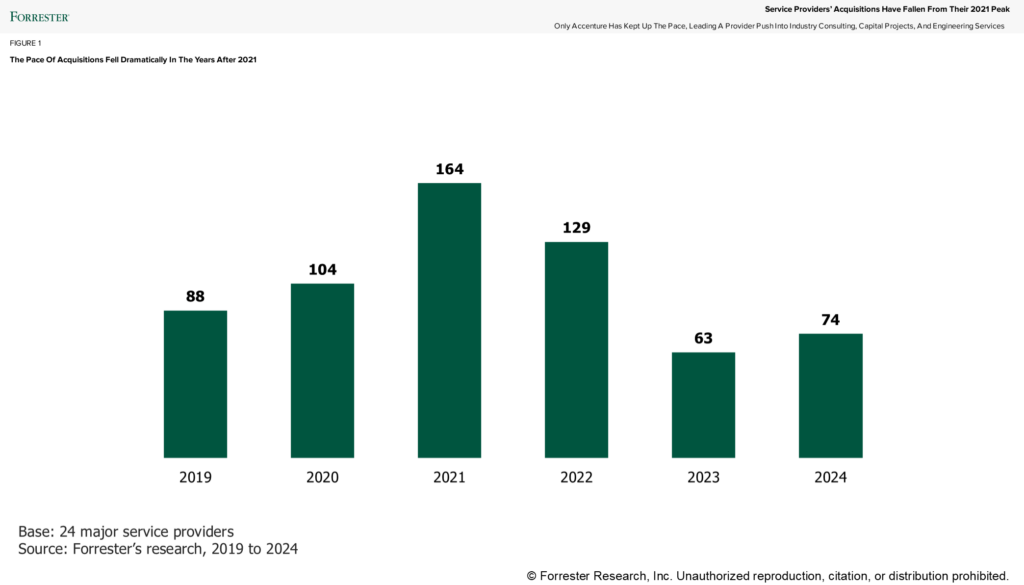
The number of acquisitions by 24 top service providers — including Accenture; Atos; Bain & Company; BearingPoint; Boston Consulting Group; Capgemini; CGI; Cognizant; Deloitte; DXC Technology; EPAM; EY; Globant; HCLTech; IBM; Infosys; KPMG; McKinsey & Company; NTT DATA; Perficient; PwC; Tech Mahindra; West Monroe; and Wipro — fell sharply from 164 in 2021 to 63 in 2023 and rebounded only slightly to 74 deals in 2024 (see the figure below). Compared with 2020 and 2021, when the COVID response still drove most deals, three factors tamped down acquisition fever in 2023 and 2024, continuing to be slow in today’s volatile environment: High valuations: unrealistically high valuations that deterred acquisitions Demand trends: flat or slowly rising demand for technology services Interest rates: high interest rates that increased the cost of capital Only Accenture kept up the pace: Over the past two years, Accenture accounted for almost half of the acquisitions tracked, adding 66 firms (and a forecasted 2–3% inorganic growth) to the 131 it acquired between 2019 and 2022. The next biggest acquirer in the period was Deloitte with nine deals — far off its pace of 55 between 2019 and 2022. This makes Accenture a bellwether for the expansion strategy of the services industry.   Providers Are Heading Toward New Kinds Of Services Service providers continually reassess their best opportunities to expand. They acquire companies to enter new markets, introduce new lines of service, or expand capacity. All three reasons motivated providers in 2023 and 2024 to acquire firms in 12 categories (see the figure below). AI and data showed up in the deal categories, rising to number three in the lineup. That AI service purchase momentum continues (in a slow deals market) in 2025 with purchases of Hakkoda by IBM Consulting and Halfspace by Accenture, for example. In addition to AI, the acquisition pivots signal where providers are headed: Industry consulting services. Industry consultants are closer to an enterprise context than general systems integrators. For example, Globant acquired US-based ExperienceIT for its healthcare prowess; Accenture acquired Italy-based Intellera Consulting, focused on public sector and healthcare services. Business application implementation services. Services to implement Oracle, Salesforce, SAP, and Workday have been on the acquisition list for years. In 2023–2024, ServiceNow became a hot acquisition target: Cognizant acquired US-based Thirdera, EY acquired UK-based whyaye, and NTT DATA acquired Brazilian provider Aoop, all for their ServiceNow skills. Capital project management services. Providers are expanding into managing large infrastructure projects. Deloitte acquired Nihar in Australia, while Accenture acquired six firms providing infrastructure project services, including Boslan in Spain and Comtech Group in Canada. Training services. Training services have gained importance due to rapid workforce changes stemming from AI. Accenture joined Infosys in 2024 by acquiring Udacity and Award Solutions to expand its learning platform and services.   What Providers’ Acquisition Strategies Mean For Technology Executives Companies depend deeply on the providers they hire. In Forrester’s Business And Technology Services Survey, 2024, enterprise services decision-makers said that, on average, their firm would spend 28% of its IT budget on third-party service providers in 2024. This means that they must care about key providers’ strategies, including their approach to acquisitions and track record of success (or quiet failure). Ask your strategic partners about their: Acquisition strategy. What is the provider’s acquisition strategy, and how will it support your evolving needs? Make their acquisition strategy part of your vetting process and annual master service agreement review. Impact on existing work. How will a particular acquisition affect the work you’re already doing with the provider? If you are already working with the acquired firm, ask it directly. If not, ask for an introduction to get the straight scoop on the acquirer’s plan. Contract protection. Procurement professionals should write contracts that protect against the provider being acquired and investigate any changes stemming from an acquisition that could affect the validity of the contract. For the in-depth report, click here. (Thanks to my colleagues Hannah Murphy and Hayden Weatherall for this research foundation.) source

Technology Service Provider Acquisitions: A Strategic Shift To AI And Industry Services Is Underway Read More »

The Verdict Is In, It’s Buying Groups For The Win

We’ve just wrapped up another great B2B Summit event, and buying groups was all the buzz … again. Marketing leaders have built their plans, budgets, metrics, and success based on the lead (marketing-qualified lead, or MQL) for decades now. But for most organizations we talk to, it’s not working like it used to. That decision-maker who sales wants to talk to isn’t working alone and definitely isn’t taking cold calls or emails. In fact, Forrester’s Buyers’ Journey Survey, 2024, says that on average, 13 people are involved in making a purchasing decision. If your organization is aiming to enhance performance and foster sustainable revenue growth, it’s time to pivot from individual leads to engaging multiple members of the buying group. This shift is not only beneficial but essential. The Real Opportunity Is Buying Groups Organizations must shift to looking beyond the lead to the group of individuals involved in making buying decisions. The typical B2B buying group is made up of individuals from different parts of the organization, each with their unique needs and roles in the buying process, including decision-maker, champion, influencer, ratifier, and user. Engaging with the entire buying group, understanding the roles that each member plays, and catering to their specific needs is the key to unlocking more opportunities and driving growth. Providers that have shifted their focus to buying groups have seen significant benefits, from uncovering more opportunities from hidden prospects and existing engagement to improving sales efficiency. “It’s all about adding buying group members with the right titles or more deeply qualifying the existing members with the right titles,” said Jeremy Schwartz, senior manager of global lead management and strategy at Palo Alto Networks and Forrester 2025 B2B Program Of The Year Awards Winner. “Our revenue process transformation approach resulted in significant improvements. During the pilot stage, win rates doubled. Upon fully scaling, we saw an 800% increase in opportunity progression to forecast. We also saw a large increase in business development rep conversions and average deal sizes for the quarter that, if applied to our previous year’s results, would have generated an estimated 13% increase in revenue.” Three Steps To Shift To Buying Groups Today Ready to make the shift? Here are three steps to get you started today: Outline the buying group and roles. Think of it as moving from a simple game of checkers to a strategic game of chess. Each member of the buying group plays a different role, from the champion pushing for change to the decision-maker holding the budget. How will your product or solution help each of them? Connect and package signals for revenue development teams. Once you’ve got a good sense of the buying group, pass that info along to your revenue development reps (also known as business development reps or sales development reps). Equip them with the insights needed to identify and engage other members of the group. Assemble buying groups and signals in early-stage opportunities. The sooner you can get a clear picture of the buying group in your sales and marketing systems, the better, as your visibility into potential revenue will improve. Why You Should Make This Shift And Begin Your Revenue Process Transformation In today’s world, it shouldn’t be a surprise that buyers have more power than ever before and expect more personalized experiences. By focusing on buying groups rather than individual leads, we can meet these expectations, uncover more opportunities, and drive sustainable growth. Plus, aligning marketing, sales, and customer success around the buyer’s journey ensures that we’re all working together to deliver value and a consistent, relevant experience every step of the way. Making the move to buying groups is not just about improving conversion rates; it’s the shift from being revenue-obsessed to being truly customer-obsessed and better aligned to how businesses make purchasing decisions today. Making the shift to buying groups isn’t new news, but after Summit this year, it’s buying groups for the win. To learn more about how to embrace the shift to buying groups, check out our latest research, Buying Groups For The Win. Want to know about some of the organizations that have already begun this shift? Hear directly from them in this webinar with Siemens, Palo Alto Networks, and Zendesk. source

The Verdict Is In, It’s Buying Groups For The Win Read More »

Leading Through Tech Workforce Changes

Many organizations, especially federal agencies, are facing unprecedented upheaval as they implement large-scale workforce reductions. For technology leaders (many navigating this process for the first time), layoffs represent a particularly challenging leadership test that cannot be executed without significant trade-offs. Despite optimistic claims about “doing more with less,” the reality is that organizations must initially accept making do with less instead, even redefining the scope of the mission. Layoffs should remain a last resort, implemented only after exhausting all other ultimately find themselves rehiring at increased costs to fill critical gaps. When workforce reductions become unavoidable or uncontrollable (as is the case for many US federal agencies currently), technology leaders must balance strategic necessity with genuine compassion, implementing changes thoughtfully to both safeguard critical capabilities and respect the human impact on their teams. To do this, technology leaders must: Prioritize reversible cost reductions to protect organizational adaptivity. Workforce reductions represent one of the most irreversible budgetary decisions an organization can make. The loss of institutional knowledge and relationships can create repercussions that reverberate for years. In today’s dynamic environment, organizational adaptability depends on retaining talent: people who understand your mission, know the functional dependencies, and possess relevant skill sets. When navigating budgetary pressures, first explore opportunities in other areas — device spending, software licenses, service provider contracts, and telecommunications costs. Only after exhausting these options should workforce reductions be considered. Communicate with clarity and compassion. Coordinate all messaging with agency leadership to prevent rumors and anxiety. Be transparent about the process and timeline, sharing information promptly. Managers new to workforce reductions need detailed guidance and support. Provide comprehensive communication toolkits, including talking points, FAQs, and guidance for difficult conversations. Schedule practice sessions for delivering tough news. Acknowledge the emotional impact on those affected while maintaining boundaries. Keep your management team close with frequent check-ins, creating safe spaces for concerns and guidance. Deliberately rebuild organizational trust. Workforce reductions impact organizational culture, causing survivor’s guilt, workload anxiety, and stability concerns. Acknowledge these feelings openly. Hold town halls to communicate priorities and listen to concerns. Support frontline managers with resources. Clearly document changed expectations and deprioritized projects. Collaborate with stakeholders to reset service agreements and timelines. Celebrate small wins to rebuild momentum. Define your sphere of control and influence. Focus on areas where you can make a difference. Sphere of control refers to the areas where you have direct authority and can make decisions or changes including tasks, projects, and responsibilities that you can manage independently. Sphere of influence encompasses areas where you can affect outcomes indirectly through relationships, persuasion, and collaboration that involves working with others to achieve goals, even if you don’t have direct control over the processes. Understanding each involves recognizing where you can take direct action versus where you need to leverage your influence to drive change. Not only will it give you grounding on what to focus on, it can give clarity to the teams you manage. If necessary, scope down the mission. If the cuts that you are experiencing are vast, you might not be navigating the dilemma of determining how to do the same with less. You’ll likely need to revisit your mission, redefining the business and IT capabilities that you must support. Collaborate with proactive team members who are ready to tackle challenges, and work closely with team members who are willing to roll up their sleeves. You need leaders who will step in and step up rather than dwell on the instability and upheaval, but note that execution will still require skills and resources. For further guidance on navigating these challenging times, please reach out to your account team to schedule a guidance session. source

Leading Through Tech Workforce Changes Read More »

CX, Digital, And Marketing Leaders: Tap Discipline And Creativity To Navigate Through Volatility

Marketing, customer experience (CX), and digital leaders in consumer-facing businesses are navigating new ways that the world now works — but you can’t let the shifting winds and heavy currents push your business off course. In Forrester’s new report, Consumer Marketing, CX, And Digital Leaders: How To Thrive Through Volatility (US) (client-only access), we outline strategies and tactics to navigate rapidly evolving economic and market conditions. The following are highlights of Forrester’s advice to consumer brand leaders in CX, marketing, and digital business. Your Customer Is Your Pivot Point For Planning, Action, And Communication Customer obsession is the surest way to business success in any operating environment — not being customer-obsessed will tangibly cost your organization because customer obsession is vital to making good decisions about your strategy, product, service, and ways of operating to grow the business amid any type of turbulence. Among other strategies and tactics: Reaffirm your customers, their needs, and how you operate to fulfill them. Build segmentation and good personas and ensure that they’re connected to business goals. Find your value sweet spot — the blend of the four value dimensions (functional, experiential, symbolic, and economic) — that delivers on your target customers’ value needs, matches what your organization excels at, and provides a competitive advantage. Create an authentic, actionable CX vision — and land quick, inexpensive wins. Tight budgets, shifting priorities, and small teams? You’ve got this. If you’re a Forrester client, use The Forrester CX Vision Development Template to speed your CX vision review. Focus on filling common gaps in the fundamentals. Use journey mapping to ensure that experiences fulfill the CX vision: Map key journeys, keep it low-fidelity, and focus on critical pain points. Adopt guerilla CX tactics to make the most of resources such as available (even micro-) data and rapid-fire experimentation and learning — and much more. Prioritize the types of insights you need for your adaptive marketing strategy. Our data tells us that using customer insights to drive decision-making is among global marketing leaders’ top challenges for 2025. Think long — not just short! — term: For example, will those acquisition tactics and dollars result in customers whom you’re best suited to serve over the long term? Flex Adaptivity, Creativity, Communication, Leadership, And Risk Management Muscles CX, digital, and marketing leaders should lead their teams to collaboratively: Create an “always on” planning structure. Work with senior leadership to develop and operationalize a continuous planning loop. Create dynamic roadmaps that embrace approaches such as agile development and design thinking; enable fast and flexible adjustments, including automation technologies; and promote exploration, iteration, and effective measurement. Unleash internal creativity. Use the “we’ll try anything” mentality and the fast-changing nature of business to start iterating, testing, and measuring new ideas. Think means to access new markets and customers, new educational materials, or new tools to help your customers navigate through uncertainty. Tap generative AI (genAI) for task improvement and effectiveness. With genAI, teams can become more efficient with tasks — and find new ways to tackle challenges. As agentic AI improves and expands, genAI’s role in productivity and creativity will only grow, especially in the hands of people who learn to use the tools well today. Lead and communicate. Be a visible change leader and steadying force, keeping employees regularly apprised. Listen to employees closest to your customers and solicit ideas for potential company actions. Ratchet up managing the risks in their control. Know the three E’s of risk management: enterprise, ecosystem, and external forces/systemic risks. The rule now: To evaluate risk trade-offs, you must become ultra-disciplined about risk management via a continuous approach to enterprise risk. Want to discuss your organization’s next steps? If you’re a Forrester client, please schedule a guidance session or inquiry with us. Not a Forrester client? Explore our complimentary resources on navigating volatility. source

CX, Digital, And Marketing Leaders: Tap Discipline And Creativity To Navigate Through Volatility Read More »

Global Tariffs: Dynamic Risk Management Meets Its Moment

The recent introduction of US-imposed tariffs has shaken global trade. While economists and financial analysts debate whether this on-again/off-again trade war fits into their model for geopolitical, economic, or supply chain risks, the result is the same: uncertainty and chaos sure to shake up business strategy for the foreseeable future. This new era of volatility will impact all companies regardless of industry or geography, forcing business leaders and technology leaders to think like risk leaders. Everyone must focus on what they can control and adapt swiftly and dynamically. This is the moment for which enterprise risk management was made. Let Context And Control Dictate Your Risk Management Response Even in times of relative calm but perhaps especially in times of chaos, the purpose of risk management is not to remove all risks but to determine which risks are worth taking — and at what cost — in pursuit of strategic goals and business objectives. Two mantras should dictate your approach: context and control. Context is key to risk response. For example, for the pharmaceutical, airline, and automotive industries, where safety is paramount, pivoting to new suppliers to avoid tariff impact may not be a viable short-term strategy, as new suppliers must be certified for safety and quality. Control is critical for risk prioritization. Trying to predict and plan for what the US administration will do next on tariffs is not a suitable basis for a stable risk management strategy. To respond dynamically but in a collected manner: Continue to align risk strategy with the business. Volatility will inevitably require companies to rethink their business strategy. That could mean deliberately shrinking certain product lines that may no longer be profitable, pivoting away from certain global markets with high complexity, or diversifying your offering to take advantage of current circumstances and new preferences. For risk leaders, now is the time to embrace a continuous risk management approach to ensure that the business is taking on the right risks, at the right costs, in pursuit of value. Focus on factors you can control. There’s never enough time, budget, or resources to tackle risk in the way we’d like. And when the risk changes with every new headline or social media post, risk pros must prioritize efforts based on level of control. To regain control over business risk arising from tariff trauma, apply the Forrester Three E’s Framework to identify risks to the enterprise that you can control directly, risks to the ecosystem for which you only have partial control, and external risk factors (systemic risks) that are outside your control when determining risk mitigation options. Risk pros must identify those levers, whether that involves sourcing alternative suppliers, cost management measures, or reimagining pricing. Bolster your risk intelligence to enable dynamic risk management. To empower executives to make the right decisions, risk professionals need to borrow a leaf from first responders and emergency services and bolster their organization’s strategic risk intelligence capabilities. Risk pros can use them to quickly spot emerging risks and threats to the business, providing actionable strategic counsel to executives when moments such as the recent tariffs occur. This requires not only good data sources but professionals who are able to quickly synthesize and write actionable and practical recommendations that executives can use to make decisions, even in the face of limited information. Scrutinize changes through a data risk lens. Data risks come in different flavors: risks to data, risks from data, and risks in the data. Assess whether this change — such as to the supplier, location, process, etc. — introduces data risks that are unacceptable or require additional risk mitigation efforts. Changing your supplier for IT equipment may introduce risks to data if it is preloaded with spyware during the manufacturing process or if it’s in locations where threat actors have a higher likelihood of intercepting shipments to tamper with the devices. Hastily restructuring to move operations out of a geography may introduce risks from data based on how you use or process the data, as well as how the data needs to flow for business purposes; this can potentially put your organization out of compliance with regulatory or contractual obligations. Adapt safety and quality control processes to cost pressures, carefully. New tariffs can negatively impact safety and quality assurance by increasing overhead costs, which pressures companies to cut corners and brings a decline in quality control practices. Yet every industry has unique requirements for safety and quality outcomes that are nonnegotiable. Pharmaceutical companies must ensure that medications are safe, even if it means incurring higher costs for quality control, and construction projects must follow quality design and safety standards for new buildings or public infrastructure. Cost pressure cannot override safety and quality outcomes. Risk leaders must communicate the value of meeting these outcomes to business leaders, even if it means higher costs in the near term. There is only so much a company can do to optimize its safety/quality management systems, so risk leaders must be involved in any new sourcing or supply chain discussions to ensure that required outcomes are upheld. US Tariffs Don’t Apply To Services Yet, But Services Will Still Be Impacted US tariffs focus on goods, with a range of tariffs applied based on a highly specific focus on the balance of trade with specific countries and the United States. The US administration has not been shy about its desire to bring more manufacturing back to the US, but the US tariffs do not apply to services that make up the majority of the US’s trade balance with the rest of the world. Don’t forget to include services in your overall context and control lens and: Include services in risk intelligence feeds. US tariffs did not initially include any tariffs on services, but by levying significant goods tariffs, other countries are now fighting back. Service sectors including financial services, healthcare, and technology services are squarely in the firing line. China has started by targeting services exports from the US in response to the

Global Tariffs: Dynamic Risk Management Meets Its Moment Read More »

With B2B Sales Disruption On The Doorstep, What’s Next?

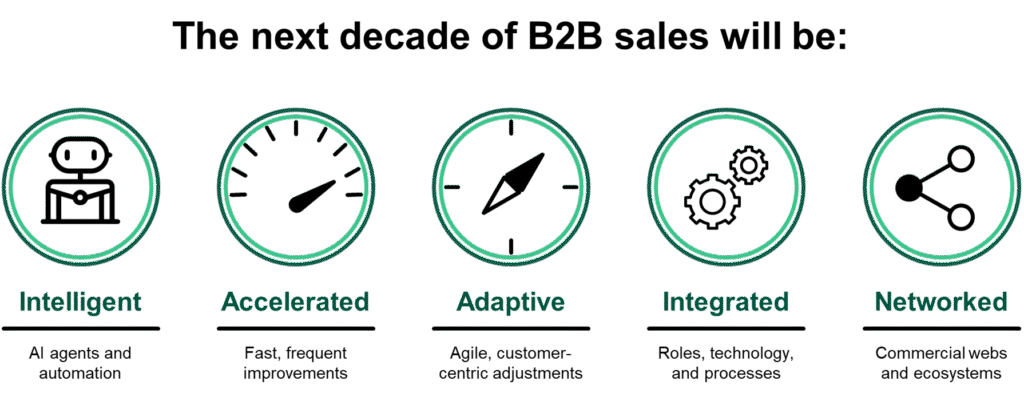
Buying and selling continue to change, and everybody wants to know how AI affects B2B sales. Here’s the situation: Sales teams have long struggled to adapt their tools and techniques to today’s purchasing dynamic. Now, new forces stress sales organizations in unprecedented ways. Paradoxically, these same forces fuel an emerging B2B sales supercycle — an extended period of growth and transformation. Our latest report, The Dawn Of A New B2B Sales Supercycle, looks at the future of sales. The disruptive decade ahead has characteristics never seen before, which significantly affect all revenue and go-to-market teams. Simultaneously, the future will be both chaotic and exciting. To succeed in this new reality, selling teams must unlearn much of what has made them successful in the past. The Enduring Forces Shaping B2B Sales Previously, the internet, cloud, and digitization have driven long cycles of growth and change. Similarly, the next supercycle is forming. This extended period of B2B sales will be more intelligent, accelerated, adaptive, integrated, and networked (see figure below). Furthermore, it will change nearly every aspect of sales: strategy, budgets, coverage, training, quotas, compensation, execution, and more. Shaping this future is a handful of forces: Artificial intelligence. AI bots will automate routine sales tasks, and AI agents will perform higher-order selling actions. With AI, sales process and tech will become essential. Self-service. Buyers continue to complete more purchasing tasks on their own. Consequently, buying motions disrupt selling motions, and sellers must prioritize buyer enablement. Buying complexity. Customers have more choices, tools, and stakeholders in their buying network, but this purchase complexity creates longer sales cycles and seller confusion. Ecosystems. Partner ecosystems are digitizing and growing, thrusting the route-to-market topic to the forefront of sales strategy. Critically, routes to market are routes to revenue. PE and VC composition. A greater number of opportunistic, tech-savvy private equity and venture capital portfolio companies increases competition for larger incumbents.   The Implications For Sales And Revenue Leaders Most B2B sales organizations have an unsustainably large amount of transformation debt, a backlog of improvements that should have been made long ago but weren’t. These improvements are often shelved in favor of short-term sales goals. Unfortunately, this puts sales teams further back on the change curve. Moreover, sales leaders face shocking new realities in the next decade: Employment and income insecurity will rise among sales professionals. In Forrester’s Future Of Work Survey, 2024, 60% of B2B employees say they fear losing their job due to automation within the next 10 years. For B2B sellers working to hit quota, this adds to already high stress and turnover rates. Sales leaders, take note: There is an emerging wellness crisis among sellers. AI sales agents will be onboarded and trained to co-sell. With AI and automation driving this supercycle, 75% of B2B automation decision-makers in Forrester’s Automation Survey, 2024, indicated that they expect their organization to invest in sales automation in the next 18 months. Indeed, AI will automate selling tasks and customer touchpoints; it will also co-sell with account executives. Sales budgets that are heavy on headcount will be light on results. Important sales tech investments come with an expectation of cost reduction and productivity elsewhere. This creates tough trade-offs. Sales leaders must optimize budgets across a changing mix of headcount, technology, and workflow. As tech improves, headcount decisions will become agonizingly difficult for sales leaders. Go-to-market roles, processes, and technologies will continue to merge. Expect convergence both within sales and across sales, marketing, product, and customer success. Convergence touches everything — process, tech, roles, working groups, and more. As an example, development rep roles will likely be partially automated and combined with other go-to-market roles. Sales Practices Must Match Sales Realities The best sellers adapt their tools and techniques for the moment. Fortunately, that hasn’t changed much. Nonetheless, it’s difficult for long-time sales leaders to reimagine their own function — and to then get the organizational support to transform it. Yet this is exactly what sales and revenue leaders must do. To understand how AI affects B2B sales, explore more insights in the new report, The Dawn Of A New B2B Sales Supercycle (client access required). You’ll also learn about several other trends and their implications for sales teams. Many B2B sales and revenue leaders are already adjusting to this new future. As a next step, schedule a guidance session to determine where best to start. source

With B2B Sales Disruption On The Doorstep, What’s Next? Read More »

The Tech Exec’s Guide To Decoding Cybersecurity Vendor Performance

Forrester analyzed the earnings calls of the 10 largest cybersecurity vendors by market cap and identified key trends for technology executives (Forrester clients can read the report here). Earnings calls provide valuable insight into your vendors’ strategic performance — you need strong partners that are not only financially resilient but have a clear strategy for how their portfolio will deal with upcoming tech, economic, and threat challenges. The trends revealed on these calls show some of your vendors’ sales tactics and negotiation strategies, which you can then use to your advantage in the procurement process. Forrester identified the following key trends in the latest round of earnings calls: Managed services gain momentum for vendors, but benefits are dubious. Vendors are increasingly leaning on managed services to boost revenue, positioning them as a way for you to save time and reduce resource strain. For example, CrowdStrike, Trend Micro and Rapid7’s managed service businesses all experienced double-digit growth. At first glance, adopting managed security services can streamline your security operations, but this is not a guarantee. Ensure that you define your desired outcomes before signing up to these seemingly attractive deals, and ask vendors to clarify the measurable benefits — such as faster incident response or more accurate threat detection — to see if these services will integrate with your existing systems and teams. Market volatility could mean better negotiating power for tech execs. Even when vendors posted strong recent earnings, stock prices often dipped due to uncertainty in their future outlook or due to weaker guidance than analysts anticipated. Additionally, headcounts dropped in 2024 only for companies to reverse back to attracting talent again in 2025. In their quest for growth in these volatile conditions, vendors are offering more aggressive pricing or bundle deals to secure your commitment. Press vendors on real ROI, rather than being tantalized by attractive discounts in contract proposals or renewals, and emphasize mutual flexibility and partnership through contract clauses. If the future is truly uncertain, you’ll want the option to pivot if budgets, technologies, or threats change more quickly than expected with your cyber partners. Platform and AI hype demand closer scrutiny. Every vendor has now built or acquired an integrated platform and invested in an AI-driven strategy. The record acquisition from Google taking over Wiz, for example, showcases Google’s strategy to buy and integrate rather than build. These dynamics provide competitive pressure on vendors, and for you, they make it harder to determine hype from reality. This not only leads to a full platform play being a key consideration for buyers but also puts pressure on competitors such as Fortinet, Palo Alto Networks, and others. Because every vendor claims an integrated platform and AI-driven strategy, it’s getting harder and harder to determine which emperors actually have no clothes. For vendors promising end-to-end coverage via a single platform, verify how seamlessly these tools truly integrate or whether AI is genuinely improving capabilities by requesting evidence of success from your peers in environments similar to yours. You want to avoid accidentally becoming the marquee client. Additionally, assess your concentration risk of working with one vendor and diversify if you need to do so. Forrester technology executive or security and risk clients who have questions about these earnings calls can reach out to to me via inquiry or guidance session. source

The Tech Exec’s Guide To Decoding Cybersecurity Vendor Performance Read More »

Google Cloud Next 2025: Agentic AI Stack, Multimodality, And Sovereignty

Loads of news came out of a hot Google Cloud Next 2025 in Las Vegas. The most notable announcements? Sovereign AI solutions on-prem, developer innovations that meet timely needs, very applicable multimodality for content and CX, and new elements for building the enterprise agentic AI stack. What was lacking? In the security domain, AI agents notably still find limited use in the security command center and SecOps. Discover what happened at Google Cloud Next 2025 and what to do about it. Top Developments At Google Cloud Next 2025 AI sovereignty: AI plays a significant part in meeting digital sovereignty requirements. Gemini can now run in Google Distributed Cloud (GDC) locally and in air-gapped environments, making AI accessible for regulated organizations. Vertex AI offers access to proprietary, third-party, and open-source models, reducing dependency on non-sovereign tools and providing flexibility. Additionally, Google announced Agentspace, which provides granular IT controls, including role-based access control (RBAC), VPC Service Controls, and IAM integration. Developer innovations: Google unveiled a comprehensive vision for AI-enhanced software development, pushing the boundaries of current paradigms centered on chat interfaces. Agent technology, described as specialized AI services that can collaborate on complex, goal-oriented tasks, is encapsulated within streamlined services like the Agent Development Kit (ADK). The Kanban-style assistant interface breaks new ground in AI coding assistance, aligning well with agile development practices and signaling an evolution in enterprise AI tools beyond chatbots. Multimodal content creation: Multimodal Vertex AI now unifies advanced generative models — Lyria (music), Veo 2 (video), Chirp 3 (speech), and Imagen 3 (images) — into a single platform. This integration enables the creation of fully orchestrated production assets, such as promotional campaigns that include photos, custom soundtracks, and voiceovers from simple text prompts. By consolidating these models with enterprise-grade safety measures, Google streamlines content creation workflows, reduces time to market, and ensures compliance, positioning multimodal Vertex AI as a transformative solution for businesses. AI-centric customer experience: In a demonstration, Google showcased how a bot could assist in finding the right fertilizer for petunias, highlighting the high-quality, human-sounding voice and the integration of video and other channels for complex interactions. The bot’s ability to consult with an agent in the background for more challenging queries demonstrated the potential for AI to enhance customer service experiences significantly. Enterprise agentic AI: Google introduced several elements to build and orchestrate enterprise agentic AI systems. The agent SDK provides a toolkit for constructing agentic architectures, linking reasoners, memory, and necessary tools and data. Interoperability between agents is a market challenge, but Google’s agent SDK supports MCP, a popular agent framework. The Agent2Agent protocol facilitates interagent and interecosystem communication for complex workflows, though it is not a security or governance framework. Security enhancements: Google unified its security portfolio under Google Unified Security (GUS), encompassing SecOps, the security control center (SCC), and Chrome Enterprise Premium, and plans to use agentic AI for security incident and malware analysis, with SCC enhancements such as agentless malware scanning, regulatory compliance management, and attack path simulation. Additionally, Google introduced Model Armor for AI protection and discussed integrating Wiz intellectual property into SCC and GCP cloud security post-acquisition. What Should You Do Next? Given the new capabilities in AI sovereignty, agentic AI, and multimodality, here’s what tech and CX leaders can plan to do next: Consider whether these new options address your digital sovereignty needs. Digital sovereignty requirements are growing and becoming more specific in nature. While full sovereignty is challenging, dedicated solutions can address specific needs. Google Distributed Cloud helps regulated sectors leverage Google Cloud functionalities on-prem. S3NS, a Google and Thales company, addresses sovereignty requirements in France under SecNum regulation, with similar constructs in development for Germany. Organizations can achieve digital sovereignty targets using foreign cloud vendors alongside native options. Public-sector organizations and orgs in regulated industries can leverage these options for their sovereign cloud deployments. Multimodal is here, so redefine your content strategy. Google Next made it clear that enterprises are leveraging multimodal platforms like Vertex AI, and so should you. But how do you get started? Identify your core objectives — marketing videos, branded imagery, or full-scale campaigns — and map them to your platform’s functionalities. Collaborate with technical teams to establish thorough safety protocols and ensure regulatory compliance at every stage. Iteratively refine your prompts and outputs to shape engaging multimedia experiences that resonate with your audience. By harnessing generative AI across multiple formats, you can streamline production, adapt swiftly to market demands, and maintain a decisive edge in an evolving creative landscape. Test out a unified agentic AI interface with context. If you leverage Google’s productivity suite, you may be able to unify agents with a single adaptive interface by connecting Agentspace to popular apps like Confluence, Google Drive, Jira, Microsoft SharePoint, ServiceNow, and more — all from within Agentspace. Diagnose changes to user interactions with applications. Enterprise application interfaces with forms, buttons, and workflows are evolving as AI evolves. Google’s agentic approach signals a major shift in user engagement, with software starting with narrow functions (i.e., a customer interacting with an agent and a human supervisor, as demoed at Next). Similar transformations will occur in marketing, employee experience, and other functions. This is a wake-up call for enterprise application and experience leaders. Enterprises must define, standardize, design, and govern how users interact with these new applications. Approach multicloud security success with skepticism. AI agents for Level 1 semiautomatic incident response and malware analysis are promising use cases (i.e., capturing evidence during detection, investigation, and response workflows), but automatic AI-driven cloud configuration security and drift remediation remain too risky. Using SCC for multicloud (AWS and Azure) is feasible but underutilized by Google Cloud Platform customers. Security professionals using GCP should monitor how Wiz IP transforms Google cloud security and whether Google can maintain Wiz as a cloud-agnostic CNAPP and cloud detection and response tool. Reach out to Forrester to schedule an inquiry to help guide your AI, cloud, and security initiatives or to dig into these announcements. source

Google Cloud Next 2025: Agentic AI Stack, Multimodality, And Sovereignty Read More »