Forrester

For Earth Day 2025 Focus On The Threefer Of Sustainability Efforts: Meet Sustainability Goals, Achieve Better Financial Results, And Reach Business Strategy Goals

This past year, I was describing what a “twofer” was to my colleague Jinan Budge in Australia. I casually dropped this term for getting two things for the price of one during a conversation. In addition to talking about how weird lingo can be, it also led to me proposing that what we were talking about was actually a “threefer” — getting three things for the price of one. I can’t seem to let the idea of the threefer go when it comes to environmental sustainability efforts. Forrester’s original framing of the green market revolution explicitly made the point that sustainability efforts can be good business, showing the twofer effect: A combination of macroforces will create a tipping point, after which companies will no longer view environmental sustainability as primarily an ethical responsibility with added benefits to brand and modest cost savings but as a financial and regulatory obligation that they can’t ignore and, more importantly, an unprecedented business opportunity. There’s also a hidden threefer effect, however, because sustainability efforts also achieve business strategy goals. Earth Day 2025’s theme is “Our Power, Our Planet” and calls for unification around renewable energy. Using energy transfer as an example, the threefer you get is to: Meet sustainability goals. Sixty-seven percent of business and technology professionals report that improving environmental sustainability is a business objective over the next 12 months. Of those respondents, 34% said that reducing the organization’s scope 1 and scope 2 carbon footprint was an action the organization is taking to improve environmental sustainability. Maybe you’ve done a t-shirt analysis of all your sustainability efforts — e.g., those that are easy, difficult, and hard to achieve. Transferring energy to renewable energy sources is typically in the easy-to-achieve bucket and has big returns on meeting sustainability goals for reducing scope 2. In fact, 28% of infrastructure hardware decision-makers reported that green energy procurement/investments in renewable energy credits provided the most impact for sustainability/carbon footprint reduction for their organization. Achieve better financial results. We predicted that operational efficiencies and financial benefits will eclipse regulations as key drivers this year. Energy transfer can do exactly that. Benchmark the cost of energy today and then go shopping. Additionally, investigate policies for demand-side management to get an extra boost in cost management. Reach business strategy goals. Resilience has risen as a board-level topic since the COVID-19 pandemic. Businesses need to adapt to climate change to ensure uninterrupted delivery to customers as much as possible. Twenty-nine percent of global business continuity decision-makers reported that power and fuel shortages/scarcity/outages make it more difficult for their organization to deliver on its vision and brand promise, no matter the crisis. One of the ways to overcome this is to get closer to energy independence. Getting your sources of energy production more local (how much can your company produce?) and/or secure renewable sources will boost your business’s resilience strategy goals. Want to take advantage of this threefer? Read more about sustainability, the green market revolution, and/or schedule a guidance session. Happy Earth Day 2025! source


For Earth Day 2025 Focus On The Threefer Of Sustainability Efforts: Meet Sustainability Goals, Achieve Better Financial Results, And Reach Business Strategy Goals Read More »

Google Cloud Next 2025’s Developer Keynote: Agents Take Center Stage

Google Cloud Next 2025’s (full takeaway blog here) developer keynote offered a detailed look at the company’s latest AI innovations, with a particular focus on agent technology and developer tools. Cohosts Richard Seroter and Stephanie Wong brought both technical insight and their signature energy to the stage, keeping the audience engaged with well-timed humor as they guided attendees through a series of practical demonstrations that built upon each other to showcase the potential of these technologies. Agent Framework Takes Shape The keynote opened with Brad Calder framing Google’s strategy around three key areas: agentic applications, developer productivity tools, and Gemini models. What followed was a series of interconnected demonstrations centered around a home renovation scenario, showcasing how multiple specialized agents could collaborate on complex tasks. The newly released Agent Development Kit (ADK) appears designed to lower the barrier to entry for creating AI agents. Dr. Fran Hinkelmann demonstrated its three core components: instructions defining an agent’s goal, tools enabling actions, and a model handling large language model (LLM) tasks. The demonstration showed an agent generating a professional renovation proposal from floor plans and customer requirements. Building on this foundation, Dr. Abirami Sukumaran presented a multiagent system in which specialized agents for proposals, permits, and material ordering work together. When one agent encountered an error, she demonstrated cloud investigations, which provided automated debugging assistance. Developer Choice Emphasized Google stressed flexibility throughout the keynote, with Debi Cabrera showcasing Gemini integration across popular IDEs including Windsurf, Cursor, and IntelliJ. She also highlighted Vertex AI’s Model Garden, which supports models from other providers including Meta, Anthropic, and Mistral. Real-World Applications In one of the more interesting demonstrations (I’m a baseball fan), MLB hackathon winner Jake DiBattista presented an application that used Gemini to analyze baseball pitching mechanics. His demo analyzed both professional pitcher Clayton Kershaw’s pitching and, to humorous effect, Richard Seroter’s more amateur (but better than what I could muster!) efforts. The application demonstrated how computer vision capabilities previously requiring specialized hardware are now accessible to developers with affordable tools. The Kanban Board: Bridging AI Hype And Real Product Team Workflows Perhaps the most significant announcement was Scott Densmore’s preview of a Kanban board interface for Gemini Code Assist. Unlike the chat interfaces that have dominated AI coding assistants to date, this approach aligns with how development teams actually work. The board enables developers to assign tasks to Code Assist including bug fixes, code reviews, and prototype development. This potentially offers a more intuitive workflow for developers than conversation-based interactions. Data Science Access Expands Jeff Nelson demonstrated a Data Science Agent that transformed complex data analysis into an approachable process. With simple prompts, the agent generated forecasting models using BigQuery, Serverless Spark, and new foundation models such as TimesFM. This culminated in a deployed data app — suggesting that specialized AI agents may someday enable less technical users to build advanced capabilities. As the industry continues to evaluate the practical impact of these tools, the keynote made a compelling case that agent-based approaches might meaningfully change how software development and data analysis teams operate together. The demonstrations suggested that Google is working to integrate AI assistance into existing development workflows rather than requiring teams to adapt to entirely new paradigms. source

Google Cloud Next 2025’s Developer Keynote: Agents Take Center Stage Read More »

Data In 2025: Enough Talk — Here’s Why Strategy Matters Now

A data strategy is no longer a nice-to-have. In 2025, regulations such as HIPAA, GDPR, and CCPA are tighter than ever; AI keeps making quantum leaps; and customers want hyper-personalization on demand. The winners won’t just be those with the largest datasets but those who know how to wield them — across the organization; at scale; and with trust to predict shifts, tailor offers, and outmaneuver the competition. Data is now the foundation for continuous innovation and strategic decision-making in this environment. From Siloed Repositories To Business Enablers AI has propelled us into a new era where data must be semantically rich. Through generative embeddings, machines glean context while user-friendly interfaces enable everyone — from executives to frontline employees — to hold informed, data-driven conversations. Moreover, the scope of what constitutes “data” keeps expanding: Real-time event streams, unstructured audio and video, semi-structured data, and graph databases capturing intricate relationships all feed into this broader, more agile insight generation. Monetization is another crucial dimension. Once regarded as purely an internal resource, data can now power entire product lines, shape industry-specific solutions, or become a pivotal asset in strategic partnerships, both internally and with third parties. Organizations must bake compliance, transparency, and ethical considerations into the very core of their data strategy to protect consumer trust and remain agile in the face of new standards. This shift from data silos and repositories to dynamic, actionable insights sets the stage for the ultimate goal: turning data into real-time, automated decisions that drive business outcomes such as revenue growth, efficiency, and a genuine competitive advantage. Turn Data Into Decisions Collecting mountains of data has never been easier. The true challenge? Converting it into business outcomes and decisions. Here’s how: Connect business objectives and dataLink every data investment directly to your core objectives. Establish a crystal-clear ROI so each department knows exactly how they benefit. Reinforce the value of data with metrics you can measure and track, keeping momentum high and ensuring transparency at every turn. Balance risk and rewardData governance isn’t about shutting doors but rather about keeping data safe, secure, and protected. Smart governance creates policies, protocols, and metrics to manage data acquisition, access, and use without stifling innovation. Think of it as the safety net that lets you push boundaries without plunging into chaos. Build a data-centric workforceThe best strategy in the world fails without the right people to execute it. From data engineers and stewards to architects and administrators, you need a skilled and curious team. Invest in upskilling, reskilling, and cultural buy-in. Don’t let insights stay trapped in silos — empower everyone to turn data into decisions. Power reusable and future-ready platformsBuild scalable, flexible platforms that can handle the demands of tomorrow, whether it’s generative AI, agentic AI, or the next big thing. Future-ready data architectures let you reuse and refactor existing investments, fill capability gaps faster, and keep pace with the market without missing a beat. Begin with communication and a roadmapLofty visions are meaningless unless everyone understands the path forward. Provide a roadmap outlining the time frame, outcomes, strategic themes, context, dependencies, and investments. Use “strategy-on-a-page” visuals and interactive workshops to break down complexity and get all stakeholders on board, from the C-suite to the front lines. Use Forrester To Navigate This Exciting Future Check out our newly published best-practice report, Unlock Business Value Through A Unified Data Strategy, for a clear framework to help you align, communicate, and activate your data strategy. Inside, you’ll learn how to build a future-ready approach for a data strategy specifically designed for the AI era, shifting from mere data storage to dynamic, real-time engagement. Clients can also connect with me through an inquiry or guidance session to discuss data strategy and any associated topics. source

Data In 2025: Enough Talk — Here’s Why Strategy Matters Now Read More »

The Digital Frontier: Acing B2B E-Commerce

Pausing isn’t an option, particularly for the dynamic world of B2B e-commerce. With the industry on the brink of significant shifts, businesses must adapt, evolve, and leap ahead. A Spotlight On The E-Commerce Maze The B2B e-commerce scene is stuck in a bit of a pickle, tangled in outdated methods and piecemeal strategies — a world away from its digital potential. A noticeable capability gap, characterized by weak customer insights and overlooking key capabilities, is putting a damper on growth. Ambition is great and all, but it needs a solid plan to back it up. Redefining And Shaping The E-Commerce Landscape Looking ahead, blending disciplines is key. Achieving success is all about piecing together an e-commerce ecosystem that knocks down old barriers, merging capabilities to create smooth customer experiences. Shifting from a product-centric view to a customer-centric one isn’t just a nice-to-have; it’s a must-do. Leaders are now presented with a structured lifeline — a framework that serves not just as a guide but as a strategic ally. This blueprint for navigating digital business emphasizes a shift toward a customer-obsessed, resilient B2B e-commerce ecosystem. Embracing strategic flexibility. The digital era doesn’t slow down, favoring those who can quickly adapt, innovate, and keep a sharp eye on what customers really want. Insights from the trenches are pushing for a mindset shift, encouraging leaders to stay one step ahead of the digital curve. Moving beyond insights. Simply having insights isn’t enough. A strong push for action is on the table, encouraging a deep dive and a fresh take on B2B e-commerce strategies. This isn’t just another hurdle; it’s a chance to shake things up in the industry. The outcome: Lead or get left behind. The digital expanse is wide, and the B2B e-commerce revolution is in full swing. The stakes are sky-high, setting the stage for either becoming a market leader or fading into the background. This framework doesn’t just sketch out the strategy; it acts as a declaration for those ready to innovate and take the lead. What’s Your Next Step? Ready to tackle this digital makeover? A detailed report awaits, filled with strategies, insights, and a master plan for conquering the digital world. For a deeper dive into these insights or to chat directly with an analyst, make your move to ensure that you’re leading the pack in the digital evolution. Reach out for the full scoop or to book a session with an analyst at [email protected]. source

The Digital Frontier: Acing B2B E-Commerce Read More »

MITRE-geddon Averted, But Fragility In CVE Processes Remains

This week, we saw the common vulnerabilities and exposure (CVE) process, as we know it, come hours from the brink of collapse when a memo started circulating on LinkedIn that the US Department of Homeland Security would cut funding to MITRE’s CVE cataloging on April 16. MITRE’s role in the CVE process is the crucial first step in assigning IDs to vulnerabilities so that practitioners, vendors, researchers, and governments across the globe can consistently reference the same vulnerability. The process also allows for responsible disclosures and accountability for vulnerabilities to software companies. The panic highlighted the elephant that’s been hanging out in the data center for too long: The CVE process is convoluted and has too many single points of failure. CVE submission processes have been falling apart for several months now, notably with NIST falling behind on assessing CVEs, scoring them with the Common Vulnerability Scoring System, and adding them to its separately maintained vulnerability catalog in the National Vulnerability Database (NVD), which many security companies utilize for their source of vulnerability truth. Without this first step of reporting vulnerabilities to an independent arbitrator like MITRE, the security community loses its ability to consistently communicate vulnerability issues in software and specify which components and versions are vulnerable. If this process ceases with no replacement, responsible and objective disclosure around newly discovered vulnerabilities would fall to the wayside, giving threat actors leverage and leaving a lack of accountability for software companies. CVE Program Renovation Leaves Uncertainty The security community recognized the need for better resilience in the CVE process. When US federal funding to a nonprofit can jeopardize so much, there is something inherently wrong. Even though MITRE ended up with funding, the status quo has proven to be unacceptable given the volatile reality of today’s cybersecurity and political landscape. Although MITRE-geddon approached and passed without disruption, many other entities have raised their hands to take on managing new vulnerabilities, including: The CVE Foundation. Members of the CVE board emphasized concerns about the global reliance on a process funded by single entities such as CISA and announced intentions to build a more resilient solution that can uphold imperatives in sustainability and neutrality. But as of now, the CVE Foundation has only released a memo and stood up thecvefoundation.org, which only states that more details about transitions will be announced. On Friday, the Dutch Institute for Vulnerability Disclosure posted its support for centralization through the CVE Foundation on LinkedIn. The European Union. Cybersecurity leaders and industry experts outside the US have expressed concern about the risks of relying on a single funding source for a critical global resource such as CVE. The European response to the uncertainty around the CVE system has been swift. Key organizations such as ENISA launched the European Vulnerability Database to enhance regional resilience and reduce reliance on a single US-funded entity. At the same time, the European Cyber Security Organization issued a clear call for European stakeholders to step up with trustworthy and transparent alternatives, reinforcing the need for sovereignty in cybersecurity infrastructure. Broader community initiatives, including CIRCL’s decentralized global CVE system, further underscore Europe’s commitment to building a robust and autonomous vulnerability management ecosystem. Many European institutions (including, again, ENISA) are already CVE Numbering Authorities, and it appears that those roles could expand. Cybersecurity vendors. Although CVE identifiers provide a consistent language for security professionals and vendors detecting and tracking vulnerabilities, vulnerability enrichment vendors like Flashpoint and VulnCheck provide their own catalogs. We anticipate that disruption to the process will provide more opportunities for vulnerability enrichment and threat intelligence solutions to sell their independent solutions. This opens the door for fragmented, paywalled alternatives, introducing new risks, costs, and dependencies. A standard, free CVE process on which everyone has relied for the past 25 years is likely to see more commercialization — with CISO budgets footing the bill. Other organizations cropping up to save the day doesn’t necessarily address the core problem. The value of having one organization responsible for maintaining CVEs is that there is then a single source of truth: a unified global ID system for security vulnerabilities, a common language across security vendors, researchers, and IT teams. This allows seamless integration into security tools such as scanners, security information and event management platforms, and vulnerability databases. What It Means For Security Teams The April 2025 incident shows that a lapse in support can disrupt a global system. When there are too many entities, like governments or commercial entities, that have their own vulnerability database, the lack of consistency will lead to more confusion. A disruption to CVE services could trigger fragmentation across the cybersecurity ecosystem, making it difficult for vendors and researchers to assign or reference vulnerabilities consistently, in turn hampering disclosure and remediation. Security researchers may need to report vulnerabilities to multiple institutions, leading to duplication and inefficiency. Additionally, most vulnerability scanners and patch management tools rely on timely and consistent CVE updates. Without those updates, systems risk becoming unreliable. Vulnerability management teams will also face new challenges with remediation prioritization efforts without consistent, up-to-date intelligence, further increasing exposure and risk. All of this won’t go unnoticed by adversaries. Expect a surge in opportunistic attacks as threat actors seek to exploit the confusion and gaps in visibility. It is also conceivable that new “vulnerability intelligence sources” could, in fact, be threat vectors, with so many authoritative sources out there. What Security Teams Can Do Now Most security teams rely on a variety of tooling and vendors to identify CVEs in their environment. Given the fragility of today’s CVE process, and an unknown future for how new CVEs will be handled, security teams should: Understand vendor plans for CVE source of truth. If your security tooling (such as vulnerability management, web application firewalls, and software composition analysis solutions) refers to CVEs to help users prioritize discovered issues, work with your vendors to understand how they will adapt if CVE updates stall or CVE ownership changes. Many vendors rely on the NVD, so

MITRE-geddon Averted, But Fragility In CVE Processes Remains Read More »

Government Organizations: Link Your Digital Metrics To Customer-Led Mission Outcomes

Digital leaders in government share a common task: transforming the way the government serves the public using technology. Despite how simple that sounds, the task is quite complex and requires keen understanding of many elements that influence how governments make decisions and operate. That’s why we studied examples of digital public services around the world, at different jurisdictional levels, and across various mandates (e.g. public health, education, transport). As a result, we created a standardized framework that links customer, operations, and budget measures to mission outcomes; and assembled a comprehensive inventory of typical metrics digital leaders in public organizations can use to track the success of their digital initiatives. Forrester’s public sector clients can access the full version report and the digital metrics inventory file, including the step-by-step approach, using the links below.  During our extensive research and granular analysis of government institutions that serve the public at local, regional, and national levels in North America, Europe and APAC, we’ve observed many challenges that governments of every type and size are facing, but also the lessons from those who’ve managed to succeed. Here are the top 3 lessons learned:   Lesson #1: What comes first: the agency mission or the customer outcome?  While looking at how some government agencies talk about their mission, we couldn’t ignore the feeling that there is some confusion among them about what should come first – the mission or the customer. This “chicken or egg” dilemma is an existential one because it affects how government entities prioritize and execute their digital strategy. This got me thinking about what my old law professor said: “The law is made for the people, not the other way around.” If we agree with that piece of wisdom, then the customer is the mission! So, in CX/DX speak, it means: “bending the mission to serve your customers, not bending the customers to serve your mission”; and that’s the most important lesson to begin with.  Lesson #2: Start tracking and reporting the metrics customers (the public) care about.  There is no shortage of numbers and statistics gathered, and sometimes transparently reported, by government agencies. But there is a shortage of insights customers (i.e. the public) would really care about. Ask yourself: “who cares more about the number of downloads of a government app or total number of digital transactions – the government or the people?” If numbers tell a story, what story will these numbers tell the people who are -let’s not forget – the rightful audience? Instead, savvy government organizations track combinations of metrics that manifest outcomes created for the people, like:   Achieving double-digit growth in children’s vaccination rate (outcome) as a result of online campaigns (proxy) and alerts (proxy) targeting new parents, including parents without insurance (proxy), and instant e-scheduling (proxy) for vaccination shots (proxy) to ensure the complete set of recommended vaccinations by age 3 (goal).  Shortening the average emergency response time (proxy) by fire and paramedic teams, thanks to automated monitoring devices and software (proxy) and alerts (proxy), resulting in a double-digit drop in fatalities by fire and heart-stokes (outcome) which are among the leading morbidities targeted for reduction (goal).  The lesson here is: make you ‘digital story’ about the stuff that people care about using the right metrics.  Lesson #3: Learn to tie digital metrics to $-signs.  If you didn’t pay for it, it didn’t get built. Yeah – budgets are important for digital ambitions, but what’s important to the budget-holders is not your digital ambitions, but ‘dollars and cents’ (or Swiss Francs, because they are more trendy nowadays– pun intended). Specifically, what the budget bosses want to know is how the costs for the digital ambitions are counted, spent, and justified. Therefore, the third – and probably the least talked about lesson is about how to connect your digital story to the money story. At Forrester we’ve been talking about this for many years, but normally addressing private sector and technology sectors who are profit-driven, and revenue-obsessed. In a government setting, without the focus on making profits, the financial talk comes down to budgets and that primarily means budget planning, cost-accounting, and constantly trying to squeeze every ounce of efficiency per dollar spent. In that context, budget-savvy digital leaders are prone to using granular tech and operational resource accounting methods, hawk-eye cost controls, and superior business-case making skills that make them more convincing. The lesson here is: learn to speak the finance language and adopt the requisite discipline.   source

Government Organizations: Link Your Digital Metrics To Customer-Led Mission Outcomes Read More »

Judge Rules That Google Is An Illegal Monopoly

Meta’s not the only Big Tech company in the hot seat this week. US District Judge Leonie Brinkema found Google liable for illegally monopolizing two online advertising technology markets: publisher ad servers and ad exchanges. This comes less than a year after another federal judge ruled that the company had a monopoly in online search. Google disagrees with the court’s decision and plans to appeal the ruling, asserting that publishers choose Google over other options because its tech tools are “simple, affordable, and effective.” As we’ve said before, the impact of these cases won’t be fully realized until the remedies stage, which may take years to play out. Any order to break up Google will spend time in the court of appeals and potentially go to the Supreme Court. When we surveyed consumers about Google’s illegal monopolies, only 18% said they “believe that Google will have to break up.” The Google Era Gives Way To A Google Overhaul Judge Brinkema’s ruling, paired with Judge Amit Mehta’s finding that Google maintains an illegal search monopoly, raises the likelihood of Google’s overhaul. The Department of Justice specifically requested divestment of Google Ad Manager, which includes its publisher ad exchange and ad server. At least, Google will be compelled to not destroy evidence of its monopolization going forward. According to Judge Brinkema, “Google’s systemic disregard of the evidentiary rules regarding spoliation of evidence and its misuse of the attorney-client privilege may well be sanctionable.” In addition, Google’s publisher adtech could be restructured by separating its ad server from its ad exchange, opening the loop between two products that have been tied to competition’s detriment. Publishers Can Expect (Eventual) Changes To The Sell-Side Adtech Ecosystem This ruling heightens (the already substantial) counterparty risk between Google and publishers, which is exacerbated by generative AI. Google’s AI Overviews, which facilitate zero-click searches, retain traffic that would, pre-ChatGPT, land on publishers’ sites. During guidance sessions, publishers tell us that they’re losing tons of traffic to AI Overviews. Publishers missing traffic must now deal with uncertainty about the future of Google’s sell-side adtech. Advertisers, however, are relatively unaffected by this decision. The DOJ failed to prove that Google has a monopoly on tech advertisers’ usage to buy display ads. In ruling for Google on the buy side, where Google fortifies tech acquired from DoubleClick and Admeld, Judge Brinkema found that advertisers choose among various ad platforms based on perceived return on ad spend. Advertisers continue to be dissatisfied by Google’s buy-side adtech’s lack of transparency and control, but Google doesn’t monopolize that market. Forrester clients: Let’s chat more about this via a Forrester guidance session. source

Judge Rules That Google Is An Illegal Monopoly Read More »

Forrester’s Top Threats For 2025

2025 started with a bang! Technology and geopolitics are changing so fast that many can’t keep track of the latest trends, with an announcement of new, benchmark-shattering genAI-related tech seemingly every week. Meanwhile, planned job cuts across US employers are at their highest levels since 2020, we are on the brink of a global trade war, and geopolitical tensions are high. On the plus side, there was a reported 35% year-over-year decrease in ransomware payments from 2024, but we’re not even one-third of the way through 2025 and things are already hectic. To help security leaders better prepare for the chaos that is and will be this year, Forrester has released our yearly report on the top threats that we expect organizations to face in 2025. Read the full report here: The Top Cybersecurity Threats In 2025. This report is based on data and trends from the changing dynamics in the threat landscape. We expect that organizations will face the following in 2025: Global regulatory disruptions. Some regulations are being established in force this year, others are cropping up net new, and still others are being revoked. With so much regulatory change, organizations must focus on compliance change management and prioritize requirements that are being enforced now. High-quality deepfakes. Convincing deepfakes are becoming easier to create thanks to the proliferation of open-source algorithms, purpose-built websites, cheap GPU power, and the wide availability of voice and audio profiles. Mitigating deepfakes requires an investment in end-user education and the implementation of strong authentication methods. Tech exuberance over generative AI. The anthropomorphizing of genAI means that people trust it even when they shouldn’t, which puts your organization at risk. It’s critical to invest in ML and AI security tools and create processes focused on discovery, policy enforcement, and detection and response. Job loss radicalization. A new economic reality has emerged in 2025, with a flurry of activity that saw job cuts to 4% of the US federal government workforce, massive tech layoffs, and job cuts in Europe. Managing potential insider threats with an insider risk management program is paramount this year. Generative AI-driven extortion. Ransomware became less lucrative in 2024, and attackers are likely to mix things up because of it. Before genAI, stealing data was only so useful — reviewing millions of emails takes far too much time. Now, with GenAI, attackers can perform a quick sentiment analysis on troves of stolen data for extortion schemes. Prepare now for infostealers, which lead to extortion and will become a bigger threat than ransomware. For more on what to know about these threats and what to do about them, read the full report. If you have more questions about the threat landscape, book an inquiry or guidance session with me or one of my colleagues. source

Forrester’s Top Threats For 2025 Read More »

Health Insurers Must Forge A New Frontier In 2025

Health insurers (HIs) face a tough road ahead to improve customer experience. As health insurance leaders balance cutting costs with the pressure for innovation in a rapidly evolving ecosystem, they must revisit their priorities to cocreate value and strengthen trust with members. To help guide health insurance leaders, our new report, The Seven Trends That Matter For US Health Insurers In 2025, explores the top seven trends for HIs in 2025, including: Redefining the end-to-end member experience. The relationship with your customers starts before they buy, and each touchpoint is an opportunity to ensure salience, fit, and trust. To earn trust, HIs must still tackle the basics, proving their competence, dependability, and accountability. Experimenting with benefits to address the affordability crisis. Affordability remains a top concern for key stakeholders including members, employers, and insurers. In response, employers are experimenting with new insurance and benefit models like Individual Coverage Health Reimbursement Arrangements (ICHRAs), Exclusive Provider Organizations (EPOs), and other plan arrangements that favor quality and cost savings. As plan options diversify, HIs must invest in more robust tools to help consumers navigate to the best plan fit. Reinventing pharmacy benefit managers (PBMs). PBMs find themselves under the microscope as HIs and regulators alike seek to improve transparency and reduce medication costs for consumers. Optum Rx’s recent move to eliminate 10% of prior authorizations signals a shift toward a simpler medication approval process, improving efficiency and patient access. HIs must prioritize affordability, revamp new pharmacy service models, and cut the red tape to drive improved outcomes. Ready to chart your course? Schedule a guidance session now to discuss how your organization can seize these opportunities. Forrester clients can also read the companion report on The Seven Trends That Matter For US Healthcare Providers In 2025 and watch our recent on-demand webinar that covers both perspectives. Not a client? Learn more about how you can have Forrester on your side and by your side. source

Health Insurers Must Forge A New Frontier In 2025 Read More »

“Still Federating After All These Years”: The Realities Of EA Maturation

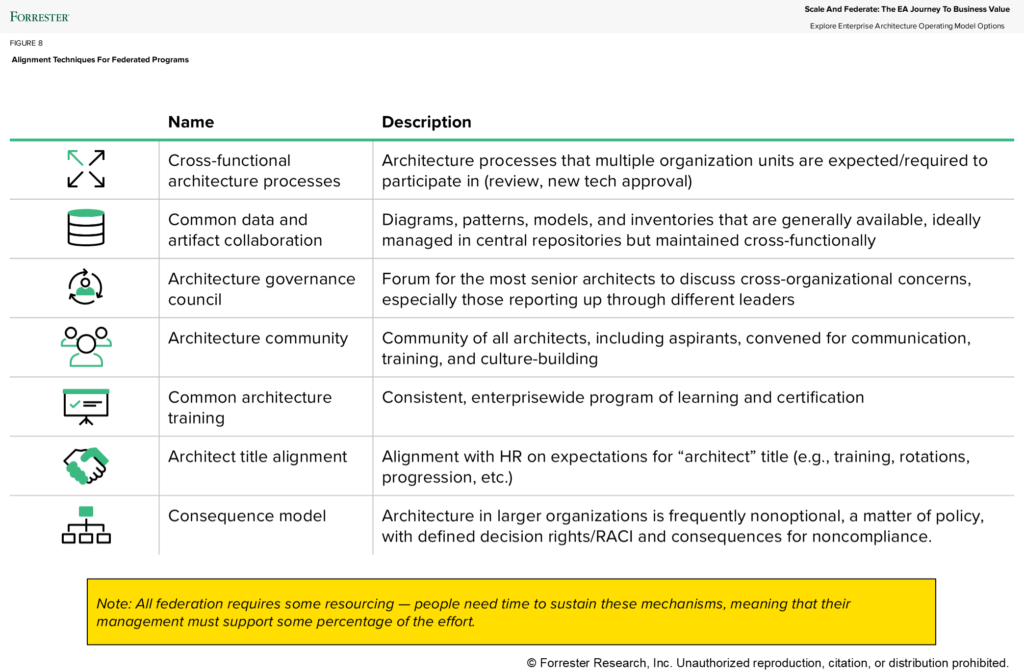
Another day, another LinkedIn hot take on enterprise architecture. They fall into various camps: those confusing EA with a Marvel villain, others who think that the 10-year-old religious war between “business” and “enterprise” architects has any actual meaning (pro tip: it’s about as relevant as whether Han shot first), or folks who think that EA […] source

“Still Federating After All These Years”: The Realities Of EA Maturation Read More »