Forrester

Does Your Digital Strategy Fit On A Single Page? It Should.

Effective digital leaders treat strategy as both a verb and a noun: a cycle of work and outputs that sets an organization’s direction and continuously explores new ideas. A strategy on a page is an output that lays out the essential components of your digital strategy on a single page. To help digital business and strategy teams condense their strategy into an easily digestible document, we built The Forrester Digital-Strategy-On-A-Page Template that focuses on the following six components of strategy: Purpose: A concise statement that describes the objective of the digital business. The purpose could be an underlying challenge your team hopes to address, the role your brand or product/service will play in people’s lives, or a digital-specific articulation of a firm’s overarching corporate strategy. Vision: A clear direction for growth, outlining where the digital business plans to be in the future. Hypotheses: A hypothesis is the bedrock of an effective strategy. It uses limited evidence and definable unknowns to predict a desirable outcome. Our template calls for multiple hypotheses: specific, falsifiable statements that challenge current thinking or assumptions about the market. Guiding principles: Three or four principles that will guide how your organization will identify opportunities, create new ideas, determine needed resources, and prioritize initiatives. Success metrics: Three to five KPIs or other metrics that will indicate the effectiveness of your firm’s digital initiatives and their efficiency. Stakeholders: The key people, personas, and roles that will lead, influence, collaborate on, and be significantly affected by your digital strategy. This can include customers, internal stakeholders, external partners, and third-party developers. Outlining your strategy through this template can help team members and collaborators think clearly about how their day-to-day actions align with the strategy. The template helps guide ongoing discussions and future strategic exercises within your team and among other teams. Clients we invite you to try the Digital-Strategy-On-A-Page Template yourself! You can also set up a guidance session to discuss how you can build your own strategy on a page. If you’re not a client, reach out to us! (This blog post was coauthored by Ashley Villarreal.) source

Does Your Digital Strategy Fit On A Single Page? It Should. Read More »

The FTC Wants To Break Up Meta

The US Federal Trade Commission sees Meta in court, starting tomorrow. It’s the culmination of a nearly six-year investigation on whether Meta has a monopoly on the personal social networking market or not. The FTC argues that by acquiring Instagram (2012) and WhatsApp (2014), it “enabled Facebook to sustain its dominance — to the detriment of competition and users — not by competing on the merits, but by avoiding competition.” Meta argues that the FTC’s case is “weak” and “ignores reality.” The company asserts that “the evidence at trial will show what every 17-year-old in the world knows: Instagram competes with TikTok (and YouTube and X and many other apps).” 54% Of Poll Respondents Think Meta Has A Monopoly On Social Media We ran an overnight “quick pulse check” poll in Forrester’s ConsumerVoices Market Research Online Community.* We asked them to react to the potential forced split-up of Meta. About 500 online adults across the US, the UK, and Canada responded. The results show ambivalence and agreement: 54% agree that Meta has a monopoly on the personal social networking market (27% are neutral and 19% disagree). 43% agree that Instagram spinning off into a separate company (separate from Meta) would be good (50% are neutral and just 7% disagree). 45% agree that WhatsApp spinning off into a separate company (separate from Meta) would be good (50% are neutral and just 5% disagree). *Note: This poll was administered to a random sample of 497 online consumers in the US, the UK, and Canada in Forrester’s qualitative ConsumerVoices online community. This data is not weighted to be representative of total country populations. Our analysis of respondents’ open-ended statements found four common themes (below), each with just one illustrative verbatim (of many): Meta has too much power: “No company should have all that power and user data.” Users are concerned about data privacy: “It’s not so easy to track behavior if on different platforms.” Some see an opportunity for innovation: “I think it allows it to grow and advance without the parent company choosing what it does.” People want marketplace competition: “Meta having a monopoly on three popular social media apps prevents competition and better oversight of these apps.” Meta Has A Trust Problem — It’s Not New When Meta was just Facebook, the company suffered from trust issues. The 2018 Cambridge Analytica scandal created mainstream awareness of consumer data privacy issues, tarnishing Facebook’s already shaky reputation. And when the company rebranded as “Meta” in late 2021, Forrester found (back then) that 75% of poll respondents disagreed that a new company name would increase their trust in Facebook. It hasn’t. And that brings us back to present day. According to Forrester’s February 2025 Consumer Pulse Survey, just about a third of online adults (35% US, 30% UK) trust Meta (as a company) the same or more today than they did in 2024, and less than that have confidence in Mark Zuckerberg as the CEO of Meta (32% US, 28% UK). But whether a Meta breakup would ultimately be good for social media users or not, according to one of our poll respondents (referring to Instagram), “depends on who takes it over.” The Real Case To Keep Meta Intact? Interoperability Some respondents in Forrester’s ConsumerVoices Market Research Online Community pointed to the connectivity and governance across Meta’s family of apps as a good thing. “It’s really easy right now when I post to Instagram; it posts automatically to my Facebook page without me having to do that, so it’s really convenient,” someone replied. Another said, “There’s uniformity of policies at the moment — for example, rules for teenagers — which makes it a little simpler.” Yet when we surveyed online adults in February, just 31% of them agreed that they benefit from Facebook, Instagram, and WhatsApp all being interoperable under one company (Meta), and 43% disagreed with that statement (37% were neutral). A Meta Breakup Is A Seismic Social Media Market Reset The ramifications of this trial, coupled with TikTok’s future in limbo, potentially puts the very core of the social media market at play. No longer would Meta be its center of gravity. We haven’t seen anything like this since around 2006–2011 — social media’s earliest days. Yes, there was a time when all of these apps were separate and then some. We’d likely see a renaissance of social media startups looking to grab a piece of the new social-media world order. So what would happen to Meta? Sure, Meta is trying to make Facebook cool again. But the company’s social media “insurance” is (and has been for a while) … Instagram. Without Instagram and WhatsApp, what really is Meta? Could Facebook seriously compete with a standalone Instagram? Can Threads monetize at scale? Doubtful. And the company absolutely should not hang its hat on its fledgling metaverse ambitions. Its AI Glasses are a bright spot, as is its broader AI work (i.e., Llama). That means, in a broken-up Meta, the company’s AI initiatives would usurp its social media roots. Would this be good for advertisers? Yes and no. It would certainly spawn a renewed wave of creativity in the marketplace. This could mean new and interesting ad types, targeting capabilities, and partnership opportunities. On the other hand, Meta’s sheer scale and reach is the one thing that makes the company’s family of apps a marketing mainstay. A more fragmented marketplace would reduce social media’s advertising efficiencies — making brands work harder to plan, buy, and create custom ads across a newly expanded portfolio of platforms. Here’s the big (unanswered) question: If Meta is just Facebook (once again), would today’s advertisers even bother with it? For now, marketing executives should keep doing what they’re doing. Meta’s not getting broken up anytime in the short term. But hang tight and let the trial begin. Forrester clients: Let’s chat more about this via a Forrester guidance session. source

The FTC Wants To Break Up Meta Read More »

CCaaS Vendors Thrive In A Wild Market

This is my second Forrester Wave™ evaluation covering contact-center-as-a-service (CCaaS) platforms, and to the uninitiated, the familiar set of vendors in this Wave could make it appear almost as if there has not been much change in the market. But looks can be deceiving. Two years has made a big difference for CCaaS vendors, as Forrester’s newly published report, The Forrester Wave™: Contact-Center-As-A-Service Platforms, Q2 2025, reveals. The CCaaS vendors have marched forward through a time of incredible change: Generative AI (genAI) is reshaping customer service, adjacent vendors are working to commoditize CCaaS, and the CCaaS vendors continue to expand their value proposition. Much as these proverbial ducks appear to be bobbing along serenely, under the surface, those feet are paddling away through the choppy waters of this market. Following are some of the most striking changes I saw while researching this Wave. In CCaaS, AI Changes The Game (Again!) ChatGPT 3.5 was announced within weeks of the launch of the 2023 CCaaS Wave, promising great potential but too soon then to impact any of the offerings in early 2023. Of course, AI was already reshaping the offerings in this space with new approaches to self-service, agent assist, analytics, quality management, and more. Now that genAI has had time to permeate CCaaS offerings, we are seeing new levels of capabilities that are changing what it means to run a contact center: Call summarization. This capability became a commodity in a matter of months. Generative AI-written notes are high-quality and save agents time performing an important but rote task, thereby freeing them to spend more time with customers. Analytics. Every call is now transcribed, and genAI enables the business to query this data to unearth business insights without requiring a data scientist. New insights are helping brands run their contact centers and hold the promise of spreading customer insights across the organization. Quality management. No longer do we need to sample 1% of calls and hope to find a good example of an interaction to judge an agent on (an old process with ineffective results). AI can score all calls, noting customer and agent sentiment to provide overall feedback. This capability frees supervisors to focus more on coaching and improvement instead of basic scoring. Agent assist. Two years ago, CCaaS offerings could demo the system, advising the agent advice such as “The customer has negative sentiment; be more empathetic.” Cool, yes, but the advice wasn’t particularly relevant or useful. GenAI provides real insights and next-best-action recommendations that save training for agents and improve outcomes for customers. Customer self-service. This is one place where the CCaaS vendors are lagging the conversational AI point-solution vendors that have aggressively embraced genAI for self-service applications, since the alternative would be quick extinction. For the CCaaS crew, genAI provides value in many places without unleashing genAI directly on customers. As a result, it’s not surprising to see that the CCaaS vendors have invested in other areas. Look for this to change before you see the next CCaaS Wave. CCaaS Vendors Deliver More Than Incremental Improvements CCaaS vendors are thinking beyond the confines of improving the traditional capabilities of a CCaaS platform. For example, they might be providing a new level of value, extending beyond the contact center, or preparing for a new, AI-centric world. Areas we saw in this Wave include: Next best action. This capability offers useful suggestions for what agents can do, which the system often suggests proactively based on the conversation between the agent and the customer. So far, this capability is more practical for conversations that happen in the digital realm, as there is still too much lag time in most solutions to keep up with the chaotic nature of spoken human conversation. Analytics reaches beyond the contact center. The more the contact center can understand what happened to the customer before they hit the contact center, the better an agent can anticipate that customer’s needs. Understanding the customer journey beyond the confines of the customer service interaction allows for a much better service experience, and CCaaS systems can provide insights that have value beyond the contact center. New pricing models. There is general agreement that as AI increases automation across the contact center, the number of agents will start to decline, putting pressure on prevalent agent-based pricing models. Vendors in this Wave evaluation showcased a variety of approaches that typically focus on monetizing AI capabilities to offset any losses from traditional seat-based revenue. The CCaaS market continues to evolve — watch for the pace of innovation to increase further. To understand what this evolution means for your organization, please schedule a guidance session or inquiry with me! source

CCaaS Vendors Thrive In A Wild Market Read More »

Google Cloud Next 2025's Developer Keynote: Agents Take Center Stage

Google Cloud Next 2025’s (full takeaway blog here) developer keynote offered a detailed look at the company’s latest AI innovations, with a particular focus on agent technology and developer tools. Cohosts Richard Seroter and Stephanie Wong brought both technical insight and their signature energy to the stage, keeping the audience engaged with well-timed humor as they guided attendees through a series of practical demonstrations that built upon each other to showcase the potential of these technologies. Agent Framework Takes Shape The keynote opened with Brad Calder framing Google’s strategy around three key areas: agentic applications, developer productivity tools, and Gemini models. What followed was a series of interconnected demonstrations centered around a home renovation scenario, showcasing how multiple specialized agents could collaborate on complex tasks. The newly released Agent Development Kit (ADK) appears designed to lower the barrier to entry for creating AI agents. Dr. Fran Hinkelmann demonstrated its three core components: instructions defining an agent’s goal, tools enabling actions, and a model handling large language model (LLM) tasks. The demonstration showed an agent generating a professional renovation proposal from floor plans and customer requirements. Building on this foundation, Dr. Abirami Sukumaran presented a multiagent system in which specialized agents for proposals, permits, and material ordering work together. When one agent encountered an error, she demonstrated cloud investigations, which provided automated debugging assistance. Developer Choice Emphasized Google stressed flexibility throughout the keynote, with Debi Cabrera showcasing Gemini integration across popular IDEs including Windsurf, Cursor, and IntelliJ. She also highlighted Vertex AI’s Model Garden, which supports models from other providers including Meta, Anthropic, and Mistral. Real-World Applications In one of the more interesting demonstrations (I’m a baseball fan), MLB hackathon winner Jake DiBattista presented an application that used Gemini to analyze baseball pitching mechanics. His demo analyzed both professional pitcher Clayton Kershaw’s pitching and, to humorous effect, Richard Seroter’s more amateur (but better than what I could muster!) efforts. The application demonstrated how computer vision capabilities previously requiring specialized hardware are now accessible to developers with affordable tools. The Kanban Board: Bridging AI Hype And Real Product Team Workflows Perhaps the most significant announcement was Scott Densmore’s preview of a Kanban board interface for Gemini Code Assist. Unlike the chat interfaces that have dominated AI coding assistants to date, this approach aligns with how development teams actually work. The board enables developers to assign tasks to Code Assist including bug fixes, code reviews, and prototype development. This potentially offers a more intuitive workflow for developers than conversation-based interactions. Data Science Access Expands Jeff Nelson demonstrated a Data Science Agent that transformed complex data analysis into an approachable process. With simple prompts, the agent generated forecasting models using BigQuery, Serverless Spark, and new foundation models such as TimesFM. This culminated in a deployed data app — suggesting that specialized AI agents may someday enable less technical users to build advanced capabilities. As the industry continues to evaluate the practical impact of these tools, the keynote made a compelling case that agent-based approaches might meaningfully change how software development and data analysis teams operate together. The demonstrations suggested that Google is working to integrate AI assistance into existing development workflows rather than requiring teams to adapt to entirely new paradigms. source

Google Cloud Next 2025's Developer Keynote: Agents Take Center Stage Read More »

Atlassian’s AI Offensive Is Changing Work Forever

Atlassian has launched a sweeping upgrade to its platform, and the message is crystal-clear: AI isn’t just a feature; it’s the foundation. If you’re working in tech, managing teams, or even just part of a business using Jira or Confluence, this isn’t a subtle shift; it’s a tectonic one. Atlassian dropped a full suite of AI-integrated upgrades on April 9. The centerpiece? Rovo, an AI-powered enterprise assistant that offers deep integration with Atlassian’s ecosystem — Jira, Confluence, Jira Service Management — and external tools such as Google Drive and SharePoint. Key Moves Rovo goes GA (Generally Available) for all paying users — no extra cost. Over 20 customizable AI agents help automate everything from HR onboarding to DevOps workflows. New Teamwork Collection and Strategy Collection apps roll out as interconnected, AI-native experiences. AI-driven service management with Rovo agents suggests actions and triages issues. Analysts Charles Betz, Diego Lo Giudice, Julie Mohr, and Will McKeon-White provide their insights on Atlassian’s annual event announcements. With Rovo, Atlassian Prepares For The AppGen World At Team ’25, Atlassian announced a pivot toward Forrester’s AppGen platform trend, highlighted by its infusion of AI and generative AI technologies in its suite of tools such as Jira, Confluence, and Align and leveraging its golden source of IT data and metadata organized in a graph, together with the beta announcement of the Rovo Dev suite. This demonstrates a potential move to try to dominate the market by blending low-code/no-code and large language model (LLM) capabilities with Forrester TuringBots (aka AI and GenAI software development tools). As CEO Mike Cannon-Brookes put it, the strategy is to generate software, not just snippets of code. We agree with that strategy, but Atlassian will need to fill a broader gap by generating not just “software” (assets) but large portions or even entire software applications, since that is what the AppGen trend will bring. The Rovo Dev Beta Announcement Proves Good Intentions But Is Playing Catchup The announcement of the Rovo Dev Beta by Atlassian at Team ’25 showcased the company’s forward-thinking approach to offering various vertical use cases to developers to speed up development work for creating code plans, generating code, reviewing pull requests, automating changes in bulk, and simplifying deployments. Although Atlassian does not position it this way, it is automating several steps of the software development lifecycle (SDLC). The thinking needs to shift, however, more toward automating the process of building applications — new ones — and not just maintaining or fixing issues. The industry is rapidly evolving with AI technologies such as Cursor and Windsurf that integrate LLM coding capabilities to truly reshape the SDLC by offering advanced coding capabilities and challenging traditional methods with the ability to generate significant portions of applications. Rovo Studio’s launch as a free beta version emphasizes automation and productivity enhancements across the SDLC, yet Atlassian’s modest promotion of Rovo’s capabilities suggests this as an area with room for improvement before it can fully leverage its potential to transform software development. The System Of Work/Teamwork Graph Continues To Gain Traction According to its leadership, Atlassian has been working toward a graph-based “system of work” for about five years, and its messaging around this vision picked up noticeably in the past couple of years. Customers seem to be resonating with the idea that a unified graph of people, work, and knowledge offers organizational visibility and a critical semantic foundation for generative AI, supplying enterprise context to answers and actions. The Teamwork Graph spans Jira and Confluence and is expanding with Rovo into more general-purpose search, giving Atlassian a flexible architecture for cross-functional knowledge and coordination. As LLMs demand structured context to reduce hallucinations, the graph becomes not just helpful but essential. A significant question for us at Team ’25 was Atlassian’s replacement strategy for Device42, a discovery and IT asset management partner recently acquired by Freshworks. The answer, confirmed from several directions, is Lansweeper. This sets the stage for Atlassian to deepen its ITAM and CMDB capabilities, a territory where ServiceNow still dominates. But the strategic play is bigger: If Atlassian can extend the Teamwork Graph into asset and infrastructure data, it could start to challenge ServiceNow’s ontological lock-in with its Common Service Data Model. That opens up a deeper discussion about whether Atlassian mirrors some of those ontology structures or defines an alternative aligned with its own modular vision. The broader architectural issue — surfacing repeatedly in conversations — is control over the graph. This plays out in three ways: physical access (can systems read from each other?), semantic alignment (do different graphs agree on the meaning of entities such as “pull request”?), and commercial control (who can access the data, and under what terms?). These aren’t theoretical concerns — they’re already creating friction. For example, small startups may seek to pull inordinate amounts of data into their systems for analysis. There already is a looming “tragedy of the commons” with public resources such as Wikipedia suffering from excessive AI agent-driven scraping. Atlassian leadership confirmed that these tensions are front of mind, and rightly so. Any enterprise architect serious about AI enablement and platform convergence will need to grapple with the messy, political, and strategic implications of graph ownership. Atlassian Is Now A Full-Fledged ESM Player Forrester has long focused on enterprise service management (ESM) — the expansion of IT service desk practices into broader business domains like HR, facilities, and marketing. Atlassian’s Jira Service Management has always been used this way, but until recently, the company hadn’t offered domain-specific solutions beyond IT. That changed with the announcement of new offerings for HR, customer service, and marketing workflows. Predictably, this raised questions about whether Atlassian is trying to compete with Workday, prompting leadership to clarify that they’re not replacing systems of record but layering engagement and request routing on top of them. That’s always been the ESM logic: HR analysts live in Workday, but they need a robust system to manage incoming requests, and Workday lacks that. Now that Atlassian has the low-code/no-code

Atlassian’s AI Offensive Is Changing Work Forever Read More »

MITREGEDDON Averted But Fragility In CVE Processes Remain

This week, we saw the common vulnerabilities and exposure (CVE) process, as we know it, come hours from the brink of collapse when a memo started circulating on LinkedIn that the US Department of Homeland Security would cut funding to MITRE’s CVE cataloging on April 16. MITRE’s role in the CVE process is the crucial first step in assigning IDs to vulnerabilities so that practitioners, vendors, researchers, and governments across the globe can consistently reference the same vulnerability. The process also allows for responsible disclosures and accountability for vulnerabilities to software companies. The panic highlighted the elephant that’s been hanging out in the data center for too long: The CVE process is convoluted and has too many single points of failure. CVE submission processes have been falling apart for several months now, notably with NIST falling behind on assessing CVEs, scoring them with the Common Vulnerability Scoring System, and adding them to its separately maintained vulnerability catalog in the National Vulnerability Database (NVD), which many security companies utilize for their source of vulnerability truth. Without this first step of reporting vulnerabilities to an independent arbitrator like MITRE, the security community loses its ability to consistently communicate vulnerability issues in software and specify which components and versions are vulnerable. If this process ceases with no replacement, responsible and objective disclosure around newly discovered vulnerabilities would fall to the wayside, giving threat actors leverage and leaving a lack of accountability for software companies. CVE Program Renovation Leaves Uncertainty The security community recognized the need for better resilience in the CVE process. When US federal funding to a nonprofit can jeopardize so much, there is something inherently wrong. Even though MITRE ended up with funding, the status quo has proven to be unacceptable given the volatile reality of today’s cybersecurity and political landscape. Although MITRE-geddon approached and passed without disruption, many other entities have raised their hands to take on managing new vulnerabilities, including: The CVE Foundation. Members of the CVE board emphasized concerns about the global reliance on a process funded by single entities such as CISA and announced intentions to build a more resilient solution that can uphold imperatives in sustainability and neutrality. But as of now, the CVE Foundation has only released a memo and stood up thecvefoundation.org, which only states that more details about transitions will be announced. On Friday, the Dutch Institute for Vulnerability Disclosure posted its support for centralization through the CVE Foundation on LinkedIn. The European Union. Cybersecurity leaders and industry experts outside the US have expressed concern about the risks of relying on a single funding source for a critical global resource such as CVE. The European response to the uncertainty around the CVE system has been swift. Key organizations such as ENISA launched the European Vulnerability Database to enhance regional resilience and reduce reliance on a single US-funded entity. At the same time, the European Cyber Security Organization issued a clear call for European stakeholders to step up with trustworthy and transparent alternatives, reinforcing the need for sovereignty in cybersecurity infrastructure. Broader community initiatives, including CIRCL’s decentralized global CVE system, further underscore Europe’s commitment to building a robust and autonomous vulnerability management ecosystem. Many European institutions (including, again, ENISA) are already CVE Numbering Authorities, and it appears that those roles could expand. Cybersecurity vendors. Although CVE identifiers provide a consistent language for security professionals and vendors detecting and tracking vulnerabilities, vulnerability enrichment vendors like Flashpoint and VulnCheck provide their own catalogs. We anticipate that disruption to the process will provide more opportunities for vulnerability enrichment and threat intelligence solutions to sell their independent solutions. This opens the door for fragmented, paywalled alternatives, introducing new risks, costs, and dependencies. A standard, free CVE process on which everyone has relied for the past 25 years is likely to see more commercialization — with CISO budgets footing the bill. Other organizations cropping up to save the day doesn’t necessarily address the core problem. The value of having one organization responsible for maintaining CVEs is that there is then a single source of truth: a unified global ID system for security vulnerabilities, a common language across security vendors, researchers, and IT teams. This allows seamless integration into security tools such as scanners, security information and event management platforms, and vulnerability databases. What It Means For Security Teams The April 2025 incident shows that a lapse in support can disrupt a global system. When there are too many entities, like governments or commercial entities, that have their own vulnerability database, the lack of consistency will lead to more confusion. A disruption to CVE services could trigger fragmentation across the cybersecurity ecosystem, making it difficult for vendors and researchers to assign or reference vulnerabilities consistently, in turn hampering disclosure and remediation. Security researchers may need to report vulnerabilities to multiple institutions, leading to duplication and inefficiency. Additionally, most vulnerability scanners and patch management tools rely on timely and consistent CVE updates. Without those updates, systems risk becoming unreliable. Vulnerability management teams will also face new challenges with remediation prioritization efforts without consistent, up-to-date intelligence, further increasing exposure and risk. All of this won’t go unnoticed by adversaries. Expect a surge in opportunistic attacks as threat actors seek to exploit the confusion and gaps in visibility. It is also conceivable that new “vulnerability intelligence sources” could, in fact, be threat vectors, with so many authoritative sources out there. What Security Teams Can Do Now Most security teams rely on a variety of tooling and vendors to identify CVEs in their environment. Given the fragility of today’s CVE process, and an unknown future for how new CVEs will be handled, security teams should: Understand vendor plans for CVE source of truth. If your security tooling (such as vulnerability management, web application firewalls, and software composition analysis solutions) refers to CVEs to help users prioritize discovered issues, work with your vendors to understand how they will adapt if CVE updates stall or CVE ownership changes. Many vendors rely on the NVD, so

MITREGEDDON Averted But Fragility In CVE Processes Remain Read More »

Despite Growing Consumer Optimism About GenAI, Concerns Are Still High

An update to ChatGPT made it easy to simulate Hayao Miyazaki’s style of animation, which has flooded social media with memes. Beyond the hype, this trend raises serious questions about copyright infringement. This article in The New York Times sums up some of the questions raised by the phenomenon. See below for an example of such an image shared on French President Emmanuel Macron’s Instagram account (source and screenshot from Le Monde).   It’s hard to miss another trend on social media, the “Starter Pack.” You can easily create your own figurine in seconds, such as this one below of French soccer star Kylian Mbappé created by Canal+ on its Instagram account. They look cool and fun, going viral very quickly.   But according to various scientists and researchers such as Dr. Sasha Luccioni, generating images via generative AI (genAI) tools consumes a lot of energy and water (several liters to cool servers for just one image). This is pale in comparison to videos. Moving forward, expect consumers to produce short-form but also long-form videos. Expect User-Generated Content on steroids. In fact, looking at the overall impact of AI (not just consumer usage), the International Energy Agency recently released a thorough analysis projecting that electricity demand from data centers worldwide is set to more than double by 2030 to around 945 terawatt-hours, slightly more than the entire electricity consumption of Japan today. AI will be the most significant driver of this increase, with electricity demand from AI-optimized data centers projected to more than quadruple by 2030. These are just two recent examples of how genAI is entering our daily lives, but there are many more. Marc Zao-Sanders recently published a very interesting piece in the Harvard Business Review on how people are really using genAI in 2025 — and it’s fascinating to see how genAI is increasingly being used for personal and professional support (for example, for therapy/companionship, organizing one’s life, or finding purpose).   At Forrester, we analyze the implications of such changes on consumer behaviors and attitudes, and what it means for brands. My colleague Audrey Chee-Read recently published a report showing that consumer optimism toward GenAI grows. We’ve just got the results from Forrester’s March 2025 Consumer Pulse Survey, where we asked 461 UK online adults — who’ve used or heard of genAI — how concerned they are about the impact of genAI. Top three concerns: Spread of misinformation/disinformation: 75% Data privacy violations: 69% Impact on human intellect: 68% Bottom two concerns: Bias and discrimination: 55% Environmental sustainability: 39% (the only one below 50%) This data was collected right before the buzz on the “Starter Pack” and “Studio Ghibli” memes. It’ll be interesting to see how it evolves in the coming months, but it’s clear that despite the growing optimism, consumers are still highly concerned. My colleague Audrey Chee-Read and myself are working on new research on this exciting topic. If you’re a Forrester client, stay tuned for additional research on how consumers use and perceive AI. Go to my Forrester bio and click “Follow” to be notified. You can also follow me on LinkedIn here. Also, as a client, you can schedule time with me for an inquiry or guidance session, or talk to your account team about workshops and strategy days on anticipating how AI will change how we interact with technology and brands. source

Despite Growing Consumer Optimism About GenAI, Concerns Are Still High Read More »

Transforming Enterprise Business Apps With Powerful AI Ecosystems and Marketplaces

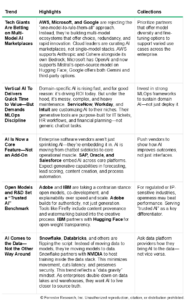
We can’t emphasize enough the importance of interconnected networks and ecosystems to the enterprise application software market. Industry cloud providers and hyperscalers possess several key advantages in nurturing and leading these innovation networks. So what does this acceleration of AI software and services on industry cloud and hyperscaler marketplaces mean? Well, it depends on the customer segment the providers are vying to attract. Enterprises are driven by strategic advantages, risk mitigation, maximizing the value derived from their AI investments, improving data locality, and reducing latency — all while prioritizing optimizing costs and operational performance. Independent software vendors (ISVs) are driven by a unique set of business and strategic goals that focus on building trust and meeting customer requirements while protecting their IP and mindshare. For regulated industries, because these ecosystems often involve third-party vendors and cloud platforms, the vetting of AI partners and solutions requires a heightened level of scrutiny. The desire for AI sovereignty is much stronger than a policy concern — it must comply with strict legal mandates and AI-specific legislation such as the EU AI Act; this is critical for national security and economic interests. They are driven by the control over key enablers of AI development, deployment, and the implications of global access and collaboration. What do all the stakeholders have to gain from enterprise software markets operating within these massive ecosystems? For Enterprises Increased accessibility to advanced AI capabilities. Enterprises gain easier access to a wide array of cutting-edge AI tools and services without the need for significant upfront investment in infrastructure or specialized AI expertise. Hyperscalers’ marketplaces offer pretrained models, machine learning platforms, and AI-powered services for various applications — all of which can be procured through committed cloud spend, cutting out vendor onboarding cycles. For example, a B2C company can readily access AI-powered recommendation engines on a hyperscaler marketplace to personalize customer experiences and increase sales after a “try before you buy” proves its value. Cost optimization. Pay-as-you-go (PAYG) pricing models can lead to cost savings compared to building and maintaining in-house AI infrastructure, but cloud migration efforts may still require upfront investments that can sometimes be offset or spread over time. Once you modernize with the cloud, enterprises can scale their AI usage based on actual needs and pace implementations that align with strategic priorities. Do beware, however, that mature governance is required to mitigate both buyer and provider challenges with the PAYG licensing model. If one software product isn’t paying off as expected, it’s easy enough to find an alternative on the marketplace and “recompose” your stack to adopt it. For ISVs Simplified go-to-market strategies. These marketplaces allow small ISVs to be part of integrated billing, procurement, logistics, and marketing tools, simplifying the way ISVs offer their AI-powered software and services to a wider audience, leveraging hyperscaler capabilities, and managing multiple listings across marketplaces. Highly scalable infrastructure capabilities. ISVs can build their solutions on top of highly scalable infrastructure, enhancing the performance and scalability of their offerings while focusing on their unique industry expertise. Faster innovation through integration. ISVs can integrate their AI solutions with other services available on the marketplaces, creating more comprehensive and valuable offerings for customers. This is quite valuable for the enterprise business application market. ISVs, this is your opportunity to leverage these marketplaces and ecosystems to develop AI models and create AI solutions that address these challenges — making your solutions a critical asset to organizations for deploying enterprise solutions at scale. For Regulated Industries Focus on specific industry needs. Industry clouds are tailored to meet the unique compliance, security, and operational requirements of regulated sectors such as government and healthcare, providing a trusted environment for deploying AI solutions. Ensuring ethics and AI sovereignty in government is a highly contentious and complex debate. New options continue to shape the landscape, but no one is dominating the headlines yet. Force much-needed attention to governance, transparency, and risk mitigation. Traditional enterprise business applications faced the “black box” problem even before AI’s unique challenges amplified the complexity of governance and risk mitigation. Users didn’t understand the internal workings of the software; debugging and problem resolution were challenging; and third-party libraries and closed-source components had limited visibility. While modern platform ecosystems expedite procurement and deployment, they inadvertently introduce complexities around data governance, model oversight, and IP protection. These accelerated networks are forcing organizations to move faster and enter the market with stronger governance. Additionally, strict contractual clauses around vendor accountability and breach notifications are crucial for meeting compliance requirements and holding the vendors accountable to those commitments. Maximize interoperability and data sharing (with safeguards). AI can facilitate secure and compliant data sharing and interoperability across different agencies or healthcare providers, leading to better insights and more coordinated services. Pay Attention To The Ecosystem Trends That Reshape The Business Landscape These trends present both opportunities and challenges that can significantly impact organizations’ strategies and long-term success.   Let’s Connect Continue the conversation with our analysts who focus on enterprise business applications, industry cloud, and hyperscalers: Faram Medhora, Kate Leggett, Akshara Naik Lopez, Joe Cicman, Tracy Woo, and Bill Martorelli. Relevant Research Thank you to the following analysts for contributing to this blog: Kate Leggett, Bill Martorelli, and Joe Cicman. source

Transforming Enterprise Business Apps With Powerful AI Ecosystems and Marketplaces Read More »

Ingenuity And Core Values Will Steady The Ship: Top Healthcare Provider Trends In 2025

Steering through a maelstrom of uncertainty and risk in a rapidly changing healthcare landscape requires resilient leaders who will adapt strategies centered on the human experience. Advancements in AI and the widespread availability of medical information are compelling US healthcare provider organizations (HPOs) to reassess how they engage with customers and employees. They are exploring creative ways to reposition themselves and demonstrate steadiness in an increasingly concentrated industry. To succeed, HPOs will achieve stability and remain relevant by leaning on core values. To help guide HPO leaders, our new report, The Seven Trends That Matter For US Healthcare Providers In 2025, explores the top seven trends for HPOs this year, including: Differentiation through content centers of excellence. With the proliferation of health-related misinformation, HPOs are positioning themselves as trusted sources by creating reliable educational content in diverse media formats. But to stand out, HPOs must tailor content to the unique needs of their patient populations and design for sustained patient engagement, leveraging data-driven storytelling and frequent updates. Culture initiatives that change how employees work. Despite their best intentions, many HPOs find that their culture initiatives fail to meaningfully impact operations and employee behavior, resulting in further disconnect between leaders and employees. HPOs must ensure that their leaders model the organization’s shared purpose, and they must institute rituals that reinforce employees’ roles in accomplishing this purpose and subsequent cultural expectations. The expansion of AI’s role on the front line. As AI becomes further integrated into everyday healthcare operations, its ability to streamline clinical workflows is becoming increasingly indispensable. On the other hand, the rise of AI in healthcare also calls for thorough governance, fairness, privacy, security, and accountability. HPOs must train — not penalize — employees on responsible AI use and adopt best practices now to mitigate risk and reap its benefits. Ready to chart your course? Schedule a guidance session now to discuss how your organization can seize these opportunities. Forrester clients can also read the companion report The Seven Trends That Matter For US Health Insurers In 2025 and watch our recent on-demand webinar that covers both perspectives. Not a client? Learn more about how you can have Forrester on your side and by your side. source

Ingenuity And Core Values Will Steady The Ship: Top Healthcare Provider Trends In 2025 Read More »

Leaders Need To Review Event Plans Amid Economic And Political Uncertainty

The political environment is impacting the appeal of US-based events for international attendees, with Tourism Economics, a subsidiary of Oxford Economics, predicting a 15.2% decline in inbound international travel due to a combination of shifts in pubic sentiment, travel advisories, and visa delays. At the same time, events focused on the US government sector are being challenged due to new approval processes and travel freezes. With announcements on tariffs likely to further increase the cost of running US-based events at a time when event budgets are flat or down for 69% of organizations, the current event environment is a complex and dynamic one for teams to navigate. Leaders Should Review And Adapt Event Plans While events continue to play a crucial role within the marketing mix, given the current uncertainty, leaders should adjust plans. They should start by taking these four actions: Review event plans and goals. Do the events you’ve planned still make sense? To what extent is an event dependent on international and/or government attendees? Are target audiences likely to be impacted by the current environment? Model the potential impact of these factors on likely attendance and consider whether you need to make changes, all the while ensuring that your events have SMART goals agreed with stakeholders. Scrutinize budgets. Are you still able to deliver the agreed plan in light of potential cost increases and/or reduced ticket revenue? Review how much spend is contractually committed and consider whether you need to cancel and/or scale back event activity. Reconsider your event mix. Does it make sense to switch some planned events to virtual and/or introduce a hybrid option for attendees unable or unwilling to travel? Teams made the pivot to alternate formats back in 2020, and ensuring that they’re able to quickly flex in the current environment makes sense. Focus on measurement. Have you agreed on performance metrics for your events with key stakeholders? With budgets and resources under strain, having clear goals and performance metrics set that enable you to understand event impact is more important than ever. To help leaders better understand the current environment, Forrester clients should register for the upcoming webinar on the future of B2B events, where we’ll be sharing key findings from Forrester’s Q1 2025 State Of B2B Events Survey. They should also take the B2B Event Maturity Assessment to help identify improvement areas. source

Leaders Need To Review Event Plans Amid Economic And Political Uncertainty Read More »