Forrester

Brands Take Cover: The Tariffs Have Hit The Fan

Markets And Consumers Are In Chaos Mode We’ve had a little time to chew on the sweeping tariff plans of “Liberation Day,” and if the markets are any indicator, it’s been tough to digest. The free-falling stock indices and the (even more than usual) crush of humanity at Costco with their cards piled high are all signs of skittish consumers and, by extension, worried businesses. Ergo, out of the blue, we teeter on the edge of a bear market. These tariffs are going to take a bite out of consumers’ household income — and the lower the income, the bigger the chunk (hence, tariffs work as a regressive tax). In response to this income hit and the continued fog of uncertainty about their future earnings, consumers have already begun to take several steps to manage the implications for their pocketbooks. Five Consumer Behaviors Here are five buying behaviors to look out for among your customers: Pantry-loading: People are stocking up because they know prices will rise. This is somewhat futile, however, as it’s not entirely clear which categories will be hit hardest (at least, the average consumer does not have the means to figure that out). More importantly, there isn’t a pantry large enough to accommodate years’ worth of trade policy chaos. Downscaling: People are purchasing less, completely skipping larger-ticket items, and opting for cheaper brands, including private labels. Promotion-hunting: Consumers are responding more eagerly to promotions, purchasing items on sale, and making real-time brand switches based on offers (such as digital deals on the grocery store app while pushing the cart down the tortilla chips aisle). Channel-shifting: Shoppers are flocking to purchase from less expensive retailers such as dollar stores, as well as from warehouse stores where buying in bulk is associated with better value (hence, the aforementioned crush of humanity at Costco). Self-servicing: Savvy consumers are relying on DIY, repairing things, and growing their vegetables (I kid you not: Numerous consumers told us this in our qualitative research!). What You Can Do To Manage The Chaos How should you react to this behavior and prepare your business and your brand? First, do the homework on your customer segments. Apply a financial resilience filter before you react in haste, because not every person and category will experience the economic effects in the same way, and a shotgun approach to giving away margins will unnecessarily deplete profits. Look before you leap — chances are that you will have to leap, but at least you will be going in the right direction. Look at any tactics through a growth framework. Use our five-lever approach — salience, product, price, experience, and access — to plan your strategy. This may take you down the road of initiatives such as shifting media dollars, changing products or pack architecture, or even providing new digital experiences with timely and relevant promotions. To better manage your brand and business through this period of uncertainty and shifting consumer behaviors, please read our report, Consumer Marketing, CX, And Digital Leaders: How To Thrive Through Volatility (US). If you are a Forrester client, stay tuned for additional research on how CMOs can better manage uncertainty and volatility. Go to my Forrester bio and click “Follow” to be notified. Also, as a client, you can schedule time with me for an inquiry or guidance session, or talk to your account team about workshops and strategy days on planning through uncertainty. source

Brands Take Cover: The Tariffs Have Hit The Fan Read More »

Financial Firms Offer Laid-Off Government Employees A Chance To … Spend More Money?!

As a former US federal employee, I’m a customer of two financial services companies that focus on current and former feds. Within the past couple of months — as millions of federal employees have been subject to on-again, off-again layoffs — these companies have emailed their customers with essentially the same message. It goes something like this: We know that in these uncertain times you’re worried about your finances. Our personal financial advisors can help you understand your finances and plan for the future. Unspoken, but obvious to everyone, is that you have to pay for this personal financial advice. So what these emails really offer is a chance for feds who may lose their jobs to spend more money! You may respond that this is how business works: Identify a need — such as financial stress — and offer a product to solve it. But there’s a better way, a way that builds longer-term customer loyalty, contributes more to business performance, and aligns more closely with these companies’ stated values — which I’ll paraphrase as things like “members first,” “service,” and “community.” This approach proved itself during the COVID-19 pandemic: Remove customer stress and offer benefits that align with the long-cultivated brand, instead of adding another expense and contradicting stated corporate values. For example, during the pandemic, companies in financial services helped customers with financial hardships by deferring loan and credit card payments, canceling various fees, and adding overdraft protection. Even better for financial services companies: Helping customers in these and other ways improves the uptake for additional paid services (like pricey personal financial advisors), as improving customer experience (CX) boosts customer loyalty in financial services and other industries. Has your company made a similar blunder, pitching an expensive upsell without first offering loyalty-building assistance to customers in need? It’s not too late to fix the problem. A few quick pieces of advice: Reaffirm your brand. It’s unlikely that market volatility affects any of your brand fundamentals. Hastily upending a well-determined brand strategy will only cause trouble once the volatility subsides. Instead, modulate your brand’s value proposition by considering all four possible types of value that your brand can provide: economic, functional, experiential, and symbolic. Recommit to CX fundamentals. Ensure that you use driver analysis for targeted CX improvements, qualitative research to plug key holes in customer understanding, data storytelling to drive action from insights, and cross-functional collaboration to ensure a journey-centric approach. Provide customers with consistent, on-brand experiences. Start by reaffirming your CX vision to ensure that it aligns with your business strategy. Use The Forrester CX Vision Development Template to speed your vision review. Balance customer and business needs to serve customers sustainably. Use an enterprisewide metrics framework to help maintain a long-term balance between the value for the customer and the business. It can also help you decide when to lean toward value to the customer in the short term, such as when people are losing their jobs. Want to talk in greater detail? Forrester clients can schedule a guidance session or contact their account team. source

Financial Firms Offer Laid-Off Government Employees A Chance To … Spend More Money?! Read More »

So There Won’t Be A Wiz IPO — What Does That Mean For Cyber IPOs In 2025?

Last week’s mega deal of Google acquiring CNAPP provider Wiz for $32 billion has some lamenting the future of IPOs in the cybersecurity space. Wiz was on a high growth trajectory, and given that Wiz had previously rebuffed Google’s interest in the summer of 2024, many assumed Wiz was on target for a 2025 IPO, the success of which was meant to serve as a bellwether for the overall health of the cybersecurity market. With Wiz no longer an IPO candidate, has momentum for cybersecurity IPOs stalled? In the short term, the answer is yes, but that is more to do with the health of the overall tech IPO market, not just cybersecurity. Genesys, a provider of AI-driven call center software, recently postponed its planned spring 2025 IPO, citing market uncertainty, with plans to revisit an IPO in the second half of 2025. And despite last year’s uneven macroeconomic environment, there were still over 220 IPOs in the US stock markets last year, up from 150 in 2023. While approximately 10% of the 2024 IPOs were of the SPAC (special-purpose acquisition company) variety, there were still several significant tech IPOs in 2024, including Reddit, OneStream, Ingram Micro, and ServiceTitan, to name a few. Rubrik’s April 2024 IPO also marked the first cybersecurity-related IPO in two years. While the cybersecurity IPO market may be muted right now, there are still several possible cybersecurity IPO candidates for 2025. While there is a lot of discussion on tariffs and the current market volatility hindering IPOs, indexes such as the Cboe’s VIX Index (which analyzes S&P 500 index options to derive a forward-looking projection of volatility) have not moved as much as the overall market indices. Some have suggested that this is because much of current volatility is derived from policy decisions (like tariffs), meaning they can be quickly reversed and are also not tied as directly to structural economic factors. Despite this current uncertainty, the resilience of the US stock market, and the fact that there are still several cybersecurity companies seeking a liquidity event, mean that cybersecurity IPOs could still happen in 2025, especially in the second half of the year. The current tech IPO bellwether is AI darling CoreWeave. Despite a tepid initial trading day, CoreWeave has since rebounded and its shares are up. This current (but by no means comprehensive) list of potential cybersecurity IPO candidates for the fall of 2025 can be put into two distinct categories: Category one: venture-backed, with $500 million or more in VC funding and high annual recurring revenue (ARR) growth of over 40% Netskope: In October 2024, Netskope CEO Sanjay Beri indicated plans to proceed with an IPO in the second half of 2025, depending on market conditions and investor appetite. Netskope has raised over $1 billion in venture capital, reported over $500 million in ARR, and competes in the high demand Zero Trust edge network security segment. While Netskope has not filed an S-1 form with the SEC yet, it is a vendor to watch in 2025 as a strong contender for an IPO. Snyk: Like Netskope, application security developer Snyk has raised over $1 billion in venture capital, hit $300 million in ARR last year, and is growing ARR 40% annually. While Snyk has not filed an S-1 with the SEC, it is long rumored to be an IPO candidate and fits the criteria for this category. Application security remains a high growth area. OneTrust: This privacy management company has raised over $1 billion and is exceeding $500 million in ARR. While the firm has been mum on any IPO plans, it meets the size, valuation, and growth metrics for an IPO. Armis has not reached the $500 million ARR milestone yet but is growing rapidly and has raised over $800 million in venture capital. According to Bloomberg, it is looking at 2026 for an IPO, so continued success and growth in 2025 will position the company for an IPO next year. Category two: established cybersecurity firm owned by private equity (PE) firms for two or more years and seeking exit This category already has a successful 2025 IPO: identity management and governance vendor SailPoint, which PE investor Thoma Bravo took public in February, raising $1.4 billion in the IPO at a $12 billion valuation. Some other IPO candidates in this category include: Proofpoint: Email and data security vendor Proofpoint was taken private by Thoma Bravo for $12 billion in 2021. Last fall, Proofpoint indicated plans to return to public markets within 12 to 18 months. Thoma Bravo has held Proofpoint for five years; this would be a good IPO candidate once market conditions improve. Illumio: Also owned by Thoma Bravo since 2021, Illumio has raised more than $500 million in funding, is growing fast, and had a $2 billion-plus valuation when acquired by Thoma Bravo. Illumio was a Leader in The Forrester Wave™: Microsegmentation Solutions, Q3 2024, last year and competes in the high-demand cloud security and Zero Trust segments. Delinea: Last week, the PE owner of privileged identity management vendor Delinea indicated that it’s considering IPO plans. TPG has owned Delinea since 2021 when it merged Thycotic and Centrify and renamed the new entity Delinea. With Delinea’s ARR at almost $400 million, it fits the criteria, especially if the PE owner is looking to exit this investment in 2025. While macroeconomic factors or geopolitical events could affect the public market’s appetite for tech IPOs, this post has hopefully shown that there are plenty of well-funded and capitalized cybersecurity companies capable of going public in the next 12 months based on market conditions. And seeing as all these companies are growing and investing in their product offerings, security professionals should view pending cybersecurity IPOs as a positive validation of the overall cybersecurity market and their supplier’s position within that market. source

So There Won’t Be A Wiz IPO — What Does That Mean For Cyber IPOs In 2025? Read More »

IoT, IIoT, IoMT, and OT – Welcome to acronym mania. What does it all mean?

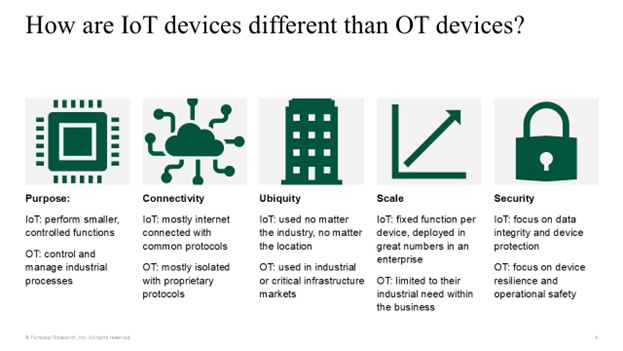
Across IT, acronyms come with the territory. Whether they’re classic ones (ENIAC, Electronic Numerical Integrator and Computer), just a tad more modern (VAX, Virtual Address eXtension), network-based (TCP/IP, Transmission Control Protocol/Internet Protocol; XNS, Xerox Network Systems), or cybersecurity-related (NGAV, next-gen antivirus; DLP, data loss prevention; IDS, intrusion detection system), the acronyms and the process of keeping up with them are endless. It doesn’t help that many IT vendors create new acronyms in an effort to stand out and make themselves feel special. In the world of autonomous endpoints, we are dealing with five primary acronyms. To clarify the meaning of these acronyms, here is some guidance and perspective. IoT: internet of things This is the broadest category, as there are a myriad of devices and technologies within it, both at home or as part of a business. Device types range from smart assistants, doorbell cameras, and fitness trackers to printers, security door locks, and warehouse label scanners. What ties these devices together is that they are designed to communicate and exchange internet data, with ‘I’ being the key letter in the acronym. IoT devices, such as sensors and actuators, are integrated into or attached to machines or assets and connected to the internet via a Wi-Fi connection or through cellular networks. The devices use cloud platforms to send and receive data to make informed decisions about the connected assets. IIoT: industrial internet of things A subset of the IoT category, these devices, as the name implies, are made for heavy work but are often larger than simple sensors or scanners. IIoT devices are usually focused on improving industrial processes, including predictive maintenance, asset tracking, quality monitoring, process optimization, supply chain visibility, and building management. The industrial aspect isn’t restrictive to just monitoring; it can also incorporate devices such as electric vehicle chargers or building management systems. The first ‘I’ is the differentiator in the acronym. OT: operational technology As the name implies, OT encompasses the hardware and software that controls the physical operation of industrial devices. Here is where we will find manufacturing, energy production and transmission, water treatment devices, or factory equipment. Connectivity is regularly restricted to private networks, but in recent years, OT has started to have external/internet connections. The focus is on the ‘O.’ To make matters worse, under OT, you also have industrial control system (ICS), supervisory control and data acquisition (SCADA), distributed control systems (DCS), and programmable logic controllers (PLC). There seems to be no end to OT-based acronyms. IoMT: internet of medical things As the ‘M’ implies, this subset of IoT revolves around devices used within the healthcare industry. These could be devices in a hospital, such as infusion pumps or smart medication dispensers, or outside devices like blood pressure monitors, CPAP machines, and pacemakers. But like IIoT, you also have devices that could be considered operational technology like MRI or X-ray machines, but it is generally accepted that IoMT, the ‘M’ for medical being the distinction, will incorporate both IoT and OT. M2M: machine to machine This entails technology that enables machines to interact via wireless or wired communication channels without human intervention. Devices connect and interact with each other to exchange information and perform actions without requiring an internet connection. M2M technology is often integrated into security, track and trace, automation, manufacturing, and facility management processes. IoT technology differs from M2M communication because IoT extends interactions to include cloud-based networks. Please note: We recognize that there are many other relevant IoT-related acronyms, which we will explore in an upcoming IoT report. A simplified version that takes these distinctions to just IoT and OT would be: IoT devices are those that you run inside your business. If these devices go offline, you may have some challenges, but your business can still function. OT devices are those that run your business. If these devices go offline, you’re not doing business. Like all analogies, there are exceptions that don’t fit. For instance, if your medical business relies on performing MRI scans and the MRI machine is offline, you can’t do business. A hospital can treat patients without IoT infusion pumps or Bluetooth pulse oximeter sensors, but it won’t be easy. And would you really want to run your industrial manufacturing tools without IoT noxious gas sensors? For a little more distinction, we could use this image below:   Device protection is important with IoT and OT, but the purpose is different. For IoT devices, the goal is to protect the data. For OT, the goal is maintaining operational safety. Because of this, the approaches to security for these technologies have historically been different. Until recently, many enterprises completely walled off their OT devices into their own air-gapped network, developing extensive human-action security policies to control the flow of data in and out of the network to ensure that these devices stayed operational and weren’t exposed to internal or external threats. Conversely, IoT devices were often interspersed throughout the enterprise with other endpoints. In more secure environments, network traffic to and from these devices is logically segmented and controlled to protect them against internet-based threats. Security in IoT and OT environments is currently changing. The walls between the OT devices and the rest of the network are becoming porous. Business leaders are still highly concerned about OT security, but the need for connectivity to IT and internet resources is growing. For IoT, simple segmentation is no longer sufficient because of the mounting threats. This is leading business and security leaders to deploy solutions to improve device security. New acronyms will continue to emerge (such as the confusing CPS, cyber physical security) as IoT and OT security solutions expand. I’m still dreading hearing about the first IoTDR solution. Vendors in this space need to stop throwing out word salad in an attempt to make something relevant and stick with established acronyms. If you’d like to get assistance in understanding the complexities of managing and securing IoT and OT devices, please schedule an inquiry or guidance session

IoT, IIoT, IoMT, and OT – Welcome to acronym mania. What does it all mean? Read More »

Translytical Databases Are Fueling Modern AI Apps

The growing demand for real-time data to power AI applications is compelling businesses to reevaluate their traditional data architectures. Legacy systems typically rely on separate platforms for transactional and analytical processing, leading to inefficiencies and delayed insights. Translytical databases are emerging as a critical solution, seamlessly integrating both transactional and analytical workloads into a single, unified platform enabling enterprises to support modern AI-driven applications such as conversational AI, chatbots for customer service, and real-time personalization. The continuous, consistent, real-time data from translytical databases drives the performance and accuracy of AI applications. Translytical Benefits Go Beyond Real-Time Data The rapid adoption of translytical databases is driven mainly by their ability to support broader AI use cases. As organizations increasingly seek to harness the full potential of AI, the need for such platforms will further grow. Several key advantages make translytical databases essential for powering these advanced AI-driven use cases: Real-time data for contextual accuracy. AI agents, large language models (LLMs), and retrieval-augmented generation (RAG) systems thrive on vast amounts of data, and their value is maximized when the data is current. Translytical databases provide access to real-time data, ensuring that AI systems receive the up-to-date context needed to generate accurate responses. This is critical in applications such as customer service chatbots, which require account or order information, and financial analysis tools, which need real-time market data and customer portfolios. Optimized data integration for AI. RAG systems frequently need to pull vast amounts of contextual data from multiple sources to improve content accuracy. Translytical databases streamline this by offering a unified platform that combines both transactional and analytical data. This integrated data view enables generative AI models, AI agents, and LLMs to generate more accurate response. Additionally, many translytical databases now incorporate vector capabilities, enhancing data retrieval for RAG applications by identifying similar data quickly. Centralized data governance to protect sensitive data. With growing concerns over data privacy and security in AI, translytical databases offer robust governance features that control data access and ensure compliance with regulatory standards. By consolidating transactional and analytical data into a single platform, these databases enable organizations to maintain stringent data security measures, protecting sensitive information and fostering trust. Seize The Translytical Advantage Now Translytical databases are transforming the way that businesses process and analyze data. As organizations strive to harness the full potential of AI, these databases have become crucial for success. To guide enterprises through this evolving landscape, Forrester published The Forrester Wave™: Translytical Data Platforms, Q4 2024, which evaluates the top 15 vendors in the translytical database market. This comprehensive analysis highlights the leading providers, offering valuable insights that can help select the most suitable provider. If your organization still uses separate systems for transactional and analytical workloads, now is the time to transition to a translytical database. This shift will help reduce issues with AI applications, such as hallucinations, by ensuring that your data is consistent, reliable, and accessible in real time. For more insights, book time with me via an inquiry or guidance session. source

Translytical Databases Are Fueling Modern AI Apps Read More »

TikTok Won’t Get Banned This Week

Shortly after the original TikTok ban deadline hit on January 19, President Trump declared an executive order that delayed enforcement of the ban by 75 days. The app went dark for a few hours but then came back online and is currently available in app stores for download. That extension expires in just a few days (on April 5), but it is highly unlikely that TikTok will go dark again. All signs point to a deal or another extension. TikTok Sans Its Algorithm Is A Downgrade If TikTok divests in the US, the real question is whether its algorithm comes with the sale. TikTok without its algorithm is like Harry Potter without his wand: simply not as powerful. TikTok operates on a content graph, not a social graph, which means it analyzes thousands of user signals to determine what content and creators the user will want to watch, making it hyper relevant and highly addictive. In fact, our data shows that 31% of US online adults consider TikTok to be addictive, more than any other social media platform. Last April, we asked TikTok users about a TikTok sale, and 54% said they would be concerned that, if TikTok was sold and run by a different company, it wouldn’t be as good of an experience as it is now. If the TikTok experience degrades, users, creators, and advertisers will spend more time and money on other media channels. TikTok’s “Replacement” Is Entertainment, Not Social Media Forrester ran a pulse check using its ConsumerVoices Market Research Online Community to ask 204 adult TikTok users about where they’d spend time if TikTok shut down. Most respondents said there is no good replacement social media app for TikTok. They said they would spend more time on the following channels if TikTok shuts down again: 51% on YouTube 41% on TV 33% on Instagram Note: This poll was administered to a random sample of online consumers in the US, the UK, and Canada in Forrester’s qualitative ConsumerVoices online community. This data is not weighted to be representative of total country populations. Instagram Reels arguably has the most comparable experience to TikTok, so it’s telling that television and YouTube are ranked higher. It means that the swap for TikTok is about finding the next best place for entertainment, not social networking. This consumer perspective matches what we’re hearing from advertisers. Digital video (including YouTube), not social media channels, is the top media channel that B2C marketing executives will shift marketing dollars to if TikTok shuts down again. Advertisers Aren’t Running Away Just Yet In our Q1 2025 CMO Pulse Survey, we asked B2C marketing executives about their TikTok investment, and nearly half said they invested media and/or influencer marketing dollars on TikTok in 2024. Ninety-four percent of those marketers say they still plan on investing in 2025 if it continues to operate in the US. In fact, major media spenders such as Amazon, Walmart, and Coca-Cola reportedly increased their US spend on TikTok despite the uncertainty. Marketers: You should still get ready to shift investments into other entertainment platforms if the TikTok experience degrades under new ownership. Forrester clients: Schedule a Forrester guidance session to talk about your TikTok and creator strategy. source

TikTok Won’t Get Banned This Week Read More »

Four Key EUC Trends From IGEL’s Now & Next 2025 Event

Last week, I had the pleasure of attending IGEL’s end-user computing (EUC) flagship event: Now & Next 2025. Hosted in Miami, Florida, the event is one of the biggest events for EUC professionals and vendors. It’s rare to get so many EUC professionals in one place all singularly focused on this unique market, which is often an afterthought in the larger tech conferences. First, a little bit about IGEL: If you’re not familiar with the company, it offers a Linux-based operating system that’s traditionally used in thin client scenarios. IGEL touts the following benefits: ease of management, strong security, and low total cost of ownership. While IGEL exited the thin-client hardware business in 2022, it is now heavily focused on IGEL OS, its Universal Management Suite, a dedicated app portal, and its USB-based OS launcher called UD Pocket. According to IGEL leadership, the company is growing its annual recurring revenue above 45%. Like many EUC vendors, its growth was accelerated during the pandemic and has slowed since, but today’s growth still outpaces most of the EUC market. And yet our research indicates that Linux adoption hovers in the low single digits, the lowest of all operating systems, revealing that the market for this model is still immature. So what were the hot topics of the event? And what should you do as an IT professional to prepare? 1) Business continuity is increasingly an EUC purchase driver. Virtual desktop infrastructure (VDI) systems have served as a backup business continuity tool for EUC professionals for years, but IT leaders are increasingly seeking to diversify their endpoint OS estate and reduce their reliance on a single vendor, especially after the CrowdStrike event last summer. IGEL OS is highly associated with thin clients and VDI, but there are examples of companies using it as an alternative device for lightweight knowledge-worker use cases. What it means: Revisit your EUC continuity strategy and consider a broad swath of approaches, such as IGEL, MacOS, ChromeOS, virtual Windows, and other Linux options, that are aligned with company goals and initiatives. 2) The browser is a new endpoint. The rise of software as a service, progressive web apps, and WebAssembly is whittling away at the thick client install base. Mark Templeton, former CEO of Citrix, took the stage at the event and shared a forecast showing that a vast majority of enterprise apps will be OS-agnostic (i.e., not native) by 2030. Forrester sees a similar trend: 49% of the nearly 5,000 respondents in our Workforce Survey, 2023, said that they can accomplish all of their work within a browser — and that was two years ago! What it means: Browser management will become more important for EUC admins going forward. That’s especially true for securing generative AI systems that are frequently accessed through the browser. Take an inventory of your existing protections today. 3) Data-driven insights are the future of EUC. Everyone talks a big game around AI, but none of that opportunity is real without telemetry. Most insights conversation today center around digital employee experience (DEX), and vendors such as ControlUp already collect telemetry for IGEL-based environments. Insights capabilities will expand beyond DEX in the future to help inform Zero Trust environments. For example, IGEL Field CTO John Walsh detailed IGEL’s plans to expand its management capabilities to take advantage of partner integrations to better enable a contextual and continuous approach to Zero Trust. What it means: IT leaders can no longer fly blindly in their EUC environment. Inventory your existing data sources now, identify gaps, and plan for integration into a unified platform. 4) OT and IT convergence is increasingly in the spotlight. According to our research, nearly 25% percent of the OS footprint in the enterprise is still running legacy versions of Windows, and many devices will not be compatible with Windows 11 come October 2025. This includes both end user and OT devices. IGEL announced its new IGEL Managed Hypervisor, which enables IT to run legacy operating systems on new devices, whether they are laptops, ATMs, MRIs, or manufacturing machines. Previous efforts to support OT environments have had mixed success, but many vendors are targeting this space. What it means: EUC leaders will likely play a greater role in supporting OT environments — especially when it comes to supporting legacy Windows and new devices such as augmented and virtual reality devices — but collaboration is key. Meet with your OT peers today to discuss how you can help. Could you benefit? It depends on your organization’s goals. The IGEL Now & Next event revealed multiple opportunities for IT leaders to rethink how they deliver, manage, and secure end user computing environments. The question is: Could your IT organization benefit? Consider the following: IGEL OS offers management, security, and cost benefits, but it’s a new management and security model, likely requiring some admin upskilling. Of course, this is easier if you can manage this environment with existing toolsets, which IGEL supports. If your goals are management simplification and Zero Trust EUC, it’s worth taking a look. This is especially true for healthcare, manufacturing, retail, and financial contexts. Knowledge worker demand for Linux is unlikely to drive adoption, though Linux fanatics in IT certainly exist. Change management must remain a top consideration as users contend with an unfamiliar user interface, especially when used natively. If your organization is making a strategic move to embrace certain types of operating systems (e.g., MacBooks), this type of model may not be a good fit. Today, IGEL OS runs on any x86-64 architecture and has partnerships with OEMs such as HP, Lenovo, and LG. These partnerships enable customers to preinstall IGEL OS and speed deployment.  What do you think of the future of end-user computing? Will approaches like IGEL’s play a larger role in your organization? Why or why not? If you’re a Forrester client and would like to discuss your EUC strategy with me directly, please reach out to [email protected]. EUC vendors are always welcome to set up a

Four Key EUC Trends From IGEL’s Now & Next 2025 Event Read More »

Intel Vision 2025 Event: An Iconic American Semiconductor Tech Titan

An Iconic American Technology Firm Looks To Reshape Its Destiny, But Can It Deliver? Alvin Nguyen, Sr Analyst | Hewlett Packard Alum JT Thykattil, VP Research Director |  Google Alum What We Expected After the announcement of Intel’s new CEO Lip-Bu Tan and the decision to keep both Products and Foundry businesses, Forrester went to Intel Vision 2025 looking for more details about the company’s turnaround plan. Specifically, we wanted to see: Lip-Bu Tan’s ability to clearly and persuasively communicate a holistic direction for Intel after the abrupt departure of Pat Gelsinger. How the company plans on addressing the data center market after losing market share to AMD. What progress has been made with the Foundry business in terms of customers and capacity. The impact on Intel employees. Intel’s messages to investors, customers, and partners. Any new or modified pivots coming out of Intel’s recent Public Sector Summit (IPSS) in March, which emphasized a “return to silicon” with more system-on-chip capabilities and a clear optimism as espoused by David Zinsner (CFO and interim CEO) and Cristoph Schell (CCO). During that recent IPSS event, there was also mention of keeping manufacturing in the US. The messaging from Intel’s core senior leadership, including leaders in data center, AI, cloud, sales, engineering, and product.   What We Got What we heard from Lip-Bu Tan’s keynote was an admission of some deep-rooted issues at Intel that he intends to correct. He specifically highlighted: Loss of talent. Lack of innovation. Lack of customer focus.   Figure 1: Lip-Bu Tan (left) and Karin Eibschitz Segal, interim general manager of the data center and AI (DCAI) group at Intel (right), speak at the main-stage presentation during Intel’s products update and go-to-market event at Intel Vision 2025 in Las Vegas. (Credit: Intel Corporation) It is clear the new CEO sees these issues as related and that he needs to change the culture at Intel to solve them. Lip-Bu Tan then explained why he is the right person for this job, discussing: His experience with the semiconductor market as a venture capitalist and as CEO of Cadence. His time on the Intel board. His focus on customer experience. His intention to see this change through. This ties in with the additional points he made in the keynote, that: Intel needs “brutal” feedback to help the company become more engaged with its customers. Intel is behind in AI and needs to develop a competitive system. Intel will empower engineers to drive innovation, which will help to attract and retain the talent it needs. Intel will leverage its ISV partners and x86 application ecosystem as an advantage. This was a measured, understated speech, very different than the showmanship that we see and expect from others, such as NVIDIA’s Jensen Huang or Lip-Bu Tan’s predecessor, Pat Gelsinger. Gone are the on-stage demonstrations from last year and the hype around a bullish new strategy. This was a look at a company laid bare, acknowledging its faults and promising that it will do better. Fortunately for Intel, it has a strong bench of senior leaders, including David Zinsner (CFO), Christoph Schell (CCO), Karin Eibschitz Segal (GM, DCAI), Michelle Johnston Holthaus (CEO of Intel products), and Kevin O’Buckley (GM Foundry Services). The sense of optimism we heard at the Public Sector Summit in March continued to resonate in April as well. Lip-Bu Tan has a strong bench, one that arms him well. Lip-Bu Tan himself during his keynote came across as authentic, but the expectations surrounding his keynote were not going to be satisfied unless he provided answers for everyone, from investors to employees to customers to partners. His coverage of the fundamental corporate issues and promise to address them lacks the details needed to satisfy the different audiences. After two weeks in the CEO role, is this fair? No, but becoming the leader of Intel or really any tech firm that wants to stay relevant and drive investor confidence requires being comfortable with unreasonable expectations. Does Lip-Bu have that certain swagger to be bold and drive innovation for this very iconic American and global semiconductor blue-chip titan? What Else We Got: A Beautiful And Well-Crafted In-Person Experience In addition to the explicit content and conversations, we wanted to share what we saw and perhaps the signal to the open market as leading technology firms continue to invest in in-person experiences. Intel Vision held at the Virgin Hotel in Las Vegas, NV, USA: Intel’s event effectively took over this “off-strip” site with a well-organized event, while allowing for peer networking and social experiences As a precursor to Vision, the Public Sector Summit in Washington, DC, USA was held at the DC Wharf. Attendees appreciated a very boutique experience and the attention to detail of the experiential side of this event. Keynotes: Core ELT @ Intel as well as customer and partner leaders presented with energy and optimism. Breakout sessions allowed for interactive capabilities, including Jason McGee (GM public cloud platform, IBM), Anil Nanduri (VP and GM, DCAI sales), and Steven Huels (VP of AI engineering). The exhibitor experience area provided demos of key technologies. Executive and leadership 1-on-1s and small group sessions were available, including with Rakesh Mehrotra (VP, GM DCAI strategy and product). Social gatherings enabled customers to speak with each other as well as with Intel and partners, meet informally, and share candid expectations and experiences.   What Tech Leaders Need To Do The impact of what Intel does cannot be understated: It is a historic and significant technology company with tremendous influence on global enterprises. The new CEO plans to change the culture of Intel to attract and retain more talent, to be more innovative, and to be more customer focused. This is not something that will happen overnight. Tech leaders need to take Lip-Bu Tan on his offer — provide Intel with the brutal truth so it becomes better. Tech leaders also need to watch Intel closely to see if and when it is able to turn around the company and

Intel Vision 2025 Event: An Iconic American Semiconductor Tech Titan Read More »

The Augmented Architect: Real-Time Enterprise Architecture in the Age of AI

  Enterprise architecture (EA) has always aimed for clarity, control, and coherence. Yet its practitioners are often thwarted by an overwhelming paradox: They must guide the evolution of vast, dynamic enterprises using tools and processes that are static, fragmented, and slow. The EA repository, intended as the source of truth, devolves into a dusty attic of outdated diagrams and deliverables. Architects are stretched thin, trying to make sense of sprawling portfolios with limited visibility and time. “Data calls” are a weekly chore for both architects and stakeholders. Architecture review boards — meant to ensure alignment — are seen as bureaucratic bottlenecks. But what if the EA function was no longer confined to episodic review and disconnected models? What if it operated in real time, continuously enriched by machine-readable data and supported by intelligent agents that advise, validate, and even act? This is not speculative fiction. It is the emerging reality — a direct consequence of what we have called the sleeping giant waking up: the operationalization of architecture via closed feedback loops, AI agents, large language models (LLMs), retrieval-augmented generation, vector databases, and dynamic graph-based systems. The Feedback Loop Strikes Back Traditional EA processes are largely open-loop. A proposal is submitted, reviewed days or weeks later, deliberated in committee, and eventually approved — often based on stale information. By then, the initiative may have pivoted or the environment may have changed. Now imagine a closed-loop learning architecture system: Every update from a continuous integration/continuous delivery pipeline, every change in a cloud API, every deviation from policy becomes a signal. These signals are fed into a living architecture graph that reflects the true current state of the enterprise. Agents ingest these signals and perform continuous analysis: Harvesting agents monitor the digital signals of the enterprise, extracting knowledge into the information stores. Dependency agents are a specialization of those, mapping the digital estate’s interconnections and analyzing both automated data such as traces as well as architectural and unstructured information that may provide essential insights into higher-order, logical dependencies that are very real yet are not readily discoverable at a technical level. Lifecycle-aware agents flag aging technologies, enabling technical debt diagnosis. Conformance agents validate proposals against approved tech stacks, standards, and design patterns. Security and cost agents trace implications across risk, compliance, and spend. Architects are notified — not weeks after the fact but during or even before decision points. The result is a form of continuous architecture governance — high-velocity, high-confidence, and fully traceable, supporting outcome-driven and valuable EA as never before. AI As Architecture Sidekick AI augments the architect by continuously updating the repository to expose only fresh data. That means no more digging through stale wikis or emailing 10 teams for basic system lifecycle info. Instead: Intelligent recommenders augment architecture artifacts with context, rationale, and even business continuity considerations. Diagram recognition agents convert scanned or even hand-drawn schematics into structured model elements. Pattern recognition agents detect anti-patterns and optimization opportunities. Chatbots enable non-architects to interact with the repository, democratizing architecture insight. Generative agents propose transition roadmaps between current and target states based on actual feasibility, not just aspirational models. This is not just automation — it’s augmentation. Architects remain in the loop, but the loop is smaller, faster, and smarter. Solving The Classics — Finally Let’s revisit the perennial problems of enterprise architecture — and how real-time AI-augmented EA addresses them: Insufficient knowledge No human can know everything about a modern digital enterprise. AI doesn’t pretend to either — but it remembers everything and brings the right detail to the fore at the right time. Think of it as a cognitive prosthetic for the architect: surfacing precedents, warnings, and rationale at the point of decision. Insufficient visibility Visibility isn’t just about having access to data — it’s about trust in its freshness. Real-time integration with operational sources (observability platforms, configuration systems, source control, deployment records) ensures that the architecture graph is never out of date. The haystack becomes a needle-sorter. Fragmented deliverables Architecture artifacts multiply: PowerPoints, spreadsheets, PDFs, whiteboards. But in an agentic system, everything is rendered on demand from the same graph (and its associated unstructured content, linked via vector embeddings). Want a heatmap of system risks? A regulatory trace? A roadmap to sunset legacy? One prompt, one view — consistent, explainable, and composable. And those unstructured artifacts? An agent is happy to harvest new insights from them back into the knowledge store. Slow review cycles Review boards become decision accelerators instead of speed bumps. Agents pre-check submissions. Exceptions, not compliance, become the focus. Draft decisions are generated and validated before the meeting even starts. Architecture decision records are automatically created and updated, then immediately operationalized in the agentic memories. Ivory tower perception Abstractions are replaced with outcomes. Architects can show how a proposed change impacts a real customer journey, service-level agreement, or unit cost. The role regains relevance — no longer distant but embedded and explanatory. Architect As Prompt Engineer Much like GitHub Copilot transformed software engineering — improving productivity and satisfaction even in large-scale settings such as ANZ Bank — architects will increasingly work alongside copilots of their own. They will define acceptable patterns and reference architectures as they have always done but with the support of LLMs to provide comprehensive, grounded feedback. They will curate the architecture graph, tasking agents with updates and corrections, even large-scale schema refactorings and migrations. (This is not mere speculation. Charlie has had Claude perform complex and error-prone refactorings on his personal graph that would have taken a skilled database administrator hours). They will design guardrails and feedback loops. They ask “What are the safe ways to evolve this system?” and let the agent generate alternatives within constraints. The architect becomes a curator, facilitator, and, most importantly, a critical thinker in a system where AI can propose but should not dictate. As Stephane notes, “Every architect exposed to AI must be trained in critical thinking. There are no more Leonardos — but there is now AI.” The Architecture Operating System

The Augmented Architect: Real-Time Enterprise Architecture in the Age of AI Read More »

Investing For Impact: The Power Of Clinical Intelligence

Healthcare organizations (HCOs) are investing heavily in technology, but these investments alone won’t optimize clinical workflows or enhance customer experiences.   The missing element: clinical intelligence.   When infused into workflows, healthcare delivery, and management, clinical intelligence optimizes both customer and employee experiences and enhances outcomes. In a future state, Intelligent Healthcare Organizations (IHOs) will evolve into digitally sophisticated entities. This advancement will enable smooth collaboration, straightforward navigation, and the adoption of strategies focused on delivering value, all powered by clinical intelligence that enhances interactions and decision-making. But reaching this future state won’t be easy. It will require an enterprise-wide cultural shift in how HCOs consume and utilize data to reshape workflows and improve experiences. Some of the hallmarks of IHOs are:  Connected and validated clinical workflows. IHOs will train powerful AI models on patient data. They will use a federated data network, one that collaborates among multiple HCOs, and continuously updates clinical applications, enabling accurate and validated workflows.  Automated clinical safety interventions. IHOs will enhance clinical safety, using ambient technology and robots to automate patient interventions with computer vision, motion sensors, and location intelligence. These technologies monitor environments and patient responses, often acting without human prompting, to ensure higher quality and safety.  Digital identities and verifiable credentials. Identity management in IHOs will ensure secure identification for all entities including humans, devices, APIs, and AI agents. Effective management of digital identities is essential for preserving data integrity and security. By implementing digital identity verification and using verifiable credentials, IHOs will give access to sensitive information only to authorized entities.  Investing in technology and achieving optimal impact from it are different challenges. The evolving needs of the healthcare industry demand that organizations organize their data. Ensuring data readiness requires a thorough and systematic approach. HCOs that fail to manage their data effectively will fall behind and miss out on the benefits of infusing clinical intelligence and becoming an IHO.  Our new report Clinical Intelligence Will Power The Intelligent Healthcare Organization provides a complete list of IHO hallmarks and the key steps to becoming an IHO. Please schedule a guidance session to learn more.   source

Investing For Impact: The Power Of Clinical Intelligence Read More »