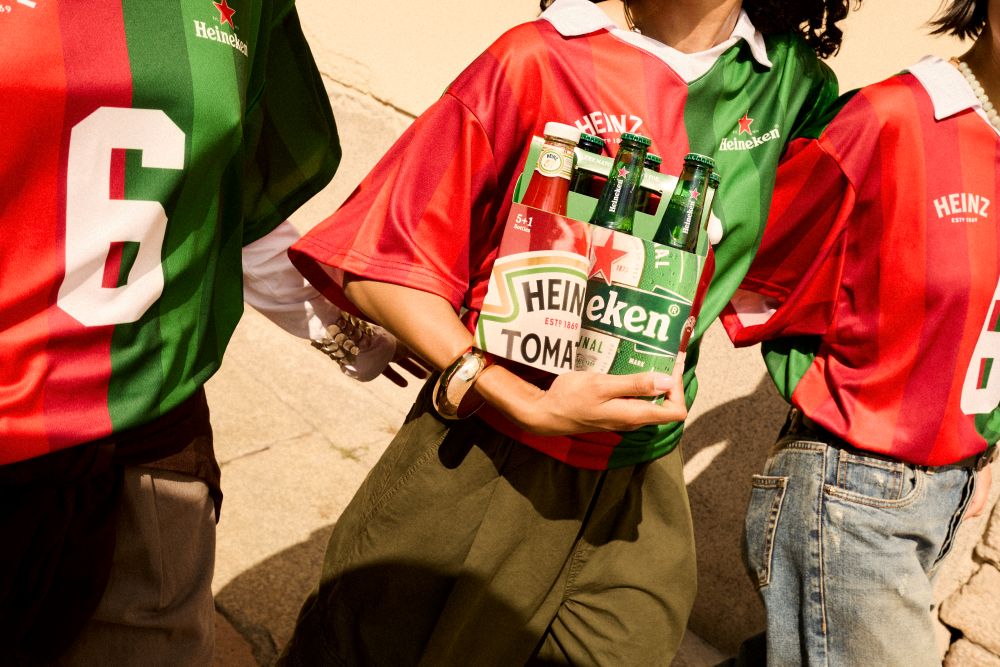
At first glance, a six-pack containing five Heineken beers and one bottle of HEINZ tomato ketchup looks like a punchline. But in a food and beverage landscape increasingly shaped by unlikely brand pairings, limited-edition drops and social-first activations, that is precisely what makes it work.
The newly launched HEINZ x Heineken six-pack brings together two brands from very different categories: beer and condiments. Yet both have spent more than 150 years appearing in the same social moments, from dinner tables and gatherings to events, summer occasions and casual get-togethers.
For Heineken, the collaboration was not about creating a new consumer behaviour. It was about recognising one that had already been happening.
Don’t miss: Heineken wraps global agency review in bid for scale and consistency
“Heinz and Heineken have been showing up in the same social moments for more than 150 years, just never officially until now,” said Dana Katz, director, integrated communications, Heineken. So rather than inventing a new behaviour, this collaboration simply recognises something people have already experienced for decades.
“The idea felt less like creating something new, and more like spotting something that had already been hiding in plain sight, even down to the names themselves,” Katz added.
That “hiding in plain sight” quality is central to the idea.
The collaboration is unexpected enough to make consumers look twice, but familiar enough to make sense almost immediately. Beer and ketchup may not belong to the same product category, but they often belong to the same occasion next to burgers, fries, grills, match-day spreads and relaxed social gatherings.
As such, HEINZ x Heineken is not asking consumers to imagine a new ritual. It is formalising a pairing many may already recognise instinctively.

A familiar surprise
The launch reflects a broader pattern in food and beverage marketing, where major brands are using collaborations to create cultural moments rather than simply introduce new products.
In 2024, OREO and Coca-Cola teamed up to launch limited-edition products that blended both brand worlds: an OREO Coca-Cola sandwich cookie and a Coca-Cola OREO zero sugar limited-edition drink.
During the time of the stunt, industry observers told MARKETING-INTERACTIVE that the strength of the partnership came from the equal weight and familiarity of both brands.
The same “familiar surprise” logic applies to HEINZ and Heineken.
The combination is surprising at category level, but familiar at occasion level. Consumers do not need a lengthy explanation for why the two might appear together and are likely to have seen both brands side by side before.
That is where the collaboration gains credibility. The brands are not creating a hybrid beer-ketchup flavour or asking either product to become something it is not. Heineken remains beer. HEINZ remains ketchup. The creative leap lies in placing both inside one limited-edition pack.
“The objective is to celebrate an existing connection between two iconic brands and turn it into something people can recognise, share and talk about. Ultimately, it’s about putting consumer insight at the heart of everything we do, not taking ourselves too seriously and reinforcing cultural relevance,” she explained.
Creating FOMO
Its scarcity is part of the mechanism. A strictly limited run gives the collaboration collectability, while the unexpected pack composition gives people a reason to pause. In a category where attention is hard to earn, the visual oddity of five beers and one ketchup bottle does much of the work.
The brand logic rests on the overlap between two complementary consumption worlds. Heineken does not need to become a food brand, and HEINZ does not need to become a drinks brand. Instead, both brands occupy the same cultural territory: informal, social, food-led occasions where people are already reaching for both.
“Heinz was the natural partner because both brands already play a role in the same kinds of moments. Heineken is rooted in quality socialising and bringing people together, while Heinz has a long-standing association with the food moments that sit alongside those occasions,” said Katz.
“The common ground is simple: quality, familiarity, and being part of moments people genuinely enjoy made the collaboration feel less like a partnership, and more like a recognition,” she added.
That idea of recognition gives the campaign its emotional logic. It is not asking consumers to buy into a contrived new occasion. It is pointing to a familiar one and giving it a branded expression. That said, the danger with any unlikely collaboration is that it becomes strange for strangeness’ sake. In recent years, brands across categories have leaned heavily into novelty, but not every unexpected pairing has a strong enough consumer truth beneath it.
For this collaboration, Heineken and Heinz chose a balance of being playful enough to earn attention, but grounded enough to avoid feeling random or gimmicky. The collaboration does not ask consumers to drink ketchup-flavoured beer or use beer-flavoured ketchup. Instead, it keeps both brands intact and places them together in a format that mirrors how they already coexist in social life.
“There is a playful, tongue-in-cheek side to it, but the foundation is very real,” said Katz, adding that:
The idea doesn’t invent a new behaviour or force a new product. It simply acknowledges something that’s already happening.
From first sips to shared tables

The collaboration also sits within Heineken’s broader push to turn everyday social rituals into branded experiences.
In Singapore this year, the brand launched “First sip house”, a three-storey pop-up on Keong Saik Road designed to get CBD workers to rethink the moment they clock out. Running from 7 to 16 May 2026, the activation positioned itself as an afterwork destination where the first sip sets the tone for the night. The format also gave the brand a more immersive way to express its pure malt, premium quality positioning.
Heineken has also been experimenting with city-based and music-led experiential formats in other markets. In Seoul, the brand rolled out “Rooftop revival”, transforming unused urban rooftops into social hubs to address what it called the “proximity paradox” of city life, where people live close together but still feel disconnected.
Across these campaigns, a pattern emerges. Heineken has repeatedly used unexpected formats to reinforce its role as a social connector, whether through afterwork drinks, rooftops, music discovery or now, a shared table with HEINZ.
While details of the HEINZ x Heineken rollout across APAC are still limited, Heineken is keeping the door open on local plans. In a category where brands are constantly searching for new ways to create relevance, the partnership shows that sometimes the most effective ideas are not entirely new. They are the familiar ones hiding in plain sight.
Related articles:
Heineken Singapore hijacks CBD office elevator in new stunt
Heineken unites football, F1 and music under new sponsorship platform
Heinz makes Christmas wait in first regional ‘Heinz season’ campaign