Forrester

The 2025 NRF Innovators: 50 Tech Solutions Solving Retail Problems

As retailers grapple with challenges from complex supply chains to skyrocketing return costs, staying ahead requires bold innovation and smart partnerships. Our new report, The 2025 NRF Innovators: Retail-Focused Tech Companies To Watch, produced in partnership with the National Retail Federation (NRF) Innovation Advisory Committee, is an overview of 50 companies tackling those very challenges. These companies are exhibiting as part of the 2025 NRF Big Show Innovators Showcase this coming week. Who are the 2025 NRF Innovators, and how are they chosen? The NRF Innovation Advisory Committee (IAC), a group of over 20 industry leaders, venture capitalists, and technology accelerators (of which Forrester is a member), selected and invited the companies as participants of the 2025 NRF Innovators Showcase. The IAC evaluates companies based on four key criteria: Problem relevance. Does the technology solve a critical issue for retailers? Significance. How widespread and impactful is the challenge that is being addressed? Product-to-market fit. Has the solution proven its value through partnerships and pilots? Scalability. Is the company ready to deliver at scale across the industry? What are some of the retail challenges that these companies tackle? Retail contributes $5 trillion annually to the US economy and employs over 50 million people, yet the industry faces several hurdles: Complex supply chains. Rising costs and global trade shifts are disrupting the flow of goods, leading to a need for more agile and efficient solutions. In-store challenges. With over 70% of retail sales still happening in physical stores, retailers must balance operational efficiency with delivering engaging customer experiences. High customer expectations. Shoppers now expect seamless, personalized interactions across all channels and touchpoints. Costly reverse logistics. Managing returns, which cost retailers nearly $890 billion annually, remains a significant strain on profitability. This report showcases technologies addressing these challenges head on, offering a roadmap for resilient and profitable retail operations in four areas (see the full list of 2025 NRF Innovators in the table below): Revolutionizing supply chains. Streamlined supply chains are nonnegotiable for modern retailers. Companies in this group are transforming supplier collaboration, simplifying global sourcing, and accelerating supply chain communication with rapid electronic data interchange onboarding, among other areas. Transforming in-store operations. Physical stores remain the retail backbone, but they need smarter tools. Innovations such as smart carts and enhanced security systems enhance operational efficiency and customer engagement. These technologies bridge the gap between digital and physical retail spaces. Personalizing customer engagement. Personalization drives customer loyalty and sales. Tools like content creation and management solutions, shoppable video content, and digital display insights, among others, enable personalized experiences, both online and in the store. Streamlining payments and returns. Efficient payment and return processes are key to profitability. Think solutions such as optimizing reverse logistics, minimizing payment declines, integrating payment methods, and enhancing last-mile delivery. If you’re at the NRF Big Show, do stop by the 2025 NRF Innovators Showcase in the River Pavilion at the Javits Center from January 12 to 14 to meet these companies. NRF members and Forrester clients can download the report from their respective websites to see more detailed descriptions of each of these companies. The 2025 NRF Innovators source

The 2025 NRF Innovators: 50 Tech Solutions Solving Retail Problems Read More »
Modernize Marketing With CRM Marketing Services

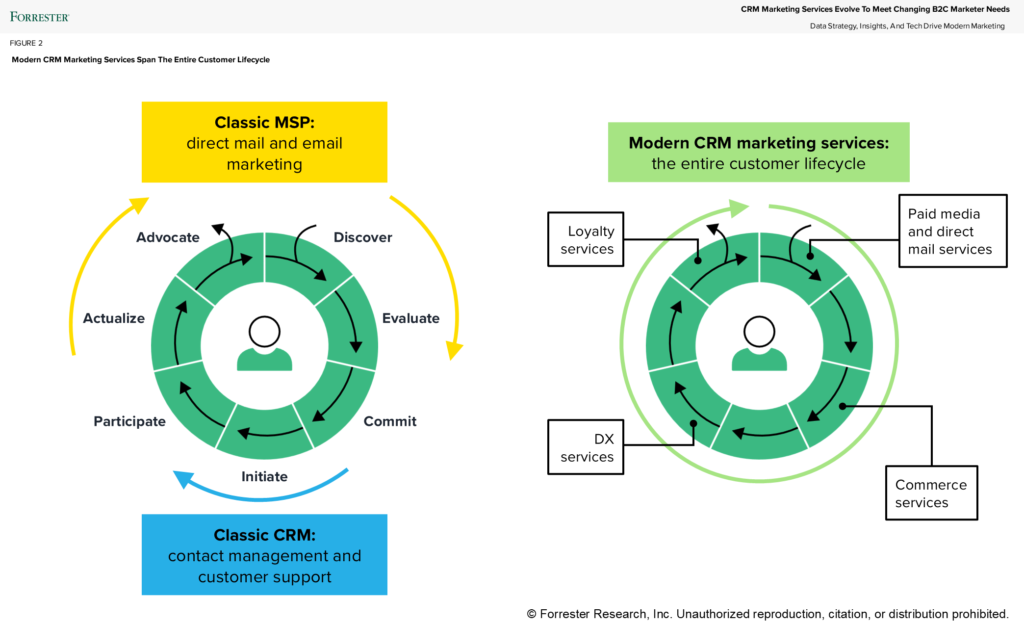
From marketing service provider to CRM marketing services … what’s in a name? An evolution and some confusion. More agencies are going to market with “CRM services,” which also spans Salesforce consulting partners to contact-center outsourcers. My new report, CRM Marketing Services Evolve To Meet Changing B2C Marketer Needs, examines what CRM marketing services entail — data, insights, and technology — and what marketers need to know. Not Your Mother’s MSP Think of CRM marketing services as an evolution of marketing service providers (MSPs). MSPs used third-party data partners and/or proprietary data to build propensity models and audiences for direct mail campaigns, driving retention and engagement through email marketing. Modern CRM marketing services take these legacy capabilities to a new level by crossing the entire customer lifecycle. Rather than a focus on acquisition and retention, CRM marketing services have also built or acquired new capabilities such as commerce services and digital experience delivery. As a result, they can address every stage of the customer lifecycle:   CRM marketing services offer an intriguing solution to address challenges that have nagged B2C marketers for years: how to meaningfully tie customer data to marketing activation. To succeed, marketers need to examine how they’re defining CRM, which will directly impact the scope of CRM marketing services. Think about the customer data flows, channels, and technologies that need to work together to deliver data-driven marketing; chances are that they’re much broader than one tool. And given the breadth of services under the CRM marketing services umbrella, this may even include paid media and loyalty program management. Check out the new report here: CRM Marketing Services Evolve To Meet Changing B2C Marketer Needs. Set up a guidance session to understand how CRM can help meet your marketing goals, and stay tuned for a landscape report coming later this year. source

Modernize Marketing With CRM Marketing Services Read More »

Key Insights From The Forrester Experience Optimization Solutions Wave, Q4 2024

Not long ago, we predicted that 2025 would be another year of customer experience (CX) mediocrity, but this rather gloomy outlook also provides an opportunity for bold leaders to buck the trend. Many will aim to do so by doubling down on digital experiences. According to Forrester’s Priorities Survey, 2024, adding or improving digital experience is the top action that business and technology professionals who indicated that improving the experience of their customers is a priority for their organization are taking to improve CX. Experience optimization (EO) solutions enable you to do exactly this: They help improve digital experience in real time by collecting and ingesting data, analyzing data to generate insights, and ideating and delivering thousands of different personalized digital experiences. Forrester defines EO solutions as: Solutions that enable the ongoing delivery of relevant, timely, and optimized digital experiences to meet evolving customer needs by leveraging cross-channel customer interactions. EO Solutions Support A Variety Of Use Cases That Win, Serve, And Retain Customers By helping digital teams understand and meet customers’ unique and evolving needs, EO solutions help their organizations win, serve, and retain customers. They also support a broad range of different use cases. The core use cases enabled by EO solutions are experimentation; next-best product, offer, or action; next-best experience; and experimentation with recommendations or personalization. Extended use cases focus on customer audience and segments, user experience/product/customer behavior understanding, cross-channel optimization, automatic optimization opportunities discovery, customer feedback and experimentation, and feature experimentation. EO Solutions Leverage GenAI To Help Companies Manage Personalization At Scale The EO market has evolved from basic online testing capabilities to offering AI-powered personalization and generative AI (genAI) applications, such as opportunities identification, creative assets generation, or segments creation. If you are looking to purchase or upgrade your EO solution, you can leverage our newly published report, The Forrester Wave™: Experience Optimization Solutions, Q4 2024, to evaluate the top 11 players and identify the best vendor for you. As you consider your options, pay attention to the following differentiators: GenAI. Providers with robust genAI capabilities have the potential to streamline the creation and optimization of digital experiences, thus facilitating a more tailored customer journey. Data integration. Advanced EO solutions stand out by integrating diverse data sources, not limited to digital interactions, to enable more effective personalization. Strategy support. Look to EO providers that offer not just technology but also strategic guidance, helping their clients refine and implement effective EO strategies. Don’t Just Count On EO Solutions To Satisfy Your Analytics Requirements Our research revealed a gap (and an opportunity) around digital analytics. Regardless of the vendor, EO customers complained about the analytics capabilities provided in their platforms. While they acknowledge the necessity of integrating EO solutions with their digital analytics solution to better inform EO activities as well as understand their performance, they’d like EO solution providers to strengthen native EO analytics capabilities. For instance, a multi-brand company told us that it’s currently unable to compare EO performance across its various brands within its EO platform. Instead, customers need to download the data from the EO solution and conduct this analysis separately. This isn’t surprising in the context of the history of EO solutions: Vendors in this space are focused on helping clients take action on data, and this is their core job, but they underestimate the importance of the analysis that informs EO. No one expects EO vendors to become the next Google Analytics, but improving analytics capabilities is a clear opportunity in two areas: 1) understanding the parts of the experience that need to be optimized, and for which customers and 2) understanding the performances of optimization activities to identify potential improvements. If you wish to understand the EO market better and which EO solution can be right for you, please schedule an inquiry or a guidance session with us. source

Key Insights From The Forrester Experience Optimization Solutions Wave, Q4 2024 Read More »

The Enterprise Architecture Tool Market Starts 2025 With A Notable Merger

In a Forrester landscape report published in May 2024, we predicted that M&A activity would continue to change and disrupt the enterprise architecture management suite (EAMS) market. This trend started in 2023, continued throughout 2024, and now, amazingly, as we enter 2025, the market has reached a further peak with three of the leading players, Bizzdesign, MEGA International, and Alfabet (Software AG), coming together under the Bizzdesign brand. With the newly formed Bizzdesign, a new EAMS leader emerges. All three vendors are Leaders in our recent evaluation, The Forrester Wave™: Enterprise Architecture Management Suites, Q4 2024, which points to the market potential of the combined product set and the level of impact that this merger will have on clients and their transformation agendas. From an analyst perspective, this merger makes sense: The existing products’ capabilities are mostly complementary, the geographical coverage of the three vendors doesn’t overlap too much, and the R&D functions of the three vendors will surely create a powerful engine for developing a new platform and integrating best-of-breed intellectual property. What type of solution can clients expect? The new platform (the name of which is kept secret for now) is planned for launch in April 2025, aiming to take the best features of each of the existing products (Horizzon, HOPEX, and Alfabet) but adding additional capabilities to create a comprehensive end-to-end enterprise transformation platform. The plan is to bring some fresh perspectives, including providing connections between the unstructured world (whiteboards, sticky notes, etc.) and the more structured formal world of enterprise architecture, platform notation analysis, and planning, to name a few. From a technical perspective, the platform is naturally planned to be cloud-native and will use a fresh tech stack to take advantage of all cloud-native features including AI. What will the new organization look like? The combined entity has about €110 million (US$113 million) in revenues and approximately 2,000 customers and over 600 employees. The new company’s setup is already in place, with leads in each region: EMEA, North America, Latin America, and APAC. There is already a single marketing team, while the sales teams will continue to sell the different existing products until the next-gen platform becomes available. The clear message is that Bizzdesign, MEGA International, and Alfabet are now working as one company. Should existing customers be concerned? There is clearly no need to panic for existing clients. The current product roadmaps will remain in place for at least the next 5–7 years. The company states that no pressure will be put on customers to migrate to the new platform once it becomes available. Clients will be able to choose between sticking to the old products or migrating to the new platform. Obviously, clients should review their existing contracts and review their current engagement to ensure that it delivers the value they expect and then decide on the best way forward. What does this mean for the enterprise architecture tool market? Running a simulation based on our recent EAMS Forrester Wave scores and taking into account what each of the three vendors brings to the table, the prospective new platform, at least on paper, will clearly outplay every other competitor in the EAMS market. The coming months will thus be very critical for Bizzdesign to deliver on the promises of the combined entity. But the new platform clearly has the potential to become the best on the market. Forrester clients can reach out and schedule an inquiry or guidance session with me to discuss this further. source

The Enterprise Architecture Tool Market Starts 2025 With A Notable Merger Read More »

The Forrester Wave™: All-In-One Event Management Platforms, Q4 2024 — Navigating The Evolving Event Tech Landscape

The B2B event technology landscape has continued to transform apace over the past two years. In this environment, standalone virtual event platforms have struggled as leading vendors have broadened their capabilities to support a wider range of event types. Despite these expanded capabilities, enterprises continue to run multiple, overlapping event technology platforms, with 22% of large enterprises deploying six or more event tech solutions. With event budgets under massive pressure, leaders should explore the benefits of consolidating onto an all-in-one event management platform. When evaluating all-in-one event technology, marketers should ask themselves three questions: What mix of events will we be running? In-person events have seen a robust resurgence over the past two years. Vendor data indicates that approximately three-quarters of all registrations are currently for in-person or hybrid events, with only a quarter for virtual-only events. But event formats are evolving. The fastest-growing event type is the small, owned/hosted in-person event with fewer than 200 attendees, while virtual events are becoming simpler and shorter. Marketers need to assess the range of events that they’re running and choose a partner that can provide centralized, scalable support. Are we maximizing the value of our event data? With increasing restrictions on access to audience data, event data has become one of the most valuable sources of zero- and first-party data, and marketers are prioritizing the maximization of its value. An all-in-one event management platform is crucial in this regard. Marketers should evaluate vendors based on their ability to capture and analyze attendee data to deliver more personalized experiences. Leading vendors can aggregate data across events and accounts, benchmark it against peer data, and use AI to answer data questions, run predictive analytics, and make customized attendee recommendations. Does this platform integrate into our broader martech stack? To fully leverage the value of event data, it is essential for marketers to integrate their all-in-one event platform into their broader marketing technology stack, but many organizations fail to do this and must prioritize it. Most vendors offer a range of native, API, and webhook integrations into leading marketing automation platforms and CRM systems, as well as app marketplaces for additional event solutions. Top vendors go further by offering deeper levels of integration, dedicated CRM objects, and exclusive partnerships. Are you interested in learning more? Forrester clients can access The Forrester Wave™: All-In-One Event Management Platforms, Q4 2024, schedule a guidance session or inquiry with me, and also register for an upcoming ask the analyst webinar, where I’ll be sharing highlights from the Wave research and taking questions! source

The Forrester Wave™: All-In-One Event Management Platforms, Q4 2024 — Navigating The Evolving Event Tech Landscape Read More »

A TikTok Ban Is More Likely, But It Might Not Go Dark

President Biden signed a bipartisan law last April stating that TikTok must either divest from its Chinese-owned parent company, ByteDance, by January 19 of this year or face a ban in the US. TikTok has since put significant time and resources into appealing this law, leading us to today’s Supreme Court hearing. Earlier today, in a last-ditch effort, ByteDance presented arguments to the Supreme Court, asking it to block the ban or, at the very least, delay it until there’s time for further consideration. ByteDance argues that the law is unconstitutional and violates first amendment rights to free speech. On the contrary, US lawmakers argue that TikTok poses a national security threat for two main reasons. The Chinese government could: Gain access to American app user data. Use TikTok’s algorithms to manipulate Americans with content. The keyword here is “could,” as there’s no public evidence that this is happening. So … What’s Next? During today’s hearing, the justices seemed to be leaning toward upholding the law to require TikTok’s divestiture or face a ban on January 19. It’s unlikely that TikTok’s arguments over free speech will ease national security concerns, but that doesn’t mean that we’re at the end of the road. Once in office, President Trump could “trump” all of that by directing the Department of Justice not to enforce the law. In that case, users, creators, and advertisers go back to “business as usual,” at least for the foreseeable future. A Ban Bodes Well For Meta And Google, Not For Creators If the ban goes into effect (and it is enforced), Meta and Google have a lot to gain. We surveyed US TikTok users last April on this topic, and 56% indicated that they would use Reels more if TikTok gets banned, and 51% indicated that they’d turn to YouTube Shorts. Advertisers will follow suit. CMOs who we’ve spoken with confirmed that they will divert their media dollars to Meta and Google if they can no longer advertise on TikTok. This is the same behavior we saw in India when they banned TikTok in 2020. An enforced ban would be incredibly disruptive to the creator and influencer community. TikTok is the place where culture happens, where trends are made, where songs take off, where books go viral, and where people shop. There’s a community for anything you can imagine, and it’s where over a million creators have invested in making content and amassing a following that many creators have monetized. If access to TikTok simply disappears in a couple of weeks for these creators, they will have to pivot and rebuild their followings, equity, and content on other platforms — likely Instagram and YouTube. This is a lesson in channel diversification that many creators are learning the hard way. Forrester clients: Schedule a Forrester guidance session to talk about your TikTok and creator contingency plans. source

A TikTok Ban Is More Likely, But It Might Not Go Dark Read More »

Meta’s Content Moderation Pivot Reflects A New Political Climate

This morning, Meta announced a pullback in its content moderation policies, just in time for a new administration to enter the White House. Meta’s current emphasis on “free expression” takes a turn from previous positions during and after the 2020 election, when it heavily promoted the measures that Meta was then taking to reduce the spread of misinformation and disinformation on its platform. This new tune reflects a growing shift in American sentiment around anti-censorship and free speech, which were central themes during this US presidential election. With five primary changes, Meta will: Swap third-party fact checkers with X-like Community Notes. Simplify policies and reduce restrictions to allow more content through. Dial back content filters and focus them on high-severity violations instead of all violations. Bring back political content on Facebook, Instagram, and Threads. Move moderation teams to Texas to alleviate concerns about political bias in California. Policy Simplification Isn’t Necessarily A Bad Thing Overzealous safety measures and keyword blocking lists are problematic in the media industry. Brands have essentially defunded the news for fear of controversy, and the few vendor-certified, brand-safe URLs have surged in price. Forrester predicts that the dam will break on unsustainable brand safety measures in 2025. The sentiment behind Meta’s proposed changes, to stop censoring innocuous content, makes sense. Even Mark Zuckerberg admits that this comes with a trade-off: Meta won’t catch all the “bad stuff” on the platform as a result. Consumers already think that social media platforms are riddled with fake news: Eighty-one percent of US online adults say there’s a lot of fake news and misinformation on social media. If these policy changes result in platform experiences riddled with spam and hateful content, consumers might spend their time elsewhere. Meta’s Changes Will Put Some Ad Dollars At Risk We’ve seen this moderation story play out already on X. When Elon Musk transformed X into a “free speech” platform, many brands stopped spending media dollars because they started appearing next to neo-Nazi content. In fact, WARC estimates that X missed out on nearly $6 billion in ad revenue since Musk took over in 2022. But … Meta isn’t X. It’s a much stronger paid media platform. It offers unprecedented scale to advertisers with auto-optimization capabilities between Facebook and Instagram (and eventually Threads). It’s an incredibly efficient one-stop shop for brands to reach their target audiences. While it was fairly easy for many advertisers to take a stand and say goodbye to X, the same won’t be true for Meta. Meta’s apps are — and will remain — a core part of most companies’ media mixes. And Meta’s position is only strengthened by the uncertainty around TikTok’s future. Forrester clients: Let’s chat more about your strategy via a Forrester guidance session. source

Meta’s Content Moderation Pivot Reflects A New Political Climate Read More »

The Future Of Mobility Will Be Connected, Autonomous, Shared, Electric

Executives in the automotive sector spent a lot of the past decade talking about cars that would be connected, autonomous, shared, and electric (CASE, sometimes ACES). Unsurprisingly, connectivity is less interesting to consumers than what they might do with it, full autonomy on public roads is hard, ride sharing hasn’t been wholeheartedly embraced, and the rate of electric vehicle (EV) adoption has slowed in many markets.   But maybe those auto execs were on to something. Instead of focusing attention on building a car that is CASE, things become a lot more interesting (and plausible) if we think about the value of making the whole mobility ecosystem CASE. That’s exactly what a cross-disciplinary team here at Forrester has been doing, and two reports based on that work have just been published. Forrester’s New Research Series On The Future Of Mobility Has Now Launched! In The Future Of Mobility Will Be Connected, Autonomous, Shared, Electric — And More, we discuss external trends affecting three broad types of mobility: personal mobility (moving individuals or small groups of people), mass transit (moving large numbers of people), and the movement of goods (short- or long-distance movement of cargo). Those external trends include themes like sustainability, post-COVID changes in mobility patterns, and a growing interest in seamless experiences more aligned to the customer’s mobility moment than to the vendor’s product. The report then builds on that final theme, stressing that the future of mobility must focus more on the mobility and less on the tech. For example: Innovators in mobility use technology to do some amazing things: Concorde used to whisk passengers from New York to London in less than 3 hours; more than 500 self-driving taxis transport paying passengers around Wuhan; drones deliver mail to several of Scotland’s islands; and Maersk cut the fuel consumption of one tanker by 8% after fitting her with high-tech sails. But Concorde was noisy and not economically viable; Baidu’s taxis in Wuhan are heavily subsidized; Royal Mail suspended deliveries in the Orkney Islands after a drone sank in the sea off Hoy; and Maersk sold the Pelican to an Indonesian shipping company. To secure real advances in mobility, technological innovation isn’t enough. New offerings must pull together a range of stakeholders capable of ensuring that products work in real-world environments (including real-world weather), are cost-effective and reliable at real-world scale, and play a useful role in the journeys of people living real (and complex) lives. In Adapt Personal Mobility Ecosystems To New Customer Expectations, we focus on the first of our three broad types of mobility: the movement of individuals or small groups of people. This report explores the relationship between personal mobility and each of connectivity, autonomy, shared mobility, and electrification. It highlights some early successes and discusses the challenges that prevent these from scaling more broadly. Organizational silos, and insufficient focus on addressing the real customer need, emerge as more prominent barriers than you might have assumed. Three more reports will follow the two we just published. There will be one each for mass transit and the movement of goods, then one will explore how changes to the mobility sector will play out over the short term (two to three years), medium term (five to 10 years), and longer term (over 10 years), with Forrester’s predictions on the innovations we should expect to see gain traction. We also have our report on the state of autonomous mobility technologies, an on-demand client webinar on the future of mobility, and plans for much more. As always, if you have your own perspectives to share, please schedule a briefing and tell me all about them. If you’re a Forrester client and want to discuss (or challenge) my thinking on this topic, please schedule an inquiry. source

The Future Of Mobility Will Be Connected, Autonomous, Shared, Electric Read More »

Accelerating US Government Modernization with Open-Source and Agile Development

Preventing waste and abuse has long eclipsed innovation as a focus for the US government. Despite this, innovation is still happening. In fact, the US government doesn’t have an innovation problem; it has an adoption problem. The theory of constraints tells us that aiming our efforts anywhere except the source of a bottleneck is unlikely to deliver value. That’s why some of the most innovative initiatives in government focus on accelerating procurement, streamlining compliance, and platform engineering. What do these things have in common? They all aim organizational effort at attacking the most impactful bottlenecks in modern service delivery in government programs. It’s critical, as government organizations continue to work to improve their delivery models and reduce time lines around procurement and compliance, that they don’t lose sight of where the rubber meets the road: modern service delivery and product development. Our research shows that two of the common threads among organizations that do this well are in embracing agile development practices from the executive down to the program office level and leveraging open-source projects where possible instead of reinventing the wheel. While these two concepts are rarely paired together explicitly, both play a key role in accelerating development and fostering innovation. Let’s explore what makes open-source and agile adoption a unique proposition for government organizations. Open-Source Adoption In Government Is Viable But Challenging Open-source software is a powerful alternative to commercial or customized solutions, allowing development teams to build on community efforts and inherit their collective innovation. But for government organizations, adopting open-source projects comes with its own set of hurdles: The stringent regulatory environment, national security considerations, and complex acquisition processes make assessing the viability of an open-source project a critical precursor to adoption. The Top Challenges In Government Open-Source Adoption Security, compliance, and privacy: Government security, compliance, and privacy laws might not be top of mind for open-source contributors, leading to gaps that must be filled during implementation. Influence over project direction: Government program offices likely won’t have significant influence over the direction of large open-source projects, making alignment with specific needs challenging if you are expecting a full solution out of the box. Licensing and legal considerations: Licensing terms and legal considerations can change, leaving programs scrambling to adapt. For example, when HashiCorp changed its licensing from the Mozilla Public License to the Business Source License, organizations had to quickly reassess their use of HashiCorp products to ensure compliance with the new terms. Interoperability and integration risks: Open-source projects are often a great starting point for new applications, but legacy modernization projects bring additional complexity and considerations. Interoperability with legacy architectures can lead to costly integration challenges. Agile: Commitment Vs. Execution Federal leaders are committed to agile development, but the results at the team level often lag. Despite strong support for modern service delivery practices, few projects are fully agile in their execution. This paradox highlights the challenges and opportunities in adopting agile methodologies within government agencies. The Key Impediments To Agile Adoption Cultural resistance and security concerns: A blend of cultural resistance and legitimate security and compliance concerns can hinder agile adoption. Waterfall-oriented frameworks: Acquisition, budgeting, and contracting frameworks still promote waterfall approaches, making agile implementation challenging. Federated organizational structure: The inherently federated structure of government organizations complicates the shift to agile. Mission-critical systems: Mission-critical systems and infrastructure cannot be replaced by half-baked experiments, necessitating a cautious approach. Unlock The Full Reports To dive deeper into how to build a foundation for success and accelerating adoption, read the full reports on assessing open-source viability in government projects and accelerating agile in the US government. source

Accelerating US Government Modernization with Open-Source and Agile Development Read More »

Navigate APAC’s Current Digital Payments Landscape

As we step into 2025, the APAC region stands at the forefront of a global financial transformation, with digital wallets and real-time payments reshaping the very fabric of commerce. Exploring the state of digital payments across six key APAC markets — Australia, metro China, Hong Kong, Singapore, Malaysia, and Indonesia — our latest report, The State Of Digital Retail Payments In Asia Pacific, 2024, offers valuable insights and trends that are shaping the industry. We found that: Buy now, pay later (BNPL) has bounced back. Although strict regulations initially damped its growth, BNPL has surged in popularity among Gen Zers and Millennials. Younger consumers are particularly attracted by its flexible repayment terms and lack of interest charges. The BNPL market in APAC still has room for growth. Cryptocurrency and stablecoin usage have increased. The use of crypto for payments increased notably in 2024, especially in high-growth economies such as India and Indonesia. Consumers are becoming more familiar with cryptocurrency and stablecoin, which will lead to increased trust and use in the coming years. Central bank digital currencies (CBDCs) are still fresh and have room to grow. CBDCs are emerging as a promising digital payment method, with several APAC countries exploring or implementing these initiatives. The introduction of CBDCs represents a significant step toward digital currency adoption, backed by the security and trust associated with central banks. Digital payments are popular in both high-growth and mature economies. This surge in digital payments is largely driven by the convenience that digital payments offer over traditional methods like cash or cards. Consumers also appreciate the ease of transaction tracking and financial management that digital options provide. Cash is resilient despite the booming digital payment landscape. During the pandemic, concerns about hygiene caused cash’s popularity to plummet, with digital payment usage growing significantly, but our more recent findings show that cash remains a popular payment method for both online and offline transactions. Keeping pace with the dynamic changes in the digital payments sector is essential for businesses aiming to succeed. With the landscape continually shifting, a deep understanding of consumer preferences and behaviors across APAC’s varied markets becomes indispensable. This knowledge allows banks, payment services, fintech companies, and merchants to refine their payment solutions to better serve their clientele. Read the full report for deeper insights into APAC’s latest digital payments landscape. Forrester clients can schedule an inquiry or guidance session with me for further details. source

Navigate APAC’s Current Digital Payments Landscape Read More »