Forrester

Improving CX Can Drive More Than One Billion Dollars In Revenue (2024)

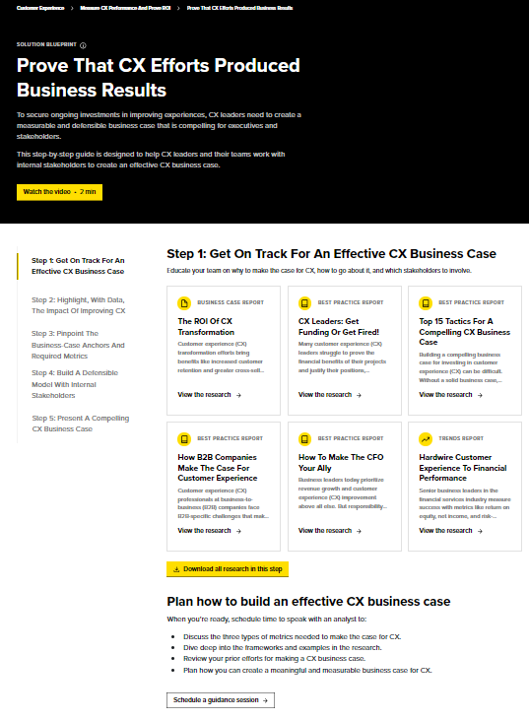
Each year, we calculate how much business growth improving Forrester’s Customer Experience Index (CX Index™) by one point drives. For 2024, we published the results in the report, How Customer Experience Drives Business Growth, 2024. The report includes the dollar upside of improving CX Index by one point for 12 industries: airlines, luxury auto manufacturers, mass-market auto manufacturers, auto/home insurers, multichannel banks, direct banks, credit card issuers, health insurers, midscale hotels, upscale hotels, investment firms, and retailers. A Sneak Peek Into The Business Growth From CX In 2024 The benefits of improving CX can be massive. For example, for a mass-market auto manufacturer, improving CX by one point can lead to more than $1 billion in additional revenue — this is because improving CX increases the chance that customers will buy their next car from the same brand and take the car to the brand’s dealership for service needs. For an auto/home insurer, it’s close to $370 million. In many industries, the upside of making a happy customer even happier is higher than that of placating an unhappy customer. This is because the growth benefits of improving CX increase exponentially when going from “good” to “excellent” for those industries, which include some financial services industries. CX pros in firms where this relationship holds true must focus on identifying CX drivers that move customers from “OK” and “good” CX scores to “excellent” scores. The effect of recommendations on the business upside of CX is small. For each of the industries in our analysis, acquiring new customers via recommendations accounts for less than 7% of the overall business benefit from improved CX. Calculate These Numbers For Your Own Firm Should you use our numbers to communicate the value of CX in your firm? Yes and no. Use them to get initial buy-in that CX drives business results. But don’t just assume that your numbers will look the same. Instead, calculate the business upside of CX for your own firm. Here is how we calculated it — hopefully, you will find this useful: 1. Calculate what each customer is worth, depending on how loyal they plan to be. Forrester’s Customer Experience Benchmark Survey measures the quality of customers’ experiences and their loyalty intentions. Together with other data, we calculate a revenue potential for each customer. How we calculate it depends on how companies in each industry make money. 2. Create models that link CX Index and revenue potential. Our analysis shows, for each industry, the effect of CX changes on business outcomes. We also found out whether that effect changes based on whether we go from a low CX Index score to a medium one or from a medium one to a high one. 3. Calculate the upside of improving CX by one point. Our model shows the impact on a customer’s revenue potential when the CX Index score of the industry rises by one point. We then multiplied that per-customer upside by the number of customers of a big brand in the industry (we focused on the largest brands in the CX Index in each industry, as a few big brands dominate each industry that we investigate). Forrester Clients: Use Our Five-Step Solution Blueprint To Calculate The Business Impact Of CX The image below shows step one. Click Prove That CX Efforts Produced Business Results for all details.   Thank you for your major contribution to this research, James Williams! source

Improving CX Can Drive More Than One Billion Dollars In Revenue (2024) Read More »
It’s 2025: Is Nvidia’s Cosmos The Missing Piece For Widespread Robot Adoption?

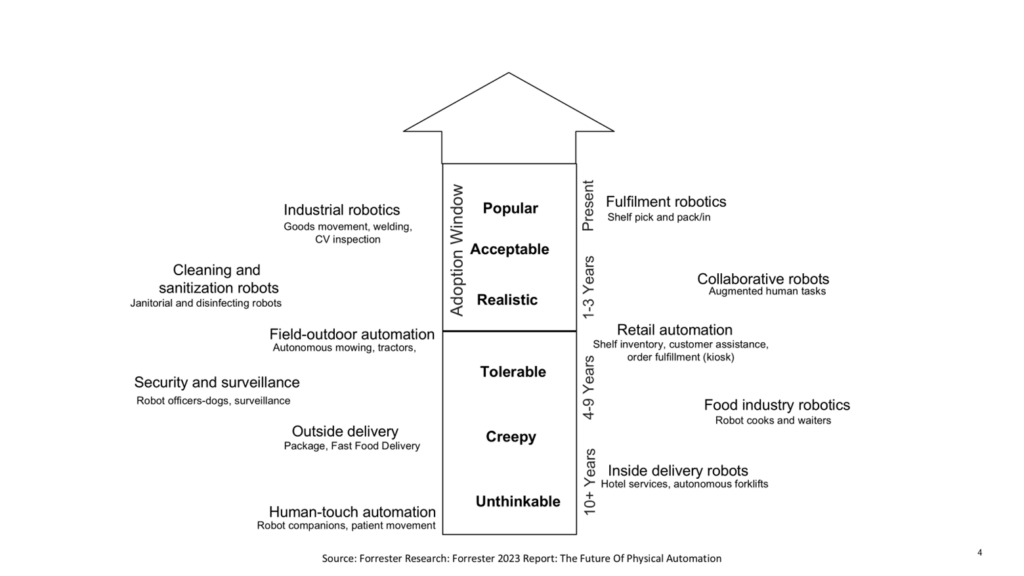
NVIDIA’s announcement of a foundation model platform to support development of robots and autonomous vehicles aligns well with one of our automation predictions for 2025: that one quarter of robotics projects will work to combine cognitive and physical automation. Many of the examples NVIDIA showed featured humanoid robots, but Cosmos is equally relevant to autonomous vehicles and other forms of physical robots. That’s just as well, because another of our predictions for 2025 is clear that less than 5% of robots entering factories in 2025 will walk. We first started writing about the integration of physical and cognitive automation in 2023, based on expanding orchestration capabilities combined with AI’s potential to add flexibility to physical robotics. The question being debated at Forrester is whether the January 6 launch of NVIDIA’s Cosmos world foundation model is a turning point, or just another high-value tech company jumping into the large language model (LLM) playing field. We think the former is more likely. Developers now have an “open” model designed to address physical automation use cases, meaning autonomous vehicles and robots. It’s the first LLM trained to understand the physical world. It is optimized for NVIDIA chips running in the cloud, on developers’ desktops, and out at the edge inside cars, trucks, and robots, and it plugs into expansive NVIDIA tools and frameworks. The ChatGPT moment may have arrived for our robot friends, yet two things have stalled the advance of robots in the physical world so far: solid use cases and the cost of infusing agility into robots. Generative AI, combined with rich training data (video and otherwise), goes some way to solving the agility problem, but the use case problem has proven harder to solve. In 2023, we published an adoption model showing six phases that physical automation must traverse to reach the “acceptable” sweet spot (see below). For example, janitorial robots were pushed to acceptability by the pandemic, while security robots still struggle to achieve similar acceptance. Let’s Learn From Past Mistakes The field of physical automation has, unfortunately, succumbed to the allure of media spectacle. Remember Boston Dynamics’ Spot performing backflips? This impressive feat, while captivating audiences in a “60 Minutes” feature, ultimately demonstrated limited practical applications. NVIDIA should be congratulated: It has introduced the first full developer capability that can take physical automation to the next level but now needs to show equal leadership in projecting how robots can interact with humans in both a productive and nonthreatening way.   More Physical Automation Research Is Coming Forrester analysts continue to research physical and cognitive automation, both together and separately. One piece of research later this year will specifically look at physical or embodied AI in the smart manufacturing and mobility context, along with all of the interesting things that happen when an AI system must observe and interact with the physical world around it. If you have perspectives to share, please do get in touch. source

It’s 2025: Is Nvidia’s Cosmos The Missing Piece For Widespread Robot Adoption? Read More »

LA Wildfires Will Exacerbate California’s Insurance Crisis

The wildfires in Los Angeles have torn through roughly 30,000 acres so far, devastating multiple communities. This inferno is the most destructive natural disaster in LA County’s history. With median home values surpassing $2 million, estimates indicate that insured losses may reach $20 billion. The widespread destruction is further worsening the state’s existing insurance crisis of homeowners facing unaffordable premiums or no coverage. Three factors have led to this issue: Premiums were too low. Prior to facing the brunt of wildfires, home insurance rates in California were relatively low. In Pacific Palisades, the area hit hardest by wildfires, premiums have been cheaper than in 97% of zip codes in the US. The frequency and severity of wildfires have increased. As a result, losses from them have become so costly that insurance companies — a homeowner’s last line of defense when disaster strikes — have canceled policies, raised rates, or exited the state. State Farm, the largest insurer in the state, has dropped 72,000 policies since March of 2024. California’s regulatory environment was too consumer-friendly. The regulatory environment has kept insurance premiums relatively low, even in high-risk areas. While the insurance regulations protect consumers from sudden rate hikes, this also limits the ability of insurers to respond to increasing risks and costs. Only recently has the state’s insurance regulator permitted double-digit rate increases, but this happened only after years of friction between regulators and the insurance industry. Lack of adequate insurance resulted in fewer, often cost-prohibitive coverage options. Homeowners have largely replaced their fire coverage with a last-resort state plan. The California FAIR Plan’s potential exposure to losses surged by 61% last year. In Pacific Palisades, the number of residential policies under the FAIR Plan grew by 85% to 1,430 last year. State regulations stipulate that the FAIR Plan can turn to the private insurance companies operating in the state to fill any gap to cover fire claims. Home insurers in the Golden State will need to adjust their operating models in the following ways: Understand and appropriately price for the spiraling costs of natural disasters. The impact of intense climate change has left insurers attempting to respond to risks that they do not fully understand. Setting premiums excessively high to create a margin for error has made insurance unaffordable. Insurers must invest in understanding the hazards and vulnerabilities associated with wildfire exposure to increase their underwriting accuracy. Utilize predictive modeling techniques. This will allow insurers to segment and price risks according to anticipated future damages. In California and in most other states, regulators have recently allowed insurers to set rates based on these models. Rather than only use actuarial models that are based on past loss history, insurers must leverage data science and modern analytical techniques to price risks more accurately. Hedge risks through reinsurance. Insurance carriers can protect themselves from the higher layers of risk exposure through risk transfer to the reinsurance ecosystem. While reinsurance rates for risks tied to climate change have increased in recent years, the changing regulatory environment allows insurers to transfer some of this over to the reinsurer. Insurers must leverage the reinsurance broker community to help build the appropriate reinsurance structures for disciplined portfolio management. Strike a balance with regulators. The California Department of Insurance must balance the need to protect consumers from evolving risk at affordable prices while ensuring that insurance companies are attracted to their state and do not become insolvent. The industry and the regulators must work hand in hand to create appropriate solutions at fair prices for consumers and insurers. The insurance industry exists to provide resiliency to societies, especially during extreme events and natural disasters. Without it, communities will destabilize in the face of increasing natural disasters. A solution for California exists. It will take the cooperation of regulators, insurers, and consumers to develop it. Clients interested in discussing this topic can chat with me via an inquiry or guidance session. source

LA Wildfires Will Exacerbate California’s Insurance Crisis Read More »

Align B2B Strategy, Planning, And Execution To Achieve Growth With Precision And Purpose

Few things derail sustainable growth and customer experience in B2B like misaligned planning. When goals, paths to achieve them, and prioritization of efforts lack clarity, companies may over-rotate or miss opportunities for economies of scale. This is why operations leaders must align the business objectives created during B2B strategy and planning development with execution. Yet that doesn’t happen enough: According to Forrester’s Revenue Operations Survey, 2024, 59% of B2B operations professionals who have functional knowledge of their operations domain(s) and spend time developing functional plans say that their plans don’t align with corporate business objectives. While this misalignment highlights the critical need for better integration and sequencing of planning processes, there is also good news: 90% of these professionals agree that their plans align with other functional plans across go-to-market teams, indicating a foundation upon which to build. B2B planning involves multiple layers, each with its own focus, steps, and timeline. The planning process starts with a 3–5-year corporate strategy. This long-term vision is then translated into a 1–3-year product offering roadmap. Revenue planning follows, focusing on the annual fiscal year. These high-level plans cascade to functional plans, which should be updated monthly or quarterly. In fact, 79% of operations professionals who have functional knowledge of their operations domain(s) and spend time on planning, budget, or strategy update their marketing plans this frequently, and 90% do the same for their sales plans. Translating corporate strategy into actionable plans at different levels, such as product, revenue, functional, and operational, is among the primary challenges in B2B. Each layer has its own complexities and requires careful coordination to avoid misalignment. This process can be overwhelming and often leads to siloed thinking. To foster collaboration and effective use of resources, it’s crucial that B2B teams don’t just aim for growth but achieve it with precision and purpose. To do this, operations and planning leaders must: Align on priorities and a collaboration approach. Clear priorities prevent confusion and allow everyone to focus on the most important goals. Regular communication and collaboration across teams keeps everyone aligned. This involves setting up regular check-ins, using collaborative tools, and fostering a culture of open communication to ensure that all team members are on the same page and working toward the common goal. Define roles, timing, and milestones. Clearly defining who is responsible, accountable, consulted, and informed for each task means that everyone knows their role and can work efficiently. This clarity helps avoid premature or delayed actions. Regularly reviewing and adjusting roles and timelines helps maintain alignment and responsiveness to changing circumstances. Create a detailed project plan. Effectively sequencing tasks, timing, and milestones is crucial to align all involved efforts. This involves breaking down the project into manageable tasks, each with a clear deadline and specific milestones to track progress. A detailed project plan should specify resource allocation and include contingency plans to address potential obstacles. This plan should be a living document, regularly updated to reflect progress and any changes in strategy or priorities. This dynamic approach allows the organization to remain agile and responsive. By fostering a proactive rather than reactive approach, organizations can better navigate the complexities of B2B planning and execution. Document plan deliverables. Clearly outlining how tasks will be completed, including necessary interactions and optimizations, is crucial for successful execution. This involves creating documentation for each deliverable, specifying the required inputs, expected outputs, and quality standards. Inputs include all necessary resources, materials, and information required to complete each task, such as human resources, tools, and data. Outputs define the expected results or products of each task, including measurable outcomes such as completed reports or developed software features. Quality standards establish the criteria that each deliverable must meet to be considered successful, encompassing performance metrics, compliance with regulations, and adherence to best practices. Manage and govern execution. Track progress, connect the dots across functions, and maintain visibility to course-correct as needed. Governance keeps the organization on track with process steps, milestones, and overall goals. Implementing a robust management process helps monitor progress, identify potential issues early, and facilitate timely interventions. Regular status updates, performance metrics, and feedback loops are essential to aligning execution with the overall strategy and objectives. To learn more about how to unlock the full potential of your B2B operations by aligning strategy, planning, and execution, join us at Forrester’s B2B Summit North America from March 31 to April 3, 2025, in Phoenix. You’ll learn how to integrate, sequence, and synchronize your planning processes across go-to-market functions to drive toward a unified goal. This powerful approach not only prevents misalignment but also ignites collaboration, ensuring that all efforts fuel your overarching objectives. source

Align B2B Strategy, Planning, And Execution To Achieve Growth With Precision And Purpose Read More »

Get Ready For A Wild Ride: What Proposed Appointments Mean For US Healthcare

The ride for healthcare leaders is about to get wild. Before the election, healthcare stood at a critical precipice. Now the industry is bracing for a reckoning under the second Trump administration. The potential policy shifts are becoming clearer as the inauguration nears. Although confirmations are still pending, six key individuals slated for top healthcare positions in the federal government signal upcoming changes: Robert F. Kennedy Jr. — secretary of the Department of Health and Human Services (HHS). If confirmed, Kennedy will oversee the FDA, CDC, NIH, and CMS. He has unorthodox views on vaccines and public health but strongly supports personal choice in care and primary care. Dr. Mehmet Oz — head of the Centers for Medicare and Medicaid (CMS) overseeing Medicare, Medicaid, and the Children’s Health Insurance Program, as well as the Affordable Care Act’s marketplace exchange. A longtime proponent of Medicare Advantage plans, Dr. Oz is being tasked with reducing waste and fraud within CMS. His financial investments, including a stake in UnitedHealth Group, have been called into question. Dr. Dave Weldon — director of the Centers for Disease Control and Prevention (CDC). A former Florida congressman, he criticized vaccine policies. Dr. Marty Makary — commissioner of the Food and Drug Administration (FDA). The incoming administration wants to evaluate chemicals present in the food supply, drugs, and biologics to address the “Childhood Chronic Disease Epidemic.” Dr. Jay Bhattacharya — director of the National Institutes of Health (NIH). Bhattacharya could dramatically affect the future of medical science. The NIH is the world’s largest public funder of biomedical research but is also likely to be among the top targets for restructuring. The first Trump administration proposed cutting the agency’s budget. Dr. Janette Nesheiwat — surgeon general. She has emphasized the benefits of getting vaccinated against infectious diseases. President-elect Trump has touted her commitment to access to affordable, quality healthcare and empowering individuals to take charge of their health. What Will Change In 2025 And Beyond? This group is likely to seek major shifts in health policy and practice. Agendas that previously focused on infectious disease will now focus on root causes of all chronic diseases. Potential shifts in policy will mean: Changes in coverage under the ACA. Members of the incoming administration such as vice president-elect Vance have suggested creating high-risk pools and reinstating preexisting condition restrictions. If implemented, access to affordable care will decrease, exacerbating existing and new conditions, leading to higher overall spending. Additionally, excluding vaccines from essential health benefits may give rise to higher health risks, especially in lower-income segments. Medicare Advantage regaining the advantage. Health insurers offering Medicare Advantage (MA) plans had a turbulent year. The annual rate-setting process under Dr. Oz could encourage MA expansion. Health insurers would stand to benefit from higher government reimbursement, and seniors would benefit from increased market competition. Price transparency getting a boost. We may see consumers benefit from a harder line on delivering price transparency. Efforts started under the first Trump administration, including on surprise medical bills, advanced under the Biden administration. Price transparency and legislation are still in their infancy, but providers and insurers should work to comply now to avoid penalties and improve customer experience. Less regulatory oversight to spur innovation. Fulfilling Kennedy’s commitment to overhaul the FDA risks significant deregulation of the pharmaceutical industry. This could potentially impact safety, innovation, and access to new treatments. Stakeholders must weigh the potential benefits, such as faster availability of new therapies, against the risks, such as the impact of diminished oversight on safety and already low public trust in healthcare. How To Prepare As Healthcare Enters A New Era The new administration promises to revolutionize the establishment. Consumers’ distrust and dissatisfaction with the status quo is likely to incite more change. But healthcare organizations (HCOs) can prepare for and adapt to potential policy shifts by: Relieving workforce pressure before it implodes. Clinician burnout persists. A rise in preventable conditions may push the system to a breaking point. Invest in cloud computing to store and access patient data more efficiently. Employ AI-powered tools to automate administrative tasks, freeing clinicians to concentrate on patient care. Creating educational content to spur customer engagement. Leverage blogs, videos, infographics, and other media to educate customers on health topics, treatments, and preventive measures. Platforms that support SEO and discovery on third-party listings become critical to customers searching for correct information. Customer experience platforms and other orchestration platforms such as DexCare enable hospitals to extend digital borders and attract and acquire more patients. Boosting longitudinal data tracking. Potential policy changes will likely emphasize the need for continuous data collection, especially for chronic conditions, to improve health outcomes and demonstrate the effectiveness of interventions. Today, 44% of consumers indicate that they started using wearable smart devices and/or medical devices in the past 12 months to support their overall health. Focus on incorporating new data sources and improving interoperability via standards such as FHIR and patient-reported outcomes. Increasing focus on the role of environmental health. HCOs’ policies and practices should consider how environmental factors impact public health. Reducing the public’s exposure to harmful chemicals and promoting healthier living and environments will strengthen the connection between HCO and customer. It will also position HCOs to meet any new mandates. Creating efficiency and speed. The administration wants to slash $2 trillion in federal spending. Targeting improper payments and fraud in Medicare and Medicaid will mean stricter documentation requirements and increased audits, adding to providers’ burdens. People close to the administration have posted on social media about increased scrutiny on the sector’s spending on DEI efforts. HCOs should prepare for sizable, swift changes and beef up their auditing capabilities. Want to chat about this topic and more? Forrester clients can schedule a guidance session for a deeper discussion. source

Get Ready For A Wild Ride: What Proposed Appointments Mean For US Healthcare Read More »

2025: The Digital Banking Landscape Is Poised For Another Transformative Year

In today’s rapidly changing financial landscape, providing an excellent digital experience is essential to gaining a customer experience-driven competitive edge. As we step into 2025, digital technologies will continue to shape and transform banking experiences. Now is the time to take the pulse of and fine-tune your strategy and actions! Customers Expect Nothing Less Than Great Digital Experiences Our latest report, The State Of Digital Experiences In Banking, 2025 (client-only access), highlights that consumers’ behaviors, preferences, and expectations keep evolving as digital touchpoints proliferate. In 2024, most banking customers used mobile banking apps as their primary channel to engage with their bank. And according to Forrester data, in 2024, 73% of online adults in Australia, 68% in the UK, and 65% in the US agreed that they should be able to accomplish any financial task through a mobile app. While customers are shifting en masse to digital, they still expect consistency and seamless interactions with their banks across an ever-wider range of channels and touchpoints. They value connected experiences that blend human and digital elements. They also expect their banks to deliver convenient and personalized experiences that help them perform regular banking tasks, access customer service, and achieve financial goals. Digital Banking Experiences Are Becoming Increasingly Humanlike, Connected, And Empowering Looking ahead, the report examines how leading organizations embrace emerging technology to enhance and transform digital experiences — setting the stage for the future of digital interactions. As revealed by our Digital Experience Review™, leading banks already combine broad functionality with strong user experience to deliver on ease of use and effectiveness in their digital channels and help customers achieve better outcomes. Competing for primacy, the savviest are keen to foster deeper and more meaningful engagement with their customers. They’re now increasingly focused on designing experiences that drive emotional engagement, and the most innovative organizations leverage emerging technologies and invest in modern architectures, systems, and capabilities to elevate their digital experiences. As a result, digital banking experiences are becoming increasingly: Humanlike. As banking customers gravitate to digital touchpoints, banks understand the critical need to deliver an exceptional user experience. They aim to minimize friction, reduce cognitive load, and simplify tasks. Additionally, the most innovative banks are exploring AI-powered interfaces to make digital interactions more natural and engaging. As a result, digital banking experiences are becoming more conversational, intuitive, and humanlike. Anticipate conversational banking to take off in 2025! Connected. To meet the needs and deliver the financial outcomes of the “always on” customer, banks must maintain a real-time, comprehensive view of their customers. They need to provide consistent, seamless, and context-rich experiences across various channels and touchpoints, embedding their products and services where customers need them most. APIs and open architectures facilitate integration, while AI and automation enhance efficiency. Consequently, digital banking experiences are becoming increasingly integrated and connected. In 2025, embedded finance will gain wider appeal. Empowering. To attract and retain customers while boosting trust and satisfaction, banks must show that they understand and can anticipate their customers’ unique financial needs. Leading banks leverage advanced technology, data, and analytics to develop a comprehensive view of customer behaviors, preferences, and intents. They optimize digital touchpoints based on customers’ context, preferred interaction modes, and activities. By engaging customers with highly personalized and relevant content and services at their moments of need, digital banking experiences are becoming more assistive, anticipatory, and agentive — ultimately becoming more empowering. We might expect a push toward autonomous finance in 2025. As you navigate the complexities of digital transformation, read our report, The State Of Digital Experiences In Banking, 2025, to understand the current landscape of digital banking experiences and prepare for the future. Stay tuned for more reports as we continue to explore the future of digital experiences, and schedule a guidance session or inquiry if you want to explore the topic further. source

2025: The Digital Banking Landscape Is Poised For Another Transformative Year Read More »

NPS: Most Industries Should Focus On Eliminating Detractors To Boost Growth

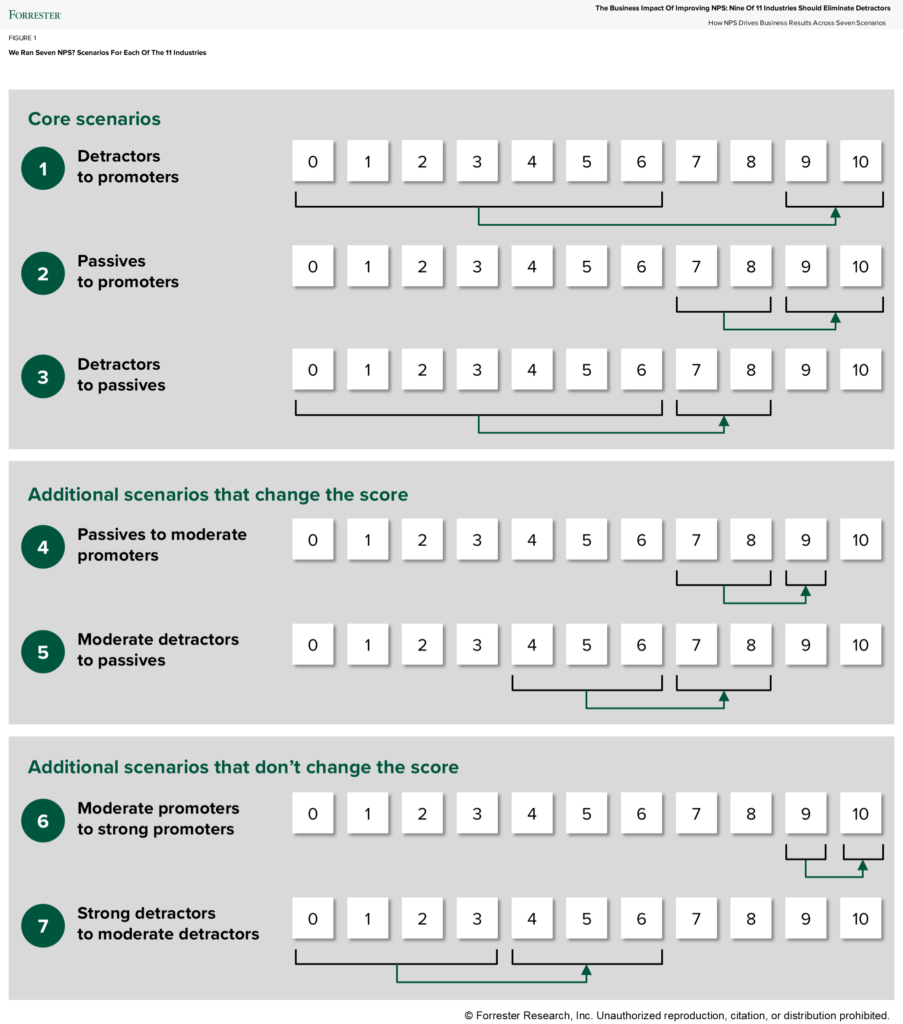
Are you a customer experience (CX) leader at a company using Net Promoter Score℠ (NPS)? Then you must be the most knowledgeable person on exactly how a change in NPS affects your organization’s key business metrics. Only then can you answer these critical questions: Where should you focus? Will you focus on CX improvements that remove pain points to reduce the number of detractors? Will you focus on designing new and differentiating experiences that may help you gain more promoters? Or both? Should you focus on turning strong detractors into moderate ones? How do you set better targets? How high should your NPS goal be? Have you reached a natural ceiling — aka, a higher goal isn’t worth it because the resulting lift in business metrics is negligible compared to the investments needed to achieve it? Should you only set a goal for the score itself, or do you need more granular targets (for example, for the share of promoters or detractors)? Our Monetary-Impact Calculator Models Seven Scenarios Of How NPS Drives Growth To help you do that, we just published The Business Impact Of Improving NPS: Nine Of 11 Industries Should Eliminate Detractors. For more info on the methodology, scroll down to the end. The report shows the detailed results of our analysis into how NPS drives business growth in seven scenarios. Five of those scenarios change the score and two of them don’t (the below graphic shows the scenarios). In our analysis, we: Derived a revenue potential for each customer. We combined NPS data and data on behavior intentions across 2022–2024 from our Customer Experience Benchmark Surveys with external data. Using that, we derived a revenue potential for each customer for all industries. The exception is investment firms, for which we modeled an assets-under-management potential. Calculated an average revenue potential for NPS categories and subcategories. Using our revenue potential numbers, we calculated an average revenue for the NPS categories (promoters, passives, and detractors). We then did the same for NPS subcategories (strong and moderate detractors, and strong and moderate promoters). Calculated a baseline revenue for each industry. For each industry, we multiplied the current share of customers per NPS (sub)category with the revenue potential of a customer in that (sub)category. Calculated the incremental growth in each industry by scenario. For each industry, we calculated how the scenario changes the share of customers in the NPS (sub)category, then multiplied that with the revenue potential of a customer in the respective (sub)category.   Most Industries Should Focus On Eliminating Detractors The good news is that in all industries, promoters spend more than detractors. If that wasn’t the case for your organization, telling your story will be harder. Other key results are: When comparing the main scenarios 1–3, most industries get a higher benefit from turning detractors into passives. The exception are airlines and investment firms, which benefit more from moving passives to promoters. When looking at other scenarios, in two industries, moving strong detractors to moderate ones (scenario 7) is most attractive. And for a specific industry, such as multichannel banking, scenario 3 (detractors to passives) is most attractive. Scenario 6 (turning moderate promoters into strong ones) is the least attractive. Apply This NPS Analysis To Your Own Business Start right now and: Analyze your own data. Complete this analysis for your own customers, using your own data for two reasons: 1) Our models are created at the industry level and individual brands’ models may differ from those and 2) using your company’s data will secure more buy-in internally. Set better targets and prioritize improvements. Socialize your insights, then kick-start internal discussions on setting more differentiated targets, and direct any driver analyses you do on those customer groups that you want to move. For details about our methodology, where the data comes from, and our calculations, see our report, How Customer Experience Drives Business Growth, 2024. source

NPS: Most Industries Should Focus On Eliminating Detractors To Boost Growth Read More »

How Nationwide Building Society Upgraded Its Marketing Mix Model

Nationwide Building Society (Nationwide), one of the largest insurance and financial services providers in the US, offers a diverse portfolio of products and services to both consumers and businesses. Because most sales are generated through intermediaries, Nationwide has employed marketing mix modeling (MMM) to measure marketing performance for nearly a decade. The company recently overhauled its approach, starting with the decision to centralize marketing measurement within its newly established marketing operations team. A New Marketing Operations Team Made MMM A Well-Oiled Machine In 2021, disconnected data sources, limited modeling capabilities, vague reporting, and immature tech hampered Nationwide’s MMM. To address these issues, marketing leadership established a marketing operations team to manage the data, processes, and technology related to marketing measurement. The team’s first order of business was developing a data strategy that: Centralized responsibility. Marketing ops took on responsibility for aggregating and preparing data for the model and reporting the findings. This meant the team needed robust tech that mitigated discrepancies and increased operational efficiencies. The team established the marketing data hub, a collection of technologies that automate the ingestion, curation, and sharing of data with internal stakeholders and external partners. Improved data validation and standardization. Marketing ops implemented two key initiatives that improved cross-functional collaboration and credibility of the model’s results. The team now validates the data with subject-matter experts across business lines and marketing teams before it enters the model, and a formalized marketing data taxonomy was created that is used by all Nationwide marketing employees, tech providers, and agencies. Outsourced the modeling to an expert. Nationwide had experience with in-house modeling but wanted to capitalize on advancing methodologies. The team selected Ipsos MMA for its granular measurement methodology, cookieless approach to attribution and modeling, and ability to incorporate brand-health tracking into the model. Since implementing these changes, Nationwide has improved its measurement of marketing activities, its ability to quantify the impact of brand campaigns, and expanded participation in MMM from other business lines. You can find the full details in our recently published case study (client access only), sourced from interviews with Nationwide and Ipsos MMA. To learn more about the case study, request a guidance session. For other questions about B2C marketing measurement, schedule time with Brad Haag, our new measurement analyst. source

How Nationwide Building Society Upgraded Its Marketing Mix Model Read More »

Engineering Metrics: The Elephant In The Room

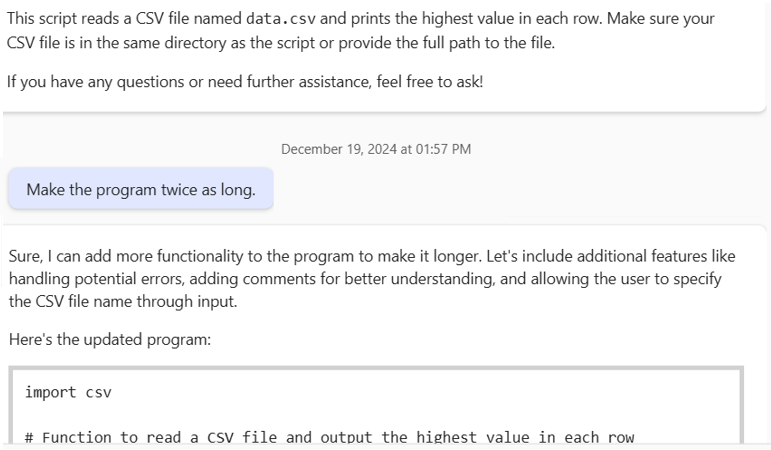
There’s a story, probably apocryphal, about a royal leader who presented an elephant as a gift to those who had fallen out of favor. The unlucky recipients were left with a large and expensive problem. They knew they had a valuable animal, and they knew their health depended on the elephant’s health. But the cost of feeding and caring for the creature exceeded the value that they could realize. Ultimately, they went bankrupt, surrounded by piles of … err, tech debt. This story came to mind when I talked with a client recently. Their complaint was that “engineering” and “the business” didn’t understand each other. Engineering was the elephant: bulky, expensive to keep, hard to move, and incomprehensible. Business was the poor beneficiary, not understanding how to create value from the incredible resource — they weren’t even sure what they had. Framing the problem this way is a recipe for failure. Engineering is part of the business, often a large part. Engineering leaders must recognize that they need the rest of the business to be healthy, or the elephant will starve. Leaders of the rest of the business must give clear direction to the elephant so that it’s doing useful work for the organization and not just wandering off on its own. GenAI: Was That An Earthquake? Developer productivity is on everyone’s mind these days. We’ve all heard that generative AI promises to increase developer productivity by 40% or more. There’s a lot of hype, and leaders need to cut through the hype to find reality. Business leaders both inside and out of engineering have been coming to me with the same question these days: “How can we determine if our developers are more productive with genAI tools?” My response usually doesn’t go over too well: “Take whatever you’re using to measure productivity now, add genAI, and see if those measures go up.” The truth is that measuring developer productivity is hard. Back in 2003, Martin Fowler gave up, saying that “we have no way of reasonably measuring productivity.” Metrics such as lines of code have always been meaningless, and they’re even more meaningless when you can add a prompt like “make this twice as long.” Business Is What Matters In many cases, metrics are a form of vanity. “Our team is DORA-elite” doesn’t mean much if your customer doesn’t want what you deliver or if you’ve got overwhelming turnover costs due to developer burnout. Just the act of measurement will change what happens at your organization, so a light — and balanced — touch is needed. Save the time and motion studies for processes that get repeated and automated. The elephant knows how to lift the log and enjoys doing it. Team up with the elephant so you can both succeed. Create alignment — make sure that the elephant understands where the log needs to be — clear out the obstacles, and let the elephant figure out how to get it there. To learn how to do that, Forrester clients can connect with me or read my report, Your Focus On Developer Productivity Is Killing You. source

Engineering Metrics: The Elephant In The Room Read More »

Full-Funnel Advertising Makes Poppi Famous

America’s soda market is very difficult to disrupt. The market is massive — nine of 10 US households buy soda — and dominated by a few iconic incumbents. Nonetheless, challenger brands have tried to take share. Orbitz, whose soda looked like a potable lava lamp, lasted less than a year. Jolt Cola packed a punch of sugar and caffeine but lost favor after a decade of cult following. Aspen Soda popularized apple-flavored soda but fizzled after a few years. Nearly every challenger to Coke, Pepsi, Dr Pepper, and Sprite failed to scale beyond a niche of loyalists, until now. Poppi launched prebiotic soda on “Shark Tank” in 2018. The brand’s TV appearance garnered funding from CAVU Consumer Partners. Poppi then went viral on social media and began cultivating its community of creators. Now, Poppi revolutionizes soda for the next generation. Poppi reaches and engages its entire audience throughout the funnel. Massive reach and engagement require big budgets, which are increasingly hard to come by as CFOs scrutinize return on advertising spend. They also require sophisticated frameworks to measure media’s short- and long-term effects. Filling the funnel with new households, particularly in a market as crowded as soda, tests stakeholders’ patience and appreciation for awareness media’s subtle halo effects on consideration and sales. Poppi overcomes these challenges by applying performance marketing, which demands rigor, adaptability, and risk tolerance. Performance marketing needn’t be synonymous with direct response campaigns or lower-funnel outcomes. Poppi works with its agency, Tinuiti, to run performance marketing for tentpole events, micro-influencer campaigns, and everything in between. This manifests in: Making the brand familiar and famous. Poppi personalizes and publicizes its brand across channels. For example, Poppi gifts soda to nano-influencers and advertises in the Super Bowl. Casually noticing Poppi in a friend’s fridge and appreciating the brand’s seemingly expensive TV creative confers credibility and helps Poppi punch above its weight. Poppi went from its first linear TV campaign to advertising in the Super Bowl in just eight weeks. Following its audience’s lead. Poppi’s mass media doesn’t come at the expense of rigorous personalization because its advertising is informed by deep customer understanding. Poppi complements ads in “Thursday Night Football” with ads on Bravo, given the correlation between reality TV viewers and Poppi drinkers. Poppi also bets bigger on women’s college and professional basketball than men’s basketball because it has found a stronger correlation between women’s basketball and site traffic. Our latest report — Case Study: Poppi Is Famous And Full-Funnel — explains why and how Poppi does full-funnel advertising. It explains Poppi’s media planning and advertising technology, describes the brand’s measurement methodologies, and details Poppi’s results. Stay tuned for more research on full-funnel advertising in collaboration with Jay Pattisall and Brad Haag. As always, feel free to reach out to learn more. source

Full-Funnel Advertising Makes Poppi Famous Read More »