Forrester

Google Pressures Microsoft 365 By Adding Gemini To Workspace For (Mostly) Free

Gemini features are now part of both Workspace Enterprise and Workspace Business without additional fees. On February 2024, I wrote a blog post declaring “You’re not switching to Google Workspace to use Gemini — yet.” Google aims to change that. Today, the company announced that it will include “the best of Google AI in Workspace Business and Enterprise plans” without the need to purchase an add-on. (Previously, Gemini for Workspace plans cost $20/user/month.) Google will now go to market with Workspace as a fully genAI-enabled productivity and collaboration suite, in contrast to Microsoft’s $30/user/month Microsoft 365 Copilot add-on. Google will raise its Workspace price, nominally, from $12/user/month to $14/user/month. Workforce Generative AI Can Be A Feature, Not A Product Driving higher productivity with generative AI has been no easy task. Approaches that embed genAI directly into the flow of work, like Microsoft 365 Copilot and Google Workspace, see higher usage than solutions that require employees to switch between applications. (Who wants to compose an email in a separate browser window, then cut and paste?) But until Google’s announcement, embedded solutions required expensive add-on licenses. Google’s bold move here: Reminds us that products can evolve into features. Forrester has long tracked the phenomenon of products becoming features; in 2014, we wrote about how Amazon Prime turned the music business into a feature of its Prime platform subscription. In 2020, we wrote about how the enterprise AI market isn’t as big as you think it is, because a lot of AI was already being expressed as a feature of existing software. Google is betting that the same will happen with genAI productivity and collaboration. Shows a case of a viable offering seeking monetization in other ways. Other companies in this space follow a similar approach. Zoom, for example, added genAI features to its core platform without an add-on subscription. The approach assumes that value can be captured via higher market share (acquiring customers) and retention (lower churn) effects. Google, with its small footprint, should be focused on the former. Tempts us to say that Google failed, but it could be a competitive boon. Some headlines will likely call this “commodification” or say that Google simply gave up because it couldn’t sell Gemini for Workspace. While there’s an element of truth to both, Google’s sales channel and customers may well celebrate. The move instantly refocuses Google’s value proposition and pricing, though, as we’ll see, it still won’t be for everyone. Google Workspace Belongs In Some Purchasing Discussions Yesterday, we released a new report, How To Build A Pragmatic Microsoft 365 Copilot Program, in which we argue that making Copilot valuable faces numerous obstacles, from measuring ROI to technical and performance challenges to a high employee training burden that isn’t being met. So M365 Copilot has vulnerabilities. But Workspace does, too; the training burden applies equally to employees using Gemini features, for example. It’s likely still not time for you to switch from Microsoft 365 to Google Workspace. But we also believe that: Google Workspace will become more competitive with Microsoft 365. Attractive pricing matters, especially when, at its new price, Google brings credible performance, a small but nontrivial roster of enterprise clients, and also some differentiated genAI features (including the innovative NotebookLM and Vids, a video-creation genAI tool). Microsoft 365 is embedded and has enduring strengths. Despite Google’s appeal, Microsoft 365’s ubiquity and quality remain hard to dislodge. Migrating M365 documents, SharePoint sites, and macros to Workspace remains a monumental effort. Plus, Microsoft 365 and M365 Copilot have genuine advocates among buyers. In addition to Copilot Studio, a range of Microsoft Azure services and development tools allows enterprises to create a wide range of applications. Increasingly, those applications can be accessed from inside Copilot. Microsoft will, however, feel pricing pressure. Building a business case for M365 Copilot that convinces the CFO to expand licenses broadly remains challenging. At most organizations, cohorts of users abandon Copilot, leading to employee license transfers, higher than expected training burdens, and less than productive outcomes. How long can Microsoft hold the line — and for how long — on $30/user/month? We’re betting the pricing strategy evolves. Next Steps For You? Let’s Talk You should consider Workspace if you are: 1) a startup (companies starting from scratch with little Microsoft legacy are more likely to adopt); 2) an SMB (small and medium businesses need fewer features and are more price-sensitive); 3) willing to segment your workforce (specific departments might benefit, even if the rest of the company uses Microsoft 365); and/or 4) in need of specific Google innovations, like Vids or NotebookLM. But regardless of whether you are already knee-deep in M365 Copilot, considering Workspace, or still haven’t jumped into any of these tools, your next steps will depend on your resources, needs, and AI readiness. Reach out to schedule a guidance session with me, and let’s get you where you need to go. source

Google Pressures Microsoft 365 By Adding Gemini To Workspace For (Mostly) Free Read More »
Introducing Forrester’s Brand Experience Index — Drive Growth With Both Brand And Customer Experience

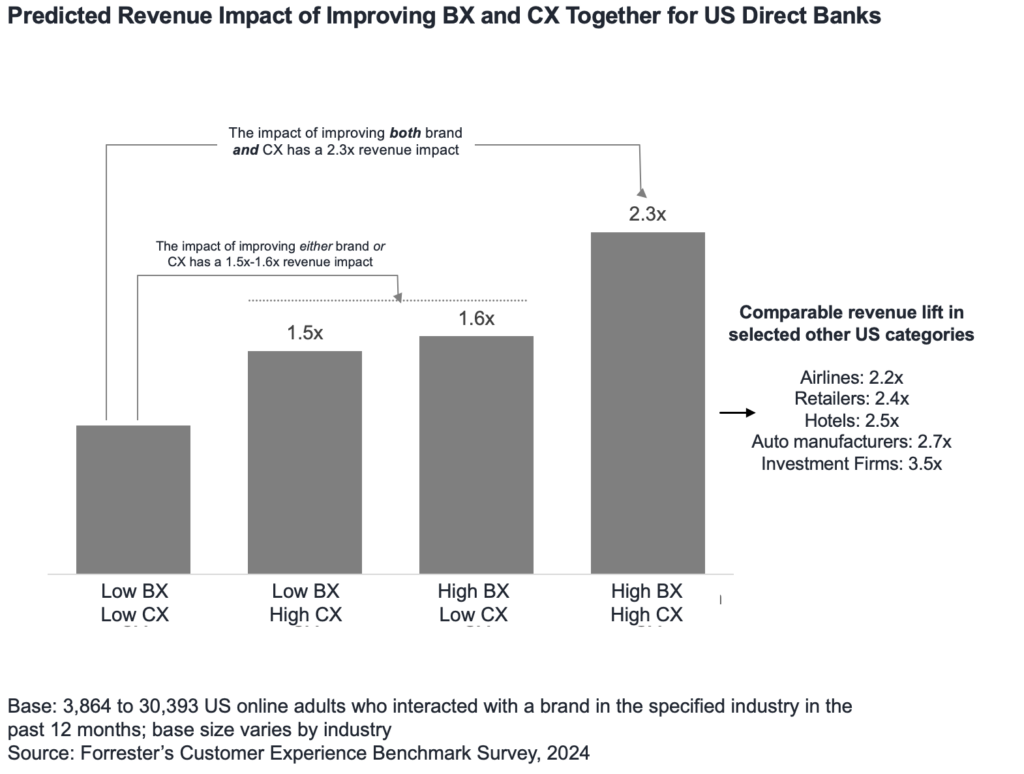
Some things are simply better together: milk and cookies, cats and laser pointers, Instagram and avocado toast — or, if you’re a Frank Sinatra fan (or a “Married… with Children” junkie), it’s love and marriage. Let me tell you what else goes together “like a horse and carriage”: brand and customer experience. Don’t get me wrong; this is not a new insight. At Forrester, we’ve been loudly declaiming the inextricability of brand experience (BX) and customer experience (CX) for many years, but we have watched in dismay as marketing and customer experience activities in many companies continue to be compartmentalized and misaligned. Let us help you with that! New Evidence Of The Multiplicative Value Of BX+CX What’s new from Forrester is that we have clear and compelling evidence showing that brand experience and customer experience work more effectively together to generate financial value. Our analyses across various categories indicate that enhancing both BX and CX has a multiplicative revenue impact compared to advancing just one of them. For instance, in direct banks in the US, the combined revenue lift is 2.3x (versus 1.5–1.6x). The same multiplicative effect is observed in airlines, retail, auto, and numerous other industries.   A New Approach: A Single View Of Growth Among Prospects And Customers What is also new from Forrester is a unified framework to measure and analyze BX and CX together, side by side. This framework provides a comprehensive view of how a brand performs with both its prospects and customers, how it compares to its peers, and what this means for its growth strategies in capturing market share and enhancing performance. We refer to this as our “growth grid.” This 2×2 grid positions a brand based on its performance with prospects and customers, categorizing brands from a specific sector into four growth quadrants, highlighting their current performance, and suggesting potential paths for improvement.   One Single View, Two Experience Indices To construct these growth grids, we rely on two key indices: Forrester’s Customer Experience Index (CX Index™) measures customers’ perception of an experience. It measures how successfully a company delivers customer experiences that create and sustain loyalty and is calculated based on three components of CX quality: ease, effectiveness, and emotion. Forrester’s new BX Index measures prospects’ and customers’ perceptions of a brand. It measures brand equity, which accrues from the sum of all experiences. The index is based on three components: salience, fit, and trust. The growth grid is much more than a theoretical construct. It allows us to assess the performance of specific brands in a category, helping them understand their position relative to the competition and fashion a strategy for the future. We’ve examined numerous applications of these growth grids, and Forrester clients can view our analysis of brands in the automotive and hospitality categories in the US and the banking markets in the UK and Singapore in the full report. Use The Two Indices And Growth Grids To Drive Strategy The calculation of the BX and CX indices and the mapping of the growth grid have multiple strategic applications for brands. They can be used to: Assess the competitive landscape and develop growth strategies. Evaluate the strength of different business lines. Compare the strengths of different brands within a portfolio. Illuminate pathways for improvement — say, from “lagging” to “leading.” Forrester clients can view our analysis of banking products and retail department store chains as examples of utilizing growth grids as strategic tools. Read our full report, Brand And Customer Experience Together Power Growth, to learn more about using Forrester’s CX Index in tandem with our BX Index to assess your competitive position and chart a course for growth and leadership. To follow my work, go to my Forrester bio and choose “Follow.” If you are a Forrester client interested in discussing these topics, please schedule time with me for an inquiry or guidance session. And if you are a Forrester client looking to host a strategy session on harmonizing BX and CX, please contact your account team or email me at [email protected]. source

Introducing Forrester’s Brand Experience Index — Drive Growth With Both Brand And Customer Experience Read More »

Some Good News in The World of IoT Security: FCC Launches the US Cyber Trust Mark Program

The US government is doing something positive around IoT security. With the launch of the US Cyber Trust Mark program, the Federal Communications Commission (FCC) authorized a program and developed rules that bring forward a voluntary labeling standard to inform consumers about the cybersecurity impact of wireless IoT devices they may bring into their homes. Consumer IoT devices are scattered everywhere, from doorbell cameras to smart appliances, baby monitors, and streaming devices. And unless consumers take the time to review all the available information online about what these device manufacturers are doing with regards to cybersecurity, they have no idea how a given device manages aspects such as authentication, cryptography, data security, or even device lifespan. This new labeling program gives buyers a quick view on the label of the key cybersecurity functions and a QR code (still need to be careful with those!) that can provide details on how the device manufacturer is addressing the security of the device and the associated data. You may be thinking, “Paddy, this is a good step for consumer devices. How does this impact the security of my business?” That’s a great question. What does the home network of your employees look like? Unless you are security-conscious by nature (or experience), segmented home networks that isolate different devices into their own secured grids are rarer than properly segmented business networks. Compromised IoT devices on the networks of your home/hybrid workers can be used to attack the business devices that your remote employees are attaching to the same home network. Even if you have no remote employees and you don’t allow BYOD laptops, you still must consider mobile device security. Unless every employee has a cell tower in their backyard and/or unlimited data on all mobile device plans, a majority of employees will still connect their smartphone to their home network to save mobile data charges and have a better experience using these mobile devices. While deploying mobile threat defense solutions onto the mobile devices accessing your business resources is a great way to reduce the impact of a compromised IoT device in this manner, security is all about layers, and having more secure IoT devices is a way to assist here. Within your business networks, how many consumer-grade smart appliances are connected? Refrigerators, coffeemakers, microwaves, or even smart assistants litter the networks of many businesses because of their availability and ease of replacement. This type of device labeling can provide security and risk leaders with more details on the impact of these devices on the overall cybersecurity posture of the corporate network. When it comes to commercial IoT devices, there are other initiatives around the world, from guidance to regulation, and within certain markets, there are other requirements and standards that need to be met, such as in healthcare or related to connected vehicles, but like any standard, guideline, or regulation, these should all be seen as the floor to establishing your secured IoT device environment, not the ceiling. With IoT security listed as one of Forrester’s top 10 emerging technologies for 2024, we have a lot of research initiatives going on to bring you, S&R practitioners and leaders, more insight on how to better protect your business when it comes to IoT devices. If you are looking to better protect your organization’s IoT assets, whether they are on your corporate network or your employees’ home network, please schedule an inquiry or guidance session with me to discuss further. source

Some Good News in The World of IoT Security: FCC Launches the US Cyber Trust Mark Program Read More »

A Quick And Dirty Guide To Cryptocurrencies, Stablecoins, And CBDCs

In the EU, the Markets in Crypto-Assets (MiCA) Regulation fully came into force on December 30, 2024; it covers cryptoasset issuance and services not covered by existing financial services and products regulation, and it includes stablecoins. While this legislation provides the regulatory clarity for which the industry has often asked, many industry players criticize it for being too onerous. By contrast, the US presidential election led to a sharp uptick in the price of Bitcoin and other cryptocurrencies; this reflects market participants’ expectation of a more lenient regulatory approach to the sector from the incoming US administration. We don’t know yet what will transpire in the US, but we do know — from the questions we get asked — that there’s a lot of confusion out there about what different terms mean and what the implications may be from a regulatory perspective, so here’s a quick reminder. Cryptocurrencies (like Bitcoin) are speculative assets. There’s no backing asset and no issuer. Despite their name, they fail the test of what constitutes “money”: Their volatility means they’re not a store of value, they’re not a universally accepted means of payment, and they’re not a unit of account anywhere (quite the contrary — the value of cryptocurrencies is typically expressed in another currency such as USD, GBP or EUR). Stablecoins come in many shapes and sizes, and the differences matter. Stablecoins were first created as an on-ramp to the cryptocurrency ecosystem, partly because the existing banking system cannot support the requirements for 24/7/365 funds transfer and partly because market participants wanted to keep their funds inside of the cryptocurrency world but without being exposed to the volatility of the actual cryptocurrencies. Most are pegged to the US dollar, but there are also stablecoins pegged to EUR, GBP, and other currencies. Stablecoins are still predominantly used within the cryptoasset ecosystem (including DeFi), but they’ve also taken on a wider role as a payment and value transfer mechanism. Unlike cryptocurrencies, most stablecoins have a backing asset to help them keep their value; in theory, holders of stablecoins should always be able to redeem their holdings at face value of the pegged currency (i.e., 1 USDC (Circle) should always be 1 USD; 1 USDT (Tether) should always be 1 USD, etc.). But all stablecoins are not created remotely equal. Here are the major different types of stablecoins you’ll encounter and the salient differences between them: Deposit tokens. Strictly speaking, they don’t even belong here, as they are direct one-to-one representations of cash in an escrow account (i.e., cash that can’t be used for other purposes until the corresponding tokens are destroyed). Deposit tokens use the same type of distributed ledger technology (DLT) as cryptocurrencies and stablecoins but aren’t available on public blockchains. The best-known example is JPMorgan’s JPM Coin (now called Kinexys Digital Payments). Their value is in faster, more efficient business payments that help keep costs down and free up liquidity. Fiat-backed stablecoins. This is the most prevalent form of stablecoin. But despite what some assume, “fiat-backed” doesn’t mean that the backing asset is cash. The backing asset of such stablecoins is typically a (small) proportion of cash, with the rest made up of Treasury bills (T-bills) and other assets that are regarded as cash-equivalent. If that sounds like a money market fund, that’s because the backing assets of many stablecoins are indeed managed like money market funds. Aside from MiCA, however, there are currently no rules regarding what constitutes a permissible backing asset. For example, should commercial paper be permitted? If so, what grade of commercial paper? And outside of MiCA’s reach, there are no reporting requirements (even though some, like Circle, voluntarily issue monthly attestations). This clearly has implications for redemption: Will you be able to get the same amount of hard currency back that you put in? Commodity-backed stablecoins. As the name suggests, the backing asset for such coins is a commodity like gold or silver or possibly oil. Examples include PAXG (PAX Gold, regulated by the New York Department of Financial Services) and XAUt (Tether Gold). Theoretically, such stablecoins could be collateralized against any fungible commodity, but so far, none of those attempts have gained any meaningful traction. Crypto-collateralized stablecoins. Again, the name speaks for itself: The backing asset for such cryptocurrencies is other cryptocurrencies such as Bitcoin or Ether. In theory, the value of the coin should be kept close to that of a hard currency (usually USD). Given that the underlying currencies are often highly unstable, such crypto-collateralized coins are typically overcollateralized, using algorithms to manage ratios. Algorithmic stablecoins. Also known as noncollateralized stablecoins, there’s no backing asset of any kind, as the name implies; algorithms decide whether the supply should go up or down to maintain an exchange value of one hard currency unit (usually USD). What could possibly go wrong? See the Terra LUNA crash of May 2022, which wiped out $50 billion in valuation and caused lots of small investors to lose all of their savings. CBDCs (central bank digital currencies). These are included here because we’re occasionally asked about “bank-issued cryptocurrencies.” Central banks don’t issue cryptocurrency; they issue fiat money — but any bank could, with regulatory permission, issue fiat-backed stablecoins. But that’s not what we’re talking about here: CBDCs are issued by a country’s or currency bloc’s central bank. They come in two forms: wholesale (for use between banks and other financial institutions) and retail or general (for use by individuals and businesses). The public focus has been mainly on retail CBDCs, which banks started investigating a while ago in reaction to declining cash use. Apart from in China and India, CBDCs in major economies remain at the investigation or design phases, and it’s not always clear what need they will actually meet. Whether or not a CBDC uses DLT is a matter of technical choice, not a foregone conclusion. Listen to my conversation with my colleagues Peter Wannemacher, Laura Koetzle, and Keith Johnston on this week’s episode of the What It Means

A Quick And Dirty Guide To Cryptocurrencies, Stablecoins, And CBDCs Read More »

Upgrade Your Sales Game: Three Key Takeaways From Forrester’s Review Of 13 North American Investing Sales Websites

The desktop website is a crucial part of the sales journey for a new investing-account customer. More than half of US and Canadian online adults who opened an investing account use a computer to research the product. To better understand and identify investing sales best practices, we evaluated the sales digital experiences of 13 North American investment firms for opening a new self-directed account across the first four phases of the customer lifecycle (discover, evaluate, commit, and initiate). Our research reveals that: Investment firms are not making it easy to get help when needed. A prospective customer may need assistance with the nuances of a self-directed account such as fees, trading options, and its rules and regulations. Live chat is readily available from most firms for existing customers. It should also be available to prospects throughout the process of researching, evaluating, and buying a product; most firms in our evaluation failed to offer this, and they are missing an opportunity to address a prospect’s concerns early in the customer lifecycle and increase the chance of converting interest into a sale. Investment firms need to make it easier to navigate the website. Investing websites have a ton of resources: product information, tutorials, articles, and more. It can be difficult for a prospect to find what they need quickly. Many firms in our evaluation struggled with having a consistent and easy-to-understand navigation menu. Their search features were likewise not easily accessible, failing to yield relevant results for a query. A prospect who cannot navigate the website effectively or find what they are looking for will quickly lose confidence in the brand and look for another firm that can meet their needs. Investment firms in the US lag behind Canadian firms. Firms in the US scored higher than the Canadian firms in just nine of the 26 digital experience criteria we used. US firms performed below-average and struggled across most criteria in the buying and onboarding phases of the customer lifecycle. Specifically, the majority of US firms lacked adequate access to human help from within the product application, relevant cross-selling capabilities in the application, and informative post-application communication. For a deeper dive into our Digital Experience Review™ research, further insights from our reviews, and specific best-practice examples, Forrester clients can check out the full report here: The Forrester Digital Experience Review™: North American Investing Sales Sites, Q1 2025. If you are interested in evaluating your own firm’s digital sales experience and want to use the same criteria we did for our reviews, be sure to check out our interactive self-assessment tool: The Forrester Investing Sales Website Digital Experience Assessment. If you want to discuss any of our findings, or the results of your digital experience self-assessment, please reach out to your Forrester account team. source

Upgrade Your Sales Game: Three Key Takeaways From Forrester’s Review Of 13 North American Investing Sales Websites Read More »

The Unifying Power Of Rebranding: HCLTech’s Strategic Transformation

HCLTech was recognized as Forrester’s 2024 B2B Program Of The Year Awards winner for marketing executives, thanks to the impressive results from its comprehensive rebrand and digital transformation. Rebrands are expensive, time-consuming, and not without risk, but when done right, a company can see substantial results. For HCLTech, the rebrand unified the company, created cohesive messaging, enabled clear buyer journeys, and ignited an even stronger sense of pride among its over 200,000 employees. The Right Time And Right Reasons For A Rebrand HCLTech, a company with impressive growth fueled by organic expansion and strategic acquisitions, nevertheless faced a brand identity crisis. Independent branding efforts across business units led to fragmented messaging, inconsistent creative, and disjointed digital experiences. With limited brand recognition in key markets, HCLTech felt it was the $13 billion company that nobody knew. Recognizing the need for a unified brand identity, HCLTech embarked on a comprehensive rebrand and digital experience transformation. Factors For Success Several factors drove HCLTech’s success: Executive support. Leadership saw the rebrand as essential for driving growth, fostering customer loyalty, and attracting top talent. They fully supported all aspects of the initiative, including the expansive digital experience transformation that encompassed a complete rearchitecting of internal and external websites, streamlining buyer journeys, and a focus on performance-driven content. Most importantly, the executive team supported substantial long-term investment in brand campaigns post-launch to ensure that the brand took hold with target audiences around the globe. A strategic initiative. The rebrand was a strategic move to unify the diverse business units under a single, powerful identity with plans for activation programs that would drive revenue growth goals. This was no vanity project focused on fonts and colors. This extensive, data-driven project aligned with the business strategy and exhibited a long-term commitment from executives. Customer- and employee-inspired. HCLTech’s rebrand was more than a name change; it was a strategic move to unify the diverse business units under a single, powerful identity derived from the company’s mission, vision, values, and brand purpose, which center around clients, people, communities, and the planet. Strategic sponsorships and aligned advertising. The company amplified the brand experience through strategic sponsorships in key markets, including the sponsorship of MetLife Stadium (home of the New York Jets and Giants), the Australian national cricket team, and the Scuderia Ferrari HP Formula One team. Targeted advertising and account-based marketing initiatives further amplified brand awareness and perceptions. Stellar Results HCLTech’s brand value surged by 15.9% year over year, making it the fastest-growing IT services brand globally according to Brand Finance Global 500 and IT Services 25 2024. The business saw a 25.7% increase in its stock price and associated market capitalization, alongside significant improvements in brand familiarity and consideration scores with a 75% lift in brand recall. The new unified digital platform enhanced user experiences, attracting more visitors and job seekers, and also delivered operational efficiencies. source

The Unifying Power Of Rebranding: HCLTech’s Strategic Transformation Read More »

Is A $7 Million Super Bowl Ad Worth It? Probably Not.

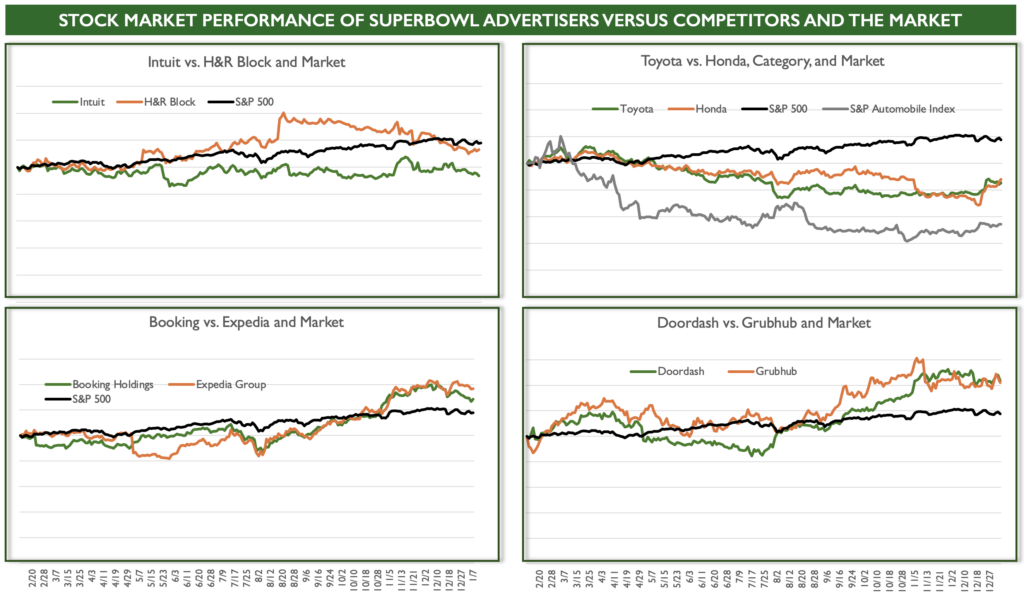
Is a Super Bowl ad worth it? A 30-second spot at this year’s Super Bowl will set you back a cool 7 million bucks. And even if you wanted one of those spots, you can’t have it — they’ve been gone for a while. That must mean these ads are like the proverbial goose laying golden eggs, right? Wrong! Can a Super Bowl ad spot be a sensible investment? Perhaps in some cases, like for a low-awareness brand that needs a jolt of awareness or for a brand making a pivot that it needs a lot of people to know about. But has it worked out for all the blue-chip brands that gobble up the ad space as soon as it hits the market? We decided to check out a few brands that advertised in 2024 (most of which plan to advertise again in 2025) and see how they fared after their Super Bowl campaign. Do Super Bowl campaigns create shareholder value? Attribution analysis of advertising spend can be extremely complex and messy, and that’s not what we are doing here. Instead, we want to see if the brands that advertised did well for their shareholders in the months following the Super Bowl. We compare the stock price of the advertised brand with that of a close peer, and then we throw in the S&P 500 (to measure against overall market movement) and, if available, an industry index (to compare against the category). Here’s how to easily read the charts below: The advertised brand is in green, the competitive brand is in orange, and the market or category indices are in black and gray. We’ve indexed the prices back to the day of Super Bowl 2024 so you can easily compare the advertised brand’s market performance versus that of the others. Seven million dollars later … Here are the findings for the four brands we analyzed:   Intuit has advertised its free online and premium paid tax software (Turbo Tax) in every Super Bowl since 2014 and plans to do so again in 2025. Since its 2024 Super Bowl ad, the company has consistently lagged the S&P 500 and, worse yet, significantly fallen short of its competitor, H&R Block, which has outperformed the market for most of the year. In 2024, Toyota featured the Tacoma in its Super Bowl ad. The year has not been kind to the automobile industry, whose category stock performance has fallen well below the S&P. Toyota did stay ahead of the industry but, for the most part, trailed Honda’s performance. Doordash has been advertising its delivery platform since 2022 and plans to do so again in Super Bowl 2025. After its 2024 campaign, which included a sweepstakes, Doordash pushed ahead of the S&P for a bit but since has had mixed results in beating the market, and unfortunately, it has trailed Grubhub by significant margins for the best part of the year following the Super Bowl. Booking Holdings, like Doordash, has been advertising at the Super Bowl since 2022 and will be back in 2025. Immediately following the Super Bowl, its stock trailed the market and Expedia for a couple of months, made up some ground through the summer months, and since then has closely tracked Expedia. There is little in Booking Holdings’ stock performance to indicate a lift from the Super Bowl. Ouch! What’s a marketer to do? Granted that more analysis needs to be done to truly determine the ROI of a Super Bowl ad (or, for that matter, any ad), but when you sink that much money into an ad campaign and your stock has nothing to show for it, it raises red flags. There are two stark lessons here for any marketer planning a campaign of any size or significance: You are ultimately answerable to the shareholder (or equivalent stakeholders in private companies) for whom you create value, so you must orient your metric around demonstrating outcomes for the enterprise. That’s how you demonstrate your utility to the business. You better be buttoned up on the numbers if you’re pitching marketing campaigns in an environment where your company performance clearly trails your peers. Can you prove that this is the best use of money compared to everything else the company could do with those funds? If I were the CMO at any of these companies that are limping along despite massive ad spend, I’d be telling my CEO that we would be far worse off if we did not make that marketing investment. But, and this is a big but, I’d have to have the numbers to back it up. Better yet, I’d make sure those numbers came with my CFO’s stamp of approval. (Tyler Castro contributed to the analyses and research for this post.) Learn more: Read my research on how brands grow. Follow my work: Go to my Forrester bio and click “Follow.” Chat with me: If you are a Forrester client interested in discussing these topics, please schedule time with me for an inquiry or a guidance session. Plan a session: If you are a Forrester client looking to host a strategy session on a related topic (for example, “the future of digital consumer experience related to AI”), please contact your account team or email me at [email protected]. source

Is A $7 Million Super Bowl Ad Worth It? Probably Not. Read More »

Announcing The Modern Application Development Services Wave, Q1 2025

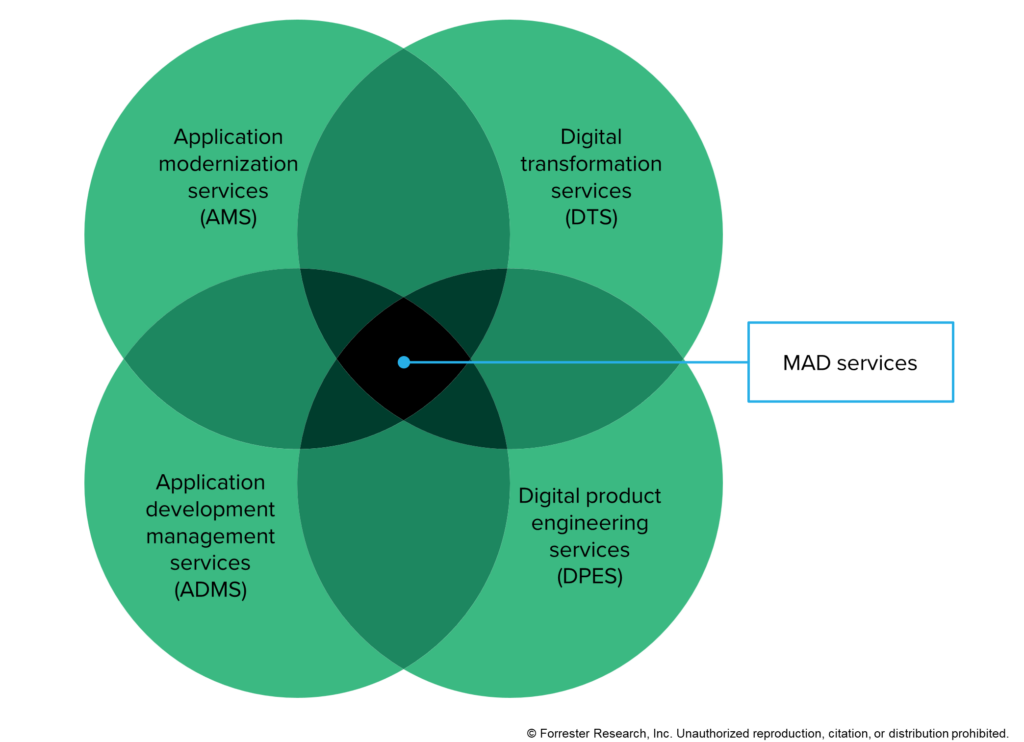
MAD Services Deliver Cool New Products While Transforming Your Development Capabilities Modern application development (MAD) services represent the next wave in custom application development services. Emerging from the convergence of current and past services such as application development management services (ADMS), digital transformation services (DTS), digital product engineering services (DPES), and broader application modernization services (AMS), MAD services are now utilized by leading organizations, with an increasing number of CIOs showing strong interest in these offerings (see figure below).   What sets MAD services apart? It’s their unique ability to not only support clients in delivering modern apps using the latest technologies and development practices but also their role in transforming and modernizing their custom development capabilities. The Venn diagram illustrates the context for MAD services and their foundational services, though it doesn’t capture the market’s multibillion-dollar scale, which is expected to grow. We just published The Forrester Wave™: Modern Application Development Services, Q1 2025, which analyzes and compares 13 medium and large market players out of more than 50 providers that offer MAD services: Accenture, Capgemini, CI&T, Cognizant, EPAM, Globant, HCLTech, Infosys, LTIMindtree, NTT DATA, Softtek, Tata Consultancy Services, and Thoughtworks. Why These Players And Not Others? The MAD services market is highly competitive, and Forrester clients can learn more about the broader landscape and discover a wider group of vendors in The Modern Application Development Services Landscape, Q3 2024. This most recent MAD services Wave’s analysis focuses on medium and large vendors compared to our previous Wave evaluation on the same market, in which the emphasis was on smaller ones. But not every company from the landscape report met the stringent criteria for inclusion in the Wave, which were: Significant peer recognition. These were providers most frequently cited in client bids. Forrester mindshare. This entails the service providers that were referenced more during briefings, inquiries, or research projects over the last year. MAD capabilities. The Wave’s vendors offer comprehensive and differentiating sets of MAD capabilities or, in Forrester’s view, unique capabilities that warrant inclusion. Global MAD services revenue of at least US$450 million. The included vendors have global MAD services revenue of US$450 million in at least two of the North America, LATAM, EMEA, or APAC regions combined. What Distinguishes The Leaders, Strong Performers, And Contenders? Our Wave methodology categorizes vendors into three groups, Leaders, Strong Performers, and Contenders, based on a range of services that we evaluated: agile, DevOps, microservices architecture, cloud services, and more advanced services such as site reliability engineering, project-to-product capabilities, AI and generative AI architecture services, and the testing and development of AI-infused applications. Showing differentiation in all these services was key to our evaluation. Reference clients, case studies, and other evidence also played a critical role in our analysis. After all, it’s the provider’s ability to enhance your team’s skills in new technologies and practices that truly differentiates MAD services from traditional ADMS or AMS services. We encourage readers not to dismiss any provider without first examining the detailed descriptions of strategy, capabilities, and client feedback in our Wave report. Download the accompanying Excel file for a breakdown of the questions, scoring, and criteria grading. For more information, feedback, or questions, email me at [email protected], or if you’re a Forrester client, schedule a guidance session or inquiry. I’m here to assist! source

Announcing The Modern Application Development Services Wave, Q1 2025 Read More »

Dry January Is Really A Lesson In Self-Optimization

The US Surgeon General’s recent warning on alcohol consumption and cancer risk comes at a time when many consumers are participating in dry January, with new terms such as sober-curious being used and demand for “sober bars.” But rather than getting caught up in the pessimistic future of alcoholic beverage companies or the food and beverage industries, the consumer implication here is really about an obsession with self-optimization. Forty-four percent of US consumers and 45% of UK consumers self-reported their plans to make New Year’s resolutions in 2025, according to Forrester’s December 2024 Consumer Pulse Survey, and much of their intentions haven’t changed over previous years: exercising better habits with their health, finances, and connections with friends and family. Consumers Now Live In The Age Of Self-Growth The global medical spa market — with services in beauty treatments such as injectables and weight loss enhancements — is projected to surpass $59.4 billion by 2033; emerging startups around longevity and biohacking are fueling headlines and investments by billionaires, with a focus on research and development around anti-aging therapies; and the percentage of US adults who received any mental health treatment in the past year increased 4% between 2019 and 2023. The emphasis on self-optimization and personal growth trends is fueled and amplified by a couple of cultural factors: Algorithms that influence content consumption. Consumer preferences are now driven by recommendation engines and social media algorithms, spotlighting the “illusory truth effect,” through which humans are more likely to believe that something is true simply because it is repeated often. Hacks, products, and advice on being a better version of yourself will continue to reign over the types of content that the individual consumer consumes and engages with. Increased access but decreased control. The feeling of being overwhelmed by too many choices has steadily grown 3% between 2021 and 2024 in the US, according to Forrester’s Consumer Benchmark Survey, 2024. In reaction to handing over agency to technology, consumers will seek ways to increase control over their life. With better metrics, technologies, and therapies — from daily usage of smartphones to expensive biotherapies — these tools optimize a person’s physical and mental health, steadily ushering consumers toward increased experimentation over self-optimization. Consumer trends typically indicate a turning point to something bigger. Identifying the trend will give you awareness, but to act on it, marketers must look at the bigger picture. Why are consumers behaving this way? Where are they turning to? Why is this trend happening at this moment? To help you better understand consumer trends in 2025 and beyond, schedule a guidance session with me. source

Dry January Is Really A Lesson In Self-Optimization Read More »

Energize Your Journey Portfolio: Optimize Journey Value For Customers And The Business

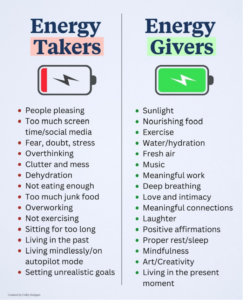
Do You Know What Your Energy Takers And Energy Givers Are? Knowing what your energy takers and energy givers are is an important step in managing your personal energy and productivity. Energy takers are too much screen time, overthinking, clutter and mess, dehydration, sitting for too long, and setting unrealistic goals. Energy givers are sunlight, nourishing food, exercise, fresh air, music, meaningful work, and laughter. Source: Colby Kultgen   What About The Energy Takers And Energy Givers In Your Journey Portfolio? Each time a customer embarks on a journey with you, it can create or destroy value, not only for that customer but for your firm. Just like in our personal lives, some customer journeys are value-positive. They leave customers feeling like they’ve gained more than they’ve given: These are the energy givers of the journey world. Then there are the value-negative journeys — the energy drainers that frustrate customers and diminish their overall perception of your brand.   Optimize Journey Value For Customers And Your Firm: Journey And Journey Portfolio If you see too many value-negative journeys dragging down your overall value equation, it’s time to roll up your sleeves and get to work: Identify the critical pain points, experiment with design changes, and find ways to turn those energy drainers into energy givers. Your customers — and your bottom line — will thank you. You must optimize value for the customer and the business on two levels: 1. An individual journey — what’s the value balance? As you work on journeys, always remember that a customer journey is a lifecycle, not a process: A customer journey is a customer’s paths and perceptions as they pursue a goal. Knowing the value of a journey for you and your customers is the first step in deciding how to manage the journey. Customer journeys are either value-positive, value-neutral, or value-negative. And that goes for your firm and your customers. If the journey is value-negative for a customer (e.g., a lot of extraneous friction), they might not complete it. As a result, you might consider process improvements to make it easier. You’ll most likely make that decision only if you think that the changed journey remains value-positive for you (e.g., higher completion). 2. A journey portfolio — what’s the journey’s role in the value of the portfolio? You must optimize value for the overall portfolio, not just for individual journeys. A journey portfolio comprises all the customer journeys in which your firm plays a meaningful role. Each individual journey can change a customer’s value perceptions of the overall journey portfolio and of your firm. That’s the “piggy bank” we show above. Value-positive journeys are deposits, and value-negative journeys are withdrawals. This also applies to the value for your firm: There are journeys that replenish the overall business value and those that deplete it. For example, a bank optimizing the account-opening journey in isolation might miss that it’s one of the first journeys that customers go on. As such, it sets the tone for the relationship and all following journeys. By considering the portfolio, the bank may invest more in the onboarding journey. Even more than what the bank gets out of it immediately, knowing the long-term benefits will make up for it. Want To Find Out More About How To Assess And Optimize Journey Value For Customers And The Business? If you are a Forrester client, we have two brand-new reports for you to energize your 2025 journey strategy! Reach out for a guidance session or inquiry with my coauthor and colleague, Maxie Schmidt, or with me. We have created checklists to help you assess journey value for customers and your firm. And we are “itching” to get practical and use this with you to energize your journey portfolio and strategy! source

Energize Your Journey Portfolio: Optimize Journey Value For Customers And The Business Read More »