Forrester

Amidst The AI Hype Agile Still Remains Relevant In 2025

After over 12 years of leading Forrester’s research on agile and, from 2011, publishing a biennial Forrester report on the global state of agile adoption, we have just published The State Of Agile Development, 2025: It’s Still Relevant, With Benefits And Challenges. In this blog, I am just quickly highlighting some of the key takeaways to hopefully motivate you to go and read the full report if you are a Forrester client. So let’s go … Agile — The Disputed Champion Of Modern Business, Still Going Strong In times when everything changes so quickly and artificial intelligence, especially generative AI (genAI), captures the imagination of tech enthusiasts and professionals alike, one technology that remains a foundational pillar of the tech industry is agile. Consider the narrative of a tech startup navigating the tumultuous waters of market demands and rapid innovation. At their core, agile methodologies enable this team to remain adaptable, collaborative, and efficient. Drop that team in an enterprise and multiply the team by 10, and what happens? Can those 10 teams still strive together in the same way as the tech startup team? Well, yes and no. But the new report reveals a striking insight: Despite the buzz around agile’s supposed decline, a commanding 95% of professionals affirm its critical relevance to their operations. This statistic, coupled with the 58% of business and technology professionals prioritizing agile adoption, paints a clear picture: Agile is not just surviving; it’s still thriving and not going away, yet it does need improvement. Agile’s Journey And Collaboration Is A Testament To Resilience Agile’s resilience is underscored by its widespread and enduring adoption across many organizations. In fact, a significant majority, 61%, report deploying agile practices for over five years, demonstrating a strong enduring commitment to its principles over older methodologies such as waterfall, which continues to see a decline. This dedication to agile reflects a broader industry trend toward valuing collaboration and flexibility over rigid hierarchies and siloed organizations. Agile teams, characterized by diverse roles including developers, testers, and scrum masters, embody this shift toward a more inclusive and dynamic approach to product development. Our survey data also proves that organizations could achieve even greater success by fully embracing agile’s collaborative ethos, values, and principles and investing in the leadership necessary to guide this cultural shift. Leaders have to do more than just commit to agile; they must lead the change! Agile Leadership Requires Foresight And Emerging Tech Adoption Despite agile’s proven benefits, the data shows that organizations face challenges in scaling agile practices and fostering a culture conducive to its adoption. Proficiency levels among teams vary, with only 7% achieving full proficiency for great agile practices but quite a higher number just being average or good, indicating room for more improvement. Overcoming these hurdles requires a strategic blend of agile frameworks tailored to each organization’s unique needs, coupled also with a commitment to modernizing all angles of the organization with continuous learning and adaptation. Businesses are not immune to that change, and there is quite more to do there. Moreover, the integration of agile with emerging technologies like generative AI and TuringBots offers a promising avenue for enhancing agile’s impact even further. TuringBots, AI, and genAI-infused tools not only streamline routine tasks but also provide valuable insights that can refine sprint planning and project prioritization. With nearly half of the respondents already leveraging genAI in their agile practices, the future of agile seems destined to be intertwined with technological advancements, driving innovation and efficiency in software development. Agile Remains An Unshakable Foundation As the tech world continues to evolve at a breakneck pace, agile values, principles, and practices stand as testament to the enduring need for adaptability, collaboration, transparency, and speed. Agile’s widespread adoption and the challenges it faces reflect an approach that is not static but dynamic, one that clients need to continuously evolve and adapt to meet the demands of an ever-changing industry landscape. Will the integration of agile and AI technologies herald a new era of software development, one where efficiency, innovation, and quality are paramount? I hope it will. As organizations navigate the complexities of digital transformation, agile remains an unshakable foundation, guiding teams toward success in the age of AI and beyond. Over the years, our research has also shown that client organizations cannot make this transition alone — you need valuable partners to work with you. This is why I see the strong connection of this research with my recently published Forrester Wave™ evaluation of modern application development services, of which agile services are mandatory table stakes. Read the full report to access more data and understand our thinking behind it. Also, reach out to me ([email protected]) or schedule an inquiry or a guidance session to get help — I’m here to assist you. I also want to thank my great senior research associate, Merve Kandemir, for her dedication to this research and amazing work to get it published. source

Amidst The AI Hype Agile Still Remains Relevant In 2025 Read More »

Consumers Crave More Than Discounts From Loyalty Programs

Last week, my dentist invited me to join their loyalty program. It’s official: The loyalty program is the “go-to” customer relationship marketing tactic. Most global consumers belong to at least one loyalty program, including 90% of online adults in the US, in Europe-5 (88%), and in Australia (93%). According to Forrester’s Consumer Benchmark Survey, 2024, 54% of US online adults agree that loyalty programs influence what they buy, and 64% agree that programs influence where they make purchases. Most agree that loyalty programs make them feel more connected to the brand. To keep members engaged in their program, loyalty marketers must appeal to what consumers really want: Financial rewards. Year after year, consumers rank monetary benefits like instant discounts, loyalty currencies, and exclusive deals from partners at the top of their list of loyalty program perks. Points and discounts are the hallmark of loyalty programs for a reason. They incentivize customers to join and drive incremental behavior that benefits the brand. VIP treatment. Members prioritize financial benefits regardless of region, but they also want a loyalty program that makes them feel special. B2C marketers can do this by providing members with exclusive access to benefits such as limited-release products, first access to deals, and member-only events. Simple loyalty experiences. With so many memberships, it’s easy for consumers to feel overwhelmed by all the rules, offers, and benefits. Maximize consumer participation in a loyalty program with intuitive experiences and personalized updates. For more insights into how consumers feel about loyalty programs, check out our recently published data overview. Questions? We’d love to help you with your loyalty initiatives. Connect with us by scheduling a guidance session. source

Consumers Crave More Than Discounts From Loyalty Programs Read More »

Some Good News In The World Of IoT Security: The FCC Launches The US Cyber Trust Mark Program

The US government is doing something positive around IoT security. With the launch of the US Cyber Trust Mark program, the Federal Communications Commission (FCC) authorized a program and developed rules that bring forward a voluntary labeling standard to inform consumers about the cybersecurity impact of wireless IoT devices they may bring into their homes. Consumer IoT devices are scattered everywhere, from doorbell cameras to smart appliances, baby monitors, and streaming devices. And unless consumers take the time to review all the available information online about what these device manufacturers are doing with regards to cybersecurity, they have no idea how a given device manages aspects such as authentication, cryptography, data security, or even device lifespan. This new labeling program gives buyers a quick view on the label of the key cybersecurity functions and a QR code (still need to be careful with those!) that can provide details on how the device manufacturer is addressing the security of the device and the associated data. You may be thinking, “Paddy, this is a good step for consumer devices. How does this impact the security of my business?” That’s a great question. What does the home network of your employees look like? Unless you are security-conscious by nature (or experience), segmented home networks that isolate different devices into their own secured grids are rarer than properly segmented business networks. Compromised IoT devices on the networks of your home/hybrid workers can be used to attack the business devices that your remote employees are attaching to the same home network. Even if you have no remote employees and you don’t allow BYOD laptops, you still must consider mobile device security. Unless every employee has a cell tower in their backyard and/or unlimited data on all mobile device plans, a majority of employees will still connect their smartphone to their home network to save mobile data charges and have a better experience using these mobile devices. While deploying mobile threat defense solutions onto the mobile devices accessing your business resources is a great way to reduce the impact of a compromised IoT device in this manner, security is all about layers, and having more secure IoT devices is a way to assist here. Within your business networks, how many consumer-grade smart appliances are connected? Refrigerators, coffeemakers, microwaves, or even smart assistants litter the networks of many businesses because of their availability and ease of replacement. This type of device labeling can provide security and risk leaders with more details on the impact of these devices on the overall cybersecurity posture of the corporate network. When it comes to commercial IoT devices, there are other initiatives around the world, from guidance to regulation, and within certain markets, there are other requirements and standards that need to be met, such as in healthcare or related to connected vehicles, but like any standard, guideline, or regulation, these should all be seen as the floor to establishing your secured IoT device environment, not the ceiling. With IoT security listed as one of Forrester’s top 10 emerging technologies for 2024, we have a lot of research initiatives going on to bring you, S&R practitioners and leaders, more insight on how to better protect your business when it comes to IoT devices. If you are looking to better protect your organization’s IoT assets, whether they are on your corporate network or your employees’ home network, please schedule an inquiry or guidance session with me to discuss further. source

Some Good News In The World Of IoT Security: The FCC Launches The US Cyber Trust Mark Program Read More »

Is A $7 Million Super Bowl Ad Worth It? Probably Not

Is a Super Bowl ad worth it? A 30-second spot at this year’s Super Bowl will set you back a cool 7 million bucks. And even if you wanted one of those spots, you can’t have it — they’ve been gone for a while. That must mean these ads are like the proverbial goose laying golden eggs, right? Wrong! Can a Super Bowl ad spot be a sensible investment? Perhaps in some cases, like for a low-awareness brand that needs a jolt of awareness or for a brand making a pivot that it needs a lot of people to know about. But has it worked out for all the blue-chip brands that gobble up the ad space as soon as it hits the market? We decided to check out a few brands that advertised in 2024 (most of which plan to advertise again in 2025) and see how they fared after their Super Bowl campaign. Do Super Bowl campaigns create shareholder value? Attribution analysis of advertising spend can be extremely complex and messy, and that’s not what we are doing here. Instead, we want to see if the brands that advertised did well for their shareholders in the months following the Super Bowl. We compare the stock price of the advertised brand with that of a close peer, and then we throw in the S&P 500 (to measure against overall market movement) and, if available, an industry index (to compare against the category). Here’s how to easily read the charts below: The advertised brand is in green, the competitive brand is in orange, and the market or category indices are in black and gray. We’ve indexed the prices back to the day of Super Bowl 2024 so you can easily compare the advertised brand’s market performance versus that of the others. Seven million dollars later … Here are the findings for the four brands we analyzed:   Intuit has advertised its free online and premium paid tax software (Turbo Tax) in every Super Bowl since 2014 and plans to do so again in 2025. Since its 2024 Super Bowl ad, the company has consistently lagged the S&P 500 and, worse yet, significantly fallen short of its competitor, H&R Block, which has outperformed the market for most of the year. In 2024, Toyota featured the Tacoma in its Super Bowl ad. The year has not been kind to the automobile industry, whose category stock performance has fallen well below the S&P. Toyota did stay ahead of the industry but, for the most part, trailed Honda’s performance. Doordash has been advertising its delivery platform since 2022 and plans to do so again in Super Bowl 2025. After its 2024 campaign, which included a sweepstakes, Doordash pushed ahead of the S&P for a bit but since has had mixed results in beating the market, and unfortunately, it has trailed Grubhub by significant margins for the best part of the year following the Super Bowl. Booking Holdings, like Doordash, has been advertising at the Super Bowl since 2022 and will be back in 2025. Immediately following the Super Bowl, its stock trailed the market and Expedia for a couple of months, made up some ground through the summer months, and since then has closely tracked Expedia. There is little in Booking Holdings’ stock performance to indicate a lift from the Super Bowl. Ouch! What’s a marketer to do? Granted that more analysis needs to be done to truly determine the ROI of a Super Bowl ad (or, for that matter, any ad), but when you sink that much money into an ad campaign and your stock has nothing to show for it, it raises red flags. There are two stark lessons here for any marketer planning a campaign of any size or significance: You are ultimately answerable to the shareholder (or equivalent stakeholders in private companies) for whom you create value, so you must orient your metric around demonstrating outcomes for the enterprise. That’s how you demonstrate your utility to the business. You better be buttoned up on the numbers if you’re pitching marketing campaigns in an environment where your company performance clearly trails your peers. Can you prove that this is the best use of money compared to everything else the company could do with those funds? If I were the CMO at any of these companies that are limping along despite massive ad spend, I’d be telling my CEO that we would be far worse off if we did not make that marketing investment. But, and this is a big but, I’d have to have the numbers to back it up. Better yet, I’d make sure those numbers came with my CFO’s stamp of approval. (Tyler Castro contributed to the analyses and research for this post.) Learn more: Forrester clients can read my research on how brands grow. Follow my work: Go to my Forrester bio and click “Follow.” Chat with me: If you are a Forrester client interested in discussing these topics, please schedule time with me for an inquiry or a guidance session. Plan a session: If you are a Forrester client looking to host a strategy session on a related topic (for example, “the future of digital consumer experience related to AI”), please contact your account team or email me at [email protected]. source

Is A $7 Million Super Bowl Ad Worth It? Probably Not Read More »

Announcing The Forrester Wave™: Modern Application Development Services, Q1 2025

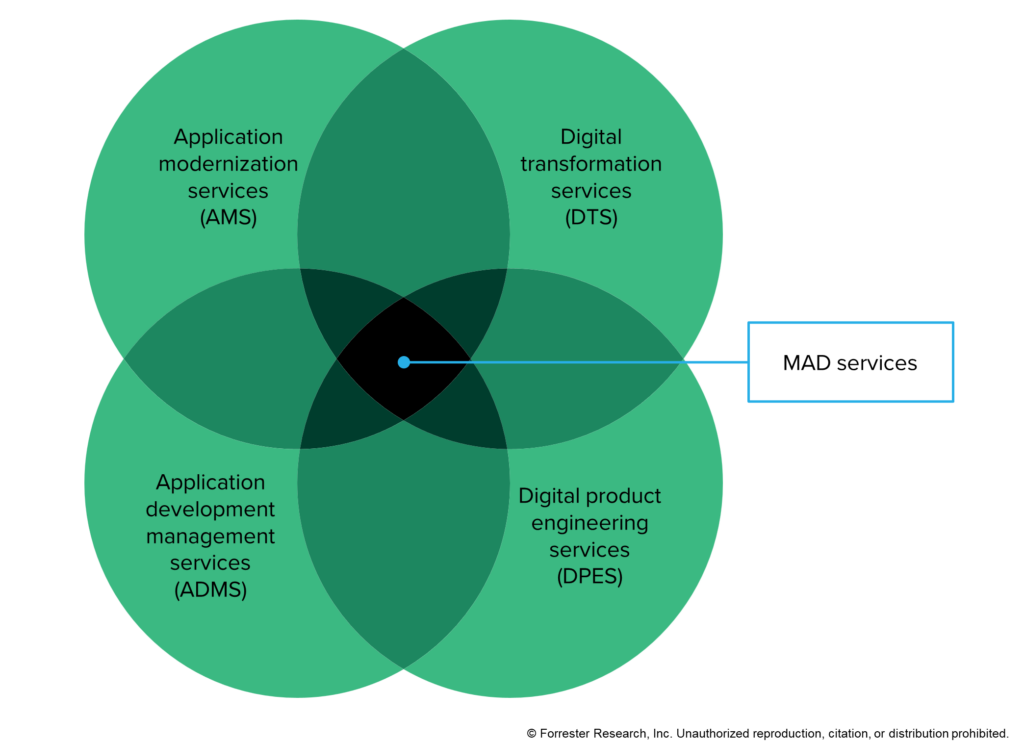
MAD Services Deliver Cool New Products While Transforming Your Development Capabilities Modern application development (MAD) services represent the next wave in custom application development services. Emerging from the convergence of current and past services such as application development management services (ADMS), digital transformation services (DTS), digital product engineering services (DPES), and broader application modernization services (AMS), MAD services are now utilized by leading organizations, with an increasing number of CIOs showing strong interest in these offerings (see figure below).   What sets MAD services apart? It’s their unique ability to not only support clients in delivering modern apps using the latest technologies and development practices but also their role in transforming and modernizing their custom development capabilities. The Venn diagram illustrates the context for MAD services and their foundational services, though it doesn’t capture the market’s multibillion-dollar scale, which is expected to grow. We just published The Forrester Wave™: Modern Application Development Services, Q1 2025, which analyzes and compares 13 medium and large market players out of more than 50 providers that offer MAD services: Accenture, Capgemini, CI&T, Cognizant, EPAM, Globant, HCLTech, Infosys, LTIMindtree, NTT DATA, Softtek, Tata Consultancy Services, and Thoughtworks. Why These Players And Not Others? The MAD services market is highly competitive, and Forrester clients can learn more about the broader landscape and discover a wider group of vendors in The Modern Application Development Services Landscape, Q3 2024. This most recent MAD services Wave’s analysis focuses on medium and large vendors compared to our previous Wave evaluation on the same market, in which the emphasis was on smaller ones. But not every company from the landscape report met the stringent criteria for inclusion in the Wave, which were: Significant peer recognition. These were providers most frequently cited in client bids. Forrester mindshare. This entails the service providers that were referenced more during briefings, inquiries, or research projects over the last year. MAD capabilities. The Wave’s vendors offer comprehensive and differentiating sets of MAD capabilities or, in Forrester’s view, unique capabilities that warrant inclusion. Global MAD services revenue of at least US$450 million. The included vendors have global MAD services revenue of US$450 million in at least two of the North America, LATAM, EMEA, or APAC regions combined. What Distinguishes The Leaders, Strong Performers, And Contenders? Our Wave methodology categorizes vendors into three groups, Leaders, Strong Performers, and Contenders, based on a range of services that we evaluated: agile, DevOps, microservices architecture, cloud services, and more advanced services such as site reliability engineering, project-to-product capabilities, AI and generative AI architecture services, and the testing and development of AI-infused applications. Showing differentiation in all these services was key to our evaluation. Reference clients, case studies, and other evidence also played a critical role in our analysis. After all, it’s the provider’s ability to enhance your team’s skills in new technologies and practices that truly differentiates MAD services from traditional ADMS or AMS services. We encourage readers not to dismiss any provider without first examining the detailed descriptions of strategy, capabilities, and client feedback in our Wave report. Download the accompanying Excel file for a breakdown of the questions, scoring, and criteria grading. For more information, feedback, or questions, email me at [email protected], or if you’re a Forrester client, schedule a guidance session or inquiry. I’m here to assist! source

Announcing The Forrester Wave™: Modern Application Development Services, Q1 2025 Read More »

Look For These Five Brand And Customer Experience Themes At CES 2025

On January 7, about 140,000 people will join serpentine queues in Las Vegas, where over 300 of the Fortune 500 will flaunt their wares at the world’s most revered tech show: CES 2025. Here are five things to expect this year (beyond mammoth TVs, flying cars, a John Deere tractor, and the occasional toilet-paper-carrying or ping-pong-playing robot): A Focus On Customer Experience You wouldn’t be faulted for thinking that CES is the “Customer Experience Show.” Over the last decade, the event has morphed into providing as much of a platform for brand and customer experiences as it does for tech mainstays such as consumer electronics and cars. Expect that trend to sustain as companies like Walmart, Delta, and John Deere show up in Las Vegas, where Accenture’s CEO will keynote on how technology can power the customer experience (CX). Everywhere AI CES, like the city it calls home, is prone to excess. In years past, the show has always doubled down on the tech du jour (such as the ubiquitous Alexa and the metaverse mania). This year, AI will be everywhere, in ways both astonishing and absurd. But one must ignore the hype and seek the diamonds in the rough. For example, CES 2025 will exhibit the world’s first AI-powered hotel, which, by design, sounds outlandish. But once you peel back the “Jetsons” layer, you will see that it’s really about AI driving pricing strategy for revenue maximization and creating personalized mobile app-based guest experiences (which is more evolution, less revolution). A Quest For What’s Next As the iPhone enters its golden years, there is a scramble to find the next singular technology that will define how consumers interact with brands. The promise of last year’s darlings such as the rabbit r1 has fizzled out but not without leaving an impression, albeit imperfect, of what the future of consumer digital experiences might look like. Expect wearables, especially glasses (given the buzz around Meta’s Ray-Ban glasses), to make a play for claiming that space. The Search For Salience The full spectrum of brand experience includes the process by which prospects search for and discover brands that they then engage with. Generative AI tools like ChatGPT and others are becoming an alternative to the conventional consumer search process for brand discovery, advice, and recommendations. AI providers such as Perplexity, which is rumored to be at CES although not exhibiting, are already testing the ad waters to let brands into that conversation. At this CES, expect many behind-the-scenes dialogues to happen about how brands can enter this new AI-powered consideration stream. AI-Powered Agents And now for something distinctly less flamboyant: There will be plenty of consumer-facing genAI agents at the show. But realize that in real life these conversations are fraught with risk and brands are extremely sensitive to such conversations spiraling out of control. Financial services brands, which tend to be quite risk-averse, have found that one of the best ways to deploy genAI to improve CX is by using it to empower customer service agents. At CES 2025, brands such as Goodyear will discuss why these unglamorous implementations may well be among the best applications for CX.   Learn more: Read my research on how brands grow and how they leverage digital touchpoints to better serve their customers. Follow my work: Go to my Forrester bio and choose “Follow.” Chat with me: If you are a Forrester client interested in discussing these topics, please schedule time with me for an inquiry or a guidance session. Plan a session: If you are a Forrester client looking to host a strategy session on a related topic (for example, “the future of digital consumer experience related to AI”), please contact your account team or email me at [email protected]. source

Look For These Five Brand And Customer Experience Themes At CES 2025 Read More »

Introducing the Forrester IT Management Systems Architecture

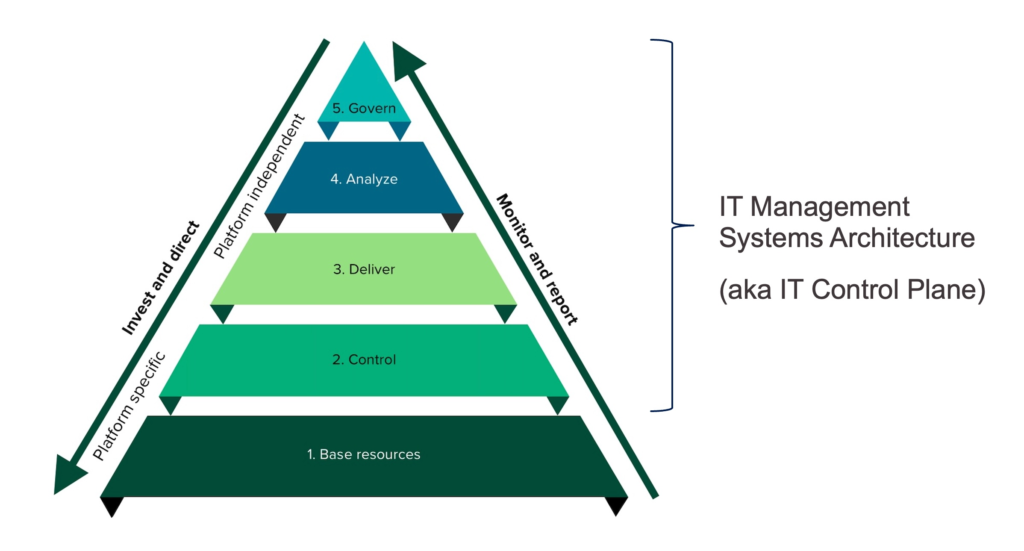
I’m pleased to announce the recent publication of the Forrester IT Management Systems Architecture. IT (information technology) uses a wide variety of systems to effectively run itself. Unlike other business areas, the discipline of IT management still relies on point, best-of-breed solutions, which require extensive integration to make them all work together. This foundational report presents a new layered architecture for understanding the systems used for secure IT delivery and discusses how this architecture will evolve in the future. This new report is a companion architecture to the Forrester Reference IT Capability Map. We maintain these two different views, in keeping with architecture best practices: The capability map shows your IT management concerns from an operating model perspective. In general, you own the development and evolution of these capabilities — they are not simply a matter of sourcing. The systems architecture classifies what you can source in the market to support your IT management capabilities, assisting you with managing this complex portfolio and identifying key integration areas and systems redundancy.   A key scoping boundary is between layer 1 and 2. Most of the multi-trillion global IT budget is spent at layer 1, representing the actual computing resources under management. Layer 1 is not in scope for the IT management systems architecture, per se. The systems in layers 2–5, while numerous and representing billions of dollars economically, are orders of magnitude less in terms of the overall share of the global IT market. The layers are defined as follows, with example systems (see the report for complete system classifications): Layer Description 5. ​Govern This is the layer at which IT investments are directed, monitored, and evaluated at the highest enterprise level and risks are tracked and controlled. It includes strategic portfolio management, enterprise architecture, risk management, and IT financial management.​ 4. ​Execute Work is defined, planned, and tracked here at a higher level, roughly aligned to a “team of teams.” This is where finances are tracked as well as higher-order concerns such as engineering performance, architecture, and technical debt. ​It includes value stream management (aka engineering performance), AIOps, and the recent trend toward security data pipeline management, among other categories. 3. ​Deliver This is the level of work management, the primary team layer. Work is coordinated and executed here, including preplanned as well as interrupt-driven work (which still must be resourced). ​It includes enterprise service management, security analytics, collaborative work management, and other products supporting team-level collaboration, among other categories. 2. ​Control This is the “closest to the metal” layer of the overall control plane. It is the layer of the individual contributor. It represents element management tooling that directly interacts with the resources under management, discovering, instantiating, and configuring them, facilitating the construction and deployment of new software, and monitoring and correcting exceptions.​ It includes products such as integrated software delivery platforms (DevOps platforms), testing automation (including security testing such as software composition analysis), endpoint management, and infrastructure automation, among other categories. 1. ​IT resources These are the core IT “things”: physical and virtual machines, clusters, serverless resources, software installed on them, networking, storage/data, and security infrastructure, along with the myriad configuration settings controlling all of this. This may be on-premises, in the cloud, or hybrid.​ This layer is out of scope for the architecture per se. What’s next in this research stream? Patterns of integration, which may ultimately drive market behavior. Recently, we’ve identified five major integration focal points in the overall architecture:   Core portfolio (configuration management database [CMDB] + enterprise architecture) AIOps Engineering performance/value stream management FinOps Risk and security operations These focus areas bring together data from most of the rest of the IT management systems. From an architecture perspective, the core portfolio is leveraged heavily by the other four (hence the durability of the often-maligned CMDB), and there is growing concern among enterprise architects I talk to about redundancy across the data marts that these product categories represent — integrations add complexity and maintenance costs. If you are an end user figuring out the big picture of your IT management systems or a vendor with a value proposition here (especially an integrative value proposition), I’d love to talk to you. source

Introducing the Forrester IT Management Systems Architecture Read More »

Order Management Systems And A Story Of Augmented Evolution

Findings From The Forrester Wave™: Order Management Systems, Q1 2025 Digital leaders know that order management systems (OMSes) are true workhorses at the heart of the commerce tech ecosystem, providing inventory, order, logistic, and operational tools. But the current OMS market shakes off all the basics. It is a story of evolution — on the part of both the vendors and the users of these systems. Our latest Forrester Wave™ evaluation of the market uncovered this new evolutionary tale. The majority of digital leaders with an OMS are happy enough to keep it (though not nearly as many as those sticking with their B2C commerce solution). But many also aren’t just blindly relying on their vendor to keep them ahead of the innovation curve. The state of the enterprise OMS market in 2025 is about: More businesses augmenting their current solution with individual modules of another — usually more modern — solution. We saw certain vendors used this way in the previous evaluation. In 2025, the rip-and-replace is less common than ever as businesses avoid (or at least delay) a replacement in favor of an incremental evolution. (Stay tuned for our fascinating Forrester Total Economic Impact™ [TEI]-based report on exactly this topic!) Broader business impacts from OMSes. Beyond expected — though matured — functionality such as AI-driven routing logic to the less expected, these solutions are going further than their traditional remit. Vendors find competitive differentiation in their solutions’ support for in-store processes (like servicing pickup orders), how they enable end customers to self-serve, and even how they deploy their solutions, creating easier on-ramps for digital businesses. Servicing different users in different ways. Although we know that unified commerce is not a thing, unification matters. Specifically, it matters that any given user has a consistent, unified, nonfrustrating experience. The market is out of patience with juggling multiple, disparate, integrated (but not unified) experiences from a single vendor. But when users are truly unique (e.g., technical users, nontechnical practitioners, and in-store associates), some OMS vendors serve uniquely appropriate experiences for each. Digital businesses selecting replacement OMS solutions — or adding pieces on top of their existing one — have a new set of decisions to make. The functionality is broader, the tooling more specialized, and the delivery more modular. Forrester clients, get in touch so I can walk you through the results of our brand-new evaluation, The Forrester Wave™: Order Management Systems, Q1 2025, the new Wave model, and Forrester’s interactive digital experience for the Wave. source

Order Management Systems And A Story Of Augmented Evolution Read More »

Getting Smart On Content Intelligence

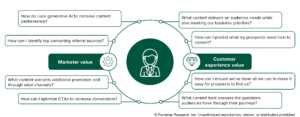
Back in March 2023, I published The Future Of B2B Content, a report that I reflected upon in recent weeks when my colleague Jessie Johnson and I published a new report, In The Age Of AI, Marketers Need To Rethink Content Intelligence. In the first report, I proposed that marketers must take a fresh look at the nature of content, pointing out that, instead of thinking of content as a container of information that’s pushed to an audience, marketers must leverage content as data in an information exchange with customers and other stakeholders. In that report, I quoted Bence Gazdag, vice president, global marketing technology, at Oracle, which remains prescient: “Today, companies predict a customer journey; in the future, we’ll simply read their actual journey in the data — that’s the nirvana.” We may not have reached that nirvana, but with AI, it’s perhaps a whole lot closer! In the new report, we define content intelligence as: The capture, correlation, and analysis of data about content and its consumption to inform buyer and customer insights, drive activation, and deliver more meaningful performance measurement. Content intelligence provides a data-based framework for marketers to harness predictive and generative AI to uncover buying signals and exchange value with buyers and customers through the differentiated experiences they demand. By doing so, marketers can transition from an often vicious cycle of ineffective content production to a virtuous cycle of continuously improving the customer experience with more personalized engagement. Andrew Bolton, chief customer officer at Knotch, put it this way: “Content measurement provides a metric, but content intelligence reveals the ‘why’ behind it — and, more importantly, guides and supports the actions to take based on that insight.” Forrester’s Marketing Survey, 2024, shows that two-thirds of B2B marketing decision-makers said they would increase their marketing tech spending on AI content creation. Doing so will open a world of content intelligence opportunity. Generative AI helps B2B marketers leverage content as data by creating asset and interaction metadata that helps them detect, classify, and extract buying signals from buyer and customer interactions. Because AI features in content technologies can auto-tag content attributes, content intelligence is codified into asset creation and activation. Then, by effectively analyzing audience and interaction intent and scenarios, marketers can use content intelligence to activate and tailor content, adapt and optimize it, and deliver increasingly frictionless, personalized interactions. We recommend that all marketers with B2B content responsibilities start putting the essential building blocks for content intelligence in place. Evaluate the current technology that is supporting the content lifecycle for content intelligence capabilities and include your digital engagement systems, revenue marketing platforms, and conversation automation systems. This will help solidify your genAI and overall content technologies roadmap to plot where such capabilities may be built into the solutions you plan to adopt. Make 2025 the year you get smart on content intelligence! Forrester Decisions clients: Access the report to learn more about harnessing content intelligence and reach out to your account manager to schedule guidance or inquiry sessions. Also, consider attending our Content Intelligence Workshop at Forrester’s B2B Summit North America 2025 this March 31–April 3 in Phoenix.   source

Getting Smart On Content Intelligence Read More »

Key Insights From The Forrester Wave™: Experience Optimization Solutions, Q4 2024

Not long ago, we predicted that 2025 would be another year of customer experience (CX) mediocrity, but this rather gloomy outlook also provides an opportunity for bold leaders to buck the trend. Many will aim to do so by doubling down on digital experiences. According to Forrester’s Priorities Survey, 2024, adding or improving digital experience is the top action that business and technology professionals who indicated that improving the experience of their customers is a priority for their organization are taking to improve CX. Experience optimization (EO) solutions enable you to do exactly this: They help improve digital experience in real time by collecting and ingesting data, analyzing data to generate insights, and ideating and delivering thousands of different personalized digital experiences. Forrester defines EO solutions as: Solutions that enable the ongoing delivery of relevant, timely, and optimized digital experiences to meet evolving customer needs by leveraging cross-channel customer interactions. EO Solutions Support A Variety Of Use Cases That Win, Serve, And Retain Customers By helping digital teams understand and meet customers’ unique and evolving needs, EO solutions help their organizations win, serve, and retain customers. They also support a broad range of different use cases. The core use cases enabled by EO solutions are experimentation; next-best product, offer, or action; next-best experience; and experimentation with recommendations or personalization. Extended use cases focus on customer audience and segments, user experience/product/customer behavior understanding, cross-channel optimization, automatic optimization opportunities discovery, customer feedback and experimentation, and feature experimentation. EO Solutions Leverage GenAI To Help Companies Manage Personalization At Scale The EO market has evolved from basic online testing capabilities to offering AI-powered personalization and generative AI (genAI) applications, such as opportunities identification, creative assets generation, or segments creation. If you are looking to purchase or upgrade your EO solution, you can leverage our newly published report, The Forrester Wave™: Experience Optimization Solutions, Q4 2024, to evaluate the top 11 players and identify the best vendor for you. As you consider your options, pay attention to the following differentiators: GenAI. Providers with robust genAI capabilities have the potential to streamline the creation and optimization of digital experiences, thus facilitating a more tailored customer journey. Data integration. Advanced EO solutions stand out by integrating diverse data sources, not limited to digital interactions, to enable more effective personalization. Strategy support. Look to EO providers that offer not just technology but also strategic guidance, helping their clients refine and implement effective EO strategies. Don’t Just Count On EO Solutions To Satisfy Your Analytics Requirements Our research revealed a gap (and an opportunity) around digital analytics. Regardless of the vendor, EO customers complained about the analytics capabilities provided in their platforms. While they acknowledge the necessity of integrating EO solutions with their digital analytics solution to better inform EO activities as well as understand their performance, they’d like EO solution providers to strengthen native EO analytics capabilities. For instance, a multi-brand company told us that it’s currently unable to compare EO performance across its various brands within its EO platform. Instead, customers need to download the data from the EO solution and conduct this analysis separately. This isn’t surprising in the context of the history of EO solutions: Vendors in this space are focused on helping clients take action on data, and this is their core job, but they underestimate the importance of the analysis that informs EO. No one expects EO vendors to become the next Google Analytics, but improving analytics capabilities is a clear opportunity in two areas: 1) understanding the parts of the experience that need to be optimized, and for which customers and 2) understanding the performances of optimization activities to identify potential improvements. If you wish to understand the EO market better and which EO solution can be right for you, please schedule an inquiry or a guidance session with us. source

Key Insights From The Forrester Wave™: Experience Optimization Solutions, Q4 2024 Read More »