Pew Research Center

How the U.S. Public and AI Experts View Artificial Intelligence

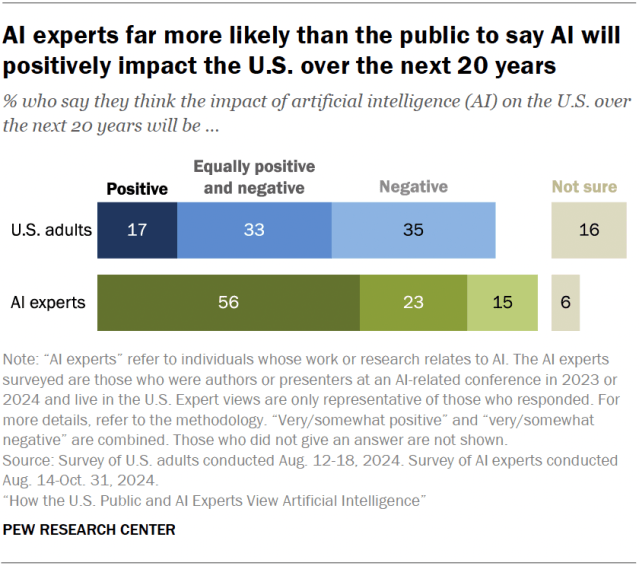
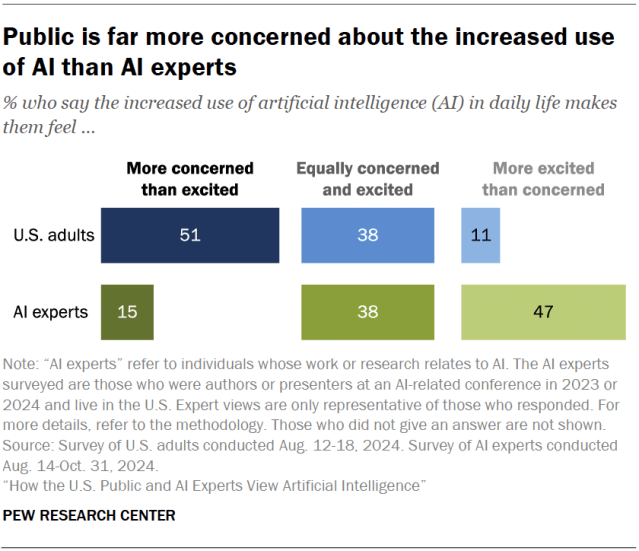
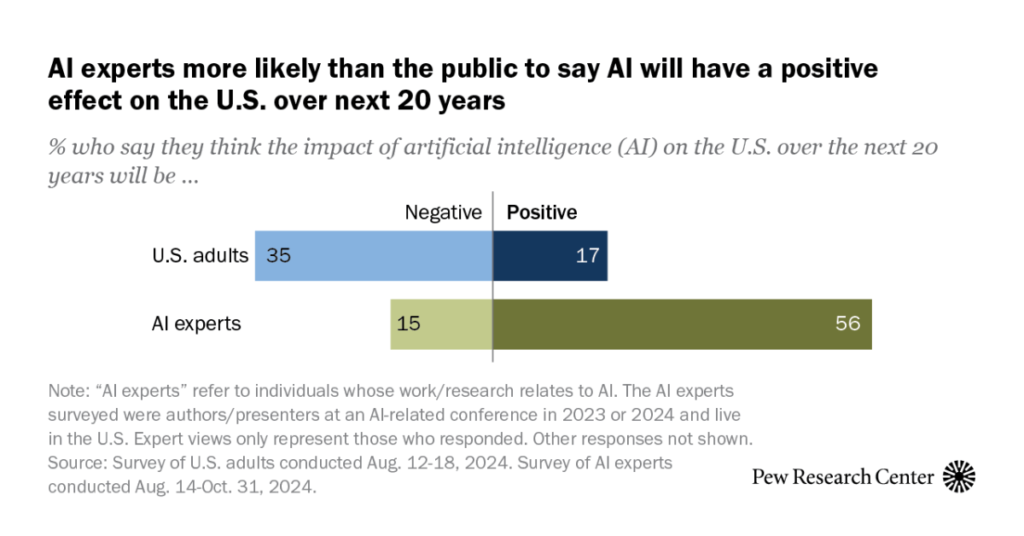
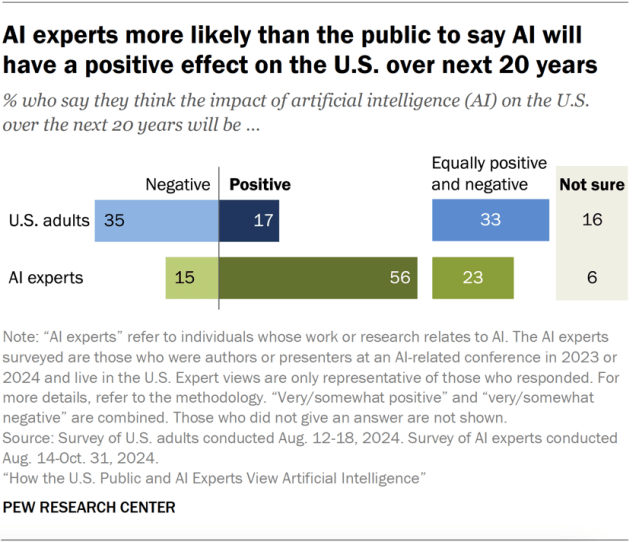
The public and experts are far apart in their enthusiasm and predictions for AI. But they share similar views in wanting more personal control and worrying regulation will fall short How we did this Pew Research Center conducted this study to understand how Americans’ views of artificial intelligence compare with the views of those who have expertise in the field. This report includes findings from a survey of U.S. adults, a survey of AI experts and a series of in-depth interviews with experts. Survey of U.S. adults To understand the views of the American public, we surveyed 5,410 adults from Aug. 12 to Aug. 18, 2024. Everyone who took part in this survey is a member of the Center’s American Trends Panel (ATP), a group of people recruited through national, random sampling of residential addresses who have agreed to take surveys regularly. This kind of recruitment gives nearly all U.S. adults a chance of selection. Interviews were conducted either online or by telephone with a live interviewer. The survey is weighted to be representative of the U.S. adult population by gender, race, ethnicity, partisan affiliation, education and other factors. Read more about the ATP’s methodology. Survey of AI experts To understand the views of AI experts, we surveyed 1,013 AI experts living in the United States from Aug. 14 to Oct. 31, 2024. To create the sample, Center researchers compiled a list of authors and presenters at 21 AI-related conferences held in 2023 or 2024. Surveys were conducted online, and experts were asked to confirm that they live in the U.S. and that their work or research relates to AI before proceeding. Because there is no definitive source of population benchmarks for this group, responses from the expert survey are unweighted. They are only representative of the views of experts who responded to the survey. In-depth interviews with AI experts To further explore expert views, we conducted 30 in-depth interviews with AI experts from Oct. 18 to Nov. 26, 2024. The interviews were designed to give AI experts across a range of different demographic dimensions, including race, ethnicity and gender, a chance to elaborate on their views. However, the in-depth interviews are not representative of any demographic group or AI experts as a whole. Quotes have been lightly edited for grammar and clarity. Here are the questions used for this report, the toplines and the methodology. With artificial intelligence no longer the stuff of science fiction, its benefits and risks are being debated by everyone from casual observers to scholars. A new Pew Research Center report examines the views of two key groups: the American public and experts in the field of AI. These surveys reveal both deep divides and common ground on AI. AI experts are far more positive than the public about AI’s potential, including on jobs. Yet both groups want more personal control of AI and worry about lax government oversight. Still, opinions among experts vary, with men more optimistic about AI than women. Here are the key findings from surveys of U.S. adults and AI experts conducted in 2024, and in-depth interviews with experts. Key findings Experts are far more positive and enthusiastic about AI than the public. For example, the AI experts we surveyed are far more likely than Americans overall to believe AI will have a very or somewhat positive impact on the United States over the next 20 years (56% vs. 17%). And while 47% of experts surveyed say they are more excited than concerned about the increased use of AI in daily life, that share drops to 11% among the public. By contrast, U.S. adults as a whole – whose concerns over AI have grown since 2021 – are more inclined than experts to say they’re more concerned than excited (51% vs. 15% among experts). Jump to: Who did we define as “AI experts” and how did we identify them? Larger shares of experts than of U.S. adults see AI as personally beneficial. Far more of the experts we surveyed believe these technologies will benefit (76%) rather than harm (15%) them personally. The public is far more likely to think AI will harm them (43%) than benefit them (24%). Still, one-third say they’re unsure. Public optimism is low regarding AI’s impact on work. While 73% of AI experts surveyed say AI will have a very or somewhat positive impact on how people do their jobs over the next 20 years, that share drops to 23% among U.S. adults. Large gaps are also present in views about AI’s effect on the economy, medical care, education and art. Both groups are skeptical of AI’s role in news and elections. Only about one-in-ten U.S. adults and experts think AI will have a positive impact on elections. Small shares in each group say the same for news. Similar shares of the public and experts want more control and regulation of AI. More than half of U.S. adults (55%) and a similar share of AI experts (57%) say they want more control over how it is used in their lives. And those in both groups worry more that government regulation of AI will be too lax than overly excessive. There are notable gender differences in the way people view AI, but these gaps are more pronounced among experts we surveyed.   Our previous surveys of U.S. adults have shown that women are often more wary than men about AI. This is true in the current survey. For example, 22% of men think AI will positively impact the U.S., compared with 12% of women.  These differences are even wider among the experts surveyed: 63% of men say AI’s impact on the U.S. over the next two decades will be very or somewhat positive, compared with 36% of women. Among experts, men are also more likely than women to say they’re more excited than concerned about AI (53% vs. 30%) or think AI will personally benefit them (81% vs. 64%). Views also vary based on the type of

How the U.S. Public and AI Experts View Artificial Intelligence Read More »
5. Religious switching into and out of Hinduism

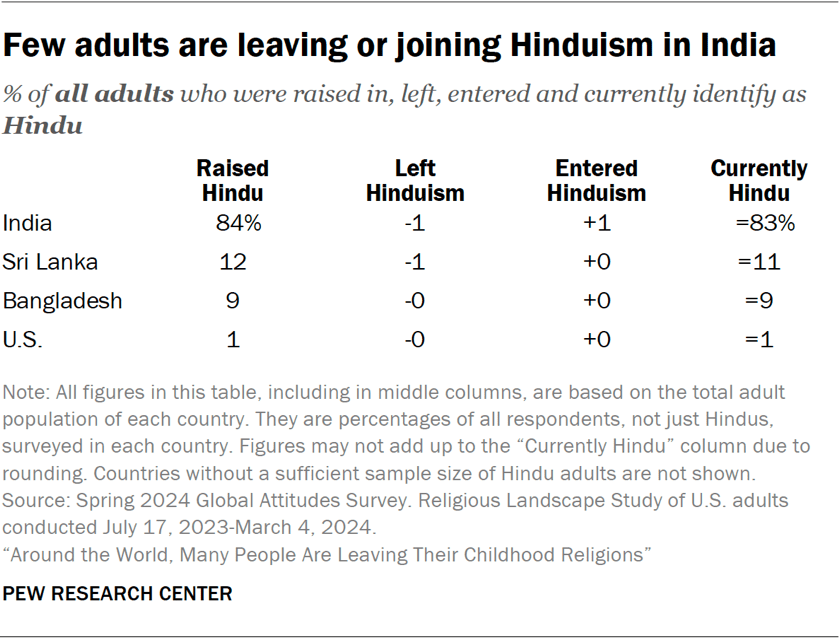
Terminology Throughout this report, religious switching refers to a change between the religious group in which a person says they were raised (during their childhood) and their religious identity now (in adulthood). The rates of religious switching are based on responses to two survey questions we asked of adults ages 18 and older: “What is your current religion, if any?” “Thinking about when you were a child, in what religion were you raised, if any?” The responses to these two questions allow us to calculate what percentage of the public has left a religious group (or “switched out”) and what percentage has entered (or “switched in”). This kind of switching can take place without any formal rite or ceremony. We have analyzed switching into and out of five widely recognized, worldwide religions to allow for consistent comparisons around the globe. Specifically, this report analyzes change between the following groups: Christianity, Islam, Judaism, Buddhism, Hinduism, other religions, religiously unaffiliated adults, and those who did not answer the question. For example, someone who was raised Buddhist but now identifies as Christian would be considered as having switched religions – as would someone who was raised Christian but is now unaffiliated. However, switching within a religious tradition, such as between Catholicism and Protestantism, is not captured in this report. (Refer to Pew Research Center’s 2023-24 Religious Landscape Study for an analysis of switching in the United States that does count some switching within Christianity. Read “4 facts about religious switching within Judaism in Israel” for an analysis of switching within Judaism.) Religiously unaffiliated refers to people who answer a question about their current religion (or their upbringing) by saying they are (or were raised as) atheist, agnostic or “nothing in particular.” This category is sometimes called “no religion” or “nones.” Other religions is an umbrella category. It contains a wide variety of religions that are not in the other categories and that have survey sample sizes too small to analyze separately in most countries. This includes Sikhism, Jainism, the Baha’i faith, African traditional religions, Native American religious traditions, and others. Disaffiliation rates refer to the percentage of adults who say they were raised in a religion but are now religiously unaffiliated (or have no religion). Net gains/losses are the differences between the percentage of survey respondents who say they were raised in a particular religious category (as children) and the percentage who identify with that same category at the time of the survey (as adults). The “net” gain or loss takes into account both sides of the equation – those who have left and those who have entered the group. Retention rates show, among all the people who say they were raised in a particular religious group, the percentage who still describe themselves as belonging to that group today. Accession rates (also called entrance rates) show, among all the people who describe themselves as belonging to a particular religious group today, the percentage who were raised in some other group. This section explores religious switching into and out of Hinduism, reviewing where Hinduism has had the largest net gains and losses, what percentage of adults who were raised Hindu are still Hindu (i.e., retention rates), which religious groups those who have left Hinduism have switched into, and where Hinduism has the largest shares of new entrants (i.e., the highest accession rates). Of the 36 countries surveyed, just four have sufficient sample sizes to allow analysis of religious switching into and out of Hinduism: Bangladesh, India, Sri Lanka and the United States. Net gains and losses for Hinduism Very small shares of the overall population in any of the countries analyzed have left or joined Hinduism. In the U.S., Hindus are a small share of the population to begin with (1%). Remaining Hindu The Hindu retention rate is high in all the places analyzed, but there is some variation. Nearly all people who were raised Hindu in India and Bangladesh still identify as Hindu today. In Sri Lanka, roughly nine-in-ten people who were brought up as Hindus have retained that identity, as have about eight-in-ten in the U.S. Leaving Hinduism Of the countries surveyed, the highest shares of people raised Hindu who no longer identify as Hindu are in the U.S. (18%) and Sri Lanka (11%). In Sri Lanka, most who have left Hinduism now identify as Christians. In the U.S., 11% of people who were raised Hindu are now religiously unaffiliated (i.e., they identify religiously as atheist, agnostic or “nothing in particular”) and 6% are Christians. Entering Hinduism Most people who currently identify as Hindu say they were raised as Hindus, resulting in low “accession” (or entrance) rates into Hinduism across the four countries analyzed. The U.S. has the highest accession rate, with 8% of Hindu American adults saying they were raised outside of Hinduism. Where has Hinduism experienced the largest net gains or losses from religious switching? Across the four countries analyzed, relatively few people (at least, as a percentage of the overall public in each country) have either left or entered Hinduism. For instance, in India, the country with the world’s largest Hindu population, roughly equal shares of Indians say they were raised Hindu (84%) and currently identify as Hindu (83%). Only 1% of all Indian adults have left Hinduism, and a similarly small share have become Hindus after having been raised in another religion or with no affiliation. In the U.S., just 1% of adults were raised Hindu, and the percentage of all U.S. adults who have left Hinduism rounds to zero – as does the percentage who have switched into Hinduism. What percentage of people raised Hindu are still Hindu? The Hindu retention rate is high in all the countries where it can be measured. For example, in Bangladesh and India, nearly all adults who were raised Hindu still identify as Hindu today (99% each). Which religious groups have former Hindus switched to? Analyzing retention rates also reveals the religious groups that former Hindus have joined. In the

5. Religious switching into and out of Hinduism Read More »

3. Public and expert predictions for AI’s next 20 years

The rapid rise of artificial intelligence promises to transform many aspects of life, from education and work to personal connections. Over the next 20 years, AI advancements will continue. But whether this leads to excitement or concern or brings more benefits than harm is highly debated. This chapter examines how the American public and experts anticipate AI’s impact across key areas in the coming decades. How will AI impact the U.S. over the next 20 years? There are many predictions for what AI may bring. However, the public and experts don’t see eye to eye on the type of impact AI will have on the country. Fully 56% of AI experts surveyed say AI will have a very or somewhat positive impact on the United States over the next 20 years. This compares with 17% among the general public. Conversely, 35% of U.S. adults believe AI will negatively affect the country over the next two decades, compared with 15% of experts. The public is also more likely than experts to say that AI’s impact on the U.S. will be equally positive and negative (33% vs. 23%) or that they’re unsure (16% vs. 6%). By gender, among AI experts surveyed and U.S. adults There are substantial gender differences among experts on AI’s potential impact on the country. Among AI experts surveyed, men are far more likely than women to say AI’s impact would be positive (63% vs. 36%). Female experts are more likely than their male counterparts to predict negative outcomes (23% vs. 12%) or to foresee an equal mix of both (36% vs. 19%). Gender gaps are also present among U.S. adults, but they are far more modest than the differences seen among experts.  Among all adults, 22% of men say AI will have a positive impact on the U.S., compared with 12% of women. (Refer to Appendix B for more details on how views vary by demographic groups.) By job sector, among AI experts surveyed We also explored experts’ views by job sector. About six-in-ten experts surveyed who work for a private company or business (63%) believe AI’s impact on the U.S. will be positive. Among those who work at a college or university, that share is 55%. AI’s impact on elections, education, jobs and health care Our survey examined public and expert opinions on AI’s impact across 10 specific sectors, revealing areas of disagreement and alignment. The starkest differences between experts and the public are about AI’s influence on work and the economy. AI experts surveyed are far more likely than the general public to believe that over the next 20 years, AI will have a very or somewhat positive impact on how people do their jobs (73% vs. 23%) or the economy (69% vs. 21%). Views also vary widely on AI’s impact on health care, education and the arts. Even as medical care is the one area in which the public is most optimistic about AI’s impact, experts are 40 percentage points more likely than the general population to believe it will positively affect medical care (84% vs. 44%). AI experts are also more likely than the public to think this technology will benefit K-12 education (61% vs. 24%) or arts and entertainment (48% vs. 20%). Still, some areas show more common ground, notably elections and news. AI experts and the public are both wary of AI’s role in politics and journalism. Just 11% of experts surveyed and 9% of the public believe AI will positively impact elections in the U.S. over the next 20 years. In fact, 61% of these experts believe AI will harm elections in the future, with 50% of the public saying the same. News is also an area where small shares of experts (18%) and the public (10%) believe it will be a good thing for the country. About half or more of experts (56%) and the public (51%) predict it will negatively affect the news people get. It’s also worth noting that the general public is generally more unsure of their predictions. For example, about a quarter of U.S. adults say they are not sure of the type of impact AI will have on the criminal justice system (28%), personal relationships (24%) or elections (23%). By gender, among AI experts surveyed There are sizable gender differences among experts in their views about AI’s impact on certain aspects of society. For example, 68% of male experts surveyed say AI’s impact on K-12 education over the next 20 years will be very or somewhat positive, compared with 42% of female experts. Among AI experts, men are also more likely than women to say AI will lead to positive outcomes for the environment (43% vs. 18%), medical care (89% vs. 72%) and the economy (74% vs. 57%), for example. By gender, among U.S. adults While the public is less confident than experts about AI’s potential positive impact on the country, there are also gender differences among U.S. adults overall. Men are consistently more optimistic than women regarding AI’s potential over the next two decades, particularly in medical care (54% vs. 34%). Larger shares of men than women say AI will benefit other areas, like how people do their jobs and the environment. There is agreement on AI’s impact on elections, with only about one-in-ten men and women saying it will have a positive effect. Will AI lead to fewer jobs? We’ve seen anxiety in our prior work around AI and jobs both among the public and workers. Our current survey finds this sentiment is more widely held among the general public than among AI experts. Overall, 64% of U.S. adults say that over the next 20 years, AI will lead to fewer jobs in the U.S., while just 5% think it will lead to more jobs. And more than one-in-ten say it either won’t make a difference (14%) or that they’re unsure (16%).  AI experts’ opinions are more mixed. Roughly four-in-ten (39%) foresee fewer jobs due to AI over the next two decades.

3. Public and expert predictions for AI’s next 20 years Read More »

2. Views of risks, opportunities and regulation of AI

As the role of artificial intelligence in daily life grows, its challenges and opportunities are front and center for experts and the public alike. This chapter covers where experts and the American public differ in their excitement and worries, as well as where they think AI might surpass humans. It also walks through the areas of agreement, such as on government regulation, corporate responsibility, and concerns about AI bias and misinformation.   Concern and excitement over AI AI experts are far more enthusiastic than the American public about the increased use of AI in daily life. The public, on the other hand, expresses far more concern. Roughly half of the experts surveyed say they are more excited than concerned (47%) about the increased use of AI in daily life. By contrast, only 11% of U.S. adults say this. About half of U.S. adults (51%) say they are more concerned than excited. This drops dramatically to 15% among the experts surveyed. What’s more, the U.S. public has become more concerned over recent years. The share who say they are more concerned than excited increased from about four-in-ten in 2021 and 2022 to roughly half in 2023. Today, identical shares of both groups say that they are equally concerned and excited (38% each).  By gender, among AI experts surveyed and U.S. adults Among both the public and AI experts, men are more excited than women about the increased use of AI in daily life. The gender difference on excitement is wider among AI experts, though. AI experts: A far greater share of men than women say they are more excited than concerned (53% vs. 30%). While just 11% of men say they’re more concerned than excited, that ticks up to 24% of women. U.S. public: Men are again more likely than women to say they are more excited than concerned (15% vs. 7%). While 46% of men are more concerned, that rises slightly to 55% among women. In in-depth interviews, we asked AI experts about what uses of AI excite them, and why. Some themes include making life easier or more efficient and improving outcomes for certain industries. (Quotes have been lightly edited for grammar and clarity.) Quotes from AI experts: Reasons for excitement about AI “I think broadly some of the things that excite me are things like applications that can save people a lot of time from repetitive and mundane tasks. So I think automating some of those workflows.” “I’ve seen that the AI can improve a lot the accuracy of the diagnosis of different diseases. Also, it can boost the development of different medicines for different treatments. Like for instance, for breast cancer classification, it can improve a lot. It can decrease the false positive rates and false negative rates. Most excited about the positive impact that it could have in the health industry.” And we also asked experts what uses of AI concern them, and why. Some themes include data privacy and misinformation. Quotes from AI experts: Reasons for concern about AI “I do think about how that [airport biometrics] technology is used, especially from a privacy and security standpoint. … Where’s that data going? How is it being housed? Where is it being used for? Where is my consent? Can I really, truly say no, I don’t want my picture taken, but what is the consequence of me saying that and still trying to make it to my flight at home?” “Misinformation has always been an issue with technology. … But I think the main issue with AI and misinformation is that you can now do misinformation at scale, at a way larger scale.” A 2021 Center survey found that some related themes also arose among U.S. adults when asked why they were either more concerned or more excited.  Specific concerns about AI Our new survey also gives us the chance to compare expert and public concern in several key areas, including those related to “deepfakes,” misinformation, job displacement and AI bias. The public is more worried about losing jobs – and human connection – than AI experts. Continuing a theme from our broader body of research, we find the public is anxious about AI’s impact on work. More than half of U.S. adults are extremely or very concerned about AI eliminating jobs, versus a smaller share of experts surveyed (56% vs. 25%). The public also fears the loss of human connection more than experts do (57% vs. 37%). There’s wide concern about inaccurate information. Seven-in-ten of the experts we surveyed and 66% of U.S. adults are highly worried about people getting inaccurate information from AI. Impersonation and data misuse are also among the top concerns. The public is more worried about each of these things than experts – most U.S. adults are highly worried. Still, six-in-ten experts say they are extremely or very concerned about data misuse, and roughly two-thirds say this about AI being used to impersonate people. Experts and the public align in their concerns about bias. Identical shares of each group (55%) are highly worried about this. About half or more of experts and the public also express notable concern about people not understanding what AI can do. By gender, among AI experts surveyed and U.S. adults There are gender differences on specific concerns about AI as well. Some of the biggest are on data misuse, bias and inaccurate information. On the other hand, women feel similarly to men about impersonation and job loss. Among the general public, most gender differences on this topic are minimal. Loss of human connection is one place we see women being somewhat more concerned in both groups, though. Women are slightly more likely than men to be highly worried about AI leading to this, both among experts (45% vs. 35%) and the public (63% vs. 52%). AI’s personal impact For some, concerns about AI extend to how they see their own futures. The public is more likely to foresee personal harm from AI than benefit, though

2. Views of risks, opportunities and regulation of AI Read More »

Appendix B: Selected tables by expert and public demographics

ABOUT PEW RESEARCH CENTER Pew Research Center is a nonpartisan, nonadvocacy fact tank that informs the public about the issues, attitudes and trends shaping the world. It does not take policy positions. The Center conducts public opinion polling, demographic research, computational social science research and other data-driven research. Pew Research Center is a subsidiary of The Pew Charitable Trusts, its primary funder. source

Appendix B: Selected tables by expert and public demographics Read More »

2. Religious switching into and out of the religiously unaffiliated group

Terminology Throughout this report, religious switching refers to a change between the religious group in which a person says they were raised (during their childhood) and their religious identity now (in adulthood). The rates of religious switching are based on responses to two survey questions we asked of adults ages 18 and older: “What is your current religion, if any?” “Thinking about when you were a child, in what religion were you raised, if any?” The responses to these two questions allow us to calculate what percentage of the public has left a religious group (or “switched out”) and what percentage has entered (or “switched in”). This kind of switching can take place without any formal rite or ceremony. We have analyzed switching into and out of five widely recognized, worldwide religions to allow for consistent comparisons around the globe. Specifically, this report analyzes change between the following groups: Christianity, Islam, Judaism, Buddhism, Hinduism, other religions, religiously unaffiliated adults, and those who did not answer the question. For example, someone who was raised Buddhist but now identifies as Christian would be considered as having switched religions – as would someone who was raised Christian but is now unaffiliated. However, switching within a religious tradition, such as between Catholicism and Protestantism, is not captured in this report. (Refer to Pew Research Center’s 2023-24 Religious Landscape Study for an analysis of switching in the United States that does count some switching within Christianity. Read “4 facts about religious switching within Judaism in Israel” for an analysis of switching within Judaism.) Religiously unaffiliated refers to people who answer a question about their current religion (or their upbringing) by saying they are (or were raised as) atheist, agnostic or “nothing in particular.” This category is sometimes called “no religion” or “nones.” Other religions is an umbrella category. It contains a wide variety of religions that are not in the other categories and that have survey sample sizes too small to analyze separately in most countries. This includes Sikhism, Jainism, the Baha’i faith, African traditional religions, Native American religious traditions, and others. Disaffiliation rates refer to the percentage of adults who say they were raised in a religion but are now religiously unaffiliated (or have no religion). Net gains/losses are the differences between the percentage of survey respondents who say they were raised in a particular religious category (as children) and the percentage who identify with that same category at the time of the survey (as adults). The “net” gain or loss takes into account both sides of the equation – those who have left and those who have entered the group. Retention rates show, among all the people who say they were raised in a particular religious group, the percentage who still describe themselves as belonging to that group today. Accession rates (also called entrance rates) show, among all the people who describe themselves as belonging to a particular religious group today, the percentage who were raised in some other group. This section takes a closer look at religious switching into and out of the religiously unaffiliated category, which consists of people who describe their religion as atheist, agnostic or “nothing in particular.” This group is sometimes referred to as religious “nones.” Read on for details about where the religiously unaffiliated population has had the largest net gains, what percentage of people raised without a religion are still unaffiliated (i.e., retention rates), which religious groups those who have left the unaffiliated have switched into, and where the religiously unaffiliated population has the largest shares of new entrants (i.e., the highest accession rates). Of the 36 countries surveyed, 22 have sufficient sample sizes of “nones” to allow analysis of religious switching into and out of the religiously unaffiliated group. Net gains for the religiously unaffiliated In almost every country analyzed, more people have entered the religiously unaffiliated category than have left it. Spain has had the largest net gains for the religiously unaffiliated from religious switching. Remaining religiously unaffiliated In many countries, the majority of adults who were raised without a religion are still unaffiliated as adults. This ranges from 63% in Argentina to 92% in Japan. Leaving the religiously unaffiliated In the countries with the largest shares of people leaving the unaffiliated – such as in Argentina – these losses are largely due to people switching to Christianity. Some places, such as Singapore, also have seen a small percentage of unaffiliated people switching to Buddhism or Islam. Entering the religiously unaffiliated Italy, Colombia and Greece have the highest levels of “accession,” or entrance, into their religiously unaffiliated populations, with roughly nine-in-ten unaffiliated adults in these countries saying they were raised in a religious tradition. Currently, 23% of Italian and Colombian adults, along with 14% of Greeks, identify as unaffiliated. Among those who have switched to become religiously unaffiliated, many were raised Christian. Where have the religiously unaffiliated experienced the largest net gains from religious switching? In over half the countries surveyed, more adults say they were raised with a religious affiliation and are now unaffiliated than say they were raised unaffiliated but have since joined a religion. To put it another way, the unaffiliated population has experienced net gains from religious switching. In Sweden, for example, 52% of adults currently identify as religiously unaffiliated, while just 22% say they were raised without a religion – a difference of 30 percentage points. It results from 32% of all Swedish adults saying they have left their childhood religion and now identify as “nones,” while just 2% of Swedish adults have moved in the opposite direction – from having no religion as children to identifying with a religion as adults. Even though South Korea has the largest share of adults who have left the ranks of the religiously unaffiliated and taken on a religion (9%), there are far more Koreans who say they were raised in a religion and have since disaffiliated (31%), yielding a 22% net gain for the unaffiliated population among all South Korean

2. Religious switching into and out of the religiously unaffiliated group Read More »

Around the World, Many People Are Leaving Their Childhood Religions

Surveys in 36 countries find that Christianity and Buddhism have the biggest losses from ‘religious switching’ Light shines through the doors of Zionskirche, a Protestant church in Berlin. (Busà Photography/Getty Images) How we did this Pew Research Center conducted this analysis to examine rates of religious switching in 36 countries across the Asia-Pacific region, Europe, Latin America, the Middle East-North Africa region, North America and sub-Saharan Africa. The countries have a variety of historically predominant religions, including Buddhism, Christianity, Hinduism, Islam and Judaism. For non-U.S. data, this analysis draws on nationally representative surveys of 41,503 adults conducted from Jan. 5 to May 22, 2024. All interviews were conducted over the phone with adults in Canada, France, Germany, Greece, Italy, Japan, Malaysia, the Netherlands, Singapore, South Korea, Spain, Sweden and the United Kingdom. Interviews were conducted face-to-face in Argentina, Bangladesh, Brazil, Chile, Colombia, Ghana, Hungary, India, Indonesia, Israel, Kenya, Mexico, Nigeria, Peru, the Philippines, Poland, South Africa, Sri Lanka, Thailand, Tunisia and Turkey. In Australia, we used a mixed-mode probability-based online panel. For the United States, data comes from the 2023-2024 Religious Landscape Study (RLS). The new RLS was conducted in English and Spanish from July 17, 2023, to March 4, 2024, among a nationally representative sample of 36,908 U.S. adults. Respondents had the option of completing the survey online, on paper, or by calling a toll-free number and completing the survey by telephone with an interviewer. The RLS was made possible by The Pew Charitable Trusts, which received support from the Lilly Endowment Inc., Templeton Religion Trust, The Arthur Vining Davis Foundations and the M.J. Murdock Charitable Trust. Here are the questions and responses used for this report, along with the survey methodology. This analysis was produced by Pew Research Center as part of the Pew-Templeton Global Religious Futures project, which analyzes religious change and its impact on societies around the world. Funding for the Global Religious Futures project comes from The Pew Charitable Trusts and the John Templeton Foundation (grant 63095). This publication does not necessarily reflect the views of the John Templeton Foundation. Terminology Throughout this report, religious switching refers to a change between the religious group in which a person says they were raised (during their childhood) and their religious identity now (in adulthood). The rates of religious switching are based on responses to two survey questions we asked of adults ages 18 and older: “What is your current religion, if any?” “Thinking about when you were a child, in what religion were you raised, if any?” The responses to these two questions allow us to calculate what percentage of the public has left a religious group (or “switched out”) and what percentage has entered (or “switched in”). This kind of switching can take place without any formal rite or ceremony. We have analyzed switching into and out of five widely recognized, worldwide religions to allow for consistent comparisons around the globe. Specifically, this report analyzes change between the following groups: Christianity, Islam, Judaism, Buddhism, Hinduism, other religions, religiously unaffiliated adults, and those who did not answer the question. For example, someone who was raised Buddhist but now identifies as Christian would be considered as having switched religions – as would someone who was raised Christian but is now unaffiliated. However, switching within a religious tradition, such as between Catholicism and Protestantism, is not captured in this report. (Refer to Pew Research Center’s 2023-24 Religious Landscape Study for an analysis of switching in the United States that does count some switching within Christianity. Read “4 facts about religious switching within Judaism in Israel” for an analysis of switching within Judaism.) Religiously unaffiliated refers to people who answer a question about their current religion (or their upbringing) by saying they are (or were raised as) atheist, agnostic or “nothing in particular.” This category is sometimes called “no religion” or “nones.” Other religions is an umbrella category. It contains a wide variety of religions that are not in the other categories and that have survey sample sizes too small to analyze separately in most countries. This includes Sikhism, Jainism, the Baha’i faith, African traditional religions, Native American religious traditions, and others. Disaffiliation rates refer to the percentage of adults who say they were raised in a religion but are now religiously unaffiliated (or have no religion). Net gains/losses are the differences between the percentage of survey respondents who say they were raised in a particular religious category (as children) and the percentage who identify with that same category at the time of the survey (as adults). The “net” gain or loss takes into account both sides of the equation – those who have left and those who have entered the group. Retention rates show, among all the people who say they were raised in a particular religious group, the percentage who still describe themselves as belonging to that group today. Accession rates (also called entrance rates) show, among all the people who describe themselves as belonging to a particular religious group today, the percentage who were raised in some other group. In many countries around the world, a fifth or more of all adults have left the religious group in which they were raised. Christianity and Buddhism have experienced especially large losses from this “religious switching,” while rising numbers of adults have no religious affiliation, according to Pew Research Center surveys of nearly 80,000 people in 36 countries. Rates of religious switching vary widely around the globe, the surveys show. What is religious switching? Throughout this report, religious switching refers to a change between the religious group in which a person says they were raised (during their childhood) and their religious identity now (in adulthood). We use the term religious switching instead of “conversion” because the changes can take place in many directions – including from having been raised in a religion to being unaffiliated. We count changes between large religious categories (such as from Buddhist to Christian, or from Hindu to unaffiliated) but not switching within a world religion (such as

Around the World, Many People Are Leaving Their Childhood Religions Read More »

3. Religious switching into and out of Buddhism

Terminology Throughout this report, religious switching refers to a change between the religious group in which a person says they were raised (during their childhood) and their religious identity now (in adulthood). The rates of religious switching are based on responses to two survey questions we asked of adults ages 18 and older: “What is your current religion, if any?” “Thinking about when you were a child, in what religion were you raised, if any?” The responses to these two questions allow us to calculate what percentage of the public has left a religious group (or “switched out”) and what percentage has entered (or “switched in”). This kind of switching can take place without any formal rite or ceremony. We have analyzed switching into and out of five widely recognized, worldwide religions to allow for consistent comparisons around the globe. Specifically, this report analyzes change between the following groups: Christianity, Islam, Judaism, Buddhism, Hinduism, other religions, religiously unaffiliated adults, and those who did not answer the question. For example, someone who was raised Buddhist but now identifies as Christian would be considered as having switched religions – as would someone who was raised Christian but is now unaffiliated. However, switching within a religious tradition, such as between Catholicism and Protestantism, is not captured in this report. (Refer to Pew Research Center’s 2023-24 Religious Landscape Study for an analysis of switching in the United States that does count some switching within Christianity. Read “4 facts about religious switching within Judaism in Israel” for an analysis of switching within Judaism.) Religiously unaffiliated refers to people who answer a question about their current religion (or their upbringing) by saying they are (or were raised as) atheist, agnostic or “nothing in particular.” This category is sometimes called “no religion” or “nones.” Other religions is an umbrella category. It contains a wide variety of religions that are not in the other categories and that have survey sample sizes too small to analyze separately in most countries. This includes Sikhism, Jainism, the Baha’i faith, African traditional religions, Native American religious traditions, and others. Disaffiliation rates refer to the percentage of adults who say they were raised in a religion but are now religiously unaffiliated (or have no religion). Net gains/losses are the differences between the percentage of survey respondents who say they were raised in a particular religious category (as children) and the percentage who identify with that same category at the time of the survey (as adults). The “net” gain or loss takes into account both sides of the equation – those who have left and those who have entered the group. Retention rates show, among all the people who say they were raised in a particular religious group, the percentage who still describe themselves as belonging to that group today. Accession rates (also called entrance rates) show, among all the people who describe themselves as belonging to a particular religious group today, the percentage who were raised in some other group. This section examines religious switching into and out of Buddhism, detailing where Buddhism has had the largest net losses, what percentage of adults who were raised Buddhist are still Buddhist (i.e., retention rates), which religious groups people who left Buddhism have switched into, and where Buddhism has the largest shares of new entrants (i.e., the highest accession rates). Along with Christians and religiously unaffiliated adults, Buddhists have relatively high levels of religious switching. However, of the 36 countries surveyed, just six – including the United States – have sufficient sample sizes to allow analysis of religious switching into and out of Buddhism. Net losses for Buddhism More people have left Buddhism than have joined it in Japan, South Korea and Singapore. Japan has had the largest net losses for Buddhism from religious switching. Remaining Buddhist Sri Lanka and Thailand have the highest Buddhist retention rates, with nearly all people who say they were raised Buddhist in those countries still identifying as Buddhist today. In the U.S. and South Korea, fewer than half of adults who were raised Buddhist remain so. Leaving Buddhism Most of the people who have left Buddhism no longer identify with any religion. In Singapore, South Korea and the U.S., small percentages of those raised Buddhist are now Christian. Entering Buddhism The highest levels of “accession,” or entrance, into Buddhism are in South Korea and the U.S., though Buddhists make up a relatively small portion of the adult populations there (17% and 1%, respectively). A third of South Korean Buddhists and about half of U.S. Buddhists say they were raised in another religion or with no religion. In the U.S., South Korea and Japan, many people who have switched into Buddhism say they were raised as Christians or without any religion. Where has Buddhism experienced the largest net losses from religious switching? In Japan, South Korea and Singapore, significant shares of adults who were raised as Buddhists do not describe themselves that way today. Japan has experienced the largest losses from Buddhism due to religious switching: 26% of all Japanese adults say they were brought up Buddhist in childhood but don’t identify as Buddhist today. However, in Thailand and Sri Lanka – two countries where Buddhists make up a majority of the overall populations – 1% or fewer of adults have either left or entered Buddhism, resulting in negligible change between childhood and current religion due to religious switching. What percentage of people raised Buddhist are still Buddhist? Buddhist retention rates vary widely. In Sri Lanka and Thailand, nearly all adults who were raised Buddhist still identify as Buddhist today (98% each). However, in South Korea, the retention rates are much lower: Just 39% of those raised Buddhist still identify as Buddhist. Which religious groups have former Buddhists switched to? Analyzing retention rates also reveals the religious groups that former Buddhists have joined. In Japan, Singapore, South Korea and the U.S., many people who have left Buddhism say they no longer identify with any religion. For example, 40% of

3. Religious switching into and out of Buddhism Read More »

1. Views on deportations and arrests of immigrants in the U.S. illegally

This chapter explores Americans’ views on which groups of immigrants who are in the country illegally should be deported, where arrests should be allowed, and whether police should be able to check a person’s immigration status. Views on whether immigrants living in the country illegally should be deported About half of U.S. adults (51%) say some immigrants living in the country illegally should be deported, compared with 32% who say all should be deported. Some 16% say none should be deported. By political party Nearly all Republicans and Republican-leaning independents (96%) say at least some immigrants living in the country illegally should be deported, compared with 71% of Democrats and Democratic leaners. A far larger share of Republicans (54%) than Democrats (10%) say all immigrants in the country illegally should be deported. By race and ethnicity Similar shares of White (87%) and Asian (86%) adults say at least some immigrants living in the country illegally should be deported. Lower shares of Black (75%) and Hispanic (72%) adults say so. However, White adults (39%) are more likely than Asian (22%), Black (19%) or Hispanic (16%) adults to say all immigrants in the country illegally should be deported. Views on which groups of immigrants living in the country illegally should be deported Among U.S. adults who say some immigrants living in the country illegally should be deported, nearly everyone supports deporting those who have committed violent crimes. However, views vary among these Americans on whether immigrants living in the country illegally should be deported if they have committed nonviolent crimes or if they have arrived in the U.S. during the last four years. Here are views by different demographic groups among U.S. adults who say some immigrants living in the country illegally should be deported: By political party A greater share of Republicans than Democrats who favor some deportations say immigrants living in the country illegally should be deported if they have committed nonviolent crimes (67% vs. 42%) or have arrived in the last four years (63% vs. 32%). When it comes to those who have committed violent crimes, nearly all Republicans and Democrats (97% each) say this group should be deported. By race and ethnicity Most White (59%) and Asian (60%) adults who support some deportations say immigrants living in the country illegally should be deported if they have committed nonviolent crimes. By contrast, lower shares of Hispanic (43%) and Black (34%) adults say this. Roughly half or fewer of White (48%), Asian (43%), Hispanic (41%) and Black (34%) adults say immigrants living in the country illegally should be deported if they have arrived in the U.S. during the last four years. The survey also asked about whether other groups of immigrants in the country illegally should be deported. Relatively few Americans support deporting these immigrants if they have a job (15%), are parents of children born in the U.S. (14%), came to the U.S. as children (9%) or are married to a U.S. citizen (5%). Views on where arrests of immigrants living in the country illegally should be allowed A majority of U.S. adults say law enforcement should be allowed to arrest immigrants living in the country illegally at protests or rallies, in their homes or in their workplaces. By political party 89% of Republicans say arrests of immigrants living in the country illegally should be allowed at protests or rallies, compared with 44% of Democrats. Republicans and Democrats hold starkly different views on whether arrests of these immigrants should be allowed in their homes (84% vs. 44%). By race and ethnicity Hispanics are the only racial or ethnic group where fewer than half say arrests of immigrants in the country illegally should be allowed in their homes (38%). Roughly a third of Black (35%) and Hispanic (32%) adults say arrests at workplaces should be allowed, a lower share than for White and Asian adults. About half or more of all racial or ethnic groups say law enforcement should be allowed to make arrests at protests or rallies. By nativity A majority of U.S.-born and immigrant adults (69% vs. 55%) say arrests of immigrants living in the country illegally should be allowed at protests or rallies. U.S.-born adults are more likely than immigrants to say arrests should be allowed in homes (67% vs. 46%) and in workplaces (57% vs. 36%). The survey also asked about whether immigration arrests should be allowed in other places. Fewer than half of Americans say arrests should be allowed in hospitals (37%), schools (35%) or places of worship (33%). Views on whether police should be able to check for immigration status A slim majority of U.S. adults say law enforcement should be able to check a person’s immigration status during daily activities like traffic stops. Overall, 56% say this should be allowed while 43% say it should not. By political party Republicans (81%) are far more likely than Democrats (33%) to say law enforcement should be allowed to check for a person’s immigration status during daily activities like traffic stops. By nativity Those born in the U.S. are more likely than immigrants (60% vs. 36%) to say law enforcement should be allowed to check for immigration status. By race and ethnicity 66% of White adults say police should be allowed to check for immigration status. By contrast, roughly half or fewer of Asian (45%), Black (42%) and Hispanic (35%) adults say so. By age U.S. adults under age 50 are less likely than those 50 and older to say law enforcement should be able to check a person’s immigration status during daily activities. source

1. Views on deportations and arrests of immigrants in the U.S. illegally Read More »

What Age Do People Around the World Think Is Best to Reach Major Life Milestones?

Across mostly middle-income survey countries, people say it’s ideal to be a spouse, parent and homeowner by 30, and to retire by 60 How we did this This Pew Research Center analysis examines what people see as the best age to get married, have a first child, buy a home and retire. It draws on nationally representative surveys of 23,022 adults across 18 countries: Argentina, Bangladesh, Brazil, Chile, Colombia, Ghana, India, Indonesia, Kenya, Mexico, Nigeria, Peru, the Philippines, South Africa, Sri Lanka, Thailand, Tunisia and Turkey. The surveys were conducted face-to-face from Jan. 5 to May 22, 2024. To analyze the ages respondents provided, we first removed any values that were more than three standard deviations from the mean. This is a common way to remove outliers, which, in survey work that requires an interviewer to log responses on a tablet in the field, can sometimes be data entry errors. For each question, we averaged responses within each country (excluding outliers) and took an overall average based on these 18 values. To compare educational groups across countries, we standardize education levels based on the United Nations’ International Standard Classification of Education (ISCED). Here are the questions used for the report, along with responses, and the survey methodology. When is the right time in life to get married or have a child? What is the best age to buy a home? Is there an ideal age for retirement? We asked adults in 18 mostly middle-income countries what they think is the best age to reach these life milestones. Overall, there is a lot of agreement around the world. On average across the countries surveyed, people say it is best to get married and have a first child around 26 years old. They place the best age for buying a home at just under 30 and the ideal age for retirement at around 58. And for each of these milestones, the average ages suggested by country are generally no more than a decade apart. For example, country averages for the ideal retirement age range from early 50s to early 60s – that is, 52.1 in Colombia to 62.7 in Nigeria. These averages give us a broad view of differences between countries, but we’re also able to take a closer look within each country at the much wider range of responses people provide. Countries included in this analysis We asked these questions about the ideal timing of life events in 18 countries where we conduct our surveys face-to-face: Argentina, Bangladesh, Brazil, Chile, Colombia, Ghana, India, Indonesia, Kenya, Mexico, Nigeria, Peru, the Philippines, South Africa, Sri Lanka, Thailand, Tunisia and Turkey. In-person interviewing generally allows for greater rapport between the interviewer and respondent, and people are often more comfortable taking longer surveys in this setting. The countries where we survey face-to-face are generally less wealthy than other nations. The World Bank classifies all countries included in this report (except Chile) as middle-income countries, while the United Nations classifies all 18 as developing economies. The middle-income nations we survey also tend to have younger populations than high-income nations, with a lower median age and life expectancy. Across the 18 countries in this analysis, the median age is 31.2 years, with a median life expectancy of 74.8 years. Best age to get married Generally, people across the 18 countries surveyed think it’s best to get married in one’s mid-20s. Average ideal ages range from 21.2 in Bangladesh to 28.9 in Argentina. More than three-quarters of adults in Bangladesh say the best age for marriage is under 25. India is the only other country where a majority think the best age is under 25. By contrast, in Argentina, Chile, Colombia, Peru, South Africa and Tunisia, roughly 10% of adults or more say the ideal age for marriage is 35 or older – the highest shares to say this among the countries surveyed. And 10% in Tunisia, 11% in Argentina and 16% in Chile say there is no best age for getting married. People in the countries surveyed, on average, actually do get married in their 20s, according to data from the United Nations. But there is a gender gap, with women typically marrying at a younger age than men. Our survey finds a similar gender gap in views of the ideal age for marriage: In 14 of 18 countries, women say the best age to get married is slightly earlier in life, compared with men. Read more in Chapter 1: What is the best age to get married? And jump to Appendix A for the actual ages at which people around the world marry, have their first child and become eligible for retirement benefits.  Best age to become a parent People across the 18 countries surveyed also largely agree that the best time to have a first child is in one’s mid-20s. Averages range from 23.5 years old in Bangladesh to 29.8 in Tunisia. A third of adults or more in Bangladesh, India, Kenya and South Africa say it is ideal to have a first child before age 25. Similar shares in Argentina, Chile, Peru, Thailand and Tunisia say the best age to become a parent is 30 or older. Though people in our survey overall place the best age for having a child at 26.1, women tend to give birth for the first time a little later than that, according to UN data. In most countries polled, the typical woman is about 28 or older when she has her first child. Read more in Chapter 2: What is the best age to have a first child? Best age to buy a home There is a little less agreement about what age is best to become a homeowner. Average ideal ages for buying a home range from 24.9 in Brazil to 36.3 in Ghana. Roughly 20% of adults or more in South Africa, Sri Lanka and across Latin America say the best time to reach this milestone is before age 25. And in 11 countries, at

What Age Do People Around the World Think Is Best to Reach Major Life Milestones? Read More »