Pew Research Center

6. Religious switching into and out of Judaism

Terminology Throughout this report, religious switching refers to a change between the religious group in which a person says they were raised (during their childhood) and their religious identity now (in adulthood). The rates of religious switching are based on responses to two survey questions we asked of adults ages 18 and older: “What is your current religion, if any?” “Thinking about when you were a child, in what religion were you raised, if any?” The responses to these two questions allow us to calculate what percentage of the public has left a religious group (or “switched out”) and what percentage has entered (or “switched in”). This kind of switching can take place without any formal rite or ceremony. We have analyzed switching into and out of five widely recognized, worldwide religions to allow for consistent comparisons around the globe. Specifically, this report analyzes change between the following groups: Christianity, Islam, Judaism, Buddhism, Hinduism, other religions, religiously unaffiliated adults, and those who did not answer the question. For example, someone who was raised Buddhist but now identifies as Christian would be considered as having switched religions – as would someone who was raised Christian but is now unaffiliated. However, switching within a religious tradition, such as between Catholicism and Protestantism, is not captured in this report. (Refer to Pew Research Center’s 2023-24 Religious Landscape Study for an analysis of switching in the United States that does count some switching within Christianity. Read “4 facts about religious switching within Judaism in Israel” for an analysis of switching within Judaism.) Religiously unaffiliated refers to people who answer a question about their current religion (or their upbringing) by saying they are (or were raised as) atheist, agnostic or “nothing in particular.” This category is sometimes called “no religion” or “nones.” Other religions is an umbrella category. It contains a wide variety of religions that are not in the other categories and that have survey sample sizes too small to analyze separately in most countries. This includes Sikhism, Jainism, the Baha’i faith, African traditional religions, Native American religious traditions, and others. Disaffiliation rates refer to the percentage of adults who say they were raised in a religion but are now religiously unaffiliated (or have no religion). Net gains/losses are the differences between the percentage of survey respondents who say they were raised in a particular religious category (as children) and the percentage who identify with that same category at the time of the survey (as adults). The “net” gain or loss takes into account both sides of the equation – those who have left and those who have entered the group. Retention rates show, among all the people who say they were raised in a particular religious group, the percentage who still describe themselves as belonging to that group today. Accession rates (also called entrance rates) show, among all the people who describe themselves as belonging to a particular religious group today, the percentage who were raised in some other group. This section describes religious switching into and out of Judaism, reviewing the net gains and losses for Judaism in Israel and the United States, what percentage of adults who were raised Jewish are still Jewish (i.e., retention rates), which religious groups those who have left Judaism have switched into, and where Judaism has the largest shares of new entrants (i.e., the highest accession rates). Around 80% of the world’s Jews live in just two countries: Israel and the United States. Both countries were included in our 2024 survey, allowing us to examine religious switching among a majority of the world’s Jewish population. However, people may identify as Jewish in a multitude of ways, including ethnically, culturally, religiously or by family background. In this report, we use the term “Jewish” to mean only religious identity, because the survey questions used in the analyses ask about a person’s current religion and what religious group they were raised in (their childhood religion). Net gains and losses for Judaism Viewed as a percentage of all U.S. adults, few people have left or joined Judaism. But Jewish adults make up only a small fraction of the U.S. population to begin with (about 2%). Remaining Jewish Most people who were raised Jewish in Israel and the U.S. still identify this way today, resulting in high Jewish retention rates in both countries – though it’s higher in Israel than in the U.S. Leaving Judaism In the U.S., about a quarter of adults who were raised Jewish no longer identify as Jewish. In Israel, fewer than 1% of adults who were raised Jewish no longer identify as such. Most adults who have left Judaism in both countries now are unaffiliated (i.e., they identify religiously as atheist, agnostic or “nothing in particular”). Entering Judaism Most Jewish adults in Israel and the U.S. were raised Jewish, meaning the “accession” (or entrance) rates into Judaism are fairly low in both places. But of the two countries, the U.S. has the higher accession rate, with 14% of Jewish Americans saying they were raised outside of Judaism, compared with just 1% of Israeli Jewish adults. Refer to Pew Research Center’s “4 facts about religious switching within Judaism in Israel” and “Denominational switching among U.S. Jews: Reform Judaism has gained, Conservative Judaism has lost” for analyses of switching within Judaism. Has Judaism experienced net gains or losses from religious switching? In Israel and the U.S., the proportion of the overall populations that have either switched into or switched out of Judaism is very small (1% or less). This is true in both places, even though Jewish adults make up a sizable majority of all adults in Israel and a small sliver of all U.S. adults. What percentage of people raised Jewish are still Jewish? The Jewish retention rate is high in both Israel and the U.S. In Israel, virtually all adults who were raised Jewish still identify as Jewish today. In the U.S., 76% of adults who were raised Jewish still identify this way. Which religious

6. Religious switching into and out of Judaism Read More »

1. Religious switching into and out of Christianity

Terminology Throughout this report, religious switching refers to a change between the religious group in which a person says they were raised (during their childhood) and their religious identity now (in adulthood). The rates of religious switching are based on responses to two survey questions we asked of adults ages 18 and older: “What is your current religion, if any?” “Thinking about when you were a child, in what religion were you raised, if any?” The responses to these two questions allow us to calculate what percentage of the public has left a religious group (or “switched out”) and what percentage has entered (or “switched in”). This kind of switching can take place without any formal rite or ceremony. We have analyzed switching into and out of five widely recognized, worldwide religions to allow for consistent comparisons around the globe. Specifically, this report analyzes change between the following groups: Christianity, Islam, Judaism, Buddhism, Hinduism, other religions, religiously unaffiliated adults, and those who did not answer the question. For example, someone who was raised Buddhist but now identifies as Christian would be considered as having switched religions – as would someone who was raised Christian but is now unaffiliated. However, switching within a religious tradition, such as between Catholicism and Protestantism, is not captured in this report. (Refer to Pew Research Center’s 2023-24 Religious Landscape Study for an analysis of switching in the United States that does count some switching within Christianity. Read “4 facts about religious switching within Judaism in Israel” for an analysis of switching within Judaism.) Religiously unaffiliated refers to people who answer a question about their current religion (or their upbringing) by saying they are (or were raised as) atheist, agnostic or “nothing in particular.” This category is sometimes called “no religion” or “nones.” Other religions is an umbrella category. It contains a wide variety of religions that are not in the other categories and that have survey sample sizes too small to analyze separately in most countries. This includes Sikhism, Jainism, the Baha’i faith, African traditional religions, Native American religious traditions, and others. Disaffiliation rates refer to the percentage of adults who say they were raised in a religion but are now religiously unaffiliated (or have no religion). Net gains/losses are the differences between the percentage of survey respondents who say they were raised in a particular religious category (as children) and the percentage who identify with that same category at the time of the survey (as adults). The “net” gain or loss takes into account both sides of the equation – those who have left and those who have entered the group. Retention rates show, among all the people who say they were raised in a particular religious group, the percentage who still describe themselves as belonging to that group today. Accession rates (also called entrance rates) show, among all the people who describe themselves as belonging to a particular religious group today, the percentage who were raised in some other group. This section takes a closer look at religious switching into and out of Christianity by reviewing where Christianity has had the largest net losses, what percentage of adults who were raised Christian are still Christian (i.e., retention rates), which religious groups people who left Christianity have switched into, and where Christianity has the largest shares of new entrants (i.e., the highest accession rates). Of the 36 countries surveyed, 27 have sufficient sample sizes of Christians to allow analysis of religious switching into and out of Christianity. Net losses for Christianity More people have left Christianity than have joined it in many of the 27 countries analyzed. Spain has the largest net losses for Christians from religious switching (in proportion to the size of its population) of any country surveyed. Remaining Christian In nearly all countries, majorities of Christians have retained their religion. This is especially true in the Philippines, Hungary and Nigeria, where nearly all people who say they were raised Christian are still Christians as adults. Leaving Christianity Most who have left Christianity no longer identify with any religion, saying they are now atheist, agnostic or have no religion in particular. In some Asian countries, small shares of those raised Christian now identify as Buddhists. Entering Christianity Singapore and South Korea have relatively high rates of “accession,” or entrance, into Christianity, with about four-in-ten or more Christian adults in these countries saying they were raised in another religion or with no religion. However, Christians remain a minority in both countries: 18% of Singaporeans and 33% of South Koreans currently identify as Christian. Among those who have switched into Christianity, many say they were raised Buddhist or without a religion. Where has Christianity experienced the largest net gains and losses from religious switching? In many countries surveyed, more people were raised as Christians and have left Christianity than have become Christians after being raised in some other tradition or without a religious affiliation. In other words, Christianity has experienced an overall or “net” loss in adherents due to religious switching in many places. For example, Spain has the largest net losses for Christians in percentage terms (as a proportion of the country’s total adult population) of the 27 countries analyzed. The vast majority of all Spanish adults surveyed (87%) say they were raised Christian. But far fewer (54%) describe themselves as Christians today – a net loss for Christianity of one-third of all Spanish adults (that is, 33% of the total adult population, not just of current Christians). This loss has occurred because 36% of Spanish adults have left Christianity (i.e., they were raised Christian but no longer identify as such) while just 3% of Spanish adults have entered Christianity (i.e., they identify as Christians today but say they were not raised that way). Even in South Korea – the country with the largest share of adults raised outside of Christianity who now identify as Christian – more people have left Christianity (19% of all South Korean adults) than have entered Christianity

1. Religious switching into and out of Christianity Read More »

Americans’ Views of Deportations

Most say arrests of immigrants living in the U.S. illegally should be allowed at protests or in homes, but not at places of worship or schools How we did this Pew Research Center conducted this study to understand the American public’s views of immigration enforcement policies and the personal impact they have on U.S. adults. For this analysis, we surveyed 5,123 adults from Feb. 24 to March 2, 2025. Everyone who took part in this survey is a member of the Center’s American Trends Panel (ATP), a group of people recruited through national, random sampling of residential addresses who have agreed to take surveys regularly. This kind of recruitment gives nearly all U.S. adults a chance of selection. Surveys were conducted either online or by telephone with a live interviewer. The survey is weighted to be representative of the U.S. adult population by gender, race, ethnicity, partisan affiliation, education and other factors. Read more about the ATP’s methodology. Here are the questions used for this report, the topline and the survey methodology. Terminology The terms Hispanic and Latino are used interchangeably in this report. Immigrant refers to people born outside of the 50 U.S. states, the District of Columbia, Puerto Rico or other U.S. territories. U.S. born refers to people born in the 50 U.S. states, the District of Columbia, Puerto Rico or other U.S. territories. As the new Trump administration begins to carry out immigration enforcement, Americans largely agree that at least some immigrants living in the United States illegally should be deported, in particular those who have committed violent crimes. However, less consensus exists on how the government should carry out deportations. Roughly one-third of U.S. adults (32%) say all immigrants living in the country illegally should be deported, while 16% say none should be deported. About half (51%) say at least some should face deportation. U.S. adults who say some immigrants living in the country illegally should be deported have varying views of who should be removed. Nearly all (97%) support deporting those who have committed violent crimes. Those who favor some deportations are more evenly divided when it comes to deporting those who have committed nonviolent crimes (52%) or have arrived in the U.S. during the past four years (44%). By contrast, far fewer say those with family ties in the U.S. should be deported, according to a Pew Research Center survey of U.S. adults conducted Feb. 24 to March 2, 2025. When it comes to law enforcement, the public has mixed views on where officers should and should not be allowed to arrest immigrants living in the U.S. illegally. Majorities of U.S. adults say immigration arrests should not take place in: Places of worship (65%) Schools (63%) Hospitals (61%) By contrast, majorities say arrests of immigrants in the U.S. illegally should be allowed in the following places: Protests or rallies (66%) Homes (63%) Workplaces (54%) Jump to Chapter 1 to read more on how different groups of Americans view deportations and where immigration arrests are acceptable. Donald Trump signed several executive orders related to immigration after becoming president on Jan. 20. By the end of February, apprehensions at the U.S.-Mexico border had dropped to historically low levels, while deportations trailed those of the Biden administration. In March, after the survey was conducted, Trump used the Alien Enemies Act of 1798 to deport hundreds of immigrants that his administration said were gang members living in the country illegally. The rarely used act allows the government, if at war, to deport immigrants without allowing them to go before a judge. During the pandemic, migration to the U.S. stalled because governments around the world restricted travel. Since 2021, U.S. Border Patrol has recorded millions of encounters with migrants crossing into the U.S. from Mexico without authorization, with many seeking asylum. These encounters peaked in 2023 and dropped sharply in 2024. As of 2022, an estimated 11 million immigrants lived in the U.S. without authorization. This group includes those who do not have a green card or other lawful temporary residence visa or are not naturalized U.S. citizens. It also includes an estimated 1.2 million immigrants enrolled in Temporary Protected Status (TPS) and Deferred Action for Childhood Arrivals (DACA) who are temporarily protected from deportation and have a permit to work. About 772,000 immigrants have received temporary protection through parole programs for Cubans, Haitians, Nicaraguans and Venezuelans (CHNV) and Ukrainians since 2022. However, the president can revoke these temporary protections. In late March, the Trump administration announced it will remove this deportation protection for the approximately 532,000 CHNV parolees. Personal impact of deportations, immigration enforcement Some U.S. adults express concern that they will be personally affected by the government’s immigration enforcement. About one-in-five U.S. adults (19%) say they worry a lot or somewhat that they, a family member or close friend could be deported. And 5% of adults say they are extremely or very worried they will be asked to prove their U.S. citizenship or immigration status during their regular day-to-day activities, while 8% say they are somewhat worried. Notably, 42% of Hispanic adults say they are worried that they or someone close to them might be deported. And 30% of immigrants say they worry that they might be asked for proof of their U.S. citizenship or immigration status. Fewer adults also say that in the month prior to taking the survey, they made changes to their day-to-day lives due to worry over being questioned about their U.S. citizenship or immigration status. 4% say they began to carry a document that proves their U.S. citizenship or immigration status (such as a passport, birth certificate, certificate of citizenship or naturalization certificate) during their daily activities. 2% say they made changes in their daily schedule or routine due to worrying they might be asked to prove their U.S. citizenship or immigration status. And 2% say they have avoided using public services (such as health care and law enforcement services) due to this worry. Jump to Chapter 2 to read more about

Americans’ Views of Deportations Read More »

2. Personal impacts of deportations and arrests on U.S. adults

This chapter explores whether U.S. adults worry about being asked to prove their U.S. citizenship or immigration status during their daily routine and if they believe deportations of immigrants living in the United States illegally will make their lives better or worse. Do people worry they or someone close to them might be deported? About one-in-five U.S. adults (19%) say they worry a lot or some that they, a family member or a friend could be deported. By nativity One-in-three immigrants in the country worry they or someone close to them could be deported. By comparison, 16% of U.S.-born adults share this worry. By race and ethnicity 42% of Latinos say they worry they or someone close to them might be deported. By contrast, 19% of Black and Asian adults and 12% of White adults say they worry they, a family member or close friend might be deported. By age About one-in-four adults ages 18 to 29 (25%) and ages 30 to 49 (24%) say they worry they or someone close to them could be deported. Fewer ages 50 to 64 (14%) or 65 and older (11%) share this worry. By political party 27% of Democrats and Democratic-leaning independents worry they or someone close them might be deported. A lower share of Republicans and Republican leaners (10%) say the same. Do people worry about being asked to prove their citizenship or immigration status during their daily routine? Some 13% of U.S. adults say they are at least somewhat worried about being asked to prove their U.S. citizenship or immigration status during their day-to-day activities, including 5% who say they are extremely or very worried. By nativity 30% of U.S. immigrants say they are worried about being asked to prove their U.S. citizenship or immigration status during their daily activities, higher than the share among U.S.-born adults (9%).  By race and ethnicity 31% of U.S. Latinos say they worry about being asked to prove their citizenship or immigration status in the country, while 24% of Asian adults and 20% of Black adults say the same. By contrast, 5% of White adults share this worry.  By age 19% of adults ages 18 to 29 worry about being asked to prove their U.S. citizenship or immigration status during their regular activities. Fewer adults 65 and older (6%) share this worry. By political party 19% of Democrats say they worry at least somewhat about being asked to prove their U.S. citizenship or immigration status during their daily routine. By comparison, 7% of Republicans share this worry. Have people made recent changes in their lives due to worry they will be asked about their citizenship or immigration status? Some U.S. adults say that in the month prior to taking the survey, they made changes in their day-to-day lives due to worry of being asked about their U.S. citizenship or immigration status. 4% say they began to carry a document that proves their U.S. citizenship or immigration status (such as a passport, birth certificate, certificate of citizenship or naturalization certificate) during their daily activities. 2% made changes in their daily schedule or routine. In addition, some groups are more likely than U.S. adults overall to say they began to carry a document that proves their U.S. citizenship or immigration status. Latinos (12%) are more likely than White (1%), Black (4%) or Asian (7%) adults to say they recently started carrying a document that proves their status in the country. Immigrants (12%) are more likely than those who are U.S. born (2%) to say they recently began to carry such documents. Do people believe deportations will impact prices in their communities? When asked about the potential effects deportations of immigrants in the country illegally might have on prices in their local area, 42% of U.S. adults say it will lead to a rise in food prices, while 23% say it will have no effect and 23% are not sure. Lower shares say deportations will increase prices of other things in their area. 26% of U.S. adults say consumer goods prices will increase in their area, while 33% say deportations will have no effect. 19% say housing prices will increase due to deportations, whereas 31% say they will have no effect and 22% say housing prices in their local area will fall due to deportations. 13% say health care prices will increase in their area. By contrast, 32% say deportations will have no effect on these prices and 25% say prices will decrease. Democrats are more likely than Republicans to say local prices will increase in all these sectors due to deportations of immigrants in the country illegally. For example, most Democrats (64%) say food prices will increase due to deportations, while 19% of Republicans say the same.  Immigrants living in the country illegally make up about 4.8% of the U.S. workforce and account for a larger share of workers in the agriculture, construction and service sectors. Other research has shown that deporting workers in these sectors has the potential to drive up food prices. Do U.S. adults believe deportations will have a positive or negative impact in their lives? About as many U.S. adults say deportations of immigrants living in the country illegally will make their lives better (29%) as say they will make their lives worse (27%). More (43%) say deportations will make no difference in their lives.  Still, differences in the shares who say deportations will make life better or worse do emerge among some groups.  By race and ethnicity 37% of Hispanic adults say deportations of immigrants living in the U.S. illegally will make their lives worse.  By comparison, lower shares of White (24%), Black (25%) and Asian (28%) adults say the same. By age 35% of those ages 18 to 29 say deportations will make their lives worse. By contrast, 20% of those 50 and older say deportations will make their lives worse. By political party  43% of Democrats say deportations will make their lives worse and 9% say they will make their

2. Personal impacts of deportations and arrests on U.S. adults Read More »

Appendix A: Marriage, childbirth and retirement statistics

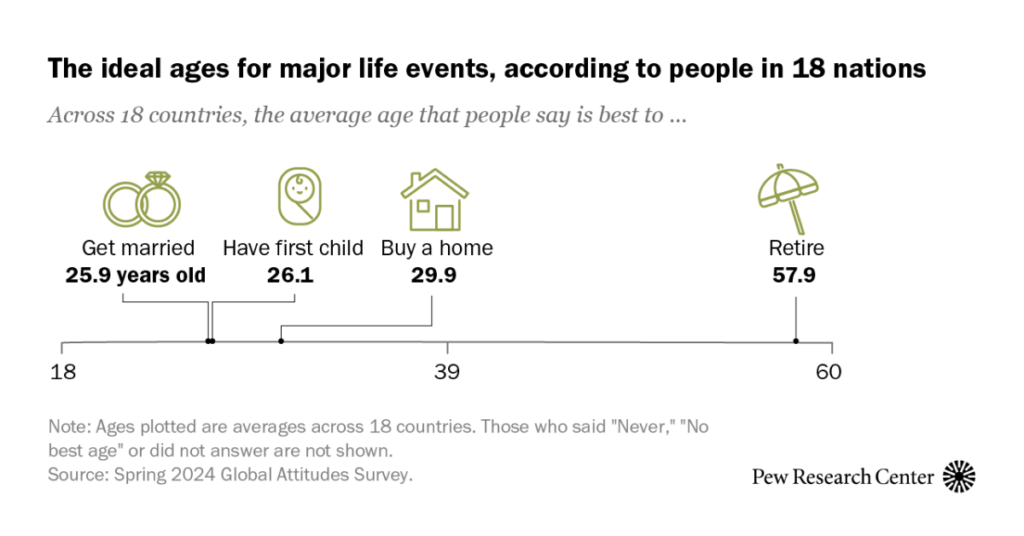
To help place the ideal ages provided by respondents in context, we compiled data on when in life people around the world actually get married, have their first child and become eligible for certain retirement benefits. Average age at first marriage comes from the United Nations Department of Economic and Social Affairs (DESA), Population Division. Data points come from different years, most recently 2019. Ages are calculated separately for men and women. Average age at first child also comes from the UN Population Division and is only available for women.  In this analysis, we use the minimum age at which people in a country become eligible for age-based pensions as that country’s actual “retirement age.” This information comes from the International Social Security Association. Notably, not everyone who meets a country’s age requirements will be eligible for retirement benefits, including people who may work in informal employment; these people are often not considered part of the labor force. source

Appendix A: Marriage, childbirth and retirement statistics Read More »

4. Teens’ future plans and goals

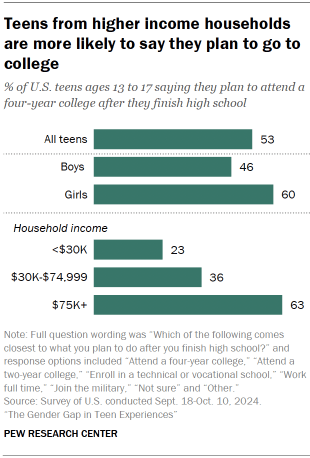
Given the current gender gap in college completion and the growing share of adults who don’t want to have children, we were curious about teens’ long-term goals and plans for adulthood.  Plans after high school When we asked teens what they plan to do after they finish high school, 53% said they plan to attend a four-year college. Among teens, plans for attending college after high school differ by key demographics: Gender: 60% of girls, compared with 46% of boys, say they plan to attend a four-year college. Household income: Teens from households that make over $75,000 annually are the most likely to say they plan to go to a four-year college after high school (63%). A much smaller share of teens from households with incomes under $30,000 say the same (23%). Some teens have other plans for after high school, including: Attending a two-year college (10%) Enrolling in a technical or vocational school (9%) Working full time (6%) Joining the military (3%) About one-in-five teens (18%) are unsure of their plans. Boys are more likely than girls to say they plan to enroll in a technical school, work full time or join the military after high school. Boys and girls are about equally likely to say they aren’t sure of what they plan to do after high school. There are also racial and ethnic differences on a couple of items. A 55% majority of White teens say they plan to attend a four-year college, while Hispanic teens are less likely to say this (43%). Among Black teens, 50% say they’ll attend a four-year college (not significantly different from White or Hispanic teens). In turn, Black and Hispanic teens are more likely than White teens to say they plan to attend a two-year college (13% and 15% vs. 7%). The sample size for Asian teens is too small for separate analysis. Future goals We also asked teens about some long-term goals – specifically, what they hope to achieve as adults. A large majority of teens (86%) say it’s extremely or very important to them to have a job or career they enjoy when they’re an adult. This includes 41% who say this is extremely important. Majorities also say having close friends (69%) and having a lot of money (58%) are highly important to them. Smaller shares of teens place a high level of importance on family life milestones like getting married (36%) and having children (30%). We saw a similar pattern among adults in 2023 when we asked what they thought was important in order for people to live a fulfilling life. Job satisfaction and having close friends ranked higher marriage and parenthood. Of the potential goals we asked about, fame is least important among teens. Only 6% say becoming famous is important to them personally. By contrast, 80% say this is not too or not at all important. Boys and girls answer similarly on all these items, except for one: Girls are 9 points more likely than boys to say having close friends is highly important to them (74% vs. 65%). There are also a couple notable racial and ethnic differences. Black and Hispanic teens are more likely than White teens to say having a lot of money is extremely or very important. Some 76% of Black teens and 66% of Hispanic teens say this, compared with 50% of White teens. In turn, White teens are more likely to say having close friends in adulthood is highly important: 75% say this, compared with 64% of Hispanic teens and 62% of Black teens. Views by political party Republican and Republican-leaning teens are more likely than Democratic and Democratic leaners to say getting married (43% vs. 29%) and having children (38% vs. 24%) are highly important to them personally. This also mirrors what we saw when we asked adults what makes a fulfilling life. In 2023, about a third of Republican adults said having children or being married is extremely or very important in order for people to live a fulfilling life. About one-in-five or fewer Democratic adults said the same. On the other items, teens from both parties give similar answers. source

4. Teens’ future plans and goals Read More »

1. What is the best age to get married?

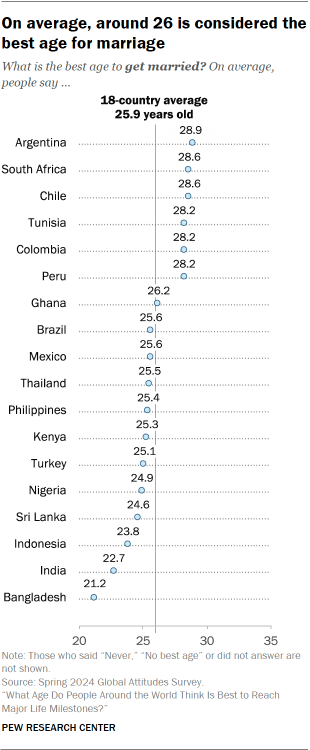
We asked people in 18 mostly middle-income countries what they think is the best age to get married. On average, respondents say 25.9 years old is the ideal age for marriage. But opinions vary by country. For instance, Argentine adults say the best age to get married is 28.9 – on the older end when compared with other country averages. People in Chile, Colombia, Peru, South Africa and Tunisia also suggest ages on the older end, saying it is best to marry around 28 years old.  Conversely, Bangladeshis say it’s best to get married younger – at 21.2 years old, on average. People in India and Indonesia generally agree that the ideal age for marriage is under 25. The United Nations has global data on when men and women typically get married for the first time. Across the countries included in our analysis, actual ages at first marriage generally fall within the same range as the ideal ages suggested in our survey: between 20 and 29 years old. Overall, the ideal and actual ages for marriage are positively related. In countries where the age of first marriage is older – Chile, South Africa and Tunisia – people tend to say it is best to get married later in life. Refer to Appendix A for actual average ages at first marriage in each country. In addition to the average age suggested in each country, we can also look at the distribution of ages people in that country say are ideal for marriage. Here, we see even more variation.  In Bangladesh for example, a majority of adults say the best age to get married is under 25. The largest share say the ideal age for this life event is between 20 and 24, and the next-largest share say under age 20 is best. In Peru, however, we measure the opposite pattern. Only 11% of Peruvians say the best age for marriage is under 25. Instead, 39% of respondents think the ideal age is between 30 and 34, and 33% say it’s between 25 and 29. Another 10% say people should wait to get married until age 35 or older. In Mexico, responses are more evenly distributed: 43% of Mexicans say the best age for marriage is between 25 and 29, while about equal shares say slightly older or slightly younger is ideal. Generally, people in the Asian countries surveyed suggest younger ages for marriage, while people in the Latin American countries choose older ideal ages. However, what is seen as the best age for marriage in many countries varies slightly based on some demographic factors. Views by gender, age, education and religiousness Men tend to say the best age for marriage is later in life, compared with women. There’s a similar gender gap in the actual ages of men and women at their first marriage. Older adults generally say the best age to get married is earlier in life, compared with younger adults. In Chile, Colombia, Peru, and Thailand, the average ideal ages suggested by the oldest and youngest respondents differ by about three years. Ghana is the only country where younger adults say it is best to get married slightly earlier in life, compared with older adults. Views also vary somewhat by education. On average, adults with more education say it is better to get married later in life, compared with those who have less education. This is especially the case across the Latin American countries surveyed. In 11 countries, people who say religion is very important in their life suggest a younger age for marriage, compared with those who say religion is somewhat or less important to them.  source

1. What is the best age to get married? Read More »

2. Pressures teens are facing

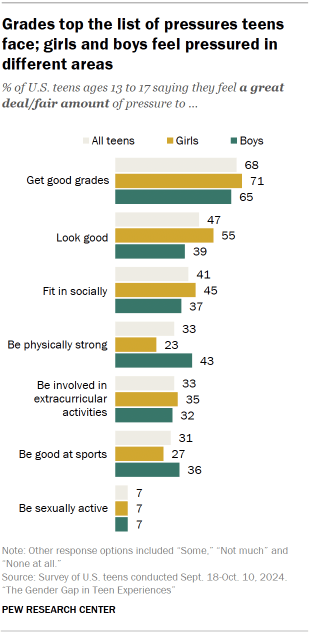
In addition to asking about the problems their peers at school are dealing with, we asked teens about the pressures they personally face. By far the biggest source of pressure for teens is their grades. Roughly seven-in-ten teens (68%) say they face a great deal or fair amount of pressure to get good grades. Substantial shares of teens say they feel certain social pressures as well. Some 47% say they feel at least a fair amount of pressure to look good, and 41% feel pressure to fit in socially. A third say they feel a great deal or fair amount of pressure to be physically strong. The same share feel pressure to be involved in extracurricular activities. And 31% say they feel pressure to be good at sports. Very few teens (7%) say they feel a great deal or fair amount of pressure to be sexually active. Differences by gender While girls and boys share some of the same pressure points, there are significant differences in certain areas. Where girls feel more pressure than boys Looking good: A 55% majority of girls say they feel a great deal or fair amount of pressure to look good. A smaller share of boys (39%) say the same. Fitting in socially: While 45% of girls say they feel pressure to fit in socially, the share is lower among boys (37%). Where boys feel more pressure than girls Being physically strong: By a margin of 20 percentage points, boys are more likely than girls to say they feel a great deal or fair amount of pressure to be physically strong (43% vs. 23%). Being good at sports: 36% of boys feel pressure to be good at sports, compared with 27% of girls. Where boys and girls feel equally pressured There are three areas where roughly equal shares of teen boys and girls say they feel a great deal or fair amount of pressure. Getting good grades: 71% of teen girls compared with 65% of teen boys say they feel a great deal or a fair amount of pressure to get good grades. Being involved in extracurricular activities: 35% of girls and 32% of boys. Being sexually active: 7% for both girls and boys. source

2. Pressures teens are facing Read More »