Appendix C: Best age to have a first child, by country
source
Appendix C: Best age to have a first child, by country Read More »


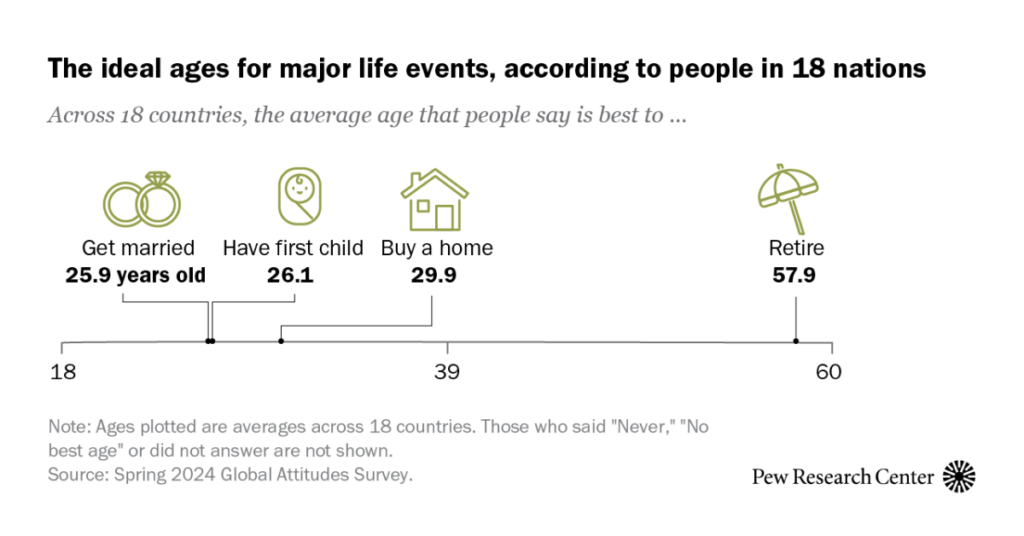
On average across 18 mostly middle-income countries surveyed, the ideal age for retirement is 57.9. Nigerians suggest the oldest ideal age for retirement (62.7, on average). Respondents in Ghana and Kenya also suggest a relatively high age (60.6 in each). Colombians give the youngest ideal age, saying 52.1 is the best age to retire. The ideal age is similarly low in Turkey (52.7). By comparison, the real retirement age – defined here as the age people become eligible for age-related pensions – varies widely across countries. And in most nations surveyed, people say the best age to retire is younger than the age they are first eligible to receive these benefits. For example, Mexico has one of the highest retirement ages of the countries surveyed: 65 years old. But Mexican adults say the best age for retirement is more than eight years earlier, placing it at 56.6. There are also countries where the ideal retirement age is older than the actual threshold for receiving benefits. Nigerians, for instance, suggest the oldest ideal age for retirement in the survey, though eligibility for benefits starts at age 50 in Nigeria. People in Ghana, India, Indonesia, Kenya, Sri Lanka and Thailand also say it is best to retire after the age of eligibility. Refer to Appendix A for actual ages of eligibility for retirement benefits in each country. The ideal retirement age also varies within countries. For example, though 31% of Turks say the best age to retire is between 50 and 54, a similar share think it’s between 55 and 59. Roughly one-in-five say it’s best to retire before 50, while 14% say the best age is between 60 and 64. The preferred retirement age similarly varies in Nigeria, where the best age to retire is placed at 62.7. While about a third say the ideal age is between 60 and 64 (36%), substantial shares think it’s best to retire between 65 and 69 (21%) and at 70 or older (22%). Views in Thailand are more uniform. A 59% majority say the best age to retire falls between 60 and 64, and roughly equal shares prefer older or younger age ranges. Views by age and gender In 11 of 18 countries, adults ages 50 and older prefer an older age for retirement than younger adults (those under 35) do. Views of the ideal retirement age also vary between men and women in some countries. In seven – Argentina, Bangladesh, Chile, Colombia, Ghana, Mexico and Tunisia – men suggest a higher age than women. The opposite is true in India, Kenya, the Philippines and South Africa, where women suggest a higher age than men. Notably, responses do not vary by education or income level in most countries surveyed. source
4. What is the best age to retire? Read More »
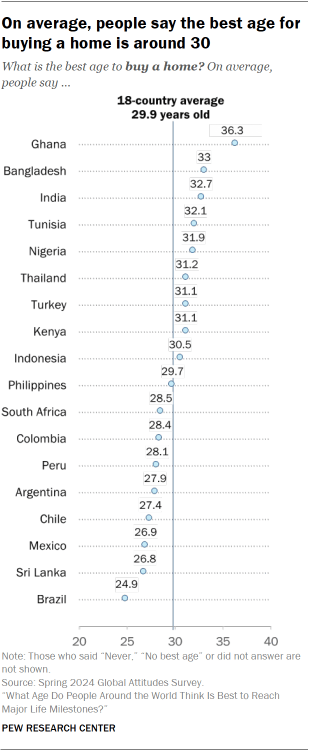
When asked about the ideal age to buy a home, people’s answers vary more than on other milestones we measured. Brazilian adults suggest the youngest age for this life event (saying 24.9 years old is best, on average), while Ghanaian adults suggest the oldest age (36.3). Across the 18 mostly middle-income countries surveyed, people think the best age to buy a home is 29.9. Adults in other Latin American countries agree with Brazilians that becoming a homeowner before 30 is ideal: People in Chile and Mexico, on average, say the best age for buying a home is around 27, while those in Argentina, Colombia and Peru say it’s around 28. As on every milestone we asked about, people within each country suggest a variety of ages for this life event. In Brazil, there are three age ranges that around a quarter of adults each see as ideal for first-time homebuying: ages 20 to 24, 25 to 29, and 30 to 34. In addition, 13% of Brazilians say the best time to buy a home is under age 20 – the highest share to say this among the countries surveyed. In other countries, there is clearer consensus on the best time in life to buy a home. For instance, 42% of Thai adults think that the best time to reach this milestone is between ages 30 and 34. Roughly one-in-five say the ideal age is 25 to 29, and a similar share say it’s 35 to 39. Conversely, roughly four-in-ten Ghanaian adults believe the best time to buy a home is at age 40 or older. That’s the highest share to suggest this age range in the survey. Views by age In eight out of 18 countries, the ideal age to buy a home differs slightly among younger and older adults. The largest difference is in Kenya, where adults under 35 say the ideal age to buy a home is 30.2, while those ages 50 and older say it’s 32.6. Notably, there are not consistent education or income differences on this question. source
3. What is the best age to buy a home? Read More »
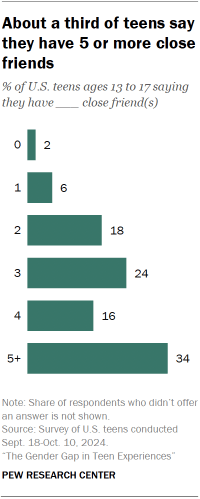
Friendships play a large role in many teens’ lives. Relationships with friends can also be a predictor of long-term outcomes for teens, including the quality of their adult relationships and work performance. We asked U.S. teens a few questions about their friend networks, and more specifically, whether they can turn to these networks for emotional support. Number and gender of friends Roughly two-thirds of teens (64%) say they have between one and four close friends. About a third (34%) say they have five or more close friends – fairly similar to the share of U.S. adults who say the same. Only 2% of teens say they have no close friends. Teens’ friends are often the same gender as them. About half of teens who have at least one close friend (49%) say all of their friends are the same gender as them. Another 48% say their friends are a mix of genders, while only 2% of teens say none of their friends are the same gender as them. There are no major differences between teen boys and girls in the number of friends they have or the gender makeup of their close friend circles. This is slightly different from what we found among adults – women are more likely than men to say all or most of their close friends are their same gender as them (71% vs. 61%). Emotional support networks Among teens with at least one close friend, most teens (89%) say they have at least one friend they can turn to for emotional support, while 11% say they do not. However, there are some notable gender gaps on this question. Boys are less likely than girls to say they have a close friend they can turn to if they need emotional support. Still a large majority of boys (85%) say they do; 16% say they don’t have a friend they can turn to. Among teen girls, 95% say they have a close friend they can go to for emotional support, while only 5% say they don’t. Relatedly, a recent Center survey of adults found a significant gap in the shares of women and men who said they would be extremely or very likely to turn to a friend as a source emotional support (54% of women vs. 38% of men). We also asked teens whether they think boys or girls have it easier when it comes to having friends they can turn to for emotional support. A 58% majority of teens say girls have it easier. About a third (35%) say it’s about the same for both, while only 7% say boys have it easier. Teen girls and boys gave similar answers on this question, with majorities of each group saying girls have it easier. Still, girls were more likely than boys to say boys have it easier (10% vs. 3%). source
3. Teens’ friendships and emotional support networks Read More »
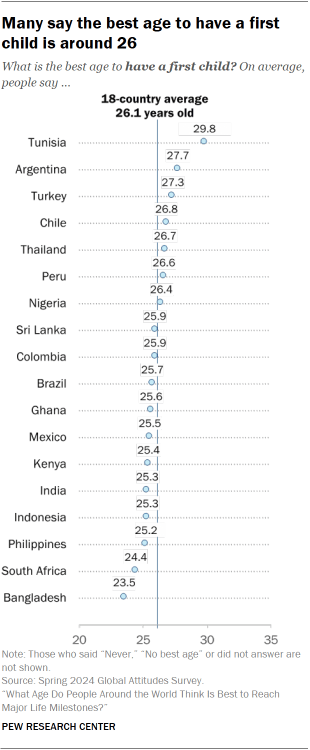
People across the 18 mostly middle-income countries surveyed say, on average, that 26.1 is the best age to have a first child. There is a lot of agreement on this timing, and in most countries, average ideal ages fall between 25 and 27. But there are some that stand out. People in Tunisia say the ideal age to have a first child is just under 30, on the higher end of the average ages suggested. And adults in Argentina say it is best to have a child at 27.7 years old. By comparison, people in Bangladesh and South Africa say the ideal age to have a first child is before 25. Women in the countries surveyed generally do become mothers in their late 20s or early 30s, according to data from the United Nations. This is somewhat older than the average ideal age people suggest in our survey overall. Women in Bangladesh, Colombia and Mexico typically have their first child at around 26 years old, slightly younger than women in the other countries surveyed. And in Chile and Tunisia, the average age at which women have their first child is 30 or older. Refer to Appendix A for actual average ages at first birth in each country. There is generally a lot of agreement within countries, too, about the best age to have a first child. In 12 of the 18 countries surveyed, at least 40% of adults think sometime between the ages of 25 and 29 is ideal. Indonesians show a particular consensus: 58% say the ideal age is in this range; roughly a quarter say between 20 and 24 is best, and very few think it’s ideal to have a first child outside of one’s 20s. Some countries have much less agreement. Responses in Tunisia, for example, are more evenly spread across age ranges. Around a third of Tunisian adults think that the best age to have a child is between 30 and 34. And of the countries surveyed, Tunisia has the largest share of people who think age 35 or older is ideal for this milestone (16%). Views by gender, age and education Men generally suggest a slightly older ideal age for having a first child than women. The average ages men say are best range from 24.8 in South Africa to 31.4 in Tunisia, while the average ages women choose range from 22.1 in Bangladesh to 28.5 in Tunisia. The Philippines is the only country where men and women agree on the best age for this milestone (25.2). Views of the best age for having a first child also vary by the age of respondents themselves. In most countries, adults under 35 think it is ideal to have a child slightly later in life, compared with adults ages 50 and older. In Peru, for instance, younger adults think the best age to become a parent is 27.7, while older adults suggest 25.0 (a gap of 2.7 years). Opinions also vary by education. In 17 of the 18 countries surveyed, adults with more education say is it best to have a first child slightly later in life, compared with those who have less education. The gap is particularly stark in Latin American countries: Chile: The average ideal age suggested by people with more education is 3.5 years older. Argentina: 3.2 years older Mexico: 3.2 years older Colombia: 3.1 years older Peru: 3.0 years older Brazil: 2.6 years older source
2. What is the best age to have a first child? Read More »

Teen girls and boys in the U.S. face different pressures and have different experiences at school but want the same things out of life (Willie B. Thomas/Getty Images) How we did this Pew Research Center conducted this study to better understand teens’ views on their school experiences, friendships and future plans. The Center conducted an online survey of 1,391 U.S. teens ages 13 to 17 from Sept. 18 to Oct. 10, 2024, through Ipsos. Ipsos recruited the teens via their parents, who were part of its KnowledgePanel. The KnowledgePanel is a probability-based web panel recruited primarily through national, random sampling of residential addresses. The survey was weighted to be representative of U.S. teens ages 13 to 17 who live with their parents by age, gender, race and ethnicity, household income, and other categories. Questions in this report that focus on students’ experiences in their school were not asked of the 91 students who said they are homeschooled. Here are the questions used for this report, along with responses, and the survey methodology. This research was reviewed and approved by an external institutional review board (IRB), Advarra, an independent committee of experts specializing in helping to protect the rights of research participants. Terminology References to White and Black teens include those who identify as only one race and are not Hispanic. Hispanic teens are of any race. The views and experiences of Asian teens are not analyzed separately in this report due to sample limitations. Asian teens’ responses – and responses of teens from other racial and ethnic groups – are incorporated into the general figures throughout the report but are not analyzed separately due to sample limitations. All references to party affiliation include those who lean toward that party. Republicans include those who identify as Republicans and those who say they lean toward the Republican Party. Democrats include those who identify as Democrats and those who say they lean toward the Democratic Party. American teens face a host of challenges these days – both inside and outside the classroom. A new Pew Research Center survey of U.S. teens ages 13 to 17 finds that, while there is some common ground, many of the problems and pressure points teens are dealing with differ significantly for boys and girls. In addition, many teens see imbalances in how boys and girls are experiencing school and how they’re performing academically. Anxiety and depression tops the list of problems teens say their peers at school are dealing with, of the issues we asked about. Three-in-ten teens say it’s extremely or very common among their fellow students. And on balance, teens say anxiety and depression is more common among girls at their school than among boys. At the same time, majorities of teen boys and girls alike say girls have it easier when it comes to having friends they can turn to for emotional support. Academics are the biggest source of pressure for teens today. Roughly seven-in-ten (68%) say they personally feel a great deal or fair amount of pressure to get good grades. Girls and boys are about equally likely to say this (71% vs. 65%). Girls are significantly more likely than boys to say they face at least a fair amount of pressure to: Look good (55% vs. 39%) Fit in socially (45% vs. 37%) Greater shares of boys than girls say they face pressure to: Be physically strong (43% vs. 23%) Be good at sports (36% vs. 27%) Teens’ plans for the future Looking ahead, boys and girls want many of the same things out of life. Majorities of teens say it’s extremely or very important to them that as adults they have a job or career they enjoy (86%), have close friends (69%) and have a lot of money (58%). But they may take different paths to get there. Teen girls are significantly more likely than teen boys to say they plan to attend a four-year college after they graduate from high school (60% vs. 46%). In turn, boys are more likely than girls to say they’ll go to a vocational school (11% vs. 7%), work full time (9% vs. 3%) or join the military (5% vs. 1%) after high school. This survey – conducted Sept. 18-Oct. 10, 2024, among 1,391 teens ages 13 to 17 – focused on school experiences, friendships and future plans. Other key findings 42% of teens say girls at their school get better grades than boys. Only 3% say boys get better grades than girls, and 55% say things are about equal. Additionally, about one-in-four teens (27%) say girls at their school get more leadership positions than boys, while 16% say boys get more of these positions; 56% say there’s no differences. 63% of teens say boys are more disruptive in class than girls. Only 4% say girls are more disruptive, and 32% say there’s no difference. Inversely, teens are more likely to say girls speak up more in class than to say the same about boys (34% vs. 18%). Roughly half (48%) say there’s no difference. Almost all teens (98%) say they have at least one close friend, with 34% saying they have five or more. Boys and girls are equally likely to say they have at least one close friend. We also asked whether they think one group has it easier when it comes to having friends they can turn to for emotional support: A 58% majority of teens say girls do. Very few say boys have an easier time (7%), and 35% say it’s about the same for both. Thinking ahead to their adult lives, teens place less importance on getting married or having children than they do on job satisfaction, friendship and financial success. Republican teens and those who lean to the Republican Party are more likely than Democrats and Democratic leaners to say marriage and parenthood are important to them. source
The Gender Gap in Teen Experiences Read More »
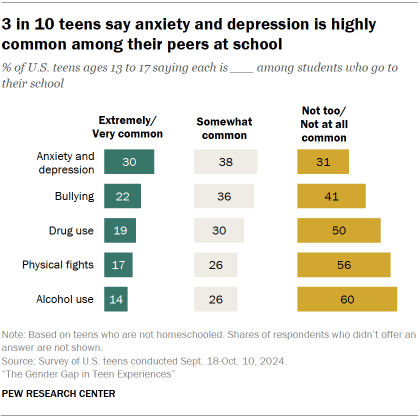
We asked U.S. teens how common a variety of problems are among students at their school. Anxiety and depression tops the list, with 30% of teens saying it’s extremely or very common at their school. About one-in-five teens (22%) say bullying is extremely or very common at their school. A similar share (19%) say the same about drug use. Some 17% of students say physical fights are highly common at their school, and 14% say alcohol use is highly common. Girls are more likely than boys to say anxiety and depression is extremely or very common at their school (35% vs. 24%). Girls are also more likely to say the same about alcohol use (17% vs. 10%). Girls and boys are about equally likely to say the other items are common at their school. Are problems in school more common among boys or girls? We asked teens who say these issues are at least somewhat common at their school whether each is more common among boys or girls. With the exception of physical fights, about half or more of these teens say the issues are equally common among boys and girls. Still, among those who see a gender difference, the scale more often tips toward boys. More common among boys Among teens who say physical fights are at least somewhat common at their school, 44% say these are more common among boys. Another 15% say fights are more common among girls, and 41% say there’s not much difference. Among those who say drug use is common at their school, 39% say it’s more common among boys, while only 3% say it’s more common among girls; 58% say there isn’t much difference. The pattern is almost identical when it comes to perceptions of alcohol use. More common among girls 39% of teens who say anxiety and depression is common at their school say it’s more common among girls. Only 5% say it’s more common among boys, and 56% say it affects both about equally. Girls are more likely than boys to say these mental health challenges are more common for girls at their school (50% vs. 28%). For their part, boys are more likely than girls to say that it’s about equal (64% vs. 49%). Mixed views Teens who say bullying is common at their school are divided on whether it’s more common among boys or girls. About one-in-four (26%) say it’s more common among boys, 22% say girls and 51% say both about equally. Boys themselves lean toward the perception that bullying is more prevalent among boys, while girls are split in their views. Do teens see gender biases in their schools? Some of the current discussion about how men are doing in the U.S. today relative to women focuses on gender gaps in K-12 education. To explore this topic from a teen perspective, we asked teens whether they think boys or girls are doing better in school and whether they receive different treatment. In three key areas – grades, leadership opportunities and treatment by teachers – majorities of teens say things are about equal. But those who do see a gender difference tend to think girls have advantages over boys. Grades: 42% of teens say girls get better grades than boys at their school. Only 3% say boys get better grades than girls; 55% say things are about equal. Girls are more likely than boys to say girls get better grades at their school (47% vs. 36%), while a higher share of boys than girls say there’s no difference (59% vs 52%). Leadership roles: 27% of teens say girls are more likely than boys to have leadership roles at their school; 16% say boys are more likely to have these roles. A 56% majority say boys and girls are about equally likely to have leadership roles. Girls and boys are largely in agreement about this. Teacher favoritism: A large majority of teens (78%) say teachers treat girls and boys about equally at their school. Among the rest, 16% say teachers favor girls and 6% say they favor boys. Boys are especially likely to say teachers favor girls (23% say this, compared with 9% of girls). We also asked teens whether girls or boys speak up more in class, and whether they think one group is more disruptive. Speaking up in class: 34% of teens say girls speak up more than boys in class, while 18% say boys speak up more. About half (48%) say both speak up about equally. Girls and boys have similar views on this. Disrupting class: A 63% majority of teens say boys are more disruptive in class than girls. Only 4% say girls are more disruptive. About a third (32%) say it’s about the equal. Again, girls and boys largely agree on this. When it comes to athletics, 53% of teens who have sports teams at their school say the boys’ teams are valued more than the girls’ teams. Only 2% say the girls’ teams are valued more, and 44% say the teams are valued about equally. Boys and girls tend to agree on this, with 51% of boys and 56% of girls saying more value is placed on the boys’ teams at their school. source
1. Problems teens see in their schools Read More »

About a third of workers say AI use will lead to fewer job opportunities for them in the long run; chatbots seen as more helpful for speeding up work than improving its quality (Maskot/Getty Images) How we did this Pew Research Center conducted this analysis to understand how American workers see the use of AI in the workplace and their own experiences with AI in their jobs. For this analysis, we surveyed 5,273 U.S. adults who are employed part time or full time and who have only one job or have more than one but consider one of them to be their primary job. The survey was conducted Oct. 7-13, 2024. Everyone who took part is a member of the Center’s American Trends Panel (ATP), a group of people recruited through national, random sampling of residential addresses who have agreed to take surveys regularly. The survey was conducted either online or by telephone with a live interviewer. The survey is weighted to be representative of the U.S. adult population by gender, race, ethnicity, partisan affiliation, education and other factors. Read more about the ATP’s methodology. Here are the questions used for this report, the topline and the survey methodology. Terminology References to workers include those who are employed part time or full time and who have only one job or have more than one but consider one of them to be their primary job. References to college graduates or people with a college degree comprise those with a bachelor’s degree or more education. “Some college” includes those with an associate degree and those who attended college but did not obtain a degree. “High school” refers to those who have a high school diploma or its equivalent, such as a General Educational Development (GED) certificate. “Middle income” is defined here as two-thirds to double the median annual family income for panelists on the American Trends Panel. “Lower income” falls below that range; “upper income” falls above it. Read the methodology for more details. Artificial intelligence is not new to the workplace, but the debut of ChatGPT just over two years ago ushered in an era of rapid expansion. American workers have mixed feelings about how this technology will affect jobs in the future. About half of workers (52%) say they’re worried about the future impact of AI use in the workplace, and 32% think it will lead to fewer job opportunities for them in the long run, according to a new Pew Research Center survey. And while 36% of workers also say they feel hopeful about how AI may be used in the workplace in the future, a similar share (33%) say they feel overwhelmed. About one-in-six workers (16%) say at least some of their work is currently done with AI. And an additional 25% say, while they’re not using it much now, at least some of their work can be done with AI. These shares are significantly higher among young workers and workers with at least a bachelor’s degree. The survey, conducted Oct. 7-13 among 5,273 employed U.S. adults, explores how workers see the use of AI in the workplace overall, as well as their own experience with AI in their jobs. Key findings Few workers think AI use in the workplace will improve their job prospects in the long run. Only 6% of workers say workplace AI use will lead to more job opportunities for them in the long run. About a third (32%) say it will lead to fewer opportunities for them, and 31% say it will not make much difference. Some 17% of workers have not heard about the use of AI in the workplace. Workers with lower and middle incomes are more likely than those with upper incomes to say workplace AI use will lead to fewer job opportunities for them. In turn, upper-income workers are more likely to say workplace AI use won’t make much difference in their job opportunities. Across industries, workers in information and technology and those working in banking, finance, accounting, real estate or insurance are among the most likely to say that the use of AI will lead to more job opportunities for them in the long run. Most American workers (63%) say they don’t use AI much or at all in their job. About one-in-six workers (16%) are AI users, meaning at least some of their work is done with AI. Another 81% of workers could be considered non-AI users. This includes 63% who say they don’t use AI much or at all in their job and 17% who have not heard of AI use in the workplace. AI users are generally younger: 73% are under 50, compared with 65% among non-AI users. And about half of AI users (51%) have at least a bachelor’s degree, compared with 39% of non-AI users. Among non-AI users, 31% say at least some of their work can be done with AI. The share saying this is larger among workers younger than 50 and among those with at least a bachelor’s degree. About one-in-ten workers say they use AI chatbots – such as ChatGPT, Gemini or Copilot – at work every day or a few times a week; 7% use them a few times a month. A majority of workers (55%) say they rarely or never use them. Across age groups, workers ages 18 to 29 are the most likely to use AI chatbots at work at least a few times a month (23% vs. 17% or less among older age groups). Among those who’ve used AI chatbots for work, the most common uses are research (57% have used them for this), editing written content (52%) and drafting written content (47%). Workers who have used AI chatbots are more likely to find them helpful in speeding up their work than in improving its quality. Four-in-ten workers who have used AI chatbots for work say these tools have been extremely or very helpful in allowing them to do things more quickly. A smaller share
U.S. Workers Are More Worried Than Hopeful About Future AI Use in the Workplace Read More »

To explore workers’ views of AI use in the workplace, we asked about their broad attitudes on how AI may be used in the future and how it will affect their job opportunities in the long run. How workers feel about AI use in the workplace About half of workers (52%) say they feel worried about how AI may be used in the workplace in the future. Just over a third (36%) say they feel hopeful about this, 33% feel overwhelmed and 29% feel excited. Workers’ views vary by age, education and income levels. Even so, feelings of worry tend to cut across these groups. Differences by age Workers ages 18 to 49 are more likely than those ages 50 and older to say they feel excited about future AI use (32% vs. 24%). About half of workers or more across age groups say they feel worried about the use of AI in the workplace, but the youngest workers are most likely to say they feel overwhelmed: 40% of workers ages 18 to 29 say this, compared with about three-in-ten among older age groups. Differences by education Workers with at least a bachelor’s degree are more likely than those with less education to say they’ve heard of workplace AI use (91% vs. 76%). They are also more likely to say they feel each of the following about its future use: Worried (57% vs. 48%) Hopeful (44% vs. 30%) Overwhelmed (36% vs. 30%) Excited (38% vs. 23%) Differences by income Across income levels, workers in the upper income tier are the most likely to say they feel: Hopeful (45% vs. 35% among middle-income workers and 30% among lower-income workers) Excited (39% vs. 28% and 24%) Differences across income groups on feelings of worry and overwhelm are either small or not statistically significant. Workers’ views on how AI will affect their job opportunities Relatively few workers think that workplace AI use will improve their job prospects in the future – only 6% say it will lead to more opportunities for them in the long run. About a third (32%) say it will lead to fewer opportunities for them, and a similar share (31%) say it will not make much difference. Some 13% say they are not sure, and 17% have not heard of workplace AI use. A couple of key demographic groups stand out as being less concerned about the impact AI will have on their future job prospects. Workers with a postgraduate degree: 24% say AI use will lead to fewer job opportunities for them in the future. This compares with 35% of workers who have a bachelor’s degree and 33% of those with some college or less education. About half of workers with a postgraduate degree (48%) say this won’t make much difference for them. Upper-income workers: 26% say AI use will lead to fewer job opportunities for them in the future. Larger shares of middle-income (33%) and lower-income (37%) workers say the same. A substantial share of upper-income workers (44%) say this won’t make much of a difference for them. Differences by AI use AI users are more likely than non-AI users to say workplace AI use will impact their job prospects – leading to either fewer (42% vs. 30%) or more (15% vs. 5%) job opportunities for them in the long run. In turn, non-AI users are more likely than AI users to say AI will not make much difference in their job opportunities (33% vs. 28%). Among non-AI users, 21% have not heard about AI use in the workplace. Differences by industry Not surprisingly, workers’ views on how AI will affect their own job opportunities in the long run differ across industries. Workers in the following industries are among the most likely to say AI use will lead to more job opportunities for them: Information and technology (16% say this) Banking, finance, accounting, real estate or insurance (11%) source
2. Workers’ views of AI use in the workplace Read More »