The Next Web TNW

Meet the 5 Nordic scaleups in TECH5 — the 'Champions League of Tech'

Five fast-growing Nordic scaleups have reached the finals of TECH5 — the “Champions League of Technology.” They join a standout quintet from Benelux, unveiled last week, in the race to be crowned Europe’s hottest scaleup. The Nordics — comprising Denmark, Finland, Iceland, Norway, and Sweden — boast just 27 million people but punch well above their weight in innovation. The region has Europe’s highest density of unicorns — privately held companies valued at over $1bn. Despite accounting for only 4% of Europe’s population, the Nordics hosted 17% of the continent’s unicorns between 2013 and 2023. Sweden leads the pack with the EU’s top startup ecosystem, according to StartupBlink’s 2024 rankings. TNW Conference – The 2025 Agenda has just touched down Discover the insightful and dare we say controversial sessions that will take place June 19-20. The Nordics also possess one of Europe’s leading investment landscapes. The region is home to over 14,000 funded startups, which collectively raised $5.6bn in 2024, according to Dealroom data. Sweden, Norway, Finland, and Denmark rank among Europe’s top 15 countries for VC investment, while Iceland sits in the top 50. This thriving ecosystem has produced global giants like Spotify and Klarna. Now, TECH5 aims to uncover the next wave of tech titans. TNW’s judges selected the five finalists based on their growth, impact, and future potential. Let’s meet them (listed in no particular order). 1. Kompasbank The Nordics have a thriving stable of fintechs. Over 1,500 of them currently reside in the region, which has also raised a herd of unicorns in the sector, from buy-now-pay giant Klarna to open banking platform Tink. Kompasbank is a leader of the new breed. The Danish scaleup has developed a new type of bank — exclusively for small and medium-sized enterprises (SMEs). These businesses are the backbone of the European economy, representing 99% of all EU firms and over 100 million jobs. Yet they remain underserved by traditional banks, facing slow decision-making, rigid processes, and financial barriers that hinder growth. Kompasbank wants to change that. Founded in 2018 by Michael Hurup Anderson — a Saxo Bank and Deloitte veteran — the company rapidly delivers loans, currency trading, payments, and other banking services to SMEs. “Our ambition is to empower SMEs to achieve their full potential by providing them with the speed, flexibility, and tailored financial solutions they need to invest, grow, and succeed,” kompasbank told TNW.   2. Lassie Sweden’s Lassie is redefining pet care — with insurance at its core. The fast-rising scaleup has a preventative focus that combines veterinary care, coaching for owners, e-commerce, and advice from vets to keep our furry companions healthy. The company’s founders have an ideal blend of skills and experience. CEO Hedda Båverud Olsson grew up with a veterinarian parent. COO Sophie Wilkinson is a former head of pet insurance at a Nordic insurer, while CTO Johan Jönsson has developer expertise honed at Spotify and King. After launching in 2020, Lassie rode a boom in pet ownership during the pandemic. By 2023, almost half of European households owned pets, which generated an estimated €24.6bn in spending on products and services. Investors have taken note, pumping over €36.5mn into Lassie. “Our ambition is to become the European leader in pet insurance and preventive care — then go global,” the company told TNW. “We’re not just covering medical costs; we’re improving pet health, extending lifespans, and giving owners peace of mind.” 3. NORNORM The norm that Denmark’s NORNORM wants to foster is circularity. Its target for the transition is office furniture. The scaleup helps businesses cut their environmental impact by ditching single-use furniture for a circular, subscription-based service. Founded in 2020 by former IKEA manager Anders Jepsen and Skype co-creator Jonas Kjellberg, NORNORM is based in Copenhagen. In 2022, the company secured €110mn in a funding round led by growth equity firm Verdane. Inter IKEA Development also contributed to the round. Today, NORNORM is active in 17 countries and 59 cities. The company plans to bring its service to many more businesses — and not only big brands. “Real impact comes from reaching the many, not the few, which is why we have designed an accessible and highly affordable solution that requires no upfront investment or long-term commitment,” NORNORM told TNW. “By making circular office interiors both attractive and scalable, we are driving systemic change in the industry and proving that sustainability and business success go hand in hand.” 4. Flower Flower is fighting climate change with power – energy grid power, to be precise. The Swedish company combines energy forecasting, optimisation, and trading software to stabilise grids by feeding them stored power when demand is high.   John Diklev founded the company in 2020 while still a university student in Stockholm. Within a few years, Flower had amassed Sweden’s largest portfolio of battery systems for electricity storage. Last April, Flower bought the largest battery facility in Sweden from wind energy developer OX2 AB. A few months later, the company completed a €45mn funding round, which took its total investments to a whopping €100mn. Diklev wants his home country to set a standard in the energy transition. “Sweden can take the lead in the electricity industry, a flourishing future sector, while also protecting Swedish consumers from price increases,” he said. 5. Collective Minds Radiology Collective Minds Radiology believes there is “almost infinite” expertise and data in healthcare. The problem is it’s trapped in siloes at hospitals and medical institutions. The Swedish scaleup has created a cloud-based collaboration platform that connects healthcare professionals, medical educators, and researchers. Its goal? Accelerating patient access to accurate diagnoses and effective treatments. “We are on a mission to build the world’s largest platform and community for professional healthcare collaboration that ultimately makes a difference for each patient in getting to the right diagnosis faster,” the company told TNW. “Long-term, this will increase efficiency in healthcare by saving time and money while improving the patient journey.” Collective Minds has high hopes for Sweden’s digital future. Alongside its talent, culture, and history of scaling big ideas,

Meet the 5 Nordic scaleups in TECH5 — the 'Champions League of Tech' Read More »

Solar panels made from moon dust could power future lunar colonies

Future lunar bases could run on solar panels forged from molten moon dust, turning the Moon’s surface into an energy source, thanks to a new research breakthrough.  Scientists at the University of Potsdam have engineered so-called “moonglass” solar cells made by melting artificial moon dust or “regolith” and then combining it with a layer of perovskite crystal to create a working solar panel.  The device could be lighter, cheaper, and more radiation-resistant than the panels already used in space, said the researchers. Their results were published in the journal Device this week. Today, solar panels power satellites, space stations, and Mars and lunar rovers. All these arrays are currently built on Earth and launched into space. But as humanity pushes for a permanent lunar presence, the need for solar power is set to skyrocket — and so will the cost of getting panels there. 3 free tickets to TNW Conference? Get them now! For a limited time, groups can get up to three extra free tickets! Book now and increase your visibility and connections at TNW Conference Felix Lang, lead author of the paper, said that while the silicon-based solar cells used in space now are “amazing” — reaching efficiencies of 30% to 40% — they are very expensive. They are also heavy because they use glass or a thick foil as a cover. “It’s hard to justify lifting all these cells into space,” he said. Harnessing the Moon’s own regolith could be a game-changer. By creating moonglass directly on the lunar surface and pairing it with a thin layer of perovskite crystals brought from Earth, the researchers found they could slash launch mass by 99%. Building solar panels on the Moon An artist’s impression of future solar cell fabrication on the Moon. Credit: Sercan Özen Once the materials are collected, turning them into solar panels on the Moon would require “minimal equipment,” according to the researchers, because they can be made with raw regolith that doesn’t need to be pre-processed. The team says they have already achieved promising results by using a large curved mirror and sunlight to focus a beam hot enough to melt regolith into moonglass. Since moonglass is made from raw regolith, it’s milky-white instead of transparent, limiting its light-harvesting potential. The best prototypes from the Potsdam team reached about 12% efficiency — roughly half that of conventional perovskite cells. But simulations suggest they could eventually match the efficiency of conventional perovskite cells.  Nicholas Bennett at the University of Technology Sydney told New Scientist that this is the first successful use of moonglass in a functioning solar cell. The real challenge now, he says, is producing large quantities of the stuff outside of the lab. Moonglass panels are the latest in a string of high-tech bids to lay the foundations for a permanent human presence on the Moon. Other planned projects include using moon dust to 3D-print a lunar base, building oxygen extraction systems from regolith, and even building space mirrors that melt the Moon’s ice into drinking water. Space age technologies will be appearing on Earth during TNW Conference, which takes place on June 19-20 in Amsterdam. Tickets for the event are now on sale. Use the code TNWXMEDIA2025 at the check-out to get 30% off the price tag. source

Solar panels made from moon dust could power future lunar colonies Read More »

DeepMind's new research rules threaten AI innovation, warns Iris.ai CEO

Google DeepMind’s reported clampdown on sharing research will stifle AI innovation, warns the CEO of Iris.ai, one of Europe’s leading startups in the space. The UK-based lab has tightened its rules on releasing AI studies, the Financial Times reported this week. Citing seven current and former DeepMind scientists, the newspaper said the company has introduced stricter vetting and additional bureaucracy, making it harder to publish research. The changes aim to protect the company’s edge in AI, the sources said. Acquired by Google in 2014, DeepMind has long been a leader in computer science breakthroughs. In recent years, however, the lab has faced increasing competition from the likes of OpenAI and DeepSeek. Under growing pressure to stay ahead, the company is reportedly erecting new barriers around its innovations and reputation. The new constraints have alarmed Anita Schjøll Abildgaard, co-founder and CEO of Iris.ai, a Norwegian startup developing an AI-powered engine for science. She fears DeepMind’s restrictions will hinder technological advances. 3 free tickets to TNW Conference? Get them now! For a limited time, groups can get up to three extra free tickets! Book now and increase your visibility and connections at TNW Conference “DeepMind’s decision marks the end of an era of openness and collaboration in AI research,” she said. The impact on AI On first impression, the changes at DeepMind may appear beneficial for other AI labs. The company’s pioneering innovations and enormous citation counts have overshadowed other researchers in the field, who could now receive a larger share of the spotlight. But Abildgaard warns the drawbacks will far outweigh the benefits. “Researchers across industries will have less access to DeepMind’s undoubtedly impressive work,” she said. She pointed to the example of DeepMind’s AlphaFold, a system that predicts protein structure with remarkable accuracy. The software has been hailed as a solution to one of biology’s biggest mysteries, with potential to fuel countless advances, from discovering new drugs to tackling climate change. “It’s hard to imagine projects of this importance being released so readily under this new diktat,” Abildgaard said. The impacts, she warned, could be severe. In response, she urged AI companies to strengthen their commitment to openness. “Europe, in particular, has one of the most fertile open-source research communities in the world,” she said. “As DeepMind looks inwards, smaller research communities can differentiate themselves from the American giants by embracing collaboration.” Europe’s AI sector features prominently in the agenda for TNW Conference, which takes place on June 19-20 in Amsterdam. Tickets for the event are now on sale. Use the code TNWXMEDIA2025 at the check-out to get 30% off the price tag. source

DeepMind's new research rules threaten AI innovation, warns Iris.ai CEO Read More »

The day a Russian missile hit a Ukrainian tech giant

Every entrepreneur has to overcome obstacles, but few have faced the challenges of Oleksandr Kosovan. As the founder and CEO of Ukrainian scaleup MacPaw, Kosovan runs his business in a country under invasion. The company has even been hit by missile barrages. As relentless Russian bombing and shelling pummel Ukraine, his team presses on with their work. In October, they released a new version of CleanMyMac, MacPaw’s flagship maintenance and optimisation product.  “It was completely developed during the war,” Kosovan tells TNW on a video call from his home in Kyiv. The software earned rave reviews. But two months later, the horrors of war arrived at MacPaw’s doorstep. TNW Conference – The 2025 Agenda has just touched down Discover the insightful and dare we say controversial sessions that will take place June 19-20. On a cold December morning, another devastating Russian ballistic missile attack struck Kyiv. The explosion hit MacPaw’s headquarters, shattering the building’s facade, windows, and engineering equipment. According to the rescue services, one person was killed in the attack.  Kosovan was en route to an event when a message about the strike appeared on his phone. “The only thing we could do is initiate our emergency procedures,” Kosovan says. “We had plans for this risk and they helped us to organise actions — because people were panicked. They didn’t know what to do.” Safety measures were swiftly implemented, emergency checks conducted, and recovery steps taken. The next day, MacPaw gained access to the office building. Staff worked alongside emergency services to salvage equipment and prevent further damage.  The company’s office spans three floors of the building. The hardest hit of them is still not operational, but the others have reopened. Staff are already working in them again. MacPaw’s wartime adaptations had given the business a head start on the recovery. Many team members were already working remotely. Processes had become highly automated. Staff were spread out geographically and shifts were scheduled to cover all critical roles during emergencies and military call-ups. While the missile strike was traumatic, MacPaw had been prepared. Preparing for war Numerous buildings were damaged by the missile strike. Credit: MacPaw As Russian troops amassed on the border with Ukraine in late 2021, MacPaw began disaster planning.  The company devised mitigation measures for various threats, from cyber attacks to Russian forces taking control of the office. An emergency team was formed from each product and service unit, with members based either outside Ukraine or in the country’s safer western regions. Communications security was beefed up, with Signal adopted as a new messaging service. Office infrastructure was moved entirely to the cloud. Satellite internet was set up to cover the risk of internet loss. The company then waited for reports on Russia’s military moves. On day one of the full-scale invasion in February 2022, MacPaw activated its risk mitigation plan. “We had to refocus our priorities,” Kosovan says. “The first of them was, of course, the safety of our people, and then the continuity of our business.” A code freeze regime was implemented for all products and infrastructure, with no changes permitted without prior approval from the emergency team. Hardware management strategies also shifted. With supply chains disrupted, new laptops now had to be sourced from abroad. At times, system administrators had to drive to remote locations and personally deliver laptops to team members. As wartime conditions became routine, the team adapted to their new reality. Nowadays, their biggest challenge is Russia’s relentless attacks on Ukrainian energy infrastructure. The strikes cause frequent and protracted power outages. In MacPaw’s home town of Kyiv, daily blackouts of eight hours have become commonplace, leading more team members to work from the office. To keep operations running, the company has installed extra power and internet access lines. A backup generator has also been acquired, alongside an uninterrupted internet access point via Starlink. “Starlink helps a lot,” Kosovan says. “It is one of the saving factors for Ukraine.” The new measures have kept MacPaw’s systems running throughout Russia’s attacks on Ukraine’s power grid. But the human impacts have been harder to resolve. The recovery process Windows have been covered in wooden panels to protect what remained inside MacPaw’s office. Credit: MacPaw Although no MacPaw staff were physically harmed in the missile attack, the psychological toll has been profound. “The greatest challenge we and many other companies are facing here right now is not the destruction of the offices, but the exhaustion of these people,” says Kosovan. “Mentally, this is very hard to process. People are breaking sometimes, and it is very hard to predict and help them.” For months, staff in Kyiv have endured air strikes day and night. “People cannot sleep normally because they always hear these explosions in the air…They don’t know whether the next night a drone will hit their house or not.” The brutality of the December missile attack was a stark contrast to the previous day at MacPaw. Staff had been preparing holiday gifts for Children of Heroes, an organisation that supports Ukrainian children who have lost parents in the war. Through the MacPaw Foundation, the company also provides Ukrainians with non-lethal aid, including protective gear, IT equipment, and medical supplies. Since 2022, the non-profit has distributed over $12mn in total support Alongside the humanitarian projects, Kosovan is helping to sustain the country’s IT sector. He’s personally invested in almost 20 Ukrainian businesses, including Osavul, a Kyiv-based AI startup that analyses information threats. Formed to counter Russian propaganda, Osavul now offers services to governments and businesses alike. “Our goal is to review the narratives, show which of them are dangerous, and then give you all the intelligence to understand what you can do,” Dmytro Bilash, the startup’s co-founder, told TNW last year. In combat zones, Ukrainian tech also has a powerful impact. Innovations range from a growing fleet of domestic drones to Delta, a battlefield management system. Developed by the military, the software combines a variety of tools, from digital maps to secure communications.  Ukrainian

The day a Russian missile hit a Ukrainian tech giant Read More »

We rode a remote-driven EV through Berlin. Is this the future of car sharing?

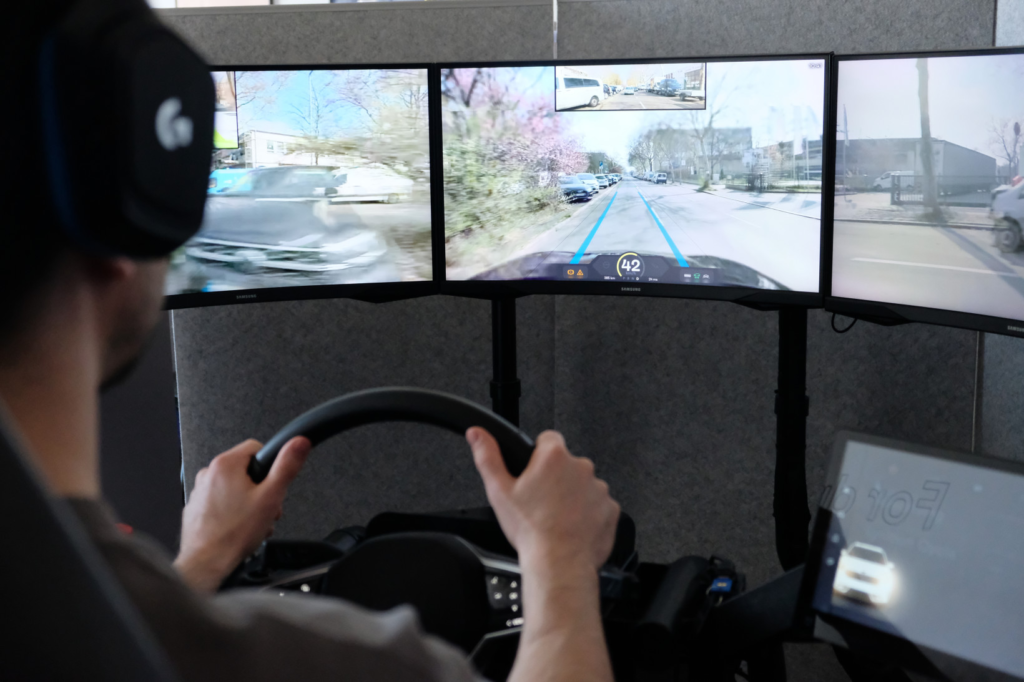
“Hello, I will be your driver for today,” says Bartek Szurgot, a software engineer at German startup Vay and my chauffeur for this ride. He disengages the handbrake, gently presses the accelerator and the new Kia Niro EV I’m sitting in slowly pulls out of the parking lot.    As we approach the first intersection, Bartek indicates, turns the steering wheel, makes his observations, and drives out onto a busy road near the centre of Berlin. So far, pretty standard — except for one big difference. Bartek isn’t in the car. He’s in an office a few blocks away, controlling the vehicle like a high-tech puppeteer. Remote operators like Bartek command Vay’s cars from a video game-style station equipped with a driver’s seat, steering wheel, pedals, and three monitors providing visibility in front of the car and to its side.  3 free tickets to TNW Conference? Get them now! For a limited time, groups can get up to three extra free tickets! Book now and increase your visibility and connections at TNW Conference Road traffic sounds, such as emergency vehicle sirens and other warning signals, are transmitted via microphones to the teledriver’s headphones. Operators could be sitting on the other side of the world.  Vay has developed a proprietary hardware and software system called “drive-by-wire” that communicates with the car’s key controls, including the steering wheel, brake, and gear shifter. Electrical signals transmitted from the remote operating station tell the system what to do, enabling the car to mirror the remote driver’s actions in real time.  Redundant mobile networks transmit the data. In the event of a network failure or emergency, the vehicle automatically comes to a safe stop. Vay’s remote drivers spend most of their time delivering vehicles to customers, who hail the cars on an app. After the car arrives, users take the wheel and drive themselves.  Teledrivers control the cars from remote locations. Credit: Siôn Geschwindt Customers can use the car for a short trip, hours, days, or even longer. Once they’re done, they stop the car safely in the road, apply the handbrake, get out, and carry on with their day. Then, a remote operator takes over again and drives on to the next client.    As anyone familiar with autonomous vehicles will know, watching a car drive itself takes some getting used to. Knowing that my “driver” was blocks away, steering through screens and sensors, made every turn feel surreal. But once you get used to it, the ride is almost disappointingly normal — I suppose that’s the point.   Vay’s tech is impressive, no doubt, but in Europe, regulators may strangle its potential before it ever scales. Meanwhile, across the Atlantic, Vay is accelerating. Vay already has a 40-strong fleet of remote-controlled cars in Las Vegas. In Berlin and across Europe, though, progress has been slower, with no commercial service in place yet.  Due to regulatory red tape, Vay is limited to test drives only and is required to keep a safety driver onboard. It has previously received an exemption, though. In 2023, it used one such regulatory hall pass to become the first company to operate a car on a European public road without a person inside.  However, the German government hands out such permits sparingly. That’s why I couldn’t take the wheel on our test drive. That was Graeme’s job, our safety driver for the trip. Nevertheless, it gave me a firm idea of what to expect. Cameras are attached to Vay’s cars. Credit: Siôn Geschwindt The future of car sharing? When I first heard of Vay’s remote driving concept a couple of years back, I was skeptical. The company touted the benefits: less hassle, cheaper fares, better working conditions for workers. But it seemed like a business model at risk of fading into irrelevancy once self-driving cars went mainstream. But with my mind fixated on the paradigms of ride-hailing on one hand and full autonomy on the other, I may have overlooked that Vay was doing something radically different. “We’re creating a whole new category of mobility,” Thomas von der Ohe, Vay’s CEO and co-founder, tells me from the company’s headquarters in Berlin. After spending years in the Bay area building self-driving cars, he came back to Europe, founding Vay in 2018 alongside Fabrizio Scelsi and Bogdan Djukic.  Vay’s rides in Las Vegas cost about half as much as Uber. Von der Ohe says they keep prices low by reducing driver labour costs. With ride-hailing services, it’s one driver, one car. But a single Vay driver can oversee up to 10 vehicles on any given day. When they drop one car at a customer, the drivers can “teleport” and gain control of another vehicle.  Vay could offer a taxi-style service where passengers ride in the back, but that would cut into profits and drive up prices. That’s why letting customers drive themselves makes business sense, says Von der Ohe.  Vay aims to make its biggest impact in car sharing and rentals, not ride-hailing. Von der Ohe says the company can match average car rental prices in Germany while helping rental firms cut costs by reducing the need for large parking facilities, especially at busy airports.  Vay also hopes to provide a better version of car sharing. Customers don’t need to pick up or park their cars — major hassles in dense European cities. Fleet owners can keep vehicles in use longer, and Von der Ohe believes the model could even reduce private car ownership in urban areas.  All this makes for a compelling value proposition. Vay has raised $150mn in funding so far, including €34mn ($37mn) from the European Investment Bank.  But there are still many potholes in the road. Outside Las Vegas, Vay is still unproven — and regulatory red tape isn’t making things easier.  In Europe, governments have been slow to adopt rules for remotely driven cars. Currently, the vehicles are subject to much the same guidelines as autonomous vehicles — which are patchy at best.  “We have the tech, it

We rode a remote-driven EV through Berlin. Is this the future of car sharing? Read More »

European tech warns Trump tariffs will hit both hardware and software

Europe’s tech industry is bracing for impact after the Trump administration announced sweeping tariffs yesterday. The US slapped a 20% tariff on imports from the EU — twice the rate for the UK. Switzerland fared even worse, receiving a hefty 32% levy.  Several European tech firms, investors, and analysts told TNW that the measures could disrupt supply chains, force pricing adjustments, and stem the flow of transatlantic VC capital — plunging European tech companies big and small into uncertainty. “Trump’s trade tariffs will have a huge impact on the global tech landscape, forcing startups to reconsider their headquarters and assess alternative markets,” said Louis Fearn, principal and sustainability lead at InMotion Ventures, the investment arm of Jaguar Land Rover.   Hugging Face, ASML, OpenAI, Monzo & Datasnipper Check out the NEW speakers for TNW Conference 2025 on June 19 & 20. For companies with hardware-dependent models, the tariffs represent a major cost challenge. Miika Mäkitalo, CEO of Finnish firm HappyOrNot, which makes customer feedback terminals, noted that nearly half of the company’s business is across the pond. He said the tariffs might force the firm to consider “initiating assembly and production in the United States.” Although the tariffs only apply to physical goods, service-based startups will also feel the impact.  Benjamin Avraham, founder and CEO of Swiss fintech Okoora, said there are many “secondary effects” that will harm the “smaller startup community” indirectly. These include changes in supply chains, barriers to VC investments, and increased volatility in exchange rates.   Software could also suffer from additional constraints. Amanda Brock, CEO at open-source lobby group OpenUK, said that while software has long been characterised as an intangible service, it “may be subject to other trade restrictions.”  The fallout has already begun. Trump’s tariffs have sent markets into disarray and risk compounding existing tensions in global trade. Stocks have plunged around the world and countries have promised retaliatory measures. “The newly announced blanket tariffs by President Trump create more uncertainty in the global tech industry,” said Martin Hartley, Group CCO of international tech consultancy Emagine. “These measures could make businesses in the EU avoid the US altogether to sidestep additional costs.” For European startups, the tariffs may force a stark strategic choice. “Trump is playing with fire,” warned Matt Penneycard, partner at UK-based Ada Ventures. “Startups selling to US customers now face two options: anchor in Europe and embrace its stability, or find ways to maintain access to the States by setting up operations there.”  He added that this moment could be an opportunity for Europe. “As the US becomes a tougher place to operate, top talent may follow stability — this is Europe’s moment to build a new Silicon Valley.” European startups are the heartbeat of TNW Conference, which takes place on June 19-20 in Amsterdam. Tickets for the event are now on sale. Use the code TNWXMEDIA2025 at the check-out to get 30% off the price tag. source

European tech warns Trump tariffs will hit both hardware and software Read More »

Soaring AI energy use sparks call to ‘fundamentally redesign’ computing

One of Europe’s leading climate tech VC firms has called for a “fundamental redesign” of traditional computing methods amid surging energy consumption from AI applications. The Berlin-based World Fund warns that simply transitioning data centres to renewable power will not be enough to fully decarbonise AI compute.  “We need to rethink the way we go about computing, from the materials and chips we use to software we run,” Daria Saharova, founding partner at World Fund, said at the Future of Green Computing event in Munich today.   At the event, World Fund joined Dealroom and Intel’s deeptech accelerator Ignite to unveil a new report that proposes a set of emerging technologies — from chips made in space to processors that mimic the brain — to curb AI’s enormous appetite for energy and usher in a new era of greener computing.  3 free tickets to TNW Conference? Get them now! For a limited time, groups can get up to three extra free tickets! Book now and increase your visibility and connections at TNW Conference Using data from Dealroom, the report maps out the green computing ecosystem. It identifies 65 startups in this space, 54 of which are European, which have collectively raised $900mn. Over half of these companies were founded within the past five years, with 12 emerging in just the last 12 months.  A greener vision of AI The report highlights three key technologies that hold the most potential to decarbonise AI.  The first is advanced semiconductor materials such as Gallium Nitride (GaN), Silicon Carbide (SiC), and graphene. These could significantly reduce AI’s energy consumption by improving efficiency and thermal performance in computing hardware.  One of the leading innovators in this space is Welsh startup Space Forge. The company is leveraging the microgravity, vacuum, and extreme temperatures of space to produce semiconductors that it claims are three to five times purer than those made on Earth.  “We’ve pushed the efficiency of silicon chips to their limit,” said Joshua Western, CEO and cofounder at Space Forge. Another promising avenue lies in new computing paradigms, such as quantum, neuromorphic, and optical computing. Quantum computers, for instance, promise to solve complex calculations much faster than classical machines, potentially reducing computational time and overall energy consumption.  “Classical computers are getting too big, too expensive, and use too much energy and water,” said Inés De Vega, VP of innovation at IQM, Europe’s best-funded quantum computing startup. “Quantum computing can both find new solutions to climate change but also drastically reduce the overall energy consumption of computing itself.” Another type of computing gaining traction is optical computing, which leverages photons — particles of light — instead of electrons. It could dramatically increase processing speed, as demonstrated by Germany’s Black Semiconductor. The company’s photonics processors could transmit signals 100 to 1,000 times faster than traditional electronic chips. Anastasiia Nosova, a former chip engineer at German semiconductor giant Infineon and host of the Anastasi In Tech podcast, argued that photonic chips could be 100 times more energy efficient than regular silicon semiconductors. “They are one of the most important developments in computing right now,” she said at the Munich event..   While hardware fixes will be critical, there’s also work to be done in advanced software that makes AI’s energy use more efficient. One of the startups working on this is London-based Deep Render. The company uses deep learning to compress files while retaining quality beyond what was previously possible. This reduces the volume of data that needs to be transmitted or stored, and thus the amount of computing power required.  While these technologies hold potential, they’re still in the nascent stages of development. Meanwhile, the energy needed to train AI models is doubling every three to four months, according to OpenAI.   “For these computing solutions to scale in Europe, we need a lot of venture capital but also government backing,” said Saharova. She believes that Europe needs to allocate about €1 trillion to bring climate tech, including green computing, to the “level it needs to be.”  The future of AI will be a hot topic at TNW Conference, which takes place on June 19-20 in Amsterdam. Tickets for the event are now on sale. Use the code TNWXMEDIA2025 at the check-out to get 30% off the price tag. source

Soaring AI energy use sparks call to ‘fundamentally redesign’ computing Read More »

Quantum simulations are still slow. A startup says it just made them 10x more efficient

A new algorithm has improved the ability of quantum computers to model new materials and chemicals by a factor of 10. That’s according to its developer, UK startup Phasecraft.  The Bristol- and London-based company describes the breakthrough as the largest single leap in quantum simulations to date — moving us a step closer to real-world quantum applications. Quantum computers improve on classical simulations by accurately modelling complex quantum behaviours — like the ever-changing interactions between molecules or the evolution of materials over time — that are too difficult for classical computers to simulate efficiently. This could lead to technological leaps in various fields, from energy to manufacturing and medicine. For example, quantum computers could simulate materials in a battery far more accurately than ever before, enabling scientists to design materials that store energy more efficiently, last longer, and charge faster. The 💜 of EU tech The latest rumblings from the EU tech scene, a story from our wise ol’ founder Boris, and some questionable AI art. It’s free, every week, in your inbox. Sign up now! Currently, quantum computers are not yet fast enough to make those world-changing calculations. Phasecraft’s new algorithm, called THRIFT, promises to accelerate the process. By optimising quantum simulation, THRIFT enables scientists to model new materials and chemicals faster and more accurately, even on today’s slow machines. In tests, THRIFT improved simulation estimates for a key benchmark in quantum physics — the one-dimensional transverse-field Ising model — by a factor of 10. The advance enables simulations that are 10 times larger and can run 10 times longer than those produced by standard methods. The findings were published in Nature Communications today. “We’ve managed to show a 10x increase on today’s machines, and we’d expect this to only get better as the hardware advances and quantum computers become better at tolerating errors and handling more complex calculations,” Raul Santos, Phasecraft’s lead quantum scientist, told TNW. The future of quantum simulations In the last year or so, the obscure world of quantum computing has emerged from the lab and entered the public domain — fuelled by Big Tech’s recent progress in quantum processors. In the past few months alone, Google launched a chip called Willow, Microsoft unveiled Majorana, and Amazon revealed Ocelot.  Advances in quantum computing are only good news for Phasecraft. “This algorithm enhances efficiency on near-term devices, like those Google and Microsoft have announced,” said Santos. “Any improvements in their performance can only enhance our approach.”  Rather than waiting for years or even decades for quantum hardware to mature sufficiently, Phasecraft is redesigning algorithms to work on today’s imperfect quantum machines.   Phasecraft was founded in 2019 by professors Ashley Montanaro (CEO), Toby Cubitt (CTO), and John Morton (director). The company spun out of the University of Bristol and UCL. The startup, which has raised over $20mn to date, works with leading quantum hardware companies, including Google, IBM, and QuEra. source

Quantum simulations are still slow. A startup says it just made them 10x more efficient Read More »

Netherlands ranks above US and entire G7 in tech competitiveness

The Netherlands has ranked 10th in a global index of tech competitiveness, ahead of the entire G7 group of the world’s largest so-called “advanced” economies. The country was praised for its thriving digital economy, mature biotech and semiconductor industries, and strong digital skills underpinned by “engineering excellence.” London-based Centre for Economics and Business Research (CEBR) and consultancy SThree produced the index, which ranks 35 countries based on economic indicators such as level of high-tech exports, number of software developers, and patent filings related to AI.  Several European countries joined the Netherlands near the top of the rankings. Ireland placed second globally and first in Europe, while Finland (fourth), Norway (sixth), Denmark (seventh), Estonia (eighth), and Sweden (ninth) also featured in the top 10. Singapore claimed the number one position overall, earning praise for its “world-class” digital infrastructure, advanced STEM education, and innovation-driven economy. All the metrics are adjusted for population size.   The UK and US lagged behind at 13th and 15th, respectively, underscoring the shifting dynamics of global tech competitiveness. Notably, G7 economies failed to secure a single position in the top 10. The study excluded India, China, and every African nation due to insufficient data.   The 20 leading nations for tech competitiveness. Credit: SThree/CEBR Robert Doornbos (FR driver), Pernilla Sjöholm (Tinder Swindler survivor) & more Check out every speaker at TNW Conference including Hugging Face, ASML, OpenAI & Datasnipper CEBR and SThree published the rankings as part of a wider study of STEM competitiveness, which evaluates nations on their ability to foster scientific and technological innovation, high-quality education, and employment in STEM-related fields. Switzerland led this index, followed by Sweden, while the Netherlands secured eighth place. The full rankings for STEM competitiveness. Credit: SThree/CEBR Positive signs for tech in the Netherlands The report highlighted the Netherlands’ strength in life sciences, where it ranked seventh, supported by a thriving ecosystem of biotech startups and a strong network of research institutions. Engineering emerged as the country’s weakest STEM sector, ranking 21st globally. The findings suggest there are grounds for optimism about the Dutch tech sector, despite recent heavy criticism. A recent report discovered a “worrying” decline in startups from the country, while founders have warned that burdensome regulation and insufficient government support are stunting the sector’s progress. The report also illustrates the outsized role played by Europe’s smaller countries in nurturing science and technology.  Timo Lehne, the chief executive of SThree, said the rankings also stand as a clear warning sign for the G7 nations — Canada, France, Germany, Italy, Japan, the UK, and the US. “Once the global epicentre for innovation, these countries are now facing stiff competition from emerging tech hubs,” he said. “Without a renewed focus on cultivating groundbreaking companies and embracing future-facing industries, their leadership in the tech race is no longer guaranteed.” The future of Dutch tech will be a hot topic at TNW Conference, which takes place on June 19-20 in Amsterdam. Check out out our initial list of speakers and our early agenda for a taste of what’s to come. Tickets for the event are now on sale. Use the code TNWXMEDIA2025 at the check-out to get 30% off the price tag. source

Netherlands ranks above US and entire G7 in tech competitiveness Read More »

Lucien Engelen: Wellbeing tech is the new battleground for top talent

Gone are the days when a bean bag and free kombucha made your office cool. Today’s top tech talent wants something far more valuable: their health. That’s the view of Lucien Engelen, a renowned healthcare innovation expert, who believes workplace wellbeing is about to spark a seismic shift. This transition will not only transform employment perks, but also create a new tech market. Engelen’s vision draws on deep experience. Across three decades in healthcare, his work has spanned acute care, ambulance services, and dispatch centres. As the founding director of the REshape Center of the Radboud University Medical Center, he spent eight years developing and implementing healthcare technologies, grabbing headlines for efforts to integrate patients in their own care and improve service provision with social media. Today, he focuses on running Transform.Health, which assists organisations such as Vodafone, Erasmus University Medical Center, Deloitte, and Sanofi in their healthcare strategies. He also delivers 100 keynotes a year across the globe about the subject. These roles revealed a fundamental flaw in conventional treatment. “We’ve built a sick care system, not a healthcare system,” he says. Hugging Face, ASML, OpenAI, Monzo & Datasnipper Check out the NEW speakers for TNW Conference 2025 on June 19 & 20. Engelen compares the problem to bad plumbing. “We wait until water gushes out of the wall before fixing the leak, instead of turning off the tap.” For Engelen, the fix is obvious. We need to shift the focus from treating illnesses to preventing them. And employers have a crucial role to play. At TNW Conference on June 19, Engelen will share his vision in full during a talk titled “CODE RED: Why the Future of Work is the Future of Health.” Ahead of the event, he shared a glimpse of what to expect. Employers as catalysts for wellbeing The business case for staff wellbeing is obvious: healthier employees deliver higher performance. Illness, stress, and long waits for medical care drain their productivity and availability. “If it takes eight weeks to get a consultation, that’s eight weeks of lower productivity,” Engelen notes. “And if they leave due to poor health, replacing them can cost about €40,000 in rehiring and training someone to reach the same level.” To stay ahead, forward-thinking employers are getting proactive. Instead of waiting for health problems to arise, they’re offering services that can prevent them.  Technology is rapidly expanding the possibilities. From digital wellbeing apps and fitness trackers to online therapy, these perks are becoming a competitive advantage in attracting elite workers.  As Engelen says, “We’re all fishing in the same bucket of talent.” To attract that talent, he urges employers to apply a broader concept of wellbeing. “It’s not only about your physical health. There’s also your mental health, and even your social health and financial health.” Gradually, this holistic model is shaping modern workplaces. The next generation For employers, mental health services have become a growing focus — and with good reason. Deloitte research found that UK organisations investing in mental health support see an average return of five to one. The benefits could be especially impactful for younger workers. A recent study by PwC found that almost four in 10 Gen Z employees in the UK have seriously considered leaving their jobs in the last year, with mental health “a major driver.”  Digital services offer promising solutions. Yet they also introduce new challenges. “The same Gen Z that is willing to step down due to mental health concerns also thinks privacy is very important — for the right reasons,” Engelen says. “The challenge now for companies is offering solutions without sacrificing their privacy.” Engelen sees employers addressing this by offering third-party services that staff can use confidentially, away from the prying eyes of bosses or colleagues. For instance, they’re providing anonymised access to online mental health services and fitness apps connected to gyms outside the company — with no data flowing back to the business. This growing focus on employee wellbeing also has powerful potential for tech firms. Engelen envisions a new market emerging for them. “We’ll see an increase in Big Tech closing big contracts with big corporates,” he says.  “We will also see Big Tech acquiring more startups in this sector than ever before, because they can not only get this technology scaled, but also access a market that is willing to pay for it. Now that employers see the real financial benefit of this, it is going to create a new revenue stream.” For tech companies, this is a lucrative opportunity. The same is true for employers.  The future of wellbeing in the workplace The benefits of healthy workplaces are well-established. Researchers have found that the ROI on employee wellness programs can be six to one.  “Employers are realising that investing in prevention is far cheaper than paying for treatment or replacing talent — and can also attract talent,” Engelen explains. Accessibility to digital wellbeing is also set to increase. Integration layers are connecting more and more healthcare apps, creating new approaches to medical care. The EU, meanwhile, recently ratified the European Health Data Space regulation, which will enforce mandatory access to medical records on users’ smartphones. As the technology progresses and enters the workplace, the ripple effects could improve lives and productivity, while alleviating pressure on overburdened health systems. By embracing wellbeing tech, Engelen believes employers can accelerate a shift from reactive healthcare to proactive prevention. “The technology is already there,” he says. “What’s changing is how we’re using it. Employers have realised that investing in health and wellbeing is not just good for their people — it’s good for business.”  Lucien Engelen will be among the standout speakers at TNW Conference, which takes place on June 19-20 in Amsterdam. Tickets for the event are now on sale. Use the code TNWXMEDIA2025 at the check-out to get 30% off the price tag. source

Lucien Engelen: Wellbeing tech is the new battleground for top talent Read More »