The Next Web TNW

Former ASML CEO: Deep tech will ‘make the impossible possible’

After steering Dutch chip giant ASML to become Europe’s most valuable tech firm, Peter Wennink is now focused on the next frontiers of deep tech. Wennink has already been involved in numerous breakthroughs in the field. Over his 25-year career at ASML — including over a decade as CEO — the company laid foundations for countless deep tech innovations. Under his leadership, the business earned renown as the sole supplier and producer of extreme ultraviolet (EUV) lithography machines. These systems are essential for manufacturing the world’s most advanced chips. They have become a crucial force in today’s AI boom, supporting everything from ChatGPT to brain-computer interfaces. Limited offer: Bag 2 tickets for the price of 1! Register for TNW Conference by 15 April and get another ticket totally free! ASML has also extended the life of Moore’s Law — the observation that transistors on chips double roughly every two years. This exponential growth has fuelled breakthroughs that once seemed unimaginable. The next advances, Wennink believes, are even harder to envision. “It’s difficult for mankind to foresee the impact of exponentiality because it often yields something seemingly impossible,” he told TNW. “But that’s exactly what science and deep tech will create, making the impossible possible.” At TNW Conference in Amsterdam on June 20, Wennink will share his vision of a new era of innovation. The future of deep tech In an exclusive session titled Gods of Industry: The Battle for Deep Tech Dominance, Wennink will take the stage alongside Young Sohn, another digital visionary. Formerly the President and Chief Strategy Officer of Samsung Electronic, Sohn is now the founding managing partner at Walden Catalyst Ventures, a VC fund dedicated to deep tech. Together, the duo will unpack the next decade of innovations. Their insights will shine a light on the next era of tech leaders. During Wennink’s tenure, ASML became one of these leaders. The company’s machines still produce the chips for all kinds of advanced device, from iPhones to self-driving cars. ASML has also supported the broader deep tech ecosystem. The firm backed DeepTechXL, a Dutch fund that last year raised €110mn, and was deeply involved in Brainport Eindhoven, which Wennink calls “probably unique” in the world of deep tech. Since retiring from ASML last year, Wennink has remained a key figure in the field. He believes the next wave of deep tech will unlock possibilities that are hard to imagine. They may require challenging paths from lab to market, deep domain expertise, and patient capital — but the payoffs will be truly transformative. At TNW Conference, Wenwick will offer a glimpse into what comes next. Peter Wennink will join a packed lineup at TNW Conference, which takes place on June 19-20 in Amsterdam. Tickets for the event are now on sale. Use the code TNWXMEDIA2025 at the check-out to get 30% off the price tag. source

Former ASML CEO: Deep tech will ‘make the impossible possible’ Read More »

Cosmic radio station could probe early universe from far side of Moon

A UK startup wants to build a cosmic radio station in the Moon’s orbit to listen to radio waves from the early universe.   Blue Skies Space has secured a contract from the Italian Space Agency to design a fleet of tiny satellites that could orbit the Moon and listen for signals from the cosmic “dark ages.” That’s the time before the first stars lit up, when the universe was mainly a swirling mass of hydrogen gas.  Hydrogen atoms naturally emit radio waves at a very specific frequency: 1420MHz  – known as the hydrogen line. When you stretch that signal across 13 billion years of cosmic expansion, it gets redshifted down into the FM radio band (about 88-108MHz). These ancient radio signals are almost impossible to detect from Earth, thanks to all our radio chatter. But parking some satellites on the far side of the Moon – away from that interference –could help scientists cut through the noise and unravel clues from the early universe.  The 💜 of EU tech The latest rumblings from the EU tech scene, a story from our wise ol’ founder Boris, and some questionable AI art. It’s free, every week, in your inbox. Sign up now! That’s what Blue Skies Space, the Italian Space Agency, and space contractor OHB Italia will investigate under the joint project, dubbed RadioLuna.  Blue Skies Space will study whether small, low-cost CubeSats — built from commercial, off-the-shelf parts — can survive and do real science while orbiting the Moon. OHB Italia will figure out how to build the spacecraft. Mapping these signals could fill in the missing piece between the Big Bang and the first stars — showing how the universe evolved from smooth hydrogen fog to the cosmic web of galaxies we see today.  Dr Marcell Tessenyi, CEO and co-founder of Blue Skies Space, told TNW that if the idea proves feasible, it could result in a commercial service.  “Depending on the technical feasibility, the funding landscape, and the appropriate infrastructure, we anticipate being able to deliver such a system within five years of the end of the study,” he said.    RadioLuna isn’t the only project Blue Skies Space is working on. In October, the startup is set to launch its first satellite into orbit. The probe — Mauve — is a stargazing satellite that will gather data on stars in the visible and UV parts of the spectrum. Scientists and academics will then be able to access the data for a small membership fee. Europe’s spacetech strategy is on the agenda for TNW Conference, which takes place on June 19-20 in Amsterdam. Tickets for the event are now on sale. Use the code TNWXMEDIA2025 at the check-out to get 30% off the price tag. source

Cosmic radio station could probe early universe from far side of Moon Read More »

Return of the dire wolf? More like a Colossal case of conservation-washing

US biotech startup Colossal Biosciences has resurrected the dire wolf — or at least that’s what the company would like you to believe. Social media is abuzz with viral videos, memes, and images of fluffy white wolf puppies. The Game of Thrones references are — predictably — omnipresent. The news even made it to Time magazine’s latest cover.  But behind the hype lies a dangerous de-extinction delusion that could distract from proven solutions to the biodiversity crisis. The Trump administration is already using Colossal’s claims as an excuse to slash endangered species protections. First, let’s set something straight — Colossal didn’t bring back the dire wolf. It took DNA from ancient dire wolves’ remains and then edited a handful of those genes into the genomes of modern grey wolves to give them larger bodies, broader skulls, and specific coat colours. It’s an impressive feat of tech-wizardry, but these fluffy white cubs are, at best, mutations.   The 💜 of EU tech The latest rumblings from the EU tech scene, a story from our wise ol’ founder Boris, and some questionable AI art. It’s free, every week, in your inbox. Sign up now! George R.R. Martin holds the first new dire wolf born in 10,000 years pic.twitter.com/5JPepJK8k1 — Winter is Coming (@WiCnet) April 8, 2025 Colossal claims it has “successfully restored a once-eradicated species through the science of de-extinction” for the “first time in human history”. That’s factually incorrect, as many scientists have already pointed out. As University of Maine paleoecologist Jacquelyn Gill wrote on Bluesky on Monday, “To see this work being done with such a casual disregard not only for the truth but for life itself is genuinely abhorrent to me.” But Colossal shows no signs of slowing down. Last month, the $10bn company used a similar technique to create a wooly mouse — a rodent genetically engineered to have mammoth-like pelts. In the future, Colossal plans to “resurrect” other extinct creatures, including the dodo, Tasmanian tiger, and the giant mammoth. The company says that these projects serve as proof of concepts for de-extinction technologies, which could aid in bringing back lost species and restoring ecological balance. It’s the flagbearer of a growing de-extinction movement in the US, joined by organisations like Revive & Restore and Re:Wild. Europe, in contrast, has focused its rewilding efforts more on bringing back existing species, like bison, wolves, and beavers, to regions where they were hunted to extinction.  While genetically engineered “dire wolves” are going viral, the extant Iberian wolf is endangered. Credit: Animal Record/Creative Commons Meanwhile, an emerging cohort of biodiversity-focused startups is tapping tech to restore nature in more sane ways. For instance, Stream Ocean from Switzerland has developed a face recognition technology for fish that helps scientists monitor species numbers. Germany’s Soilytix tracks soil health using environmental DNA, while UK startup Pivotal Earth connects corporate funding to credited conservation projects.   This is where technology can find its use in biodiversity restoration, not in Frankensteinian conservation attempts, which aren’t just over-hyped but present a dangerous distraction from proven measures.  Colossal has broadcast the message that extinction is reversible — but it is not. While the public fawns over adorable mutated “dire wolves” on Instagram, biodiversity loss is snowballing. One million (known) species are threatened with extinction, with extinction rates now occurring up to 1,000 times the rate pre-humans. We need to mobilise resources to protect the species that we still have left, like the Iberian wolf. Once widespread, the canid is now confined to mountainous regions of Portugal and Spain. Only around 2,200 individuals remain.  Humanity’s top priority should be to safeguard existing biodiversity and restore what’s been damaged. Instead of playing God with long-extinct creatures, we must fight for the endangered species we still have left. source

Return of the dire wolf? More like a Colossal case of conservation-washing Read More »

Spotify CEO’s Neko Health opens its biggest body-scan clinic yet

Body-scanning startup Neko Health has opened its largest clinic yet, continuing its expansion in London — just six months after launching its first site in the city. The futuristic new facility expands access to Neko’s high-tech health vision. Blending body scans, lidar sensors, and AI with blood tests, eye pressure checks, and strength tests, the startup maps millions of data points in minutes.  The findings can reveal warning signs about the skin, heart, blood vessels, and inflammation. A human doctor then immediately takes the user through the findings. Within an hour of arriving, they’re on their way out of the clinic. The system is the brainchild of Spotify CEO Daniel Ek and his business partner Hjalmar Nilsonne. The duo want to shift healthcare systems from reactive to proactive. Limited offer: Bag 2 tickets for the price of 1! Register for TNW Conference by 15 April and get another ticket totally free! After launching Neko in their native Sweden in 2023, they began expanding the service to London last year, starting with a new health centre in the chic neighbourhood of Marylebone. The second London facility dramatically expands the company’s capacity. Located in the buzzy Spitalfields Market, the centre covers a roomy 7,466 square feet, with capacity for up to 30,000 scans annually. “This health centre is built for scale, and we’re doubling down in London,” said Nilsonne. London calling Neko The new centre has a suitably space-age design, which echoes the aesthetic of the inaugural London site. Neko already has plans to open two more clinics in the UK’s capital, with launches in other cities in the country also targeted for this year. A spokesperson for the company told TNW that London was “a strategic choice” for Neko’s international expansion beyond Stockholm. “It represents the global market in a way; offering a lot of health tourism and a very competitive space when it comes to private healthcare,” they said. “If we can break into this market we have a chance to do it elsewhere. Additionally, London is a global healthcare hub, with world-class medical institutions and research centres.” The city also evidently has enough people prepared to pay the £299 that each body scan costs. The Marylebone centre attracted lengthy waitlists. Across the London and Stockholm sites, 80% of members book and prepay a scan for the following year at the end of their appointment, Neko said. Between the two centres, Neko has now completed over 15,000 scans. Earlier this year, TNW added one more to the total. During the doctor’s consultation, we were advised to seek a further review. Once we finally have our appointment with the NHS, we’ll reveal all the details about our experience — and Neko’s findings. If you want to try the scan out for yourself, you can sign up to the waitlist here. The future of healthcare on the agenda for TNW Conference, which takes place on June 19-20 in Amsterdam. Tickets for the event are now on sale. Use the code TNWXMEDIA2025 at the check-out to get 30% off the price tag. source

Spotify CEO’s Neko Health opens its biggest body-scan clinic yet Read More »

An answer to AI’s energy addiction? More AI, says the IEA

The International Energy Agency (IEA) has published its first major report on the AI gold rush’s impact on global energy consumption — and its findings paint a worrying, and perhaps contradictory, picture.   Energy use from data centres, including for artificial intelligence applications, is predicted to double over the next five years to 3% of global energy use. AI-specific power consumption could drive over half of this growth globally, the report found. Some data centres today consume as much electricity as 100,000 households. The hyperscalers of the future could gobble up 20x that number, according to the IEA. By 2030, data centres are predicted to run on 50% renewable energy, the rest comprising a mix of coal, nuclear power, and new natural gas-fired plants. The findings paint a bleak picture for the climate, but there’s a silver lining, the IEA said. While AI is set to gobble up more energy, its ability to unlock efficiencies from power systems and discover new materials could provide a counterweight.   “With the rise of AI, the energy sector is at the forefront of one of the most important technological revolutions of our time,” said Fatih Birol, IEA’s executive director. “AI is a tool, potentially an incredibly powerful one, but it is up to us – our societies, governments, and companies – how we use it.”  AI can help to optimise power grids, increase the energy output of solar and wind farms through better weather forecasting, and detect leaks in vital infrastructure. The technology could also be used to more effectively plan transport routes or design cities. AI also has the potential to discover new green materials for tech like batteries.  However, the IEA warned that the combined impact of these AI-powered solutions would be “marginal” unless governments create the necessary “enabling conditions.” “The net impact of AI on emissions – and therefore climate change – will depend on how AI applications are rolled out, what incentives and business cases arise, and how regulatory frameworks respond to the evolving AI landscape,” the report said.  Divisions in the AI energy debate While AI could, theoretically, curb energy use, major questions remain. Meanwhile, the technology’s negative climate impact is already set in.  The IEA predicts data centres will contribute 1.4% of global “combustion emissions” by 2030, almost triple today’s figure and nearly as much as air travel. While that doesn’t sound like much, the IEA’s figure doesn’t account for the embodied emissions created from constructing all those new data centres and producing all the materials therein.  Alex de Vries, a researcher at VU Amsterdam and the founder of Digiconomist, told Nature that he thinks the IEA has underestimated the growth in AI’s energy consumption. “Regardless of the exact number, we’re talking several percentage of our global electricity consumption,” said de Vries. This uptick in data centre electricity use “could be a serious risk for our ability to achieve our climate goals,” he added.  Claude Turmes, Luxembourg’s energy minister, accused the IEA of presenting an overly optimistic view and not addressing the tough realities that policymakers need to hear.   “Instead of making practical recommendations to governments on how to regulate and thus minimise the huge negative impact of AI and new mega data centres on the energy system, the IEA and its [executive director] Fatih Birol are making a welcome gift to the new Trump administration and the tech companies which sponsored this new US government,” he told the Guardian.  Aside from AI, there are more proven ways to curb energy use from data centres. These include immersion cooling, pioneered by startups like Netherlands-based Asperitas, Spain’s Submer, and UK-based Iceotope. Another is repurposing data centre heat for other applications, which is the value proposition of UK venture DeepGreen.  All of these weird and wonderful solutions will need to scale up fast if they are to make a dent in data centres’ thirst for electricity. Ultimately, we also need to start using computing power more wisely.    The debate on sustainable AI will continue at TNW Conference, which takes place on June 19-20 in Amsterdam. Tickets for the event are now on sale. Use the code TNWXMEDIA2025 at the check-out to get 30% off the price tag. source

An answer to AI’s energy addiction? More AI, says the IEA Read More »

Defence tech startup ARX targets 1,800 land drones a year at new UK plant

German startup ARX Robotics has announced plans to invest £45mn into a new UK facility, where it will build autonomous battlefield robots for deployment in war zones around the world. Located at an undisclosed site in southwest England, ARX expects the plant to produce 1,800 ground-based drones each year once up and running. ARX’s battlefield robots look like small tanks — but without guns. The vehicles drive around on treads and can be fitted with equipment such as radar, mine-sweeping devices, or medical stretchers.  The largest of ARX’s machines carries military payloads weighing up to 500kg — including injured soldiers — across the battlefield. Another model acts as a moving target-practice device, while another carries aerial drones into combat.  The robots are modular, built using off-the-shelf components. They’re designed so soldiers can fix them on the battlefield within minutes, without tools. The drones move around autonomously, but military personnel can also control them remotely from a tablet. Limited offer: Bag 2 tickets for the price of 1! Register for TNW Conference by 15 April and get another ticket totally free! Soldiers can control the robots with a tablet. Credit: ARX Robotics The armed forces of Germany, Austria, Switzerland, Hungary, and the UK have already conducted field tests of ARX’s technology. In February, the company delivered 30 of its war bots to Ukrainian Armed Forces units engaged in active combat.   Marc Wietfeld, ARX’s CEO — who will speak at TNW Conference in June — said the facility in Britain would contribute to the “long-term technological sovereignty” of both the UK and broader Europe. He noted that we live in an “increasingly volatile and fast-moving world.”  “This is about strengthening European resilience, through technological sovereignty, scalable autonomy, and the modernisation of land forces,” he said. Defence tech rising in Europe ​In response to escalating geopolitical tensions, European nations have pledged substantial increases in defence spending in recent months.  In March 2025, EU leaders endorsed the “ReArm Europe” plan, aiming to mobilise up to £683bn (€800bn) over the next four years to enhance military capabilities. Similarly, the UK government has committed to raising defence spending to 2.5% of GDP and wants to spend at least 10% of its defence budget on “innovative technologies”.  ARX looks to capitalise on this political momentum.  The UK Secretary of State for Defence, John Healey, said he “warmly welcomed” the startup’s £45mn investment into the UK. “It will create highly skilled jobs and support European security,” Healey said. Wietfeld founded ARX in 2022 alongside fellow German army veterans Stefan Röbel and Maximilian Wied. Last year, the company raised £7.7mn (€9mn) in seed funding from NATO’s innovation fund.  Marc Wietfeld will share his insights at TNW Conference, which takes place on June 19-20 in Amsterdam. Tickets for the event are now on sale. Use the code TNWXMEDIA2025 at the check-out to get 30% off the price tag. source

Defence tech startup ARX targets 1,800 land drones a year at new UK plant Read More »

European startup founders work longer hours than you might think

Despite recent claims that European startups aren’t working hard enough, new research shows the continent’s founders are putting in serious shifts to turn their ideas into successful businesses. A survey of 128 founders by early-stage VC firm Antler found that three-quarters of them work more than 60 hours weekly, with 19% exceeding 80 hours.  German founders emerged as Europe’s hardest workers, with 94% working more than 60 hours weekly and 38% exceeding 80 hours.  Daria Stepanova, co-founder of German startup AIRMO, said she’s sacrificed “time, stability, and relationships” to grow her company. However, she sees a certain level of obsession is a good thing. Otherwise, “what you’re building probably isn’t worth building.” Swedish entrepreneurs followed closely behind. While UK founders were still working long hours, they were least likely to cross the 80-hour threshold, with only 10% doing so. The 💜 of EU tech The latest rumblings from the EU tech scene, a story from our wise ol’ founder Boris, and some questionable AI art. It’s free, every week, in your inbox. Sign up now! Over 70% describe building their company as “easily the hardest thing they have ever done.” Yet nearly all (98%) remain passionate about their career choice.  That’s despite feeling underappreciated for their hard work. Nearly three-quarters (73%) of European founders feel their dedication goes unacknowledged.  “In Europe, you are more likely to be an Olympic medalist than the founder of a unicorn company,” said Alan Poensgen, a partner at Antler. “Whilst both require similar levels of ambition, resilience, and endurance, founders don’t get the same level of recognition.” What’s motivating founders? The survey paints a picture of founders driven more by impact than income. Only 4% cited financial reward as their primary motivation, with the majority instead pointing to creating innovation (27%), positive global impact (22%), and proving they can tackle difficult challenges (19%). This commitment comes at a cost. Founders identified their biggest sacrifices as work-life balance (61%) and salary reduction (36%). Family concerns add another layer of pressure, with 62% reporting that relatives expressed confusion about their decision to leave stable careers.  What keeps these ambitious entrepreneurs awake at night? Execution speed (40%), customer acquisition (24%), and runway concerns (18%) top the list of worries — reflecting the intense pressure to deliver results with limited resources and time. The findings come amid a growing debate in European tech over whether workplace culture is holding the region back compared to the US or China.  In a podcast interview last month, Revolut boss Nik Storonsky criticised European startup entrepreneurs, saying they weren’t working hard enough and valued work-life balance too highly. Those comments followed a lively social media debate earlier this year about whether French founders lacked the “grindset” to succeed.   However, Antler’s findings challenge the notion that European founders prioritise balance over hustle — suggesting that behind the continent’s startup scene is a culture of quiet, often overlooked, hard work.  “People often see the headlines but not the sleepless nights or personal risks behind them,” said Danyal Oezdeuzenciler, co-founder of London-based Capsa AI. “Founders pour so much into an idea — financially, emotionally, mentally — and the resilience it takes is pretty extraordinary.” Startup founders from all over Europe are heading to Amsterdam for TNW Conference, which takes place on June 19-20. Tickets for the event are now on sale. Use the code TNWXMEDIA2025 at the check-out to get 30% off the price tag. source

European startup founders work longer hours than you might think Read More »

Mews leads top 10 funding rounds in rough quarter for Dutch tech

Hospitality software firm Mews raised Dutch tech’s biggest funding round in the first quarter of 2025, in what was a tough start to the year for the sector. Dutch startups raised around €460mn in the quarter, with a 59% decline in growth-stage funding raising alarm bells, according to the Quarterly Startup Report. Together, the top 10 deals accounted for over €320mn — more than 75% of all funding raised last quarter. Here are the biggest Dutch deals of Q1 2025: 1. Mews — €68mn ($75mn)  Mews, based at TNW City in Amsterdam, has built a cloud-based system that helps hotels and other hospitality businesses streamline tasks like booking rooms, checking guests in and out, and processing payments.  The 💜 of EU tech The latest rumblings from the EU tech scene, a story from our wise ol’ founder Boris, and some questionable AI art. It’s free, every week, in your inbox. Sign up now! This round follows a raise of $100mn in credit financing in September and a $110mn equity round in March 2024 — when the scaleup became a unicorn.  2. Alesta Therapeutics — €65mn Alesta Therapeutics, based in Leiden, Netherlands, is a biotechnology company focused on developing novel oral small-molecule therapies for rare diseases.  3. Leyden Labs — €63mn ($70mn) Leyden Labs is another biotech startup from Leiden — home to one of Europe’s leading life science hubs. The company is developing intranasal medicines to protect against respiratory viruses.  4. Vivici — €32.5mn Vivici is a Dutch foodtech startup using precision fermentation to produce animal-free dairy proteins. Its proteins are designed to replace traditional dairy ingredients like whey and casein.  5. QuantWare — €20mn Quantware designs and manufactures superconducting quantum processors. The startup claims to have created a 3D chip architecture that offers the fastest route to a 1-million qubit quantum computer — and plans to sell it to Big Tech companies.    6. Thorizon – €16mn Deep tech startup Thorizon is developing modular molten salt reactors (MSRs) that utilise long-lived nuclear waste as fuel.  7. Varmx — €15mn Varmx is a biotech startup developing a treatment to reverse bleeding in patients taking blood thinners. 8. Workwize — €12mn ($13mn) Workwize provides cloud-based software for managing IT hardware in remote and hybrid workplaces. 9. Sirius Medical — €10mn Another biotech startup, Sirius Medical has developed a tumour localisation technology that helps surgeons to precisely locate and remove breast tumours. 10. Stacks — €9mn ($10mn)  ​Amsterdam-based Stacks provides an AI-driven platform that streamlines financial closing processes for businesses. Despite several eye-catching deals, a significant drop in growth-stage funding and fewer deals overall are raising concerns about the long-term health of the  Dutch tech ecosystem.  Fewer deals, fewer growth rounds for Dutch tech In total, just 79 deals were recorded in Q1 2025 — an 11% drop compared to the same period last year. It marked the fifth consecutive quarter in which deal count has fallen. Most striking is the sharp decline in later-stage funding. Series B+ rounds halved from 14 in Q1 2024 to just seven this year. In total, late-stage startups raised €287mn — down an eye-watering €609mn from the previous year.  Equally telling, for the second quarter in a row, there were no Dutch mega-deals above €100mn — a stark contrast to previous years when such rounds were relatively common, the report found. Early-stage startups, on the other hand, were a rare bright spot in an otherwise poor outlook. Seed deals (typically €1mn-€4mn) accounted for nearly half of all investments in Q1 2025, with total funding in this category growing over 15% year-on-year to €58.4mn. That’s a healthy sign for future innovation, but without sufficient late-stage capital, there’s a risk that promising Dutch startups will be forced to look abroad for growth funding. What’s next? The outlook for the rest of 2025 is mixed. On the one hand, the resilience of seed investment and a growing interest in deep tech and hardware — areas where Dutch startups like QuantWare and Thorizon excel — provide reasons for optimism. “We can be proud of the Dutch entrepreneurs who, together with investors, realise world-class deep tech innovations,” said Myrthe Hooijman, director of ecosystem change and governmental affairs at Techleap.  On the other hand, several issues are causing concern. Global trade tensions, a sluggish exit market, and the increasing caution of international investors could slow down growth-stage funding even further, according to the report. “We are not yet sounding the alarm, but standing still means going backwards,” said Lucien Burm, chairman of the Dutch Startup Association. “Not only did Europe lose its position internationally, but within Europe, the Netherlands is now losing importance.” “With the geopolitical and economic unrest of the moment, instead of reactive measures, broad and deep investment in the business and investment climate is the recipe.” The Quarterly Startup Report was put together by Dealroom.co, Golden Egg Check, KPMG, the Regional Development Companies (ROMs), the Dutch Association of Private Equity Companies (NVP), the Dutch Startup Association (dSa), and Techleap. The future of Dutch tech is a key theme at TNW Conference, which takes place on June 19-20 in Amsterdam. Tickets for the event are now on sale. Use the code TNWXMEDIA2025 at the check-out to get 30% off the price tag. source

Mews leads top 10 funding rounds in rough quarter for Dutch tech Read More »

Airbus to build lander for Europe’s first Mars rover after Russia dropped

The European Space Agency’s (ESA) Rosalind Franklin rover is back on course for a landmark trip to Mars, where it will probe the red planet for signs of extraterrestrial life.  ESA initially designed the Mars rover alongside Roscosmos, Russia’s space agency, as part of the ExoMars programme. The vehicle was set to launch in 2022, but when Russia invaded Ukraine, ESA severed ties with Moscow, putting the mission in jeopardy. Rosalind Franklin — named after the British chemist whose work was crucial to understanding the structure of DNA— was left without several key components, including a landing platform to safely touch down on the Martian surface.  But now, ESA and Thales Alenia Space, the prime contractor for the ExoMars mission, have issued Airbus a £150mn contract to build a new lander at the company’s facility in Stevenage, UK. The British government will fund the lander via the UK Space Agency.   “Getting the Rosalind Franklin rover onto the surface of Mars is a huge international challenge and the culmination of more than 20 years’ work,” said Kata Escott, managing director at Airbus Defence and Space UK, which also designed and built the rover.     The ExoMars spacecraft is set to launch from the US in 2028. Arrival on Mars is expected by 2030.  The 💜 of EU tech The latest rumblings from the EU tech scene, a story from our wise ol’ founder Boris, and some questionable AI art. It’s free, every week, in your inbox. Sign up now! If successful, it will be Europe’s first rover to be sent to Mars. The US space agency NASA already has two in operation— Perseverance and Opportunity — while China has one, called Zhurong. The trip to Mars UK Technology Secretary Peter Kyle next to a mockup of the ExoMars Rosalind Franklin rover at Airbus’s facility in Stevenage in the UK. Credit: DSIT As the spacecraft approaches Mars, the lander — carrying the rover — will separate and begin its rapid descent into the atmosphere. A combination of a heat shield, parachutes, and braking rockets will slow down the lander just before touchdown.  Once on the surface, the lander will deploy ramps, allowing the rover to drive off and begin its exploration. Rosalind Franklin’s instruments will look for evidence of past and present Martian life. The rover includes a drill designed to probe as deep as two metres into the surface, acquiring samples shielded from radiation on the surface. It’s designed to operate for at least seven months.  Since its fallout with Russia, ESA has secured new agreements for various components of the ExoMars spacecraft, including a contract with NASA to supply adjustable braking engines for the landing platform and radioisotope heating units (RHUs). These RHUs use radioactive decay to generate heat, preventing the rover from freezing in the frigid Martian environment. source

Airbus to build lander for Europe’s first Mars rover after Russia dropped Read More »

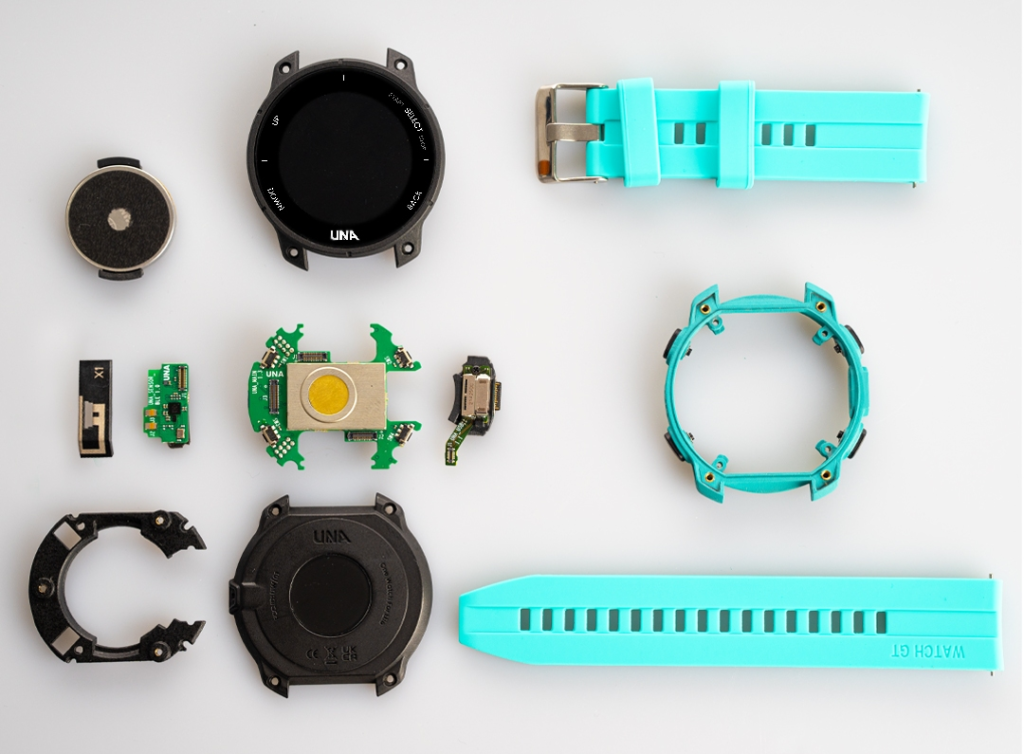
This UNA smartwatch can be taken apart like LEGO and repaired at home

Consumer tech devices, including smartwatches, have deplorably short lives. Most are tossed aside when the screen cracks, the battery dies, or the software falls behind — adding to the world’s whopping great pile of e-waste.   Scottish startup Una aims to upend this take-make-waste cycle. The company’s sports smartwatch is built to be repaired. Users can easily swap, replace, and upgrade individual components like the screen, battery, and health sensors, extending the device’s lifespan. “Customers are tired of replacing expensive tech every few years,” said Lewis Allison, Una’s founder. “We’re showing the industry there’s a better way.” The Una Watch can be disassembled and reassembled like LEGO. Credit: UNA Una had a blockbuster launch on Kickstarter last week, signalling early demand for its repairable, upgradable smartwatch. The startup raised over £200,000 in just 48 hours after its launch on the crowdfunding platform. That’s more than 20 times its initial fundraising goal of £10,000. 3 free tickets to TNW Conference? Get them now! For a limited time, groups can get up to three extra free tickets! Book now and increase your visibility and connections at TNW Conference Over 3,000 people have pre-ordered Una’s smartwatch. The first deliveries are due to begin in August 2025 to customers in the EU, UK, Canada, and the US. Early backers can secure one of the watches for £210 ($275) — £60 ($75) off the retail price of £270 ($350).  High-tech, open-source  While sustainability is at its core, Una’s watch doesn’t compromise on high-tech features. The smartwatch uses dual-frequency GPS, improving the accuracy, reliability, and robustness of location data. The device also packs a bunch of sensors. These include a barometric altimeter for elevation changes, an accelerometer to track movement, and a magnetometer for orientation. It also measures heart rate and blood oxygen levels. Powered by an ultra-efficient Cortex-M33 chip, the smartwatch offers up to 10 days of battery life. It charges via a regular USB-C cable. Una is targeting outdoor and sports users for activities like running, hiking, and cycling. Credit: UNA Una runs on FreeRTOS, an open-source operating system for microelectronics. The company also offers add-on hardware and software “kits” that allow users to build custom apps, create new hardware modules, and even write their own firmware. Una departs from proprietary, closed-source devices like the Apple Watch and Garmin, which dominate the global smartwatch market, worth $33bn last year. The Edinburgh-based startup is one of a growing number of tech companies developing products that customers can fix and upgrade themselves. Other examples include Fairphone, which makes smartphones that can be repaired at home using just a screwdriver and a video manual, and Framework, which builds modular laptops. Una’s Kickstarter success follows a £300,000 investment from SFC Capital in March. The company also won £100,000 in the Scottish EDGE startup competition last year. source

This UNA smartwatch can be taken apart like LEGO and repaired at home Read More »