The Next Web TNW

Trump’s ‘war on science’ hands Europe major tech talent opportunity

As the Trump administration ramps up what academics call a  “war on science,” US researchers are increasingly looking to Europe for new opportunities — which could be good news for the continent’s tech sectors. France, in particular, is positioning itself as a safe haven for scientists. In a not-so-subtle appeal to disaffected US talent on Friday, the country’s president, Emmanuel Macron, called on researchers to “choose France, choose Europe” for their next job. In a post on X, he promoted a new platform that aims to make it easier for international scientists to conduct research in the country.  “Here in France, research is a priority, innovation a culture, science a limitless horizon,” he said. Yann LeCun, Meta’s chief AI scientist, called Macron’s announcement a “smart move.” LeCun has previously criticised Trump’s cuts to science funding at institutions such as Harvard, Columbia, and NASA. From Shark Tank to Tinder Swindler TNW Conference 2025 combines the latest breakthroughs in tech, the startup ecosystem & enterprise innovation “The US seems set on destroying its public research funding system,” he said in a LinkedIn post last month. “[Europe] may have an opportunity to attract some of the best scientists in the world.” European institutions are already seizing that opportunity. Last month, France’s Aix-Marseille University opened applications for its Safe Space for Science scheme, which specifically targets US researchers looking to relocate. Belgium’s Vrije Universiteit Brussel has opened a similar programme targeting American scientists “under threat.” Europe’s appeal to refugees from a war on science Three out of four US researchers recently surveyed by Nature said they were thinking about relocating to Europe or Canada, driven by growing concerns over President Trump’s stance on science.  An exodus of US researchers could have knock-on impacts on Europe’s tech ecosystem. Many of the continent’s most successful startups — from DeepMind to ClimeWorks — emerged from university labs.   Kanika Chandaria, a climate expert at Danish carbon credit startup Agreena, told TNW that the exodus of US researchers presents a “strategic opportunity for European countries,” especially in climate tech. With the US rolling back climate protections, European countries could move to “attract top talent and position themselves at the forefront of climate research and technology development,” she said. However, while Europe hopes to lure in disillusioned US scientists with promises of a high quality of life and research freedoms, there are potential drawbacks to relocating. LeCun highlighted several of them, including lower compensation than in the US and limited access to research funding. “To attract the best scientific and technological talents, make science and technology research professions attractive,” he wrote. “It’s pretty straightforward.” European tech talent will flock to Amsterdam on June 19-20 for TNW Conference. Tickets for the event are now on sale. Use the code TNWXMEDIA2025 at the check-out to get 30% off the price tag. source

Trump’s ‘war on science’ hands Europe major tech talent opportunity Read More »

How scientists detected the 'strongest evidence' yet of alien life

Astronomers using the James Webb Space Telescope say they have detected the “strongest evidence yet” that life exists outside our solar system.   Scientists at the University of Cambridge found signs of the gases dimethyl sulfide (DMS) and/or dimethyl disulfide (DMDS) in the atmosphere of exoplanet K2-18b. On Earth, these gases are only produced by living organisms like phytoplankton, suggesting that K2-18b may also support life.  Located 124 light years away, K2-18b is almost three times the size of Earth and inhabits a region in space where temperatures might allow liquid water. This has long made the exoplanet a top candidate in humanity’s search for alien life.  Armed with the world’s most powerful space telescope, scientists are closer than ever to unearthing the mysteries of this far-off world.  How did the team spot signs of extraterrestrial life? From Shark Tank to Tinder Swindler TNW Conference 2025 combines the latest breakthroughs in tech, the startup ecosystem & enterprise innovation To arrive at their conclusions, the scientists employed a technique known as transit spectroscopy.  When K2-18b transits in front of its parent star, some of the starlight passes through its atmosphere before reaching Earth. Different gases absorb specific colours or wavelengths of the starlight, which can be picked up by James Webb’s instruments.  By studying the “missing” light colours, the scientists could piece together which gases are present in the exoplanet’s atmosphere.  The new findings support existing theories that K2-18b is a “hycean planet” — home to vast oceans and a hydrogen-rich atmosphere. “Given everything we know about this planet, a Hycean world with an ocean that is teeming with life is the scenario that best fits the data we have,” said Professor Nikku Madhusudhan from Cambridge’s Institute of Astronomy, who led the research.  Madhusudhan and his team admit that an unknown chemical process may be the source of these gases. However, the observations reached a “three-sigma” level of statistical significance, meaning there’s only a 0.3% probability they occurred by chance. That’s not the 0.00006% needed to reach the accepted classification for a scientific discovery — but it’s compelling evidence nonetheless. In 2023, the same team of Cambridge researchers found signs of methane and CO2 in K2-18b’s atmosphere using two different James Webb instruments — the Near-Infrared Imager and Slitless Spectrograph (NIRISS) and the Near-Infrared Spectrograph (NIRSpec). This marked the first detection of carbon-based molecules on an exoplanet within the habitable zone.  During these first observations, the researchers also noticed faint signals that potentially indicated DMS. Intrigued by this possibility, the team conducted follow-up observations two years later, this time using the Mid-Infrared Instrument (MIRI).  “This is an independent line of evidence, using a different instrument than we did before and a different wavelength range of light, where there is no overlap with the previous observations,” said Madhusudhan. “The signal came through strong and clear.”  The researchers estimate that 16 to 24 hours of follow-up observation time with JWST may push the findings past the threshold for a scientific discovery.   source

How scientists detected the 'strongest evidence' yet of alien life Read More »

UK unleashes drone-zapping microwave weapon amid defence tech drive

The British Army has successfully neutralised swarms of drones in a trial of the “RapidDestroyer” — a new kind of weapon that uses high-frequency microwaves to disable critical electronic components in unmanned aerial vehicles (UAVs), causing them to crash. The Army said it took down two swarms of eight drones during a single test at a site in West Wales. During the entire trial period, the weapon was used to “track, engage and defeat” more than 100 drones.  RapidDestroyer could be deployed in war zones across the world, including Ukraine, where drones have become ubiquitous on the battlefield. The UK’s Defence Intelligence agency estimates that Ukraine had to defend against attacks from more than 18,000 Russian drones last year.  “With improvements on range and power, which could come with further development, this would be a great asset to Layered Air Defence,” said Sergeant Mayers, who became the first British soldier to bring down drones using a radiofrequency weapon.   From Shark Tank to Tinder Swindler TNW Conference 2025 combines the latest breakthroughs in tech, the startup ecosystem & enterprise innovation While still under development, the weapon could provide a cheaper alternative to missile-based defence systems for specific applications, like taking down large swarms of drones. The Army estimates that each microwave blast costs just £0.10 (€0.12), with one shot enough to take out several small UAVs from a maximum range of 1km.  The RapidDestroyer was transported on a truck. Credit: GOV.UK RapidDestoyer isn’t the only direct-energy weapon the UK is working on. The British Army has also carried out several tests of DragonFire, a machine that fires high-powered laser beams at aerial targets.    These developments come amid a Europe-wide push in defence tech spending, as the continent looks to better arm itself amid tensions with the US. In March 2025, EU leaders endorsed the “ReArm Europe” plan, aiming to mobilise up to £683bn (€800bn) over the next four years to enhance military capabilities. The UK government, meanwhile, has committed to raising defence spending to 2.5% of GDP and wants to spend at least 10% of its defence budget on “innovative technologies.” Defence tech is a key theme of this year’s Assembly, the invite-only policy track of TNW Conference. The event takes place on June 19 and 20 — a week before the NATO Summit arrives in Amsterdam. Tickets for TNW Conference are now on sale — use the code TNWXMEDIA2025 to grab an exclusive discount. source

UK unleashes drone-zapping microwave weapon amid defence tech drive Read More »

As AI swamps music platforms, Deezer is fighting back

Songs generated by AI tools such as Suno and Udio are flooding Deezer — but the French music streaming platform is trying to fight back.  Deezer said on Wednesday that users are adding over 20,000 fully AI-generated tracks to its platform each day. This bot-made audio now makes up 18% of “total uploaded content” — almost double the 10% figure the company shared in January.  Aurelian Herault, Deezer’s chief innovation officer, said the flood of AI-generated slop songs is an issue that shows “no sign of slowing down.” In January, Deezer launched a tool that detects AI-generated music. The algorithm can identify artificially created songs made using several popular generative AI models, including Suno and Udio, which turn basic text prompts into “music.”   From Shark Tank to Tinder Swindler TNW Conference 2025 combines the latest breakthroughs in tech, the startup ecosystem & enterprise innovation Thanks to the tool, Deezer is already “removing fully AI-generated content from the algorithmic recommendations,” Herault said. The company also plans to develop a tagging system for fully AI-generated content, it said in January.   Deezer’s tool stands out in an industry that largely seems to be turning a blind eye to the issue. Rival platform Spotify has yet to launch any equivalent tool to track AI-generated music. It also hasn’t made any attempts to label such content, at least not publicly.      CEO Daniel Ek previously said that tracks created with AI were fair game on the platform — unless they mimicked real artists. However, Spotify seems to be doing a lousy job of identifying and removing these AI imitations, according to several reports.  Other music streaming platforms, including Apple Music, Amazon Music, and Tidal, have remained virtually mute on the topic. It’s perhaps unsurprising that popular music streaming platforms are sitting on their hands. There are currently no laws in place to regulate the flow of AI-generated songs, or a consensus on what kinds of artificial music are acceptable or not.  Last year, a group of US record labels sued Suno and Udio, alleging copyright infringement on a “massive scale.” However, the two companies claim that training their models on copyrighted music falls under “fair use,” a common defence from AI firms. “Generative AI has the potential to positively impact music creation and consumption, but we need to approach the development with responsibility and care in order to safeguard the rights and revenues of artists and songwriters, while maintaining transparency for the fans,” said Herault. source

As AI swamps music platforms, Deezer is fighting back Read More »

TECH5: DACH’s 5 top scaleups enter 'Champions League of Tech'

Five fast-rising scaleups from the DACH region have qualified for TECH5 — the “Champions League of Technology.” The DACH entrants fought off off stiff competition to reach the finals, which will crown the hottest scaleup in Europe. Comprising Germany, Austria, and Switzerland, DACH blends deep industrial roots, high R&D spending, elite research institutions, and a growing startup scene. Collectively, the three nations have created a regional tech powerhouse. Individually, each of them has unique strengths.  Germany leads with a booming startup scene in Berlin and a deep tech hub in Munich. The county also had Europe’s second-highest total VC investment last year, after the UK.  Austria’s compact but vibrant ecosystem has an impressive track record of greentech and health innovation. The industry centres in Vienna, which was named the world’s most liveable city for the third year running in 2024 by the Economist Intelligence Unit. The 💜 of EU tech The latest rumblings from the EU tech scene, a story from our wise ol’ founder Boris, and some questionable AI art. It’s free, every week, in your inbox. Sign up now! Switzerland blends scientific excellence, fintech nous, and blockchain leadership. In 2024, the country ranked number one in the Global Innovation Index (GII) for the 14th consecutive year.  Funding in DACH has also enjoyed a solid start to 2025, growing in deal value year-on-year. The region aggregated €12bn in exit value in Q1 — 20% more than its average quarter over the past five years — according to Pitchbook.  Scaleups from all three DACH nations have qualified for TECH5. Our judges picked them based on an analysis of their growth, impact, and future potential and then placed them in random order. It’s time to introduce them. 1. The Exploration Company The Exploration Company is an emerging European leader in the limitless universe of space travel. The Franco-German scaleup develops reusable, modular spacecraft that make access to the cosmos more affordable, sustainable, and open to a broader ecosystem. Hélène Huby, the company’s founder and CEO, said she plans to democratise the routes to space. “By working together across borders and sectors, we can make space exploration a cooperative effort rather than a competition between nations, ensuring it remains accessible and drives innovation that benefits many, not just a few,” Huby told TNW. The Exploration Company enjoyed a banner 2024, raising a whopping €151.6mn in a Series B round and winning a contract with the European Space Agency (ESA) to develop cargo shuttle vehicles for low Earth orbit. This year has also had a strong start, with the German aerospace agency becoming an anchor customer for the scaleup’s Nyx spacecraft. 2. Neustark Swiss sustainability scaleup Neustark has an ambitious target: remove 1 million tons of CO₂ by 2030. The company plans to achieve this by storing CO₂ from the air in recycled mineral waste — specifically demolished concrete, which Neustark calls “the world’s largest waste stream.” The scaleup’s solution mineralises CO₂ in demolished concrete aggregate, removing the compound from the atmosphere and permanently storing it. “We need to exponentially accelerate the removal of CO2 if we want to reach net-zero goals by 2050,” said Johannes Tiefenthaler, Neustark’s co-founder and co-CEO. “This target will only be possible by globally deploying highly scalable, measurable, and commercially viable carbon removal solutions at the scale of millions of tons per year.” Tiefenthaler founded Neustark alongside Valentin Gutknecht in 2019 as an ETH Zurich spin-off. Last year, they secured their biggest funding round yet, raising $69mn to take their carbon capture tech global. 3. Metaloop The sole Austrian contender in the DACH finals, Metaloop aims to fundamentally reshape the global metal recycling industry. To reach that goal, the scaleup has developed an all-in-one platform for metal scrap trading. The company’s matchmaking system connects buyers and sellers in real time. Consequently, clients can generate revenue, safe time, and fosters sustainability. The software also eliminates fraud, enhances transparency, and optimises supply chains — valuable services for the traditionally opaque and fragmented metal scrap sector. The solution has enjoyed a rapid rise. In 2024, Metaloop was named by the Financial Times as one of Europe’s fastest-growing companies for a third year in a row. “By directly connecting industrial manufacturers with certified smelters, we ensure fair pricing, consistent quality, and streamlined logistics — turning scrap metal from a risk factor into a reliable, high-value asset,” the company told TNW. “Ultimately, we see Metaloop as a catalyst for a more sustainable, circular economy.”  4. Vytal Before contending for TECH5, Germany’s Vytal had already claimed an impressive title: the world’s largest provider of smart reusable packaging solutions. Founded in 2019, Vytal has created a new form of sustainable containers for takeaway and delivery food. Investors have been impressed, injecting a steady stream of cash into the scaleup. Just last month, the company secured another €14.2mn to accelerate its international growth. The round was led by Inven Capital, a VC firm that specialises in scaling climate tech. “This new funding comes less than nine months after our last raise and reflects an incredibly successful 2024 for the Vytal team,” said Dr Tim Breker, Vytal’s co-founder and managing director.  “With Inven Capital’s expertise in supporting international growth strategies, we are well-positioned to scale our impact further and make tech-enabled reusable packaging the new standard in gastronomy, events, and entertainment globally.” 5. Yokoy The second Swiss contender in the DACH finals, Yokoy develops a powerful all-in-one spend management solution. The AI-powered platform simplifies the management of expenses, invoices, and corporate cards, while delivering new insights, eliminating routine work, and providing full control. Founded in 2019, Yokoy is a resident of TNW City. Last year, the company topped Sifted’s inaugural rankings of Central Europe’s fastest-growing startups by revenue. Across the past three financial years, the company had hit a compound annual growth rate (CAGR) of 281.88%. In January, Yokoy was acquired by the Spanish travel-management company TravelPerk. Philippe Sahli, the scaleup’s co-founder and CEO, heralded the deal as the beginning of a new era for intelligent spend management. “Starting

TECH5: DACH’s 5 top scaleups enter 'Champions League of Tech' Read More »

Paebbl opens ‘world’s first’ demo plant that turns CO2 into dust

Paebbl has opened its first demo plant in Rotterdam as it looks to ramp up its carbon capture technology.   When we visited Paebbl’s sprawling facility in June last year, it was a mishmash of prototype machines, batch samples, machinery, and equipment — some of it still in its packaging. Now, the site is purportedly the world’s biggest plant capable of continuously mineralising CO2. Paebbl said the plant was completed in “record time” with the help of Dutch engineering companies Spie and Vicoma. The project also received an undisclosed financial investment from the Netherlands Enterprise Agency (RVO).   Andreas Saari, co-CEO and co-founder of Paebbl, said the milestone brings the Dutch-Nordic startup “one step closer” to bringing high-performance materials and climate impact together “on a scale that really matters.”  Saari, the former CEO of Slush, co-founded Paebbl in 2021 alongside his former Northzone partner Marta Sjögren, early Klarna investor Jane Walerud, and Dutch scientist Pol Knops.       From Shark Tank to Tinder Swindler TNW Conference 2025 combines the latest breakthroughs in tech, the startup ecosystem & enterprise innovation How does Paebbl’s technology mineralise CO2? Paebbl’s technology artificially accelerates the slow, natural process of carbon mineralisation.   Paebbl feeds crushed olivine rock and CO2 captured from heavy industry into its machine, where it undergoes enhanced mineralisation. The CO2 turns into CO3 (carbon trioxide) and binds to the olivine.  For every ton of CO2 captured, it produces about three tons of powder, the scientific name for which is “silicon-rich” magnesium carbonate.  This powder feels like a soft, fine dust and is grey with a tinge of green from the olivine it’s made from. Around half of the emissions from cement are produced when limestone is heated to produce lime. Paebbl’s powder can replace lime and other additives in substances like wall filler, turning buildings into carbon sinks.  Paebbl is one of an emerging cohort of carbon removal startups looking to capture CO2 and use it as a resource to make new, cleaner products.  Known as carbon capture, utilisation, and storage (CCUS), this approach differs from the more established carbon capture and storage (CCS) championed by the oil and gas industry, where carbon is captured at source and buried underground.  In October, Paebbl secured $25mn from the likes of Amazon and German cement industry giants Holcim and Goldbeck, bringing its total raised to $38mn, according to Dealroom data. Paebbl aims to build a commercial-scale plant in 2027. While the company hasn’t yet disclosed the location of this facility, Marta previously told TNW that they will focus on setting up factories in areas with “high demand for end products (building material), nearby feedstock supply (CO2 and olivine rock)”, and access to renewable energy. In Europe, the Nordics, Spain, and Portugal stand out in this respect.   Paebbl aims to bring 1 million tons of its product to the market by 2030. The startup plans to make money by selling the rock powder itself and through providing carbon removal credits to companies looking to offset their emissions. Sustainability will be a hot topic at TNW Conference, which takes place on June 19-20 in Amsterdam. Tickets for the event are now on sale. Use the code TNWXMEDIA2025 at the check-out to get 30% off the price tag. source

Paebbl opens ‘world’s first’ demo plant that turns CO2 into dust Read More »

We stepped into IQM’s quantum lab to witness a new computing frontier

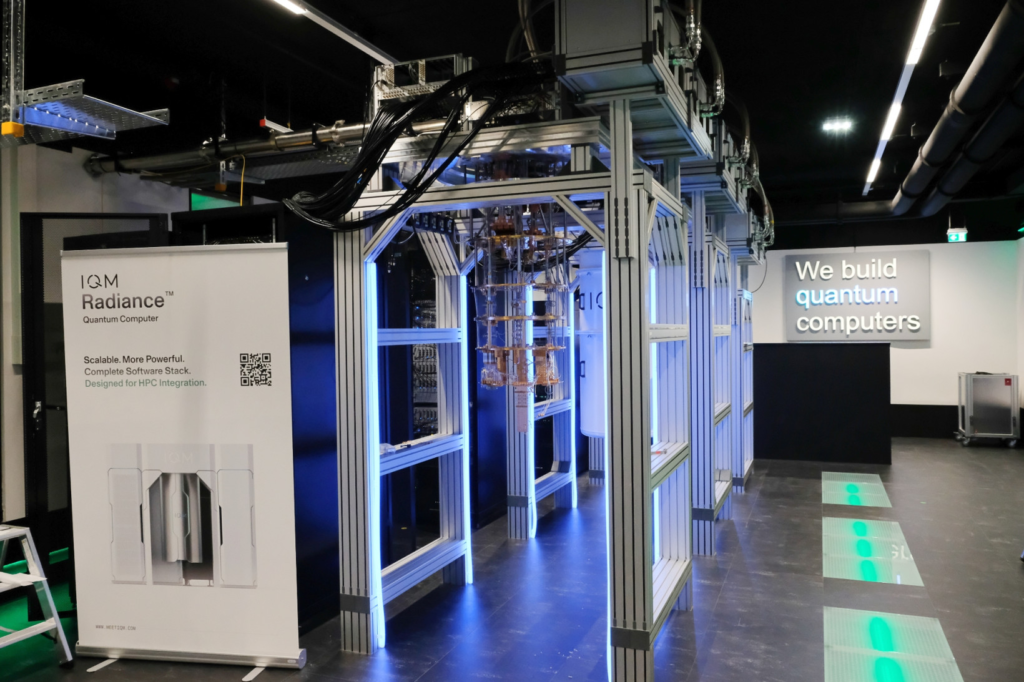
“The Future is Here,” declares a glowing neon sign at the entrance to IQM’s quantum data centre in Munich. It’s a bold claim — but one the Finland-based startup is determined to fulfil. To the right of the entrance sign stands a hefty, metal blue door. My host, physicist Frank Deppe, IQM’s head of quantum processing unit (QPU) technology, ushers me inside. Opened last year as part of IQM’s European expansion, the facility hosts six state-of-the-art superconducting quantum computers — used for the company’s own research and offered as a cloud-based service to scientists around the globe. IQM’s Munich quantum data centre. Credit: Siôn Geschwindt My initial impression is the sound — a low, steady purr punctuated by a bizarre rhythmic pumping noise. That, I would later discover, was the heartbeat of a quantum computer.   The 💜 of EU tech The latest rumblings from the EU tech scene, a story from our wise ol’ founder Boris, and some questionable AI art. It’s free, every week, in your inbox. Sign up now! The centrepiece of the data centre, though, is the cryostats — the golden chandelier-like structures that have become synonymous with quantum computing in the public imagination.  Cryostats are made up of an intricate system of gold-plated brass and copper wiring that channels microwave signals down to the QPU or “chip,” which sits right at the bottom of the chandelier. These microwave pulses allow scientists to control and manipulate the qubits on the chip, and, in turn, run algorithms to perform quantum calculations.  Intricate wiring inside the cryostat channels microwave pulses down to the quantum chip. Credit: Siôn Geschwindt For all this to work, however, superconducting quantum computers need to be cooled to close to absolute zero (or -273.15 degrees Celsius). That makes machines like these among the coldest places in the known universe. Qubits, which are the basic units of information in a quantum computer, are incredibly sensitive — to heat, vibration, stray particles, or electromagnetic signals. Even the slightest disturbance can cause errors or wipe out information entirely, says Frank, gesturing around us as if he can see the waves and particles flying around the room.    At ultra-cold temperatures, however, superconducting materials lose all electrical resistance, allowing qubits to maintain their delicate quantum properties. But ultra-cold isn’t enough — qubits also need near-perfect isolation from other particles in the air. That’s why cryostats are placed in a thick metal vacuum chamber, which helps to shield the qubits from interference. When operational, the cryostat is locked inside a super-cooled, vacuum chamber, which makes machines like this among the coldest places in the known universe. Credit: Siôn Geschwindt Each machine is supported by some serious industrial hardware. One of the largest pieces of equipment in the lab is the cryogenics system. Comprising a network of compressors, tanks, pumps, and pipes, its job is to transfer liquid helium to super-cool the cryostat. The helium compressor produces the distinctive rhythmic sound of a quantum computer — the cryostat itself is completely silent. Then there are the servers, placed beside each cryostat. They provide the precise control and support infrastructure that allows delicate quantum systems to operate effectively. They also produce the specific microwave pulses required to keep the qubits stable.  Yes, even the quantum computers of the future will need classical computers to function, Frank says.  An example of the classical electronics cabinet required run one of IQM’s quantum computers. Credit: IQM I was amazed by the extraordinary amount of infrastructure needed to power a quantum chip barely larger than my fingernail. But all that tech is essential — it protects the fragile qubits while still allowing for their manipulation.  “You need to isolate qubits from the environment — but still control them,” says Frank. “That’s the engineering paradox of quantum computing.”  Tapping into the subatomic world of quantum mechanics — with phenomena such as superposition and entanglement — to perform useful calculations is one of the toughest challenges in modern science. It’s baffled researchers for decades. But now, after years of steady progress, we’re closer than ever to potentially world-changing applications — and the payoffs could be huge. Towards quantum advantage The quantum computers of the future are expected to solve problems that are far beyond the reach of today’s most powerful supercomputers — a point known as “quantum advantage.” These machines could simulate complex molecules for drug discovery, design new materials from the atomic level up, and revolutionise logistics and finance by cracking massive optimisation problems. They could also break all internet encryption on what is known as Q-Day — so there are risks, too. However, most experts agree that we’ll need a 1 million-qubit system and beyond to make those sorts of calculations — and that’s still a long way off. We’re currently in what is known as the Noisy Intermediate-Scale Quantum (NISQ) era, where we have small quantum computers that can run real experiments but are still too “noisy” and error-prone to do anything truly groundbreaking. IQM’s quantum processors currently range from six to 50 qubits. Next year, it’s set to release a larger 54 to 150-qubit system called Radiance, which it says will “pave the way” to quantum advantage — when a quantum computer can solve a problem no classical computer can). The company hopes to produce a 1 million-qubit system by 2033.  One of IQM’s open cryostats. The chip is housed behind the metal cylinder right at the bottom of the chandelier. Credit: IQM Headquartered in Helsinki, IQM has built a business based on helping researchers train on and navigate smaller systems before larger ones become commercially available. Using these machines, scientists can already explore quantum algorithms, develop hardware, and prototype solutions for specific problems such as climate modelling or drug discovery.  Founded in 2018, IQM has raised $210mn to date, making it Europe’s second best-funded quantum computing company. According to Bloomberg, the startup is also in talks to raise over $200mn in fresh capital, which would bring its total to over $400mn. In June, the

We stepped into IQM’s quantum lab to witness a new computing frontier Read More »

Quantum utility is at most 10 years away, industry experts believe

Quantum professionals around the world overwhelmingly agree that quantum utility will arrive within the next decade, according to a new survey by Economist Impact. Quantum utility refers to the point at which quantum computers provide practical advantages over classical computers in solving specific real-world problems. A whopping 83% of the survey’s respondents think that moment will come within 10 years or less.  One-third of them are even more optimistic, predicting that quantum utility could be achieved within the next one-to-five years. That’s more in line with the roadmaps of quantum companies like Finnish startup IQM, which is targeting quantum utility as early as next year.  Some of the world’s biggest tech leaders have also cast their predictions on this hot topic in recent months. In February, Google’s CEO Sundar Pichai said he believes “practically useful” quantum computers are five-to-10 years away. A month earlier, Nvidia’s Jensen Huang suggested we’re still at least 15 years out — a comment that sent quantum stocks tumbling. The discrepancy in estimates reflects the uncertainty over when quantum will have its breakout moment. It also points to a broader confusion over quantum jargon. The 💜 of EU tech The latest rumblings from the EU tech scene, a story from our wise ol’ founder Boris, and some questionable AI art. It’s free, every week, in your inbox. Sign up now! Quantum utility will mean that quantum computers can solve meaningful real-world problems. However, even within the industry, the term is often used interchangeably with quantum “advantage” or “supremacy,” which is widely considered the point at which quantum computers outperform classical ones.  Economist Impact — a research-driven consultancy and content arm of Britain’s Economist Group — illustrates how muddled the terms have become in its own press release: “Quantum utility [is] when quantum computers will overcome hardware and error correction challenges to perform better than classical computers.”   That makes the next finding from the survey quite fitting.  Quantum utility challenges Over half of the respondents believe misconceptions about quantum computing are actively hindering advancement. The findings highlight a gap between technological progress and business preparedness, emphasising the need for improved education about what quantum computing is. Public misunderstanding of quantum computing is far from the biggest headache for quantum professionals, however. Overcoming engineering challenges and acquiring enough talent to grow are right at the top of the list of concerns.   Over 80% of respondents cited overcoming technical challenges — particularly error correction — as a key hurdle to reaching quantum utility.  Three-quarters identified a shortage of talent and expertise as a critical issue. Quantum experts are in short supply, exacerbated by the rapid growth of the quantum sector, where startups and tech giants alike are competing for a small pool of qualified professionals.    Tapping into the subatomic world of quantum mechanics to perform useful calculations was never going to come easy, though. It is one of the toughest challenges in modern science — but if cracked, the payoff could be huge.  Quantum computers have the potential to solve problems that are far beyond the reach of today’s most powerful supercomputers. They could simulate complex molecules for drug discovery, design new materials from the atomic level up, and revolutionise logistics and finance by cracking massive optimisation problems. They could also break all internet encryption on what is known as Q-Day — so there are risks, too. Europe’s race to secure leadership in quantum is on the agenda for TNW Conference, which takes place on June 19-20 in Amsterdam. Tickets for the event are now on sale. Use the code TNWXMEDIA2025 at the check-out to get 30% off the price tag. source

Quantum utility is at most 10 years away, industry experts believe Read More »

LinkedIn’s AI action figure fad is ‘obviously unsustainable,’ warns UK tech mogul

If you’ve been scrolling social media over the past week, you may have noticed miniature action figure versions of friends, family, or colleagues neatly wrapped in a blister pack. These plastic-fantastic portraits are the latest AI-powered photo trend to sweep the internet — especially LinkedIn. After digital avatars and Studio Ghibli-inspired selfies, we now have the action figure, produced using ChatGPT’s free image generator.  It’s all fun and games, right? But look closer, and behind the gloss and giggles lies some pretty crucial fine print. With this action figure, sustainability is not included.  Mel Morris, the founder of research engine Corpora.ai and former chairman of Candy Crush creator King, has slammed the environmental costs. “The LinkedIn action figure trend and its demand on GPUs is obviously unsustainable,” he said.  The 💜 of EU tech The latest rumblings from the EU tech scene, a story from our wise ol’ founder Boris, and some questionable AI art. It’s free, every week, in your inbox. Sign up now! Some researchers estimate that using AI to generate text consumes 20-30 times more energy than a traditional search, depending on the model. Creating AI-generated images from written prompts uses at least double that amount, according to data from HuggingFace.  “GPUs aren’t infinite,” said Morris. “They come at a carbon cost, and this kind of casual overuse shows how disconnected we’ve become from the true costs associated with these tools.” Energy use from data centres, including for AI applications, is predicted to double over the next five years to 3% of global energy use, according to the International Energy Agency’s latest figures. Globally, almost half of that power is predicted to come from burning fossil fuels like coal and natural gas.   “As a technologist, I believe in the power of AI, but not at any cost,” said Morris. “If we want sustainable innovation, then we need to learn what genuine progress looks and feels like — I’m willing to bet that it’s not the dopamine hit after posting your AI-made figurine.” AI and sustainability feature heavily on the agenda of TNW Conference, which takes place on June 19-20 in Amsterdam. Tickets for the event are now on sale. Use the code TNWXMEDIA2025 at the check-out to get 30% off the price tag. source

LinkedIn’s AI action figure fad is ‘obviously unsustainable,’ warns UK tech mogul Read More »

How the McMurtry Spéirling became the first car to drive upside down

Motorheads have long theorised that the extreme downforce generated by high-performance cars could one day let them drive upside down. Now, British carmaker McMurtry has turned that wild idea into a reality for the first time. In a stunt that would make Batman jealous, McMurtry drove its insanely fast electric Spéirling flipped over. More impressively, it did that for over a minute while keeping the vehicle completely stationary — save for a quick acceleration to prove the car wasn’t tied down.  While it might look like the car has defied gravity, in reality, it’s basic physics coupled with some clever engineering.  To drive upside down using conventional aerodynamics, an F1-style car would need to hit at least 100–150 mph to generate enough downforce to exceed its own weight and “stick” to the ceiling.   From Shark Tank to Tinder Swindler TNW Conference 2025 combines the latest breakthroughs in tech, the startup ecosystem & enterprise innovation But the Spéirling is a fan car. Twin electric turbines positioned behind the cockpit of the vehicle pull air from under the chassis and expel it through a rear-mounted exhaust system, creating a low-pressure zone underneath that presses the car onto the road. This system means the Spéirling can generate 2,000kg of downforce on demand. That’s great for grip in high-speed turns, but it also means the 1,000kg car can hang upside down, even when standing still.  That’s how McMurtry’s co-founder Thomas Yates was able to drive the Spéirling onto a rotating rig, flip it 180 degrees upside down, and have it stay there. No wires. No magnets. Just an insane amount of downforce.  The route to public roads for McMurtry McMurtry steered the Spéirling up a ramp and drove it upside down. Credit: McMurtry While this was just a stunt — for now — one can’t help but wonder what the future might hold. Stuck in tunnel traffic? Just drive up the wall, flip upside down, and cruise on the ceiling. Goodbye, gridlock.  The Spéirling Pure, the company’s first commercially available vehicle, is set to go on sale next year for £895,000. So, technically, you could try upside-down driving yourself.  “That said, customers are strongly advised not to try [driving upside down] at home,” a McMurtry spokesperson told TNW. If you’re mad enough to give it a go, McMurtry recommends contacting the company directly to discuss “pre-flight checks, preparation and safety equipment, and controlled demonstration environments.” For now, though, McMurtry is preoccupied with smashing records the right side up. On the same day as the Batmobile-like stunt, the Spéirling beat the all-time Top Gear track record by 3.1 seconds, dethroning a Renault F1 car at the top of the leaderboard. The McMurtry Spéirling’s fan-based tech gives it incredible grip in corners. It’s no slouch, either. Dual electric motors — one for each rear wheel — deliver over 1,000 horsepower combined. Paired with a featherweight chassis, this allows the car to clock 0–60mph in 1.5 seconds. source

How the McMurtry Spéirling became the first car to drive upside down Read More »