The Next Web TNW

Why I want the EU to pause the AI Act — as a climate advocate

“There is no stop the clock. There is no grace period. There is no pause.” So said Thomas Regnier, a spokesman for the European Commission, in response to calls for a pause on the EU’s AI Act. These landmark rules on artificial intelligence will, then, be rolled out according to the timeline specified in the legislation. The EC will ignore calls from 46 CEOs across the continent to halt the legislation for two years — including me. This will surprise some people. My company, Kayrros, was the world’s first to track and attribute methane globally. We were cited when John Kerry announced the Global Methane Pledge, and we played a role in shaping the EU’s 2024 methane law. We have worked with countless organisations to monitor greenhouse gas emissions and other climate events — deforestation and wildfire spread, for example — and numerous businesses keen to reduce their carbon footprint. Surely, unregulated AI means an explosion in energy use and the creation of fuel-hungry data centres? Here is my concern. The European Commission, in its zeal to pass the first major piece of AI regulation — and for the best of reasons, I should add — is missing the wood for the trees. Yes, we need guardrails. Yes, we need AI to be ethical and human-centred. Yes, AI is powerful, and powerful technologies have a way of developing in unpredictable ways. And yes, less regulation means more AI deployment, which means more energy use. But the AI Act is still a mistake. First, AI will make industries vastly more efficient, reducing emissions for years to come. As Nvidia’s Jensen Huang has pointed out, once created, AI models perform tasks far more efficiently than traditional computing methods. For example, an AI weather model can forecast over 1,000 times more efficiently than conventional techniques can. Thus, whatever energy is invested in AI is repaid, with change, as the model is reused. Due to recent developments in AI, such as the creation of increasingly sophisticated large language models (LLMs) and remote-sensing foundation models (RSFMs), data analysis that once took days now only needs hours. In my line of work, that means near-real-time analysis of satellite imagery, allowing us to do extraordinary things like predict floods and wildfires, enabling vast cost savings and, in the hands of the emergency services, potentially even preventing loss of life. But as my counterparts at BNP Paribas, AXA, Siemens, and countless other household names have persuasively argued, the real fear with the AI Act is that it will hamstring our ability to compete globally in the world’s most consequential technological field. Do not think that the world powers will have the same qualms that we in Europe do about this. They will race ahead into the future, as they have in other critical areas, like space, and create such a distance that it will become exponentially harder for us to catch up. This is not what we need: Europe is awash with world-class talent eager to make the continent an AI superpower. There is a lack of clarity here, too. Justifiably, startup founders in particular are worried about how general-purpose AI models will be regulated. What if there is a patchwork of different rules in different member states? Won’t it be easier for the big, wealthy US tech companies to navigate these than smaller businesses whose pockets aren’t so deep? The fear of breaking the rules — and facing hefty penalties — could deter startups from developing and deploying AI. That’s the last thing we want. They’re the ones best placed to move fast and break things. The defence case here is as strong as the economic one. The global balance of power is shifting, and Europe — as the recent pledge to boost spending to 5% of GDP showed — is acutely aware of its need to rearm. Ask anyone in the defence sector, and they will stress the role that data, software, and technological innovation play now in conflict. AI can’t be divorced from this. The risk here is that we scupper our attempts to develop a modern fighting force capable of keeping peace on the continent and protecting European interests and values. AI is not just one area of the world economy, but the kind of technology that will soon come to underpin almost every sector. I am not against AI regulation in some shape or form. But I signed the open letter because I believe that we are being far too hasty, and putting at risk, through our eagerness to regulate, the soft power, economic security, technological sophistication, and military strength of our continent. source

Why I want the EU to pause the AI Act — as a climate advocate Read More »

Whisper emerges from stealth with ‘God Mode’ to tackle cybercrime

Dutch startup Whisper has emerged from stealth with a cybersecurity platform that promises to detect online threats before they strike. It plans to do this with what it calls a “God Mode” view of the internet. At the heart of Whisper’s approach is a massive, real-time map of global internet infrastructure. The map is built from more than 45 billion data points sourced from 18 different systems, such as domain name registries (DNS), IP address databases, routing protocols (BGP), and ownership records (Whois).  Using knowledge graph technology to organise this information, the map updates in sub-seconds. Whisper’s CEO Leonardo Carlo Calisse said it allows cybersecurity teams to enter the aforementioned “God Mode,” a term borrowed from gaming, where it denotes invincibility and total control. “‘God Mode’ refers to Whisper’s advanced cybersecurity visibility, an unprecedented, real-time view of the entire internet’s infrastructure,” Calisse told TNW. “It enables organisations to detect and track cyber threats by exposing attacker infrastructure and hidden relationships before any damage occurs.” The 💜 of EU tech The latest rumblings from the EU tech scene, a story from our wise ol’ founder Boris, and some questionable AI art. It’s free, every week, in your inbox. Sign up now! Whisper’s platform returns real-time threat scores and metadata on anything from a suspicious domain to a shadowy network cluster. It’s also been designed to minimise false alarms, using what the company describes as entropy-based scoring to help security teams save time. The cyber threat landscape Whisper arrives in challenging times for online security. Cyber attacks are becoming harder to detect as threat actors deploy increasingly sophisticated methods. These include so-called multi-vector attacks — coordinated campaigns that target different parts of a system simultaneously. Artificial intelligence is also increasingly used to automate and disguise malicious activity online.  As these tactics evolve, the overall scale of cybercrime is increasing rapidly, having surged over 300% since 2015. McKinsey estimates global cybersecurity-related losses could hit $10.5 trillion (€9 trillion)  annually by the end of 2025.  Calisse said he believes the surge in the amount and type of online crime demands an “entirely new generation” of cybersecurity tools.  Since launching in January, Whisper has already secured pilot projects with other cybersecurity providers. The startup now plans to scale following a €1.6mn pre-seed round, led by Atlas AI^VB Fund I, with participation from Antler, D11Z, Tioga Trust, and Volve Capital. source

Whisper emerges from stealth with ‘God Mode’ to tackle cybercrime Read More »

Vibe coding platform Lovable becomes fastest-growing software startup ever

Swedish AI startup Lovable says it has surpassed $100mn in annual recurring revenue (ARR) just eight months after launch. That makes it the fastest-growing software startup ever — eclipsing the historically rapid growth rates of companies such as Cursor and Wiz.  Lovable’s rise stems from the popularity of its generative AI platform. The system allows non-technical users to build apps or websites based on simple text prompts.  The platform is the brainchild of Anton Osika, who co-founded Lovable in 2023. “I decided what we needed to do is build for the 99% who do not create software,” he told TNW in April.  By allowing non-technical founders to create successful businesses without any prior coding or software experience, Osika believes the company is “unlocking a new economy.”  Lovable has now reached over 2.3 million active users and seen more than 10 million projects built on its platform. According to the company, more than 100,000 new projects are being created each day.  Last week, Lovable announced a $200mn Series A round led by Accel, with participation from 20VC, byFounders, Creandum, Hummingbird, and Visionaries Club. The funding valued the startup at $1.8bn and ranks among the largest Series A rounds ever raised by a European company. Lovable also revealed it is now “fully agentic,” giving the platform the ability to “think through problems, make plans, and proactively take actions like a real developer.” The upgrade enables Lovable to search the web for content, debug code, and edit applications with full context — all without human intervention. The company has also launched a Business Plan offering “enterprise-grade security, privacy, and control,” which includes features like reusable templates, self-serve SSO, private projects, and data opt-out. Early customers include Klarna, Hubspot, and Photoroom. “Despite our rapid growth, we are still just beginning to understand what this means for people and businesses around the world,” Osika said in a statement. “AI is unlocking the potential for people to build easily, create new companies at an unprecedented rate, and have a positive impact on the world.” source

Vibe coding platform Lovable becomes fastest-growing software startup ever Read More »

Swiss startup says its AI weather forecaster beats Microsoft, Google

Swiss startup Jua has launched an AI-powered weather forecaster that it says beats leading models from tech giants — potentially making it the world’s most accurate weather forecasting system. Jua claims its model — dubbed EPT-2 — is faster and more accurate than both Microsoft’s Aurora and Google DeepMind’s Graphcast. In separate, peer-reviewed studies, both of those models were shown to be more accurate than the European Centre for Medium-Range Weather Forecasts (ECMWF)’s ENS forecast, widely regarded as the world leader. Jua backs up its bold claims with a new report, published today, that puts EPT-2 head-to-head with top-tier models — including Aurora and two of ECMWF’s best: ENS and IFS HRES. According to the paper, EPT-2 came out on top, delivering the most accurate forecasts across the board. It beat Aurora on key variables like 10-metre wind speed and 2-metre air temperature over a 10-day period, ran forecasts 25% faster, and posted the lowest error scores of all models tested. Jua says it achieved all this while using 75% less computing power than Aurora, the second most efficient system tested.  TNW City Coworking space – Where your best work happens A workspace designed for growth, collaboration, and endless networking opportunities in the heart of tech. The research is due to be published on the open-access archive arXiv next week, according to Jua. DeepMind’s Graphcast model was not included in the study. Nevertheless, Marvin Gabler, Jua’s CEO and co-founder, is confident that it can beat all of the competition.  “We respect players like Microsoft Aurora, GraphCast, and Tomorrow.io, but they’re either too slow, too narrow, or still reliant on legacy infrastructure,” said Gabler.  AI-based weather forecasting has been making waves in recent years, driven by demand for more accurate and cheaper ways to predict the Earth’s climate.  Traditional weather models, like those from ECMWF or NOAA, use complex physics equations run on billion-dollar supercomputers. AI models skip the equations, learning patterns from massive datasets, potentially making accurate forecasts thousands of times faster on far cheaper, less energy-intensive machines. However, Gabler says Jua takes it a step further than previous AI-based forecasters. “While others are retrofitting AI onto legacy systems, we’ve built a native physics simulation that understands how Earth’s atmosphere actually behaves,” he said.  Jua released its first global AI weather model three years ago. The startup has since raised a total of $27mn in funding from backers including 468 Capital, Future Energy Ventures, and Promus Ventures. source

Swiss startup says its AI weather forecaster beats Microsoft, Google Read More »

Why traditional VC is failing deep tech — and what can fix it

Europe’s deep tech future hinges on evolving investment strategies. The reason for this is that traditional funding models cannot support the long-term financial commitments that innovation demands. There is a European paradox where, despite substantial scientific research, early commercialisation and a focus on shorter-term goals prevent the region from realising the full potential of deep tech. Although startups provide strong support, the sector still lags behind the US and Asia in bringing breakthroughs from the lab to market. To maintain a competitive industry, Europe needs to advance technologies like AI, robotics, synthetic biology, and quantum computing, which are at the heart of the deep tech sector. These technologies aren’t just profitable; they can transform the world, from cochlear implants restoring hearing to aerospace engineering enabling missions to Mars. But none of these advances happen without patient, long-term investment in science, engineering, and design. Startups focused on rapid-deployment SaaS or consumer apps can commercialise quickly and attract early investment. Deep tech is different: there’s a “valley of death” driven by long R&D cycles, high upfront costs, and greater risk tolerance than in traditional software ventures. It’s worth examining which new funding models are working — and how they are starting to take hold in Europe. Drawing on insights from my investment practice — Zubr Capital — this analysis explores the real opportunity for Europe to leverage deep tech and reclaim lost market share, rather than see its startups move to mature financial ecosystems like the US, Asia, or Israel. Why classic VC struggles with deep tech Traditional software startups typically follow a familiar funding cycle blueprint. They raise a 10-year fund, deploy gained capital over three to five years, and aim for lucrative investment exits within five to seven years. The startup defines a successful funding cycle based on rapid growth, scalability, and relatively low capital requirements. The 💜 of EU tech The latest rumblings from the EU tech scene, a story from our wise ol’ founder Boris, and some questionable AI art. It’s free, every week, in your inbox. Sign up now! Deep tech cannot operate within this traditional financial mould. Startups operating in this category need development cycles that often exceed a decade. Regulations from sectors like healthcare, energy, and aerospace require numerous certifications and tests to verify advanced capabilities. That is an area where generalist VCs rarely tread due to a need for patient capital. Most deep tech companies have to overcome specific industrial and geographical thresholds. A French aerospace firm, for instance, may not have the infrastructure to take advantage of traditional funding the way a US airline giant like Delta can. Established investment models present several obstacles to deep tech companies. For example: Pressure for visible traction pushes startups to pivot from deep tech to commercial projects. Traditional VCs often lack the expertise to evaluate complex projects properly. Europe has smaller funds for upfront and long-term costs. There is a valley of death for deep tech to cover R&D from public funds. EU investors tend to be risk-averse due to the stigma of failure. Fragmentation within the industry, with multiple markets, regulations, and heavy bureaucracy, slows funding. Foreign funding steps in for late-stage rounds, frequently taking the tech to other countries. Another pain point in deep tech is the reliance on education. A traditional startup leader only has two to three years of higher education. Deep tech requires about five to seven years due to the complexity of the subject matter. An overwhelming 81% of deep tech founders believe European investors lack the knowledge to really understand the in-depth details of their projects or goals. There also simply isn’t enough money to offer. A European fund managing €150mn can write a few €10mn-€15mn checks, but that isn’t enough to build something as complex as a gigafactory or scale a new fusion plant. The mismatch of traditional VC funding with deep tech in Europe is what drives systemic underfunding, stalled startups, and the loss of world-changing innovations. There is a history of outside and foreign entities like Amazon, Facebook, Microsoft, and others picking up European tech talent to integrate into their R&D sectors. Such losses slow European deep tech advancement. The evidence: when VC fails deep tech The idea of mismatched VCs isn’t theoretical. There are many real-world examples of funding failures leading to Europe losing deep tech opportunities to international competitors. Here are just a few examples. Prophesee in France Prophesee creates neuromorphic vision sensors that enable machines to mimic human sight. The company raised €126mn over several rounds. However, in October of 2024, Prophesee entered judicial recovery after failing to secure additional funding. Even though the startup received massive global recognition for its technical validation (proof of concept), the length and uncertainty of financing led to complications in development. Mycorena in Sweden Mycorena had to file for bankruptcy and is now permanently closed. What began with the promise of mycelium-based protein that could be used in all kinds of industries failed after the startup couldn’t secure Series B funding in the mid-2020s. Mycorena was ultimately acquired for next to nothing, underscoring the hurdles deep tech companies encounter during scale-up.  Blickfeld in Germany Blickfeld was an emerging leader in LiDAR, which enables autonomous vehicles to perceive their environment and operate safely. The company raised a total of €68mn — including €15mn from the European Investment Bank (EIB). But in June 2024, Blickfeld had to file for insolvency. Revenue came in too slowly to meet the demands of patient capital. There are many other examples of investment shortcomings undermining promising European tech firms.  Take MaaS Global in Finland, best known for the Whim app, which burnt through too much capital without a sustainable business model. Or Sweden’s Northvolt, whose battery manufacturing business failed even with a blended funding model. The pattern is strikingly consistent: funding dries up when capital needs spike and investors push for exits while R&D is still trying to work out the final solution. Meanwhile, public funding fails to arrive in time, and technical

Why traditional VC is failing deep tech — and what can fix it Read More »

Denmark taps Microsoft to build world’s most powerful quantum computer

Denmark is aiming to stake a bold claim in the global quantum race with plans to build the world’s most powerful quantum computer. Backed by €80mn from EIFO (Denmark’s export and investment fund) and the Novo Nordisk Foundation, the new initiative — dubbed QuNorth — aims to deploy the Nordic region’s first “Level 2” quantum system.   Microsoft and California-based Atom Computing will deliver the system, named Magne, after the mythological son of Thor. Microsoft will contribute its Azure Quantum software stack. Atom will provide hardware based on its “neutral atom” design. Magne is expected to include around 50 logical qubits and more than 1,200 physical qubits. That would make it a contender for the most advanced quantum computer ever made.  Atom Computing holds the record for the most physical qubits in a single system: 1180. Rival firm Quantinuum, meanwhile, leads on logical qubits, having demonstrated a record of 50. So far, no one has combined those two feats in a single machine. That could be set to change. The 💜 of EU tech The latest rumblings from the EU tech scene, a story from our wise ol’ founder Boris, and some questionable AI art. It’s free, every week, in your inbox. Sign up now! Why do logical qubits matter?  To understand the significance of the plans, here’s a short quantum brief.  A qubit is the basic unit of information in a quantum computer, similar to a regular bit in classical computing, but with quantum properties that allow it to be in multiple states at once. However, qubits are extremely fragile and prone to errors. To get around this, quantum computers use logical qubits, which are error-corrected “virtual” qubits made by combining multiple physical qubits. Their function is to make quantum calculations much more stable and reliable. Getting more logical qubits to run efficiently is the hallmark of Level 2 machines, which offer in-built error correction and are seen as a critical stepping stone to quantum advantage. That’s the point at which quantum computers provide practical advantages over classical computers in solving specific real-world problems.  While quantum computing remains in its infancy, proponents argue it could revolutionise areas from drug discovery to climate modelling by performing much faster, more detailed calculations and simulations than classical computers. Yet Europe has often been seen as lagging behind the US and China in the quantum race. Danish officials appear keen to change that narrative. “Quantum technology comes with enormous potential, and Denmark and the EU must seize this opportunity,” said Morten Bødskov, Denmark’s minister for business, in a statement. “With the investment in the world’s strongest quantum computer, we are making a solid shift in the global quantum race.” Construction of Magne is expected to start in autumn 2025. If all goes according to plan, the computer will begin operations around the turn of 2026/27. QuNorth is now searching for a CEO to lead the project. The initiative will initially employ a team of around 10, with a full launch and academic programme planned for late next year. The computer will be housed in Copenhagen and be 100% Danish-owned, with equal ownership split between the two founding institutions. source

Denmark taps Microsoft to build world’s most powerful quantum computer Read More »

Spotify’s AI songs from dead artists spark fresh outrage over exploitation

Spotify has been hit with another AI controversy after publishing computer-generated songs under the names of dead musicians. An investigation by 404 Media found that Spotify is releasing AI-generated songs on the pages of deceased artists — without approval from their estates or labels.  One such track, “Together,” recently appeared on the official page of Blake Foley, a country singer who was murdered in 1989. The song sounds vaguely similar to Foley’s style, but the accompanying image features a blonde, young man who looks nothing like him.  404 Media linked the track to a company account called Syntax Error, which was also responsible for several other seemingly fabricated numbers. One included “Happened To You,” a song supposedly performed by Grammy-winning country singer-songwriter Guy Clark, who died in 2016.  Spotify removed the unauthorised tracks after 404 Media’s report was published. However, while this is a particularly grim example of AI-generated music on the Swedish streaming platform, it’s not the first — and unlikely to be the last. The 💜 of EU tech The latest rumblings from the EU tech scene, a story from our wise ol’ founder Boris, and some questionable AI art. It’s free, every week, in your inbox. Sign up now! Last month, an AI-generated band called the Velvet Sundown popped up on Spotify. Its top track, “Dust on the Wind” — which sounds similar to the 1977 Kansas hit “Dust in the Wind”  — has been played almost 2 million times since its release on June 20.  Velvet Sundown’s Spotify bio now describes the band as a “synthetic music project,” but the platform doesn’t label the tracks — or any other music — as AI-generated.  Daniel Ek, Spotify’s CEO, has taken a consistently laissez-faire approach to managing AI-generated content. Ek previously said that tracks created with AI were fair game on the platform — unless they mimicked real artists. However, Spotify seems to be doing a lousy job of identifying and removing these AI imitations as well, according to several reports.  The rise of AI-generated music on Spotify has sparked widespread backlash for several reasons. One involves the frequent use of AI tools like Suno or Udio, which generate entire tracks based on a simple text prompt. While the companies behind them claim that training their models on copyrighted music falls under “fair use,” opponents argue it amounts to copyright infringement. Critics also warn that AI-generated tracks compete for streams, reducing the share of royalties available to human artists.  Sophie Jones, the chief strategy officer at the music trade body the British Phonographic Industry (BPI), called for new protections in an interview with the Guardian last week.  “The rise of AI-generated bands and music entering the market points to the fact that tech companies have been training AI models using creative works — largely without authorisation or payment to creators and rights-holders — in order to directly compete with human artistry,” she said.   Another concern is that deceiving listeners with AI-generated profiles and songs is a form of misinformation that risks ruining the reputation of human artists.  To give creators a fair shot, Jones and others argue that streaming platforms should start by clearly labelling AI-generated content. That’s a move pioneered by rival streaming app Deezer, which has developed an algorithm that can identify artificially created songs made using several popular generative AI models, including Suno and Udio.   “AI is not inherently good or bad, but we believe a responsible and transparent approach is key to building trust with our users and the music industry,” Deezer’s CEO Alexis Lanternier said in June. “We are also clear in our commitment to safeguarding the rights of artists and songwriters at a time where copyright law is being put into question in favour of training AI models.” source

Spotify’s AI songs from dead artists spark fresh outrage over exploitation Read More »

Germany snaps up 90% of Europe’s record defence tech funding

Funding focus is a new series analysing cash flow into the European tech ecosystem. Last week, we looked at the largest investment rounds in fusion energy this year, and now we’re honing in on Europe’s booming defence tech arena.  Europe’s defence tech startups secured $971mn in funding in the first half of this year, as VCs look to capitalise on the continent’s push to rearm amid heightened geopolitical tensions.  Funding in H1 2025 has already shot past the whole of 2024 — the previous record year — which saw defence startups raise $605mn, according to Dealroom data. German startups led the charge, raising $881mn — 90% of Europe’s total defence tech investments.  Munich-based Helsing took the lion’s share. In June, the startup secured a whopping €600mn ($660mn) in Europe’s largest funding round of the year so far. The deal, led by Spotify CEO Daniel Ek’s VC firm Prima Materia, valued Helsing at €12bn ($13.2bn), making it one of the continent’s most valuable private companies. Founded in 2021, Helsing develops AI software for weapons, vehicles, and military strategy. Its tech has been integrated into battlefield simulations, electronic warfare for fighter jets, and drones in Ukraine. The company also recently unveiled plans for a fleet of autonomous reconnaissance submarines to boost Europe’s maritime defences. The 💜 of EU tech The latest rumblings from the EU tech scene, a story from our wise ol’ founder Boris, and some questionable AI art. It’s free, every week, in your inbox. Sign up now! Helsing AI agent Centaur successfully “flew” a Saab Gripen E fighter jet in a test in June. Credit: Saab/Helsing The year’s second biggest cash injection went to another German company —  Quantum Systems, which raised €160mn ($176mn) at a valuation north of €1bn ($1.1bn).   Quantum Systems builds electric, AI-powered autonomous surveillance drones that are dual-use, meaning they can serve both military and civil purposes.  Defence forces can use the unmanned aerial vehicles (UAVs) to spy on enemies and gather intel. The drones can also be used by farmers to inspect their crops, by energy companies to check power lines, and by search and rescue teams to look for survivors.   Quantum Systems’s Vector AI drone. Credit: Quantum Systems The third biggest round also went to a German company: ARX Robotics, headquartered near Munich, which bagged €31mn ($34mn) in April to expand its fleet of autonomous land drones. The round came shortly after ARX announced plans to invest £45mn ($58mn) into a new UK factory.  ARX’s machines drive around on treads and can be fitted with equipment such as radar, mine-sweeping devices, or medical stretchers. The largest carries military payloads weighing up to 500kg — including injured soldiers — across the battlefield.  Credit: ARX RoboticsAn ARX Robotics battlefield robot with four soldiers carrying guns. Credit: ARX Robotics Other notable defence tech deals this year include a $20mn round for Britain’s Skyral — a startup founded by former Prime Minister Tony Blair’s son, Nick. The company is developing military simulation tech for the British Army and NATO. Another German business also got a big funding boost: Swarm Biotactics. The startup raised €10mn ($11mn) to advance its unusual biorobotic system, which equips live cockroaches with sensors to monitor extreme environments.  Swarm Biotactics is developing backpacks for cockroaches that allow you to control them remotely and gather data from hard-to-access locations. Credit: Swarm Biotactics The investments come amid a broader defence tech boom in Europe, with governments turning to technologies like drones, submarines, and AI-based weaponry.  Kate Leaman, chief market analyst at online broker AvaTrade, previously told TNW that military tech companies have “huge potential” for growth — particularly those with AI-driven solutions. “We’re already seeing a shake-up in the defence sector, with AI-focused players like Palantir outperforming more traditional defence giants,” Leaman said. “This suggests that cutting-edge, tech-centric firms could possibly capture a sizeable share of the market.” source

Germany snaps up 90% of Europe’s record defence tech funding Read More »

Meet the 5 space tech firms vying to be Europe’s next launch provider

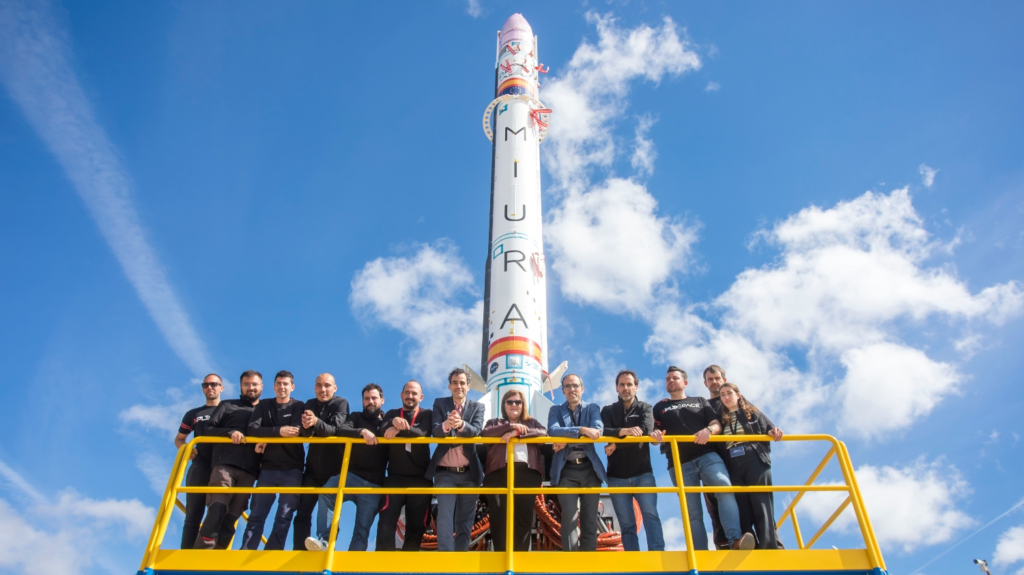
Five rocket companies will compete for contracts to provide Europe’s next launch services — and boost the continent’s troubled access to space. The European Space Agency (ESA) selected the quintet, who will now contend for two types of contracts: Providing launch services for ESA between 2026 and 2030. Demonstrating upgraded launch capabilities, including at least one flight test. The initiative — named the European Launcher Challenge (ELC) — aims to expand Europe’s pathways into the cosmos. In recent years, these routes have been painfully limited. When the Ariane 5 rocket was retired in July 2023, ESA was left with no independent access to space. The agency instead relied exclusively on SpaceX for its launches, leaving it with no autonomous control over its flight paths. Meanwhile, European taxpayer funds were being funnelled to an American company that competes with domestic businesses. Thierry Breton, the EU’s commissioner for the internal market, described the situation as an “unprecedented crisis.” TNW City Coworking space – Where your best work happens A workspace designed for growth, collaboration, and endless networking opportunities in the heart of tech. ESA finally regained sovereign access to space in July, when the Ariane 6 rocket had its maiden voyage. The launch provided welcome relief, but the rocket faces severe limitations. Unlike SpaceX’s Falcon 9, it’s not reusable. It’s also more expensive, less flexible for small-scale launches, and suffers from slower launch rates due to bureaucratic constraints. The ELC was designed to lower these barriers. There’s also big money on the line — ESA has earmarked up to €169mn per participant. Here are the five contenders for the cash. Isar Aerospace Founded: 2018Headquarters: Ottobrunn, Germany Europe’s best-funded space tech firm, Isar Aerospace develops rockets for small to medium satellite payloads. A spin-off from the Technical University of Munich, the company aims to offer affordable and flexible launch services.  In March, Isar’s Spectrum vehicle had its debut flight — the first vertical orbital rocket launch from Western Europe. Unfortunately, the rocket exploded shortly after takeoff. Isar nonetheless hailed the launch a “great success.” MaiaSpace Founded: 2021Headquarters: Paris, France MaiaSpace designs, manufactures, and operates competitive and sustainable solutions for space mobility. A subsidiary of ArianeGroup — the prime contractor for Ariane 6 — the company is developing a reusable, two-stage rocket called Maia. Designed for vertical takeoff and landing, Maia has been compared to a smaller-scale Falcon 9. Its first launch is planned for 2026. PLD Space Founded: 2011Headquarters: Elche, Spain PLD Space also focuses on reusability. Its suborbital Miura 1 vehicle completed a successful test flight in 2023, marking Europe’s first fully private rocket launch. PLD Space is now building the larger Miura 5, a two-stage reusable orbital launcher for small payloads. Last December, the company secured an €11mn loan to support its development. The rocket’s inaugural flight is expected to take place in the first quarter of 2026. The Miura 1 launch took place at the Arenosillo Test Centre (CEDEA) in Huelva, Spain. Credit: PLD Space Rocket Factory Augsburg (RFA) Founded: 2018Headquarters: Augsburg, Germany RFA is a spinoff from OHB SE, a German space tech giant. The startup’s flagship rocket is the RFA One, designed for frequent, low-cost missions. The company also secured access to SaxaVord Spaceport’s first launch pad — but the facility hasn’t always been a happy home for RFA. Last year, its rocket exploded during a test at the site. Undeterred, RFA has continued its mission to build low-cost, high-performance rockets. It’s targeting an inaugural launch later this year. Orbital Express Launch Founded: 2021Headquarters: Forres, Scotland Also known as Orbex, Orbital Express Launch is developing a small orbital rocket called Prime. Billed as an environmentally friendly, reusable launcher, the vehicle is slated for a maiden flight in 2026. Orbex is also building a larger rocket, called Proxima. In June, the company’s CEO claimed Proxima would allow Orbex to compete with SpaceX on price — as long as it won a contract with the ELC. That target is now one step closer to reality. ESA will next discuss the proposals with the five challengers and their respective Member States, before determining which of them will be awarded contracts. source

Meet the 5 space tech firms vying to be Europe’s next launch provider Read More »

Britain just launched its top supercomputer. Here’s how it ranks globally

The UK has just launched its most advanced supercomputer — the 11th most powerful in the world.  Isambard-AI, hosted at the University of Bristol, officially went live this week. The machine was built by Hewlett-Packard Enterprises (HPE) using its Cray EX architecture and fitted with over 5400 NVIDIA Grace Hopper superchips.  Its raw computing power is measured at 216.5 petaflops, with a peak theoretical performance of 278.6 petaflops. For the uninitiated, one petaflop is equal to 1 quadrillion (1,000,000,000,000,000) calculations per second. The system is more than 10x faster than the UK’s next-fastest supercomputer — the Njoerd supercluster in London. Funded by £225mn ($300mn) in government money, Isambard-AI is designed to run demanding artificial intelligence and scientific calculations, from modelling protein structures to simulating climate change and training large language models.  How Isambard-AI compares to the world’s most powerful supercomputers While Isambard-AI has become the UK’s most powerful supercomputer, on the global stage, it faces stiff competition. According to the TOP500 rankings, the current world leader is El Capitan in the United States, which clocks in at a staggering 1,742 petaflops of actual performance.  Frontier and Aurora take second and third place, both American-built systems operating above the 1,000-petaflop threshold — the equivalent of one exaflop. The top three are the world’s only currently operational exascale supercomputers.  Europe’s frontrunner, Germany’s JUPITER Booster, ranks fourth globally. The continent also hosts four other machines in the top 10: Italy’s HPC6 (6th), Switzerland’s Alps (8th), Finland’s LUMI (9th), and Italy’s Leonardo (10th). Still, Isambard-AI’s entry into the top 11 is a significant leap for the UK, whose Labour government wants to make the country a leader in AI development.  Peter Kyle, the UK’s science, innovation, and technology secretary, said the new machine would “propel” Britain to the “forefront of AI discovery.”  “Today we put the most powerful computer system in the country into the hands of British researchers and entrepreneurs,” he said. Some of the first applications of Isambard-AI include powering a prostate cancer detection system developed by University College London and helping Liverpool researchers discover greener, more sustainable industrial materials.  But Isambard-AI’s reign at the top may be short-lived. In June, Prime Minister Keir Starmer’s administration committed £750mn to a supercomputer in Edinburgh that aims to give the UK one of the world’s few exascale systems.  source

Britain just launched its top supercomputer. Here’s how it ranks globally Read More »