Emotional connection may soon matter more than brand loyalty itself, as consumers increasingly turn to AI for recommendations, advice and even companionship. This is according to an Accenture report, which found that 34% of consumers said they would switch from a preferred brand to one that makes them feel special, particularly amid ongoing economic uncertainty.
The report, titled “Me, my brand and AI: The new world of consumer engagement”, surveyed more than 18,000 consumers across 14 markets including the US, UK, China, India and Australia.
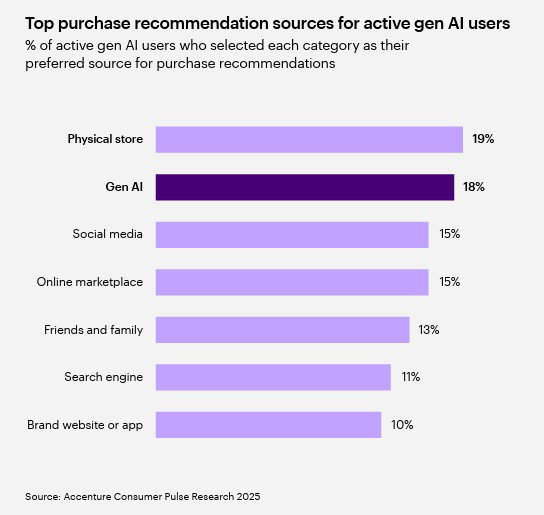
It found that generative AI is rapidly becoming embedded in daily life, with 72% of consumers using the technology regularly. More notably, 36% of active gen AI users described the technology as a “good friend”, while nearly one in 10 consumers already rank gen AI as their single most trusted source for purchase recommendations.
Don’t miss: Brands struggle with AI disclosure as usage surges across marketing
The findings point to a major shift in how consumers discover, evaluate and engage with brands. Rather than competing solely on price or convenience, brands will increasingly need to focus on emotionally resonant experiences and differentiated engagement.
The report added that active gen AI users now see AI as one of their top purchase recommendation channels, second only to physical stores. Gen AI ranked ahead of social media, online marketplaces and even friends and family.

At the same time, consumers are becoming more open to AI-powered commerce. According to the report, 75% of consumers are willing to use a trusted AI-powered personal shopper capable of understanding their needs and making purchases on their behalf.
Against this backdrop, the report warned that brands risk becoming interchangeable if AI agents optimise decisions based purely on pricing or product specifications. Instead, it argued that brands should focus on experiences AI cannot commoditise, including emotional storytelling, immersive experiences and human-centred engagement.
Zooming in locally, Christina Yeow, lead at Accenture Song Malaysia, said brands can no longer rely on transactional relationships if they want to remain relevant in an AI-driven environment. She said:
Consumers today are not just looking for convenience. They are looking for brands that understand them, anticipate their needs and make them feel valued.
She added that AI presents an opportunity for brands to move beyond traditional personalisation towards more proactive and emotionally intelligent engagement.
“Brands that succeed will be the ones that combine AI capabilities with authentic human connection. The technology can enable scale and relevance, but trust and emotional resonance still need to come from the brand experience itself,” she said.
According to Yeow, this is especially critical as economic uncertainty continues to shape purchasing behaviour, with consumers becoming more selective about which brands they trust and remain loyal to.
The report also highlighted growing concerns around authenticity in AI-generated interactions. About 45% of consumers said AI-generated content lacks personability, while 41% questioned its authenticity. As such, brands will need to strike a careful balance between automation and maintaining a human touch.
Beyond marketing, the report also pointed to the rise of “agentic AI”, where AI systems can autonomously complete tasks and make purchasing decisions for consumers.
It noted that this could fundamentally reshape traditional consumer journeys, potentially bypassing conventional touchpoints such as banner ads, search engines and retail media placements altogether.
To prepare for this shift, brands are advised to strengthen their visibility within large language model ecosystems, invest in AI discoverability and build experiences that foster emotional loyalty rather than purely functional value.
“As LLMs transition from being novelty tools to becoming trusted guides for consumers, the risk for brands is not just being misunderstood. It is the risk of becoming invisible. In the Singapore market, where digital maturity is high, brands must pivot from traditional SEO to GEO,” said Simone Morandi, SEA and Oceania lead at Accenture Song.
He added, “By providing high quality, legible data and real-time commerce signals, brands ensure they are not just represented by an algorithm. Instead, they are actively co-authoring the customer journey alongside it.”
Morandi also noted that brands are entering an era of “skeptical consumption”, pointing to the report’s finding that 41% of consumers distrust AI-generated content. He explained that for brands in Southeast Asia, the challenge is no longer just about speed, but about standing out through authenticity, creativity and distinctiveness
“Winning hearts, minds, and algorithms requires a human-centric approach that uses AI to amplify a brand’s unique personality rather than diluting it. In this new landscape, trust is the only currency that AI cannot commoditise,” he added.
The findings come as Southeast Asia continues to ramp up AI adoption across industries, even as many businesses struggle to turn implementation into measurable returns.
According to a recent report by McKinsey & Company, 88% of companies globally now use AI in at least one business function, up from 78% a year ago. The report also found that nearly half of organisations in Southeast Asia have moved beyond pilot stages, placing the region slightly ahead of the global average, with Singapore leading adoption in the region.
Related articles:
AI shifts CMOs from marketing performance to growth accountability: Forrester
More companies miss revenue targets as AI and volatility reshape B2B growth
Are AI chatbots building the next walled garden?