Muslim-friendly sports tourism could grow into a US$21 billion global opportunity by 2030, according to a new report by Mastercard and CrescentRating, as demand for sports-related travel continues to rise among Muslim travellers worldwide.
The report, titled “Proof wins: The convergence of sports, travel and faith 2026”, found that while enthusiasm for sports travel is high among Muslim consumers, destinations and event organisers continue to lose potential bookings when essential information around faith-based and practical travel needs is unclear.
According to the study, Muslim sports-event travel currently represents an estimated US$11 billion market. By 2030, that figure could rise to US$21 billion if destinations improve visibility around Muslim-friendly facilities and services during both the booking and event experience.
The projected growth would be driven by two factors: a 25% increase in attendance when Muslim-friendly essentials are clearly communicated before booking, and a 20% uplift in on-site spending when halal food options are accessible, trusted and clearly labelled.
Don’t miss: Muslim travellers projected to hit 245m by 2030 as women reshape tourism demand
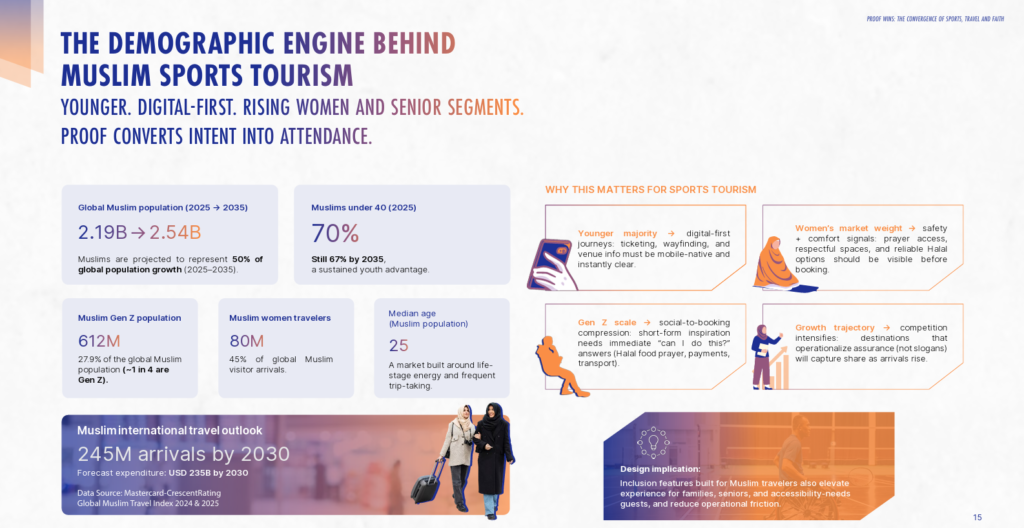
The findings come amid broader growth in the Muslim travel market. Muslim international arrivals are forecast to rise from 186 million in 2025 to 245 million by 2030, generating an estimated US$235 billion in travel expenditure globally.
Despite this, only 6% of international Muslim trips currently involve attending a sporting event, highlighting what the report describes as a significant untapped opportunity for destinations and organisers.

Confidence drives conversion
At the centre of the report is the concept that “proof” matters as much as interest when it comes to converting sports tourism demand.
Researchers found that Muslim travellers require clear and verifiable information around halal food availability, prayer facilities, transport options, ticketing and payment methods before committing to travel.
Affordability remains the most important booking driver, cited by 61% of respondents. This was followed by access to halal food and prayer facilities (48%), as well as safety and crowd management considerations (45%). The report also found that 87% of Muslim travellers consider prayer flexibility important when selecting sports events.
However, challenges remain. Nearly half (46%) of respondents said they had encountered limited or unavailable prayer facilities at sports venues, while 36% reported a lack of ablution facilities and 28% struggled to find halal food options during events.
“What this research clearly shows is that demand alone is not the constraint, confidence is,” said Fazal Bahardeen, founder and CEO of CrescentRating. “Muslim travellers are highly motivated by major sporting events. However, participation increases only when essential needs such as halal food, prayer access and transport are clearly communicated and trusted well before travel begins.”

A younger, digitally connected audience
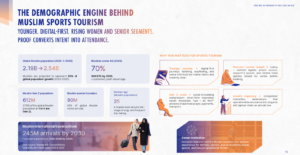
The report paints Muslim sports travellers as a young and highly connected audience segment. Globally, there are 612 million Muslim Gen Z consumers, accounting for almost 28% of the total Muslim population. Meanwhile, 70% of Muslims worldwide are under the age of 40.
Social media emerged as the dominant event discovery channel, with 72% of respondents learning about sports events through platforms such as Instagram, TikTok and X.
However, discovery alone does not guarantee conversion. The report found that official event websites remain the most trusted ticket purchasing channel, used by 59% of respondents. Digital payment convenience also plays an important role, with e-wallets emerging as the most preferred payment method, ahead of credit and debit cards.
According to Aisha Islam, SVP, customer solutions center, Southeast Asia at Mastercard, major sporting events increasingly represent opportunities to connect fans, destinations and businesses.
“Muslim travellers represent one of the fastest-growing segments in global travel. When destinations provide clarity and confidence, from payment security to halal dining and prayer access, they unlock significant participation and spending potential,” she said.

Lessons from major sporting events
Meanwhile, the report also highlighted examples of how major sporting events are integrating Muslim-friendly considerations.
The FIFA World Cup Qatar 2022 was cited as a benchmark, having incorporated prayer facilities, halal-compliant food standards and culturally aligned hospitality into the visitor experience. The tournament attracted more than 1.2 million visitors and generated an estimated US$4.1 billion in tourism revenue.
Meanwhile, the Singapore Grand Prix was identified as an opportunity for greater inclusion. While halal dining and prayer facilities are available around the Marina Bay precinct, the report noted that clearer venue-based prayer access and more extensive halal food options could help boost participation among Muslim visitors.
Looking ahead, researchers also identified eSports, padel and pickleball tourism as emerging growth areas, particularly among younger Muslim travellers who expect mobile-first experiences and seamless access to information.
Across all event types, the report concludes that Muslim-friendly readiness must be visible before booking, not buried in FAQs or communicated only after arrival. For destinations and organisers, making faith-friendly services easy to find may prove to be one of the most effective ways to convert growing demand into attendance and spending.
Earlier this year, Mastercard and CrescentRating released two other reports titled “Halal Travel Trends 2026” and “Muslim Women in Travel 2026”, projecting international Muslim visitor arrivals to reach 245 million by 2030, up from an estimated 186 million in 2025, highlighting the scale of opportunity for tourism brands, destinations and hospitality players seeking to capture the expanding market.
Based on the findings, Muslim women emerged as one of its most influential traveller segments and destinations facing increasing pressure to deliver more trusted, inclusive and digitally enabled experiences.
Related articles:
Why Southeast Asia can’t afford to ignore halal travellers
HKTB and Klook partner up to enhance Muslim travel experience
Muslim travel index shifts: Malaysia reclaims crown as Indonesia slips