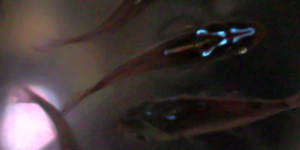
The rules of biology have been torn up by a small fish in the Pacific that steals light-producing molecules from its food in the only known example of kleptoproteinism.
Researchers from Tohoku University in Japan have uncovered how the golden sweeper fish (Parapriacanthus ransonneti) glows despite missing a gene for luciferase, the enzyme critical for bioluminescence.
Using advanced whole-genome sequencing, the researchers uncovered how these crafty 7-cm (2.8-in) fish “steal” light-producing molecules from their prey – a tiny ostracod, a crustacean known as a “sea firefly” – in an incredibly rare example of molecular thievery.
Fish “Steals” Glowing Protein: Genome Sequencing Proves Unique Survival Strategyキンメモドキの発光 c美ら海水族館
In previous research, the scientists found that sea fireflies (Cypridina noctiluca) appeared to be critical to the glow-up seen in P. ransonneti fish. But it wasn’t clear whether the bioluminescence was triggered within the fish or if it was an external acquisition.
Not only was the luciferase gene absent, but the team found no evidence that the fish had acquired it through horizontal gene transfer – the process by which DNA can occasionally jump between unrelated species.
“These results provide compelling and conclusive evidence that this fish does not possess the genetic blueprint for bioluminescence,” says Manabu Bessho-Uehara, an associate professor at Tohoku University. “Instead, it relies entirely on proteins obtained from its prey, representing a truly unique form of biological adaptation.”
Essentially, the fish has no way of making the enzyme it needs to glow, and it hasn’t borrowed the instructions to make it.
“Taken together, we conclude that the ostracod luciferase gene is absent in the genome of P. ransonneti, supporting the hypothesis that P. ransonneti cannot produce luciferase by itself but instead sequesters and uses the luciferase from ostracod prey for its bioluminescence,” the researchers note.
Instead, it targets a luminous prey species, extracting its fully formed luciferase protein, and then transports it to its own light organs. This method means it’s not an infinite glow, but the light is topped up with each feed.

Government Park (Ocean Expo Park)/Okinawa Churaumi Aquarium
While it may not seem like a big deal, this sort of phenomenon shows how resourceful nature can be. Conserving a gene that can produce bioluminescence can be energy-intensive – so the fish have basically outsourced the job.
But then there’s more to this story. The bioluminescence isn’t used for attracting a mate or luring prey, but camouflage – which sounds counterintuitive.
In dim, moonlit waters, predators beneath a school of P. ransonnetis can identify the silhouettes of the fish and pick them off. But when these thieving fish harness the power of their stolen light to glow from their organs, it cancels out their silhouettes. The strategy, known as counterillumination, is one of nature’s most sophisticated forms of concealment.
It’s a fascinating – and extremely rare – example of how evolution has aided a species in developing the survival strategies it needs but can’t do on its own. So, rather than holding onto the genes needed to produce its own bioluminescent machinery, the golden sweeper has harnessed a way to “steal” the materials it needs for its “invisibility cloak”, saving the species energy and protecting them in the process.
That is, as long as the fish can access a supply of sea fireflies.
“The sequestration and use of prey protein, known as kleptoprotein, is reported only from Parapriacanthus ransonneti,” the researchers note.
“Our findings revealed that the acquisition of the function of the prey organism can be achieved without horizontal gene transfer. The molecular mechanisms underlying protein sequestration are not elucidated yet. The genome sequence of P. ransonneti provides a fundamental source to understand the evolution of kleptoprotein bioluminescence.”
The research was published in Scientific Reports.
Source: Tohoku University
Fact-checked by Mike McRae