[HKGHH] Premier Networking Night @LKF

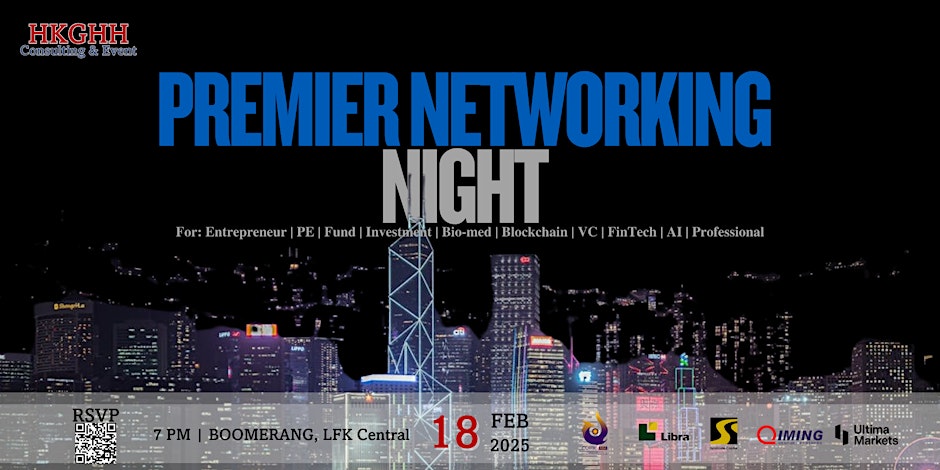
[HKGHH] Premier Networking Night @LKF Your Gateway to Opportunity in Hong Kong’s Top Regular Business Networking Event! This is your chance to expand your professional network, spark new ideas, and forge meaningful collaborations—all over a drink or two. 🍷 Special Drink Discount & Super Special Discount for Lady Guests 💃 Why Attend? 🤝 Meet Experts — from diverse fields like Fintec, VC, Bio-medical, Investment, Entrepreneur, Professional, AI, and beyond. 💡 Discover Opportunities — whether you’re hiring, job hunting, freelancing, or looking to invest or collaborate. Our Partners: CUHK Innovation and Entrepreneurship Club Libra Advertising Group Worldwide New Atlas Capital Qiming Venture Partners Syndicate Capital Group Ultima Markets Meet these partners and other industry leaders during the event! Event Format: 🍹 One drink minimum (This helps secure to the venue and ensures the continuation of these networking nights!) 💌 Don’t forget to bring enough business cards! ✨ Smart casual vibe, leave those gym shorts and slippers for another day! 🌟 RSVP Now & Share the Fun! Register your spot today and invite your friends to join, Let’s make this the best networking event in Hong Kong! Event Link: https://hongkongexperthappyhour.eventbrite.hk LinkedIn Updates: https://www.linkedin.com/groups/10490780/ See You @BOOMERANG! Raise a glass to new connections, new projects, and new opportunities. Cheers! 🥂 For more details, please click here.

[HKGHH] Premier Networking Night @LKF Read More »

(LAST CALL) HKTDC Hong Kong International Medical & Healthcare Fair 2025 | 26-28 May 2025

There’s no better place to showcase your medical supplies and healthcare business than in the HKIMHF. Following the success of the previous 15 editions, the upcoming edition will be held on 26-28 May 2025, in the convenient downtown location of the Hong Kong Convention and Exhibition Centre. The fair will coincide with the Asia Summit on Global Health and provide a favourable one-stop platform for marketing, sourcing and getting industry intelligence For more details, please click here.

(LAST CALL) HKTDC Hong Kong International Medical & Healthcare Fair 2025 | 26-28 May 2025 Read More »

Emerging Internet of things & Smart cities Showcase

Our Emerging Internet of Things showcase stage provides a unique opportunity to explore and sample the latest innovations, platforms, technologies and products set to affect our world in 2016 and beyond. On the day we will provide showcases on IoT, Contextual Tech & Platforms & the latest Starts ups. Our showcase stage is aimed to all those looking to explore advancements in iOT technology and become inspired by the opportunities. For more details, please click here.

Emerging Internet of things & Smart cities Showcase Read More »

Tech Fest Summit

On 21 May 2025, join 1,500+ senior tech leaders in an event produced by the teams behind three iconic events—Cloud Forum (a KORNERSTONE event), Revive Tech Asia, and Cyber Attack (a TEH Group event). This brand-new experience is designed to unite the expertise and innovation of these events, creating a fresh platform for exploring the future of technology. For more details, please click here.

Tech Fest Summit Read More »

4/F, Conference Hall, HKPC, Kowloon Tong

[HKGHH] Premier Networking Night @LKF Your Gateway to Opportunity in Hong Kong’s Top Regular Business Networking Event! This is your chance to expand your professional network, spark new ideas, and forge meaningful collaborations—all over a drink or two. 🍷 Special Drink Discount & Super Special Discount for Lady Guests 💃 Why Attend? 🤝 Meet Experts — from diverse fields like Fintec, VC, Bio-medical, Investment, Entrepreneur, Professional, AI, and beyond. 💡 Discover Opportunities — whether you’re hiring, job hunting, freelancing, or looking to invest or collaborate. Our Partners: CUHK Innovation and Entrepreneurship Club Libra Advertising Group Worldwide New Atlas Capital Qiming Venture Partners Syndicate Capital Group Ultima Markets Meet these partners and other industry leaders during the event! Event Format: 🍹 One drink minimum (This helps secure to the venue and ensures the continuation of these networking nights!) 💌 Don’t forget to bring enough business cards! ✨ Smart casual vibe, leave those gym shorts and slippers for another day! 🌟 RSVP Now & Share the Fun! Register your spot today and invite your friends to join, Let’s make this the best networking event in Hong Kong! Event Link: https://hongkongexperthappyhour.eventbrite.hk LinkedIn Updates: https://www.linkedin.com/groups/10490780/ See You @BOOMERANG! Raise a glass to new connections, new projects, and new opportunities. Cheers! 🥂 For more details, please click here.

4/F, Conference Hall, HKPC, Kowloon Tong Read More »

Tech to Connect 2024 AI Leaders’ Summit

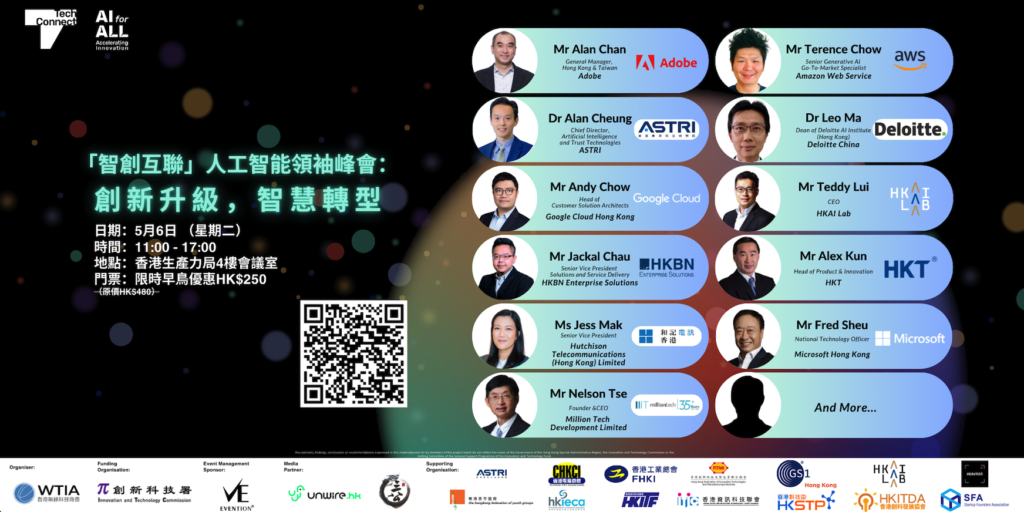
🔥業界盛事再度回歸,企業精英聚首一堂🔥 香港無線科技商會 (WTIA)再度舉辦人工智能領袖峰會,再次帶領業界邁向創新! 由WTIA主辦「智創互聯人工智能領袖峰會:創作升級,智慧轉型」,是一個匯集 ICT 專業人士和產業領袖的卓越平台,共同探索 AI 如何優化營運、提升決策效率,並在各行各業中釋放前所未有的生產力. 本次高峰會亮點包括: 👨🏻‍💼主題演講: 掌握最新的 AI 趨勢、技術突破和創新應用. 🪑專家座談: 聆聽產業領袖分享實戰經驗、策略洞察和未來展望. 🤝交流互動: 與來自各個領域的菁英建立聯繫,拓展合作機會. 💡 千萬不要錯過這次學習和交流的寶貴機會!與業界專家交流,獲取實用的知識和策略 智創互聯人工智能領袖峰會:創作升級,智慧轉型 📆日期: 2025 年 5 月 6 日 (星期二) ⏰時間:11:00 am – 5:00pm 📍地點: 香港生產力局樓會議廳 🗣️語言: 廣東話 🎫門票價格:HK$480 💰限時早鳥優惠:HK$250 ✍🏻報名:https://form.jotform.com/250720095591456 🔥立即報名,與我們及各行業精英共同探討人工智能與創科生態的無限可能,共同塑造香港的智慧未來! #AI #人工智能 #leaders #summit #hongkong #industry #ICT #seminar #networking #datamanagement #GenAI #cloud #technology 欲知更多信息,請點擊這裡。

Tech to Connect 2024 AI Leaders’ Summit Read More »

Microsoft, OpenAI Want Out Of Musk's For-Profit Challenge

By Nadia Dreid ( April 11, 2025, 10:17 PM EDT) — OpenAI and Microsoft are ready to be done with a lawsuit brought by Elon Musk accusing them of swindling the billionaire by turning OpenAI, the maker of ChatGPT, into a private entity after he and others invested in the artificial intelligence venture…. Law360 is on it, so you are, too. A Law360 subscription puts you at the center of fast-moving legal issues, trends and developments so you can act with speed and confidence. Over 200 articles are published daily across more than 60 topics, industries, practice areas and jurisdictions. A Law360 subscription includes features such as Daily newsletters Expert analysis Mobile app Advanced search Judge information Real-time alerts 450K+ searchable archived articles And more! Experience Law360 today with a free 7-day trial. source

Microsoft, OpenAI Want Out Of Musk's For-Profit Challenge Read More »

CIOs: Use Scenario Planning To Prepare For The Impact Of Tariffs On IT Costs

The new US tariffs — 10% generally, 34% on Chinese imports, and 20% on EU goods — have set the stage for increasing IT costs. The impacts will evolve over the next two to three quarters as vendors consider, develop, and roll out new pricing strategies. To navigate these challenges, identify worst-case, best-case, and likely scenarios, along with the specific actions needed to mitigate the heightened cost pressures entailed in each. Tariffs Will Affect More Than Just Hardware While the immediate hit will be on hardware budgets, ripple effects will cascade to other parts of the IT ecosystem as all providers and partners absorb higher infrastructure expenses: Rising device costs will collide with Windows 10 end of service. CIOs in the US could see a 45% price increase on laptops and tablets. This comes at an especially bad time, as many organizations are planning to refresh their Windows fleet ahead of the impending Windows 10 end of service this coming October. Tariffs will make mass capital expenditures for PCs more expensive, prompting many to: 1) delay their Windows 11 refresh and pay for extended support for Windows 10; 2) seek alternative approaches to a hardware refresh (e.g., virtual desktops); and 3) investigate opex-based purchasing (i.e., device as a service) to avoid a massive capex purchase (though prices will rise for both traditional purchasing and leasing). Servers, storage, and network equipment will be hit directly. IT infrastructure will likely see significant price increases as major manufacturing nations face high tariff rates, especially in the US. The rising costs could balloon budgets and force CIOs to delay or prioritize the most important projects. CIOs and other tech leaders will need to proactively analyze costs, diversify sourcing, optimize inventory, and prioritize the projects that don’t sacrifice critical AI ambitions. Cloud, SaaS, and other services costs aren’t immune. While not currently subject to tariffs, the cost of cloud, software as a service, and other services could go up as their underlying costs increase and exchange rates fluctuate. More concerning would be if other countries retaliate by directly targeting US services where there is a surplus to many countries. The US has a $100 billion services trade surplus with the EU. If the EU escalates its regulatory non-tariff barriers to trade in services, including managed services or hyperscaler capacity, unit costs for American customers could increase while European customers’ choice of local solutions dwindles. Price hikes will surface in unrelated — seemingly risk-free — areas. Service providers and even software vendors will find ways to recoup cost, even for contracts seemingly unavailable for renegotiation. For example, a large enterprise that has purchased several products from the same vendor may find higher-than-usual price increases on a completely unrelated renewal to offset the inability to affect contracts directly impacted by the tariffs. This occurred previously during the US-China trade war in 2018–2019, when many tech hardware vendors were hit with 25% import tariffs on components. These vendors added a “tariff surcharge” to fixed price agreements, which many customers reluctantly paid. Heightened chip supply concerns could jeopardize AI plans. The disruption caused by changing the funding and tax incentives of the US Chips Act will also have long-term cost implications. While chip manufacturing in the US is announced, those plants will not start delivering before 2027. A threat in Europe’s trade-negotiation arsenal is restricting export of ASML machinery. If implemented, this could negatively impact chip supply in the medium term. The result: more price increases. US CIOs should plan to boost AI project budgets, as previously allocated budgets will likely not suffice to continue these projects at their current pace. Identify And Prepare For Four Scenarios Indiscriminate budget cuts can be costly and undermine priorities such as AI-led business and IT transformation that are crucial to long-term success. Forrester has identified a number of cost-cutting options that are much more targeted and, in many cases, overdue — e.g., app portfolio consolidation and rationalization. Even more effective is to embrace scenario-based planning. Envisioning best- and worst-case outcomes and mapping potential scenarios (such as recession-driven cuts, demand surges, and regulatory shifts) builds a proactive response toolbox. Consider these four scenarios: Scenario 1: Tariff pause or delay. Earlier this year, the Trump administration paused initial tariffs on Canadian and Mexican goods. We could see a similar reaction this time around, either due to domestic pressure or international negotiations. This is the most favorable scenario and the least likely, however. Even in this scenario, CIOs should engage in difficult prioritization discussions, as we project that real GDP will slow sharply to 1.8% over the next three years, and tech spending growth typically follows this closely. In addition, procurement teams should be engaged now to assess current contracts in flight and prepare for possibly contentious midterm renegotiation scenarios (see next scenario). Scenario 2: Tariff reductions. Negotiations occur and certain tariffs are reduced, but there is a new normal of trade tariffs that businesses just adapt to over time. Markets expected a 10% average tariff (on goods, not services) initially, so after the initial dust settles and negotiations occur, this is a reasonable and likely outcome. Regarding prioritization, CIOs should partner with their executive peers to rank-order key business priorities in terms of value to the company and have an agreement on where to draw the line for demand cuts in response to tariff actions. This line will likely need to be mobile, as tariff actions can either be minimal or highly escalatory (see next scenario). Scenario 3: Escalating retaliatory trade tariffs. In this worst-case scenario, negotiations are unsuccessful, and impacted nations impose equal tariffs on goods as well as add services to the mix where the US tends to have a trade surplus. In this scenario, CIOs must pursue an urgent overhaul of spend management playbooks, prioritize ruthlessly, and defer non-essential hardware upgrades to navigate the heightened cost pressures and potential talent constraints. CIOs will also need to support the business in urgent work to review strategic options for supply chain reconfiguration

CIOs: Use Scenario Planning To Prepare For The Impact Of Tariffs On IT Costs Read More »

From First Touch To Automated Engagement: The Evolving Front Office

The Forrester Wave™: Customer Relationship Management Software, Q1 2025, our latest evaluation of CRM providers, shows a market on the cusp of change. Agentic AI reshapes the value of CRM as we know it. Looking a decade or more into the future, the landscape of front-office jobs will likely be significantly transformed. At this point, agentic AI — not humans — will be the first touchpoint for all customer interactions. The front office will be dedicated to supporting and optimizing automations. Of course, there will still be a need for human engagement — for consultative sales, for relationship building, or for addressing customer issues that carry emotion. But the number of these roles will lessen as much of customer operations shifts to the middle and back office. There will also be a need for new roles such as AI supervisors that manage the success of AI to business goals. Also, AI agents will get stuck mid-process and will require human intervention in real time to make a simple decision, which paves the path for a “bot unblocker” job. The CRMs Of The Future Will Embrace Agentic AI CRMs themselves will change — and they are already doing so today. For example, CRMs will contain: An agentic layer. CRMs will package AI agents for predefined tasks and actions. They will include an AI agent studio to create agents. They will include integration frameworks to access data from other apps. Also, they will include orchestration and observability capabilities to manage and govern AI agents toward business goals. Vendors will offer marketplaces for AI agents, such as what Salesforce is doing today. A data layer to access real-time enterprise and customer data. A low-code platform to create custom workflows and extensions. The quality of this platform will be one of the major decisions in selecting a CRM. CRM workflows. Gone will be the days of monolithic CRM clouds. CRMs will be deconstructed into resuable components and will be accessible via AI agents and other business apps. Industry workflows will retain value. Also, end-to-end workflows will be more valuable than the ones constrained to the front office. Trust, security, and compliance. CRMs, like they do today, must comply to industry regulations and must ensure governance, trust, fairness, and protection for all data used in AI models. New UX. Experiences will be role-based — for example, a relationship manager may engage with customers via video, with augmented-reality overlays, while automation supervisors work in dashboards. The user experience will also be primarily conversational. Screens will contain less data and fewer options for the user. CRM data and workflows will be embedded into and accessed via other business applications. We already see signs of this transformation. Every CRM vendor in the Wave has released AI agents, as well as developer tools to manage AI agents. What has to happen now is a refactoring of current CRM capabilities for this agentic future. Connect with me via inquiry or briefing to continue this conversation. source

From First Touch To Automated Engagement: The Evolving Front Office Read More »

EU AI Rules Delay Tech Rollouts, But Civil Societies Say Safety Comes First

Tech companies are adamant that the regulation of artificial intelligence in the E.U. is preventing its citizens from accessing the latest and greatest products. However, civil society groups BEUC and noyb feel otherwise, maintaining that AI developers need to produce products that uphold their customers’ safety and privacy. Some of tech giants’ delayed launches in EU There have been a number of instances where the launches of AI products in the E.U. have either been delayed or cancelled as a result of regulations. For instance, this week, Meta’s Llama 4 series of AI models was released everywhere except Europe. Its AI chatbots integrated into WhatsApp, Messenger, and Instagram only made it to the bloc 18 months after the U.S. Similarly, Google’s AI Overviews currently only appear in eight member states, having arrived nine months later than in the States, and both its Bard and Gemini models had delayed European releases. Apple Intelligence has only just become available in the E.U. with the release of iOS 18.4, after “regulatory uncertainties brought about by the Digital Markets Act” held up its release in the region. “If certain companies cannot guarantee that their AI products respect the law, then consumers are not missing out; these are products that are simply not safe to be released on the E.U. market yet,” Sébastien Pant, deputy head of communications at the European consumer organisation BEUC, told Euronews. “It is not for legislation to bend to new features rolled out by tech companies. It is instead for companies to make sure that new features, products or technologies comply with existing laws before they hit the EU market.” SEE: EU’s AI Act: Europe’s New Rules for Artificial Intelligence EU regulations push companies to build more privacy-conscious tools E.U. legislation hasn’t always excluded E.U. citizens from AI products; instead, it has often compelled tech companies to adapt and deliver better, more privacy-conscious solutions for them. For example, X agreed to permanently stop processing personal data from E.U. users’ public posts to train its AI model Grok after it was taken to court by the Data Protection Commission. Kleanthi Sardeli, a data protection lawyer working with the advocacy group noyb, told Euronews that users generally don’t anticipate their public posts being used to train AI models, yet that’s precisely what many tech companies are doing, often with little regard for transparency. “The right to data protection is a fundamental human right and it should be taken into account when designing and deploying AI tools.” Google, Meta claim EU AI laws disadvantage citizens, but their revenue is also at stake Google and Meta have openly criticised European regulation of AI, suggesting it will quash the region’s innovation potential. Last year, Google published a report that detailed how Europe lags behind other global superpowers when it comes to AI innovation. It found that only 34% of E.U. businesses used cloud computing technologies in 2022, a critical enabler for AI developments, which is vastly behind the European Commission’s target of 75% by 2030. Europe also filed just 2% of global AI patents in 2022, while China and the U.S., the top two largest producers, filed 61% and 21% respectively. The report placed much of the blame on E.U. regulations for the region’s struggles to innovate in advanced technologies. “Since 2019, the EU has introduced over 100 pieces of legislation that impact the digital economy and society. It’s not just the sheer number of regulations that’s the challenge — it’s the complexity,” said Matt Brittin, president of Google EMEA, in an accompanying blog post. “Moving from the regulatory-first approach can help to unlock the opportunity of AI.” But Google, Meta, and the other tech giants do stand to suffer financially if the rules prevent them from launching products in the E.U., as the region represents a huge market with 448 million people. On the other hand, if they go ahead with launches but break the rules, they could face hefty fines of up to €35 million or 7% of global turnover, in the case of the AI Act. Europe is currently embroiled in multiple regulatory battles with major tech firms in the U.S., many of which have already led to substantial fines. In February, Meta declared it was prepared to escalate its concerns over what it saw as unfair regulation directly to the U.S. president. U.S. President Donald Trump referred to the fines as “a form of taxation” at the World Economic Forum in January. In a speech at February’s Paris AI Action Summit, U.S. Vice President Vance disparaged Europe’s use of “excessive regulation” and said that the international approach should “foster the creation of AI technology rather than strangle it.” source

EU AI Rules Delay Tech Rollouts, But Civil Societies Say Safety Comes First Read More »