Ameritas chief AI officer on creating the future AI workforce

00:00 Maryfran Johnson 0:00Hello. Good afternoon and welcome to CIO Leadership Live. I’m your host, Maryfran Johnson, the CEO of Maryfran Johnson media and the former editor in chief of CIO magazine. Since November 2017 this video and audio podcast has been produced by the editors of CIO.com and the digital media division of Foundry, which is an IDG company, our growing library of past interviews, all of them openly available on both cio.com and CIOs. YouTube channel includes more than 150 chief information technology and digital officers from mid sized to large companies across every industry joining that esteemed lineup of CIOs today is a long time friend of the family who has been interviewed in CIO magazine and on ci.com a number of times over the years. Richard Wiedenbeck, he’s the chief AI officer at Ameritas, based in Lincoln, Nebraska. Ameritas is a mutual based financial services company with annual revenues of 3.4 billion. It serves some 6 million customers, many of them in the small to mid sized business space, and it serves them with a broad array of life annuities, retirement, disability, dental and vision insurance plans. Rich has worked in business and Senior Technology roles for more than three decades across multiple industries, including defense, manufacturing, consulting and software. He joined Ameritas in 2010 as the vice president of it, moving up into the CIOs chair in 2013 in 2020, he was inducted into our CIO Hall of Fame, which every year honors an elite group of outstanding business technology leaders. Then last year, in January of 2024, rich joined yet another elite group of leaders who hold the newly minted and still relatively rare title of Chief AI officer. According to our 2025 state of the CIO survey, only 14% of mid sized to large companies have caios, and another 21% of companies are out there actively looking to hire one the responsibilities of this emerging CI C suite role which are being covered by a lot of our cio.com reporters these days. Those responsibilities range from setting a company’s overall ai ai strategy and overseeing how and where the AI tech is being used to developing an AI skilled workforce and to establishing a new enterprise governance that integrates with existing corporate cultures. It is no small task, as you’re going to hear about during this conversation with rich, and there’s some really great expectations around this role. So we have a lot to talk about here. Welcome rich. Thanks for joining me today.Richard Wiedenbeck 3:05Thank you. Maryfran, always a pleasure to be chatting with you. Totally.Maryfran Johnson 3:09Alright, let’s start out with let’s talk first about a broader picture of how the broader business picture about how Ameritas has been doing during these last few challenging years, and the role that it has been playing in the business success you have been having,Richard Wiedenbeck 3:28yeah, absolutely. So, I mean, Ameritas, I always like to say, if you look at our kind of growth, right, our growth has been relative, has been really good, relative to the industry, right? We’re classified, even with that broad range of diversified products, we still get classified in the life and annuity space, or the life insurance space. If you look at that industry, or sub part of the insurance industry, it’s been growing at about one to 3% a year, and we’ve been growing at about seven to nine so we’re clearly outgrowing our industry, which is a good sign. But by the same token, if you look at our expense structure, our expense structure seems to be holding pace with our top line, right? So top line growing, bottom line going, or top expense structure growing at the same rate, right? So, so the challenge to do that cost curve. And then around 2020, we took a look at that and said, Hey, we really, you know, we really need to modernize, you know, I mean, a lot of the standard stories. We need to modernize our systems. We need to really look at how we’re getting things done. We need to look at the interactions and the digital advancements we’re having, and then we need, we need to look at this kind of cost curve bending thing. And we took on a transformation project, an enterprise wide transformation project, we call Pepi, everybody. Everybody gives it a name. Everybody gets an acronym. You know, you always,Maryfran Johnson 4:55everybody loves a good title on a program, right? Yes,Richard Wiedenbeck 4:58always, um. And so we started that journey and and we’re, you know, we’re obviously, you know, four years into it, we’ve, you know, like any transformation journey, you’re going to say, these things went well. These things didn’t go as planned. These things. We wish we could go back and do a little differently, but I think all in all, we’ve made meaningful progress on that, on that journey, and then we started to see the AI frame come in and and we didn’t want to lose sight of that, and we didn’t think it was something to wrap into that. It was something to really start to pay attention to a little bit differently. But I think a lot of firms are on that broad, transformative journey, whether you call it Age of the Customer digital, you know, all of those are pieces of the puzzle and Ameritas certainly, just like other firms in our industry, and even our industries, have been actively pushing to make progress on that, not just kind of doing it as a Hey, here’s our portfolio, let’s prioritize. We actually chose to drive our investment levels up for a period of time to really try to make meaningful progress on it. And now we’re kind of coming on the tail end of that saying now let’s get into that standard. Still continue to make investments, but But where are we pushing those priorities, and how do we bring this

Ameritas chief AI officer on creating the future AI workforce Read More »

All You Need to Know about Edtech

Technology is revolutionizing numerous aspects of our daily lives, and the landscape of education is no exception. In modern education, technology is reshaping the way we teach, learn, and interact within educational environments. Its significance lies in its potential to enhance learning experiences, streamline administrative tasks, and prepare students for a technologically driven world. The role of edtech in modern education Edtech, short for educational technology, refers to the modern learning landscape that uses digital tools and resources to enhance the ultimate learning experience. Edtech encompasses a wide range of opportunities, from using electronic gadgets (e.g., laptops and tablets) in a conventional classroom setting for note-taking to making online courses accessible. Understanding and embracing edtech has become a necessity for educators, students, and institutions alike. According to Research and Markets’s EdTech and Smart Classrooms Global Market Report 2025, the edtech and smart classrooms market globally is forecasted to grown from $185.78 billion in 2024 to $214.73 billion in 2025. Leveraging edtech to its fullest requires a thorough grasp of its concepts and key terminologies. Exploring core edtech concepts Sharpen your edtech knowledge with TechRepublic Premium’s quick glossary of important terms and concepts. For example, this in-depth resource breaks down the definition of adaptive learning, which refers to technology that tailors the content and pace of instruction based on individual learner needs. This strategy acknowledges that each student has differing learning styles and that a single, universal approach to teaching may not be helpful for all learners. It also describes asynchronous learning. This concept is defined as learning that occurs at different times and places, allowing students to access materials and complete assignments at their own pace. As technology progresses and more individuals gain access to online education platforms, this method is becoming more popular. In the glossary, collaborative learning is explained too. This is an educational strategy that encourages learners to work together on course projects, assignments, or activities. This is frequently supported by digital tools and platforms that foster cooperation and teamwork. Moreover, the resource delves into the details of immersive learning technologies, a term that describes technologies that offer immersive educational experiences by imitating real-world surroundings or adding digital features to the actual world. This includes virtual reality and augmented reality. Other key terminologies featured in the resource include the curriculum management system, distance education, flipped classroom, learning management system, and virtual classroom. Education is a valuable asset that can’t be taken away. For those aspiring to expand their understanding of edtech, this 13-page quick glossary is available for just $19 at TechRepublic Premium. source

All You Need to Know about Edtech Read More »

AI culture war: Hidden bias in training models may push political propaganda

Hangzhou developed DeepSeek despite US export controls on high-performance chips commonly used to design and test AI models, thus proving how quickly advanced AI models can emerge despite roadblocks, adds Adnan Masood, chief AI architect at digital transformation company UST. With a lower cost of entry, it’s now easier for organizations to create powerful AIs with cultural and political biases built in. “On the ground, it means entire populations can unknowingly consume narratives shaped by a foreign policy machine,” Masood says. “By the time policy executives realize it, the narratives may already be embedded in the public psyche.” Technology as propaganda While few people have talked about AI models as tools for propaganda, it shouldn’t come as a big surprise, Moogimane adds. After all, many technologies, including television, the Internet, and social media, became avenues for pushing political and cultural agendas as they reached the mass market. source

AI culture war: Hidden bias in training models may push political propaganda Read More »

Intel CEO Tan Starts Company’s Pivot: Spin Off Non-Core Assets

Intel CEO Lip-Bu Tan. Image: Intel Business/YouTube Intel will spin off assets that aren’t part of its core mission, according to Bloomberg. Intel CEO Lip-Bu Tan, who became CEO in mid-March after Pat Gelsinger took a heavily encouraged suggestion to retire, made the announcement on March 31 at the Intel Vision conference. Tan did not define the core business or which parts of the business would be affected. Intel will try to expand its core business using AI and Software 2.0, Tan said. Software 2.0 is a term about the way generative AI allows for coding without writing individual lines of code; instead, the technique, named by computer vision scientist Andrej Karpathy, uses natural language and an AI model. Software 2.0 has some similarities to “vibe coding,” although Software 2.0 encompasses more possible uses for generative AI. More must-read AI coverage Tan tries to turn Intel around as other semiconductor companies pull ahead in the AI boom Despite the AI boom, Intel was not lifted on the wave of demand for chips. Gelsinger’s departure and the state of the company under his last few years of leadership left the future uncertain for Intel. Some considered breaking up the company, according to Bloomberg. Intel rival Taiwan Semiconductor Manufacturing Company (TSMC) was in the running as a potential buyer, as was Broadcom. Splitting its interests between manufacturing or designing chips may have allowed other companies, like TSMC, to pull well ahead. NVIDIA also outweighs Intel in the fight to benefit from the AI boom. SEE: Arm Shocked the Semiconductor Industry by Announcing It May Sell Its Own Chips Tan’s leadership must involve some effort to regain Intel’s footing. His motto is “under-promise and over-deliver,” Tan said. He also said he would focus on recruiting quality engineering talent and boosting Intel’s chip foundry work. One of the few specifics Bloomberg noted from Tan was Intel may begin to launch a custom semiconductor service for customers. Tan previously served on Intel’s board of directors. He was CEO of Cadence Design Systems, where he negotiated design solutions and IP with Intel. Some of Intel’s factory-building is on hold Intel had planned to build two advanced semiconductor plants in Ohio. Those plans were delayed in late March due to misalignment with “the needs of our business and broader market demand,” said Intel Foundry Manufacturing executive vice president, chief global operations officer and general manager Naga Chandrasekaran. source

Intel CEO Tan Starts Company’s Pivot: Spin Off Non-Core Assets Read More »

3 keys to maximizing data strategies

Business leaders know it’s crucial to use identity-driven customer data to make smart decisions. But often, they get stuck because they don’t have a unified view of their customers and prospects. That’s a recipe for poor business outcomes. The consequences of getting identity wrong are substantial: Poor data quality = missed insights, operational inefficiencies, and wasted marketing spend. Vendor lock-in and cost overruns = higher expenses with limited flexibility. Slow digital adoption = inability to activate customer data reliably at scale. Customers are engaging through multiple channels, yet 2024 Forrester Research reported that consumer perceptions of Customer Experience had dropped in three consecutive years to its lowest point ever.[i] CIOs face mounting pressure to optimize their data strategy, manage vendors effectively, and accelerate digital transformation. Identity resolution is central to all three, yet many organizations struggle with fragmented data, vendor management, and scalable identity solutions.  We share three common mistakes that hinder data strategies and how they can be fixed. 1. Underestimating the complexity of a customer data strategy Data siloed across platforms prevents unified customer profiles. Companies collect on average 100+ data points per consumer, with at least 22% becoming obsolete each year.[ii] Inaccurate data impacts AI models, personalization efforts, and decision-making. How CIOs can reduce complexity: Adopt a first-party identity graph that continuously resolves and updates customer data for accuracy. Bring customer consent into the graph building process to align with regulatory requirements.  The impact: Companies that effectively organize and manage the customer experience can realize a 20% improvement in customer satisfaction, a 15% increase in sales conversion, and a 30% lower cost-to-serve.[iii] 2. Relying on a single vendor Many identity solutions are bound within a single ecosystem, limiting expansion flexibility. Vendor lock-in risk has only increased with the migration to cloud, and it complicates AI adoption.[iv] How CIOs can fix vendor lock-in issues: Build a vendor- and data-agnostic identity framework that supports cloud architectures that allows for interoperability, flexibility, and user control. The impact: A flexible identity framework reduces vendor costs, aligns with regulatory requirements, minimizes data movement, and accelerates business outcomes. 3. Treating identity solely as an IT problem When organizations lack a unified identity resolution, they struggle to activate customer data efficiently. Data silos hinder digital transformation, according to 81% of IT leaders, and 95% say data integration issues are impeding AI adoption.[v] How CIOs can fix identity issues: Treat identity resolution as a core enabler of digital transformation to create value across all functions. Implement enterprise identity solutions that empower business users to activate and collaborate on customer data without delays. The impact: Organizations that integrate identity resolution into digital transformation see faster time-to-market and improved AI-driven insights. Identity strategy as a CIO growth lever Unless they can overcome siloed data problems, CIOs will struggle to unlock the value of their data, enable AI-powered insights, and truly understand their customers. Solutions such as LiveRamp’s Enterprise Identity framework unify customer data into a singular, actionable profile that enables precise targeting and personalization. The company utilizes advanced ML algorithms to construct an accurate view of the customer.  Build an actionable and measurable view of customers. Learn more here. i Jacques, Pete, “Customer Experience Quality In The US Falls To An All-Time Low,” June 17, 2024. Forrester Research. ii Maurici, Vinny, “Understanding the Phenomenon Also Known as Data Decay,” April 13, 2023, Dun & Bradstreet. iii Erlich, et al, “How the operating model can unlock the full power of customer experience,” June 28, 2022. McKinsey & Co. iv Rooney, Paula. “CIOs weigh the new economics and risks of cloud lock-in,” Dec. 14, 2023. CIO. v “85% of IT Leaders See AI Boosting Productivity, but Data Integration and Overwhelmed Teams Hinder Success,” January 23, 2024. Salesforce. source

3 keys to maximizing data strategies Read More »

Wireless Industry Asks FCC To Loosen NEPA Rules

By Jared Foretek ( April 1, 2025, 7:34 PM EDT) — A major wireless trade association is urging the Federal Communications Commission to drop National Environmental Policy Act requirements on certain wireless infrastructure deployments, saying that the “burdensome” “red tape” is hindering future wireless expansion, rather than facilitating it…. Law360 is on it, so you are, too. A Law360 subscription puts you at the center of fast-moving legal issues, trends and developments so you can act with speed and confidence. Over 200 articles are published daily across more than 60 topics, industries, practice areas and jurisdictions. A Law360 subscription includes features such as Daily newsletters Expert analysis Mobile app Advanced search Judge information Real-time alerts 450K+ searchable archived articles And more! Experience Law360 today with a free 7-day trial. source

Wireless Industry Asks FCC To Loosen NEPA Rules Read More »

OpenAI Seeks Feedback About Open Model That Will Be Revealed ‘In the Coming Months’

Image credit: Creative Commons Developers have the opportunity to weigh in on OpenAI’s latest project. On March 31, the AI giant published applications for feedback sessions on an upcoming open language model, the second such model since OpenAI’s LLMs went private after GPT-2. It will be released “in the coming months,” according to a post on X by OpenAI CEO Sam Altman. Open-weight models can be modified by their users. In particular, “weights” in generative AI refers to the connections between digital neurons; changing them might change which concepts the model associates together or the emphasis put on those associations. In Altman’s post, he said the model currently in development will be a “reasoning” model like OpenAI o1. “We’ve been thinking about this for a long time but other priorities took precedence. now it feels important to do,” Altman said. Developers can comment on what they want from an open model Developers in San Francisco will be able to attend an OpenAI event “to gather feedback and later play with early prototypes” in a couple of weeks, he said. OpenAI will hold similar events in Europe and APAC; Altman did not disclose specific locations for those events. “Before release, we will evaluate this model according out our preparedness framework, like we would for any other model. and we will do extra work given that we know this model will be modified post-release,” Altman wrote. OpenAI’s feedback form OpenAI is soliciting feedback about the open model from developers, as well as researchers and anyone in the broader community. The application on OpenAI’s site asks interested developers to provide links to their GitHub profiles and social or professional profiles. It also asks what open models the applicant has used in the past, what they would want to see in an open-weight model from OpenAI, and what they would use it for. “We’re excited to collaborate with developers, researchers, and the broader community to gather inputs and make this model as useful as possible,” OpenAI wrote. SEE: xAI has acquired social media platform X for $45 billion, a consolidation of Elon Musk’s AI startup and the platform formally known as Twitter.  The definition of open source can be murky. One organization, the Open Source Initiative, defines open source AI as models that can be used for any purpose, modified in any way, studied to see how they arrived at their output, and shared with others. More must-read AI coverage Open models are a point of differentiation among AI giants As TechCrunch pointed out, OpenAI’s competitors have more recent examples of success with open models. Developers can download Llama AI model weights from Meta; DeepSeek opened its R1 and V3 models, including some of the model code. OpenAI may be banking on the idea that letting developers run the model themselves will give them a competitive edge in the increasingly crowded AI market. source

OpenAI Seeks Feedback About Open Model That Will Be Revealed ‘In the Coming Months’ Read More »

AI brings complexity to cybersecurity and fraud

PM Ramdas explains that when executives understand the security implications of AI initiatives, they become strong advocates for balanced, secure implementation strategies. This proactive approach helps build a corporate culture where cybersecurity is viewed as an enabler of AI innovation rather than a hindrance. Trust in the age of Deepfake AI ‘Seeing is believing’ was an adage to live by, but in the era of undetectable, sophisticated deepfake fraud courtesy AI, this doesn’t quite ring true. Apart from public misinformation, organizations suffer massive impact to business, reputation and trust deficit if the evil side of AI runs unchecked. Rohit Singh speaks of their ‘AI vs AI’ mechanisms to stay ahead of scammers. “We counter AI-driven fraud with AI-powered detection tools that analyse micro-expressions, vocal tonality, and inconsistencies in digital communications to identify deepfake attempts in real time. We also employ adaptive authentication, such as liveness detection, contextual MFA, and real-time identity challenges, to thwart impersonation attempts.” source

AI brings complexity to cybersecurity and fraud Read More »

Streamline Your Workflow with AI Editing Tools Built for Professionals

Image: StackCommerce TL;DR: Get a three-year license to Adobe Photoshop Elements 2025 for just $100 — edit, enhance, and create stunning photos with pro-level results using AI-powered tools, no subscription required. If you’ve been waiting for a powerful photo editing tool that delivers both performance and affordability, Adobe Photoshop Elements 2025 could be your perfect match. For just $99.99, you can lock in three full years of creative freedom — no monthly payments, no ongoing fees, just one flat price for a powerhouse of visual editing tools. Whether you’re managing a brand, elevating your marketing visuals, or simply want better control over your image content, this software offers everything you need to work smarter and create faster. Designed with both professionals and aspiring creatives in mind, Photoshop Elements 2025 makes the process of editing images feel intuitive — thanks to Adobe’s AI-powered engine. Want to remove an object from a photo? Fix lighting? Add movement to your static images? It’s all possible with just a few clicks. What’s more, the addition of mobile and web-based beta apps extends your editing capabilities beyond your desktop. You can now sync and access your projects wherever you are, giving professionals the flexibility to make tweaks on the go — whether you’re on a set, in the office, or traveling for business. This version of Photoshop Elements also adds brand-new effects and templates, allowing for even more customization in how you present and share your work. From designing branded visuals for a startup to cleaning up e-commerce photos or building standout social content, it provides the control and quality professionals expect — without the commitment of an endless subscription. Even better, the included 59 guided edits function like your personal design coach, helping you grow your skills as you use the software. You’ll learn to create scroll-stopping effects, blend multiple images seamlessly, and take full advantage of smart editing tools — all within a clean, approachable interface. Get three years of Photoshop Elements 2025 while it’s available for just $99.99. StackSocial prices subject to change. source

Streamline Your Workflow with AI Editing Tools Built for Professionals Read More »

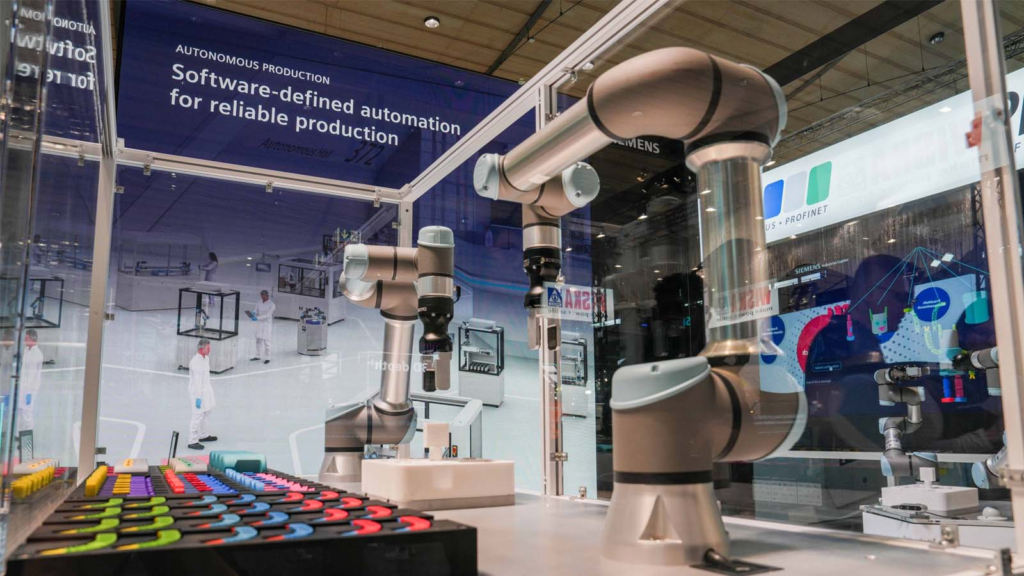
Siemens and Accenture launch joint business group to transform manufacturing

At Hannover Messe 2025, Accenture and Siemens announced an extension of their strategic partnership in the form of the Accenture Siemens Business Group, an Accenture-based joint business unit that will employ 7,000 professionals with manufacturing and IT expertise worldwide. The group will develop software-defined products and factories, combining industrial technology with AI-supported engineering and manufacturing expertise. To achieve this, the group will leverage the Siemens Xcelerator portfolio for automation, industrial AI, and software, as well as Accenture’s data and AI expertise, to help companies redesign their engineering and manufacturing processes. Digitalization of manufacturing Roland Busch, president and CEO of Siemens AG, extolled the advantages of the partnership: “Two market leaders bring together their unique capabilities: technology, data access, and strong expertise in software, automation, and industrial AI — and Accenture’s strength, data, and AI in engineering and manufacturing.” source

Siemens and Accenture launch joint business group to transform manufacturing Read More »