Apple Aims To Make Transparency The Core Of Its Trust Strategy

We made a call last week that Apple had created a trust issue in the UK, and possibly more widely, by breaking its commitment to protecting its users’ privacy by withdrawing Advanced Data Protection (ADP) for UK users to comply with the government’s demands to, in certain circumstances, be able to access all of a user’s data. Is Apple Doing Its Business Out In Public To Try To Show Transparency? But wait, there’s more: On one hand … a transparently public vote. Apple took the decision to remove or retain its DEI policies to its shareholders. Rather than stand firm and proclaim a commitment to diversity and inclusion, or capitulate and remove its public DEI commitment, Apple’s leadership put the vote to its shareholders, who overwhelmingly voted (97%) to keep DEI on Apple’s agenda. On the other … an effort that might cause some to question its commitment to its values. After removing ADP in the UK, Apple then took the case to the Investigatory Powers Tribunal, which in its own words is an “independent judicial body. We provide the right of redress to anyone who believes they have been the victim of unlawful action by a public authority using covert investigative techniques.” In both instances, Apple had a choice: Make a stand or comply. Was the former case weakness on behalf of Tim Cook and his leadership team unwilling to make a personal stand? Or a power play to demonstrate what they already knew that shareholders would tell them? Was the latter a play to publicly demonstrate the stakes and amplify the conversation? Or a strategy misstep that Apple is now trying to rectify? Transparency Matters Since we’ve been invoking classical mythology in our recent blogs, let’s turn to Greek historian Plutarch this week, who tells us of a statue of veiled Isis in the city of Sais in Egypt, symbolizing mystery and the unknowable. In both of Apple’s recent cases, the true motives are veiled and unknowable without a candid interview with Apple’s leaders. As analysts, we look at multiple angles, but right or wrong, transparency matters — a lot. When we established our trust research in 2021 and into 2022, we studied the impact of various levers of trust, such as transparency. Back then (and there’s no reason to think that this has significantly changed), we found that for a consumer technology company (like Apple), customers who believed the company was transparent were more than twice as likely to buy additional products/services from the company and were almost four times as likely to forgive company mistakes compared to those who didn’t believe that the company was transparent. Apple Has More To Lose In The UK Than In The US In Forrester’s December 2024 Consumer Pulse Survey, we asked 540 UK and 551 US online adults, “Which of the following specific companies or organizations do you trust to keep your personal information and data secure?” We found that: UK consumers trust Apple more than the national government. Some 35% of UK consumers trust Apple with their personal data compared to 25% who trust the government, and high-income UK households lean significantly more toward trusting Apple. US consumers trust federal, state, and local government more than Apple. State (42%) and federal government (40%) garner more trust when it comes to protecting personal data than Apple does, with only 31% of US consumers saying they’d trust Apple to keep their data secure. Region matters in the US, with Apple’s trust level plummeting in the Midwest and drawing even with state and local government on the West Coast. Transparency is a key driver of consumer trust, which in turn is a key driver of brand experience. Apple needs to step up the transparency of its transparency game in the UK, because while UK consumers trust it for now, complacency is a killer. Learn more about the relationship between brand experience and customer experience at our CX Summit EMEA this year, June 2–4 in London. source

Apple Aims To Make Transparency The Core Of Its Trust Strategy Read More »

Nike Receives $355K From Lululemon In Shoe Patent Trial

By Ryan Davis ( March 10, 2025, 10:46 PM EDT) — A New York federal jury has found that athletic apparel maker Lululemon infringed one Nike footwear manufacturing patent but did not infringe a second, and awarded Nike $355,450 in damages, well below the $2.8 million the shoe giant was seeking…. Law360 is on it, so you are, too. A Law360 subscription puts you at the center of fast-moving legal issues, trends and developments so you can act with speed and confidence. Over 200 articles are published daily across more than 60 topics, industries, practice areas and jurisdictions. A Law360 subscription includes features such as Daily newsletters Expert analysis Mobile app Advanced search Judge information Real-time alerts 450K+ searchable archived articles And more! Experience Law360 today with a free 7-day trial. source

Nike Receives $355K From Lululemon In Shoe Patent Trial Read More »

1. Problems teens see in their schools

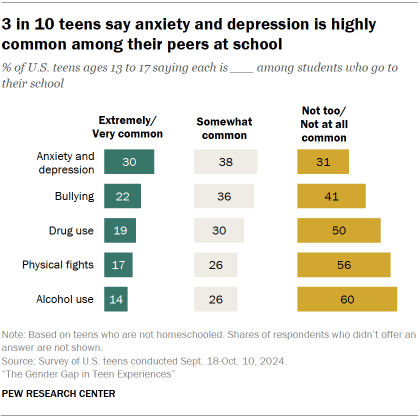
We asked U.S. teens how common a variety of problems are among students at their school. Anxiety and depression tops the list, with 30% of teens saying it’s extremely or very common at their school. About one-in-five teens (22%) say bullying is extremely or very common at their school. A similar share (19%) say the same about drug use. Some 17% of students say physical fights are highly common at their school, and 14% say alcohol use is highly common. Girls are more likely than boys to say anxiety and depression is extremely or very common at their school (35% vs. 24%). Girls are also more likely to say the same about alcohol use (17% vs. 10%). Girls and boys are about equally likely to say the other items are common at their school. Are problems in school more common among boys or girls? We asked teens who say these issues are at least somewhat common at their school whether each is more common among boys or girls. With the exception of physical fights, about half or more of these teens say the issues are equally common among boys and girls. Still, among those who see a gender difference, the scale more often tips toward boys. More common among boys Among teens who say physical fights are at least somewhat common at their school, 44% say these are more common among boys. Another 15% say fights are more common among girls, and 41% say there’s not much difference. Among those who say drug use is common at their school, 39% say it’s more common among boys, while only 3% say it’s more common among girls; 58% say there isn’t much difference. The pattern is almost identical when it comes to perceptions of alcohol use. More common among girls 39% of teens who say anxiety and depression is common at their school say it’s more common among girls. Only 5% say it’s more common among boys, and 56% say it affects both about equally. Girls are more likely than boys to say these mental health challenges are more common for girls at their school (50% vs. 28%). For their part, boys are more likely than girls to say that it’s about equal (64% vs. 49%). Mixed views Teens who say bullying is common at their school are divided on whether it’s more common among boys or girls. About one-in-four (26%) say it’s more common among boys, 22% say girls and 51% say both about equally. Boys themselves lean toward the perception that bullying is more prevalent among boys, while girls are split in their views. Do teens see gender biases in their schools? Some of the current discussion about how men are doing in the U.S. today relative to women focuses on gender gaps in K-12 education. To explore this topic from a teen perspective, we asked teens whether they think boys or girls are doing better in school and whether they receive different treatment. In three key areas – grades, leadership opportunities and treatment by teachers – majorities of teens say things are about equal. But those who do see a gender difference tend to think girls have advantages over boys. Grades: 42% of teens say girls get better grades than boys at their school. Only 3% say boys get better grades than girls; 55% say things are about equal. Girls are more likely than boys to say girls get better grades at their school (47% vs. 36%), while a higher share of boys than girls say there’s no difference (59% vs 52%). Leadership roles: 27% of teens say girls are more likely than boys to have leadership roles at their school; 16% say boys are more likely to have these roles. A 56% majority say boys and girls are about equally likely to have leadership roles. Girls and boys are largely in agreement about this. Teacher favoritism: A large majority of teens (78%) say teachers treat girls and boys about equally at their school. Among the rest, 16% say teachers favor girls and 6% say they favor boys. Boys are especially likely to say teachers favor girls (23% say this, compared with 9% of girls). We also asked teens whether girls or boys speak up more in class, and whether they think one group is more disruptive. Speaking up in class: 34% of teens say girls speak up more than boys in class, while 18% say boys speak up more. About half (48%) say both speak up about equally. Girls and boys have similar views on this. Disrupting class: A 63% majority of teens say boys are more disruptive in class than girls. Only 4% say girls are more disruptive. About a third (32%) say it’s about the equal. Again, girls and boys largely agree on this. When it comes to athletics, 53% of teens who have sports teams at their school say the boys’ teams are valued more than the girls’ teams. Only 2% say the girls’ teams are valued more, and 44% say the teams are valued about equally. Boys and girls tend to agree on this, with 51% of boys and 56% of girls saying more value is placed on the boys’ teams at their school. source

1. Problems teens see in their schools Read More »

Culture and cloud combine to harness data at Regeneron

On gen AI trends: A lot of the things we’re looking at are practical examples of where generative AI can help. One simple example is, within our industry, you have lab notebooks where you have to track everything. Historically they were done on paper, so we’ve identified some paper lab books with a wealth of information, but it’s not in an easily accessible format. So where we’re using generative AI is to scan and interpret those and read them, and it’s dealing with handwritten notes, pictures, and sketches, but it’s presenting it in a format now that we can expose to many others and capture it. And while the generative AI maybe doesn’t understand at all, it’s able to tag it in a way that others will be able to look at it and see if there’s value. On cloud to manage data: Not everyone might want to hear this, but it takes a long time to rework infrastructure to transition to cloud. We took a native cloud approach and moved probably 60 to 70% of everything we do to cloud. But we did that very thoughtfully. We identified what made sense to stay on premise. And then in the move to cloud, we also refactored and redesigned it to make sure we took the benefits. So once you get it into the cloud, you suddenly realize you can deal with much bigger data sets, and this idea of connected data comes into play. So the approach we took was we’ve got to have a data platform that’s going to deal with all the ingestion with the quality issues. We’ve got to present the data in the right formats to different groups. Some of them work with research data, others with clinical data or manufacturing with regulatory reform. But it’s about taking a very thoughtful approach to understanding what the process is, how it’s being used, and who’s using it. The other aspect is to be prepared to re-engineer because the technology is moving and processes move so fast. For example, we had an award for high performance computer in the cloud, and since then, we’ve made adjustments to it, but it looks nothing like what it looked like three years ago. So you got to keep revisiting and looking at how people use it and decide if cloud is still the answer, or does it make sense to bring it closer and bring it back in-house. So it’s continually evaluated. On creating educational partnerships: I personally went out and became OECD certified. Part of it was I wanted to think about what the pressures are there because if you think of what’s happened in the last few years, with Covid-19, for example, the SEC started putting more rigor into things like cybersecurity. So the board had to lean into it. And now you have AI, so just being able to understand how they’re thinking about it helps me shape how I message things. All the boards are slightly different and I mostly interact with the audit committee, and they’re very concerned about cybersecurity. So we do briefings on it all the time. They’re also very interested in AI and we use it a lot. I think sometimes with generative AI, people see that it’s only two years old, but it’s actually been around a long time. But there’s a lot of interest, so we’re doing more presentations and more updates. But as a CIO, you have to put yourself in their shoes and the risks to board members has increased, too. So providing that oversight can be really challenging in the dynamic world that we’re in today. source

Culture and cloud combine to harness data at Regeneron Read More »

ITC To Review Optimum Patent Case, Skips Another Case

By Andrea Keckley ( March 12, 2025, 7:31 PM EDT) — The U.S. International Trade Commission agreed Tuesday to review a final initial determination holding no infringement of Optimum Communications Services Inc.’s patent for passive optical network equipment, but it also affirmed a rare decision not to investigate a separate infringement complaint by Optimum against several Chinese tech companies over network switching and routing patents…. Law360 is on it, so you are, too. A Law360 subscription puts you at the center of fast-moving legal issues, trends and developments so you can act with speed and confidence. Over 200 articles are published daily across more than 60 topics, industries, practice areas and jurisdictions. A Law360 subscription includes features such as Daily newsletters Expert analysis Mobile app Advanced search Judge information Real-time alerts 450K+ searchable archived articles And more! Experience Law360 today with a free 7-day trial. source

ITC To Review Optimum Patent Case, Skips Another Case Read More »

Sycamore Partners’ $10 Billion Prescription For Walgreens

Walgreens Boots Alliance (WBA) announced it will go private in a $10 billion deal with Sycamore Partners. It comes at a crucial time for Walgreens, which faces declining sales, profitability issues, and scrutiny for its role in the opioid crisis. The formation of WBA in 2014 was intended to deliver a wider range of products and services globally and become a leading player in the international healthcare retail industry. Signs of large strategic shifts in the retail healthcare space emerged late last year, which Forrester analyzed in a CX Cast episode. Recently, WBA announced, among other measures, the closure of more than 1,200 stores and a pivot to expand its specialty pharmacy business. Reimagining The Corner Store: What Walgreens Looks Like Post-Deal Sycamore plans to retain Walgreens’ core retail operations while selling off or taking public other parts of the company. WBA CEO Tim Wentworth notes that going private will enable the company to “realize [its] goal of being the first choice for pharmacy, retail, and health services.” After the split, the company will be divided into three distinct units: US Retail Pharmacy. This unit will focus on Walgreens’ core retail pharmacy operations in the US, which currently includes approximately 8,500 stores. As US consumers rank location as the top attribute for why they choose a pharmacy, it will be imperative for Walgreens to strategically manage any future location closures. Shields Health Solutions. This unit will handle Walgreens’ specialty pharmacy operations, addressing the rapidly growing demand for specialty drugs for chronic conditions such as cystic fibrosis and hepatitis. In recent years, specialty drugs have accounted for more than half of the total prescription spending managed by any health plan, employer, or government health program. Boots. UK-based Boots includes 3,364 retail pharmacies and health and beauty stores in the UK, Mexico, Thailand, and the Republic of Ireland. As the UK has experienced some store closures, the company could potentially close more locations as part of the broader strategy to streamline operations and focus on profitability. In the US market, competitors Amazon and CVS Health are continuing to differentiate themselves. Amazon’s RxPass addresses price transparency, affordability, and convenience, offering Prime members eligible (“50+ commonly prescribed”) medications at home for a flat fee of $5 per month. CVS diversified through deeper vertical integration of insurance and pharmacy benefits and launched CVS CostVantage to lower prescription costs. A smaller footprint will require Walgreens to accelerate its digital transformation and improve CX if it is going to retain current customers and lure new customers away from these competitors. To win with customers, it will also have to enhance and build services that increase convenience and promote price transparency. Let’s Connect Forrester clients can continue the conversation by scheduling a guidance session with us here. Not a Forrester client? The healthcare industry is facing rapid change. Reach out to learn more about what it means to have Forrester on your side and by your side. Now is the time to be bold. source

Sycamore Partners’ $10 Billion Prescription For Walgreens Read More »

Stock Price Downturn for Tech's ‘Magnificent 7’

The tech sector faced a significant setback on Monday, March 10, 2025, as the so-called “Magnificent 7” – Apple, Microsoft, Alphabet, Tesla, NVIDIA, Meta, and Amazon – contributed to a sweeping stock market decline. Stock prices overview: A Monday washout for tech According to an article from Yahoo Finance, shares of NVIDIA, Tesla, Alphabet, Amazon, Meta, Apple, and Microsoft all dipped, with Tesla plunging 15% to spearhead the losses. Of the seven megacap tech stocks, five fell by more than 4%, while Microsoft and Amazon recorded smaller declines of 3.3% and 2.3%, respectively. More about Innovation Investor concerns and future outlook Investors were startled by the rapid slide in stock prices from these powerhouse tech companies, which have long been considered symbols of market resilience and innovation. While some see this as a temporary correction in an otherwise buoyant market, others worry the current climate could signal deeper, structural issues within the tech sector. As Yahoo Finance reported, market analysts are now closely examining trends and risk factors that could affect these influential companies and the broader market ecosystem. The tech companies’ stock price slumps on Monday also reflect concerns about supply chain challenges, regulatory pressures, and the shifting dynamics of global trade. Industry leaders and financial experts will be monitoring the situation closely to assess whether these stock price drops are an isolated event or a harbinger of more significant market adjustments. The performance of the Magnificent 7 will continue to be a focal point for market analysts. source

Stock Price Downturn for Tech's ‘Magnificent 7’ Read More »

Advocacy Orgs. Slam FCC's '60 Minutes' Probe As Unfounded

By Nadia Dreid ( March 10, 2025, 9:02 PM EDT) — The FCC “has denied requests alleging much worse” than CBS’ choice to edit down then-Vice President Kamala Harris’ “60 Minutes” interview, says an advocacy group that is asking the agency to kill its probe into whether the network committed “news distortion.”… Law360 is on it, so you are, too. A Law360 subscription puts you at the center of fast-moving legal issues, trends and developments so you can act with speed and confidence. Over 200 articles are published daily across more than 60 topics, industries, practice areas and jurisdictions. A Law360 subscription includes features such as Daily newsletters Expert analysis Mobile app Advanced search Judge information Real-time alerts 450K+ searchable archived articles And more! Experience Law360 today with a free 7-day trial. source

Advocacy Orgs. Slam FCC's '60 Minutes' Probe As Unfounded Read More »

A Triple-Screen Setup without the Bulk

Image: StackCommerce TL;DR: The Trio 2.0 Tri-Screen Display adds two full HD 1080p screens to your 13″-14″ laptop for just $379.99 (reg. $699.99) until March 30 with code DISPLAY50. A single laptop screen can only take you so far before it starts slowing you down. Whether you’re a developer, financial analyst, designer, or business professional, the ability to work across multiple screens can significantly enhance productivity. With the Trio 2.0 Tri-Screen Display, you can seamlessly expand your workspace with two additional full HD screens, turning your laptop into a multi-monitor workstation. For a limited time, you can grab the Trio 2.0 for just $379.99 (regularly $699.99) by using code DISPLAY50 at checkout. This upgraded version is 20% thinner and 1lb (0.45 kg) lighter, making it easier to take your triple-screen setup wherever you go. When your work involves juggling multiple tabs, spreadsheets, research documents, or coding environments, constantly switching between windows slows down your workflow. The Trio 2.0 eliminates that frustration by giving you two additional screens, allowing you to work more efficiently without losing momentum. Designed for 13″-14″ laptops, it features built-in sliding 1080p FHD displays that extend outward, instantly giving you a wider, more functional workspace. Professionals across industries will appreciate this setup’s versatility. Stock traders can monitor multiple charts and financial reports simultaneously. Programmers can keep code on one screen while testing on another. Business professionals can host virtual meetings while taking notes and working on presentations — all without tabbing between applications. With more screen real estate, productivity naturally increases. This system adapts to your needs, whether you need an extended display for multitasking, a mirrored setup for presentations, or a flipped orientation for collaboration. It supports landscape mode for an expanded workspace, collaboration mode for sharing with colleagues, portrait mode for reading or editing large documents, and presentation mode for client meetings. Don’t miss grabbing the Trio 2.0 while it’s just $379.99 (reg. $699.99) until March 30 with code DISPLAY50. Trio 2.0 Tri-Screen Display for 13″ -14″ Laptops – $429.99 Use Code Here StackSocial prices subject to change. source

A Triple-Screen Setup without the Bulk Read More »

March 2025 TIOBE Index: Legacy ‘Dinosaur’ Languages Are Making a Comeback

Image: Envato/TonyTheTigersSon Legacy programming languages, once thought to be relics of the past, are having a surprising comeback. This month, Fortran, Ada, COBOL, and Delphi all vying for positions in the TIOBE Index top 20. Takeaways from the March TIOBE rankings: Python: Recently named “TIOBE’s programming language of the year 2024” in January by TIOBE CEO Paul Jansen continues its meteoric rise. C++: Maintains its stronghold at second place on the leaderboard. Fortran and Delphi: Both legacy languages, are fighting for a spot in the top 10. COBOL and Ada: Both re-entered the top 20 this month. Ada, notably, was the third highest ranking language back in 1985. “I think that it (comeback) has to do with the many vital legacy systems that keep the world running,” Jansen said in the TIOBE Programming Community Index in March. “Most of them are developed with the aid of these dinosaur languages.” A shift in priorities: February vs. March This marks a noticeable shift from February’s rankings, which were dominated by speed-focused languages like C+ +, Go, and Rust. Jansen attributed that trend to the growing need for computational efficiency. Jansen said this was because the “the world needs to crunch more and more numbers per second,” and because hardware doesn’t evolve fast enough, programs must be faster. However, March’s rankings highlight a different reality — many organizations prioritize stability over speed. Image: TIOBE Software Why the older programming languages are still popular Organisations that handle critical infrastructure are well-known for harbouring legacy devices, as replacing outdated technology while maintaining normal operations is both difficult and expensive. Jansen explained that this is why “new and promising languages” aren’t seeing a similar uptrend to older ones. SEE: 80% of Critical Infrastructure Companies Experienced an Email Security Breach in 2024 “Now that the last of the core developers of these systems are about to retire, companies avoid any risk and choose to keep the existing systems and even extend them rather than replacing them by newer systems based on more modern languages,” he said. Despite being referred to as “dinosaurs,” these legacy languages have not remained static. To stay relevant, many have received significant updates in recent years. New language definitions have been published for Fortran, Delphi, Ada, and COBOL in just the past two years. “We might frown to see these languages being in the TIOBE index top 20, but they definitely serve a purpose and deserve credit,” Jansen said. Python remains the most talked-about programming language Yet again, Python is the number one language on the TIOBE Index, meaning it receives the most attention in search engine queries, job postings, and educational resources. Its popularity and usage have been rising steadily since 2017, but really boomed from June 2024 onwards. This trend is believed to be closely tied to the growing availability and widespread adoption of artificial intelligence technologies. As more companies hire early-career programmers for AI-related roles, such as prompt engineering, Python — known for its simplicity and intuitiveness — has become their language of choice. “This is why Python is here to stay,” Jansen wrote last month. While newer languages continue to emerge, it is clear that legacy languages still play a crucial role in modern computing. Their adaptability and deep-rooted presence in critical systems suggest that these so-called ‘dinosaurs’ are far from extinct. source

March 2025 TIOBE Index: Legacy ‘Dinosaur’ Languages Are Making a Comeback Read More »