How Enterprise Leaders Can Shape AI’s Future in 2025 and Beyond

Once confined to narrow applications, artificial intelligence is now mainstream. It’s driving innovations that are reshaping industries, transforming workflows, and challenging long-standing norms.  In 2024, generative AI tools became regular fixtures in workplaces, doubling their adoption rates compared to the previous year, according to McKinsey. This surge in adoption highlights AI’s transformative potential. At the same time, it underscores the urgency for businesses to fully grasp the opportunities and significant responsibilities that accompany this shift.  AI’s applications are astonishingly broad, from personalized healthcare diagnostics and real-time financial forecasting to bolstering cybersecurity defenses and driving workforce automation. These advancements promise substantial efficiency gains and insight, yet they also come with profound risks. For enterprise IT managers, who often spearhead these initiatives, the stakes have never been more significant or more complex.  The years ahead likely will be defined by how adeptly businesses can navigate this duality. The immense promise of transformative AI innovation is counterbalanced by the equally critical need to mitigate risks through robust data validation, human-in-the-loop systems, and proactive ethical safeguards. As we head into 2025, these three themes will drive the future of AI.  Related:What Tech Workers Should Know About Federal Job Cuts and Legal Pushback Human-Machine Interaction Will Grow  The promise of AI lies not in replacing human oversight but in enhancing it. The increased adoption of AI means it increasingly will integrate into workflows where human judgment remains essential, particularly in high-stakes sectors such as healthcare and finance.  In healthcare, AI is revolutionizing diagnostics and treatment planning. Systems can process vast amounts of medical data, highlighting potential issues and providing insights that save lives. Yet, the final decision often rests with clinicians, whose expertise is essential to interpreting and acting on AI-generated recommendations. This collaborative approach safeguards against over-reliance on technology and ensures ethical considerations remain central.  Similarly, in financial services, AI aids in risk assessment and fraud detection. While these tools offer unparalleled efficiency, they require human oversight to account for nuances and contextual factors that algorithms may miss. This balance between automation and human input is critical to building trust and achieving sustainable outcomes.  Deploying AI responsibly requires enterprise IT managers to prioritize systems that maintain this collaborative framework. Setting the stage for responsible use requires implementing mechanisms for continuous oversight, designing workflows that incorporate checks and balances, and ensuring transparency in how AI tools arrive at their outputs.  Related:Tech Company Layoffs: The COVID Tech Bubble Bursts AI Accuracy Is Even More Important  Accurate AI systems are critical in fields where errors can have far-reaching consequences. For example, a health misdiagnosis resulting from faulty AI predictions could endanger patients. In finance, an erroneous risk assessment could cost organizations millions.   One key challenge is ensuring that the data feeding these systems is reliable and relevant. AI models, no matter how advanced, are only as good as the data they are trained on. Inaccurate or biased data can lead to flawed predictions, misaligned recommendations and even ethical lapses. For instance, financial models trained on outdated or incomplete datasets may expose organizations to unforeseen risks, while medical AI could misinterpret diagnostic data.  But capitalizing on what AI has to offer requires more than just accurate, clean data.   The selection of the right model for a given task plays a crucial role in maintaining accuracy. Over-reliance on generic or poorly matched models can undermine trust and effectiveness. Enterprises should tailor AI tools to specific datasets and applications, integrating domain-specific expertise to ensure optimal performance.  Related:AI Upskilling: How to Train Your Employees to Be Better Prompt Engineers Enterprise IT managers must adopt proactive measures like rigorous data validation protocols, routinely auditing AI systems for biases, and incorporating human review as a safeguard against errors. With these best practices, organizations can elevate the accuracy and reliability of their AI deployments, paving the way for more informed and ethical decision-making.  Regulatory Focus Will Be Narrow  As AI continues to evolve, its growing influence has prompted an urgent need for thoughtful regulation and governance. With the incoming administration prioritizing a smaller government impact, regulatory frameworks will likely focus only on high-stakes applications where AI poses significant risks to safety, privacy and economic stability, such as autonomous vehicles or financial fraud detection.   Regulative attention could intensify in sectors like healthcare and finance as governments and industries strive to mitigate potential harm. Failures in these areas could endanger lives and livelihoods and erode trust in the technology itself.  Cybersecurity is another area where governance will take center stage. The Department of Homeland Security recently unveiled guidance for how to use AI in critical infrastructure, which has become a target for exploitation. Regulatory measures may require organizations to demonstrate robust safeguards against vulnerabilities, including adversarial attacks and data breaches.   However, regulation alone is not enough. Enterprises must also foster a culture of accountability and ethical responsibility. This involves setting internal standards that go beyond compliance, such as prioritizing fairness, reducing bias, and ensuring that AI systems are designed with end-users in mind.  Enterprise IT managers hold the keys to striking this balance by implementing transparent practices and fostering trust. By acting thoughtfully now, organizations can harness AI to drive innovation while addressing its inherent risks, ensuring it becomes a cornerstone of progress for years to come.  source

How Enterprise Leaders Can Shape AI’s Future in 2025 and Beyond Read More »

Why the CIO role should be split in two

This ‘hybrid’ architecture is a combination of best and bad practice. When there is an outage, the new digital platforms can invariably be restored to recover business process support. But because they do not operate in isolation, instead connecting with legacy technologies, business operations themselves may not fully recover if the legacy systems continue to be impacted by the outage. For most enterprises stuck in this hybrid state, the way forward is to be more discipline around architecture. As a CIO, I’ve experienced that many enterprises have strong architecture disciplines with great governance practices and a roadmap that closely aligns various IT strategies. Strong alignment of IT and cyber strategy, however, is often an exception rather than a rule. Keep IT simple Simplifying architecture at an enterprise level is something the CIO and CISO should work together concurrently as a shared goal. The benefits of doing so will accrue over time rather than immediately, hence there can be some reluctance to prioritize. source

Why the CIO role should be split in two Read More »

At 'Fly In,' Carriers Stress Broadband Funding To Lawmakers

By Christopher Cole ( February 14, 2025, 9:13 PM EST) — Regional telecom carriers gathered on Capitol Hill to call for stable future funding to build high-speed communications networks and make sure rural areas have enough access to spectrum in the coming years…. Law360 is on it, so you are, too. A Law360 subscription puts you at the center of fast-moving legal issues, trends and developments so you can act with speed and confidence. Over 200 articles are published daily across more than 60 topics, industries, practice areas and jurisdictions. A Law360 subscription includes features such as Daily newsletters Expert analysis Mobile app Advanced search Judge information Real-time alerts 450K+ searchable archived articles And more! Experience Law360 today with a free 7-day trial. source

At 'Fly In,' Carriers Stress Broadband Funding To Lawmakers Read More »

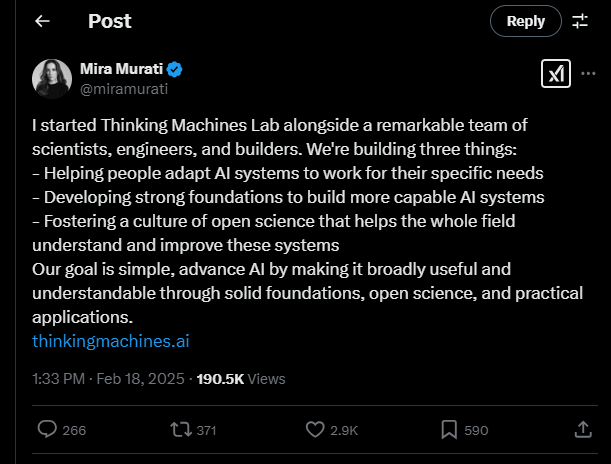
Ex-OpenAI CTO Mira Murati unveils Thinking Machines: A startup focused on multimodality, human-AI collaboration

Join our daily and weekly newsletters for the latest updates and exclusive content on industry-leading AI coverage. Learn More Ever since Mira Murati departed OpenAI last fall, many have wondered about the former CTO’s next move. Well, now we know (or at least have a rough idea).  Murati took to X today to announce her new venture Thinking Machines Lab, an AI research and product company with a goal to “advance AI by making it broadly useful and understandable through solid foundations, open science and practical applications.” Murati posted: “We’re building three things: Helping people adapt AI systems to work for their specific needs; Developing strong foundations to build more capable AI systems; Fostering a culture of open science that helps the whole field understand and improve these systems.” Thinking Machinea’ team of roughly two dozen engineers and scientists is stacked with other OpenAI alums — including cofounder and deep reinforcement learning pioneer John Schulman and ChatGPT co-creator Barret Zoph — which could position the startup to make significant strides in AI research and development.  As of the posting of this article, the company’s newly-launched X account @thinkymachines had already amassed roughly 14,000 followers.  Model intelligence, multimodality, strong infrastructure  Thinking Machines — not to be mistaken with the now defunct supercomputer and AI firm of the 1980s — isn’t yet offering specific examples of intended projects, but suggests a broad focus on multimodal capabilities, human-AI collaboration (as opposed to purely agentic systems) and strong infrastructure. The goal is to build more “flexible, adaptable and personalized AI systems,” the company writes on its new website.  Multimodality is “critical” to the future of AI, Thinking Machines says, as it allows for more natural and efficient communication that captures intent and supports deeper integration. “Instead of focusing solely on making fully autonomous AI systems, we are excited to build multimodal systems that work with people collaboratively,” the company writes.  Going forward, the startup will build models “at the frontier of capabilities” in areas including science and programming. Model intelligence will be key, as will infrastructure quality. “We aim to build things correctly for the long haul, to maximize both productivity and security, rather than taking shortcuts,” Thinking Machines writes.  Calling scientific progress a “collective effort,” the company says it will collaborate with the AI community and publish technical blog posts, papers and code. It will also take an “empirical and iterative” approach to AI safety, and pledges to maintain a “high safety bar” to prevent misuse, perform red-teaming and post-deployment monitoring and share best practices, datasets, code and model specs.  Expanding on a decorated team Thinking Machines boasts an impressive team of scientists, engineers and builders behind top AI models including ChatGPT, Character AI and Mistral, as well as popular open-source projects PyTorch, the OpenAI Gym Python library, the Fairseq sequence modeling toolkit and Meta AI’s Segment Anything.  The startup is looking to expand on that base; it is currently on the lookout for a research program manager, as well as product builders and machine learning (ML) experts. The goal is to put together a “small, high-caliber team” of both PhD holders and the self-taught, the company writes. Those interested should apply here.  Another OpenAI competitor? Murati abruptly resigned from OpenAI in September 2024 — following the unexpected departure of other execs including Schulman and cofounder and former chief scientist Ilya Sutskever — after joining the company in 2018 and ascending to CTO in 2022 (the year that brought us the groundbreaking ChatGPT).  At the time, she teased on X: “I’m stepping away because I want to create the time and space to do my own exploration.” Her next move had been a topic of speculation given her reputation as a steady operational force during OpenAI’s tumultuous period in late 2023, when the board’s attempted ousting of CEO Sam Altman briefly upended the company. Internally, she was seen as a pragmatic leader who kept OpenAI stable through uncertainty. Her decision to strike out on her own follows a broader shift in the AI research landscape — where the breakneck race to train ever-larger models is giving way to an era of applied AI, agentic systems and real-world execution. Her Thinking Machines announcement comes amid a flurry of new model capabilities and benchmark-shattering. OpenAI continues to make innovative breakthroughs — including its new o3-powered Deep Research mode, which scrolls the web and curates extensive reports — but it also faces strong competition in all directions. Just today, for instance, xAI released Grok 3, which rivals GPT-4o’s performance.  With OpenAI cofounder Ilya Sutskever launching Safe Superintelligence and other industry veterans charting their own paths, the question now is where Thinking Machines will place its bets in this evolving landscape. source

Ex-OpenAI CTO Mira Murati unveils Thinking Machines: A startup focused on multimodality, human-AI collaboration Read More »

Salesforce bets big on Saudi Arabia with 500M USD AI investment

Salesforce has announced a $500 million USD investment in Saudi Arabia, signaling its commitment to fostering innovation and economic growth in the region. The investment, unveiled at LEAP 2025, aims to bolster workforce development through AI skilling initiatives and expand Salesforce’s local partner ecosystem. This move follows Salesforce’s pledge at Davos to establish a new regional headquarters in Riyadh. A key component of this expansion is the introduction of Hyperforce, Salesforce’s next-generation platform architecture, to Saudi Arabia. Delivered in partnership with Amazon Web Services (AWS), Hyperforce will enable Salesforce customers to run workloads locally while adhering to regulatory requirements. “We are entering a new era where autonomous AI agents working with humans are transforming workforces and businesses across the globe,” said Marc Benioff, Chair and CEO, Salesforce. “With Agentforce, Hyperforce, and our global partner ecosystem, we are empowering Saudi organizations to deliver unprecedented levels of productivity, growth, and customer success.” source

Salesforce bets big on Saudi Arabia with 500M USD AI investment Read More »

FCC Could Pull Equipment OKs For New Dahua US Owner

By Jared Foretek ( February 14, 2025, 8:04 PM EST) — The Federal Communications Commission is threatening to pull authorizations for a Taiwanese network infrastructure company’s U.S. subsidiary, saying the company appears to be selling video surveillance products that are restricted as part of the commission’s “covered list” of equipment found to pose a national security risk…. Law360 is on it, so you are, too. A Law360 subscription puts you at the center of fast-moving legal issues, trends and developments so you can act with speed and confidence. Over 200 articles are published daily across more than 60 topics, industries, practice areas and jurisdictions. A Law360 subscription includes features such as Daily newsletters Expert analysis Mobile app Advanced search Judge information Real-time alerts 450K+ searchable archived articles And more! Experience Law360 today with a free 7-day trial. source

FCC Could Pull Equipment OKs For New Dahua US Owner Read More »

Quick Study: The IT Hiring/Talent Challenge

So, you told a friend that you need to hire more IT folks. The friend replied, “Hah, good luck!”   Circumstances dealt IT leaders a challenging hand over the past few years, from the great resignation to executive demands for digital transformation, and onward to corporate fascination with artificial intelligence, hiring and keeping IT talent requires new strategies.  There was no single cause of today’s hiring challenges, and there’s no single, easy answer short of hitting the lottery and retiring. However, contributors to InformationWeek have shared their experiences and advice to IT leaders on ways to staff up and skill up, all while staying under budget and keeping IT operational lights on.  In this guide to today’s IT hiring and talent challenges, we have compiled a collection of advice and news articles focused on finding, hiring and retaining IT talent. We hope it helps you succeed this year.  A World of Change  Help Wanted: IT Hiring Trends in 2025  IT’s role is becoming more strategic. Increasingly, it is expected to drive business value as organizations focus on digital transformation.  IT Security Hiring Must Adapt to Skills Shortages  Diverse recruitment strategies, expanded training, and incentivized development programs can all help organizations narrow the skills gap in an era of rapidly evolving threat landscapes.  Top IT Skills and Certifications in 2025  In 2025 top IT certifications in cloud security and data will offer high salaries as businesses prioritize multi-cloud and AI.  How To Be Competitive in a Tight IT Employment Market  A slumping economy, emerging technologies, and over-hiring has led to a tight IT jobs market. Yet positions are still abundant for individuals possessing the right skills and attitude.  The Soft Side of IT: How Non-Technical Skills Shape Career Success  Here’s why soft skills matter in IT careers and how to effectively highlight them on a resume. Show that you are a good human.  Salary Report: IT in Choppy Economic Seas and Roaring Winds of Change  Last year brought a sustained adrenaline rush for IT. Everything changed. Some of it with a whimper and some of it with a bang. Through it all IT pros held steady, but is it enough to sail safely through the end of 2024?  Quick Study: The Future of Work Is Here  The workplace of the future isn’t off in the future. It’s been here for a few years — even pre-pandemic.  10 Unexpected, Under the Radar Predictions for 2025  From looming energy shortages and forced AI confessions to the rising ranks of AI-faked employees and a glimmer of a new cyber-iron curtain, here’s what’s happening that may require you to change your company’s course.  Finding Talent  AI Speeds IT Team Hiring  Can AI help your organization find top IT job candidates quickly and easily? A growing number of hiring experts are convinced it can.  Skills-Based Hiring in IT: How to Do it Right  By focusing directly on skills instead of more subjective criteria, IT leaders can build highly capable teams. Here’s what you need to know to get started.  The Evolution of IT Job Interviews: Preparing for Skills-Based Hiring  The traditional tech job interview process is undergoing a significant shift as companies increasingly focus on skills-based hiring and move away from the traditional emphasis of academic degrees.  IT Careers: Does Skills-Based Hiring Really Work?  More organizations are moving toward skills-based hiring and getting mixed results. Here’s how to avoid some of the pitfalls.  Jumping the IT Talent Gap: Cyber, Cloud, and Software Devs  Businesses must first determine where their IT skill sets need bolstering and then develop an upskilling strategy or focus on strategic new hires.  Top Career Paths for New IT Candidates  More organizations are moving from roles-based staffing to skills-based staffing. In IT, flexibility is key.  Why IT Leaders Should Hire Veterans for Cybersecurity Roles  Maintaining cybersecurity requires the effort of a team. Veterans are uniquely skilled to operate in this role and bring strengths that meet key industry needs.  How to Find a Qualified IT Intern Among Candidates  IT organizations offering intern programs often find themselves swamped with applicants. Here’s how to find the most knowledgeable and prepared candidates.  The Search for Solid Hires Between AI Screening and GenAI Resumes  Do AI-generated job applications gum up the recruitment process for hiring managers by filling inboxes with dubiously written CVs?  3 Things You Should Look for When Hiring New Graduates  Each year, entry-level applicants in IT look a little different. Here’s what you need to be looking for as the class of 2023 infiltrates the workforce.  Why a College Degree is No Longer Necessary for IT Success  Who needs student debt? A growing number of employers are hiring IT pros with little or no college experience.  Recruiting Talent  In Global Contest for Tech Talent, US Skills Draw Top Pay  After several years of economic uncertainty and layoffs, US talent is once again attracting good pay in the global competition for tech skills. But gender disparity continues in many job categories.  Hiring Hi-Tech Talent by Kickin’ It Old School  Using elements of a traditional approach to recruiting IT professionals can attract and grow the modern workforce, but it’s the soft skills shown during an interview that make a big difference.  The Impact of AI Skills on Hiring and Career Advancement  Demand is high for professionals with knowledge of AI, but do such talents really get implemented on the job?  How to Channel a ‘World’s Fair’ Culture to Engage IT Talent  Even the most well-funded and innovative companies will fail if they lack one thing: A diverse, united team. A CEO shares his experience and advice.  Bridging IT Skills Gap in the Age of Digital Transformation  Innovations in automation, cloud computing, big data analytics, and AI have not only changed the way businesses operate but have intensified the demand for specialized skills.  5 Traits To Look for When Hiring Business and IT Innovators  Hiring resilient and forward-thinking employees is the cornerstone to innovation. If you’re looking to hire a “trailblazer,” here are five traits to seek, as

Quick Study: The IT Hiring/Talent Challenge Read More »

Elon Musk just released an AI that’s smarter than ChatGPT — here’s why that matters

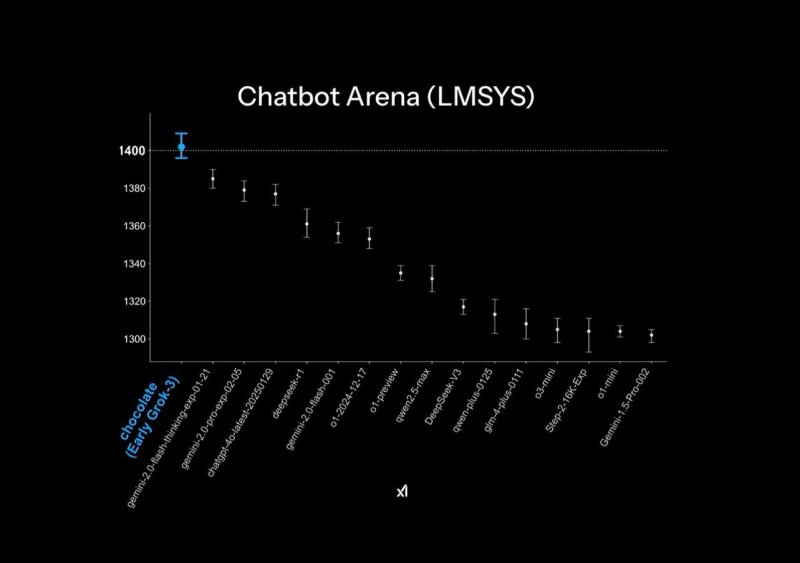
Join our daily and weekly newsletters for the latest updates and exclusive content on industry-leading AI coverage. Learn More Elon Musk’s artificial intelligence startup xAI has unveiled Grok 3, its latest AI model that the company claims outperforms leading competitors across key technical benchmarks. The announcement marks a significant escalation in the race to develop more powerful AI systems. The launch comes just days after Musk’s failed $97.4 billion bid to acquire OpenAI, the company he co-founded with Sam Altman in 2015. During a livestreamed demonstration on X, Musk characterized Grok 3 as “an order of magnitude more capable than Grok 2” and emphasized its ability to reason through complex problems. Early testing appears to support some of xAI’s claims. The model topped the influential Chatbot Arena leaderboard, scoring higher than OpenAI’s GPT-4o, Google’s Gemini and DeepSeek’s V3 model in blind user testing. Published benchmarks show Grok 3 achieving superior scores in mathematics (AIME ’24), scientific reasoning (GPQA) and coding tasks. Grok 3 leads the Chatbot Arena leaderboard with a score of approximately 1400, significantly outperforming other major AI models in blind user testing. (Source: xAI) Inside Grok 3’s massive computing infrastructure: 200,000 GPUs and a new data center “Grok 3 clearly has around state of the art thinking capabilities,” wrote former OpenAI researcher Andrej Karpathy in an X post after early-access testing. “Few models get this right reliably. The top OpenAI thinking models get it too, but all of DeepSeek-R1, Gemini 2.0 Flash Thinking, and Claude do not.” The model’s development required massive computational resources. xAI doubled its GPU cluster to 200,000 Nvidia chips for training, housed in a new Memphis data center. This infrastructure investment highlights the increasing computational demands of advanced AI development, as companies race to build more capable systems. I was given early access to Grok 3 earlier today, making me I think one of the first few who could run a quick vibe check. Thinking✅ First, Grok 3 clearly has an around state of the art thinking model (“Think” button) and did great out of the box on my Settler’s of Catan… pic.twitter.com/qIrUAN1IfD — Andrej Karpathy (@karpathy) February 18, 2025 DeepSearch and advanced reasoning: how Grok 3 aims to outsmart ChatGPT and Google Gemini A key innovation is Grok 3’s “DeepSearch” feature, which combines web searching with reasoning capabilities to analyze information from multiple sources. The system also includes specialized modes for complex problem-solving, including a “Think” function that shows its reasoning process and a “Big Brain” mode that allocates additional computing power to difficult tasks. “The thing to really pay attention to in AI is learning speed. And @xai is learning way faster than any other,” posted tech industry veteran Robert Scoble, citing a conversation with Apple Siri cofounder Tom Gruber. Grok 3 benchmarks. The thing to really pay attention to in AI is learning speed. And @xai is learning way faster than any other. Who said that? Apple Siri cofounder Tom Gruber. He told me at dinner a decade ago that that is the most important thing to pay attention to. pic.twitter.com/yWCiJsN9pU — Robert Scoble (@Scobleizer) February 18, 2025 However, some limitations emerged during testing. Karpathy noted that the model sometimes fabricates citations and struggles with certain types of humor and ethical reasoning tasks. These challenges are common across current AI systems and highlight the ongoing difficulties in developing truly human-like artificial intelligence. Scale.ai CEO Alexandr Wang praised the release, tweeting: “Grok 3 is a new best model in the world from the @xai team!” He noted its superior performance on various benchmarks and expressed enthusiasm for future collaboration. Grok 3 is a new best model in the world from the @xai team! Grok 3 ranks #1 on Chatbot Arena w/a big gap, and scores impressively on pretraining and reasoning evals. congrats to @elonmusk @ibab @jimmybajimmyba @Yuhu_ai_ looking forward to more partnership on grok4 & beyond ? pic.twitter.com/BrPGz17P51 — Alexandr Wang (@alexandr_wang) February 18, 2025 AI industry competition heats up: what Grok 3’s launch means for OpenAI, DeepSeek and the future of artificial intelligence The model will be available through X’s Premium+ subscription ($40/month) and a new standalone “SuperGrok” service ($30/month). Enterprise API access is planned for the coming weeks. This launch intensifies competition in the AI industry, particularly as Chinese startup DeepSeek recently demonstrated comparable performance with reportedly lower computational requirements. The development also raises questions about the sustainability of the computational arms race in AI, as companies invest billions in increasingly powerful hardware infrastructure. In key performance benchmarks, Grok 3 and its mini variant show superior scores across mathematics, science and coding tests compared to competing models from Google, OpenAI, Anthropic and DeepSeek. The full-size Grok 3 model (dark blue) achieved particularly strong results in scientific reasoning. (Source: xAI) Musk emphasized that Grok 3 remains in beta, with improvements expected “almost every day.” The company plans to add voice interaction capabilities within weeks and will open-source its previous model, Grok 2, once the new version stabilizes. Yet perhaps the most telling aspect of Grok 3’s debut isn’t its technical specifications or benchmark scores, but what it represents: the mounting tension between Musk and his former colleagues at OpenAI. Just days after his failed $97.4 billion bid to acquire OpenAI, Musk has unveiled a model that challenges its supremacy — suggesting that in the high-stakes race for AI dominance, even a rejected suitor can become a formidable rival. source

Elon Musk just released an AI that’s smarter than ChatGPT — here’s why that matters Read More »

Trump Picks Atty Who Worked At Apple To Head NHTSA

By Rae Ann Varona ( February 13, 2025, 11:18 PM EST) — President Donald Trump has tapped Jonathan Morrison, an attorney with an automotive background who most recently worked at Apple Inc., to head the National Highway Traffic Safety Administration, according to a recent U.S. Senate filing…. Law360 is on it, so you are, too. A Law360 subscription puts you at the center of fast-moving legal issues, trends and developments so you can act with speed and confidence. Over 200 articles are published daily across more than 60 topics, industries, practice areas and jurisdictions. A Law360 subscription includes features such as Daily newsletters Expert analysis Mobile app Advanced search Judge information Real-time alerts 450K+ searchable archived articles And more! Experience Law360 today with a free 7-day trial. source

Trump Picks Atty Who Worked At Apple To Head NHTSA Read More »

Sun Life 永明推全新永明強積金收益基金

(相)香港永明金融有限公司財富及退休金業務總經理潘紀虹(中)及永明資產管理(香港)有限公司行政總裁顏建華(右)宣佈推出全新永明強積金收益基金,旨在協助強積金成員在退休 前累積儲備,並邀得藝人苟芸慧(左)拍攝宣傳廣告。 Sun Life 永明宣佈推出新的成分基金「永明強積金收益基金」,旨在提供穩定派息(派發息率並不保證,派息可從資本中分派),並透過自動再投資持續滾存資本,協助強積金成員在退休前累積儲備。隨著永明強積金收益基金的推出,Sun Life 永明的強積金成分基金將由 18 隻增加至 19 隻,為強積金成員提供更多元化的選擇,滿足不同的投資偏好及需求。 永明強積金收益基金透過投資於混合資產,包括環球定息證券、環球股票和房地產投資信託基金(「房地產基金」)等,致力尋求為投資者提供中至長期的穩定收益及資本增長。永明強積金收益基金將於基金成立後的第七個月(或由投資經理 – 永明資產管理(香港) 有限公司建議且受託人或投資經理認為合適的任何其他月份),旨在定期向成員的強積金帳戶分發派息(派發息率並不保證,派息可從資本中分派),並根據記錄日強積金成員的年齡,自動再投資於永明強積金收益基金或永明強積金保守基金。 為配合新基金,Sun Life 永明同步推出新的常行提取指示服務,當合資格強積金成員屆滿 65 歲退休年齡或 60 歲提早退休年齡時,可選擇設置常行指示,按月、按季或按年提取其 於永明強積金保守基金下累算權益。 香港永明金融有限公司財富及退休金業務總經理潘紀虹表示:「強積金制度自成立以來已經 24 年,愈來愈多強積金成員步入退休年齡。作為全球最長壽的地區之一,香港打工仔需要更全面的退休規劃,以應對可能長達超過廿年的退休生活。永明強積金收益基金是一個靈活的方案,照顧強積金成員退休前後不同階段的需要。此外,我們新增的常行提取指示服務,有別於過往需要逐次發出分期提取指示,當合資格強積金成員屆滿 65 歲退休年齡或 60 歲提早退休年齡時,可選擇常行指示,按月、按季或按年提取其於永明強積金保守基 金下累算權益,相等於『自製長糧』,並將餘下的資金保留於強積金帳戶繼續投資。」 永明資產管理(香港)有限公司行政總裁顏建華指出:「永明強積金收益基金充分利用全球市場的潛力,通過多元化的資產配置,旨在為投資者提供穩定收益,並爭取長期增值的 機會。隨著積金局於過去幾年放寬強積金可投資於房地產基金的比例及市場數目,投資經 理可有更大的靈活性,為計劃成員提供更多元化的選擇。永明強積金收益基金聚焦具備派息能力的混合資產組合,包括房地產基金等,旨在提供穩定收入及分散風險的雙重優勢, 為強積金成員提供更具彈性的投資選擇,旨在保障退休期間享有可持續的財務支持。」 永明資產管理(香港)有限公司首席投資策略師龔偉怡表示:「投資市場瞬息萬變,穩健的投資策略對於實現長期回報至關重要。投資者較熟悉的資產類別通常為股票和債券,而永明強積金收益基金則進一步投資於房地產基金,實現更加均衡和分散的資產配置策略,長遠或有助投資者把握更多機遇。我們的資產管理團隊密切監察全球經濟走勢及市場變化, 展望 2025 年,我們認為環球經濟將維持強韌,但市場仍然存在各種不確定因素,包括特朗普再度入主白宮、美國貨幣政策等風險不容忽視。投資者應考慮分散投資,避免過度集中於單一地區或投資工具的風險,亦可考慮防守性較佳的策略,如低波幅和高股息策略等。」 LinkedIn Email Facebook Twitter WhatsApp source

Sun Life 永明推全新永明強積金收益基金 Read More »